
Living in the Wild Leaves its Behavioral Mark for Morris Maze: Comparison Apodemus sylvaticus vs Domestic Mus musculus
The two rodent strains compared in this study are familiarly related, but they are notoriously different. They are both goodswimmers in the Morris maze but statistically significant differences in their performances, styles of behaviors or goals inthe swimming strategies were found in between these two strains. With this naturalistic and behavioral observation, froman empirical point of view, we discuss some relevant facts for Neuroscience and biopsychological research such as the effectsof domestication, consanguinity or inbreeding, the presence of neurogenesis in the wild and in adult human dentate gyrus,the age cohort differences in performances and styles of swimming (from thigmotaxis to direct) or the individualism afterenvironmental stimulation.
Introduction
The Apodemus sylvaticus, (AS) (Linnaeus, 1758) also known as wood mouse, is a sylvester long tailed rodent from the family of Muridae. Their phenotype is quite different from the laboratorium mice, although their size is very similar. Apodemus Sylvaticus (Figure 1) with very large and awake dark eyes, bigger head, quite autonomous front limbs, surprising agility to jump and speed of movements, have shown an excellent performance in the Morris Water Maze when tested, having a completely different style in the performance. Their attentional skills seem to be also different, being alert and aware of what is happening in their immediate environment (inside the cage), but also beyond the cage. Their exploratory behavior, learning abilities and neurogenesis rate in the dentate gyrus (DG) have been proved to be higher compared to other laboratory species [1]. Preserving their memory several days after the tests, the AS is able to retain their skills without further training in between tests [2, 3, 4]. However, the opposite results were also published: Hauser, et al. [5] found the AS did not increase their neurogenesis, compared to lab mice, after using a motor running wheel recorder by a controller system for one hour [5]. It is remarkable that the AS is able to control a cognitive map of 10.000 cm2 [2, 6], subsequently their brains need to be different from the lab mice, although some anatomy and connections might seems to be quite similar: in the brain of AS has a connection from the Suprachiasmatic nucleus to the medial anterior hypothalamic area, similarly to their “cousins” Mus Musculus” [7]. It is a challenge for Neuroscience and Neuroanatomy to find out where AS differs in their brain.
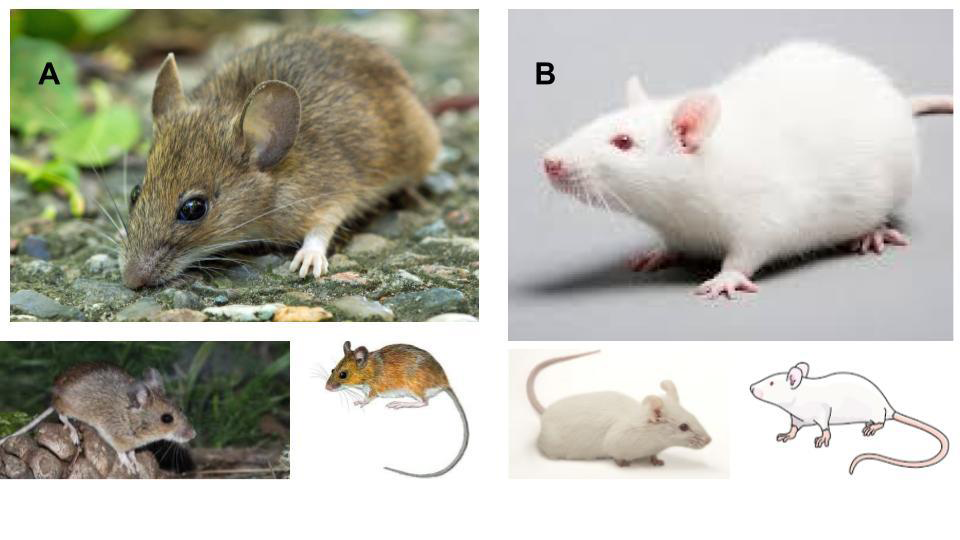
Figure 1: Picture depicted the two rodent strains compared in this study, which are familiarly related but they are notoriously different. In picture (A), the undomesticated Apodemus Sylvaticus, with very large and awake dark eyes, bigger head, quite autonomous front limbs, surprising agility to jump and speed of movements. In picture (B) the domestic Mus Musculus, albino mouse with red delicate eyes, very curious about their immediate reality, are much more collaborative and cooperative to produce numbers and graphs for Neuroscientists.
Learning skills might be considerably different between species, contrary to what was exposed by Skinner about gross behavioral measures and general theories of operant conditioning learning. Skinner studied the pigeon, monkey and rat of general and common learning rules to all species for instrumental conditioning. However different animals might have completely distinctive strategies to handle and deal with difficult and dangerous situations thus questioning the interspecies universality of operant conditioning [8].
It is possible that, as a wild undomesticated species, the AS is using different strategies and consequently, specific signaling cascade pathways of proteins in their hippocampus for spatial memory compared to domesticated laboratory mice [4]. They have proved superior learning abilities than several other rodent species such as the mouse C57BL/6J, Mus Musculus OF1 or the bank vole [1, 8, 9]. Different observations through the years have shown that the AS is able to explore a land area as large as 10 km2, keeping that excellent spatial memory performance [2, 6].
Mice of a pet store Mus Musculus (MM) have an unknown genetic background and consanguinity very often happens in this strain. However they are usually sold to become pets or to be food for captive reptiles, when they are certainly good specimens for obtaining scientific behavioral observations or, experimental and genetic data (consanguinity) because of their mammalian brains. Moreover they might also be useful to study and obtain information about the effects of inbreeding on the brain, cerebellum or kidneys too. They are known as home or domestic Mus Musculus (MM). These two strains, AS and MM are different, but phenotypically, behaviorally, biologically or psychobiologically (brains) speaking, they are very similar so they belong to the same rodent families. To the best of our knowledge, no other studies comparing wild caught undomesticated Apodemus Sylvaticus (AS) with domestic or house mice Mus Musculus (MM) (Figure 1) in settings for spatial memory testing in the Morris Maze or differences in swimming styles were published thus, forming the rationale to carry out the current study.
It has been widely suggested that an enriched environment with novelties is very important variable for cognitive learning processes, plasticity, brain neurogenesis, reducing anxiety levels and inducing individuality in behavior [10]. These domesticated rodents MM have been motor and cognitive stimulated as further is explained. They have shown interest for changes in their environments and were much more collaborative and cooperative to produce numbers and graphs compared to wild specimens, and empirical data are highly estimated values in Neuroscience. Charles Darwin in 1874 realized that the effect of environmental stimulation and domestication might change the brain size, pointing out that the brains of domestic rabbits were smaller than those that were living in the wild [11]. Moreover, in 1913
the well known Spanish Neuroscientific Santiago Ramon y Cajal stated that brain stimulation could establish new and more numerous networks and synapses between neurons [12]. Also some years later, Hebb in 1947 affirmed that enriched environments during infancy for animals could produce permanent brain changes which lead to an increase in problems solving capabilities [13].
Method
Two domestic or house mice rodents Mus Musculus (one male, one female) were obtained by acquisition in an official pet store. They mated on February the 14th and subsequent offspring of that couple were used for these experimental behavioral observations. A total of 9 female experimental animals were clustered in three groups: I) an adult group (N = 3) of 5 months old domestic Mus Musculus (born 16th March); II) a younger-junior group (N = 3) of 2 months old domestic Mus Musculus (born 9th and 12th June) and III) 3 trapped wild healthy undomesticated specimens of Apodemus Sylvaticus (long tail wood mice; AS) were tested with a Morris Maze test.
All mice were group housed per ages, sexes and domestic state at 25°C, under standard 12 h day/night cycle, in comfortable cages provided with beds of finely ground Spanish pine sawdust, fresh hay, straw and rodent litter. All the cages were cleaned, changed and dewormed using antiparasitic spray, sepiolite and diatomite litter at least once every week. The food provided was carefully chosen in a healthy variety for little rodent necessities (seeds, nuts, peanut butter, lettuce, broccoli, etc) and source of proteins with small invertebrates [dried or alive tenebrio molitor coleoptera, dried larvae of hermetia illucens (black soldier fly) or unpoisoned and dewormed cockroaches without mites] with clean fresh water ad libitum. These undomesticated rodents AS were trapped by domestic cats and immediately settled in an individual cage with food and water ad libitum, each of them separately and they were not directly manipulated. Cats have powerful jaws that can easily tear apart mice necks. However, they can also tenderly carry their pups between their teeth, without causing a single scratch. Apodemus Sylvaticus are fast jumpers with their muscular hind legs, so hunting these creatures and keeping them unharmed and alive is quite a feat. Each Apodemus was observed one day before the behavioral experiment and only when they did not show any disturbance (psychomotor, motility, sense of vision, etc), they were included in the observation. The day after the test finished, on the eighth day of their capture, they were again released into their natural habitats.
The AS are omnivores and eat seeds (oak, beech, ash, lime, hawthorn and sycamore), fruits, fungus, roots and little insects, they are intersocial and try to avoid human proximity. In other research publications they have trapped the AS with different baits: chocolate cookies, peanuts or rye bread soaked in sunflower oil [14].
For proper cognitive and motor stimulation (proprioception) domestic Mus Musculus were housed with interconnected cardboard cylinders, rotating wheels (vertical and diagonal), creative colorful pipe tube tunnels, made with plastic or wood, with directions in their connections, outside and inside spacious nests, several height levels to roam around in each cage, elastic or fixed aerial horizontal ladders made from popsicle sticks and vertical ladder made from bamboo sticks. With this stimulation we attempt to ensure their behavior and responses to the risk situation were going to be as creative and individual as possible. All those stimuli have been changed and renewed once a week to create an updated and fresh environment to stimulate their roaming entropy and exploratory behavior [10]. All behavioral observations were approved by local authorities and were in accordance with the guidelines for animal handling of the EU (Directive 2010/63/EU). We also strictly follow the general protocols established for mice by the American Institutional Animal Care & Use Committee (IACUC) concerning the Policy on Investigation Noncompliance and Animal Welfare and the Environmental Enrichment for Animals Standard Operating Procedures (SOP).
Behavioral Experimental Design: Morris Water Maze Task
In brief, a circular water tank (color: black, height: 31 cm, diameter: 53 cm, and 167 cm of perimeter) was located 35 cm away from the floor. The color of the water tank was transparent and the color of the plexiglass-platform was black as well, no additional color was added into the water. This circular platform (height: 11,5 cm, and diameter: 8,5 cm) was fixed at a particular location during each trial and it changed every time for the 6 days. Additionally, the platform was submerged to a depth of 0,5-1 cm above the water surface, but always depending on the size of the animal´s paws (water above the platform has to be the same to half the length of the rodent lower extremities). The recording was done from a fixed place, located in the distance, providing a good view of the animal behavior, but with one blind spot, that was a traffic area. The recorder was stopped as soon as a mouse sat on a hidden platform or if the mouse swam for a maximum of 60 seconds per trial without finding the platform. Mice had to learn to find a hidden platform using distal spatial visual cues because it was assumed they all were able to distinguish the clues in the surrounding environment by seeing. All of them were able to swim acceptably and efficiently [14, 15, 16, 17].
After training they learned, as the adult group, different strategies of approaching the platform in the Morris Maze, according to their search swimming styles, from less to more focus on the goal of platform: thigmotaxis, random, scanning, chaining, focal, directed and direct: Thigmotaxis defines the behavior of the animal which swims in reaction to the feelings of the water but with not a clear goal. The Random style defines the haphazard movements of the animal in the water without conscious choice. The next manner of behavior in the water is the Scanning strategy that refers to the recursive and repetitive circles that an animal does in the same area and Chaining performance is the same as Scanning but happening in several different areas. Focal performance for swimming happens when the animal’s behavior is clearly aimed to escape from there, but with no defined clear direction. However, Direct and Directed behaviors occur when the platform is the main goal where the animal straights all the movements toward. That means, the attention of the animal flows from the direct physical sensations on their bodies (water, unstable and uninhabitable medium) to understand the maze (cognition) for defining and finding the platform (behavior to escape). Two dependent variables were registered: 1) latency in water till finding the platform (seconds), 2) and track length of the swimming (centimeters). Every group (Junior vs Adult vs Apodemus Sylvaticus) swam in a session of 6 trials, in consecutive days, at the same time, around 7pm, when sunsets and their biorhythms start to be more active, because they are all crepuscular and nocturnal creatures [8]. This Morris Maze behavioral test was designed as other authors explained in already published papers. But because of our research purpose, we did not include the variable of removing the escape platform in the 6th trial nor recorded the time spent in each quadrant of the maze. This testing environment of water reduces odor trial interferences [14]. Clean water was changed every three trials. Group comparisons of the mean about the difference across groups per each dependent variable (repeated measurements) were performed with T´s for matched pairs variables. Statistical significance level was determined at 5%. Analysis, graphs and figures were made with JMP Statistical Discovery [Trial 18.0.1 (766619)] and PowerPoint for Windows.
Results
We found the AS was not only able to swim masterfully, but they also have their own style doing so: gripped to the walls of the labyrinth to pause, scuba dived successfully from opposite points in distance and jumped from the platform without fainting, trying to find an escape. Those behaviors were absent in the domesticated Mus Musculus. The Mus Musculus group were also successful in learning skills to efficiency and finding the platform, making it shorter and shorter through trials. Some differences between age cohorts were also found.
In Figures 2-4 it is noticeable how the Apodemus Sylvaticus made a completely different performance than the other two groups.
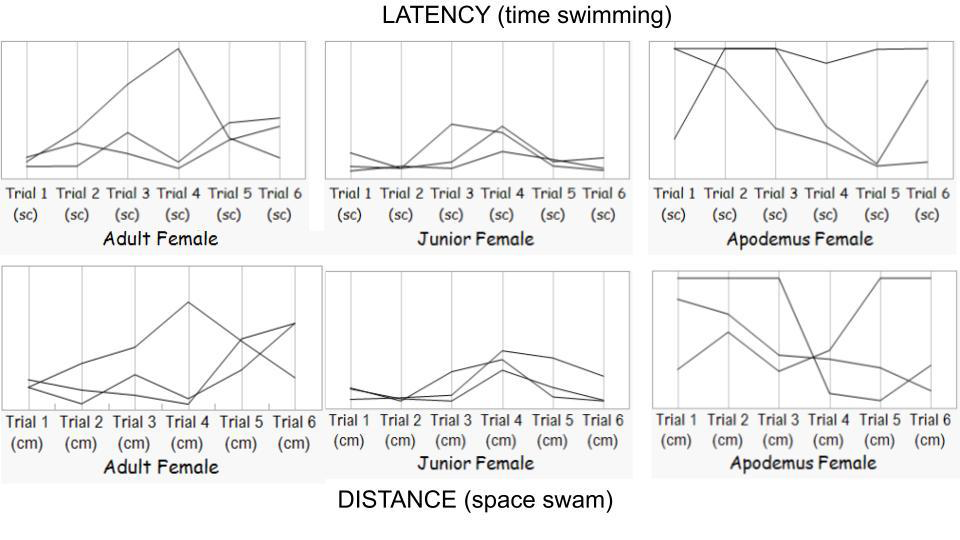
Figure 2: Graphs showing the general performance of the three groups in the six different trials. In the upper row the values about the time (seconds) the animals were in the water swimming until finding the platform. It is noticeable how the domestic groups (adults and junior) show equivalent values, while the Apodemus Sylvaticus had their own style and performance. The same for the length (centimeters) the animals swan (low row). In trial 3 AS seemed to understand the game having a similar value to the other groups, but their performances got different again, perhaps showing their main interest was not so much to get on the platform but rather to escape.
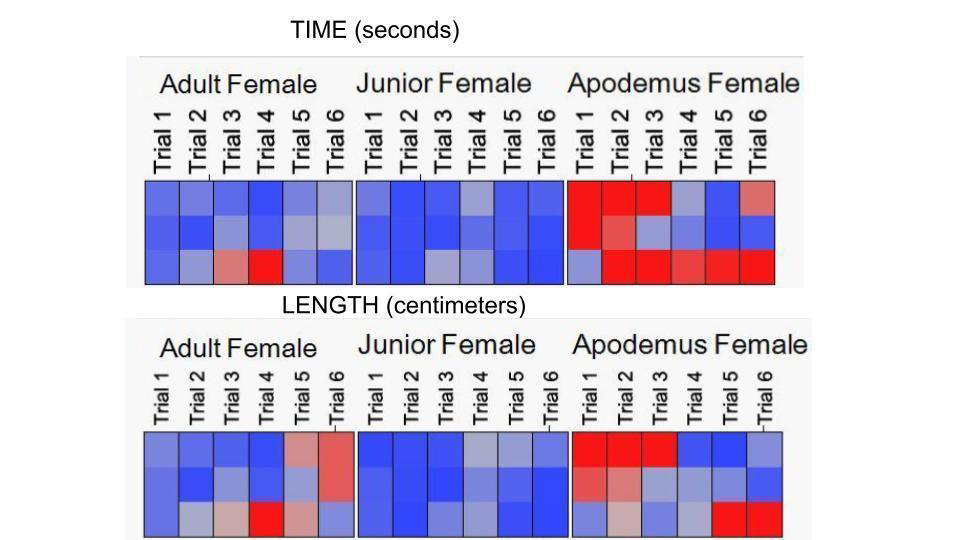
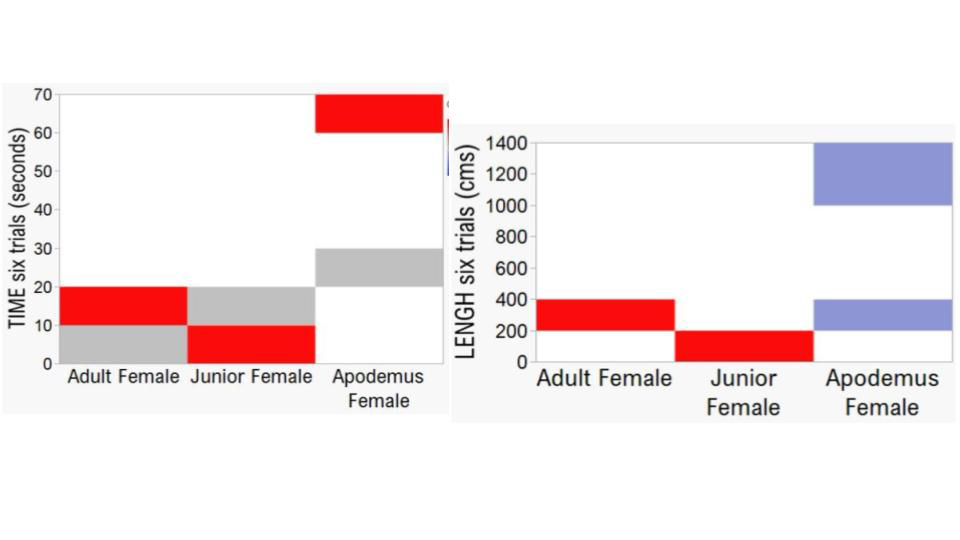
Inter groups comparisons show clear statistical differences in the second and third trial between Apodemus Sylvaticus and the other two groups (Adults and Junior) for time and length [SECOND TRIAL = Time: AS vs Adult: T (2) = -19.8; p = 0.0013; AS vs Junior: T (2) = -14.54; p = 0.0023) and Length: AS vs Junior: T (2) = -6.05; p = 0.013]; [THIRD TRIAL = Time: AS vs Junior: T (2) = -3.59; p = 0.034], (Figures 5 & 6).
For the last two trials, we found a statistical difference between the age cohorts, Adult vs Junior: [FIFTH TRIAL =
(Adult vs Junior): Time: T (2) = -6.57; p = 0.0112; Length: T (2) = -3.454; p = 0.037]; [SIXTH TRIAL =: (Adult vs Junior): Length: T (2) = -3.69; p = 0.033] (Figures 2,3,5 & 6).
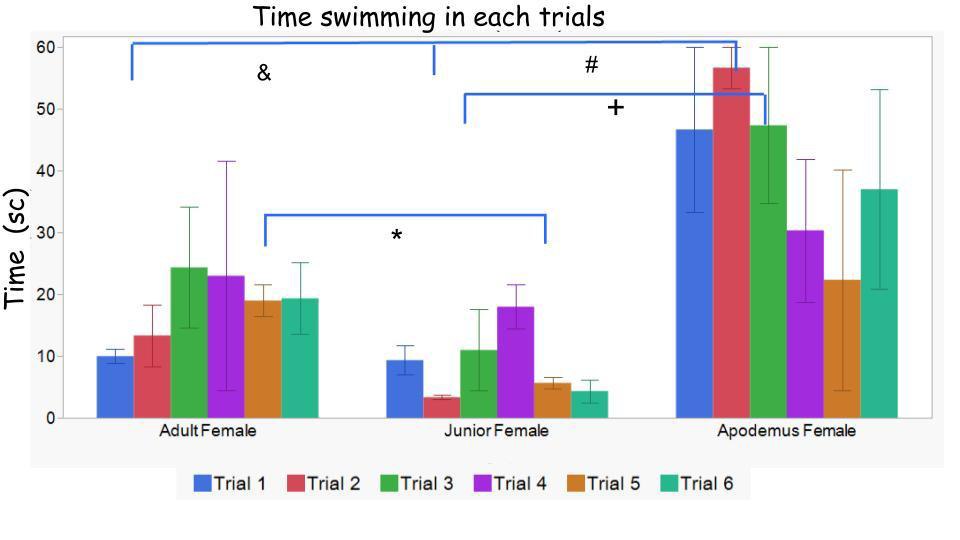
Figure 5: This graph shows the mean of time each group spent in the water per trial. Statistical significance was found between the Apodemus Sylvaticus (AS) group and the other two in trial 2. In trial 3 the difference was between AS and the MM Junior group, having the later the smaller latencies. In trial 5 both domestic MM groups, Adult vs Junior were statistically significantly different. & p < 0.0013 in trial 1; # p < 0.0023 in trial 1; + p < 0.034 in trial 3; * p < 0.0112 in trial 5.
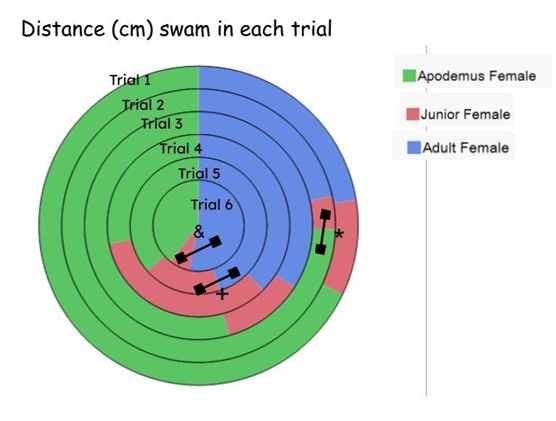
Figure 6: Graph showing differences in distance swam, during the six trials, for the three experimental groups. It is noticeable that the Apodemus sylvaticus (AS, green color) made a bigger distance, followed by the adult MM (blue color) and the junior MM (red color) groups. Contrary to expected, they were not tired after the exercise, but were able to dive and jump, having complete control on their own breathing after such a long distance swim. Statistical significance was found in trial 2 (Apodemus vs Junior) and in trials 5 and 6 (Adult vs Junior). * p < 0.013 in trial 2; + p < 0.037 in trial 5; & p < 0.033 in trial 6.
Discussion
The fact of a different way of trapping the Apodemus Sylvaticus (AS) in this observation seemed to have an effect on the behavioral results. We did not use baits or physical traps, but they were catched with the intervention of other animals, such as cats. That implies the AS had to badly fight for their lives and felt true fear, before doing the Morris Maze. Cats are perfectly capable of acting as predators, killing them, but they did not do so. Then the AS levels of cortisol or stress hormones might have been elevated for a few days, and certainly that might have an effect over their posterior behavioral responses and certainly be different from those animals captured with baits. Consequently AS, specimen (I) found a manner to pause the swimming when the platform was not found: learned to grip the walls of the maze with her frontal limbs and from that position, looked around to understand better. Specimen (II) found the platform the first trial and had an excellent performance: each trial she was closer and closer to jump from the platform to get outside the maze. In trial 6 she did it, found the platform only in a few seconds and from there, she jumped to the edge of the maze walls and then popped out to freedom, giving another meaning and sense to the exit of the maze and success.
Cats around helped to re-trap her to be feeded and rested. Specimen (III) managed to escape when trial 3 was about to happen: her speed and unpredictable movements while infrastructures were being prepared to record trial 3 together with a distraction of just a few seconds, made her quick and sudden exit possible. Fortunately cats around helped re-trapping her again and the complete experiment became possible, although the AS motivation was clearly lower after that incident. The AS remembered what happened in the previous sessions and from that point they tried to escape. It is very remarkable that none of these behaviors have ever been observed in domestic Mus Musculus.
Mostly all the research made with the Apodemus Sylvaticus´s brains found neurogenesis in the dentate gyrus (DG) [1, 2, 3, 4]. The absence of neurogenesis found by Houser, et al. [5] might be caused by different variables: 1) they research was done with the second generation of AS (inbreed in their lab as the other mice), not the directly the wild ones or 2) the AS might simply be not interested in running the wheel, because it is something that they have never found in their natural environments: we have put a wheel in the cage of an AS and she used it to hide, but never played. That is why they cannot be compared at this level. The AS has a superior level of a cognitive map through the control of a large land area [6] and that certainly requires an active and neuroplastic brain framework according to the need. In humans adult neurogenesis has been reported, especially in the DG of the hippocampus, however many technological challenges are required to be overcome to provide conclusive results. Behavioral data are also of interest for human studies, because memory, anxiety, depression and fear might be affected by the neurogenesis degree [18]. It is probed that many antidepressant medicines (i. e. fluoxetine) are stimulating adult neurogenesis [18, 19].
Our observational and behavioral data show how the AS started having a worse performance than the other two groups, being statistically significant in time and length during trials 2 and in time during trial 3. The undomestic group seemed more clumsy and had less motivation to learn, but just wanted to escape because of their probable certainty that they were going to be killed by drowning. But from trial 3 on, they changed the strategy and they all improved their performances till the level to equaling the domesticated groups finding platforms in standard latencies. However, their particular style described previously, made these observations quite surprising.
An age cohort effect was found in trials 5 and 6. Female junior group showed a slightly better and more efficient performance than the adult female group (Figures 5 & 6). It turned out one of the junior females (#4) was pregnant during the 6 trials and had an offspring of 4. These results contrast with those previously found in the male groups, where the junior males made the higher markers for time and length during the first trials compared to adult males [16, 17]. This result in female groups may suggest a gender difference in the process of learning and managing the water maze for the domestic Mus Musculus that needs further research.
This Mus Musculus strain showed also interesting data to describe. Their swimming was a sign of health and strength as well. One specimen, that seemed to be an Egyptian mouse, (no hair and bigger ears) was tested in the Morris maze: it sank into the water and could not survive because of drowning. Autopsy revealed it has liquid in the abdominal and stomach cavity that made it drown in the water under the weight of its own liquid. That disease could be caused by kidney failure. Another disease has been found in this strain with a specimen that is blind and has ataxia-type mobility problems, probably because of a cerebellum-occipital congenita damage. Those illnesses or diseases might be due perhaps to inbreeding because of the consanguinity. Certainly a field of high interest to study for Neuroscience.
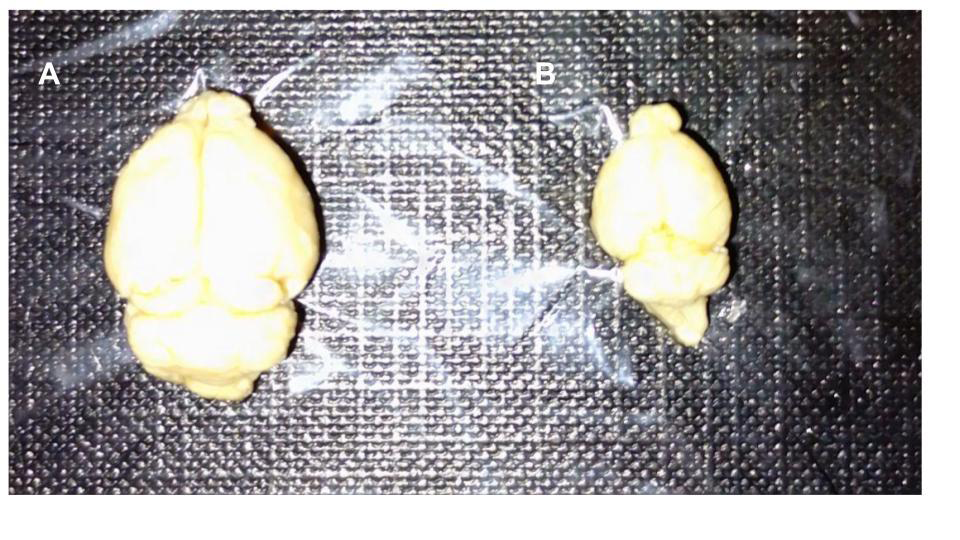
As Darwin wrote concerning the rabbits, a bigger head happens in wild species. The AS has an enriched environment in their natural habitat and that might have an effect on their brain size, cognitive learning processes, plasticity, brain neurogenesis and inducing individuality in behavior. We weighed the brains of some females Apodemus and Mus Musculus with their olfactory bulbs and found the AS had encephalon between 1 and 2 grams of weight, while the Mus Musculus did not reach a gram of weight in any case (Figure 7).
Considering most of the chemical, physical or environmental changes happen first in the wild non domesticated reality, it is noticeable this savage characteristic would contribute relevantly to obtain valuable information with Scientific purposes.
This study has some limitations because of the small number of animals (N = 3 per group). A bigger amount of AS specimens was very unlikely, because each alive Apodemus was delivered in dribs and drabs making impossible a group recording, but only individual observations. However, the unique features of these animals trapped by three generous cats, made these results valuable enough to be known, as a preliminary naturalistic empirical data, having indeed an interest for the Neuroscientific community as a starting point.
Researching with domestic mice has some particularities. These animals, in genes, behavior, brain material, etc. are the same as experimental animals from the laboratory (Mus Musculus), however their genetic background has not been controlled. For being like pets they have a different treatment, more affectionate, by the researcher or caregivers, building bounds of trust and common understanding. This research evidences that these mice are certainly good mammalian specimens for obtaining scientific behavioral and experimental data to provide information to the scientific community.
Acknowledgements
We would like to thank Prof. Swaab at the Netherlands Institute for Neuroscience for his inspirational ideas. We would like to thank the reviewers for their improvements. Moreover, I would like to thank my cats who trapped the live and healthy specimens of Apodemus Sylvaticus, supervised the observations and helped me in learning about the mice world.
References
-
Galsworthy MJ, Amrein I, Kuptsov PA, Poletaeva II, Zinn P, et al. (2005) A comparison of wild-caught wood mice and bank voles in the Intellicage: assessing exploration, daily activity patterns and place learning paradigms. Behav Brain Res 157: 211-217.
-
Patil SS, Sunyer B, Höger H, Lubec G (2008) Apodemus sylvaticus (LOXT) is a suitable mouse strain for testing spatial memory retention in the Morris water maze. Neurobiol Learn Mem 89: 552-559.
-
Patil SS, Schlick F, Höger H, Lubec G (2010) Linkage of hippocampal proteins to spatial memory formation and strain-dependence in Apodemus sylvaticus, C57BL/6J and PWD/PhJ mice. Neurochem Int 56: 522-527.
-
Patil SS, Boddul SV, Schlick K, Kang SU, Zehetmayer S, et al. (2011) Differences in hippocampal protein levels between C57Bl/6J, PWD/PhJ, and Apodemus sylvaticus are paralleled by differences in spatial memory. Hippocampus 21: 714-723.
-
Hauser T, Klaus F, Lipp HP, Amrein I (2009) No effect of running and laboratory housing on adult hippocampal neurogenesis in wild caught long-tailed wood mouse. BMC Neurosci 6(10): 43.
-
Dell’Omo G, Shore RF (1996) Behavioral effects of acute sublethal exposure to dimethoate on wood mice, Apodemus sylvaticus: II--Field studies on radio-tagged mice in a cereal ecosystem. Arch Environ Contam Toxicol 31: 538-342.
-
Kucera P, Favrod P (1979) Suprachiasmatic nucleus projection to mesencephalic central grey in the woodmouse (Apodemus sylvaticus L.). Neuroscience 4: 1705-1716.
-
Lejeune H, Huynen MC, Ferrara A (2000) Temporal differentiation in two strains of small rodents: a wood mouse (Apodemus sylvaticus) and an albino mouse (Mus musculus OF1). Behav Processes 52: 155-169.
-
Fernandes C, Liu L, Paya-Cano JL, Gregorová S, Forejt J, et al. (2004) Behavioral characterization of wild derived male mice (Mus musculus musculus) of the PWD/Ph inbred strain: high exploration compared to C57BL/6J. Behav Genet 34: 621-30.
-
Zocher S, Schilling S, Grzyb AN, Adusumilli VS, Bogado Lopes J, et al. (2020) Early-life environmental enrichment generates persistent individualized behavior in mice. Sci Adv 26: eabb1478.
-
Darwin CH (1874) The descent of man, and selection in relation to sex; John Murray. UK.
-
Cajal SR (1913) Estudios sobre la degeneración y regeneración del sistema nervioso; Moya: Madrid, Spain.
-
Hebb D (1947) The effects of early experience on problem-solving at maturity. Am Psychol 2: 306-307.
-
Bromley-Brits K, Deng Y, Song W (2011) Morris water maze test for learning and memory deficits in Alzheimer’s disease model mice. J Vis Exp 20: 2920.
-
Vorhees CV, Williams MT (2006) Morris water maze: procedures for assessing spatial and related forms of learning and memory. Nat Protoc 1: 848-858.
-
Garcia-Falgueras Alicia (2024) Cognitive Map is Earned with Experience, Effort and Physical Activity:Possible Disfigurement of Memory with Early GPS Use. Psychol Psychology Res Int J 9(4): 000438.
-
Garcia-Falgueras, Alicia (2024) Aging Might Increase Efficiency in Behavioral Performance for Risk Situations. Psychol Behav Sci Int J 22(3): 556087.
-
Salta E, Lazarov O, Fitzsimons CP, Tanzi R, Lucassen PJ, Choi SH (2023) Adult hippocampal neurogenesis in Alzheimer's disease: A roadmap to clinical relevance. Cell Stem Cell 30: 120-136.
-
Brooker SM, Gobeske KT, Chen J, Peng CY, Kessler JA (2017) Hippocampal bone morphogenetic protein signaling mediates behavioral effects of antidepressant treatment. Mol Psychiatry. 22: 910-919.
- Occupational Stress and Mental Health Outcomes Among Police Officers: A Mini Review
- The Experience of Counterproductive Leadership on Mental Health and Impact on Retention in U.S. Marines: A Phenomenological Study
- Nomophobia in the Digital Age: A Study on College and University Students
- Emotional Regulation in Children with Autism and Learning Disabilities
- Antisemitism on American College Campuses and Its Impact on Jewish Students
- Exploring the Role of Empathy in the Associations of Family Functioning and Purpose in Life with Attitude towards Abortion among Undergraduates: A Moderation Analysis