
Synthesis, Characterization and Antimicrobial Studies of 2-{(E)- [(4 Chlorophenyl)Imino]Methyl}Phenol Schiff Base Ligand and its Cu(II) Complex
A Schiff base ligand (84% yield) was prepared by the condensation of 4-chloroaniline and salicylaldehyde in their ethanolic solutions. The corresponding Cu(II) complex (64% yield) of the prepared Schiff base was obtained by refluxing the ethanolic solution of the Schiff base. The melting point temperature of the Schiff base was found to be 138℃, while the decomposition temperature of the Cu(II) complex was found to be 209℃. Both the Schiff base and the corresponding Cu(II) complex were found to be soluble in some organic solvents but Cu(II) was insoluble in diethylether and n-hexane. The formation of the Schiff base and its Cu(II) complex was confirmed using FTIR spectroscopy. Both the Schiff base and its Cu(II) complex were found to be stable at room temperature. The antimicrobial activity of the Schiff base and its complex were tested against human pathogenic bacteria as well as fungi and the zones of inhibition were recorded. A comparative study of zone of inhibition (ZOI) values of Schiff base and its Cu(II) complex show that, the complex display higher antibacterial activity than the free ligand and this is probably due to the greater lipophilic nature of the complex, which showed 16 mm, 20 mm, 21 mm, 17 mm, 16 mm and 15 mm against Escherichia coli, Staphylococcus aureus, Streptococcus pyogenes, Aspergillus niger, Candida albicans and Mucus indicus respectively. In addition, the results showed that, the complex Cu(II) exhibited potent antibacterial activity with the reference standard ciprofloxacin and Clotrimazole.
Introduction
Schiff bases, named after Hugo Schiff (1864) are formed when any primary amine reacts with an aldehyde or a ketone under specific conditions. Structurally, a Schiff base (also known as imine or azomethine) is a nitrogen analogue of an aldehyde or ketone in which the carbonyl group (C=O) has been replaced by an imine or azomethine group. Schiff bases are some of the most widely used organic compounds. They are used as pigments, dyes, catalysts, intermediates in organic synthesis, and as polymer stabilisers [1]. Schiff bases have also been shown to exhibit a broad range of biological activities, including antifungal, antibacterial, antimalarial, antiproliferative, anti-inflammatory, antiviral, and antipyretic properties [2]. Due to the excellent selectivity, sensitivity and stability of Schiff bases for specific metal ions such as Ag(II), Al(III), Co(II), Cu(II), Gd(III), Hg(II), Ni(II), Pb(II), Y(III) and Zn(II), many different Schiff base ligands have been used as cation carriers in potentiometric sensors [1].
The interest in metal complexes in which the Schiff bases play a role as the ligands are increasing as evidenced by the number of publications appearing annually (approximately 500) [3]. So much interest in imines can be explained by the fact that they are widely distributed in many biological systems and they are used in organic synthesis and chemical catalysis, medicine, pharmacy and chemical analysis, as well as new technologies [4]. Schiff base compounds have been shown to be promising leads for the design of efficient antimicrobial agents as a result of the broad range of biological activities exhibited by these compounds.
Schiff bases offer a versatile and flexible series of ligands able to bind with various metal ions to give complexes with suitable properties for theoretical and/or practical applications. Many poly-dentate Schiff’s base compounds have been structurally characterized and extensively investigated [5]. Schiff’s base ligands and their metal complexes have been extensively studied over past few decades.
Metal complexes containing synthetic macrocyclic ligands have attracted a great deal of attention because they can be used as models for more intricate biological macrocyclic systems like metalloporphyrins (hemoglobin, myoglobin, cytochromes, chlorophylls), corrins (vitamin B12) and antibiotics (valinomycin, nonactin). So it attracted the attention of both inorganic and bioinorganic chemists [6]. Metal complexes of the Schiff bases are generally prepared by treating metal salts with Schiff base ligands under suitable experimental conditions. However, for some catalytic NH2 H OH OH O Reflux EtOH + Salicyldehyde Cl Scheme 1: Preparation of Schiff Base.
Preparation of the Metal Complex
To a 6 mmol Ethanolic solution of the Schiff base, 3 mmol of Copper (II) chloride solution was added in ratio of 2:1. The mixture was refluxed for 3 hours. 10 cm3 of ethanol was OH H
2 Cl
application the Schiff base metal complexes are prepared in situ in the reaction system.
This work aimed to synthesise, characterize and study the antimicrobial potentials of 2-{(E)-[(4-chlorophenyl) imino]methyl}phenol Schiff base and its Cu(II) complex.
Materials and Methods
All the reagents and solvents purchased were of analytical grade and used without further purification. The melting point/decomposition temperature for the Schiff base and its corresponding Cu(II) complex were determined using melting point apparatus SMP1. The FTIR spectra of the prepared Schiff base and its corresponding Cu(II) complex were carried out in a range of 4000 – 400cm-1 on Shimadzu FTIR – 8400S.
Preparation of the Schiff Base
To a stirred solution of chloroaniline (0.01mol) in ethanol, a solution of salicylaldehyde (0.01mol) in ethanol 50 cm3 was added. The resulting mixture were refluxed for a period of 3 Hours, the resulting mixture was then left to cool at room temperature. After cooling, it was filtered, washed and dried in a desiccator over anhydrous CaCl2 [7] (Scheme 1).
H Cl
N
+ O H2
4-Chloroanaline 2-{(E)-[(4-chlorophenyl)imino]methyl}phenol added and the mixture was refluxed for 3 hours using a hot plate magnetic stirrer. The reaction mixture was allowed to cool at room temperature, filtered, washed with ethanol and stored in a desiccator containing phosphorus pentaoxide for 3 hours [7] (Scheme 2).
H
N Cl
OH2
Cu O O
+ 2H2O reflux, 3 hrs 3 mmol CuCl N Cl
O H2
N
H
Proposed structure of Cu(II) complex
Scheme 2: Preparation of Cu(II) complex from Schiff base loigand.
Solubility Test
The solubility of the Schiff base and the corresponding Cu(II) complex were studied from ethanol, chloroform, distilled water, DMSO, DMF, methanol, n-hexane, diethylether.
Schiff Base Solubility Test
0.2g of the Schiff base was measured and transferred into the solvents, stirred and allowed for about 3 min, the resulting mixture was filtered, allowed to dry and weighed.
Metal Complex Solubility Test
0.2g of the metal complex was measured and transferred into the respective solvents, it was stirred for 2-3 minutes, and the resulting mixture was filtered, allowed to dry then weighed.
Antimicrobial Activity
The synthesized ligand and its complexes were tested for their in-vitro antimicrobial activity against the bacteria Staphylococcus aureus, Escherichia coli and Streptococcus pyogenes as well as against the fungi Candida albicans, Aspergillus niger and Mucus indicus using agar well diffusion method. The stock solutions (102 mol L-1) of the compounds were prepared in DMSO and the zone of inhibition values of the compound were determined by serial dilution method. For determination of zone of inhibition, the respective medium was poured into the petriplates and allowed to solidify at room temperature. Wells were made on the solidified medium and the serially diluted solutions were added on to the wells and allowed to diffuse into the wells. The indicator organisms were overlaid on to the agar medium and the plates were incubated for 37°C for 48 h. After incubation the zone of inhibition by the compound were measured and zone of inhibition was determined.
Results and Discussion
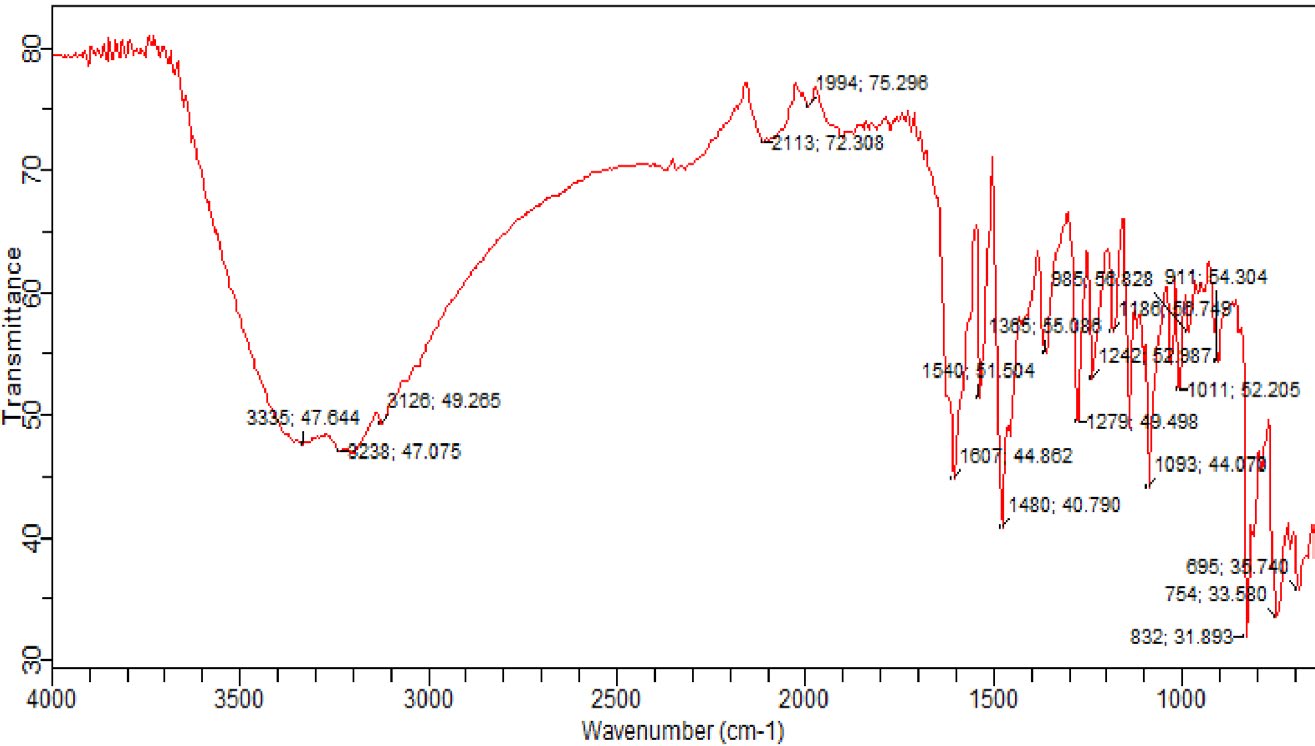
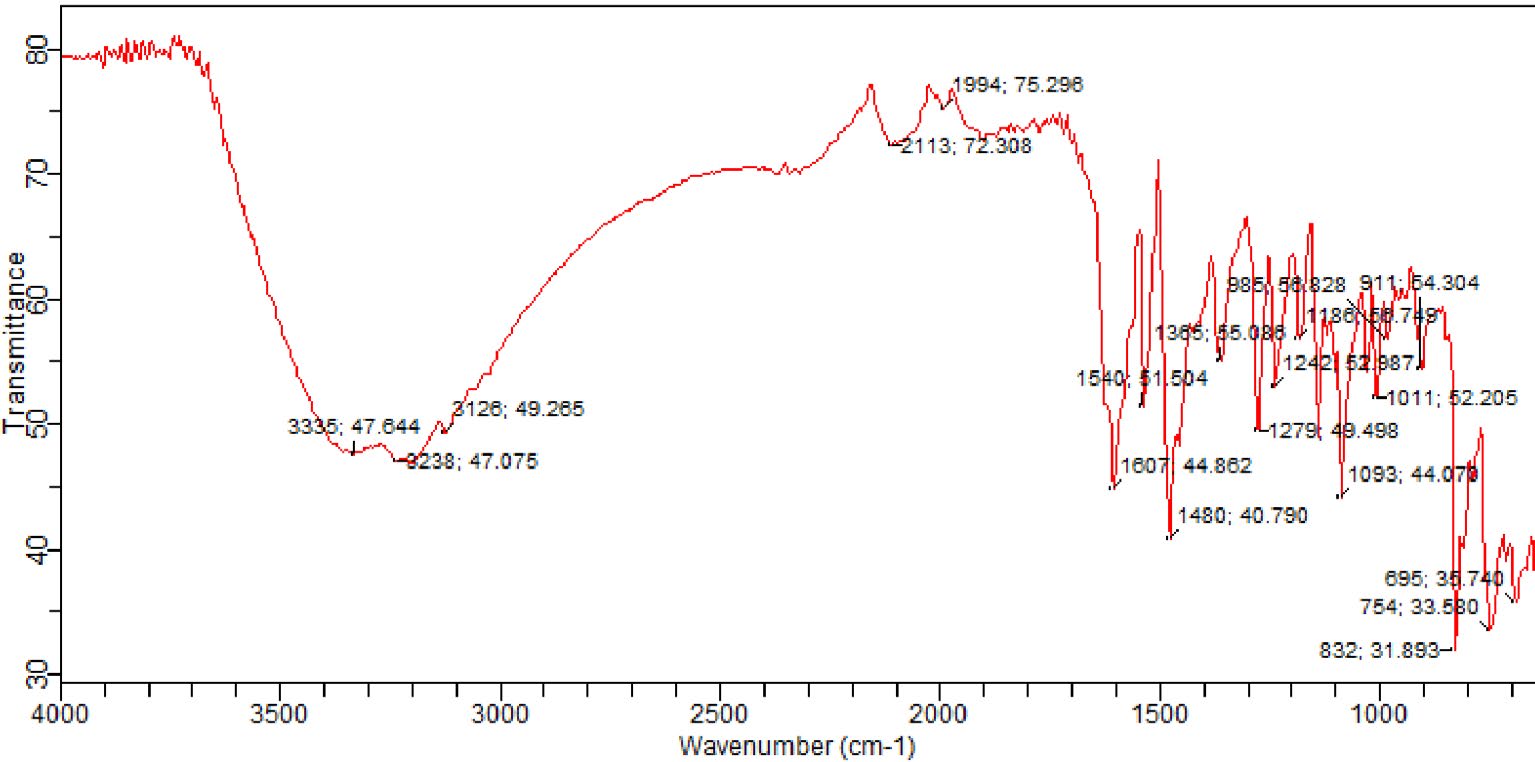
The Schiff base ligand and its metal complex were characterized by FT-IR (Figure 1). The results in Table 1 indicate that, the Schiff base and its corresponding Cu(II) complex are colored. The color orange is for the Schiff base as reported by Archana, et al. & Hassan, et al. [8, 9] while the brown colour is for Cu(II) complex. The change in color of the Schiff base from orange to the brown color of the Cu(II) complex was due to complexation which resulted into the formation of coordination compound. The melting point for the Schiff base and its corresponding Cu(II) complex range between 130°C – 210°C (Table 1). The results showed some similarities in physical properties of both Schiff base and its corresponding Cu(II) complex. There were similarities with a report by Mustapha, et al. [10] and it indicated the high stability of the compounds.
| Compound | Melting point (°C) | Decomposition Tempera- ture (°C) | Percentage Yield (%) | Colour | Molecular Formula |
|---|---|---|---|---|---|
| Schiff base | 138 | - | 84 | Orange | C H ClNO 13 10 |
| Cu(II) | - | 209 | 64 | Brown | C H Cl CuN O 26 22 2 2 4 |
Table 1: FTIR data of the Schiff base and its Cu(II) complex.
| Functional Groups | Schiff Base (cm-1) | Cu(II) Complex (cm-1) |
|---|---|---|
| V(C-Cl) | 590 | - |
| v(OH) | 3339 | 3238 |
| v(M-N) | - | 562 |
| v(C=N) | 1611 | 1614 |
| H2O | - | 3335 |
| v(C-H ) | 3095.7 | - |
Table 2: FTIR data of the Schiff base and its Cu(II) complex.
The FTIR results were reported in Table 2, and showed The appearance of absorption band at the region of 1611cm-
1 assigned to υ(C=N) stretching vibration which is an important feature of Schiff base and it was supported by the literature [9, 11]. Absorption band also appeared in the free ligand at 3095.70cm-1 can be assigned to υ (C-H) stretching vibration and is within the range of 3100-3000cm-1 for C-H aromatic. A weak absorption band appeared at 590-1 can be assigned to υ (C-Cl) because it was within the range of 590 –
700 cm-1 [12]. In the Cu(II) complex (Figure 2), there were a little shift in υ (C=N) from 1614.60 to 1615.90 – 1614.80 cm-1 this indicate stretching vibration of the azomethine group and possible formation of the complex [13]. The appearance of weak absorption band in the C(II) complex at the range of 562.33 – 557.15 cm-1 can be attributed to the stretching vibration of Metal –Nitrogen (M–N) and it was similar to what was confirmed in the literatures (Deoghoria, Bagihalli, Shahabadi [14]).
| Solvents | Schiff Base | Cu(II) Complex | |
|---|---|---|---|
| n-hexane | S | IS | |
| DMSO | S | S | |
| Ethanol | S | SS | |
| Methanol | S | S | |
| DMF | S | S | |
| Chloroform | SS | SS | |
| Distilled water | SS | SS | |
| Diethyl ether | SS | IS | |
| Test Microbes | Ligand(mm) | Cu(II) complex(mm) | Ciprofalxacin |
| Escherichia coli | 13 | 16 | 20 |
| Staphylococcus aureus | 10 | 20 | 24 |
| Streptococcus pyogenes | 11 | 21 | 23 |
| Clotrimazole | |||
| Aspergillus niger | 13 | 17 | 21 |
| Candida albicans | 14 | 16 | 22 |
| Mucus indicus | 14 | 15 | 19 |
Table 3: Solubility of the Schiff base and Cu(II) Complex. KEY: IS = Insoluble, S = Soluble, SS = Slightly Soluble.
Chandra Mohan, et al. [15] reported the Infrared spectra of the ligands which showed strong bands at 3407 cm-1 and 3146 cm-1 and were assigned to symmetric or asymmetric ν(NH2) stretching and ν(N–H) vibration of free NH2 groups. The spectrum also shows bands at 1588, 1294 and 838 cm−1 due to the ν(C=N), ν (C=S) & δ(C=S) groups respectively (Table 3).
The solubility test was also carried out and the results obtained from the Schiff base and its corresponding Cu(II) complex showed that both were soluble in DMSO, Methanol and DMF. The table also showed that, the Cu(II) complex is insoluble in n-hexane and Diethyl-ether while the Schiff base is soluble in n-hexane and slightly soluble in Diethyl ether.
Both the Schiff base and the corresponding Cu(II) complex are slightly soluble in chloroform and distilled water. However, the solubility of the Schiff base and the Cu(II) complex in different organic solvents can be attributed to the covalent nature of the of the compounds (Table 4).
The Schiff base ligand and its Cu(II) complex have been monitored for their antibacterial activity against various pathogenic bacteria such as Staphylococcus aureus, Streptococcus pyogenes and Escherichia coli and antifungal activity against Candida albicans, Aspergillus niger and Mucus indicus. Ciprofloxacin and Amphotericin-B were used as the standard for bacterial and fungal studies respectively. The antimicrobial activity of the Schiff base and its complexes were tested against human pathogenic bacteria as well as fungi and the zones of inhibition were recorded. A comparative study of the growth inhibition zone values of Schiff base and its Cu(II) complex show that complex display higher antibacterial activity than the free ligand and this is probably due to the greater lipophilic nature of the complex. Metal complexes activity can be explained on the basis of Overtone’s concept and Tweedy’s chelation theory [16, 17]. According to the overtone concept of cell permeability, the lipid membrane surrounding the cell favours the passage of only lipid-soluble materials, which means that liposolubility is an important factor controlling antimicrobial activity. On chelation, the polarity of metal ion is reduced to a greater extent due to overlap of the ligand orbital and partial sharing of its positive charge with the donor groups. In addition, it is also due to delocalization of the π-electrons over whole chelate ring, enhancing the penetration of the complexes into the lipid membranes and the blocking of the metal binding sites of the enzymes of the microorganisms.
Conclusion
The Schiff base and its corresponding copper(II) complex were successfully synthesized and characterized by FTIR spectroscopic technique, FT-IR spectra confirm the functional groups present in the ligand and its complex. The solubilities of the ligand and its corresponding Cu(II) complex were determined from solvents of different polarities, and were found to be soluble in most organic solvents. A comparative study of zone of inhibition (ZOI) values of Schiff base and its Cu(II) complex show that, the complex display higher antibacterial activity than the free ligand and this is probably due to the greater lipophilic nature of the complex.
Acknowledgments
The authors wish to thank the Staff and laboratory technologist of Chemistry department Al-Qalam University Katsina, Katsina State for providing facilities to carry out this research.
References
-
Singh K, Barwa MS, Tyagi P (2006) Synthesis, Characterization and biological studies of Co(II), Ni(II), Cu(II) and Zn(II) complexes with bidentate Schiff bases derived by heterocyclic ketone. European Journal of Medicinal Chemisrty 41(1): 147-153.
-
Przybylski J, Shingnapurkar D, Padhye S, Ratledge C (2009) Schiff base conjugates of P-aminosalicylic acid as antimicobacterial agents_._ Bio-org Med Chem Lett 16(6): 1514-1517.
-
Krygowski B, Jerald J, Venugopala KN (1997) Synthesis and characterization of Schiff bases of 2-amino-4-(3- coumarinyl) thiazole as potential NSAIDs. Chem Abstr 142: 113952.
-
Upadhyay Y, Lu B, Yu X, Ye W, Wang S (2008) Studies of synthesis and plant harmone on Schiff bases of tetrazole. Chem J Internet 3: 109238.
-
Middleson G, Omar M, Hindy A (1998) Synthesis, characterization and biological activity of some transition metal with Schiff base derived from 2-thiophene carboxaldehyde and aminobenzoic acid. Spect Chem Acta 62(4-5): 1140-1150.
-
Bayri A, Pamana E, Farina Y (2007) Synthesis, characterization and antimicrobial activity of some metal ions with 2-thioacetic-5phenyl-1,3,4-oxadiazole. J Al-Nahrain Univ (Sci) 13(1): 36-42.
-
Kumar K, Salehzadeh S, Parish V (2002) Synthesis of two potentially heptadentate (N4O3) schiff base ligand derived from condensation of tris (3-amino propylamine and salicylaldehyde or 4-hydroxysalicylaldehyde Ni(II) and Cu(II) complexes of the former ligand. Molecules 7(2): 140-144.
-
Archana S (2013) Synthesis and characterization of Schiff base derivedfrom salicylaldehyde andthiohydrazones and its metalcomplexes. Advances in Applied Science Research 4(4): 152-154.
-
Hassan HM, Omid P, Christoph J (2006) Synthesis and Spectral Characterization of Hydrazone Schiff Bases Derived from2, 4-Dinitrophenylhydrazine and Crystal Structure of Salicylaldehyde-2, 4-Dinitrophenylhydrazone. Zeitschrift für Naturforschung B 62(5): 717-720.
-
Mustapha A, Reglinski J, Kennedy AR (2009) The use of Hydrogenated Schiff Base ligands in the synthesis of Multimetallic compounds. Inorganic Chemistry Acta 362(4): 1267-1274.
-
Imtiyaz RP, Athar AH (2015) Synthesisof Schiff Base Complexes of Mn (II) and Co(II) and their Catalytic Oxidation towards Olefins and Alcohols. Canadian Chemical transaction pp: 65-71.
-
Kazuo N (2009) Infrared and Raman Spectra of Inorganic and Coordination Compounds, application in Coordination, Organometallic and Bioinorganic Chemistry. 6th(Edn.), Wiley-Interscience, pp: 408.
-
Dhar DN, Taploo CL (2009) Schiff bases and their applications. J Sci Ind Res 41: 501-506.
-
Bagihalli GB, Avaji PG (2008) Synthesis, spectral characterization, _in vitro_ antibacterial, antifungal and cytotoxic activities of Co(II), Ni(II) and Cu(II) complexes with 1,2,4-triazole Schiff bases. European Journal of Medicinal Chemistry 43(12): 2639-2649.
-
Chandra, M, Vinod K, Sarla K (2018) Synthesis, characterization, and antibacterial activity of Schiff bases derived from thiosemicarbazide, 2-acetyl thiophene and thiophene-2 aldehyde. Int Res J Pharm 9(7): 153-158.
-
Tai X, Yin X, Chem Q, Tan M (2003) Synthesis of some transition metal complexes of a novel Schiff base ligand derived from 2,2 – bis (p–methoxyphenylamine) and salicylaldehyde, Molecules 8(5): 439-443.
-
Zeng-Chen L, Zheng-Yin Y, Tian-Rong L, Bao-Dui W, Yong L, et al. (2011) DNA-binding, Antioxidant activity and solid-state fluorescence studies of copper(II), zinc(II) and nickel(II) complexes with a Schiff base derived from 2-oxo-quinoline-3-carbaldehyde. Transition Met Chem 36: 489-498.
- Sense, Gravity, Parity & Chirality in Mathematical Physics
- Quantum Lattice Simulations PHYSICS: Microcircuit Particle Formation and Observable Macroscopic Irreversible Time - A Discrete Lagrangian with Cellular Automata Framework
- Quantum Biology from Biomacromolecule to Cell, and Central Dogma Described by Quantum Theory
- Focus, Agility, Speed and Technology (FAST) for Sustainability and Growth
- Square Root Metric Geometry and Pati-Salam Model in Curved Space-Time
- A Simple System Demonstrating the Mpemba Effect in Classical Mechanics