
Biophysical Characterization of Heavy Metal Stress in Spirodela polyrhiza (L.) Schleid
In the present investigation the effect of heavy metal stress on photosynthetic performance of Spirodela polyrhiza was studied. The photosynthetic activity was measured by using chlorophyll a fluorescence analysis. S. polyrhiza were treated with various concentrations of HgCl2 (0, 0.2, 0.4 and 0.6 μM). After 48-hour, various fluorescence parameters (Fm. Fv/Fm and PIcsm) and chlorophyll a content were measured. Results show that with increasing the metal concentration, fluorescence parameters and chlorophyll a content were decreased. The study reveal that heavy metal decreased the photosynthetic activity of S. polyrhiza.
Introduction
In nature plants are contentiously faced with biotic and abiotic stresses. Through industrialization and other anthropogenic activities heavy metals such as, Hg, Cu, Zn, Pb, Cd, Co, Ni, Fe, As etc. are introduced into environment [1]. In plants heavy metal stress disturb function of important enzymes and proteins. Heavy metal stress also interferes with various physiological and metabolic functions of plants such as photosynthesis, respiration etc. [2]. On the other hand, increased level of heavy metals enhance the reactive oxygen species amount which trigger oxidative stress [3]. Mercury (Hg) is a highly toxic element for the plants without any beneficiary effect [4] and it is five to ten time more toxic than Cu [5]. The decrement in Chlorophyll and other pigments is one of the major effect of heavy metal stress [6].
At multiple sites including the OEC, the PS II reaction center and the antenna of PSII, Mercury hinders photosynthesis electron transport [7].
Chlorophyll a fluorescence is an important tool to study the effects of various environmental stresses on photosynthesis [8]. It is a key approach to analysing PSII function and its response to environmental changes and other growth conditions [9].
Duckweeds is a group of small aquatic plant species found in all around the globe and mainly reproduces by vegetative budding found on frond [10]. Duckweed is monocotyledon and placed in family Lemnaceae [10]. The Lemnaceae family comprises four genera, Lemna, Spirodela, Woiffia, and Wolffiella [11]. Duckweeds have a great ability to tolerate adverse condition. Therefore, species having high potential for phytoremediation [12].
Some chlorophyll parameters such as Fv/Fm, Fm and PIcsm and Chlorophyll a content was analysed in the Spirodela polyrhiza grow under various concentration Hg.
Materials and Methods
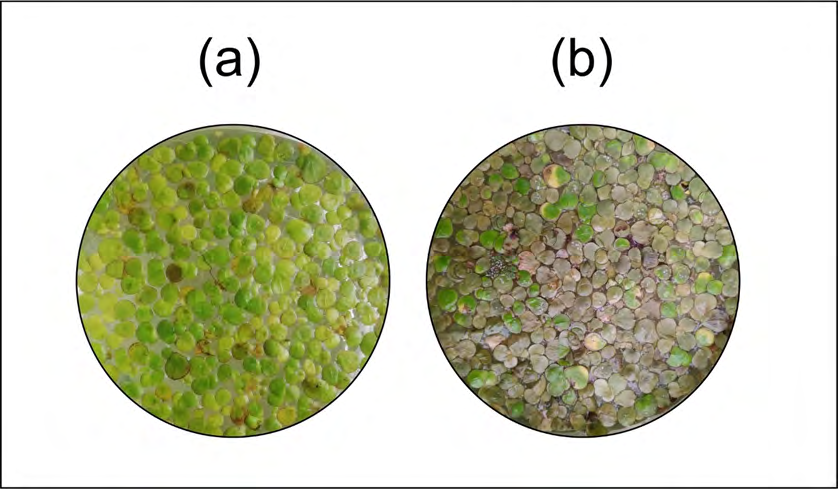
S. polyrhiza used in this investigation were collected from a freshwater pond in Udaipur City, India. The fronds were acclimatized in 10 % Hoagland’s growth medium in laboratory condition as per OECD 221(6500–10000 lux light irradiance, 14-h photoperiod, and 25/20°C day/night temperature [12]. After 1 week of acclimatization of plants in medium, healthy, similar-sized fronds (about 3 g) were treated with Hg+2 treatment was induced by incorporating the various concentrations of HgCl2 (0, 0.2, 0.4, 0.6 µM) in the medium (Figure 1).
Chlorophyll a fluorescence was measured using plant efficiency analyser (Handy PEA fluorimeter, Hansatech instruments Ltd. England) after 48 hrs. of heavy metal treatment. Before measurement duckweed fronds were dark- adapted for 50–60 min at 26°C. Thereafter, Chl a fluorescence signals were analysed with the Biolyzer v.3.0.6 software (developed by Laboratory of Bioenergetics, University of Geneva, Switzerland) [13]. Appropriate numbers of replicates were taken and the experiment was repeated three times to ensure the results. Abbreviations, formulas, and definitions of the JIP-test parameters used in the current study are Fv/ Fm, Fm and PIcsm.
Results and Discussion
Chlorophyll fluorescence often represents the function of photosynthetic complex [14, 15]. A decline in PSII quantum yield represented by Fv/Fm was observed during the heavy metal treatments at successive concentrations. When plants grow under a favorable environment, Fv/Fm is kept in a stable range but it decreases, under the adverse environment [16].
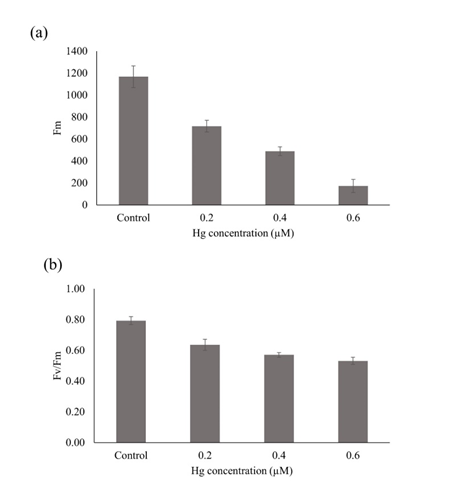
The rapid decline in Fm (Figure 2a) would suggest a change in the ultrastructure of the thylakoid membrane, affecting the electron transport rate. The reduction in PSII photochemical efficiency could be partially attributed to the destruction of antennae pigments [17]. With the decline in quantum yield and, therefore, reduction in electron transport rate, a gradual increase in the pH will become established across the thylakoid membrane, as a result of the heavy metal impact on the photosynthetic apparatus. Maximum fluorescence, defines the maximum number of reaction centers reduced or closed by a saturating light pulse. In general, the greater the plant stress, the fewer open reaction centers available, and the Fv/Fm ratio is lowered [18]. Maximum Fluorescence level decreased with the increase in Hg concentration and found to be minimum in case of 0.6 µM Hg, 0.4 and 0.6 µM Hg concentration almost showed the same pattern.
Quantum yield (Fv/Fm) decreased with increase of Hg concentration having no significant difference between the 0.4 and 0.6 treatments but with comparatively lower values from control (Figure 2b). Exposure of S. polyrhiza to Hg concentration decreased the Fv/Fm ratios, which characterize the functional activity of the photosynthetic apparatus. The inactive reaction center of PSII that can result in photoinhibition might have resulted in lower Fv/Fm under different concertation [19].
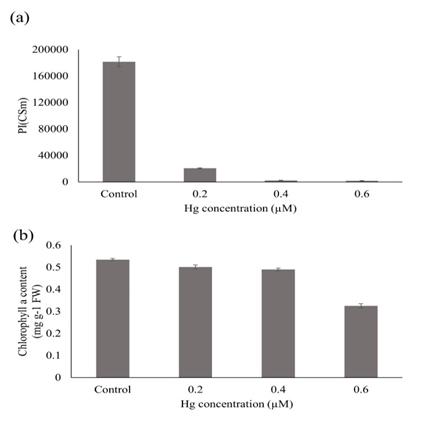
Photosynthesis performance rate of the S. polyrhiza fronds decreased rapidly with the successive Hg concentration but it is minimum in plants treated with 0.6 µM Hg as compared to control (Figure 3a). Performance index (PI) is considered to be a good indicator of stress, which is the combined measurement of the density of RC, maximum energy flux reaching PSII reaction centres and the electron transport. The significant decreases in PI in heavy metal stress reflect an inefficient performance of PSII [20]. Our experiment showed that chlorophyll a content was reduced with successive concertation (Figure 3b), which was primarily caused by fast reduction in the reaction centers than LHC of PSII. Changes in Chl a content are also considered an indicator for relative photosystem stoichiometry that help us determine the changes in the size of the light-harvesting antenna of PSII and the PSII amount [21].
Conclusions
In conclusion, Heavy metal decreased the florescence yield due to restrictions of electron flow at oxidizing side of PS II. Increasing concentrations of Hg decreased the photochemical efficiency (Fv/Fm), photosynthetic performance index (PIcsm) and Chlorophyll a concentration. Thus, Hg stress significantly inhibit the photosynthetic function of S. polyrhiza.
References
-
Aydinalp C, Marinova S (2009) The effects of heavy metals on seed germination and plant growth on alfalfa plant (Medicago sativa). Bulgarian Journal of Agricultural Science 15(4): 347-350.
-
Hossain MA, Piyatida P, da Silva JAT, Fujita M (2012) Molecular Mechanism of Heavy Metal Toxicity and Tolerance in Plants: Central Role of Glutathione in Detoxification of Reactive Oxygen Species and Methylglyoxal and in Heavy Metal Chelation. Journal of Botany 110(2): 1-37.
-
Zengin FK, Munzuroglu O (2005) Effects of some heavy metals on content of chlorophyll, proline and some antioxidant chemicals in bean (Phaseolus vulgaris L.) seedlings. Acta Biologica Cracoviensia Series Botanica 47(2): 157-164.
-
Hameed A, Qadri TN, Mahmooduzzafar TOS, Ozturk M, Altay V, et al. (2017) Physio-biochemical and nutritional responses of abelmoschus esculentus (L.) moench (okra) under mercury contamination. Fresenius Environmental Bulletin 26(10): 5814-5823.
-
Boucher N, Carpentier R (1999) Hg2+, Cu2+, and Pb2+- induced changes in photosystem II photochemical yield and energy storage in isolated thylakoid membranes: a study using simultaneous fluorescence and photoacoustic measurements. Photosynthesis research 59(2-3): 167-174.
-
Kumar D, Singh H, Raj S, Soni V (2020a) Chlorophyll a fluorescence kinetics of mung bean (Vigna radiata L.) grown under artificial continuous light. Biochemistry and Biophysics Reports 24: 100813.
-
Joshi MK, Mohanty P (2007) Chlorophyll a Fluorescence as a Probe of Heavy Metal Ion Toxicity in Plants. In: Papageorgio GC, Govindjee (Eds.), Chlorophyll a Fluorescence. Springer, Dordrecht, pp: 636-661.
-
Allakhverdiev SI, Murata N (2004) Environmental stress inhibits the synthesis de novo of proteins involved in the photodamage-repair cycle of Photosystem II in Synechocystis sp. PCC 6803. Biochim Biophys Acta 1657(1): 23-32.
-
Kalaji MH, Pietkiewicz S (2004) Some physiological indices to be exploited as a crucial tool in plant breeding. Plant Breed Seeds Sci 49: 19-39.
-
Landolt E (1986) Biosystematic investigations in the family of duckweeds (Lemnaceae). Volume 2, The family of Lemnaceae: a monographic study. Veröffentlichungen des Geobotanischen Institutes der ETH, Stiftung Rübel, Zürich, 71.
-
Cui W, Cheng JJ (2015) Growing duckweed for biofuel production: A review. Plant Biology 17(S1): 16-23.
-
Singh H, Kumar D, Soni V (2020) Copper and mercury induced oxidative stresses and antioxidant responses of Spirodela polyrhiza (L.) Schleid. Biochemistry and Biophysics Reports 23.
-
Kumar D, Singh H, Raj S, Soni V (2020b) Chlorophyll a fluorescence kinetics of mung bean (Vigna radiata L.) grown under artificial continuous light. Biochemistry and Biophysics Reports 24.
-
Tsimilli-Michael M, Eggenberg P, Biro B, Köves-Pechy K, Vörös I, et al. (2000) Synergistic and antagonistic effects of arbuscular mycorrhizal fungi and Azospirillum and Rhizobium nitrogen-fixers on the photosynthetic activity of alfalfa, probed by the polyphasic chlorophyll a fluorescence transient O-J-I-P. Applied Soil Ecology 15(2): 169-182.
-
Kalaji HM, Carpentier R, Allakhverdiev SI, Bosa K (2012) Fluorescence parameters as early indicators of light stress in barley. Journal of Photochemistry and Photobiology B: Biology 112: 1-6.
-
Mohammed GH, Zarco-Tejada P, Miller JR (2003) Applications of Chlorophyll Fluorescence in Forestry and Ecophysiology. In: DeEll JR, Toivonen PMA (Eds.), Practical Applications of Chlorophyll Fluorescence in Plant Biology. Springer, Boston, MA, pp: 79-124.
-
Bukhov NG, Carpentier R (2004) Effects of water stress on the photosynthetic efficiency of plants. In: Papageorgio (GC), Govindjee (Eds.), Chlorophyll a Fluorescence. Springer, Switzerland, pp: 623-635.
-
Sunil B, Strasser RJ, Raghavendra AS (2020) Targets of nitric oxide (NO) during modulation of photosystems in pea mesophyll protoplasts: Studies using chlorophyll A fluorescence. Photosynthetica
-
Ghassemi-Golezani K, Lotfi R (2015) The impact of salicylic acid and silicon on chlorophyll a fluorescence in mung bean under salt stress. Russian Journal of Plant Physiology 62: 611-616.
-
Kmieć K, Rubinowska K, Michałek W, Sytykiewicz H (2018) The effect of galling aphids feeding on photosynthesis photochemistry of elm trees (Ulmus sp.). Photosynthetica 56(4): 989-997.
-
Strasserf RJ, Srivastava A, Govindjee (1995) Polyphasic Chlorophyll a Fluorescence Transient in Plants and Cyanobacteria. Photochemistry and Photobiology 61(1): 32-42.
- Sense, Gravity, Parity & Chirality in Mathematical Physics
- Quantum Lattice Simulations PHYSICS: Microcircuit Particle Formation and Observable Macroscopic Irreversible Time - A Discrete Lagrangian with Cellular Automata Framework
- Quantum Biology from Biomacromolecule to Cell, and Central Dogma Described by Quantum Theory
- Focus, Agility, Speed and Technology (FAST) for Sustainability and Growth
- Square Root Metric Geometry and Pati-Salam Model in Curved Space-Time
- A Simple System Demonstrating the Mpemba Effect in Classical Mechanics