
Anisotropic Charged Solutions for Quark Stars with Linear Equation of State
We present two new classes of solutions for the Einstein-Maxwell system of field equations in a spherically symmetric spacetime considering the MIT bag model equation of state and a particular form of one of the metric potentials. The obtained solutions can be written in terms of elementary functions, namely polynomials and algebraic functions. The first class has a singularity at the centre. For the second class a physical analysis indicates that is regular and well behaved in the stellar interior.
Introduction
The search of exact solutions for the Einstein-Maxwell system of field equations is an interesting area of research because it allows describe compact objects with strong gravitational fields as neutron stars [1, 2]. It is for this reason that many researches have used a great variety of techniques to try in order to obtain solutions of the Einstein- Maxwell field as has been demonstrated by Komathiraj and Maharaj [3], Thirukkanesh and Maharaj [4], Maharaj, et al. [5], Thirukkanesh and Ragel [6, 7], Feroze and Siddiqui [8, 9], Sunzu, et al. [10], Pant, et al. [11] and Malaver [12, 13, 14, 15].
Stellar models consisting of spherically symmetric distribution of matter with presence of anisotropy in the pressure have been widely considered in the frame of general relativity [16, 17, 18, 19, 20, 21, 22, 23, 24]. The existence of anisotropy within a star can be explained by the presence of a solid core, phase transitions, a type III super fluid [25], a pion condensation or another physical phenomenon by the presence of an Investigation Paper Volume 5 Issue 1 electrical field [26].
In order to analytically integrate field equations the choice of the appropriate equation of state allows obtain models of compact stars physically acceptable [27]. Komathiraj and Maharaj [3], Malaver [28], Thirukkanesh and Maharaj [29] and Dey, et al. [30] assume linear equation of state for quark stars. Feroze and Siddiqui [8] consider a quadratic equation of state for the matter distribution and specify particular forms for the gravitational potential and electric field intensity. Mafa Takisa and Maharaj [31] obtained new exact solutions to the Einstein-Maxwell system of equations with a polytropic equation of state.
In this paper we generated new classes of exact solutions for anisotropic charged distribution with a linear equation of state consistent with quark matter. New models have been obtained by specifying a particular form for one of the metric potentials and for the measure of anisotropy. The paper has been organized as follows: In section 2, we present the Einstein-Maxwell field equations. In section 3, we have chosen a particular form of one of the gravitational potentials and the measure of anisotropy. In section 4, we conclude.
Field Equations
We consider a spherically symmetric, static and homogeneous spacetime. In Schwarzschild coordinates the metric is given by:
$$ d s ^ {2} + = - e ^ {2 v} d \delta d t) ^ {2} + e ^ {2 \lambda (r)} d r ^ {2} + r ^ {2} \left(d ^ {2} \sin^ {2} ^ {2} \right. \tag {1} $$ where ( )r ν and a ( )r λ are two arbitrary functions.
Using the transformations, 2 x = cr , ( ) 2 r Z(x)= e λ − and
2 2 2 í (r) A y (x)= e with arbitrary constants A and c>0, suggested by Durgapal and Bannerji [32], the Einstein-Maxwell field equations shown in [29] can be written as:
2 1 2Z 2 $$ \left| \frac {- \bar {u}}{x} - \frac {E}{2} \dot {Z} = \frac {}{C} + \frac {2}{2 C} \right| $$ $$ \frac {1 - \bar {z}}{x} - \frac {E}{2} \dot {Z} = \frac {2}{C} + \frac {2}{2 C} (2) $$
2 1 4Z 2 $$ \left| \frac {\dot {y}}{y} - \frac {1 - Z}{x} = \frac {p _ {r}}{C} - \frac {E ^ {2}}{2 C} \right| $$ $$ \frac {\dot {y}}{v} - \frac {1 - Z}{x} = \frac {p _ {r}}{C} - \frac {E ^ {2}}{2 C} \tag {3} $$ $$ p _ {t} = p _ {r} + \Delta (4) $$
2 1 4 1 2 y y Z E xZ Z x C y y x C
$$ \frac {\Delta}{C} = 4 x Z \frac {\ddot {y}}{y} + \dot {Z} \left(1 + 2 x \frac {\dot {y}}{y}\right) + \frac {1 - Z}{x} - $$ (5) $$ \sigma^ {2} = \frac {4 C Z}{x} \left(x \dot {E} + E\right) ^ {2} \tag {6} $$ ρ is the energy density, rp is the radial pressure, E is electric field intensity, tp is the tangential pressure, σ is the charge density, t r p p ∆= − is the measure of anisotropy and dots denote differentiations with respect to x.
In this paper, we assume the following linear equation of state in the bag model ∆ + + + − +
| 3 | x |
|---|
| 3 | x |
|---|
$$ p _ {r} = \frac {1}{3} \left(\rho - 4 B\right) \tag {7} $$
where B is the bag constant. We can write the Einstein- Maxwell field equations with the equation (7) in the following form $$ \rho = 3 p _ {r} + 4 B \mathrm {(8)} $$ $$ \frac {p _ {r}}{C} = Z \frac {\dot {y}}{y} - \frac {1}{2} \dot {Z} - \frac {B}{C} [ 9 ] $$
1 2 $$ p _ {t} = p _ {r} $$
+ ∆ (10)
$$ \frac {E ^ {2}}{2 C} = \frac {1 - Z}{x} - 3 Z \frac {\dot {y}}{y} - \frac {1}{2} \dot {Z} - \frac {B}{C} (1 1) $$ $$ \sigma = 2 \sqrt {\frac {C Z}{x}} \left(x \dot {E} + E\right) \tag {12} $$ The Equations (8),(9), (10), (11), (12) governs the gravitational behavior of a anisotropic charged quark star.
New Classes of Solutions
Using the method suggested by Komathiraj and Maharaj [3], it is possible to obtain a exact solution of the Einstein- Maxwell system. According to Malaver [23], Komathiraj [33] and Komathiraj and Sharma [34], we take the particular form of the metric potential.
$$ y (x) = \left(a + \alpha x ^ {m}\right) ^ {n} \tag {13} $$
where a, m and n are constants and α is an adjustable parameter. This potential is regular at the origin and well behaved in the interior of the sphere. We specify the measure of anisotropy of the following form:
$$ \Delta = C x \left(\alpha + x\right) ^ {n} \tag {14} $$
In this paper we have considered the particular cases: Case I: With α=2/3, n=1 and m=1/2, the substitution of (13) and (14) in (5) allows to obtain the equation of the first order (15)
| 3 | x |
|---|
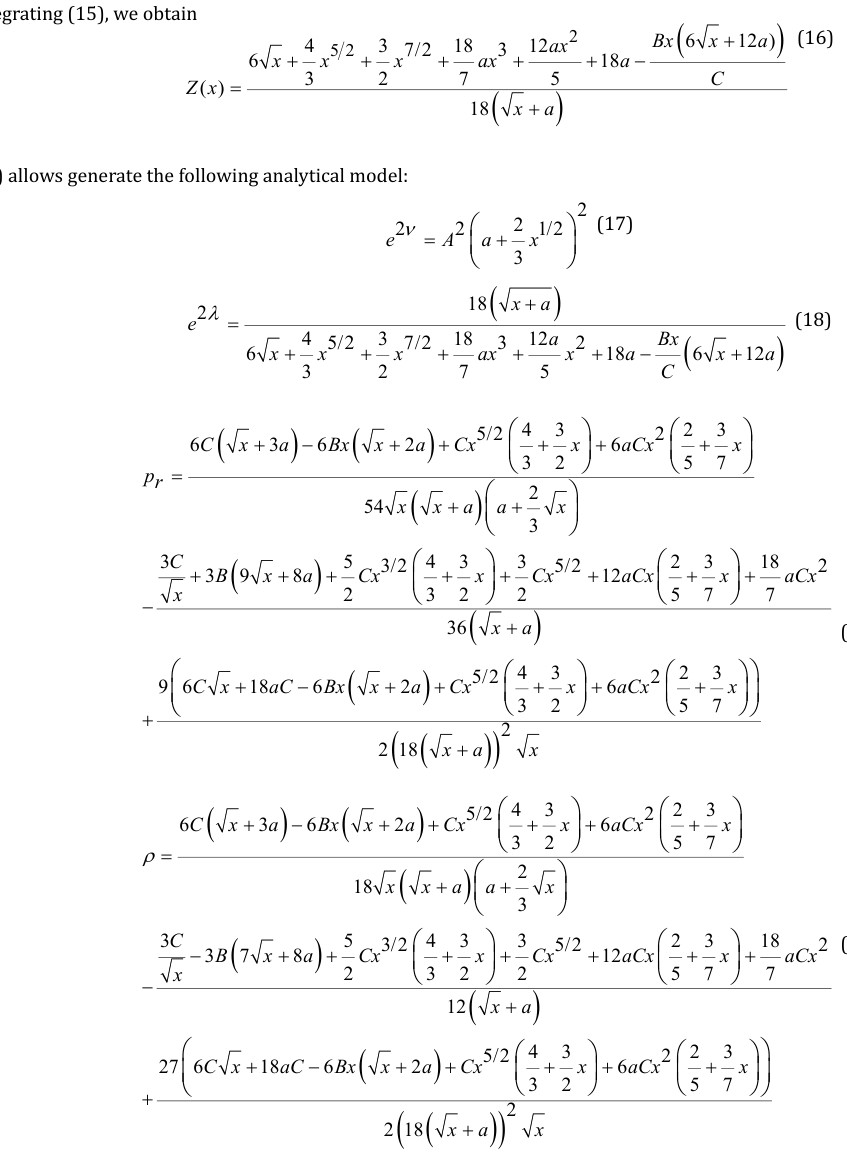
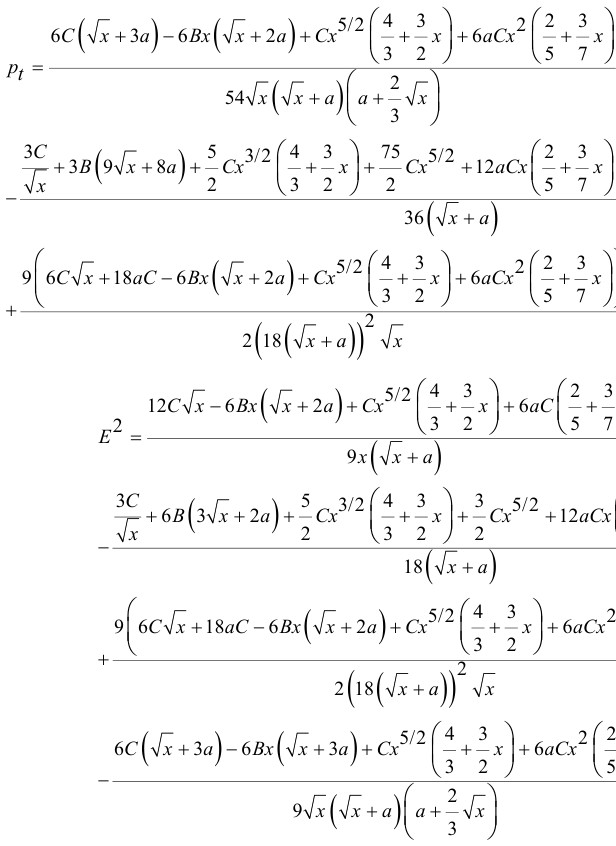
We have obtained a new exact solution to the Einstein- Maxwell system of equations with the MIT bag model equation of state. This new solution can be expressed in terms of elementary functions and has a simple form. The obtained model is singular in the charge density and energy density at the origin r=0, feature that is shared with the Mak and Harko [35] model but the metric potentials functions 2_v_ e and 2 e λ remain finite at the centre in contrast with the
2 2 2 2 2 2 (3 ) 1 3 72 36 ( 3 ) ( 3 )
xB x x a x x x a x a x C Z Z x x a x a x x x a x a x + + − + + + + + + = + + + + + +
2 2 2 6 ( 3 ) ( 3 ) 2 6 3 ( 3 )
singularities that shown in the gravitational potentials of Mak and Harko when x=0.
Case II: With α=3, n=2 and m=1 we obtain for the metric function (13)
$$ y (x) = \left(a + 3 x\right) ^ {2} \tag {23} $$
and the equation of first order can be written as ( )
(24) ( )
| 2 | x |
|---|
| 2 | x |
|---|
Integrating (24), the gravitational potential $Z(x)$ is given by
$$81081x^7 + (93555a + 561330)x^6 + (36855a^2 + 663390a + 995085)x^5 + \left(5005a^3 + 270270a^2 + 1216215a\right)x^4 + \left(38610a^3 + 521235a^2 + 173745\right)x^3 + Z(x) = \frac{\left(81081a^3 + 243243a\right)x^2 + 135135a^2x + 45045a^3 - \frac{2Bx}{C}\left(135135x^3 + 173695ax^2 + 81081a^2x + 15015a^3\right)}{45045\left(a + 3x\right)^2(9x + a)}$$
With equation (23) and equation (25) we can find the following analytical model
$$e^{2\nu} = A^2\left(a + 3x\right)^4$$
$$e^{2\lambda} = \frac{45045\left(a + 3x\right)^2(9x + a)}{81081x^7 + (93555a + 561330)x^6 + (36855a^2 + 663390a + 995085)x^5 + \left(5005a^3 + 270270a^2 + 1216215a\right)x^4 + \left(38610a^3 + 521235a^2 + 173745\right)x^3 + \left(81081a^3 + 243243a\right)x^2 + 135135a^2x + 45045a^3 - \frac{2Bx}{C}\left(135135x^3 + 173695ax^2 + 81081a^2x + 15015a^3\right)}$$
$$p_r = \frac{-45045B\left(a + 3x\right)^3(9x + a)}{45045\left(a + 3x\right)^3(9x + a)}$$
$$\frac{567567x^6 + 6\left(93555a + 561330\right)x^5 + 5\left(36855a^2 + 663390a + 995085\right)x^4 + 4\left(5005a^3 + 270270a^2 + 1216215a\right)x^3 + 3\left(38610a^3 + 521235a^2 + 173745\right)x^2 + 2\left(81081a^3 + 243243a\right)x + 135135a^2 - \frac{2Bx}{C}\left(15015a^3 + 81081a^2x + 173695ax^2 + 135135x^3\right)}{90090\left(a + 3x\right)^2(9x + a)}$$
$$\frac{81081x^7 + (93555a + 561330)x^6 + (36855a^2 + 663390a + 995085)x^5 + \left(5005a^3 + 270270a^2 + 1216215a\right)x^4 + \left(38610a^3 + 521235a^2 + 173745\right)x^3 + \left(81081a^3 + 243243a\right)x^2 + 135135a^2x + 45045a^3}{15015\left(a + 3x\right)^3(9x + a)}$$
$$\frac{81081x^7 + (93555a + 561330)x^6 + (36855a^2 + 663390a + 995085)x^5 + \left(5005a^3 + 270270a^2 + 1216215a\right)x^4 + \left(38610a^3 + 521235a^2 + 173745\right)x^3 + \left(81081a^3 + 243243a\right)x^2 + 135135a^2x + 45045a^3}{10010\left(a + 3x\right)^2(9x + a)}$$ $$\rho = \frac{+15015B(a + 3x)^3(9x + a)}{15015(a + 3x)^3(9x + a)}$$
$$\begin{align*} 567567x^6 + 6(93555a + 561330)x^5 + 5(36855a^2 + 663390a + 995085)x^4 + 4(5005a^3 + 270270a^2 + 1216215a)x^3 + 3(38610a^3 + 521235a^2 + 173745)x^2 + 2(81081a^3 + 243243a)x + 135135a^2 - \frac{2Bx}{C}(15015a^3 + 81081a^2x + 173695ax^2 + 135135x^3) - \frac{2Bx}{C}(81081a^2 + 347390ax + 405405x^2) \\ 30030(a + 3x)^2(9x + a) \end{align*}$$
$$5005(a + 3x)^3(9x + a)$$
$$\begin{align*} 81081x^7 + (93555a + 561330)x^6 + (36855a^2 + 663390a + 995085)x^5 + 5(5005a^3 + 270270a^2 + 1216215a)x^4 + 3(38610a^3 + 521235a^2 + 173745)x^3 + 81081a^3 + 243243a)x + 135135a^2 - \frac{2Bx}{C}(15015a^3 + 81081a^2x + 173695ax^2 + 135135x^3) \\ 10010(a + 3x)^2(9x + a) \end{align*}$$
$$45045B(a + 3x)^3(9x + a) + 45045Cx(3 + x)^2(a + 3x)^3(9x + a)$$
$$45045(a + 3x)^3(9x + a)$$
$$\begin{align*} 567567x^6 + 6(93555a + 561330)x^5 + 5(36855a^2 + 663390a + 995085)x^4 + 4(5005a^3 + 270270a^2 + 1216215a)x^3 + 3(38610a^3 + 521235a^2 + 173745)x^2 + 2(81081a^3 + 243243a)x + 135135a^2 - \frac{2Bx}{C}(15015a^3 + 81081a^2x + 173695ax^2 + 135135x^3) \\ 15015(a + 3x)^3(9x + a) \end{align*}$$
$$81081x^7 + (93555a + 561330)x^6 + (36855a^2 + 663390a + 995085)x^5 + 5(5005a^3 + 270270a^2 + 1216215a)x^4 + 3(38610a^3 + 521235a^2 + 173745)x^3 + 81081a^3 + 243243a)x + 135135a^2 - \frac{2Bx}{C}(15015a^3 + 81081a^2x + 173695ax^2 + 135135x^3) \\ 10010(a + 3x)^2(9x + a) \end{align*}$$
$$45045B(a + 3x)^3(9x + a) + 45045Cx(3 + x)^2(a + 3x)^3(9x + a)$$
$$45045(a + 3x)^3(9x + a)$$
2 2 6 5 2 4 675675 2837835 3648645 81081 93555 561330 36855 663390 995085
Ca Cax Cx Cx a Cx a a Cx
$$ ^ {2} + 2 8 3 7 8 3 5 C a x + 3 6 4 8 6 4 5 C x ^ {2} - 8 1 0 8 1 C x ^ {6} - \left(9 3 5 5 5 a + 5 6 1 3 3 0\right) C x ^ {5} - \left(3 6 8 5 5 a ^ {2} + 6 6 3 3 9 0 a + 9 6 3 9 9 0\right) $$ ( ) ( ) ( )
3 2 3 3 2 2 3 5005 270270 1216215 38610 521235 173745 81081 243243
a a a Cx a a Cx a a Cx
$$ - \left(5 0 0 5 a ^ {3} + 2 7 0 2 7 0 a ^ {2} + 1 2 1 6 2 1 5 a\right) C x ^ {3} - \left(3 8 6 1 0 a ^ {3} + 5 2 1 2 3 5 a ^ {2} + 1 7 3 7 4 5\right) C x ^ {2} - \left(8 1 0 8 1 a ^ {3} + 2 7 0 2 7 0 a ^ {2}\right) $$ ( )
2 45045 3 9
3 2 2 3 2 135135 173695 81081 15015 2 2
$$ ^ {2} = 2 C \frac {\left[ - 2 B \left(1 3 5 1 3 5 x ^ {3} + 1 7 3 6 9 5 a x ^ {2} + 8 1 0 8 1 a ^ {2} x + 1 5 0 1 5 a ^ {3}\right) - 4 5 0 4 5 \left(a + 3 x\right) ^ {2} \left(9 x + a\right) \right]}{4 5 0 4 5 \left(a + 3 x\right) ^ {2} \left(0 + a\right)} $$ B x ax a x a E C a x x a + +
2 45045 3 9 ( ) ( )
a x x a + +
( ) ( ) ( )
7 6 2 5 3 2 4 81081 93555 561330 36855 663390 995085 5005 270270 1216215
x a x a a x a a a x + + + + + + + +
( ) ( )
2 3 2 3 3 2 2 3 3 38610 521235 173745 81081 243243 135135 45045 15015 81081 2
Bx a a x a a x a x a a C C
$$ - 2 C \frac {\left[ + \left(3 8 6 1 0 a ^ {3} + 5 2 1 2 3 5 a ^ {2} + 1 7 3 7 4 5\right) x ^ {3} + \left(8 1 0 8 1 a ^ {3} + 2 4 3 2 4 3 a\right) x ^ {2} + 1 3 5 1 3 5 a ^ {2} x + 4 5 0 4 5 a ^ {3} - \frac {2 B x}{C} \left(1 5 0 1 5 a ^ {3} + 8\right) \right]}{5 0 0 5 \left(a + 2 a\right) ^ {3} \left(0 + a\right)} $$
3 5005 3 9 ( ) ( )
a x x a + +
( ) ( ) ( )
6 5 2 4 3 2 3 567567 6 93555 561330 5 36855 663390 995085 4 5005 270270 1216215
x a x a a x a a a x + + + + + + + + +
( ) ( )
2 3 2 2 3 2 3 2 3 38610 521235 173745 2 81081 243243 135135 15015 81081
B a a x a a x a a a x C
$$ ^ {3} + 5 2 1 2 3 5 a ^ {2} + 1 7 3 7 4 5) x ^ {2} + 2 \left(8 1 0 8 1 a ^ {3} + 2 4 3 2 4 3 a\right) x + 1 3 5 1 3 5 a ^ {2} - \frac {2 B}{C} \left(1 5 0 1 5 a ^ {3} + 8\right) $$ ( )
2 2 2 81081 347490 405405
Bx a ax x C $$ - \frac {2 B x}{C} \left(8 1 0 8 1 a ^ {2} + 3 4 7 4 9 0 a x + 4\right) $$ C −
2 45045 3 9 ( ) ( )
a x x a + +
( ) ( ) ( )
7 6 2 5 3 2 4 81081 93555 561330 36855 663390 995085 5005 270270 1216215
x a x a a x a a a x + + + + + + + +
( ) ( )
2 2 3 135135 45045
3 2 3 3 38610 521235 173745 81081 243243
a x a a a x a a x + +
+ + + + + ( )
2 3 2 2 3 15015 81081 173695 135135
Bx a a x ax x C
$$ - \frac {2 B x}{C} \left(1 5 0 1 5 a ^ {3} + 8 1 0 8 1 a ^ {2} x + 1 7 3 6 9 5 a x ^ {2} + 1\right) $$
2 C +
3 15015 3 9 ( ) ( )
a x x a + +
( ) ( ) ( )
7 6 2 5 3 2 4 81081 93555 561330 36855 663390 995085 5005 270270 1216215
x a x a a x a a a x + + + + + + + +
( ) ( ) C a a a x x a
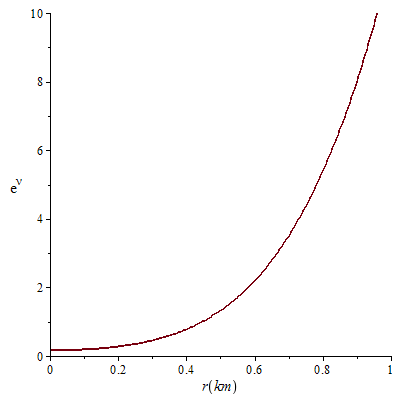
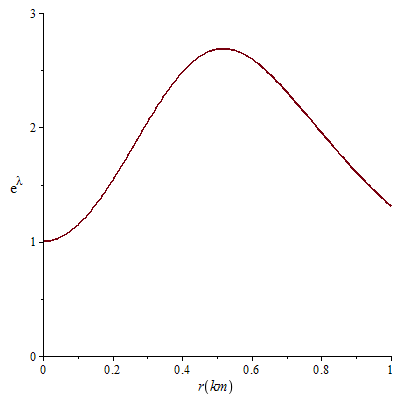
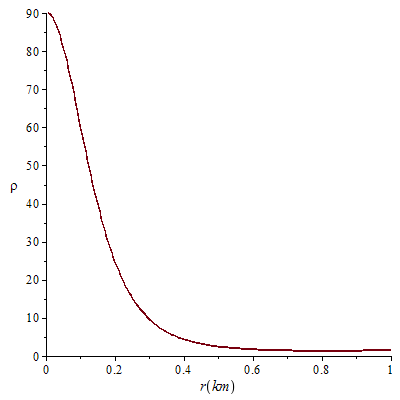
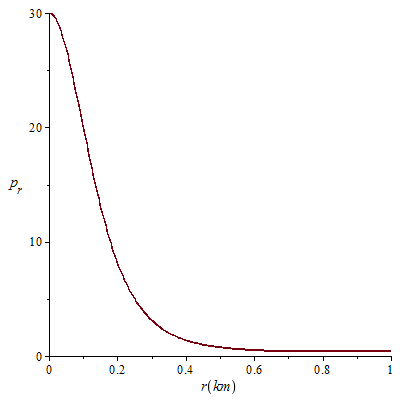
$$ - \frac {2 B x}{C} \left(1 5 0 1 5 a ^ {3} + 8 1 0 8 1 a ^ {2} x + 1 7 3 6 9 5 a x ^ {2} + 1\right) $$ This new exact model satisfies the Einstein-Maxwell field equations and constitutes a new family of analytical solutions for a charged strange quark star. The metric potentials 2_v_ e and 2_e_ λ can be written in terms of polynomials and elementary functions, are continuous, well behaved in the interior of the sphere and take finite values at the centre. The energy density ρ is positive throughout the interior of the star, regular at the centre and has the value $$ \rho_ {0} = 2 \left(\frac {1 8 C}{a} + B\right). $$ . The radial pressure is regular at the $$ p _ {0} = 2 \left(\frac {6 C}{a} - \frac {B}{3}\right). $$ centre and reaches the value 0 6 2 3 . The electric field intensity is continuous inside the star and vanishes at the origin, 2 0 E = en 0 x = . Therefore the exact models can describe charged strange stars with physically acceptable interior distributions. The Figures 1-4 shows the dependence of eν , eλ , ρ and r p with the radial coordinate for a=0.4 , ( ) ( ) ( )
2 2 3 173695 135135 a x ax x
+ + ( )
2 3 173695 135135 ax x
+ + (32)
B=0.05 and A=C=1. We considered the interval 0
$$ 0 \leq r \leq 1. $$
Conclusion
We found a new class of exact solutions for the Einstein- Maxwell field equations for an anisotropic charged stellar configuration choosing a particular form the measure of anisotropy and one of the metric potentials. The MIT bag model equation of state was incorporated in the new obtained models for strange quark stars. We have analyzed two cases: The first is a model that admits a singularity in the electric field, radial pressure and energy density at the centre of the stellar object. The second is regular is regular throughout the stellar interior, has finite values for the gravitational potentials and not include singularities at the origin r=0. We hope that the new obtained models may contribute to studies of anisotropic quark stars with an electromagnetic field distribution and provide useful information in the description of compact strange candidates considering different equations of state.
References
-
Kuhfitting PK (2011) Some remarks on exact wormhole solutions. Adv Stud Theor Phys 5(8): 365-370.
-
Bicak J (2006) Einstein equations: exact solutions. In: Francoise JP, Naber GL, Tsou ST (Eds.), Encyclopaedia of Mathematical Physics 2: 165-173.
-
Komathiraj K, Maharaj SD (2007) Analytical models for quark stars. Int J Mod Phys D 16(11): 1803-1811.
-
Thirukkanesh S, Maharaj SD (2008) Charged anisotropic matter with a linear equation of state. Class.Quant Grav 25: 235001.
-
Maharaj SD, Sunzu JM, Ray S (2014) Some simple models for quark stars. Eur Phys J Plus 129: 3.
-
Thirukkanesh S, Ragel FC (2012) Exact anisotropic sphere with polytropic equation of state. Pramana 78: 687-696.
-
Thirukkanesh S, Ragel FC (2013) A class of exact strange quark star model. Pramana 81(2): 275-286.
-
Feroze T, Siddiqui AA (2011) Charged anisotropic matter with quadratic equation of state. Gen Rel Grav 43: 1025- 1035.
-
Feroze T, Siddiqui A (2014) Some Exact Solutions of the Einstein-Maxwell Equations with a Quadratic Equation of State. J Korean Phys Soc 65: 944-947.
-
Sunzu JM, Maharaj SD, Ray S (2014) Quark star model with charged anisotropic matter. Astrophysics Space Sci 354: 517-524.
-
Pant N, Pradhan N, Malaver M (2015) Anisotropic fluid star model in isotropic coordinates. International Journal of Astrophysics and Space Science 3(1): 1-5.
-
Malaver M (2014) Strange Quark Star Model with Quadratic Equation of State. Frontiers of Mathematics and Its Applications 1(1): 9-15.
-
Malaver M (2018) Charged anisotropic models in a modified Tolman IV space time. World Scientific News 101: 31-43.
-
Malaver M (2018) Charged stellar model with a prescribed form of metric function y(x) in a Tolman VII spacetime. World Scientific News 108: 41-52.
-
Malaver M (2016) Classes of relativistic stars with quadratic equation of state_._ World Scientific News 57: 70-80.
-
Esculpi M, Malaver M, Aloma EA (2007) Comparative Analysis of the Adiabatic Stability of Anisotropic Spherically Symmetric solutions in General Relativity. Gen Relat Grav 39: 633-652.
-
Cosenza M, Herrera L, Esculpi M, Witten L (1982) Evolution of radiating anisotropic spheres in general relativity. Phys Rev D 25(10): 2527-2535.
-
Tello-Ortiz F, Malaver M, Rincón A, Gomez-Leyton Y (2020_)_ Relativistic Anisotropic Fluid Spheres Satisfying a Non-Linear Equation of State. Eur Phys J C 80: 371.
-
Herrera L (1992) Cracking of self-gravitating compact objects. Phys Lett A 165(3): 206-210.
-
Herrera L, Nuñez L (1989) Modeling ‘hydrodynamic phase transitions’ in a radiating spherically symmetric distribution of matter. The Astrophysical Journal 339: 339-353.
-
Malaver M (2014) Quark Star Model with Charge Distributions. Open Science Journal of Modern Physics 1(1): 6-11.
-
Malaver M (2018) Some new models of anisotropic compact stars with quadratic equation of state. World Scientific News 109: 180-194.
-
Malaver M (2018) Generalized Nonsingular Model for Compact Stars Electrically Charged. World Scientific News 92(2): 327-339.
-
Bowers RL, Liang EPT (1974) Anisotropic Spheres in General Relativity. Astrophys J 188: 657-665.
-
Sokolov AI (1980) Phase transitions in a superfluid neutron liquid. Sov Phys JETP 52(4): 575-576.
-
Usov VV (2004) Electric fields at the quark surface of strange stars in the color-flavor locked phase. Phys Rev D 70: 067301.
-
Sunzu JM (2018) Realistic Polytropic Models for Neutral Stars with Vanishing Pressure Anisotropy. Global Journal of Science Frontier Research: A Physics and Space Science 18: 2249-4626.
-
Malaver M (2017) New Mathematical Models of Compact Stars with Charge distributions. International Journal of Systems Science and Applied Mathematics 2(4): 93-98.
-
Thirukkanesh S, Maharaj SD (2008) Charged anisotropic matter with a linear equation of state. Class Quantum Gravity 25(23): 235001.
-
Dey M, Bombaci I, Dey J, Ray S, Samanta BC (1998) Strange stars with realistic quark vector interaction and phenomenological density-dependent scalar potential. Phys Lett B 438(1-2): 123-128.
-
Mafa Takisa P, Maharaj SD (2013) Some charged polytropic models. Gen Rel Grav 45: 1951-1969.
-
Durgapal MC, Bannerji R (1983) New analytical stellar model in general relativity. Phys Rev D 27(2): 328-331.
-
Komathiraj K (2021) Analytical models for quark stars with the MIT Bag model equation of state. World Scientific News 153(2): 205-215.
-
Komathiraj K, Sharma R (2020) Exact solution for an anisotropic star admitting the MIT Bag model equation of state. Journal of Science-FAS-SEUSL 1(1): 22-33.
-
Mak MK, Harko T (2004) Quark stars admitting a one- parameter group of conformal motions. Int J Mod Phys D 13(1): 149-156.
- Sense, Gravity, Parity & Chirality in Mathematical Physics
- Quantum Lattice Simulations PHYSICS: Microcircuit Particle Formation and Observable Macroscopic Irreversible Time - A Discrete Lagrangian with Cellular Automata Framework
- Quantum Biology from Biomacromolecule to Cell, and Central Dogma Described by Quantum Theory
- Focus, Agility, Speed and Technology (FAST) for Sustainability and Growth
- Square Root Metric Geometry and Pati-Salam Model in Curved Space-Time
- A Simple System Demonstrating the Mpemba Effect in Classical Mechanics