
Increasing of Decontamination Rate of Infected Fluid by Rotation Channels under the Dispersion of Ultraviolet C Radiation by Composite Metamaterial
In this communication, we propose the combination of acceleration of pathogens between the elements of metamaterial together with the repacking procedure of earlier proposed metamaterials, which may improve the decontamination rate using the traditional sources of ultraviolet C radiation (200-280 nm). The first method is connected with the acceleration of pathogens (viruses and bacteria) diluted in the fluid between the elements of transparent in UVC radiation which have the refraction index relative larger than in the fluids (water, blood, air, etc.). The second effect is the continuation of repacking of proposed metamaterials consisted of big spheres (or thick fiber) with smaller ones (thin fibers) in order to improve the contact surface between the UVC radiation and fluid. © 2021 The Author(s)
Introduction
Pathogens (viruses and bacteria) can reach the organism not only through transmission traditional mechanisms like direct contact with other persons but in the last time is observed the positive correlation has been observed between the spread of the virus through fluids (water or air) pollution [1]. COVID-19 could have an air/water transmission through particulate matter could create a suitable environment for transporting the virus at greater distances than those considered for close contact. SARS-CoV-2 is an enveloped virus into a droplet with 0.1 m m » in diameter. Viruses are often transmitted through respiratory droplets produced by coughing and sneezing. Respiratory droplets are usually divided into two size types: large droplets ( 5 m m ³ in diameter) that fall rapidly to the ground and are thus transmitted only over short distances, and small droplets ( 5 m m £ in diameter). Small droplets can evaporate into ’droplet nuclei’, remain suspended in the air for significant periods of time, and could be inhaled [2, 3, 4, 5]. As a usual, they are not transparent in UVC decontamination diapason and need a more near action of such radiation obtained from traditional sources from all directions to such droplets in order to achieve a good effect. This decontamination mode may be possible in rotating channels of the twisted metamaterial represented in Figure 1. Here centrifugal forces can drive the pathogen to the surface of the fibre where it is taken up by the evanescent field of UVC propagation through them.
The modern interests in the more compact decontamination equipments for liquids and gases, based on the idea of the construction of composite metamaterials from micro to nano skills using the optical contact of its elements, drastically increased in the last time. In this aspect, the repacking technologies metamaterials in the combination of thick and thin elements formed from quart spheres or optical fibre are in tandem with minimization of decontamination equipments in order to achieve the expected results in decontamination efficiency. For this, we revised all packing structures formed by the bubbles/fibres packing method. We are interested in declining of the space between the big elements of metamaterial, which is not penetrated by the UVC radiation. This space may be expressed through the ball packing density in each quasi-periodical system, where the cell density, depends on the packing structure of the metamaterial. For example, in the hexagonal lattice arrangement, this density is larger than tetrahedral lattice packing one. Taking into consideration the efficiency of the decontamination contact surface between the elements of the metamaterials-like photonic crystals or photonic crystal fibre described in our experiments [6, 7, 8], we propose to use the combination of elements of metamaterials like spheres/ fibres in the close packing procedure which form in principle the good material for the propagation of UVC radiation and flows of contaminated liquids/gases penetration in it [4].
In this paper, we propose the combine repacking method of metamaterial structures with centrifugal acceleration of pathogen droplets, between the elements of metamaterial penetrated by UVC. The first experiments were axed to the acceleration of pathogens (viruses and bacteria) between the elements of transparent in UVC radiation which have the refraction index relative larger than in the fluids (water, blood, air, etc.). The second one was based on the reaching procedures of metamaterials described in Enaki N, et al. [7, 8] consisted of big spheres (or thick fibre) with smaller ones (thin fibres) in order to improve the contact surface between the UVC radiation and fluid. In the section 3 we propose the theoretical models which take into consideration the possible effects which may give the substantial improvement of decontamination rate. The section 4 on the bases of proposed models is annualized some experimental situation of deactivation of yeast fungus in dynamical and static regime. The repacking of metamaterials with small elements are also taking into consideration in the proposed model of section 3 and experimental situation in section 4.
Acceleration of Pathogens and Winning of Contact Surface through the Remaking Procedures of Metamaterial
The main idea is connected with the rotation of contaminated liquids and gases by screw channels of meta-materials, prepared from UVC fibre optics, in the torsion configuration represented in the Figures 1 & 2. The contamination liquids are rotated along the flow direction. Considering that the density of virus and bacteria into droplets are larger than the density of liquids, the adherence of the pathogens to the ”external surface” of the rotation channels increases as a function of the torsion degree of channels [7, 8]. As the number of such rotation canals in the proposed meta-material is large, the total surface consists of the sum of each flow canal area between the fibres. This UVC decontamination effect depends on the inertial centrifugal force, which appear on the droplets infected by pathogens during its rotation flow along the channel. The large density of pathogens gives us the possibility to find the connection between its flow velocity and spinning radius of rotation channel. The centrifugal force must pull the pathogen droplets to the fibre/sphere surface penetrated by evanescent UVC radiation in the flow channel during the spinning effect (see Figure 2). This UVC decontamination process depends on the inertial centrifugal force, which appears during its rotation flow along the channel.
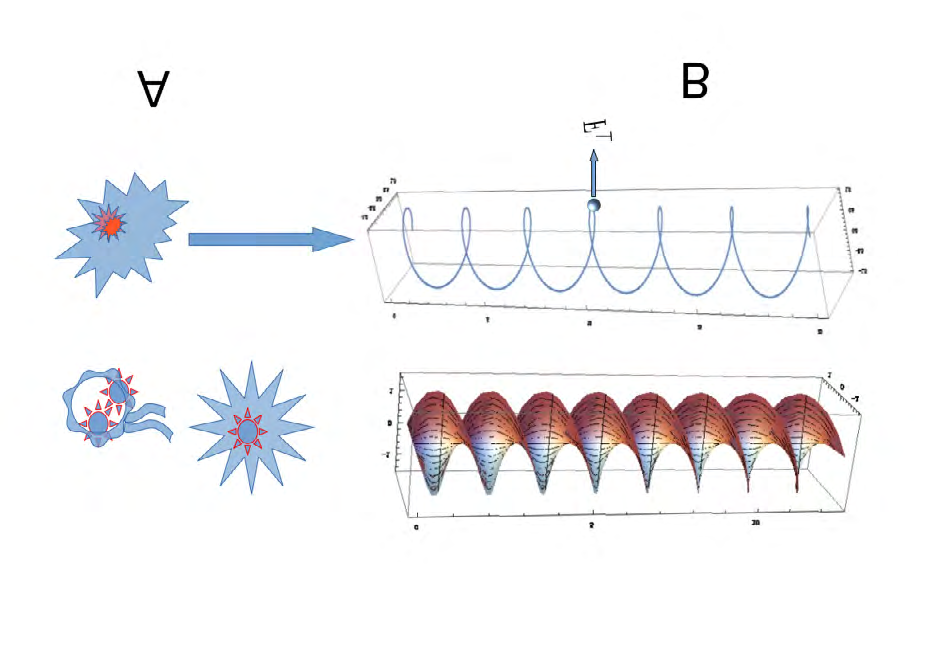
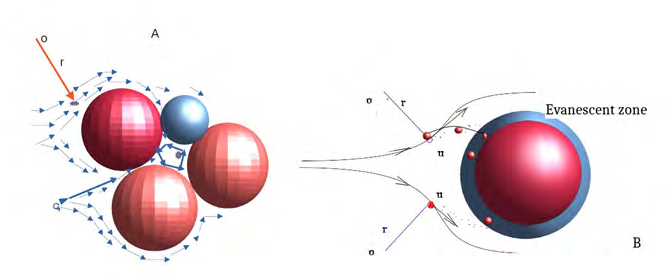
Figure 2: (A) The realization of the rotation channels in the acceleration of the pathogens around the elements of meta-material and possible turbulent flow with the acceleration of the pathogens in the circle or Screw Channels in the three-dimension case (see fig A and B). If the density of the pathogens is higher than the density of the fluids the viruses or bacteria can stick to the surface of spheres of metamaterial elements penetrated by ultraviolet C radiation.
Considering that the density of the pathogens, p r is slightly higher than the density of fluids, fr . In this situation we can use the description of lending of pathogens on the surface of fibre/spherical elements of metamaterials in process of centrifugal rotation, like the buoyant particles described [9, 10, 11, 12, 13] using the for moving in non-inertial system of coordinate [14, 15].
2 $$ \left[ \frac {\mathrm {d} ^ {2} \mathbf {r}}{\mathrm {d} t ^ {2}} \right] = \mathbf {F} - m _ {p} \frac {\mathrm {d} \omega}{\mathrm {d} t} \times \mathbf {r} - 2 m _ {p} \omega \times \left[ \frac {\mathrm {d} \mathbf {r}}{\mathrm {d} t} \right] - \left(m _ {p} - m _ {f}\right) \omega \times (\omega \times \mathbf {r}) - \gamma \frac {a}{c} $$ r r r F r r
2 d d d 2 ( ) d d d p p p p f d m m m m m t t t dt ( )
(1) Here, 2 2 d r dt is acceleration in the rotating system of coordinate; (d / d )t ω − × r is the Euler force; p 2m [dr dt] w´ is the Coriolis force. The buoyancy centrifugal force, $$ \left(m _ {p} - m _ {f}\right) \omega \times \left(\omega \times \mathbf {r}\right) $$
× r experienced by the particles is an important component of the total force acting on the pathogen inside the fluid in the non-inertial system of coordinates rotated with frequencyω ; p m and f m are the masses of the particle and the fluid displaced by particle. This mass difference is connected to the particle volume, DV , through the density in the according to the, $$ m _ {p} - m _ {f} = \Delta V \left(\rho_ {p} - \rho_ {l}\right) $$ The Newton law describes dynamics in terms of the absolute acceleration represented in Expression 1 by the force F. d dt γ r is the friction force of the particle in the fluid, γ πµ = 6 a , where a is the radios of contaminated droplet, µ is the viscosity of the fluid. The square bracket in the Expression 1 represents the physical s of acceleration and velocity relative to the rotation frame.
For low rotation frequencies and higher viscosity, we may neglect the Euler and Coriolis forces from the Expression 1. Taking into consideration the propagation of pathogen droplet along the centrifugal force, we can project the equation (1) on this direction. The centrifugal force projection, $$ F _ {\perp} = \Delta V \left(\rho_ {p} - \rho_ {f}\right) \omega^ {2} r $$ is slightly compensated by fluid friction acts on the pathogen droplet and its acceleration along the radius is described by the equation (see Figures 1 & 2) $$ \rho_ {p} \frac {d ^ {2}}{d t ^ {2}} r = - \beta \frac {d r}{d t} + \left(\rho_ {p} - \rho_ {f}\right) \omega^ {2} r \tag {2} $$ ( ) The solution of this equation can be represented in the following form ( )
2 2 ρ ρ ω β β $$ ) = C _ {1} \exp \left| - \frac {\beta}{2 \rho} t + t _ {1} \left(\frac {\beta}{2 \rho}\right) ^ {2} + \frac {\left(\rho_ {p} - \rho_ {f}\right) \omega^ {2}}{\rho} \right| + $$ p f ( ) exp 2 2 r t C t t
1 ρ ρ ρ p p p (3)
( )
2 2 ρ ρ ω β β $$ \left| - \frac {\beta}{2 \rho} t - t \sqrt {\left(\frac {\beta}{2 \rho}\right) ^ {2} + \frac {\left(\rho_ {p} - \rho\right)}{\rho}} \right| $$ p f exp 2 2 C t t
2 ρ ρ ρ p p p where In the initial rotation state we onside that the particle $$ r (0) = C _ {1} + C _ {2} \mathrm {a n d} v (0) = - C _ {1} \lambda_ {1} - C _ {2} \lambda_ {2}, $$
, where the radius ( ) 0 r and velocity ( ) 0 v may compared in the magnitudes with the mean value of radius of quartz spheres of metamaterial, and mean value of the fluid velocity respectively ( ) 2 2 − = − ± + ρ ρ ω β β λ ρ ρ ρ p f
1;2 2 2 p p p
(0) (0) (0) (0) ; r v r v C C λ λ $$ = \frac {\lambda_ {2} r (0) + v (0)}{\lambda_ {2} - \lambda_ {1}}; C _ {2} = \frac {\lambda_ {1} r (0) + v}{\lambda_ {1} - \lambda_ {2}} $$
2 1 1 2 2 1 1 2
λ λ λ λ Analytical solution (3) can be simplified if we consider that ( ) 2 2
$$ \left[ \left(\frac {\beta}{2 \rho_ {p}}\right) ^ {2} > \frac {\left(\rho_ {p} - \rho\right)}{\rho} \right. $$ ρ ρ ω β p f so that the acceleration in Equation
2 ρ ρ p p (2) becomes equal to zero,
$$ 0 = \left(\rho_ {p} - \rho_ {f}\right) \omega^ {2} r - \beta d r / d t \mathrm {O r i n} $$ this description radius increases as function of time in the $$ r (t) = r _ {0} \exp \left[ \left(\rho_ {p} - \rho_ {f}\right) \omega^ {2} t / \beta \right]. $$
2 0 exp / p f r t r t . From which follows the pathogens deflects from the flows lines achieved the UVC evanescent zone of the elements of metamaterial represented in Figure 2. This estimation demonstrates why the quick decontamination effect may be achieved with higher efficiency in the dynamic situation in comparison with static representation. The decontamination efficiency substantially increases in the moving pathogens together with liquids (or infected aerosols in flow gazes) between the elements of metamaterials in comparison with quasi-stationary decontamination regime. This effect may give substantially contribute to the turbulent flow of fluids, Figure 2A.
In comparison with earlier proposed equipment [6], our
investigation is focused on the application of various
geometry of packing elements which will create the rotation
obstacles of contaminated fluid during its leakage between
the optical elements of metamaterial. For example, combining
the various packing procedures brings us to the possibilities
to construct swirls of circular motion of the vortex type of the
fluid like this is represented in Figure 2. These whirlpools are
more pronounced in places where some quartz balls are
missing when packed regularly. This random packing of
small and big spheres is represented by Figure 3 and are
used in our experiments. The estimations demonstrate that
during the rotation of the fluid in the dislocation places or in
the leakage rotation canals create the centrifugal force which
moves the particle on the surface of spheres in the evanescent
zone of UVC radiation. This force increase with the increasing
of fluid velocity and may have the same sign as Ashikin
acceleration and trapping of articles by the field gradient
(see [16]) of the evanescent zone of propagation of UVC
$$ \text{radiation.} \quad \text{The} \quad \text{last}, \quad F = \alpha \nabla \left( E^{2} \right), \quad \text{where} $$ $$ \alpha = 4 \pi n _ {0} ^ {2} \varepsilon_ {0} a ^ {3} \left(m ^ {2} - 1\right) / \left(m ^ {2} + 2\right). $$
. Here a is the particle radius, n0 is the index of refraction of the particle and m=n0/ n1 is the relative refractive index between the particle and the fluid [17] (Figure 4).
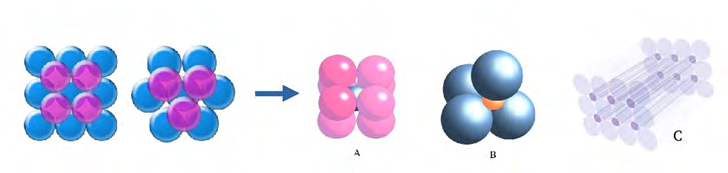
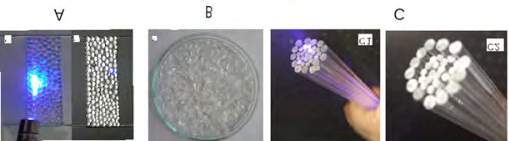
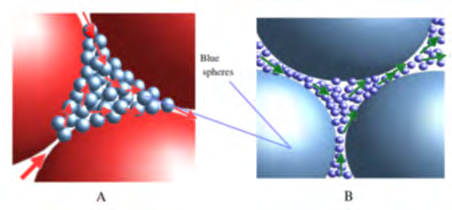
Figure 4: The realization of the close random packing of the small and big spheres (fibers) realized in our experiments: Figure A corresponds to the blue laser radiation of the sample and 2A without blue laser radiation. Figure B corresponds to the metamaterials formed from dropped quartz (granulated metamaterial) with different dimensions from 10-5 mm to 1-2 mm. Figure C, represents the packing of two types of optical fibers proposed for the decontamination core of the equipment. So the free non-penetrated by UVC radiation space between the elements of each material achieves the minimal value.
In a cubic packing of spheres, we have more free space than in a hexagonal one. Following this example, we want to find the efficient decontamination volume, which is proportional to the contact surface of the contaminated liquid with such packing balls. Taking into consideration that the penetration depth, $k \sim \lambda / \left[ 2\pi v \sqrt{n_m^2 - n_f^2} \right]$, of UVC radiation on the free space between the balls is proportional wavelength of radiation and inverse proportional to the difference between the square values of refractive indexes of metamaterial, $n_m$ and fluid, $n_p$. We easily find this effective volume, $V = kS$. We observe that this volume is smaller than the free volume between the balls. As the decontamination efficient volume around the ensemble of packing balls is proportional to the penetration depth of UVC radiation and inverse proportional to the diameter of the balls, we observe that only for the small diameter of the spheres balls it can achieve the free volume between the balls described by the free volume. For the wining in the contact surface and penetration depth, we propose to repack these structures1 with the sampler balls as this is represented in Figure 3A and B. The repacking structures must be in optical resonances between the gallery modes of each sphere/fibre subsystems in closed packing as this Figure 3A, B, C. Not so larger estimations show us that for the big ball diameters and large spectral radiation of UVC surfaces practically these resonances are possible and experimentally observed (see Figure 3). In Figure 3A, B it is represented right expresses the possible resonance between micro-spheres with different dimensions when the light wave can regard as a standing whispering-gallery-mode (with its own Eigen state). This gallery penetration of the radiation can be also used between close packing procedure of optical fibres with different thicknesses, respecting the conditions of guiding the waves through them represented in Figure 3C. When we fill up the free space between the elements of metamaterial with other small elements, it is observed that the total surface of two species of balls, $S_u = S_u1 + S_u2$. Here $S_u1 = \pi d_1^2 N$ and $S_u1 = \pi d_2^2 N$ are the total surfaces of each species of the spheres. The diameter $d_2$ depends on the close repacking of tetrahedral structures, $d_2 = \left( \sqrt{3/2} - 1 \right) d_1$ or cubic $d_2 = \left( \sqrt{3} - 1 \right) d_1$, represented in the Figure 2. We not that the small spheres with diameter, $d_2$, are situated in the centre of the cubes/the trader of the big one and don't have direct contact between them.
In order to change the radius of the rotation trajectories for pathogens inside the fluid and improve in such a way the decontamination rate is better to take the spheres with diameter 5-10 times smaller the distance between the big sphere and study the total contact surface with contaminated fluid. If we're consecutively packing the "n" species of spheres with dimension about one order less, $K \gg 1$ in the free between the spheres we obtain the following improving total contact surface, $S_{np}$ with contaminated fluid flowing through the between obtained metamaterial
$$S_{tm} = S_1 + S_2 + \ldots + S_n$$
Taking into consideration the analytic for each species of the packing spheres the (4) we obtain the new relation for contact surface of the composite ensemble formed from "n"-species of balls
$$S_{tm} = 4\pi V / d_1 + 4\pi V(1 - \rho) / d_2 + 4\pi V(1 - \rho)^2 / d_3 + \ldots + 4\pi V(1 - \rho)^{n-1} / d_n$$
Here was taken into consideration that the number of spheres with diameter $d_i$ is proportional to $N_i = V_{fi} / d_i^3$, where after the next remain free volume is about $V_{fi} = V(1 - \rho)^{i-1}$. Let us takes the real example, in which the space between the big spheres (diameter about $d_1 \sim 2 - 3mm$) are filled up by the space between them with the quarts spheres with diameter $K = 10$ times smaller ($d_2 \sim 0.2 - 0.3mm$) as this is represented in Figure 5. After that, it is possible to fill up again space between $d_2$-spheres by other granules with the diameter $K$ times less than $d_2$ ($d_2 \sim 0.02 - 0.03mm$). If we 10-times increase the dimensions between the blue spheres of Figure 4A after filling this space with violet balls the situation looks like in Figure 5. We continue this procedure to fill up the free space between the elements of metamaterial we observe that the total surface if $S_i$-species of balls is $S_i = 4\pi V_{fi} / d_i$, becomes proportional to the $S_i = 4\pi V(1 - \rho)^{i-1} 10^{n-1} / d_i$ and the next free space becomes smaller than in $(i+1)$-packing stage $V(1 - \rho)^{i-1}$. Here $d_i = 10^{i-1} d_i$. For "n"-consecutive packing with the babbles with diameter $d_{yr}$, $d_2 = d_{yr}/K$, ..., $d_n = d_{yr}/K^{n-1}$ the expression (5) is transformed in the sum of geometrical progression type of spheres in the contaminated liquid we obtain the following for the total surface
$$S_{tm} = \frac{4\pi V}{d_1} \frac{1 - q^n}{1 - q},$$
where $q = (1 - \rho)K$. In the above example $K = 10$.
In the above example, may be the situation in which the last term of the expression (5) gives the main contribution the total surface (6). This is realized when the ration 1 q . In this situation the main contribution in total surface (5) gives the surface with the smallest diameter. In this situation, $$ \left(1 - \rho\right) K \gg 1 $$
the total area drastically increases with decreasing of the sphere diameter,
$$ = 1 0 ^ {- (n - 1)} a $$
1 10 n n d d , of the smallest type of the spherical metamaterial introduced into
the contaminated liquid in comparison with traditional one.
But analytical takes into consideration and other situations
in which K > 1 and
$$ (1 - \rho) < 1 s $$
so that the ration of the
geometrical progression is about unity.
$$ q = (1 - \rho) K \sim 1. \mathrm {I n} $$
this situation all species of quartz balls with diameter, $$ d _ {i} = d _ {i - 1} / I $$
K , give the substantial contribution.
According to the solution (3) the trajectory of centrifugal force of buoyant particles moving between the big and small spheres with diameters d1 and d1/K has an exponential factor proportional to( ) ω 2 2 / / k k k k r v r , where rk must be proportional to the radius of second spheres d1/(2K). The next repacking procedure drastically change the centrifugal trajectory of the buoyant particles, manipulating them in the relaxing on the small spheres. If such small sphere is penetrated by UVC radiation due to optical contacts, the inactivation of pathogens may be fatal (Figure 5). Of course, the resistance to fluid leakage between the small spheres will increase substantially in proportion to the total contact surface of all spheres (6). Similar conclusions can be made for the packing procedure of the twisted fibres represented in Figure 6A with different diameters and the same length is inserted between the thick fibers represented in Figure 3C.
Experimental Estimations and Analyses
It is complicated to use pathogens in the decontamination procedures in the physics laboratory. But taking into consideration that the big number of pathogens are more sensitive to UVC radiation and can be inactivated easily than eukaryotic cellular structures, we have to substitute these contaminated fluids with yeast solution, which has larger resistance to UVC radiation in comparison with many viruses or bacteria. In this approach, the improving of the inactivation rate of the yeast colony using this type of metamaterial will mean that this efficient method will work successfully in the case of prokaryotic cells specific for many bacteria.
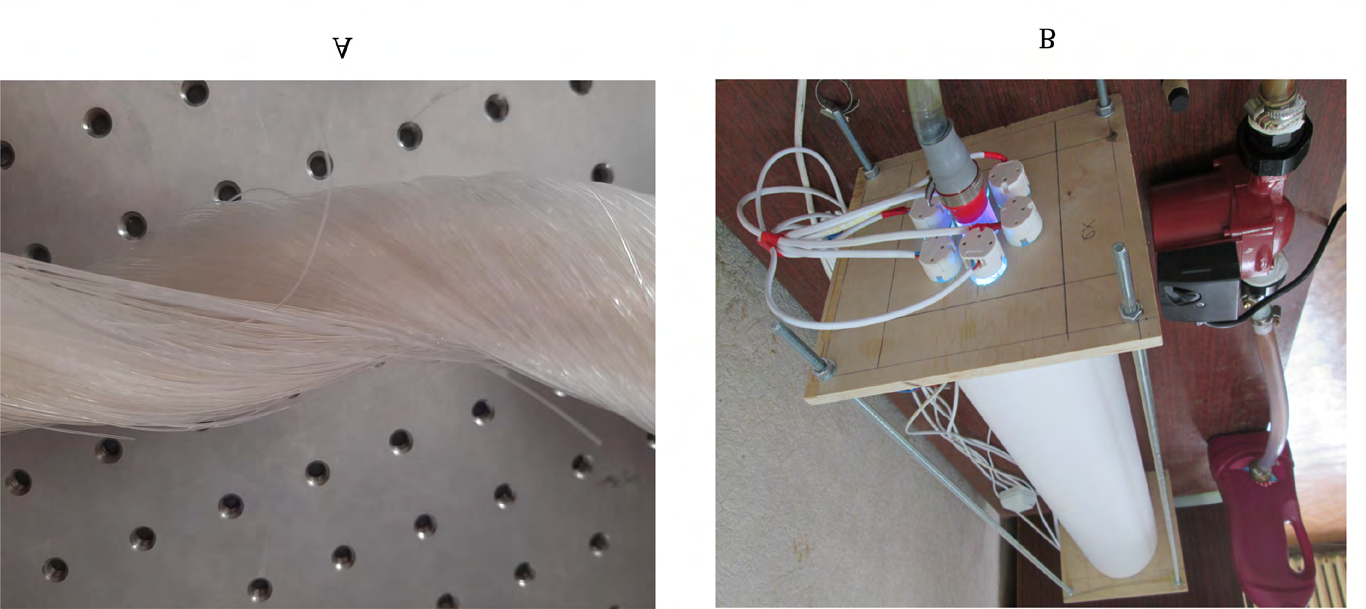
For obtaining good experimental results was taken 2.1 L of water in which was dissolved 80 Gr of yeast and added 44 Gr of sugar. Our decontamination core with 0.8 M length and 2.5 cm in diameter is filled up with a diameter of spheres about 0:5? 1 mm of the quartz material. The core is covered by 6 mercurial lamps which a maximum of radiation is 250- 260 nm. To improve the efficiency of UVC radiation, all the system is placed in the aluminum cylinder with the diameter about 20 cm so that the intensity of the radiation in the center of the big cylinder increase significantly due to the reflection proprieties of the aluminium. More than this, the researchers and people from the room are well protected from the direct action of UVC radiation obtained from 6 lamps represented in the Figure 6.
The core of the equipment proposed in Enaki N, et al. [7, 8] and represented in Figure 6B is adapted to the new conception of the repacking of studied metamaterial small quartz balls/fibres between the big one. In this approach, the improving of the inactivation rate of the yeast colony using these types of metamaterial represented in Figure 4 will mean that the proposed efficient method will work successfully well in the case of prokaryotic cells specific for many bacteria. In the experimental results in Figure 7, the mixture of the granulated quartz material with large dispersion in the mean value of the granule dimension (from 0.01 cm to 0.5 cm) demonstrate the big rate in comparison with the mixture of big and small spheres or fibre system repacked (see Figures 3 & 4). As follows from the first experimental results, the composed metamaterial gives a substantial increase in the decontamination rate in comparison with homogeneous one formed from the elements with the same dimension and topological form [7, 8].
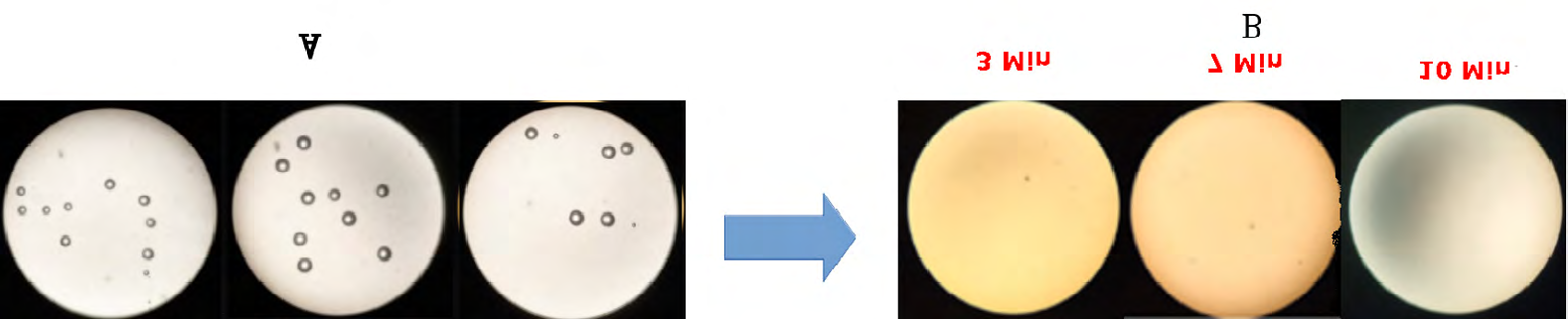
For comparison of dynamic and static decontamination modes, we observe that in the dynamic situation it is used less than 5 M in time interval for the 50.0% of the dimension decreasing of yeast colonies in the 1:15 L of fluid (Figure 7).
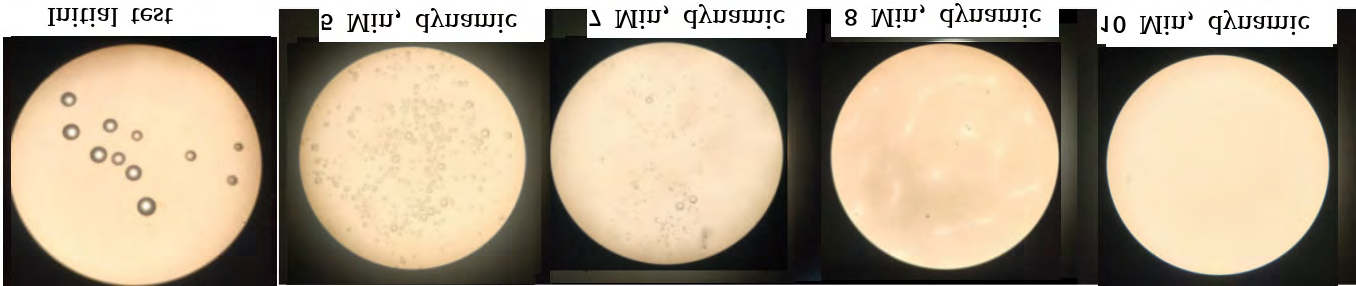
Figure 7: The decontamination procedure of 1:8L of yeast solution in which the fungus colonies were measured after 5, 7, 8 and 10 Min respectively in dynamic regime. Beginning with decontamination time interval 7 and 10 Min the fungus colonies are not observed with our optical microscope. We mention that during the cyclical pump of 1.5 L of solution through the metamaterial element of our equipment, only 0.1 L part of the solution was under the UVC radiation. The remaining part was in the cyclical moving.
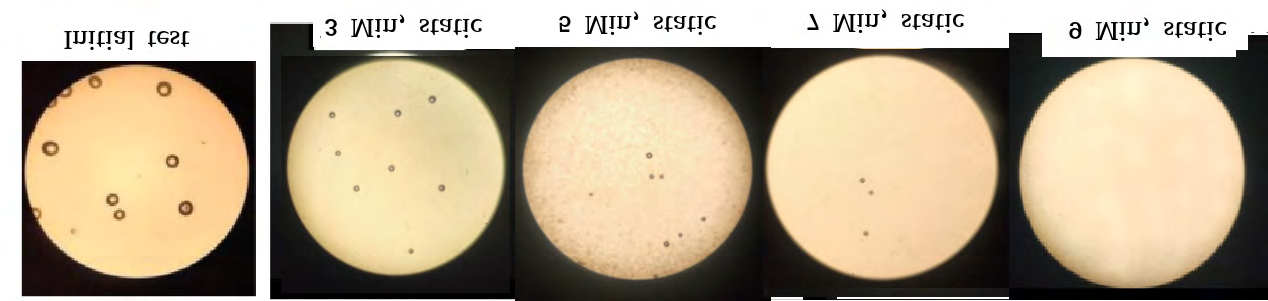
In order to compare this result with the static decontamination method, it would be correct to divide 1.55 L into 15 parts according to the volume of the decontamination core represented in Figure 6B, which can inactivate 1/2 yeast colonies from 115mL of fluids in the time interval 3. Min. It follows that 1550 mL must be statically decontaminated during the time, 15 X 3 (Figure 8). Considering that the average decontamination time in the dynamic regime is about 5 Min in comparison with 45 Min in the static one for the same fluid quantity and same inactivation rate 1/2 we conclude that the efficiency of the dynamic regime is 9-10 times larger than in the static one.
The influence of repacking procedure follows from the comparison of dynamical decontamination spherical metamaterial and granulated one represented in Figure 4 A and B. According to the Expressions (4)-(6), the granulated quartz has large contact surface with infected fluid in comparison with repacked spheres. This follows from the experimental results plotted in Figures 7 & 9, from which we observe that granulated quart gives efficient results in the decontamination in the time interval equal to 3 Min. The quantity of yeast solutions in both experiments is the same.
Conclusions
The estimation results demonstrate that the application of UVC radiation for decontamination of fluids and surfaces by viruses and bacteria needs a new approach in order to achieve the higher efficiency and the compact decontamination systems. Till today, the open propagation of UVC in the free space can’t give us the expected results due to the fact that the radiation is not reflected back from the walls of rooms. The procedure of UVC decontamination needs the absence of the people on the working place in the time interval UVC actions. The closed aluminium reflector and good pumping of fluid into the decontamination core proposed in this communication perhaps solve the above problems connected with multiple reflection of UVC radiation and people protection during its actions.
If optical fibres/spheres are separated, then this surface consists of fibre length multiplied by the length of the base perimeter. These surfaces per volume increase if such optical systems are arranged in the quasi periodical optical structures with good optical contacts between them. An attractive efficiency in the decontamination rate follows from the dependence of the yeast inactivation on the rotation of channels into metamaterial, in which the pathogens are involved together with fluid. The screw channels of give us the possibility to manipulate the trajectory of pathogens, regarding them as buoyant particles inside the centrifugal rotation motions accelerating them on the evanescent zone of metamaterial. In these zones, the intensity of UVC radiation is larger than in other free space between the metamaterial elements.
On the basis of repacking and centrifugal acceleration of yeast colonies in our laboratory was upgraded the decontamination equipment supported by earlier by NATO EAP SFPP 984890 project. The inactivation of yeast colonies with high resistance to UVC radiation predicts the possibilities to inactivate the pathogen agents, which in physical laboratory are not accessible and needs special protection. In order to decontaminate a large volume of fluids (gas or liquid) it is not difficult to observe that equipments like as the one shown in Figure 6 can be arranged each on other forming a matrix of such decontamination systems, so that the distributed fluid pressure on the cores of each element (equipment) can be in agreement with proposed estimations in this communication.
Acknowledgments: This paper is supported by the projects: No. 20.80009.5007.01 and NATO EAP SFPP 984890.
References
-
Comunian S, Dongo D, Milani Ch, Palestini P (2020) Air Pollution and COVID-19: The Role of articulate Matter in the Spread and Increase of COVID-19 Morbidity and Mortality. Int J Environ Res Public Health 17(12): 4487.
-
Shadloo-Jahromi A, Bavi O, Heydari MH, Kharati-Koopaee M, Avazzadeh Z (2020) Dynamics of respiratory droplets carrying SARS-CoV-2 virus in closed atmosphere. Results in Physics 19: 103482.
-
Hebling M, Hones K, Vatter P, Lingenfelder C (2020) Ultraviolet irradiation doses for coronavirus inactivation- review and analysis of coronavirus photoinactivation studies. GMS Hyg Infect Control 15.
-
Bormann M, Alt M, Schipper L, Sand L, Otte M, et al. (2021) Disinfection of SARS-CoV-2 Contaminated Surfaces of Personal Items with UVC-LED Disinfection Boxes. Viruses 13(4): 598.
-
Duguid JP (2009) The size and the duration of air- carriage of respiratory droplets and droplet-nuclei. J Hyg (Lond) 44(6): 471-479.
-
Enaki NA, Turcan T, Bazgan S, Starodub E, Paslari T, et al. (2020) Composite Metamaterials for Biological Decontamination of Fluids, IFMBE Proceedings, Springer, 77: 373-377.
-
Enaki N, Profir A, Ciobanu N, Bazgan S, Nistreanu A, et al. (2018) Optical metamaterials for decontamination of translucent liquids and gases. J Phys D Appl Phys 51(38): 385101-385111.
-
Enaki N, Bazgan S, Ciobanu N, Turcan M, Paslari T, et al. (2017) Improvement in ultraviolet based decontamination rate using meta-materials. Applied Surfaace Science 417: 40-47.
-
Wick GL, Tooby PF (1977) Centrifugal buoyancy forces. Am J Phys 45(11): 1074.
-
Sudarshan K, Jonghoon L, Anki RK, Anugrah S (2018) Particle dynamics and pattern formation in a rotating suspension of positively buoyant particles. Phys Rev Fluids 3(4): 044301.
-
Chang SW, Cai WL, Shen HD, Yu KC (2018) Uncoupling Coriolis Force and Rotating Buoyancy Effects on Full- Field Heat Transfer Properties of a Rotating Channel. J Vis Exp 140: 57630.
-
Zhang D, Peng L, Shang XX. Zheng W, You H, et al. (2020) Buoyant particulate strategy for few-to-single particle- based plasmonic enhanced nanosensors. Nat Commun 11: 2603.
-
Vadasza P (2021) Centrifugal buoyancy in a rotating fluid layer next to and distant from the rotation axis. Physics of Fluids 33(3): 034123.
-
Landau LD, Lifshitz LM (1976) Mechanics. 3rd(Edn.), Butterworth-Heinemann, pp: 128.
-
Hand LN, Finch JD (1998) Analytical Mechanics. Cambridge University Press, USA, pp: 590.
-
Ashkin A (1970) Acceleration and Trapping of Particles by Radiation Pressure. Phys Rev Lett 24(4): 156-159.
-
Harada Y, Asakura T (1996) Radiation Forces on a dielectric sphere in the Rayleigh Scattering Regime. Optics Communications 124(5-6): 529-541.
- Sense, Gravity, Parity & Chirality in Mathematical Physics
- Quantum Lattice Simulations PHYSICS: Microcircuit Particle Formation and Observable Macroscopic Irreversible Time - A Discrete Lagrangian with Cellular Automata Framework
- Quantum Biology from Biomacromolecule to Cell, and Central Dogma Described by Quantum Theory
- Focus, Agility, Speed and Technology (FAST) for Sustainability and Growth
- Square Root Metric Geometry and Pati-Salam Model in Curved Space-Time
- A Simple System Demonstrating the Mpemba Effect in Classical Mechanics