
Light Propagation in an Imperfect 1D Photonic Crystal
The virtual crystal approximation is used for numerical simulation of a polariton spectrum transformation in 1D photonic crystal, consisting of alternating silicon and liquid crystal layers and randomly included admixture layers. The character of dependence of the band gap width and the refractive index upon the concentration of admixture layers is discussed. It is shown that the energy structure of the imperfect superlattice can be significantly altered by implantation of appropriate defect layers.
Introduction
Propagation of electromagnetic waves in thin films and layered crystalline ambiences is currently drawing a close attention. Lourtioz JM, Belotelov VI, Lyubchanskii IL, Nau D [1, 2, 3, 4] give the account of the related research carried out for photonic crystals, Rumyantsev VV [5] for composite materials based on silicon and liquid crystal. The interest towards these objects is on one hand due to their significance for electronics, and on the other hand due to the advance of technology allowing growth of ultrathin films and periodic structures with controlled characteristics. There are numerous theoretical and experimental studies (see e.g. Pokatilov EP [6]) on exciton-like excitations in ideal dielectric superlattices. A general theory of optical waves in anisotropic crystals, including those, formed of macroscopic layers, is discussed in Yariv A [7]. Lyubchanskii IL [8] investigates the dispersion of polaritons in a superlattice with two admixture layers. At the same time a considerable interest is focused on non-ideal superlattices with an arbitrary number of admixture layers as well as on dependence of the polariton spectrum on the concentration of corresponding defects. The further development of the theory of layered structures requires considering more complex models like superlattices with randomly included admixture layers of the variable composition. A better understanding of how the optical properties of such systems depend on concentration of admixture layers gives basis for modeling and constructing the layered materials with prescribed characteristics.
The method applied for calculating polariton excitation spectra is rather similar to the ones, used in cases of other quasiparticle excitations, like electronic, phononic etc. In the present work we employ the virtual crystal approximation (VCA) [9, 10], based on configurational averaging, for description of polariton excitations in a macroscopically inhomogeneous medium. It is a well-known method; however its use up to now [11] has been limited to microscopic calculating the quasiparticles excitations spectra in disordered systems. Mathematical posing of the problem is similar in these two cases.
VCA, proposed originally by Nordheim L and Parmenter RH in Parmenter RH [9], consist in replacing the exact one- electron potential (appropriate to a given configuration of atoms of the alloy) by its average which is taken over all possible random configurations. This approximation is widely used in studies on disordered structures. For example, based on the pseudopotential scheme under the VCA in which the effect of compositional disorder is involved, the dependence of optoelectronic properties of GaAs x Sb1-x
on alloy composition $x$ have been studied in [12]. Within this approximation the configurationally dependent parameters of the Hamiltonian are replaced with their configurationally averaged values. Description of transformation of a polariton spectrum in a sufficiently simple superlattice, using VCA, is the first step towards the study of imperfect systems. However, investigation of properties of polariton spectra and the related physical quantities (density of elementary excitation states, characteristics of the normal electromagnetic waves etc.) in less simple systems requires application of more complex methods. Such are the method of the coherent (one- or many-site) potential [11], the averaged T-matrix method [13] and their numerous modifications used for various particular problems.
In the paper a superlattice is modeled as a set of macroscopically homogeneous layers with randomly included extrinsic (with respect to the ideal super lattice) layers. Corresponding configuration-dependent material tensors in our model of an imperfect superlattice are represented in terms of random quantities. After configuration-averaging the translational symmetry of a considered system is “restored” that allows us obtain the system of equations which define normal modes of electromagnetic waves, propagating in one-dimensional (1D) “periodic” medium. Within the VCA we study of peculiarities of the dependence of the band gap width and refractive index upon concentration of admixture layers for the nonideal Si - liquid crystal system.
**Theoretical Background**
Dielectric $\tilde{\varepsilon}(\vec{r})$ and magnetic $\hat{\mu}(\vec{r})$ permeability, which determine optical characteristics of a 1D photonic crystal, must satisfy the periodic boundary conditions:
$$\hat{\varepsilon}(x, y, z) = \hat{\varepsilon}(x, y, z + d),$$
$$\hat{\mu}(x, y, z) = \hat{\mu}(x, y, z + d),$$
where $d = \sum_{j=1}^{n} a_j$ is the period of the superlattice, $\sigma$ is the number of layers per elementary cell, $a_j$ are the thicknesses of the layers which form a 1D chain of elements oriented along the $z$-axis. The material tensors $\hat{\varepsilon}$ and $\hat{\mu}$ of the crystalline structure with an arbitrary number of layers $\sigma$ have the following form in the coordinate representation:
$$\begin{align*} \hat{\varepsilon}(z) &= \sum_{j=1}^{n} \hat{\mu}_{nj} \left\{ \begin{array}{l} 0 \\ z - (n-1)d - \left( \sum_{j=1}^{n} a_j - a_{nj} \right) \end{array} \right\}, \\ \theta(z) &= \text{Heaviside function}, \quad n = \pm 1, \pm 2, \dots \end{align*}$$
is the number of a one-dimensional crystal cell, index $\alpha = 1, 2, \dots, \sigma$ designates the elements of the cell. Below we consider an imperfect system, in which disordering is connected with variation of the composition (rather then of the thickness) of admixture layers, so that $a_{n\alpha} \equiv a_\alpha$. Within our model, the configurationally dependent tensors $\hat{\varepsilon}{n\alpha}, \hat{\mu}{n\alpha}$ are expressed through the random quantities $\eta_{n\alpha}^v$ ($\eta_{n\alpha}^v = 1$ if the $\nu(\alpha)$-th sort of layer is in the $(n\alpha)$-th site of the crystalline chain, $\eta_{n\alpha}^v = 0$ otherwise):
$$\begin{align*} \left( \hat{\varepsilon}_{n\alpha} \right) &= \sum_{\nu(\alpha)} \left( \hat{\varepsilon}_{\alpha}^v \right) \eta_{n\alpha}^v, \\ \left( \hat{\mu}_{n\alpha} \right) &= \sum_{\alpha, \nu(\alpha)} \left( \hat{\varepsilon}_{\alpha}^v \right) \eta_{n\alpha}^v, \\ C_\alpha^{v(\alpha)} &= 1. \end{align*}$$
Calculation of a polariton spectrum for the imperfect 1D photonic crystal is realized within the VCA (similarly to the solid quasi-particle approach) through the following replacement: $\hat{\varepsilon} \rightarrow \langle \hat{\varepsilon} \rangle$, $\hat{\mu} \rightarrow \langle \hat{\mu} \rangle$ (angular parentheses designate the procedure of configuration averaging). In addition, from Eq. (3) and Parmenter RH [9] we have:
$$\begin{align*} \left( \langle \hat{\varepsilon}_{n\alpha} \rangle \right) &= \sum_{\alpha, \nu(\alpha)} \left( \hat{\varepsilon}_{\alpha}^v \right) C_\alpha^{v(\alpha)}, \\ \left( \hat{\mu}_{n\alpha} \right) &= C_\alpha^{v(\alpha)}, \end{align*}$$
where $C_\alpha^{v(\alpha)}$ is the concentration of the $\nu(\alpha)$-th sort of admixture layer in the $\alpha$-th sublattice. There is a normalization condition $\sum_{\nu(\alpha)} C_\alpha^{v(\alpha)} = 1$. It follows from Eq. (2) that the Fourier-amplitudes $\hat{\varepsilon}l, \hat{\mu}_l$ and the averaged dielectric $\langle \hat{\varepsilon}{n\alpha} \rangle$ and magnetic $\langle \hat{\mu}_{n\alpha} \rangle$ permeabilities of layers (4) are related as
$$\begin{align*} \left( \hat{\varepsilon}_l \right) &= -\frac{i}{2\pi} \sum_{\alpha} \left( \hat{\varepsilon}_{n\alpha} \right) \left( \hat{\mu}_{n\alpha} \right) \exp \left( i \frac{2\pi}{d} l \sum_{j=1}^{n} a_j - a_\alpha \right), \\ \left( \hat{\mu}_l \right) &= \exp \left( i \frac{2\pi}{d} l \sum_{j=1}^{n} a_j - a_\alpha \right), \end{align*}$$
Since the configurational averaging “restores” the translational symmetry of a crystalline system, in the considered case of imperfect superlattice the “acquired” translational invariance of the 1D chain allows us to present Maxwell equations (for harmonic dependency of the electric and magnetic field strengths $\vec{E}(\vec{r}, \omega)$, $\vec{H}(\vec{r}, \omega)$ on a time in the form:
$$\nabla \times \vec{E}(\vec{r}, \omega) = \frac{i\omega}{c} \langle \hat{\mu}(z) \rangle \cdot \vec{H}(\vec{r}, \omega), \nabla \times \vec{H}(\vec{r}, \omega) = -\frac{i\omega}{c} \langle \hat{\varepsilon}(z) \rangle \cdot \vec{E}(\vec{r}, \omega).$$
Hence, according to the Floquet theorem, Fourier-amplitudes $\vec{f}_{K,p}^{(E,H)}$ of the electric and magnetic field strengths satisfy the following relation:
$$\left[ \vec{\beta} + \left( K + p \frac{2\pi}{d} \right) \vec{e}_z \right] \times \left[ \vec{f}_{K,p}^{(H)} \right] = \frac{\omega}{c} \left[ \begin{array}{c} -\sum_i \hat{\varepsilon}_i \cdot \vec{f}_{K,p-1}^{(E)} \\ \sum_i \hat{\mu}_i \cdot \vec{f}_{K,p-1}^{(H)} \end{array} \right].$$
Here $\vec{\beta}$ is an arbitrary planar (in the XOY plane) wave vector, $\vec{e}_z$ is a unit vector along the $z$-axis, $\vec{K} = (0,0,K)$ is the Bloch vector. The system (7) defines normal modes of electromagnetic waves, propagating in the considered "periodic" medium. Below, for simplicity, we shall restrict our study to the case of light, propagating along the $z$-axis ($\vec{\beta} = 0$) in a nonmagnetic lattice ($\hat{\mu} = \hat{I}$ is a unit matrix); the liquid-crystal layers we shall treat (like in Rumyantsev VV [5]) as uniaxial ($\varepsilon_f = \varepsilon_x \delta_x \delta_k + \varepsilon_y \delta_y \delta_y + \varepsilon_z \delta_z \delta_f$; obviously, that for $\vec{K} \mid z$, $zz$-components of the tensor $\hat{\varepsilon}$ do not appear in final formulas, and $\varepsilon_x = \varepsilon_y \equiv \varepsilon$).
Furthermore, we shall (like in Yariv A [7]) assume, that $\vec{K}$ is close to the value, defined by the Bragg's condition: $$\left| K - \frac{2\pi}{d} \right| \approx K, \quad c^2 K^2 \approx \omega^2 \varepsilon_0.$$ This case corresponds to a resonance of plane waves between the components $\vec{f}_{K,p}^{(E,H)}$ at $p = 0$, $-1$ (these terms dominate in the system (7)). After eliminating the $\vec{f}^{(H)}$ variables, Equations (7) with respect to $\vec{f}^{(E)}$ take the form:
$$\left[ \begin{array}{c} K^2 - \frac{\omega^2}{c^2} \varepsilon^{(0)} \\ -\frac{\omega^2 \varepsilon^{(-1)}}{c^2} \end{array} \right] \left( K - \frac{2\pi}{d} \right)^2 - \frac{\omega^2}{c^2} \varepsilon^{(0)} \left[ \begin{array}{c} f_{K,0}^{(E)} \\ f_{K,-1}^{(E)} \end{array} \right] = 0.$$
Where $\varepsilon_{l=0} \equiv \varepsilon^{(0)}, \varepsilon_{l=±1} \equiv \varepsilon^{(\pm1)}$. Putting the determinant of the system (8) equal to zero we obtain the dispersion relations $\omega_\pm = \omega(K)$. Two roots of this equation $\omega_\pm$ define the boundaries of the spectral band: at frequencies $\omega_-(K) < \omega < \omega_+(K)$ (band gap) the roots are complex and electromagnetic waves decay (Bragg's reflection); frequencies $\omega < \omega_-$, $\omega > \omega_+$ correspond to propagating waves.
Results and Discussion
We shall confine ourselves to the case of propagation of electromagnetic radiation in a nonmagnetic super lattice with the two layers-elements (Si-layer and liquid crystal layer) per elementary cell. Concentration and dielectric permeability of the base material in the first and the second sub lattice are denoted by $C_1^{(1)}, C_1^{(2)}$ and $C_2^{(1)}, C_2^{(2)}$ ($\varepsilon_1^{(1)} = 11.7$, $\varepsilon_2^{(1)} = 5.5$) respectively. For admixture this quantities are denoted by $C_1^{(2)}, C_1^{(2)}$ and $C_2^{(2)}, C_2^{(2)}$. Simple transformations (with the account that $\left| \varepsilon^{(-1)} \right| = \left| \varepsilon^{(1)} \right|$) lead to the following relations for the refractive index $n \equiv K / \omega$ of the studied system:
$$n_+^2 \left( C_1^{(2)}, C_2^{(2)} \right) = \varepsilon^{(0)} \left( C_1^{(2)}, C_2^{(2)} \right) \pm \left| \varepsilon^{(1)} \left( C_1^{(2)}, C_2^{(2)} \right) \right| \approx \varepsilon^{(0)} \left[ 1 \pm \frac{\Delta \omega_1 \left( C_1^{(2)}, C_2^{(2)} \right)}{\omega} \right],$$
$$n_-^2 - n_+^2 / 2 \varepsilon^{(0)} \approx \Delta \omega_1 / \omega, \quad \Delta \omega_1 = \left| \omega_+ - \omega_- \right|$$ is the lowest band gap width. It follows from Eq. (9) that the quantity $\Delta \omega_1$ is determined by the corresponding coefficient of the Fourier expansion (5), which in this case is $\left| \varepsilon^{(1)} \right|$. In Rumyantsev VV, Yariv A [5, 7] it was shown that the band gaps of higher orders are as well determined by corresponding Fourier-coefficients of the dielectric permeability.
$$\varepsilon^{(0)} = \left( \varepsilon_1^{(1)} f_1 a_1 + \varepsilon_2^{(1)} f_2 a_2 \right) / d$$
$$|\varepsilon^{(1)}| = \frac{1}{\pi} \left| \varepsilon_2^{(1)} f_2 - \varepsilon_1^{(1)} f_1 \right| \sin \pi a_1 / d.$$ The functions ( ) ( )
( ) ( ) ( ) ( )
( ) ( ) $$ f _ {1} \left(C _ {1} ^ {(2)}, \frac {\varepsilon_ {1} ^ {(2)}}{\varepsilon_ {1} ^ {(1)}}\right) = 1 - C _ {1} ^ {(2)} \left(1 - \frac {\varepsilon_ {1} ^ {(2)}}{\varepsilon_ {1} ^ {(1)}}\right), f _ {2} \left(C _ {2} ^ {(2)}, \frac {\varepsilon_ {2} ^ {(2)}}{\varepsilon_ {2} ^ {(1)}}\right) = 1 - C _ {2} ^ {(2)} \left(1 - \frac {\varepsilon_ {2} ^ {(2)}}{\varepsilon_ {2} ^ {(1)}}\right) $$
2 2 2 2 2 2 2 2 1 1 2 2 1 1 1 2 2 2 1 1 1 1 1 1 2 2 , 1 1 , , 1 1 f C C f C C ε ε ε ε ( ) ( ) ( ) ( ) relative dielectric permeability.
depend on the concentration of admixture layers and their
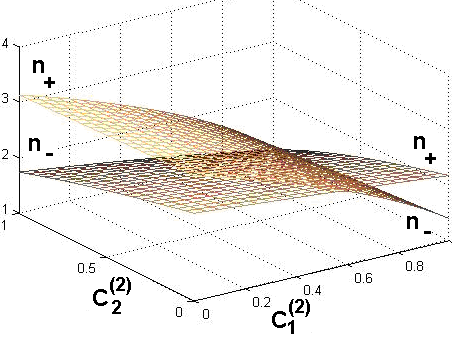
a) b) Figure 1: Refractive index
$$ n _ {\pm} \equiv K / \omega_ {\pm} $$
of the composite super lattice (with alternating silicon and liquid-crystal layers) vs. the concentrations of admixture layers: a)
$$ \varepsilon_ {1} ^ {(2)} / \varepsilon_ {1} ^ {(1)} = 0. 1, \varepsilon_ {2} ^ {(2)} / \varepsilon_ {2} ^ {(1)} = 0. 2; \mathrm {b}) \varepsilon_ {1} ^ {(2)} / \varepsilon_ {1} ^ {(1)} = 2 0, \varepsilon_ {2} ^ {(2)} / \varepsilon_ {2} ^ {(1)} = 0. 2; a _ {1} / a _ {2} = 1. $$ Figure 1 shows the concentration dependence of the
$$ \text{refractive index } n _ {\pm} \equiv K / \omega_ {\pm} $$
of the studied composite superlattice. It is readily seen, that the form of the corresponding surfaces has a non-monotone character if the dielectric permeability of both admixtures is
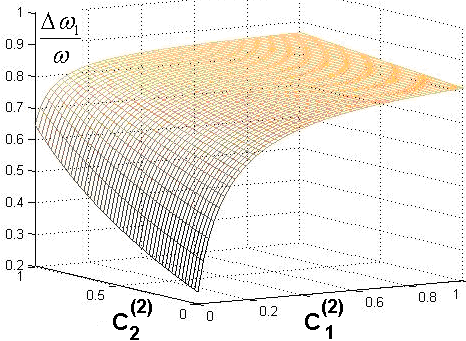
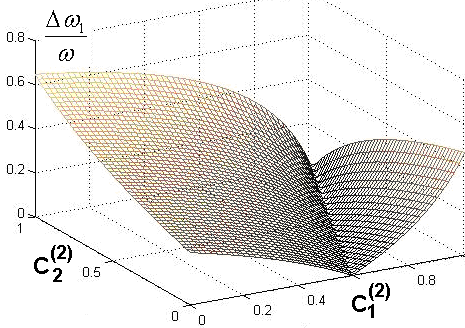
a) Figure 2: Relative width of the lowest band gap 1 / ω ω ∆ of the composite superlattice (with alternating silicon and liquid- crystal layers) vs. the concentrations of admixture layers. Surface a) for the case ( ) ( ) 2 1 1 1 / 0.1 ε ε = , ( ) ( ) 2 1 2 2 / 0.2 ε ε = ;surface b) for the case ( ) ( ) 2 1 1 1 / 20 ε ε = , ( ) ( ) 2 1 2 2 / 0.2 ε ε = ; 1 2 / 1 a a = .
$$ \varepsilon_ {i} ^ {(2)} / \varepsilon_ {i} ^ {(1)} \ll 1 (i = 1, 2) $$
(case a) or
$$ \cdot \varepsilon_ {i} ^ {(2)} / \varepsilon_ {i} ^ {(1)} \gg 1 (i = 1, 2). \mathrm {T h e} $$ dependence of n+ and n−on ( ) 2 1 C and ( ) 2 2 C becomes monotonous in another cases (b). The latter fact determines the behavior of the lowest band gap.
b)
In Figure 2 the lowest energy gap width is plotted vs. the concentrations $C_1^{(2)}$, $C_2^{(2)}$ of admixture layers for a superlattice with alternating silicon and liquid-crystal layers. The energy gap $\Delta\omega$ vanishes at $\varepsilon_1^{(1)} f_1 = \varepsilon_2^{(1)} f_2$ for the case a) in Figure 2.
Conclusion
Our present study shows that optical characteristics of an imperfect 1D photonic crystal may be significantly altered as a result of transformation of its polariton spectrum due to presence of admixture layers. The developed theory is a basis for phenomenological description of a wide class of optical processes in nonideal multilayered systems. Formulas (2-5, 7) allow a numerical calculation of the concentration dependence of relevant optical characteristics. The essential quantities governing the propagation of electromagnetic waves through the studied media are the refractive indices, the photon gap width and the directly measured quantities, which they define (for example, the light transmission coefficient). Graphic representation of $n_{\pm}, \Delta\omega/\omega(C_1^{(2)}, C_2^{(2)})$ (Figs. 1 and 2) shows, that for the considered binary systems the character of the concentration dependence is different in different concentration intervals. The case of nonideal multilayered systems with bigger number sublattices and components of alien layers (see Rumyantsev VV [5]) allows even for a greater variety in behavior of the refractive index and the gap width. This circumstance considerably widens the opportunities for modeling composite materials with prescribed properties, it also creates prerequisites for solving the problem of finding polariton modes (necessary for calculating, for example, gyrotropic characteristics [14, 15]) in spatially dispersed superlattices.
References
-
Lourtioz JM, Benisty H, Berger V, Gerard JM, Maystre D, et al. (2005) Photonic Crystals: Towards Nanoscale Photonic Devices. 2nd (Edn.), Springer, New York, USA.
-
Belotelov VI, Kotov VA, Zvezdin AK, Alameh K, Vasiliev MV (2005) Optical properties of the magnetic crystals at the oblique light incidence. International Conference "Functional Materials", Proceedings V. Vernadsky Taurida National University, Ukraine, pp: 132.
-
Lyubchanskii IL, Dadoenkova NN, Lyubchanskii ML, Shapovalov EA, Lakhtakia A, et al. (2004) One-dimensional bigyrotropic magnetic photonic crystals. Applied Phys Lett 85(24): 5932-5934.
-
Nau D, Schonhardt A, Chigrin DN, Kroha H, Christ A, et al. (2007) Polariton bandstructure of disordered metallic photonic crystal slabs. Physica status solidi(b) 244: 1262-1269.
-
Rumyantsev VV, Fedorov SA (2007) Polariton spectrum of imperfect lyotropic lamellar system. Liquid Crystals and Their Application 1(19): 67-74.
-
Pokatilov EP, Fomin VM, Beril SI (1990) Vibrational Excitations, Polarons, and Excitons in Multilayer Systems and Superlattices. Chisinau, Shtiintsa, pp: 280.
-
Yariv A, Yeh P (1987) Optical waves in crystals. John Willey & Sons Inc, New York, USA.
-
Lyubchanskii IL, Dadoenkova NN, Lyubchanskii ML (2005) Light propagation in magnetic photonic crystals: oblique incidence. International Conference "Functional Materials". Proceedings, V. Vernadsky Taurida National University, pp: 133.
-
Parmenter RH (1955) Energy Levels of a Disordered Alloy. Phys Rev 97(3): 587-698.
-
Dargan TG, Capaz RB, Koiler B (1997) Critical Analysis of the Virtual Crystal Approximation. Brazilian J of Phys 27/A(4): 299-304.
-
Ziman JM (1979) Models of disorder. The theoretical physics of homogeneously disordered systems. John Willey & Sons Inc, New York, USA.
-
Mezrag F, Aouina NY, Bouarissa N (2006) Optoelectronic and dielectric properties of GaAs$_x$ Sb$_{1-x}$ ternary alloys. Journal of Materials Science 41: 5323-5328.
-
Los’ VF (1987) Projection operator method in the theory of disorder systems. 1. Spectra of quasiparticles. Theor and Math Phys 73(1): 85-102.
-
Rumyantsev VV, Fedorov SA, Gumennyk KV (2012) Dependence of the specific angle of optical rotation on the admixture concentration in a 1D-superlattice. Superlattices and Microstructures 51(1): 86-91.
-
Rybalka AYe, Rumyantsev VV, Fedorov SA, Gumennyk KV (2021) Features of the frequency dispersion of the natural optical activity of a non-ideal molecular crystal in the exciton region of the energy spectrum. Optics and spectroscopy 110(5): 748-754.
- Sense, Gravity, Parity & Chirality in Mathematical Physics
- Quantum Lattice Simulations PHYSICS: Microcircuit Particle Formation and Observable Macroscopic Irreversible Time - A Discrete Lagrangian with Cellular Automata Framework
- Quantum Biology from Biomacromolecule to Cell, and Central Dogma Described by Quantum Theory
- Focus, Agility, Speed and Technology (FAST) for Sustainability and Growth
- Square Root Metric Geometry and Pati-Salam Model in Curved Space-Time
- A Simple System Demonstrating the Mpemba Effect in Classical Mechanics