
Computer Design Optimal Parameters of Permeable Planar Thermoelectric Element for Cooling Applications
Physical model of permeable planar thermo element with a developed heat exchange system for cooling heat flow is described. Theory of calculation and computer methods to seek for optimal functions of the legs material inhomogeneity combined with a search for optimal parameters (electric current density, heat consumption) under which thermodynamic efficiency of power conversion will be maximum are discussed. Optimal inhomogeneity distribution for Bi2Te3 based material is given. Rational use of such converters in optimal conditions has been shown to increase coefficient of performance by 40-60%.
Introduction
There are thermoelectric elements where heat exchange with the heat source and sink occurs not only on thermoelement junctions, but also in the bulk of the legs material [1, 2, 3]. Variants of realization of such models include permeable thermoelements wherein the legs materials along electric current flow employ channels (pores) for heat carrier pumping. Control over heat exchange conditions (heat carrier velocity, heat exchange intensity, etc.) combined with a distribution of physical effects in the legs material can affect the energy efficiency of power conversion. Study of permeable thermoelectric elements [3, 4, 5] has shown good prospects for their use, since it allows increasing coefficient of performance by a factor of 1.2-1.4.
The method of hot pressing to obtain permeable porous structure branches thermocouple for materials described in the paper [6]. Such materials are proposed to be used in thermoelectric generators, in which the processes of fuel combustion take place in the middle of the thermocouple branches. A numerical model has been developed to estimate the temperatures, pressures, and velocities of the heat carrier in the permeable material. The model does not take into account the presence of thermal effects of Joule and Thomson; the physical properties of the material parameters were considered constant; considered, that the physical properties of the coolant is described by equations of ideal gas. Theoretical or experimental data to determine the possibility of effectiveness porous thermocouples and advantages in efficiency there. Options porous structures also were investigated in Cui Y [7], Reddy ES [8], Cui YJ [9]. Estimated output power (Pout) porous ring thermoelectric generator for collecting waste heat held in the work [7]. This paper display is, that the porous thermoelectric conversions have better features than the bulky tag. Discovered, that influence the speed of gas at Pout slightly ( for example, the rate increased from 4.9 m/s to 24.5 m/s, and Pout at the same time increases only 0.06 mW). The output power increases and then decreases in dependence on the value of external resistance, porosity and square cross-section. It is evident that the value of optimized porosity greater for thermoelectric materials with smaller diameter pores.
However, practical realization of such thermoelements is related to certain material research and technological difficulties, stimulating search for and study of the simplest variants of physical models of converters with internal heat exchange. A variant of internal heat exchange realization includes planar thermoelements (Figure 1), wherein each leg consists of a certain number of plates, spaced from each other. Intervals between the plates form channels for pumping heat carrier (liquid or gas). The purpose of this work is to study such thermoelements in order to determine their extreme energy characteristics.
Problem Formulation
Physical model of a planar permeable thermoelectric element working in cooling mode is shown in Figure 1. It comprises n- and p-_type legs, each leg consisting of _Np segments (planes), spaced at the distance of hk from each other. The segment width is h, and its thickness is hp. Intervals between the segments form channels for pumping heat carrier (air or liquid) for cooling. Hot and cold thermoelement junctions at kept at constant values of Th and Tc, respectively. Heat carrier is pumped in the direction from the hot to cold junctions. Heat carrier temperature at thermoelement input is Tа. Heat exchange coefficient of heat carrier inside the channels of permeable junction thermoelement is a_T_.
x ,
| 0 | n-t | ype | p-type | |||
Tc Figure 1: Physical model of a planar cooling thermoelement.
To find temperature distribution in thermoelement material, one should solve a differential equation ( ) ( ) ( ) ( ) 2 2 0 T d T d dT T i T Ti T t dx dx dx h $$ \frac {1}{x} \left(\kappa (T) \frac {d T}{d x}\right) + i ^ {2} \rho (T) - T i \frac {d \alpha (T)}{d x} - \frac {2 \alpha_ {T}}{h _ {p}} (T - t) = 0 $$ , (1) p where t is heat carrier temperature at point x; T is leg temperature at point x; α T is heat exchange coefficient; i is electric current density (i= I S S − ); α(T), κ(T), ρ(T) are Ê thermoelectric coefficient, thermal conductivity and resistivity of material that are functions of temperature T. Note that parameters of thermoelectric medium α, κ, ρ are interdependent. The system of these relations assigns a certain area Gξ of a change in inhomogeneity ξ. Elaborating on leg material, it is necessary to assign these relations, for example, in the form of theoretical or experimental dependences α, κ, ρ on T and define the area Gξ.
Heat carrier passing through the legs of permeable thermoelement is cooled. On the portion of leg segment dx a change in heat carrier temperature dt is determined by the law of energy conversion; differential equation for heat carrier temperature t distribution is of the form ( ) 2 T $$ \frac {d t}{d x} = \frac {2 \alpha_ {T}}{V c _ {P} h _ {p}} (T - t). \tag {2} $$ P p where V is specific mass velocity of heat carrier in the channel (V = vρ T; v – velocity, ρ T – heat carrier density); сР – specific heat of heat carrier.
Equations (1) and (2), written for n- and p-legs of thermoelement, form a system of differential equations to determine temperature distribution in the legs material and the substance being pumped ( ) ( ) ( ) ( ) , 2 , , 0, d T d dT T i T Ti T t dx dx dx h $$ \left\{ \begin{array}{l} \frac {d}{d x} \left(\kappa (T, \xi) \frac {d T}{d x}\right) + i ^ {2} \rho (T, \xi) - T i \frac {d \alpha (T , \xi)}{d x} - \frac {2 \alpha_ {T}}{h _ {p}} (T - t) = 0 \\ \frac {d t}{d x} = \frac {2 \alpha_ {T}}{V c _ {P} h _ {P}} (T - t). \end{array} \right. $$
2 T p (3)
2 .
dt T t dx Vc h ( )
T P P n p For convenience, let us transform this system of equations, introducing the following variables:
$$ q = \alpha (T, \xi) i T - \kappa (T, \xi) \frac {d T}{d x}, j = i l, x = \frac {x}{l}, $$ $$ \ddot {I} _ {K} = 2 \cdot h, S _ {\mathrm {k}} = h \cdot h _ {\mathrm {k}} \cdot N _ {p}, S = h \cdot \left(h _ {\mathrm {k}} + h _ {p}\right) \cdot N _ {p}; $$ where l is thermoelement height; q is thermal flow;
K Ï is perimeter of a channel taking part in heat exchange;
kS is cross-sectional area of all the channels; S is cross- sectional area of the leg (leg material together with the channels). Let us direct coordinate system from the hot to cold surface, then αj = –|α j|, subsequently the module sign will be explicitly lowered.
Then the system of differential equations will look like α = − − κ κ α α α = + + ρ − − κ − α = − , dT j T q dx Ï N l dq j j T q i T t dx dx S S j
2 2 2 , ( ) ( )
TÊ Ê (4) Ê Ï N l dt T t dx Vc S
( ) .
T K P P R n p , Here physical parameters of thermoelectric medium $\alpha$, $\kappa$, $\rho$ are interdependent, imposing restrictions on their possible values. System of these restrictions forms a certain control field $G_{\xi}$, therefore permissible controls $\xi$ should belong to this field. Elaborating on a physical model, one must have dependences of $\alpha$, $\kappa$, $\rho$ on concentration and temperature.
Let us consider the problem of maximum power efficiency of thermoelectric cooling under fixed heat source temperatures $T_h$ and $T_c$.
The problem is reduced to search for maximum coefficient of performance
$$\varepsilon = \frac{Q_c}{Q_h - Q_c} \quad (5)$$
in case of differential relations (3) and boundary conditions
$$T_{n,p}(0) = T_h, \quad T_{n,p}(1) = T_c, \quad t_{n,p}(0) = T_s, \quad (6)$$
where $T_h$ is junction hot surface temperature, $T_c$ is junction cold surface temperature. $T_x$ is initial temperature of heat carrier, $Q_h$, $Q_c$ are thermal flows which thermoelement exchanges with external heat sources
$$Q_h = Q_n(0) + Q_p(0),$$
$$Q_c = Q_n(1) + Q_p(1) + Q_L;$$
here $Q_L$ is heat input due to internal heat exchange from cooled heat carrier $Q_L = \sum_{n,p} V_c p S_R (t(0) - t(1))$.
Hereinafter instead of maximum $\varepsilon$ it is convenient to consider functional minimum $\Im$:
$$\Im = \ln q(0) - \ln q(1), \quad (7)$$
where
$$q(0) = \frac{Q_h}{I} = q_n(0) + q_p(0),$$
$$q(1) = \frac{Q_c}{I} = q_n(1) + q_p(1) + \frac{Q_L}{j(S - S_K)} l,$$
here $q_n(1), q_p(1), q_n(0), q_p(0)$ are the values of specific heat flows on the cold and hot junctions of thermoelement for $n$ and $p$-type legs, found from solving the system of differential equations (4).
Optimization problem lies in the fact that from a variety of permissible controls $\xi \in G_{\xi}$ to select such concentration functions $\xi^{np}(x)$ and simultaneously assign such specific mass velocity of heat carrier in channels $V = V_0$ that in the case of restrictions (3)-(4) and condition for electric current density $j$ impart to functional $\Im$ the least value, the coefficient of performance in this case being maximum [6].
$$q_n(1) + q_p(1) = 0 \quad (8)$$
Method of Solving Formulated Problem
To solve the problem, let us use mathematical theory of optimal control developed under the supervision of Pontryagin LS [10, 11]. Let us formulate in brief the basic concepts of this theory.
In “mathematics language”, the problem reduces to finding control $\xi(x)$, vector-parameters and their respective solution $X(x)$ of system (3),(6) such that functional $\Im$ accepts the least possible value. The thus formulated problem is called optimization problem. Its solution in the most general form was first formulated by Pontryagin in the form of a principle of the maximum, providing the necessary optimality condition in optimal control problems.
Principle of the maximum is formulated by the following theorem.
Let $\xi'(x)$ be optimal control, $\omega'$ optimal vector-parameter, $X'(x)$ optimal trajectory. Then there exists such pulse vector $\psi'(x)$ that for each $x$ the following conditions are met:
1. Hamiltonian function in the form of equation (9)
$$H(X',(x),\xi',(x),\psi',(x),\omega',x) = (\psi,f) \quad (9)$$
(in our case $f_1, f_2, f_3$ are right-hand sides if equation system (4)), variable $\xi$ reaches maximum (10)
$$H(X',(x),\xi',(x),\psi',(x),\omega',x) = \max_{\xi \in G_n} H(X',(x),\xi',(x),\omega',x). \quad (10)$$
2. Vector-parameter $\omega$ must satisfy the system of integral-differential equations (11)
$$-\frac{\partial \Im(x(x),\omega)}{\partial \omega_i} + \int \sum_{j=1}^{n} \psi_j \cdot \frac{\partial f_j^k(x,\xi,\omega)}{(11)^2 \omega_i} dt = 0, \quad i = 1,...,r.$$
Pulse vector $\psi(x)$ satisfies the system of differential equations of the form
$$\frac{d\psi}{dx} = -\frac{\partial H}{\partial X}, \quad (12)$$
canonically to conjugate system (4), where $X(X_1,X_2,X_3)$ is vector-function of phase variables (in our case with components $X_1 = T$, $X_2 = q$, $X_3 = t$), with conditions at the boundary
$$\psi(x) = -\frac{\partial J}{\partial X}. \quad (13)$$
Solution of the optimal problems, based on the use of principle of the maximum, can be realized by numerical methods with elaboration of the respective computer programs.
The above formulated principle of the maximum is the basic result of theory of optimal processes. It can help to study various optimal control problems differing in the means of assigning functional (Lagrangian, Mayer, Boltz problems), restrictions, etc.
Let us elaborate on the formalism of mathematical theory of optimal control set forth before with regard to our problem.
Let us introduce the Hamiltonian function $$ H = \psi_ {1} f _ {1} + \psi_ {2} f _ {2} + \psi_ {3} f _ {3}, \tag {14} $$ here 1_f_ , 2_f_ , 3_f_ are right-hand sides of equation system (4):
2 2 2 1 2 , ,
Ï N l j T q j j f f T q i T t dx S S j
$$ i _ {1} = - \frac {\alpha j T}{\kappa} - \frac {q}{\kappa}, f _ {2} = \frac {\alpha^ {2} j}{d x} T + \frac {\alpha j}{\kappa} q + i ^ {2} \rho - \frac {\alpha_ {E} \ddot {I} _ {E} N l ^ {2}}{\left(S - S _ {E}\right) j} (T - t $$ ( ) ( ) TÊ Ê Ê Ï N l f T t Vc S $$ I _ {3} = \frac {\alpha_ {T} \ddot {I} _ {K} N _ {K} l}{V c _ {0} S _ {0}} \left(T - t\right) $$ ( ) .
T K K
3 P R Functions (х) (pulses) must satisfy the system of equations (with regard to (9) and (12)):
$$ \left\{ \begin{array}{l} \frac {\ddot {l} \psi_ {N}}{d x} = \frac {l \alpha j}{\kappa} R _ {1} \psi_ {1} \frac {\ddot {I}}{R _ {1}} \left(\frac {\partial N j l}{\kappa} R _ {2} - \frac {\alpha_ {E} \dot {E}}{(S - S _ {\dot {E}}) j}\right) \psi_ {2} ^ {T} \frac {\alpha_ {K} K}{V c _ {P} S _ {R}} \psi_ {3}, \\ \frac {d \psi_ {2}}{d x} = \frac {j}{\kappa} \psi_ {1} - \frac {\alpha j}{\kappa} \psi_ {2}, \\ \frac {d t}{d x} = - \frac {\alpha_ {E} \ddot {I} _ {E} N l ^ {2}}{(S - S _ {\dot {E}}) j} \psi_ {2} ^ {T} \frac {\alpha_ {K} \ddot {I} _ {K} N l}{V c _ {P} S _ {R}} \psi_ {3}. \end{array} \right. $$
2 1 1 1 2 2 3
, x dÏ N l Ï N l j j R R d S S j Vc S
TÊ Ê T K K ( )
Ê P R , x d j j d Ï N l Ï N l dt d S S j Vc S
(15)
where ln ln 1 d d q R T T dT dT
$$ \left\{ \begin{array}{l} R _ {1} = 1 + \frac {d \ln \alpha}{d T} T - \frac {d \ln \kappa}{d T} \left(T + \frac {q}{\alpha}\right) \\ R _ {2} = R _ {1} + \frac {1}{Z _ {K}} \frac {d \ln \sigma}{d T} + \frac {d \ln \kappa}{d T} \left(T + \frac {q}{\alpha}\right) \end{array} \right. $$
1
1 ln ln d d q R R T Z dT dT
2 1 K n p ,
canonically to conjugate system (4).
With boundary conditions (transversality conditions)
$$ \left. \frac {\partial \bar {J}}{\partial y} \right| _ {x = 0}, \quad \psi (1) = - \left. \frac {\partial \bar {J}}{\partial y} \right| _ {x = 1} $$ $$ \psi (0) = \left. \frac {\partial \bar {J}}{\partial y} \right| _ {x = 0}, \quad \psi (1) = - \left. \frac {\partial \bar {J}}{\partial y} \right| _ {x = 1}, \tag {16} $$ ( ) ( )
0 1 0 , 1 x x
$$ \text {w h e r e} \bar {J} = J + \sum \left(v, g\right) $$
is expanded functional;
, g ν are
vectors of undefined constant Lagrangian multipliers and
boundary conditions (6).
Then the boundary conditions for the conjugate system will become
1 0 , 0 0 ( ) ( ) ( )
, 2 n p $$ \psi_ {2} ^ {n, p} (0) = \frac {1}{q _ {n} (0) + q _ {1}} $$
q q n p ( ) ( ) ( )
S S j $$ \psi_ {2} ^ {n, p} (1) = - \frac {\left(S - S _ {K}\right) j}{l V c _ {P} S _ {R} \left(2 t (0) - t _ {n} (1) - t\right)} $$ K n p , 2
1 , 2 (0) (1) (1)
lVc S t t t
P R n p
1 1 . 2 (0) (1) (1)
( ) , 3 n p $$ \psi_ {3} ^ {n, p} (1) = - \frac {1}{2 t (0) - t _ {n} (1) - t} $$ t t t n p Using the system of equations (6)-(16) with regard to relations (4)-(5) and numerical solution methods, program of computer design of optimal functions of thermoelectric material inhomogeneity ξ(х) and optimal heat carrier velocity V was created with a view to achieve maximum energy efficiency of permeable planar cooling element.
Results of Research on Bi-Te-Based Permeable Planar Thermoelectric Element
Let us give the results of computer design of optimal inhomogeneity of semiconductor thermoelectric material combined with optimal function of distribution of heat sources (sinks) for permeable planar cooling thermoelements. Heat exchange coefficient for heat carrier inside channels a_T_ was assumed equal to 0.01W/сm2К. Approximated experimental temperature dependences of parameters α, κ, ρ of Bi2Te3 based material for n- and р-types for different impurity concentrations were used. Results of inhomogeneity optimization of semiconductor materials of n-, p-_types and distribution of heat sources in thermoelement legs at temperature difference on its junctions 50 К, _Nр=5шт., hk=0.1 cm; h=1cm, l=1cm, hp=0.1cm, Th= 300 К, Ta= 300 К, сp=1.0 J/(кg·К) are shown in Figure 2.
Table 1 gives the data on a change in maximum coefficient of performance (СОР), thermoelement cooling capacity (Qп), power consumption (W), voltage (U), heat carrier temperature at thermoelement inlet (Tc_v), optimal heat carrier consumption (Vо) depending on fin thickness (h_p) for legs height l= 1.0 cm.
| H , сm _p | 0.5 | 0.1 | 0.05 | 0.01 |
|---|---|---|---|---|
| COP | 0.524 | 0.566 | 0.574 | 0.581 |
| Q , W п | 2.660 | 0.565 | 0.287 | 0.058 |
| W, W | 5.060 | 0.999 | 0.500 | 0.100 |
| U, V | 0.071 | 0.071 | 0.071 | 0.071 |
| T , К c_v | 280.3 | 255.1 | 252.5 | 250.5 |
| Vо, kg/(сm s) | 0.135 | 0.013 | 0.006 | 0.001 |
Table 2: The data on a change in maximum coefficient of performance (СОР), thermoelement cooling capacity (_Q_п), power consumpti
Table 1: The data on a change in maximum coefficient of performance (СОР), thermoelement cooling capacity (Qп), power consumption (W), voltage (U), heat carrier temperature at thermoelement inlet (Tc_v), optimal heat carrier consumption (Vо) depending on fin thickness (h_p) for legs height l= 1.0 cm It can be seen that there is rational fin thickness (about 0.1 сm), when thermoelement characteristics have the most favourable values both in technological conditions and in the energy data. Similar data can be also obtained for other legs heights.
Сonclusion
Optimal distribution of inhomogeneities for Bi-Te-based legs material has been obtained, in which case under given thermal physical conditions the Peltier and Thomson bulk thermoelectric effects are best realized, giving maximum value to coefficient of performance.
Computer research on permeable planar thermoelements of _Bi-Te-_based materials has been made for various temperature operating conditions. It has been shown that rational use of such power converters allows increasing coefficient of performance by 40-60%. The above results testify to good prospects of creating permeable planar thermoelements for thermoelectric coolers of increased efficiency.
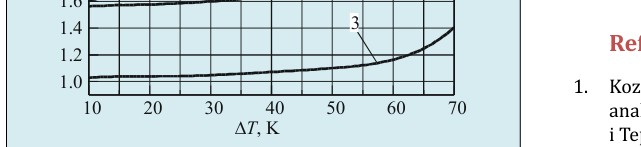
Figure 2: Increase of coefficient of performance of permeable planar thermoelement ε of optimally homogeneous materials (dependence 1) and of functionally graded nmaterials (dependence 2) with respect to its value for nonpermeable homogeneous thermoelement εо fordifferent temperature differences. Dependence 3 – additional increase of coefficient of performance of permeable planar FGM thermoelement with respect to its value for permeable homogeneous thermoelement.
Comparison of the efficiency of operation of permeable and nonpermeable thermoelements in thermodynamic efficiency of cooling process is shown in Figure 2. This figure shows the increase in coefficient of performance of permeable planar thermoelement of optimally homogeneous materials (dependence 1) and of functionally graded materials (dependence 2) with respect to its value for the bulk homogeneous thermoelment. Comparison shows that coefficient of performance of homogeneous permeable thermoelement is factor of 1.6÷2 higher than that of the nonpermeable one. The use of functionally graded thermoelectric materials for permeable thermoelements under boundary temperature differences (60÷70 К) allows additional increase of coefficient of performance by a factor of 1.2÷1.4 (dependence 3). Thus, the efficiency of permeable thermoelements of materials with programmed inhomogeneity is 2÷2.8-fold higher compared to traditionally used homogeneous bulk thermoelements.
2. Kotyrlo GK, Kozlyuk VN, Lobunets YuN (1975) Thermoelectric generator with developed heat exchange surface. Teplotekhnicheskiye Problemy Pryamogo Preobrazovaniya Energii 7: 85-95.
3. Lobunets YuN (1989) Methods for calculation and design of thermoelectric power converters. K. Naukova Dumka, pp: 176.
4. Anatychuk LI, Cherkez RG (2003) On the properties of permeable thermoelements. Proc of XXII International conference on thermoelectrics, France, pp: 480-483.
5. Cherkez RG (2003) Thermoelements with internal and lateral heat exchange. J of Thermoelectricity 1: 70-77.
6. Eura T, Komine T, Hasegava Y, Takata A, Katsuki F, et al. (2001) Research and Development on a thermoelectric power generating system using Low-Calorie Exhaust Gas. The 20th International Conference on Thermoelectrics, pp: 409-412.
7. Cui Y, Wanga BL, Wang KF, Zheng L (2019) Power output evaluation of a porous annular thermoelectric generator for waste heat harvesting. International Journal of Heat and Mass Transfer 137: 979-989.
8. Reddy ES, Noudem JG, Goupil C (2007) Open porous foam oxide thermoelectric elements for hot gases and liquid environments . Energy Convers Manage 48(4): 1251-1254.
9. Cui YJ, Wang BL, Wang KF, et al. (2018) Fracture mechanics analysis of delamination buckling of a porous ceramic foam coating from elastic substrates. Ceram Int 44: 17986-17991.
10. Anatychuk LI, Vykhor LM, Cherkez RG (2000) Optimal control over inhomogeneity of semiconductor material for permeable cooling thermoelements. J of Thermoelectricity 3: 46-57.
11. Pontryagin LS, Boltyansky VG, Gamkrelidze RV, Mischenko EF (1976) Mathematical theory of optimal processes. М.:Nauka, pp: 392.
- Sense, Gravity, Parity & Chirality in Mathematical Physics
- Quantum Lattice Simulations PHYSICS: Microcircuit Particle Formation and Observable Macroscopic Irreversible Time - A Discrete Lagrangian with Cellular Automata Framework
- Quantum Biology from Biomacromolecule to Cell, and Central Dogma Described by Quantum Theory
- Focus, Agility, Speed and Technology (FAST) for Sustainability and Growth
- Square Root Metric Geometry and Pati-Salam Model in Curved Space-Time
- A Simple System Demonstrating the Mpemba Effect in Classical Mechanics