
Physics Formalism Helmholtz Iyer Markoulakis Hamiltonian Mechanics Metrics towards Electromagnetic Gravitational Hilbert Coulomb Gauge String metrics
Iyer Markoulakis Helmholtz Hamiltonian metrics have been gauged to Coulombic Hilbert metrics, representing Gilbertian and Amperian natures of electromagnetic fields from mechanics of vortex rotational fields acting with gradient fields, typically in zero-point microblackhole general fields, extending to vacuum gravitational fields gauge. This ansatz general gaging helps to properly isolate field effects with physical analyses – mechanical, electric, magnetic components within the analytical processes. Vacuum gravitational fields and the flavor Higgs-Boson matter inertial gravitational fields have been thus quantified extending to stringmetrics constructs matrix showing charge asymmetry gauge metrics. Physical Analysis with applications to particle physics, Quantum ASTROPHYSICS, as well as grand unification physics have been advanced. Particle physics gauge matrix pointing to Dirac seas of electrons, monopoles with positrons, electron-positron annihilation leading to energy production, and the relativistic energy generating matter provided literature correlations. Quantum astrophysics extending gauge metrix analyzes of superluminal profile of signals velocity generating electron-positron chain like “curdling” action validates formalism with physics literature of electron-photon observed oscillatory fields configurations. Mechanism of creation of neutrino antineutrino pair orthogonal to electron positron “curdling” planes, that may lead to formation of protonic hydrogen of stars or orthogonally muon particles. These proposals will help to explain receding or fast expanding universe with the dark matter in terms of flavor metrics versus gauge associating metrics fields. Vacuum and gravitational monopoles, that are representation of compressed mass out of vortex Helmholtz decomposition fields have been interpolated to energy generation via electron positron monopole particles at cosmos extent of infinity.
Introduction
Gauge transforms are necessary part of physics today to match relativity with quantum physics, developing consistency to observables classically, where all the basic forces are unified at the scale set by gauge-coupling unification quantitatively, thus for example, explaining observed feebleness of gravity [1]. Gauge fields are included in the Lagrangian to ensure its invariance under the local group transformations, also called gauge invariance [2, 3, 4, 5, 6]. Typical classical Maxwell an electrodynamics have gauge fields, that are like equation 41 in [7]. Gauge theory is a class of quantum field theory, a mathematical theory involving both quantum mechanics and Einstein’s special theory of relativity that is commonly used to describe subatomic particles and their associated wave fields, also may constitute scalar gauge fields [8]. In author’s original conceptuality, gauge invariance is like removing variables using high differentiation to get to constants that will have consistent values across the board of all types – mechanical, electronic, and magnetic fields.
Typical gauge transformation in general can be any formal, systematic transformation of the potentials that leaves the fields invariant, although in quantum theory it can be perhaps a bit more subtle than that because of the additional degree of freedom represented by the quantum phase [8, 9]. These gauge transformations between possible gauges tend to form a Lie group, in general referred as symmetry group or the gauge group of the theory; Lie algebra of group generators quantifies a lie group [9].
Gauge conversions are quite useful to invariantly transfer information of fields of one type, like mechanics onto the fields of another type, like electromagnetism, as above literature suggests. For example, Helmholtz Hamiltonian mechanics metrics quantifying mechanical fields can be gauged to Coulombic Hilbert metrics, representing Gilbertian and Amperian natures of electromagnetic fields [6].
Iyer Markoulakis Helmholtz Hamiltonian mechanics formalisms mathematically modeled the physics with vortex rotational fields acting in cohort to gradient fields, typically in a zero-point as well as of microblackhole general fields, modeled by abstracting observations with Ferrolens of vortex magnetic fields within a real magnet on configured to synthetic magnetic monopole assembly [10, 11]. Author has extensively successfully applied this ansatz formalism to general as well as specific problem solving of attractive and repulsive forces specially encountered in all electronic and magnetic entity forms, like monopoles within a dipole quagmire; here, physical analysis will specifically concentrate on the process physics [12].
In the present paper, ansatz formalism quantifies gauge to electromagnetic fields mathematically. Section 4 models mathematically with Theoretical Results Physics Gaging Formalism showing construction of gauge matrices fundamentally from field and energy forms to gauge metrics by applying original micro macro connectivity formalism that author has recently developed [13]; Section 4.1 models by configuring constructs that will abstract derivative formalism of Helmholtz Hamiltonian mechanism partial differential equation sets already developed earlier, formulating Iyer Markoulakis metrics general formalism [11]. Section 5 expounds Physical Analysis with Results and Discussions. Section 5.1 shows with a brief note about how Helmholtz metrics will gauge to axial eccentric quantum fields gravity. Section 5.2 superimposes conceptually model of Signal Superluminal Profile Graph onto Proper Real Extended Time. Section 5.3 applies ansatz gauge metrix formalism to Particle Physics Gauge Matrix to model a way to quantify Helmholtz Hamiltonian Mechanics to Dirac Monopoles. Section 5.4 shows Quantum Astrophysics Gauge Matrix conceptualizations, then Section 5.5 extends formalism with interpretations on virtual gravitational dipoles, as well as newly developing concept gravitational monopoles at Planck dimensions. Section 6 summarizes modeling ansatz gauge general formalisms with application to unitarization, linking to special unitary groups.
Theoretical Results Physics Gaging Formalism
Problem: Hamiltonian Schrodinger wave function is not a gauge invariant Lagrangian, hence it will have to undergo transformation also called gauge transformation in this context obtaining the unitary equivalent Schrödinger equation [14]; per author’s explanations that will constitute essentially acting like functor, i. e. physically distinct categories.
Hint literature solving problem: In recent years, functor – category of cobordisms - extending topological quantum field theory (TQFT) has been completely formalized with action functional that generates geometrically quantized models [15]. Schrodinger equation will be made invariant under gauge transformation, by changing the wave function by a phase / ie c e Λ η [16], acting like a function that generate functional coupling categories. In Schwarz-type TQFTs, the correlation functions or partition functions of a system are computed by the path integral of metric-independent action functional. For example, in time-dependent correlation functions, the time-ordering operator is included; these typical correlation functions are also simply called correlators. The correlation function can also be interpreted physically as the amplitude for propagation of a particle or excitation between y and x parameters, having equations- like with product of wave functions [17]. The Fock complex vertex operator implements the aspects of those interactions in the BRST-BV formulation of the theory, for example [18]. The Fock space special unitary group is built upon the spin 0 ground state, then getting natural grading [19]. Fock space may be considered as an algebraic technique used in quantum mechanics to construct the quantum states space of a variable or unknown number of identical particles from a single particle Hilbert space; also, one may infer informally, a Fock space is the sum of a set of Hilbert spaces representing zero particle states, one particle states, two particle states, and so on [20]. If the identical particles are bosons, the $n$-particle states are vectors in a symmetrized tensor product of $n$ single-particle Hilbert spaces; for example, if the identical particles are fermions, the $n$-particle states are vectors in an anti-symmetrized tensor product of $n$ single-particle Hilbert spaces; also, technically the Fock space is the Hilbert space completion of the direct sum of the symmetric or ant symmetric tensors in the tensor powers of a single-particle Hilbert space [19, 20].
Solution: Applying above “Hint literature”, having a coupling function to the quantum wave function may enable transforming of a typical functor, which is mathematically equivalently logic of physically distinct categories, compatible to gauge functional, that will equivalently make tensor or vector to scalar. To achieve this, author has developed matrix process general formalism with Equation (11) [13]: $F^E_t = \rho(t) (<\Psi_u(t)|\Psi_u(t)>^{-1}\mathbf{v}$ that can be graphed by setting $Y = f(X)$, with $X = \rho(t)$ and $Y = F^E_t$, representing observables’ functional commutator varying with quantum density matrix, $\rho(t)$ characterizing pure state, like coupling constant of general relativity. From these, we can interpret that $f$, the function operator transforms micro to macro parametrically quantum density matrix, $\rho(t)$ to functional commutator, $F^E_t$, with inner product of up and down aspects of vortex action wave eigenfunctions, $\Psi_u(t)$ and $\Psi_u(t)$, acting alongside general energy fields, $V$, like scalar potential in general relativity. Author has also inferred that effectively, quantum density matrix, $\rho(t)$ can be seen to be influencing time event process via energy quanta, wherein time fields that are typical of micro-blackholes analytically are extractable from partial differential equations (43) and (46) that have already been developed and presented all within modeling of Iyer Markoulis formalism [11] characterizing these processes. Notable is also that outliers with X-Y plot of real data may provide observables of monopoles that may be measurable systematically with physical analysis, such as observables measured experimentally in Bose-Einstein condensates as well as within experimental measurements of monopoles using spin ice specifics [11, 12]. Author will exemplify these further in subsequent analysis here, applying this formalism enabling gaging of Helmholtz Hamiltonian mechanics to electromagnetic quantum fields, following transformation of Helmholtz metrics via Coulomb gauge in Section 4.1.
Configuring Abstraction through Derivative Formalism from Iyer Markoulakis Helmholtz Hamiltonian to the Amperian Gilbertian Hilbert Coulomb Matrix Gauge
Originally, Helmholtz matrix operating Density Field Matrix Eigenvector Operators per magneton [10, 11] observations lead to physical mathematical quantum constructs [11, 12] that shows the Helmholtz matrix equated to gauge parameters:
$$\begin{pmatrix} \hat{e}_r & \hat{e}_g & \hat{e}_r^H \\ \hat{e}_g & \hat{e}_g & \hat{e}_r^H \end{pmatrix}$$
with $\hat{e}_r = 0$ and $\hat{e}_r^H$ for rotational vortex fields, while $\hat{e}_g = \hat{e}_g^H$, and $\hat{e}_r^H = \hat{G}^{-1}$ for gradient fields, according to gauge and non-gauge field tensor operationally. $M’s$ are Hilbert gauge like Higgs metrics mass of Higgs-Boson matter, while $\hat{G}$ is the Coulomb gauge equivalent fields representation,
with the $\hat{G}^{-1}$ is the Coulomb inverse equivalent fields representing vortex.
Partial differential equations characterizing zero-point microblackhole entities Hamiltonian operator physics have been developed elsewhere [11, 12]:
(i) Zero-point Hamiltonian operator eigen fields tensor zero-point gradient differential equations energy gradient fields are given by Iyer R [11]:
$$\nabla^3 E_g \nabla^2 E_g \nabla^2 E_g$$
(ii) microblackhole Hamiltonian operator eigen fields rotational tensor microblackhole differential equations with Helmholtz rotational fields are given by Iyer R [11]:
$$\nabla^3 e_r \nabla^2 e_r \nabla^2 e_r$$
(3) $$\nabla^2 e_r \nabla^2 e_r \nabla^2 e_r$$
(4) To conform with system of P.D.E.s, $\hat{e}_g$ must be transformed to the energy form characteristics like: $\hat{e}_g := \hat{E}_g$; however, $\hat{e}_r$ must be in field forms $\hat{e}_r := \hat{E}_r$. Therefore, applying Equations (2), (3) & (4), Equation (1) equivalent Helmholtz matrix will...
have characteristics:
$$ \left( \begin{array}{l l} \hat {\varepsilon} _ {\mathbf {r}, \mu \mathbf {v}} & \hat {\varepsilon} _ {g} ^ {\mu \mathbf {v}} \\ \hat {\varepsilon} _ {\mathbf {g}, \mu \mathbf {v}} & \hat {\varepsilon} _ {r} ^ {\mu \mathbf {v}} \end{array} \right) = >: < = \left( \begin{array}{l l} \hat {\varepsilon} _ {\mathbf {r}, \mu \mathbf {v}} & \nabla^ {2} \mathrm {E} _ {\mathbf {g}} ^ {\mu \mathbf {v}} \\ \nabla^ {2} \mathrm {E} _ {\mathbf {g}, \mu \mathbf {v}} & \hat {\varepsilon} _ {r} ^ {\mu \mathbf {v}} \end{array} \right) $$ (5) Note: It is possible to transform from Helmholtz metrics, using Coulomb gauge that will link to Coulomb branch gauge group with Hilbert series having SuperSymmetry (SUSY) Quantum Field Theory (QFT) charge conjugation [21, 22]. Subsequent to that it is possible to link charge conjugation to rotating charges per Dirac Maxwell Einstein Kerr Newmann metrics [23, 24].
Based on the arguments [11, 12, 21, 22, 23, 24] and above explanations, we transform Helmholtz matrix Equation (5) onto gauge matrix, i.e. we convert Helmholtz to gauge by having equivalently Helmholtz metrics to Coulomb gauge:
$$ \left\{\nabla^ {2} \mathrm {E} _ {\mathrm {g}, \mu \nu}, \nabla^ {2} \mathrm {E} _ {\mathrm {g}} ^ {\mu \nu} \right\} | = > \left\{\hat {\mathrm {G}} _ {\mathrm {g}, \mu \nu}, \hat {\mathrm {G}} _ {\mathrm {g}} ^ {\mu \nu} \right\} $$ , with branching to Hilbert gauge $$ \left\{\hat {\varepsilon} _ {\mathrm {r}, \mu \nu}, \hat {\varepsilon} _ {\mathrm {r}} ^ {\mu \nu} \right\} | = > \left\{\hat {\mathrm {M}} _ {\mathrm {r}, \mu \nu}, \hat {\mathrm {M}} _ {\mathrm {r}} ^ {\mu \nu} \right\} $$ , having M’s like Higgs metrics mass of Higgs-Boson matter. Equation (5) then will become:
$$ \left| \left( \begin{array}{c c} \hat {\varepsilon} _ {\mathbf {r}, \mu \mathbf {v}} & \nabla^ {2} \mathrm {E} _ {\mathbf {g}} ^ {\mu \mathbf {v}} \\ \nabla^ {2} \mathrm {E} _ {\mathbf {g}, \mu \mathbf {v}} & \hat {\varepsilon} _ {r} ^ {\mu \mathbf {v}} \end{array} \right) \right| = > < = \left| \left( \begin{array}{c c} \hat {\mathbf {M}} _ {\mathbf {r}, \mu \mathbf {v}} & \hat {\mathbf {G}} _ {\mathbf {g}} ^ {u v} \\ \hat {\mathbf {G}} _ {\mathbf {g}, \mu \mathbf {v}} & \hat {\mathbf {M}} _ {r} ^ {\mu \mathbf {v}} \end{array} \right) \right| $$ (6) Additionally, per arguments [11], gradient zero-point will have Gilbertian nature, and the $$ \left\{\nabla^ {2} \mathrm {E} _ {\mathrm {g}, \mu \nu}, \nabla^ {2} \mathrm {E} _ {\mathrm {g}} ^ {\mu \nu} \right\} | = > \left\{\hat {\mathrm {G}} _ {\mathrm {g}, \mu \nu}, \hat {\mathrm {G}} _ {\mathrm {g}} ^ {\mu \nu} \right\} $$ will have Amperian nature. We can show $$ \left\{\hat {\varepsilon} _ {\mathrm {r}, \mu \mathrm {v}} ^ {\prime}, \hat {\varepsilon} _ {\mathrm {r}} ^ {\mathrm {i v}} \right\} | = > \left\{\hat {\mathrm {M}} _ {\mathrm {r}, \mu \mathrm {v}}, \hat {\mathrm {M}} _ {\mathrm {r}} ^ {\mathrm {i v}} \right\} $$ $$ \left\| \hat {\mathrm {M}} _ {\mathrm {r}} ^ {\mu \nu} \right\| \equiv \mathrm {M} $$ and that in vacuum gravitational fields, $$ \hat {\mathbf {M}} _ {\mathrm {r}; \mu \nu} - > 0 $$ , representing like the flavor Higgs-Boson matter mass, quantifying inertia with gravitational field manifestations. Wherefore, Equation (6) will become in vacuum gravitational fields:
$$ \left( \begin{array}{l l} \hat {\mathbf {M}} _ {\mathbf {r}, \mu \mathbf {v}} & \hat {\mathbf {G}} _ {\mathbf {g}} ^ {u v} \\ \hat {\mathbf {G}} _ {\mathbf {g}, \mu \mathbf {v}} & \hat {\mathbf {M}} _ {r} ^ {\mu \mathbf {v}} \end{array} \right) | = > < = | \left( \begin{array}{l l} 0 & \hat {\mathbf {G}} \\ \hat {\mathbf {G}} ^ {- 1} & \hat {\mathbf {M}} \end{array} \right) $$ (7) with ˆG ≡ gauge, [G];
$$ \hat {\mathbf {G}} ^ {- 1} \equiv $$
≡ gauge inverter, [G]-1; ˆM ≡ flavor or the dark matter energy, [M], giving determinant equation of
$$ 0. \hat {\mathbf {M}} - \hat {\mathbf {G}} ^ {- 1} \hat {\mathbf {G}} $$
= 0 – I, having magnitude of -1.
We may also rewrite:
1 0 ˆ
ˆ ˆ −
G
to have unitary determinant (8)
G M
so that determinant of this matrix is an identity I, instead of $$ \left| \widehat {- G} ^ {- 1} \right| $$ will represent a point mirror symmetry of ˆG .
-I. Further,
These aspects will be addressed further in crystal point mathematical formalism proofs with “Rotation Matrix” in later publications of the Materials Science Group Theory, deriving formalism with point matrix reflection imaginary parity value.
Physical Analysis with Results, Discussions, and further Applications
It can also be noted by comparison with physics literature these results have similarity or an analogous model reflective of non-Hermitian quantum CPT physics [25]. We may also note that this matrix in Equation (8) can represent PT symmetry with quaternion typically having typical “-1 problem” [25, 26, 27, 28, 29, 30]. In subsequent papers, author will highlight analyzing these aspects. What the above foregoing results and discussions analytically project will be capable is to have extension of gauge matrix metrics, having Equation (8) like stringmetrics, shown below.
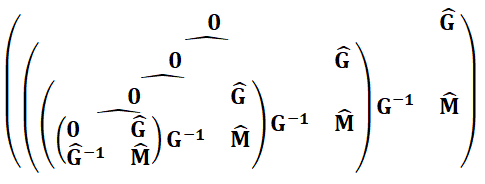
(9) Graphic Figure Equation (9) Matrix construct showing charge asymmetry gauge metrics key.
Essentially, 1 ˆ ˆ −−> G G , cross-diagonal, will extend like gauge “ray” analogous to negative charge like fermion or electron of Gilbertian nature from infinity bringing to real spacelike volt or potential; it is like classical definition of potential unit volt. However, non-gauge with $$ \widehat {- \mathbf {G}} ^ {- 1} $$ also refer to point mirror symmetry of ˆG , as pointed out earlier, which is adequately considerable as gauge field having “star ray”. In essence, therefore 1 ˆ ˆ −−> G G will represent Coulomb gauge fermion charge of microblackhole from infinity of vacuum to real space gauge field of radiation wave. These aspects link charge conjugation to rotating charges per Dirac Maxwell Einstein Kerr Newman metrics [23, 24].
Whereas 0 ˆ −> M , the diagonal Hilbert Higgs metrics within physics literature [22], perhaps quantifies Higgs mechanistic field operator generator, signifying action to matter inertia effectively operating with gravitational field moving from vacuum to matter; $M$ in general will represent Helmholtz transformation symplectics to Higgs field, having subsequent Higgs mechanism to originate God particle giving flavor in the particle mass of Higgs Boson system [11, 12, 21, 22, 23, 24, 25, 26, 27, 28, 29].
Now turning our attention to application of matrix process general formalism having Equation (11) [13] $F^E_t = \rho(t) (<\Psi_\mu(t)|\Psi^\mu(t)>^{-1}v$, we substitute equivalent gauge parameters, obtained from above rigorous derivations as: $\nabla^2 E^pv_g = \hat{G}$, quantifying in Equations (7,8) and (9), we can write logically conclusively extending above solution's arguments as follows:
Let $F^E_t = \hat{G}$; then, we set that $Y = f(X)$, with $X = \rho(t)$ and $Y = F^E_t$ having observables gaging $v = \left\| \nabla E^pv_g \right\|$, giving scalar potential, working with $\rho(t) = \text{quantum density matrix}$, typically representing pure state like coupling constant with general relativity. So,
$$\hat{G} = \left( <\Psi_\mu(t)|\Psi^\mu(t)>^{-1} \right) \left\| \nabla E^pv_g \right\| \rho(t)$$
$f$ is the function operator transforming micro to macro parametrically $\rho(t)$ to $\hat{G}$, that is quantifiable like equation:
$$f = \left( <\Psi_\mu(t)|\Psi^\mu(t)>^{-1} \right) \left\| \nabla E^pv_g \right\|,$$
thereby $\hat{G} = f, \rho(t)$.
With quantum mechanics extendable to non-Hermitian hydrodynamical precessions with classical observables' quantum physics considerations [25, 26, 27, 28, 29, 30, 31, 32, 33, 34, 35, 36], it is possible to advance general gauge formalism quantified above to more compact algorithm of switching modes, that may provide most fundamental physics with nature [37]. In terms of typical systems switching modes {0, off, on} [37], functor can mathematically characterize existence of physics 0 _mode => ::<= on_mode. Off_mode switches may provide compatible coupling function activating functional from 0 _mode towards on_mode; similarly, off_mode coupling function transitioning from on_mode towards 0 _mode can also provide conjugately compatible coupling function activating functional. These processes thence can be effective causality to quantum entangle categorical mode states; we may also note that by virtue of typical character of a functor [15, 18], physically 0 and on modes are quantum decohered at their default states.
One can exemplify observables' analogies with the logical comparable statements giving: rock is like 0 _mode, and fire is like on_mode; then, air is like off_mode function that if it can be compatible coupler agent, then it may activate quantum entanglement of 0 and on modes' default decohered states with natural processes phenomena. Testing of the physical observables naturally may be evident from observation of rock fires, that require special configuration of air with pressure, temperature, humidity, environmental chemistry, among other properties and aspects to get activated epiphany.
These formal gauge metrics set proper situations to apply unitarization processes that help in gauge matching special unitary group mathematical physics. They may then properly herald a grand unification scheme to bring together Theory of Everything, Grand Unified Theories, Standard Model, String Theories, Super Symmetry, Quantum Field Theory with charge, parity, time reversal physical resolutions of matter antimatter asymmetry and provable observables with physics demonstrating natural phenomenological processes. The present question about the role of monopoles will highlight author's ongoing collaborative physics projects with international scientific groups to be able to resolve these issues.
Brief Note about Helmholtz Metrics Gauge to Axial Eccentric Quantum Fields Gravity
With our previous section 4.1 discussion of gauge inverter with gauge, we continue analyzing $\hat{G}^{-1} -> \hat{G}$ gauge "ray" as being nonorthogonal to $0 -> \hat{M}$ vacuum gravitational field axially, having also the diagonal-cross_diagonal matrix with eccentric gauge "ray" axiality. This nonorthogonality aspect promotes precessions, like well-known classical angular momenta physics, as well as nuclear magnetic resonance [31, 32, 33], and the fact that earth's seasons are evolved from precession around eccentric axis [34, 35]. Hence, these are fundamental consequence of magneto gravitational effect shown by above gauge string metrics Equation (9), that can explain Coulomb Gilbertian magnetic monopole gauge non-gauge axial precession around Hilbert Amperian vacuum gravitational field due to nonorthogonal axialities. Quite possibly, microscopic quantum time reversibility inferable from physics with Equation (9) showing Gauge Strings, giving local inversion with non-gauge matter $\hat{G}^{-1} -> \hat{M} < -\hat{G}^{-1}$ gravitational interactive tunneling collapse effect may be analyzed further. Also, one may surmise that these explanations further help to understand about time compression that has proper potential in shifting relativistic worldlines [36], although these are beyond the scope of this paper.
Superposing Signal Superluminal Profile Graph onto Proper Real Extension Time
Like transparencies overlaying on original signal graph [12], one can mathematically hereby conceive of stacking 5 or 6 Riemann sheets like planes, possibly overlaying typically Riemann sheets with Planck thickness “h” [38, 39, 40, 41]. Presently author will enumerate following listing only to explore later:
- constructing on “Vacuum Genesis” original physics literature c speed of light graphic, how real time and proper time will act like outliers.
- superluminal signal profile graph [12] dipping onto outliers’ real proper time.
- $\hat{G}^{-1} \rightarrow M < \hat{G}^{-1}$ extended matrix with constructing
- Coulomb gauge out of Helmholtz matrix already demonstrated having above Equation (9) to generalize unification theories.
- 0-off-on switching modes, with “off” switching mode at left edge having the $\hat{G}^{-1}$ and “on” switching mode at the right edge of the $\hat{G}$ gauge ray, that is nonorthogonal to the 0–$\hat{M}$ vacuum gravitational field axial, and diagonal-cross diagonal matrix with eccentric gauge ray axiality. Notably, [0, off, on] modes will satisfy “Theorem of Switches” [37]. $\hat{M}$ will then add as the fourth “diamond” bridge to the gravitational field proper time metrics branch, indicating non-linear time pathing worldline.
- Quantum Field Theory Feynman diagram [38] also superposable with having vertically twisted or equivalently phase shifted diagram, pointing positron and electron pairs correct direction to the gauge signal graph, with branching of light or magneto field originating from monopole to electron positron generator, considered more here in Particle Physics discussions.
Particle Physics Gauge Matrix
Equation (9) may be inferred as pointing to a typical Dirac’s Sea of electrons towards left infinity of $\hat{G}^{-1}$ Dirac monopoles, while generating positrons at the right infinity of $\hat{G}$, along the gauge ray, $\hat{G}^{-1} \rightarrow \hat{G}$. This separation of the charges can be thought to be likely generators of the spatial matter. It is also quite interesting that local inversion of gauge-nongauge, $\hat{G}^{-1} \rightarrow M < \hat{G}^{-1}$ will constitute positron electron annihilation, leading to energy production, relativistically energy, $E/c^2 = M$, will generate matter as well. Quantum relativity physics becomes consistent theory of everything thus. The vortex Helmholtz decomposition fields may play role of possibly converging thereby generating compressed monopoles, for example, or may expand after divergence to create vacuum monopoles, as expounded below. We analogically equate zero-point $\equiv$ vacuum monopole, microblackhole $\equiv$ gravitational monopole, particle $\equiv$ discrete entity of partial differential equations. In the very “cradle” of the “curdling” plane, $\hat{G}^{-1} \rightarrow M < \hat{G}^{-1}$ can to the $E/c^2 = M$ transformation to create typically neutrino antineutrino pair orthogonal to electron positron “curdling” plane. Far out in that action region, electron + neutron, synthesized out of neutrino grouping, may give rise to proton, which is a hydrogen H+, that are the starry matter. In contrast, away from it (orthogonally), positron + antineutrino may give rise to muons, which constitute equivalent electrons’ mass that much lower. Hence one physics conjecture possibly is that “curdling” of the milky way having Equation (9) of particles with “galaxy” referring to the high signal profile of superluminal velocity [12] will constitute plasmatic quagmire. These are explainable in the context of quantum astrophysics given below.
Quantum Astrophysics Gauge Matrix
Equation (6) as well as this superluminal profile of signals velocity [12] may provide more insight with local inversion of gauge-nongauge, $\hat{G}^{-1} \rightarrow M < \hat{G}^{-1}$ constituting electron positron annihilation, leading to energy production, having relativistically energy originating matter per that $E/c^2 = M$. We know per quantum field theory that electron positron can generate chain like “curdling” action, as per physics literature, explained above in Section 6. Hence one physics conjecture, as mentioned above is possibly that “curdling” of the milky way having Equation (9) of particles with “galaxy” referring to the high signal profile of superluminal velocity [12] will constitute plasmatic quagmire. Overall, receding or fast expanding universe with dark matter may be happening in the background as well that will emphasize about missing matter paradox. One may think of $M$, the flavor metrics with the Standard Model in general with $G$, the gauge field associating with metric flavor. Author is pursuing these aspects of Quantum Astrophysics with his scientific group, where a theoretical model Einstein Gauss Bonnet gravity is fully developed alongside quantum physical analyses that will explain observations of dark energy stars [42].
Interpretations on Virtual Gravitational Dipoles
One may also construe Equation (6) $\hat{G}^{-1} \rightarrow M < \hat{G}^{-1}$ to be two different representations of the gravitational monopoles having gravitational charge of opposite sign per physics literature [24, 25, 26, 29]. Gravitational monopoles probably occur at Planck dimensions particularly originating center of a supermassive blackhole [43, 44]. While vacuum monopoles probably occur infinitely with universal vacuum quanta cosmos extent [45, 46].
**Summary Conclusions**
Author has presented convincingly general formulation of gaging Helmholtz Hamiltonian mechanics to Amperian Gilbertian Hilbert Coulomb Matrix Gauge fields electromagnetic gravity. Iyer Markoulakis Helmholtz Hamiltonian general formalisms have been aptly converted to gauge matrix, following physics literature procedures. Transformation of Helmholtz metrics to Coulomb gauge, linking also Coulomb branch gauge group with Hilbert series has been quantifiably achieved having gradient fields $\left\{ \nabla^2 E_{gpv}, \nabla^2 E_{gpv} \right\} |=\left\{ \hat{G}{gpv}, \hat{G}{gpv} \right\}$ Coulomb gauge, with branching to Hilbertgaugerotationalvortexfields $\left\{ \hat{E}{r{gpv}}, \hat{E}{r{gpv}} \right\} |=\left\{ \hat{M}{r{gpv}}, \hat{M}{r{gpv}} \right\}$, having $M$'s like Higgs metrics mass of Higgs-Boson matter, and conforming to partial differential equations of vortex and the gradient fields obtained per Iyer Markoulakis original formalism.
Vacuum gravitational solutions of the fields provided means to arrive at unitary determinant $\begin{pmatrix} 0 & \hat{G}^{-1} \\ \hat{G}^{-1} & \hat{M} \end{pmatrix}$ that will analytically project having extension of gauge matrix metrics like string metrics construct showing charge asymmetry gauge metrics:
$$\hat{G}^{-1} \rightarrow \hat{G}, \text{cross-diagonal can be extended like gauge "ray" analogous to negative charge like a Standard Model having a fermion or electron of Gilbertian nature at infinity bringing to real spacelike volt or potential, while non-gauge with } -\hat{G}^{-1}$$
refer to point mirror symmetry of $\hat{G}$, typically. Whereas $0 \rightarrow \hat{M}$, the diagonal Hilbert Higgs metrics can quantify as Higgs mechanics field operator generator, signifying action to matter inertia in terms of gravitational field moving the vacuum to matter, $M$ in general representing Helmholtz transformational symplectics to typical Higgs field, having subsequent Higgs mechanism to originate God particle giving flavor mass particle Higgs Boson system.
Further basing author's recent proof formalism, invoking prime matrix properties, derivation of a general potential wave quantum density commutator matrix physics, gauge equivalent expressions have been advanced like $\hat{G} = \left( < \Psi_{\mu}(t) | \Psi_{\nu}(t) \right)>^{-1} \left| \nabla E_{gpv} \right| \rho(t)$, incorporating observables gaging $V = \left| \nabla E_{gpv} \right|$, scalar potential combining with $\rho(t) =$ quantum density matrix, typically representing pure state, like coupling constant in general relativity. Observables' analogies statements compact algorithm of switching modes characterizing most fundamental physics with nature: rock is like 0_mode, and fire is like on_mode; then, air is like off_mode function that maybe epiphany evident from observation of rock fires.
Physical analysis explaining Helmholtz metrics gaging to axial eccentric quantum fields gravity, superimposing model of signal superluminal profile Graph onto proper and real extended time gauge, particle physics gauge matrix to model a way to quantify Helmholtz Hamiltonian mechanics to Dirac monopoles, quantum astrophysics gauge matrix conceptualizations, formalism applying to interpretations on virtual gravitational dipoles, vacuum, and gravitational monopoles at Planck dimensions.
Author is already working to have verification of physical observables with experimental physicists, that will also span quantum, mesoscopic, astrophysical quantum relativistic and classical consistency within a material environmental system having order of magnitude validity, thus narrowing the current range of trillions differential magnitude existing presently. Fundamental logical physical mathematics abstracting observable phenomena mechanisms provide key to physics natural quantifiability that these formalisms demonstrate adequately. Gauge metrics set proper situations to apply unitarization processes that help in gauge matching special unitary group mathematical physics will be next step that author is hoping to undertake. Author hopes having applications spanning across many branches of science, engineering, technology, algorithmic mathematics application to Information Systems, specifically extending to artificial expert systems with quantum computing physics.
**Acknowledgements**
Encouragements with group projects support of Emmanouil Markoulakis of Hellenic Mediterranean
University in Greece, Manuel Malaver of Maritime University of the Caribbean in Venezuela, and perpetual project support of Engineeringinc International Operational Teknet Earth Global Platform collaborations would be appreciated highly. Author is thankful particularly to active RESEARCHGATE scientific physics forums to stimulate sessions providing collaborative ongoing debates, having brainstorming sessions. Ongoing collaborative project, conference, and presentation platforms progress are highly appreciated as well.
References
-
Wilczek F (2016) Physics in 100 years. Physics Today 69(4).
-
Frampton PH (2008) Gauge Field Theories. 3rd (Edn.), Wiley-VCH, Germany, pp: 1-353.
-
Becchi C (1997) Introduction to Gauge Theories. High Energy Physics, arXiv, pp: 28.
-
Jackson JD (2002) From Lorenz to Coulomb and other explicit gauge transformations. Am J Phys 70 (9): 917- 928.
-
Svetlichny G (1999) Preparation for Gauge Theory. Mathematical Physics, arXiv, pp: 97.
-
Cremonesi S, Hanany A, Mekareeyab N, Zaffaronic A (2014) Coulomb branch Hilbert series and Hall- Littlewood polynomials. Journal of High Energy Physics 178(59): arXiv:1403.0585.
-
CLASSICAL GAUGE FIELDS ch3 of Field Theory.
-
Guendelman EI, Singleton D (2014) Scalar gauge fields. Journal of High Energy Physics Springer, JHEP, 1405: 96.
-
Randall L (1997) New Mechanisms of Gauge-Mediated Supersymmetry Breaking. Nuclear Physics, Section B, 495(1): 37-56.
-
Markoulakis E, Konstantaras A, Chatzakis J, Iyer R, Antonidakis E (2019) Real time observation of a stationary magneton. Results in Physics 15: 102793.
-
Iyer R, Markoulakis E (2021) Theory of a superluminous vacuum quanta as the fabric of Space. Phys Astron Int J 5(2): 43-53.
-
Iyer R (2021) Problem Solving Vacuum Quanta Fields. IJRRAS 47(1): 15-25.
-
Iyer R, Malaver M (2021) Proof Formalism General Quantum Density Commutator Matrix Physics. Phys Sci Biophys J 5(2): 000185.
-
Justin JZ, Guida R (2008) Gauge invariance. Scholarpedia 3(12): 8287.
-
Schreiber U, Corfield D (2012) Differential Cohomology in a Cohesive Topos. Schreiber.
-
Gauge Invariance of the Hamiltonian of the electromagnetic field. Physics.
-
Schwarz A (2000) Topological quantum field theories. High Energy Physics, arXiv.
-
Bengtsson AKH (2007) Structure of higher spin gauge interactions. Journal of Mathematical Physics 48(7): 072302.
-
Bengtsson AKH (2008) Towards Unifying Structures in Higher Spin Gauge Symmetry? SIGMA 4(13): 23.
-
Reed M, Simon B (1980) Methods of Modern Mathematical Physics. Volume II, Academic Press INC, pp: 328.
-
McDonald KT (2020) The Helmholtz Decomposition and the Coulomb Gauge. Joseph Henry Laboratories, Princeton University, Princeton, NJ, pp: 1-13.
-
Tamargo GA, Bourget A, Pini A, Gomez DR (2019) Discrete gauge theories of charge conjugation. Nuclear Physics B 946: 114721.
-
Elena Giorgi (2021) The Carter tensor and the physical- space analysis in perturbations of Kerr-Newman spacetime. General Relativity and Quantum Cosmology Mathematical Physics, arXiv, pp: 53.
-
Hafner D, Nicolas JP (2004) Scattering of Massless Dirac Fields by a Kerr Black Hole. Reviews in Mathematical Physics 16(1): 29-123.
-
Weinberg S (2015) Lectures on Quantum Mechanics. 2nd (Edn.), Cambridge University Press, USA.
-
Smith KJ (2013) About identifying quasi-particles using non-Hermitian quantum mechanics, using PT quantum mechanics, Philosophical Transactions: Mathematical, Physical and Engineering Sciences 371(1989): 1-14.
-
Hossenfelder S (2006) Interpretation of Quantum Field Theories with a Minimal Length Scale. Phys Rev D 73: 105013.
-
Matthew D (2014) Quantum Field Theory and the Standard Model. Cambridge University Press.
-
Dirac PAM (1931) Quantised singularities in the electrovacuum field. Proc R Soc Lond 133(821): 60–72.
-
Carl M (2019) PT Symmetry: In Quantum and Classical Physics. World Scientific Publishing.
-
Halliday D, Resnick R, Walker J (2018) Fundamentals of Physics. 11th (Edn), Wiley PLUS Publishing, pp: 1456.
-
Milstead D (2021) The Quantum Mechanics of MRI.
-
Eisbeg R, Resnick R (1985) Quantum Physics of Atoms, Molecules, Solids, Nuclei, and Particles. 2nd (Edn.), John Wiley & Sons, pp: 864.
-
Van den Heuvel EPJ (1966) On the Precession as a Cause of Pleistocene Variations of the Atlantic Ocean Water Temperatures. Geophysical Journal International 11(3): 323–336.
-
Berger A, Loutre MF, Melice JL (2006) Equatorial insolation: from precession harmonics to eccentricity frequencies. Clim Past Discuss 2 (4): 519-533.
-
Andrew JS (2020) General Relativity, Black Holes, and Cosmology. pp: 1-1078.
-
Iyer R (2000) Absolute Genesis Fire Fifth Dimension Mathematical Physics. Engineeringinc International Publisher.
-
Kaiser D (2005) Physics and Feynman’s Diagrams. American Scientist 93 (2): 156-165.
-
Haigh JD (2017) Interactive comment on “The representation of solar cycle signals in stratospheric ozone. Part II: Analysis of global models” by Amanda C. Maycock et al. Atmos Chem Phys Discuss pp C1-C2.
-
Michalski KA, Mustafa MM (2018) On the computation of hybrid modes in planar layered waveguides with multiple anisotropic conductive sheets. Proc R Soc A 474(2218): 1-20.
-
Passarino G, Sturm C, Uccirati S (2010) Higgs Pseudo- Observables, Second Riemann Sheet and All That. Nucl Phys B 834(2): 77-115.
-
Malaver M, Kasmaei HD, Iyer R, Sadhukhan S, Kar A (2021)A theoretical model of Dark Energy Stars in Einstein-Gauss-Bonnet Gravity. General Relativity and Quantum Cosmology pp: 1-26.
-
Benn IM, Dereli T, Tucker RW (1980) Gravitational monopoles with classical torsion. Journal of Physics A: Mathematical and General 13(10): L359-L363.
-
Cho YM Theory of Gravitational Monopole. pp: 715-718.
-
Lantsman LD, Pervushin VN (2003) Monopole Vacuum in Non-Abelian Theories. Phys Atom Nucl 66: 1384-1394.
-
Tesh S (2017) Flash Physics: Sandra Faber wins Gruber prize, transforming magnetic monopoles, vacuum scattering revealed. Cosmology News.
- Sense, Gravity, Parity & Chirality in Mathematical Physics
- Quantum Lattice Simulations PHYSICS: Microcircuit Particle Formation and Observable Macroscopic Irreversible Time - A Discrete Lagrangian with Cellular Automata Framework
- Quantum Biology from Biomacromolecule to Cell, and Central Dogma Described by Quantum Theory
- Focus, Agility, Speed and Technology (FAST) for Sustainability and Growth
- Square Root Metric Geometry and Pati-Salam Model in Curved Space-Time
- A Simple System Demonstrating the Mpemba Effect in Classical Mechanics