
Final Simplest Model of Smallest Particles and Possibly Developed Directions of Particle Physics
First, so far the high energy experiments in the past sixty years have shown that the smallest mass fermions are proton, electron, neutrino and photon, which form the simplest model of particles. These fermions seem to be inseparable truth “atoms” (elements), because further experiments derive particles with bigger mass. They correspond to four interactions, and are also only stable particles. Next, the final simplest theory is based on leptons (e-ν e ) and nucleons (p-n) or (u-d) in quark model with SU(2) symmetry and corresponding Yang-Mills field. Other particles and quark-lepton are their excited states. Their spectrum is mass formula and symmetric lifetime formula. Some applications are discussed. Further, the simplest interactions and unification of weak-strong interactions by QCD are discussed. We research opposite continuous separable models. Finally, we propose some possibly developed directions of particle physics, for example, violation of basic principles, in particular, the uncertainty principle, and precision and systematization of the simplest model, etc.
Introduction
First mesons π are found in 1947, many hyperons are found in 1950s, J / ψ is found in 1974. W-Z bosons are found in 1983, Higgs boson is found in 2012 [1, 2, 3]. Current results include: New experiments validated that quantum mechanics possesses the nonlocality and entangled state [4, 5, 6, 7, 8, 9], and deny the locality hypothesis of relativity, and disobey the Bell inequality. Some experiments indicated existence of superluminal phenomena [5, 6].
In experiments, so far mesons from 135MeV( 0 π ) to states with 6316-6350MeV [10] across 50 times. Quarks from 1.5-3.0MeV(u) to 174GeV(t) across 105, and the mass difference of quark-lepton in the same generation and the corresponding symmetry breaking are bigger and bigger.
At present, accelerators are getting bigger, energy is getting higher, particle mass is getting bigger and bigger. It forms a strange circle and the dilemmas: This is made up of tiny particles from huge particles. The approximate degrees of some theories are increasing, far less than the blackbody radiation, photoelectric effect, atomic spectrum in the early quantum theory, and anomalous magnetic moments and Lamb shift in 1950s. Theory of particle physics seems to appear a big problem! In this paper, we propose the final simplest model on smallest particles and some possibly developed directions of particle physics.
The Simplest Model of the Smallest Particles
1988 Nobel Physics Prize gainer L. Lederman, et al., pointed out that we only must be u and d for quark model, both are composed nucleons p and n. Other particles are electron e and neutrino $v_e$ [11]. In fact first generation of quark-lepton in standard model ($u,d; e,v_e$) constructs the whole stability world. 2004 Nobel Physics Prize gainer Wilczek proposed that standard model should reasonably be called the core theory [12, 13].
So far the high energy experiments in the past sixty years have shown the smallest elements are quark-parton (gluon) in nucleon, and electron as point particle, so are neutrino and photon. Three fermions p, e, $v_e$ and photon are only stable particles. These fermions seem to be inseparable truth “atoms” (elements, unit), because further they are separated to derive particles with growing mass from hyperons to $\Omega_b$ by accelerators at huge energy. These are also the smallest masses fermions with strong, electromagnetic and weak interactions, and $m(v_e) \approx 0$, $m(\gamma) = 0$. Later particles are their complete symmetric excited states, so they decay to the ground state, such as $\mu \rightarrow e\bar{v}v_\mu$ and $\pi^\pm \rightarrow \mu v$, which are strong interactions become into electromagnetic and weak interactions. Further, there are particles with higher energy and bigger mass. It is also results of current high energy experiments.
Free quark cannot be separated and nucleons cannot be broken down again should suggest that quarks are probably true inseparable, where only the composition of three quarks is stable, and correspond to the baryon number conservation. The main thrust result is mesons (quark pair), such as $\gamma + p \rightarrow \rho^0 + p$, and $\pi^- + p \rightarrow K^0 + \Lambda$, then $\Lambda \rightarrow p\pi^- \rightarrow n\pi^0$. So most of particles produced at high-energy are mesons.
The bootstrap mechanism [14] has the rationality, whose basis is that all particles are combined, and their elements correspond to the first generation leptons ($e, v_e$) and quarks ($u, d$), which may develop to nucleons ($p-n, l=1/2$). Then they are some excited states. For example, muon as heavy electron cannot be a point particle because $\mu \rightarrow e\bar{v}v_\mu$, and it should be an excited electron. So is also lepton $\tau$.
The Simplest Theory
Arkani-Hamed, et al. searched the simplest quantum field theory [15]. Faced to very complex particle physics, firstly we must distinguish carefully the experimental results (for example, mass, lifetime, decay modes and various scattering data, etc.) and primary theories which are proved by some basic experiments, and other secondary theories, which are only mathematical or physical hypothesis or deduction [16].
1. Basic states of all particles are photon, leptons ($e-\nu_e$) and nucleons ($p-n$) or ($u-d$) in quark model. The most basis corresponds to the symmetry SU(2) with $l=1/2$ ($p-n$) and quarks ($u-d$), and SU(2) with leptons ($e-\nu_e$). Other particles and second-third generations of quark-lepton are their excited states. These SU(2) are all the isospin I violated due to electromagnetic interaction. Two SU(2) are symmetry and unification. The nucleons are composed of three inseparable quarks $p=uud$ and $n=udd$. Two charges of ($p-n$) and ($e-\nu_e$) are +1 and -1, respectively. First generation quark-lepton are three colors and eight particles, and total charge is all $3(u+d)+e+\nu_e=0$.
SU(2) corresponds to Yang-Mills field equation. This is a symmetric field, and corresponds to mesons $\pi^\pm, \pi^0$ of strong interaction and symmetric bosons $W^\pm, Z$ of weak interaction. $\pi^\pm, \pi^0$ are mesons and hadrons with the smallest mass, both mass difference is 4.59MeV. Mass of $W^\pm, Z$ difference is -10.79GeV.
If electromagnetic interactions are neglected, nucleon-quark and lepton are respectively strong and weak interactions, and latter parity P violation. Further, photon and graviton (spin $J=1,2$) are possibly a pairs, or graviton and repulsion (spin $J=2, -2$) are a pairs.
But, mass of quark model is uncertainty, for example, $m(u)=1.5-3.0\text{MeV}$ and $m(d)=3-7\text{MeV}$, so how to form proton and neutron? $n-p=ddu-duu=du(d-u)=1.29\text{MeV}$.
Proton and electron are Dirac equations only with different masses, whose development is the unified field equation [17]. Neutrino is Weyl equation with $m=0$, photon is Maxwell equation.
2. In particle physics three main interactions are electromagnetic, strong and weak ones. The basic equation of quantum mechanics is the non-relativistic Schrödinger equation:
$$i\hbar \frac{\partial \psi}{\partial t} = \left( -\frac{\hbar^2}{2m} \nabla^2 + U \right) \psi . \tag{1}$$
The time-independent Schrödinger equation is:
$$\nabla^2 \psi + \frac{2m}{\hbar^2} (E - U) \psi = 0 . \tag{2}$$
In the central field Schrödinger equation is:
$$\frac{d^2 \psi}{dr^2} + \left[ -\frac{K(K+1)}{r^2} + \frac{2m}{\hbar^2} (E - U) \right] \psi = 0 . \tag{3}$$
Coulomb potential of electromagnetic interaction is:
$$U_{\text{co}} = -\frac{Q^2}{r} . \tag{4}$$
It may derive the well-known Bohr atomic energy level and spectrum, which corresponds to the mass formula. Energy levels are continuous for $E > 0$, and are discrete spectra for $E < 0$. For general electromagnetic interaction $p_{\mu} \rightarrow p_{\mu} - \frac{e}{c} A_{\mu}$, it may obtain Aharanov-Bohm (A-B) effect, etc.
Yukawa potential of strong interaction is:
$$U_s = -g_s \frac{e^{-mr}}{r} . \tag{5}$$
$$U_s \approx -g_s \left( \frac{1}{r} - m + m^2 r - m^3 r^2 + m^4 r^3 - \dots \right) . \tag{6}$$
It is a unifying potential, which includes already Coulomb potential (first term and $m=0$), constant potential (second term), linear potential (third term), and the potential of the anharmonic oscillator [18, 19] (fourth and fifth terms):
$$U(r) = \frac{1}{2} m \omega^2 r^2 + \alpha r^3 . \tag{7}$$
This theory forms the mass spectrum, which is the Rosen-Ross formula for leptons [20, 21]:
$$M = m_e \left( 1 + \frac{n}{2\alpha} \right) . \tag{8}$$
Assume that $n=3$,
$$M = 206.554 m_e = 105.5 \text{ MeV} = m_{\mu} (105.6 \text{ MeV}) . \tag{9}$$
We extended it to meson [21], let $n=4$, so
$$M = 275.072 m_e = 140.56 \text{ MeV} = m_{\pi^2} (139.57 \text{ MeV}) . \tag{10}$$
Further, assume that hadrons are formed from the emergence string. Usual string possesses two moving states: oscillation and rotation, so we proposed corresponding potential and the equation of the emergence string [22], whose energy spectrum is namely the GMO mass formula and its modified accurate mass formula [21, 22, 23, 24]:
$$M = M_0 + AS + B \left[ I(I+1) - S^2 / 2 \right] . \tag{11}$$
Here $S$ (C) and $I$ correspond to oscillation energy and rotation energy, and the former is much larger than the latter, which is consistent with the conclusion of diatomic molecules. These are some relations between the string and observable experimental data. It may also be based on Higgs breaking or dynamical breaking, and on Morse potential $U = A \left( 1 - Ce^{-br} \right)^2$. First SU(3) is $(u,d,s)$, then it is developed to the symmetric $(u,d,c)$ [22, 23, 24].
For $D_s^{\pm} = c\bar{s}, \bar{c}s \left( J^P = 1^+ \right)$ Martin calculated its average mass is 2.532GeV [25]. Experimental value is 2.535GeV [26].
Based on the Y-Q and I-U symmetries between mass and lifetime on the general SU(3) theory, we derived the lifetime formulas of hyperons and mesons [21, 22, 23, 24]:
$$\tau = A \left[ 2U(U+1) - Q / 2 \right] , \tag{12}$$
and $$\tau = A' \left[ (1/2) + 2U(U+1) - Q / 2 - Q^2 / 3 \right] . \tag{13}$$
They agree better with experiments. It is a new method on lifetime of hadrons described by quantum numbers. They are symmetrical with the corresponding mass formulas, and can be unified for mass and lifetime. Further, these formulas may extend to describe masses and lifetime of heavy flavor hadrons. For hadrons with S,C,B,T, $I=0$, they must consider $S^2, C^2, B^2, T^2$.
For the potential of weak interaction
$$U_w = -g_w \frac{e^{-Mr}}{r} \approx \varepsilon \cong 0 . \tag{14}$$
It is cause very small $g_w$ and very big $M(W-Z)$. Decays are $A \rightarrow B + C + D + \dots$, whose final results are all stable particles $p, e, \nu_e$ and photon.
$U=0$ is free particles. The solution of equation (1) is:
$$\psi = Ae^{ikr} + A'e^{-ikr} = A(\cos kr - i \sin kr) . \tag{15}$$
It is wave form, here $k = \pm \frac{\sqrt{2mE}}{\hbar}$. It corresponds to weak interaction, and asymptotic freedom.
$U_w \approx \varepsilon$ is approximately perturbation. It should be specially perturbation with repulsion in electroweak unified theory.
Strong and weak interactions have probably some similar results with Aharonov-Bohm effect. For example, for smaller range and higher energy there is hyperfine structure.
Rydberg energy is $R_{it} = \frac{1}{2} \alpha^2 \mu_{it} = 3.28805128 \times 10^9 \text{MHz}$, which corresponds to electromagnetic interaction. Weak interaction connects probably Lamb shift: $10^{-6} R_w \approx ag_w R_H$, and hyper Lamb shift (HLS) [27, 28].
The anomalous magnetic moments $\mu$ of electron by the renormalization theory is:
$$\mu = \left[ 1 + \frac{1}{2} \left( \frac{\alpha}{\pi} \right) + C_2 \left( \frac{\alpha}{\pi} \right)^2 + C_3 \left( \frac{\alpha}{\pi} \right)^3 + C_4 \left( \frac{\alpha}{\pi} \right)^4 + \ldots \right] \mu_0.$$
Here $C_2 \approx 0.328479$ [29], $C_3 \approx 1.183$, etc. So far, the experimental $\mu = 1.0011596521859$, and the theoretical $\mu = 1.001159652460$ [30]. They are probably some weak interaction effects, for example, assume that $c' \left( \frac{\omega}{\pi} \right)^2 = g_w$.
For the muon magnetic moment, the theoretical calculation is [31]:
$$\mu = \frac{e \hbar}{2m_\mu} \left( 1 + \frac{e^2}{8 \pi^2} + \frac{e^4}{96 \pi^4} \left[ \ln \frac{m_\mu^2}{m_e^2} + O(1) \right] \right) = 1.00116546 \frac{e \hbar}{2m_\mu}.$$
The experimental value is $\mu_\mu = 1.0011659208(6) \frac{e \hbar}{2m_\mu}$.
Weak interaction only produces decay. Decays develop to electromagnetic and strong interactions should be different equations and formulas, and seem to corresponding electromagnetic and strong decays.
3. Applications
1). The unifying potential (6) includes
By Schrödinger equation this potential may describe $J/\psi, \psi'$ and $Y, Y'$ mesons, and of quarkonium ($c\bar{c}, bb$, etc) [32, 33, 34, 35, 36, 37, 38]. Buchmuller, et al. used a similar QCD potential [39, 40]. Martin used the central potential [41]:
$$V = A + Br^\alpha.$$
$$V = -8.064 + 6.870 r^{0.1}.$$
It corresponds to quark mass $m_c = 1.8$ and $m_b = 5.174$.
2). The decay modes and fractions in particle physics are some quantitative and very complex questions. From free field equation of the decay particles in the momentum coordinate system, we derived the universal decay formulas [21, 42]:
$$\Gamma = \frac{G^2}{4\pi N} m_i^\alpha |P_{i|m|}(x)|^2.$$
In which $x$ is the ratio of the mass-sum of the final state and the mass of the initial state of particle. It can describe generally many important decays of particles ($0^{-+}$ mesons, $(1/2)^+$ baryons and $\mu^\pm$) and some known decays of resonances by the square of some types of the associated Legendre functions $P_l^i$ and $P_{l+1}^i$. This is probably the simplest dynamical basis. It is combined with the $\Delta I = 1/2$ rule, then the agreements are very good. The decay formulas of the similar decay modes are the same. For the same types of particles, the coupling constants are kept to be invariant, and only six constants are independent. Further, we discussed some general decays and their rules, and apply the decay formulas to some massive hadrons. It should correspond to the mass formula and spectrum of free particles [42].
3). The basic equation of scattering (collisions) is the same radial Schrödinger equation. Its spherical scattering elastic wave is:
$$\psi \rightarrow Ae^{ikr} + f(\theta) \frac{e^{ikr}}{r}.$$
So cross section is $q(\theta) = |f(\theta)|^2$. In theory, quantum field theory can describe various scattering sections.
Scattering and its reaction pathways vary, but in the final analysis they divide all into electromagnetic interaction with long-range and strong interaction with short-range. For Coulomb potential and Yukawa potential the Born approximation may obtain the well-known Rutherford formula and cross section
$$\sigma = \frac{4m^2A^2}{\hbar^4(m^2+q^2)^2}.$$
The Pomeranchuk theorem assume that all quark-quark and quark-antiquark scattering amplitudes are asymptotically equal, which is valid at high energy [43].
4. Based on the time-space operators of energy-momentum representation in quantum mechanics, we discussed the space-time operators and their generalization, and proposed some operator equations of general relativity and special relativity. Further, we researched some applications of this method, in particular, the lifetime formulas of particles are obtained from the time equation [44], and they agree better with the experimental data [26]. The width formula and mass formula are symmetry [21, 22]. Both are all strong interaction. This is the simplest unifying quantum theory and general relativity, and corresponds to the extensive quantum theory, and may overcome the singularity problem in general relativity. In a word, this is the combination and unification on quantum mechanics and general relativity [44].
5. For relativistic quantum mechanics [45], the general form of a free-particle solution is:
$$\psi(x) = \omega(k)e^{-ik_\mu x_\mu}.$$ (23)
It is known that Dirac equation may obtain the fine structure of spectrum, electron spin $s=1/2$, intrinsic magnetic moment, and spin-orbit coupling (Thomas term) and so on. We proposed that Bose-Einstein (BE) and Fermi-Dirac (FD) distributions are derived from the nonlinear Klein-Gordon (KG) equation and nonlinear Dirac equation, and both may be unified [21, 46].
Dirac equation is:
$$\gamma_\mu \partial_\mu \psi + m\psi = j.$$ (24)
Let $\eta = \frac{\gamma_\alpha x_\alpha - u\gamma_0 t}{1+u}$, Eq.(24) becomes an ordinary differential equation, whose solution is:
$$\psi = e^{-m\eta} \left( \int je^{m\eta} d\eta + C \right).$$ (25)
If $j$ is independent with $\eta$, so $\psi = (j/m) + Ce^{-m\eta}$. When $m=0$, $\psi = j\eta + C$.
There is a strong similarity between the nucleon and lepton coupling [45]. It is namely similarity between strong and weak interactions.
This theory seems to be already the simplified theory of everything.
Another aspect is well-known theories QED and QCD [47], etc. Some known semi-phenomenological theories include: The S-matrix is a formal device for describing the connections between all possible reactions [43], which has various symmetries [29]. The dispersion relations use the analyticity and unitarity of scattering amplitudes as a way of deriving general non-perturbation results that would not depend on any particular field theory [29]. Both and Regge trajectories and the dual resonance model and scaling are successful in many respects. QCD and new theory of strong interaction should derive these results.
It can be divided into fermions, Dirac equation and bosons, KG equation, and two representations. But, these equations describe usually free particles. This may develop to unified equations of fermion and boson [45] and interactions and momentum representation.
Then it should be extended to gravitational interaction. Unity of big-small scaling is the quantum mechanics of solar system.
Proton $p$ and neutron $n$ consists not of others, but of nuclei. For nuclei the average field is used by Woods-Saxon potential. This has also the saturation. Both add electrons are atoms. A basic reaction is $n \rightarrow pe\bar{v}_e$, which passes through weak interaction, and derives three basic fermions $p, e$ and neutrino.
For leptons, on the one hand, the three generations leptons are $I=1/2$ symmetry; on the other hand, the mass difference of the same generation ($l, v$) is increasing. The strange mesons (K) derive $s$ quark. $J/\psi, \psi'$ derives $c$ quark. ($W^\pm, Z$) corresponds to $(e, \nu_e)$. But, weak interactions (zero mass $\nu_e - \nu_e$) and (very small mass $e - \nu_e$) exchange $W^\pm, Z$ with huge mass, it is surprising. And what do $W^\pm, Z$ consist of, or by the subquark?
The Simplest Interactions and Unification of Weak-Strong Interactions by QCD
QCD is the modern theory of strong interactions, and is a non-Abelian theory based on the gauge group SU(3) [48]. The most general renormalizable Lagrangian for QCD is [48]:
$$L = -\frac{1}{4} F_{\alpha}^{\mu\nu} F_{\alpha\mu\nu} - \sum_{n} \bar{\psi}_{n} [\partial - i g A_{\alpha} t_{\alpha} + m_{n}] \psi_{n} . \tag{26}$$
Here $A_{\alpha}$ is the color gauge vector potential, and $g$ is the strong coupling constant.
Strong interaction exists between quarks $u$ and $d$. This description must only a simplified QCD for $u$-d. Electromagnetic interaction exists between quarks $u$-d and $e$. Weak interaction exists among all quarks and leptons.
Various interacting particles are gluon $g$ with I(J)=0(1), photon $\gamma$ and $W^{+}, Z^{0}$, in which the simplest model has only four particles. Further, they may be composed of first generation of quark-lepton: $g^{+} = u d^{-}$, $\gamma = v \bar{\nu}$ (both masses are zero) and $W^{+} = e^{+} v$, $Z^{0} = e^{-} e^{+}$ (both masses are very big).
The best important real fermions are four: $p, n, e$ and $\nu_{e}$. Strong interactions between nucleons ($p, n$) pass through $\pi^{+}, \pi^{0}$. Electromagnetic interactions between nucleons and electrons pass through photon $\gamma$. Weak interaction among all nucleons and leptons pass through $W^{+}, Z^{0}$. It adds again graviton, and then are six particles.
Further, it should combine the nonlocal theory and entangled states, which are relation between particles outside and particles. QCD are particles inside and strong interaction.
Now experiments verified the quark-parton model. Except the valence quark, there are the sea quarks and gluons, how many quarks in a particle we know there are? Assume that $p = u u d + n(q \bar{q}) + m g$ and $n = u d d + n'(q \bar{q}) + m' g$. Let $n=n', m=m'$, so mass difference of $n$ and $p$ is $u-d$.
Gluon has gauge invariance, and $m=0$. So its interaction distance should be infinite, and it derives the ghost field. But, it predicts the gluon globe has not been found so far.
The coupling constant $\varepsilon > 0$ is repulsion, and combination of quarks and antiquarks forms a color singlet, so interaction $\varepsilon = -8/3 < 0$ is attraction.
Only consider two quarks ($u, d$), $\psi = \begin{bmatrix} u \\ d \end{bmatrix}$. If $m$ is not 0, it will be Dirac equation. Mass of electron is very small, and $m=0$ has the isospin SU(2) and chiral symmetry. For Goldstone particle SU(2) corresponds to $\pi$ meson with $m$ is approximately 0; mass is not 0, which corresponds to the partial conservation of axial-vector current (PCAC).
Schrödinger equation with potential may apply to N-body and many-particles [49]. But, so far it remains still problems that the relativistic Klein-Gordon equation and Dirac equation apply to many-particles. This may be:
- Similar potential, but the description of relativistic potential is difficult.
- Nonlinearity and interactions.
- Formation of general relativity.
These are also related by quantum field theory. All three correspondence principle is Schrödinger equation with potential.
Dyson and Lenard gave proof of “material stability” [50]. Lieb and Thirring made quantitative simplification and great improvement [51], but it still needs deep study [52].
Assume that Pions $\pi$ as Goldstone bosons, the classic example of a broken symmetry in particle physics is the approximate symmetry of strong interactions known as chiral SU(2)×SU(2) [48]. This symmetry arises because there are two quarks fields, $u$ and $d$, that happen to have relatively small masses.
It is known that the coupling constant of strong interaction is $g^{2}/4 \pi \approx 15$, the coupling constant of weak interaction is $\approx 10^{6}$. The range of strong interaction is $m_{\pi}^{-1} \approx 1.4 \times 10^{-13} \text{ cm}$ [53], the range of weak interaction should be $m_{WZ}^{-1} \approx 2 \times 10^{-16} \text{ cm}$. When distance is reduced to this range, and corresponding energy increase, weak interaction will play a main role: repulsion each other and decay. This may be the reason why particles cannot be separable.
Based on various known unified theories of interactions in particle physics, we proposed that strong and weak interactions with short-range should more be unified. Except different action ranges their main character is: strong interactions are attraction each other, and weak interactions are mutual repulsion and derive decay. We researched a possible method on their unification, whose coupling constants are negative and positive, respectively [54].
The main features of QCD are asymptotic freedom and quark confinement. For the effective ‘running’ coupling constant under a single-loop graph approximation the basic formula is a very successful formula:
$$ \alpha_ {\mathrm {S}} \left(Q ^ {2}\right) = \frac {g _ {S} ^ {2}}{4 \pi} = \frac {4 \pi}{\beta_ {0} \ln \left(Q ^ {2} / \Lambda^ {2}\right)}. \tag {27} $$ ) / ln( 4 4 ) ( 2 2 0 When energy 2 Q ∞, the coupling constant of strong interaction ) ( 2 S Q α 0, i.e., asymptotic freedom. When 2 Q 0, the coupling constant ) ( 2 S Q α ∞, i.e., quark confinement.
For general case 0 0 > β , when energy 2 2 Λ > Q in which Λ is QCD scale parameter, and is few hundred MeV.
The coupling constant ) ( 2 S Q α >0, i.e., strong interaction with attraction; when 2 2 Λ < Q , ) ( 2 S Q α <0, which should be weak interaction with repulsion. If 0 0 < β , so case will be opposite. This is from strong interaction and QCD to weak interaction and quantum weak dynamics (QWD).
$$ \mathrm {L e t} \beta_ {0} = 1 1 - \left(2 n _ {f} / 3\right), \mathrm {s o} $$ $$ \chi_ {s} \left(Q ^ {2}\right) = \frac {4 \pi}{\left(1 - 2 n _ {f} / 3\right) \ln \left(Q ^ {2} / \Lambda^ {2}\right)} $$ π α , (28) ) / ln( ) 3 / 2 1( where fn is the number of quark flavors participating in the interaction at this Q.
General fn <33/2=16.5, s α >0. fn >16.5, s α <0. fn =16.5, s α =∞. Let fn =6 and β =0, f α =12.726 is an inflection point, from infrared attraction to ultra-violet repulsion [55]. The unification of strong and weak interactions is that SU(3) degenerate and simplified to SU(2) at shorter action distances and decay. Eight gluons are simplified to three W and Z.
Further, strong-weak interactions and QED may be unified by δ 2 0 g , in which δ >0 for QCD, δ <0 for SU(2), and δ =0 for QED [56].
In each energy range there have a different scale Λ , for example, Λ =253MeV [48] or Λ =500MeV [57]. For unified s α in Eq.(28), if fn <33/2, s α >0 for Q> Λ ; when Q∞, s α 0 is the asymptotic freedom; when Q= Λ , s α ∞ is an impossible state; s α <0 for Q< Λ .
So far, gravitational interaction has only one mass, electromagnetic interaction has two charges, strong interaction has three colors. Further, we proposed the Figure 1 on the unification of the four basic interactions in three-dimensional space. Based on the simplest unified gauge group GL(6,C) of four-interactions, a possible form of Lagrangian is researched. Some relations and the equations of different interactions are discussed.
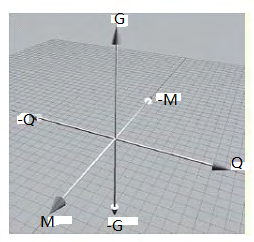
In the electroweak theory the couplings:
θ sin / e g − = and θ cos / ' e g − = , (29)
so g and $g' < 0$ [48].
Continuous Separable Model
Opposite model is continuous separable, as if subquark-preon model, even prepreon model and infinite small sandon model, and superstring model, etc. Quark-leptons are composed of smaller subquarks. The simplest subquark model is the rishon model [58], or equivalence quip model [59], in which first generation leptons ($e, \nu_e$) and quarks ($u,d$) with three colors are eight, which are composed of two elements T, V (or $a^+$, $a^0$). Assume that both correspond to R (Yin) and L (Yang), so first generation quark-lepton is:
$$e^+ = \text{LLL}, \nu_e = \text{RRR} \text{ and } u = (\text{LLR}, \text{LRL}, \text{RLL}), \bar{d} = (\text{LRR}, \text{RLR}, \text{RRL}).$$
In this model leptons composed of single elements $e^+ = \text{LLL}$ and $\nu_e = \text{RRR}$, and quarks composed of mixture elements $u = \text{LLR}$ and $\bar{d} = \text{LRR}$. Their electric charge are $e(L) = 1/3$ and $e(R) = 0$.
This will be completely the same with the Eight Diagrams composed of R and L [21]. Therefore, it is called subquark model of Eight Diagrams. But, spins of this type of models cannot overcome.
Second and third generations of quark-lepton $c, s, \mu, \nu_\mu$ and $t, b, \tau, \nu_r$ should be different excitations by the same elements. They possess beautiful symmetry. Symmetry is unified and beautiful, but symmetry breaking can produce complexity and evolution. QCD and quark-gluon are strictly symmetrical for color.
If strong interaction $g > 0$, i.e., $g(1+1/2+1/3+...)$, and weak interaction $g' < 0$, i.e., $g' = (-1-1/2-1/3-...)$, so both add results as the perturbation theory $g-g'$, or $g(1-1/2+1/3-1/4+...) = 0.693_g$ for $g=g'$.
Possibly Developing Directions of Particle Physics
1. Continue to probe various particles of the standard model. This is the current mainstream of high energy physics.
2. Possible violations of some basic principles. A key is the uncertainty principle. We proposed a necessary contradiction between the uncertainty principle and the constancy of the speed of light [60]. Based on quantum mechanics we obtained the uncertainty relations of velocity as a ratio of position to time are:
$$\Delta v \Delta(pt) = \hbar,$$
or $$\Delta v \Delta(mx) = \hbar.$$
The speed of light as the velocity is also uncertain, for $v=c$ [31][32] become:
$$\Delta c \Delta(\frac{\nu}{c^2} x) = 1,$$
or $$\Delta c \Delta(\frac{\nu}{c} t) = 1,$$
where $\nu$ is the frequency of light, $x$ and $t$ are position and time of uncertainty, respectively. So long as the uncertainty principle holds, the speed of light possesses uncertainty necessarily, moreover, when $x$ and $t$ and $\nu$ are made more definite, $c$ becomes less definite. The speed of light should have the statistical fluctuations inside a small space-time and at high energy. Further, some fundamental constants probably are also uncertain. We proposed that relativity and quantum theory will be able to be unified completely only after both are developed [60, 61].
Generally, if the uncertainty principle holds always, separable particles should be come to an end. The known size of superstring is very small $\Delta x \cong 10^{-35} \text{cm}$. According to the uncertainty principle, a corresponding momentum of superstring is:
$$\Delta p = h / \Delta x \cong 6.626 \times 10^8 \text{gcm/s}.$$
If the velocity of superstring is approximately velocity of light, its moving-mass will possess a macroscopic mass $5.618 \times 10^{26} \text{MeV/c}^2 = 2.209 \times 10^{-2} \text{g}$ [61].
Special relativity should research the superluminal and direction of time. They can correspond to the non-commutation of time operator in quantum mechanics. We investigated the irreversible and evolutional physics, and introduced various arrows of time and their possible unification. We researched the possible mathematical formations on the irreversibility of time, which includes semigroup and supercomplex time of vector, and proposed mathematically the semigroup physics and the semigroup science, and searched generalized Noether’s theorem [62].
3. Precision and systematization of the simplest model. This seems to correspond to the “ultimate theory”.
4. Great physicist Feynman pointed out: “There are certain situations in which the peculiarities of quantum mechanics can come out in a special way on large scale.” In a special situation “quantum mechanics will produce its own characteristic effects on a large or ‘macroscopic’ scale” [63]. According to Feynman’s idea and based on a new form $r_n = an^2$ of the Titius-Bode law, we developed a similar theory with the Bohr atom model, and obtain the quantum constants of the solar system and corresponding Schrödinger equation. Further, we proposed the extensive quantum theory [64, 65] and its three laws:
- Extensive quantum is its element in any system.
- Its theory has similar quantum formulations with different quantum constants H.
- Evolutions of systems may be continuous, but stable states are quantized [66].
Its mathematical base is fractal. We researched superconductivity, superfluidity, Bose-Einstein condensation (BEC), and various macroscopic quantum phenomena by this theory. We search the extensive quantum biology [65] and its application in DNA, and researched the extensive quantum theory in social sciences, and the social entangled states and exclusion [66].
Generally, the extensive string develops to the extensive loop. For Sun-Earth system, the extensive Planck space-time is:
$$L_{eP} = \left( \frac{HMG}{c^3} \right)^{1/2} = 4.15 \times 10^{40} \times 1.61 \times 10^{-35} = 6.6815 \times 10^5 \text{ m}.$$
(36)
$$t_{eP} = \left( \frac{HMG}{c^5} \right)^{1/2} = 2.23 \times 10^3 \text{ sec}.$$
Further, G and c may also chance.
5. Beyond the smallest standard model are the known CP asymmetry, Higgs mechanism and hierarchy problem, neutrino oscillations, supersymmetry and so on.
6. Other new possible developments include possibly: a) Quantum entanglement, and corresponding the nonlinear superposition principle [21, 67]. b) In astronomy dark matter, dark energy, and high energy astrophysics. c) Unification of various interactions, and of quantum and gravitation. d) Possible entropy decrease due to internal interactions in some isolated systems [68, 69, 70, 71, 72, 73]. In 2021, we proposed that since coherence, entanglement and correlation are all internal interactions in information systems, we discussed quantitatively entropy decrease along coherence, and entropy increase only for incoherence. Based on some astrophysical simulation models, they shown that the universe evolves from disorder to structures, which correspond to entropy decrease. This is consistence with theoretical result. The simulation must be an isolated system only using internal gravitational interactions [74]. e) Biophysics, molecular motors in biology, viruses, etc.
Conclusion
Our model agrees with the Occam’s razor, and with inference to the best explanation. From ancient Greek philosophers to great scientists Newton, R. Boyle and J. Dalton believed that matter is composed of inseparable basic units. But, it lacks reliable evidence, and is constantly broken through. Now sixty years of scientific development seem to prove this clear conclusion, and it is also an edge of knowledge [75].
References
-
ATLAS Collaboration, Aad G, Abajyan T, Abbott B, Abdallah J, et al. (2012) Observation of a new particle in the search for the standard model Higgs boson with the ATLAS Detector at the LHC. Phys Lett B 716(1): 1-29.
-
Aaltonen T, Abazov VM, Abbott B, Acharya BS, Adams M, et al. (2012) Evidence for a particle produced in association with weak bosons and decaying to a bottom-antibottom quark pair in Higgs boson searches at the Tevatron. Phys Re Lett 109(7): 071804.
-
Chatrchyan S, Khachatryan V, Sirunyan AM, Tumasyan A, Adam W, et al. (2012) Observation of a new boson at a mass of 125 GeV with the CMS experiment at the LHC. Phys Lett B 716(1): 30-61.
-
Pan JW, Bouwmeester D, Daniell M, Weinfurter H, Zeilinger A (2000) Experimental test of quantum nonlocality in three-photon Greenberger-Horne-Zeilinger entanglement. Nature 403(6769): 515-519.
-
Zbinden H, Brendel J, Gisin N, Tittel W (2001) Experimental test of nonlocal quantum correlation in relativistic configurations. Phys Rev A 63: 022111.
-
Stefanov A, Zbiden H, Gisin N, Suarez A (2002) Quantum Correlations with Spacelike Separated Beam Splitters in Motion: Experimental Test of Multisimultaneity. Phy Rev Lett 88(12): 120404.
-
Bussieres F, Slater J, Jin J, Godbout N, Tittel W (2010) Testing nonlocality over 12.4 km of underground fiber with universal time-bin qubit analyzers. Phys Rev A 81: 052106.
-
Mazzola L, Bellomo B, Franco RL, Compagno G (2010) Connection among entanglement, mixedness and nonlocality in a dynamical context. Phys Rev A 81: 052116.
-
Miao H, Danilishin S, Chen Y (2010) Universal quantum entanglement between an oscillator and continuous fields. Phys Rev A 81: 052307.
-
Aaij R (2020) First Observation of Excited − Ωb States. Phys Rev Lett 124(8): 082002.
-
Lederman L, Teresi D (1993) The God Particle: If the Universe Is the Answer, What Is the Question? Boston: Houghton Mifflin.
-
Wilczek F (2009) The Lightness of Being: Mass, Ether, and the Unification of Forces. Physics Today 62(4): 61.
-
Wilczek F (2015) A Beautiful Question: Finding Nature’s Deep Design.
-
Chew GF (1966) The Analytic S Matrix, a Basis for Nuclear Democracy and the Analytic S matrix. Physics Today 20(9): 82.
-
Arkani-Hamed N, Cachazo F, Kaplan J (2010) What is the simplest quantum field theory? J High Energy Physics 9: 016.
-
Chang YF (2009) Ten Puzzles in Particle Theory and Quarks as Only Possible Magic Particles with Some Symmetries, pp: 1-15.
-
Heisenberg W (1966) Introduction to the Unified Field Theory of Elementary Particles. Inter science Publishers.
-
Landau L, Lifshitz E (1977) Quantum Mechanics, Non- Relativistic Theory. Oxford: Pergamon Press 39(5-6): 250.
-
Flugge S (1999) Practical Quantum Mechanics. Springer- Velag Berlin Heidelberg.
-
Ross DK (1972) A heuristic model of the muon. Nuov Cim 9: 254-262.
-
Chang YF (1989) New Research of Particle Physics and Relativity. Phys Abst V 93: 1371.
-
Chang YF (2012) Emergence string to mass formulas of hadrons and symmetric lifetime formulas of hadrons. International Review of Physics 6(3): 261-268.
-
Chang YF (2018) Accurate mass formulas and prediction of masses on heavy flavor hadrons. Hadronic Journal 41(3): 221-231.
-
Chang YF (2018) Mass predictions and lifetime formulas of heavy flavor hadrons, and simplify of supersymmetry. Hadronic Journal 43: 153-160.
-
Martin A (1989) The mass of the cs P state. Phys Lett B 223: 103-104.
-
Tanabashi M (2018) Review of Particle Physics. Phys Rev D 98(3): 030001.
-
Weitz M, Huber A, Schmidt-Kaler F, Leibfried D, Hänsch TW (1995) Precision measurement of the hydrogen and deuterium ground state Lamb shift. Phys Rev Lett 52(4): 2664.
-
Jentschura UD, Mohr PJ, Soff G (1999) Calculation of the electron self-energy for low nuclear charge. Phys Rev Lett 82: 53-55.
-
Petermann A (1957) Magnetic Moment of the μ Meson. Phys Rev 105(6): 1931.
-
Kinoshita T, Lindquist WB, Kinoshita T, Lindquist WB (1981) Eighth-order anomalous magnetic moment of the electron. Phys Rev Lett 47: 1573-1576.
-
Weinberg S (1995) The Quantum Theory of Fields. Volume 1: Foundations, Cambridge University Press, USA.
-
Applequist T, De Rujula A, Politzer HD, Glashow SL (1975) Spectroscopy of the new mesons. Phys Rev Lett 34(6-10): 365-368.
-
Eichten E, Gottfried K, Kinoshita T, Kogut J, Lane KD, et al. (1975) Spectrum of charmed quark-antiquark bound states. Phys Rev Lett 34(6): 369-371.
-
De Rujula A, Geogi H, Glashow SL (1975) Hadron masses in a gauge theory. Phys Rev 12(1): 147-162.
-
Stanley DPT, Robson D (1980) Do Quarks Interact Pairwise and Satisfy the Color Hypothesis? Phys Rev Lett 45(4): 235-238.
-
Stanley DP, Robson D (1980) Nonperturbative potential model for light and heavy quark-antiquark systems. Phys Rev D 21(11): 3180-3196.
-
Kociuk P, NaIsgur N (1980) Baryon decays in a quark model with chromodynamics. Phys Rev D 21(7): 1868- 1886.
-
Richard JM, Taxil P (1983) Ground state baryons in the non-relativistic quark model. Annals Phys 150(1): 267- 286.
-
Buchmuller W, Grunberg G, Tye SHH (1980) Regge slope and the Λ parameter in quantum chromodynamics: An empirical approach via quarkonia. Phys Rev Lett 45(2): 103-105.
-
Buchmuller W, Tye SHH (1981) Quarkonia and quantum chromodynamics. Phys Rev D 24(1): 132-156.
-
Martin A (1981) A simultaneous fit of b overlineb, c overlinec,s overlines (bcs Pairs) and c overlines spectra. Phys Lett B 100(6): 511-514.
-
Chang YF (2013) Universal decay formulas of particles and magnetic moment formulas of baryons determined by quantum numbers. International Journal of Modern Theoretical Physics 2(3): 184-205.
-
Feld BT (1969) Models of Elementary Particles. Blaisdell Publishing Company.
-
Chang YF (2020) Quantum time-space equations and applications, and unifying quantum theory and general relativity. International Journal of Modern Applied Physics 10(1): 16-34.
-
Bjorken JD, Drell SD (1964) Relativistic Quantum Mechanics. McGraw-Hill, Inc.
-
Chang YF (2013) Unified quantum statistics, possible violation of Pauli exclusion principle, nonlinear equations and some basic problems of entropy. International Review of Physics 7(4): 299-306.
-
Muta T (1998) Foundations of Quantum Chromodynamics, 2nd (Edn.), World Scientific.
-
Weinberg S (1998) The Quantum Theory of Fields. Volume 2: Modern Applications. Cambridge University Press.
-
Grosse H, Martin A (1997) Particle Physics and the Schrödinger Equation. Cambridge University Press.
-
Dyson FJ, Lenard A (1967) Stabilily of matter. J Math Phys 8: 423-434.
-
Lieb EH, Thirring W (1975) Bound for the kinetic energy of fermions which proves the stability of matter. Phys Rev Lett 35(11): 687-688.
-
Helffer B, Robert D (1990) Riesz means of bounds states and semiclassical limit connected with a Lieb-Thirring’s conjecture I. Asymptotic Analysis 3(2): 91-103.
-
Marshak RE, Riazuddin, Ryan CP (1969) Theory of Weak Interactions in Particle Physics. Wiley-Interscience.
-
Chang YF (2020) Unification of strong-weak interactions and possible unified scheme of four-interactions. European Journal of Applied Sciences 8(5): 28-47.
-
Yong BL (1987) Introduction to Field Theory. Science Press.
-
Lee TD (1981) Particle Physics and Introduction to Quantum Field Theories. Amsterdam: OPA.
-
Yagi K, Hatsuda T, Miake Y (2005) Quark-Gluon Plasma: From Big Bang to Little Bang. Cambridge University Press, USA.
-
Harari H (1979) A schematic model of quarks and leptons. Phys Lett B 86(1): 83-86.
-
Shupe MA (1979) A composite model of leptons and quarks. Phys Lett B 86(1): 87-92.
-
Chang YF (2001) Contradiction between the uncertainty principle and the Constancy light speed. Galilean Electrodynamics 12(4): 77-79.
-
Chang YF (2016) Uncertain physics, fluctuation-chaos and general uncertain sciences. International Journal of Modern Mathematical Sciences 14(4): 386-397.
-
Chang YF (2015) Irreversible physics of evolution, arrows of time and semigroup physics. International Journal of Modern Theoretical Physics 4(1): 59-77.
-
Feynman RP, Leighton RB, Sands M (1966) The Feynman Lectures on Physics. Vol 3, Chapter 21, Addison-Wesley Publishing Company, 21-1.
-
Chang YF (2002) Development of Titius-Bode law and the extensive quantum theory. Physics Essays 15(2): 133-137.
-
Chang YF (2012) Extensive quantum biology, applications of nonlinear biology and nonlinear mechanism of memory. NeuroQuantology 10(2): 183-189.
-
Chang YF (2018) Extensive quantum theory with different quantum constants, and its applications. International Journal of Modern Mathematical Sciences 16(2): 148-164.
-
Chang YF (2014) A possible development of nonlinear quantum theory and its tests. International Journal of Modern Mathematical Sciences 11(2): 75-93.
-
Chang YF (1997) Possible decrease of entropy due to internal interactions in isolated systems. Apeiron. 4(4): 97-99.
-
Chang YF (2005) Entropy, fluctuation magnified and internal interactions. Entropy 7(3): 190-198.
-
Chang YF (2012) “Negative temperature” fallacy, sufficient-necessary condition on entropy decrease in isolated systems and some possible tests in physics, chemistry and biology. International Review of Physics 6(6): 469-476.
-
Chang YF (2019) Self-organization, critical phenomena, entropy decrease in isolated systems and its tests. International Journal of Modern Theoretical Physics 8(1):17-32.
-
Chang YF (2020) Entropy decrease in isolated systems: theory, fact and tests. International Journal of Fundamental Physical Sciences (IJFPS) 10(2): 16-25.
-
Chang YF (2020) Development of entropy change in philosophy of science. Philosophy Study 10(9):517-524.
-
Chang YF (2021) Information, entropy decrease and simulations of astrophysical evolutions. Physical Sciences & Biophysics Journal 5(2): 1-11.
-
Sautoy MD (2016) What We Cannot Know: Explorations at the Edge of Knowledge. Fourth Estate.
- Sense, Gravity, Parity & Chirality in Mathematical Physics
- Quantum Lattice Simulations PHYSICS: Microcircuit Particle Formation and Observable Macroscopic Irreversible Time - A Discrete Lagrangian with Cellular Automata Framework
- Quantum Biology from Biomacromolecule to Cell, and Central Dogma Described by Quantum Theory
- Focus, Agility, Speed and Technology (FAST) for Sustainability and Growth
- Square Root Metric Geometry and Pati-Salam Model in Curved Space-Time
- A Simple System Demonstrating the Mpemba Effect in Classical Mechanics