
Why do we See One Side of the Moon?
As a rule, this is explained by the fact that it makes one revolution around its axis during one flyby around the Earth. But what and how makes her do this? There is another explanation-because of tidal forces, but how do they affect and what are tidal forces on the moon? If there are tides, then there must be tides, but they are not detected. In principle, these two explanations are legitimate, but it is necessary to explain a little the mechanics of such a movement. By the way, many satellites behave the same way as the Moon, rotating around their planets.
Short Communication
Its former rotation is indicated by the presence of meteorite craters on the entire surface, and not only on the side facing space, from where meteorites come. The former rotation is also confirmed by the fact that previously it had a strong magnetic field, and now only a residual one, i.e. what remained in the form of magnetized particles of the lunar soil. And a magnetic field can only occur when electric charges move, and movement is possible only when rotating.
You can read about how the Magnetic Field of the planets originated in the article [1].
During the evolution of the Solar System and the cooling of the Moon, heavier masses of internal matter, ceasing to move in a circle, grouped in the side of the satellite facing the Earth, thus turning the Moon into a kind of “Roly-Poly”, and forcing it to turn to us with the same heavy side.
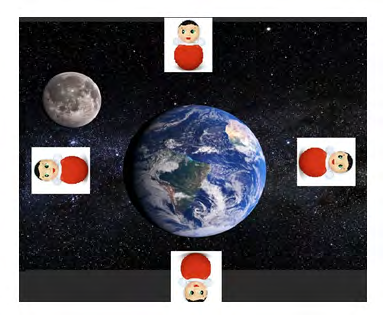
And just like this famous toy, it sways, relative to the heavy part, forming a so-called liberation, which allows the terrestrial observer to look a little beyond the geometric edges of the visible flat circle (Figure 1).
Thus, the gravitational force of the Earth not only keeps the Moon in the orbit of the satellite, but also makes it constantly rotate, and energy is spent on this and, probably, this can lead to partial cooling of the Earth, but, on the other hand, the mass of the Moon affects the movement of the inner core of the Earth, and the movement of the core leads, due to friction forces, to the warming of the planet. Which of these causes affects more is not very clear yet.
The fact that most satellites revolve around their planets, turning one side towards them, and the rotation of planets such as Venus and Mercury. Synchronized with the movement of the Earth (these two planets, when approaching the Earth, turn towards it with one hemisphere), suggests that the planets interact with each other as bodies with displaced centers of mass. At the same time, in the case of a liquid, mobile, core, this center can move inside the solid shell of the planet.
References
-
Danilov V (2016) On the Nature of the Magnetic Field of the Earth and Other Planets. Progress in Physics Issue 12(1): 41-48.
- Sense, Gravity, Parity & Chirality in Mathematical Physics
- Quantum Lattice Simulations PHYSICS: Microcircuit Particle Formation and Observable Macroscopic Irreversible Time - A Discrete Lagrangian with Cellular Automata Framework
- Quantum Biology from Biomacromolecule to Cell, and Central Dogma Described by Quantum Theory
- Focus, Agility, Speed and Technology (FAST) for Sustainability and Growth
- Square Root Metric Geometry and Pati-Salam Model in Curved Space-Time
- A Simple System Demonstrating the Mpemba Effect in Classical Mechanics