
Study of Nano-Al2O3 + Nano-SiO2 + H2O System by Fourier-IR-Spectroscopy Method
The radiation-thermal decomposition of water in the nano-Al2 O3 +nano-SiO2 +H2 O system in the temperature range (T=373÷673K) under the influence of -rays using Fourier transform IR spectroscopy has been studied. Intermediate-active products of radiation-heterogeneous decomposition of water such as aluminum and silicon hydrides, hydroxyl groups have been registered. It was determined that in this heterosystem, an absorption dose of 10 kGy occurs in the radiation-chemical decomposition of water.
Introduction
The development of nanomaterials production is determined by important issues of modern materials science. The transition to nanoscale materials, on the one hand, leads to a reduction in existing dimensions, on the other hand, to a significant increase in the surface area of the nanoparticle system. Thus, when considering processes involving nanoparticles, two factors at the same time - small size and large values of the specific surface - play an important role. Nanooxides (ZrO2, SiO2, TiO2, Al2O3, etc.) are currently used as catalysts in the formation of molecular hydrogen during the radiolysis of water under the influence of gamma quanta [1, 2, 3, 4]. The most promising catalysts among such nanooxides are aluminum and silicon oxides. These nanoxides are considered selective catalysts for radiation-hetero-gene processes. In the process of radiolysis of water, various methods are used to determine the mechanism of radiation- catalytic action of oxide catalysts, as well as spectroscopic methods [4, 5, 6, 7]. Radiation-thermal decomposition of water in many nanooxide + water systems has been studied using Fourier-IR spectroscopy [8, 9, 10]. However, there is almost no information in the literature on the radiation-thermal decomposition of water in the nano-Al2O3 + nano-SiO2 + H2O system. The results of Fourier-IR spectroscopic studies of radiation-thermal decomposition of water at different temperatures on the surface of the nano-Al2O3 + nano-SiO2 + H2O heterosystem are presented in the presented work.
Experimental Part
Al2O3 and SiO2 (Sky Spring Nanomaterials, USA) nanoparticles with dimensions d = 20-30 and 20-60 nm and 99.9% purity were used in the research. After adsorption, aluminum and silicon oxides were subjected to thermovacuum treatment at T = 673K and P = 10-3Pa for 8 hours to clean the surface from organic contaminants. Water adsorption was carried out by the method [6]. Fourier-IR spectra were recorded on the Varian 640FT-IR spectrometer in the range 4000-400cm-1. For this purpose, samples with a thickness of 0.6-1.2 microns were prepared from Al2O3 and SiO2 nanooxides. Radiation-thermal decomposition of water was carried out in nano-Al2O3 + nano-SiO2 + H2O system at different temperatures. The samples were irradiated at a dose rate of dDγ / dt = 0.11 Gy/ s at a 60Co isotope source. Source dosimetry was performed with ferrosulfate and methane dosimeters [11]. The radiation absorption dose in the studied systems was compared with the electron densities. Radiation time was τ = 25 hours (Dγ = 10kGy).
Discussion of Results
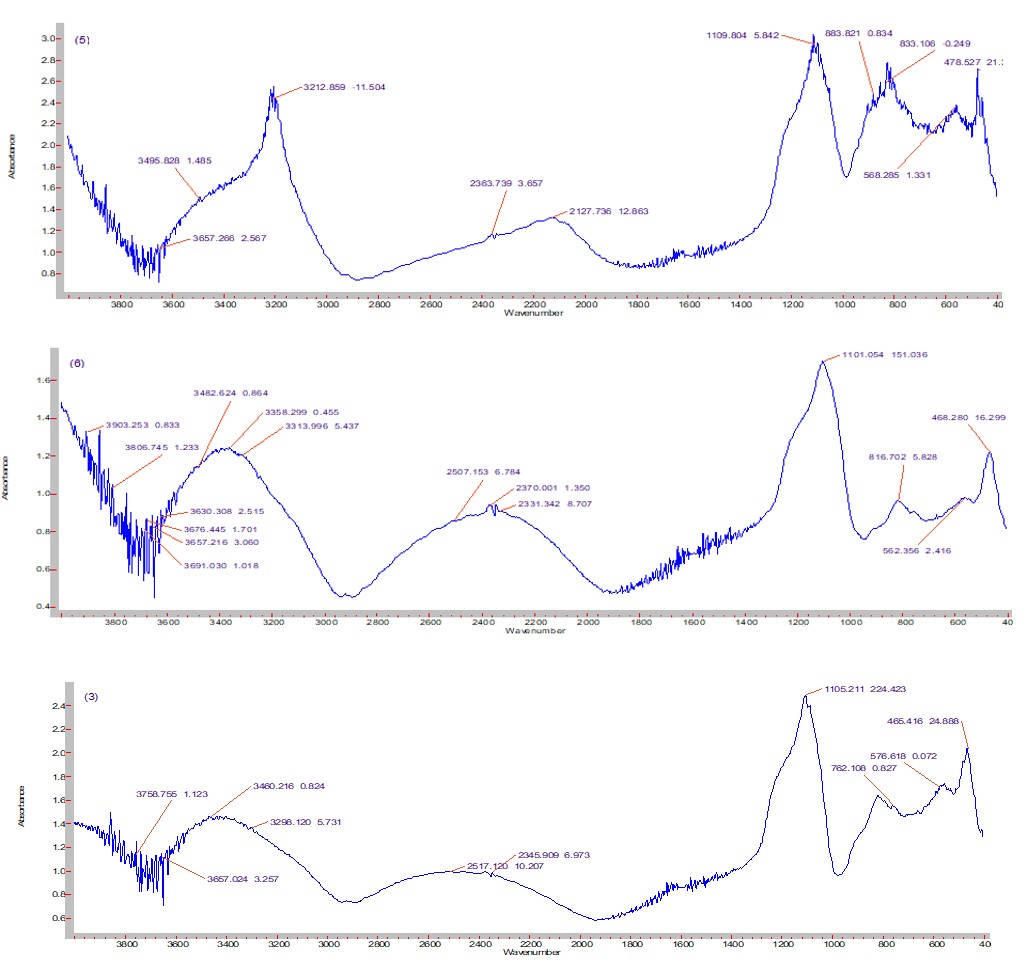
Fourier-IR spectroscopic studies of the nano-Al2O3 + nano-SiO2 + H2O (1: 1) system were conducted to reveal the interaction between the components of nanooxide (nano- Al2O3 and nano-SiO2), as well as the mechanism of adsorption and radiation-heterogeneous processes. Figure 1 shows the Fourier-IR spectra of the nano-Al2O3 + nano-SiO2 system at different temperatures and during irradiation after water adsorption.
T=373K
T=473K
T=573K
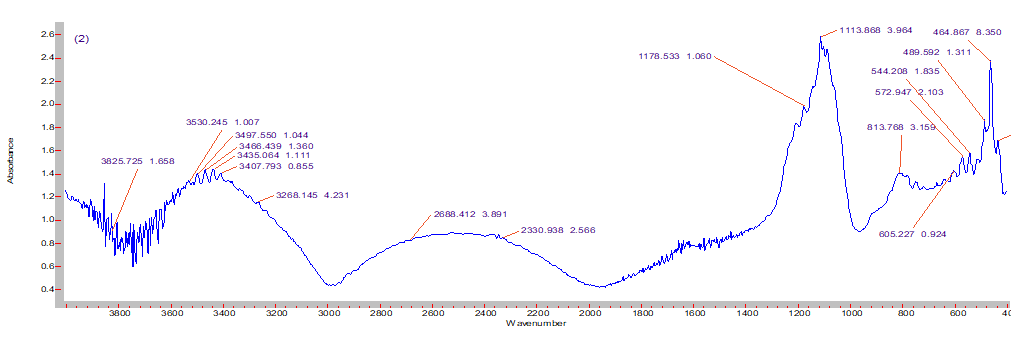
T=673K Figure 1: Fourier-IR spectra of nano-Al2O3 + nano-SiO2 + H2O system at different temperatures.
Absorption bands of 3217, 3300, 3495 cm-1 maximum hydrogen bonded groups were observed. Increasing the temperature (up to 673 K) in the process of radiation- thermal decomposition of water leads to a decrease in the intensity of hydrogen-bonded absorption bands in the nano-Al2O3 + nano-SiO2 + H2O heterosystem. At T = 673K, hydrogen-bonded OH-groups and hydrides of nanooxides are completely decomposed. This is due to changes in surface conditions and their defects.
As can be seen from Figure 1, the absorption bands of hydrocarbon-derived contaminants are not observed in the spectra of the heat-treated nanooxide (nano-Al2O3 and nano-SiO2) components [12, 13]. Maximum absorption bands 566, 576 and 468, 465 cm-1 corresponding to Al-O-Al and Al-O valence oscillations were observed in the spectrum of nano-Al2O3 oxide lattice oscillations (ν = 850-400cm-1). As can be seen from the spectra, the maximum peaks of 468, 818, and 1100 cm-1 were observed in the region of the lattice oscillations of nano-SiO2 oxide (ν = 1400-400 cm-1). The observed bands belong to the symmetrical and asymmetric Si-O and Si-O-Si valence oscillations.
Irradiation of the nano-Al2O3 + nano-SiO2 + H2O system with γ-quanta at a temperature of T = 373K leads to radiation-thermal decomposition of water and the formation of intermediate active products of decomposition. In the heterogeneous system nano-Al2O3 + nano-SiO2 + H2O, changes in the region of valence oscillations of OH-groups due to radiation-thermal decomposition of water at a temperature of T = 373K are shown in Figure 1.
Conclusion
Radiation-thermal decomposition of water in the nano- Al2O3 + nano-SiO2 + H2O system in the temperature range T = 373÷673K under the influence of γ-quanta was studied by Fourier-IR spectroscopy. Water adsorption on aluminum and silicon nanooxides occurs by molecular and dissociative mechanisms. Intermediate-active products of radiation- heterogeneous decomposition of water - aluminum and silicon hydrides, hydroxyl groups were recorded. It was determined that in this heterosystem, an absorption dose of 10 kGy occurs in the radiation-chemical decomposition of water. In contrast to the homogeneous phase, radiolysis of water in the presence of aluminum and silicon nanooxides is accompanied by the formation of surface hydrides and hydroxyl groups.
References
-
Kharlamov AN, Lunina EV, Lunin VV (1994) Acidic properties of the surface of zirconium dioxide modified with Me2O3 oxides (Me = Sc, Y, La). Journal of Physical Chemistry 68(4): 692-697.
-
Lunina EV (1987) Catalysis, fundamental and applied research_._ MGU, Moscow, pp: 262.
-
Chukin FD (2010) The structure of aluminum oxide and hydrodesulphurization catalysts_._ Reaction mechanisms, Printing house Paladin, Moscow.
-
Garibov AA, Agayev TN, Imanova GT, Eyubov KT (2015) Kinetics of radiation and thermocatalytic decomposition of water in the presence of nano-zirconium dioxide. Issues of atomic science and technology 5-99: 48-51.
-
Miyata H, Fuji K, Inui S, Kuvakova Y (1986) Application of Band Shape Analysis to Infrared Spectra of Adsorbed Species on Solid Catalysts. Appl Spectroscopy 40(8): 1177-1180.
-
Seino S, Yamamoto TA, Fujimoto R, Hashimoto K, Katsura M, et al. (2001) Enchancement of hydrogen evaluation yield from water dispersing nanoparticles, irradiated with gamma ray. Nucl Sci Technol 38(8): 633-636.
-
Petric NG, Alexandrov AB, Vall AI (2001) Interfacial energy transfer during gamma radiolysis of water on the surface of ZrO2 and some other oxides. J Phys Chem B 105(25): 5935-5944.
-
Seino S, Fujimoto R, Yamamoto TA, Katsura M, Okuda S, et al. (1999) Hydrogen gas evaluation from water dispersing nanoparticles irradiated with gamma ray. Mater Online Proceedings Library 608: 505-510.
-
Garibov AA, Agayev TN, Melikova SZ, Imanova GT, Faradjzade IA (2017) Radiation and catalytic properties on the n-ZrO2+n-Al2O3 systems in the process of hydrogen production from water. Nanotechnologies in Russia 12(5-6): 252-257.
-
Agayev TN, Garibov AA, Melikova SZ, Imanova GT (2018) Radiation-induced heterogeneous processes of water decomposition in the presence of mixtures of silica and zirconia nanoparticles. High Energy Chemistry 52(2): 145-151.
-
Pikaev AK (1975) Dosimetry in Radiation Chemistry. Nauka, Moscow, pp: 312.
-
Kuchuk I, Almasheva O (2012) Structural transformations in the ZrO2-Al2O3 nanocomposite during heat treatment. Nanosystems: physics, chemistry, mathematics 3(3): 123-129.
-
Garibov AA, Agayev TN, Imanova GT, Melikova SZ, Gadzhieva NN (2014) IR spectroscopy study of the radiation-thermal decomposition of water on nanosized zirconium dioxide. High Energy Chemistry 48(3): 239- 243.
- Sense, Gravity, Parity & Chirality in Mathematical Physics
- Quantum Lattice Simulations PHYSICS: Microcircuit Particle Formation and Observable Macroscopic Irreversible Time - A Discrete Lagrangian with Cellular Automata Framework
- Quantum Biology from Biomacromolecule to Cell, and Central Dogma Described by Quantum Theory
- Focus, Agility, Speed and Technology (FAST) for Sustainability and Growth
- Square Root Metric Geometry and Pati-Salam Model in Curved Space-Time
- A Simple System Demonstrating the Mpemba Effect in Classical Mechanics