
Comparative DMA Analysis of a Natural Based Potential Adhesive Extracts from Caesalipinia Decapelata
Adhesives have for long been developed from plant and animal materials. This includes animal proteins like casein and plant materials such as starches and dextrin’s which form precursors to synthetic adhesives. In this work, the mechanical properties of the extracted, isolated pod latex/adhesive samples of the Caesalipinia decapelata species were investigated using the Dynamic Mechanical Analysis (DMA) to study cure behavior of the adhesive observed on application of stress over a range of temperatures. The cure properties of this natural adhesive were compared to commercially available adhesives.
Introduction
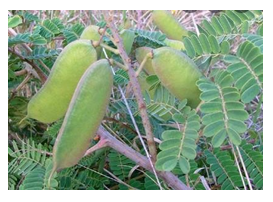
Plants have been of great importance to man. They are rich in several substances which man has been able to isolate; among them adhesives which include starches, and dextrin derived from corn, wheat, potatoes and rice which have been used for bonding paper, wood and textiles [1, 2]. Caesalipinia decapelata known as Mauritius thorns, one of the plants with latex/adhesive rich pods, is highly distributed in highland and grassland regions and to a lesser extent in swampy areas. It needs about 1000mm of rain. It grows on a variety of soils but prefer well drained sols which are neutral [1]. Propagation is by seed and layering. It flowers after 1 year producing nectar containing flowers which later produce pods bearing of the latex/adhesive and seeds [1] (Figure 1).
In this project, a test was carried out on the adhesive properties of Caesalipinia decapulata pods’ extrude to promote the use of biodegradable and renewable natural resources [3]. Also, a comparison on the curing (mechanical) properties between the latex from Caesalipinia decapulata and already available synthetic adhesives by the use of Dynamic Mechanical Analysis (DMA). DMA is a thermal technique that measures the properties of materials as they are deformed under periodic stress. It tests cure properties as well as mechanical properties of various state to another is accompanied by change in modules and this is the basis of the dynamic mechanical analysis. It separates the viscoelastic properties into the elastic (storage), and viscous (loss) modules [4, 5]. This separation describes two independent processes and proceeding within the materials elasticity and viscosity. Further, this method continuously monitors materials modules for long term, elevated temperature performance [4]. Information about curing properties e.g. onset of cure, gel point, glass transition temperature can be obtained as the analysis progress [3].
Methodology
Collection Identification and Preparation of Sample
The pods of the plant caesalipinia decapelata were collected from the botanic garden, opened and then the latex sample from the open pods was extracted by scrapping the surface of the pods softly using a scalpel to collect the latex sample into a container.
The latex sample collected was stored in a cool dry place to prevent drying.
Extraction and Concentration of Crude Extract
The sample was extracted in various solvents (polar and non-polar) and then filled and concentrated in a rotary evaporator and this was analyzed using TLC plates. This gave the best indication of the best separation in chromatography column.
Analysis by D.M.A Machine
An oscillation frequency of 1Hz was selected and this was entered into a computer thermal solution instrument control program and visco- elasticity was investigated at various set temperatures.
Results and Discussion
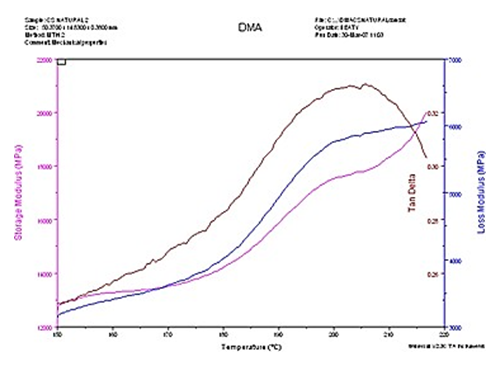
The cure profile of the extracted natural adhesive between 150℃ and 215℃ is shown on Figure 2 below. This temperature range was chosen for this adhesive extract from Caesalipinia decapelata because it the ideal temperature that most natural adhesives show cure profiles [6]. The profile (Figure 2) shows a significant change in storage modulus though it initially starts to rise slightly, attributable to increase in viscosity within the sample as temperature rises. There is rise in storage modulus at about 160℃ to the highest point of 205℃ after which it decreases rapidly. This implies that below 160℃ was a low viscosity liquid and only mechanical contribution to the system was from the glass braid support. The increase in storage modulus corresponds to the rapid increase in cross link density as the adhesive cures and these proceeds up to 120℃ beyond it shows a drop corresponding to decomposing within the sample.
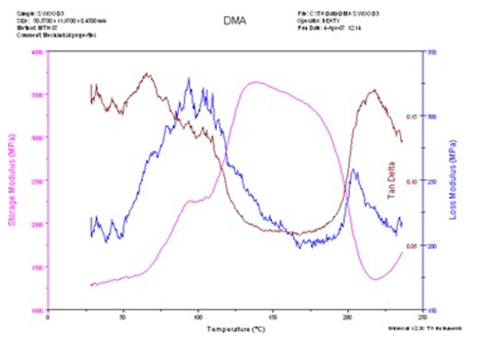
On comparison, the results of a synthetic stick wood commercial glue display a classical cure profile in which initially there is no significant increase in storage modulus and only mechanical contribution from the glass braid support is observed up to about 50℃ (Figure 3) [7]. It starts to rise up gently signifying on-set of cure up to 150℃. It then drops corresponding to decomposition within the sample. The on-set of cure is accompanied by a loss modulus peak, which shows a significant change within the sample. Tan delta curve also shows a point of significant transition within the sample adhesive.
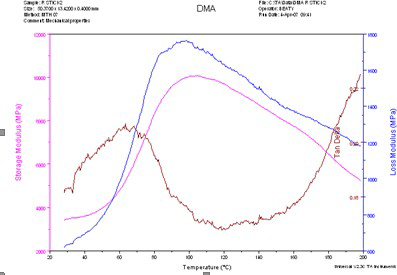
The cure profile above for the second synthetic stick rigid commercial glue which its storage modulus starts rising slowly at about 28℃ (room temperature) to highest point at about 120℃ then levels up slightly as shown in Figure 4 below. Concomitant with the natural adhesive under study, it then drops corresponding to decomposition within the glue [8, 9, 10, 11].
Conclusion and Recommendations
In conclusion, the latex obtained from Caesalipinia decapelata is a potential high temperature curing adhesive. It displayed a classical curing behavior and its curing temperatures were between 150℃ and 200℃. It can be used for high temperature applications however its specific uses still need to be investigated through further research.
The results of the natural adhesive were comparable to those of the two commercial adhesives in terms of cure profile but the natural adhesive displayed a much high temperature performance indicating that it is very stable at high temperatures, while the commercial adhesives cured at much lower temperatures.
This work recommends further studies to ascertain the of functional groups that are responsible for the extracted adhesive
References
-
Mabberly (1993) The flowering plants and ferns.
-
Storts AGE (1998) More about trees increasing uses of some common trees.
-
Cook RW, Tod DA (1993) A study of the cure of adhesive using Dynamic mechanical analysis. In J Adhesion and Adhesive 13(3): 157-162.
-
Ohunyon PE, Ebomele RO (1992) Adhesive age.
-
Johnson O (1923) Adhesive formula and the proved produced.
-
Haris NIN, Hassan MZ, IIyas RA, Suhot MA, Sapuan SM, et al. (2022) Dynamic mechanical properties of natural fiber reinforced hybrid polymer composites: a review. Journal of Materials Research and Technology 19: 167- 182.
-
Mackay CD (1998) Wood adhesive bonding.
-
Vogel I (1996) Elementary practical organic chemistry. Part 2, Qualitative organic analysis. 2nd (Edn.), Longman, London, pp: 284-295.
-
Philips PC (1951) The Genera of South African flowering plants. 2nd (Edn.), Cape times LTD, Government printers, pp: 353-316.
-
Sanders KJ (1988) Organic polymer chemistry. 2nd (Edn.), Blaucel Acadame and professional, pp: 508.
-
Foye WO (1982) Dictionary of organic compounds. 5th (Edn.), Volume 1, Chapman and Hall, New York, pp 107- 109.
- Sense, Gravity, Parity & Chirality in Mathematical Physics
- Quantum Lattice Simulations PHYSICS: Microcircuit Particle Formation and Observable Macroscopic Irreversible Time - A Discrete Lagrangian with Cellular Automata Framework
- Quantum Biology from Biomacromolecule to Cell, and Central Dogma Described by Quantum Theory
- Focus, Agility, Speed and Technology (FAST) for Sustainability and Growth
- Square Root Metric Geometry and Pati-Salam Model in Curved Space-Time
- A Simple System Demonstrating the Mpemba Effect in Classical Mechanics