
Modified Metrics of Acoustic Black Holes: A Review
In this brief review, we will address acoustic black holes arising from quantum field theory in the Lorentz-violating and non-commutative background. Thus, we consider canonical acoustic black holes with effective metrics for the purpose of investigating Hawking radiation and entropy. We show that due to the generalized uncertainty principle and the modified dispersion relation, the Hawking temperature is regularized, that is, free from the singularity when the horizon radius goes to zero. In addition, we also find logarithmic corrections in the leading order for entropy.
Introduction
Gravitational analogue models are topics of great interest and have been widely studied in the literature due to the possibility of detecting Hawking radiation in the table experiment. In particular, acoustic black holes were proposed by Unruh [1, 2] in 1981 for the purpose of exploring Hawking radiation, as well as investigating other issues to understand quantum gravity effects. It is well known that an acoustic black hole can be generated when fluid motion reaches a speed greater than the local speed of sound. These objects can exhibit properties similar to the laws of thermodynamics of gravitational black holes, such as a Hawking-like temperature and entropy (entanglement entropy). Besides, it has been conjectured that phenomena that are observed in black holes may also occur in acoustic black holes. Furthermore, with the detection of gravitational waves [3, 4] and the capture of the image of a supermassive black hole [5, 6], a window of possibilities in the physics of black holes and also in analogous models was opened. Acoustic black holes have applications in various branches of physics, namely high energy physics, condensed matter, and quantum physics [7, 8]. On the experimental side, Hawking radiation has been successfully measured in the works reported in Muñoz and Isoard M [9, 10]. And also carried out in other branches of physics [11, 12, 13, 14, 15, 16]. However, in the physics of acoustic black holes, the first experimental measurement of Hawking radiation was devised in the Bose-Einstein condensate [17].
In a recent paper, acoustic black holes embedded in a curved background were constructed by applying relativistic Gross-Pitaevskii and Yang-Mills theories [18]. In Yu C, et al. [19] an acoustic black hole of a D3-black brane was proposed. On the other hand, relativistic acoustic black holes in Minkowski space time were generated from the Abelian Higgs model [20, 21, 22, 23, 24]. Also, relativistic acoustic black holes have emerged from other physical models [25, 26, 27, 28]. In addition, these objects have been used to analyze various physical phenomena, such as superradiance [29, 30, 31, 32, 33], entropy [34, 35, 36, 37, 38], quasinormal modes [39, 40, 41, 42, 43, 44], and as well as, in other models [45, 46, 47, 48, 49, 50, 51, 52, 53, 54, 55]. Moreover Zhang B [56], was reported that there is a thermodynamic-like description for acoustic black holes in two dimensions. In this sense, an analogous form of Bekenstein-Hawking entropy (understood as an entanglement entropy) was addressed in Rinaldi M [57] by analyzing the Bose-Einstein condensate system. In addition, the dependence of entropy on the area of the event horizon of the acoustic black hole was explored in Steinhauer J [58]. Also, in the entanglement entropy of an acoustic black hole was examined Giovanazzi S [59].
In this brief review, we are interested in investigating modified acoustic black holes that have been constructed from field theory by considering the Abelian Higgs model in the Lorentz-violating [21] and noncommutative [22] background. To this end, we will explore canonical acoustic black holes with modified metrics to examine the effect of Lorentz symmetry breaking and noncommutativity on Hawking radiation and entropy. In addition, by applying the generalized uncertainty principle and a modified dispersion relation, we show that the Hawking temperature singularity disappears when the horizon radius vanishes. Besides, we also find logarithmic correction terms for entropy. Recently, the stability of the canonical acoustic black hole in the presence of noncommutative effects and minimum length has been addressed by us in Anacleto MA [60]. Thus, it was verified that the noncommutativity and the minimum length act as regulators in the Hawking temperature, that is, the singularity is removed. Also, it was shown that for a certain minimum radius the canonical acoustic black hole presents stability. This brief review is organized as follows. In Sec. II, we briefly review the steps to find the relativistic acoustic black hole metrics. In Sec. III, we briefly review the steps to find the relativistic acoustic black hole modified metrics. In Sec. IV, we will focus on canonical acoustic black holes with effective metrics to compute Hawking temperature and entropy. In Sec. V, we will introduce quantum corrections via the generalized uncertainty principle and the modified dispersion relation in the calculation of Hawking temperature and entropy. Finally in Sec. VI we present our final considerations.
**Acoustic Black Hole**
In this section we review the steps to obtain the relativistic acoustic metric from the Lagrangian density of the charged scalar field. Here we will follow the procedure adopted in Ge XH, et al. [20].
**Relativistic Acoustic Metric**
In order to determine the relativistic acoustic metric, we start by considering the following Lagrangian density:
$$\mathcal{L} = \partial_\mu \phi^* \partial^\mu \phi + m^2 |\phi|^2 - b |\phi|^4$$
Now, we decompose the scalar field as
$$\phi = \sqrt{\rho(x,t)} \exp(iS(x,t))$$ such that
$$\mathcal{L} = \rho \partial_\mu S \partial^\mu S + m^2 \rho - b \rho^2 + \frac{\rho}{\sqrt{\rho}} \left( \partial_\mu \partial^\mu \right) \sqrt{\rho}$$
Moreover, from the above Lagrangian, we find the equations of motion for $S$ and $\rho$ given respectively by
$$\partial_\mu (\rho \partial^\mu S) = 0$$
and
$$\frac{1}{\sqrt{\rho}} \partial_\mu \partial^\mu \sqrt{\rho} + \partial_\mu S \partial^\mu S + m^2 - 2b \rho = 0$$
Where the Eq. (3) is the continuity equation and Eq. (4) is an equation describing a hydro dynamical fluid, and the term,
$$\left( \sqrt{\rho} \right)^{-1} \partial_\mu \partial^\mu \sqrt{\rho}$$
called the quantum potential can be neglected in the hydrodynamic region. Now, by performing the following perturbations on equations of motion (3) and (4):
$$\rho = \rho_0 + \varepsilon \rho_1 + O\left(\varepsilon^2\right)$$
$$S = S_0 + \varepsilon \psi + O\left(\varepsilon^2\right)$$
We obtain
$$\partial_\mu \left( \rho_1 u_0^\mu + \rho_0 \partial^\mu \psi \right) = 0,$$
and
$$u_0^\mu \partial_\mu \psi - b \rho_1 = 0,$$
where we have defined $u_0^\mu = \partial^\mu S_0$, Hence, solving (8) for $\rho_1$ and substituting into (7), we have
$$\partial_\mu \left[ u_0^\mu u_0^\nu + b \rho_0 g^{\mu\nu} \right] \partial_\nu \psi = 0.$$
We can also write the above equation as follows:
$$\partial_i \left\{ \omega_0^2 \left[ -1 - \frac{b \rho_0}{2 \omega_0^2} \right] \partial_i \psi - \frac{\omega_0^2 v_0^2}{\omega_0} \partial_i \psi + \omega_0^2 \left[ -\frac{v_0^2 v_0^2}{\omega_0^2} \right] \partial_j \psi \right\} = 0,$$
(10)
$$ \text {W h e r e} \omega_ {0} = \partial^ {i} S _ {0} \text {a n d} v _ {0} ^ {i} = \partial_ {i} S _ {0} $$
(the local velocity field). In
addition, we define
2 2 0 0 / 2 sc bρ ω =
to be the speed of sound
$$ \text {a n d} v ^ {i} = v _ {0} ^ {i} / \omega_ {0}. $$
. However, the equation (10) becomes $$ \partial_ {t} \left\{\frac {b \rho_ {0}}{2 c _ {s} ^ {2}} \left[ \left(- 1 - c _ {s} ^ {2}\right) \partial_ {t} \psi - v ^ {i} \partial_ {i} \psi \right] \right\} + \partial_ {i} \left\{\frac {b \rho_ {0}}{2 c _ {s} ^ {2}} \left[ - v ^ {i} \partial_ {t} \psi \left(- v ^ {i} v ^ {j} + c _ {s} ^ {2} \delta^ {i j}\right) \partial_ {j} \psi \right] \right\} = 0 $$ ( ) ( ) 2 2 0 0 2 2 1 – – – 0. 2 2 i i i j ij t s t i i t s j s s (11) In this way, the above equation can be written as a Klein- Gordon equation in (3+1) dimensional curved space as follows:
( ) 1 0, g g g
$$ \frac {1}{\sqrt {- g}} \partial_ {\mu} \left(\sqrt {- g} g ^ {\mu \nu} \partial_ {\nu}\right) \psi = 0 $$ (12) Where 2 2 i s –
0 ΛΛ ΛΛ (13)
| 2c2 s | 1+c2−v2 s |
|---|
δ Hence, by determining the inverse of g µν , we find the relativistic acoustic metric given by
2 2 i s –
0 ΛΛ ΛΛ (14)
| 2c2 s | 1+c2−v2 s |
|---|
δ The metric depends on the density 0 ρ , the local sound speed in the fluid cs, the velocity of flow vρ. This is the acoustic black hole metric for high sc and vρspeeds Note that, in the non-relativistic limit, up to an overall factor, the metric found by Unruh is obtained.
$$ = \frac {b \rho_ {0}}{2 c _ {s} ^ {2}} \left( \begin{array}{c c c} - c _ {s} ^ {2} + v ^ {2} & \vdots & - v ^ {i} \\ \dots \dots & \cdot & \dots \dots \\ - v ^ {j} & \vdots & \delta^ {i j} \end{array} \right). $$
2 2 i s – c v v b g c v
µν ρ . 2
0 2 ΛΛ ΛΛ (15) s j ij
δ The relativistic acoustic metric (14) has also been obtained from the Abelian Higgs model [20].
The Dispersion Relation
Here we aim to examine the dispersion relation. Hence, we will adopt the notation written below ρρ ρ $$ \psi \sim R e \left[ e ^ {i \omega t - i \vec {k} \cdot \vec {x}} \right], \omega = \frac {\partial \psi}{\partial t}, \vec {k} = \nabla \psi . $$ , , . i t i k x Re e k t (16) So we can write the Klein-Gordon equation (11) in terms of momentum and frequency as follows:
( ) ( ) ( ) 2 2 2 2 2 1 2 0. s s c v k c v k ω ω + + ⋅ − − = ρ ρ (17) Now, by making 1, i i k δ = we have
| −v k± c k 1 s | 1+c2 – v2 s 1 |
|---|
| −v k±c k 1 s | 1+(c – v )(c + v ) s 1 s 1 |
|---|
s s (18) In the limit of small 1_v_ , we find the modified dispersion relation $$ \omega \approx E \left(1 + \frac {v _ {1}}{2}\right), $$ (19) $$ \text {W h e r e} E = c _ {s} k $$
is the linear dispersion relation.
Modified Acoustic Black Hole
In this section, we review the derivation of the relativistic acoustic metric from the Abelian Higgs model in the background violating-Lorentz and noncommutative
The Lorentz-Violating Model
At this point, we consider the Abelian Higgs model with Lorentz symmetry breaking that has been introduced as a change in the scalar sector of the Lagrangian [61]. Moreover, the relativistic acoustic metric violating Lorentz has been found in Anacleto MA, et al. [21]. Then, the corresponding Lagrangian for the Abelian Higgs model in the Lorentz- violating background is written as follows:
$$ \mathcal {L} = - \frac {1}{4} F _ {\mu \nu} F ^ {\mu \nu} + \left| D _ {\mu} \phi \right| ^ {2} + m ^ {2} \left| \phi \right| ^ {2} - b \left| \phi \right| ^ {4} + k ^ {\mu \nu} D _ {\mu} \phi^ {*} D _ {\nu} \phi , \tag {20} $$ being – F A A µν µ ν ν µ =∂ ∂ the field intensity tensor, – D ieA µ µ µ φ φ φ = ∂ the covariant derivative and kµν a constant tensor implementing the Lorentz symmetry breaking, given by Anacleto MA, et al. [21].
$$ = \left[ \begin{array}{c c c c} \beta & \alpha & \alpha & \alpha \\ \alpha & \beta & \alpha & \alpha \\ \alpha & \alpha & \beta & \alpha \\ \alpha & \alpha & \alpha & \beta \end{array} \right], $$ β α α α α β α α α α β α α α α β , kµν (21) where α and β are real parameters.
Next, following the steps taken in the previous section
to derive the relativistic acoustic metric from quantum
field theory, we consider
$$ \phi = \sqrt {\rho (x , t)} \exp \left(i S (x, t)\right) \mathrm {i n} \mathrm {t h e} $$
Lagrangian above. Thus, we have
1 2 4
2 2 2 µ µν µ µ µν µ µ µ F F S S e A S e A A m b
ρ ρ ρ ρ ρ = − + ∂ ∂ − ∂ + + −
Λ ρ ρ ρ ρ (22)
+ ∂ ∂ − ∂ + + ∂∂
2 ( 2 ) ( )
µν µ µ ν µ ν µ ν µ k S S eA S e A A
$$ \text {W h e r e} \tilde {\partial} ^ {\mu} = \partial^ {\mu} + k ^ {\mu \nu} \partial_ {\nu}. $$
. Then, the equations of motion
for S and ρ are:
$$ \partial \mu \left[ \rho u ^ {\mu} + \rho k ^ {\mu \nu} u _ {\nu} \right] = 0, \tag {23} $$ and (24)
| ρ |
|---|
where we have defined
$$ u _ {\mu} = \partial_ {\mu} S - e A _ {\mu}. $$
Now, by linearizing
the equations above around the background (
) 0 0 , S ρ , with $$ \rho = \rho_ {0} + \varepsilon \rho_ {1} + O \left(\varepsilon^ {2}\right) \tag {25} $$ $$ S = S _ {0} + \varepsilon \psi + O \left(\varepsilon^ {2}\right), \tag {26} $$ and keeping the vector field Aµ unchanged, we have $$ \partial_ {\mu} \left[ \rho_ {1} \left(u _ {0} ^ {\mu} + k ^ {\mu \nu} u _ {0 \nu}\right) + \rho_ {0} \left(g ^ {\mu \nu} + k ^ {\mu \nu}\right) \partial_ {\nu} \psi \right] = 0, \tag {27} $$ and $$ \left(u _ {0} ^ {\mu} + k ^ {\mu \nu} u _ {0 \nu}\right) \partial_ {\mu} \psi - b \rho_ {1} = 0, \tag {28} $$ by solving (28) for 1 ρ and replacing into equation (27), we obtain $$ \partial_ {\mu} \left[ u _ {0} ^ {\mu} u _ {0} ^ {\nu} + k ^ {\mu \lambda} u _ {0 \lambda} u _ {0} ^ {\nu} + u _ {0} ^ {\mu} k ^ {\nu \lambda} u _ {0 \lambda} + b \rho_ {0} \left(g ^ {\mu \nu} + k ^ {\mu \nu}\right) \right] \partial_ {\nu} \psi = 0. \tag {29} $$ Hence, we find the equation of motion for a linear acoustic disturbance ψ given by a Klein-Gordon equation curved space ( ) 1 0, g g g $$ \frac {1}{\sqrt {- g}} \partial_ {\mu} \left(\sqrt {- g} g ^ {\mu \nu} \partial_ {\nu}\right) \psi = 0 $$ (30) where µν g is the relativistic acoustic metrics. For β ≠0 and α=0 , we have Anacleto MA, et al. [21]
− + − = ⋅ − +
2 2 c v v β β β ρ β i s
− $$ \underline {{\tilde {\beta} _ {-}}} \quad \begin{array}{c c} \beta_ {+} & \beta_ {+} \\ \dots \dots \end{array} $$ b g c v f v v
0 ΛΛ Λ Λ (31) µν
2 2 Θ s j ij i j
β δ β − β +
+ + = + − Θ and − − + = + − .
2 2 1 sc v β β β
2 2 sc v fβ β β β β β −
+ − where The acoustic line element in the Lorentz-violating background can be written as follows ρ ρ ρ ρ ρ Θ $$ = \frac {b \rho_ {0} \sqrt {\tilde {\beta} _ {-}}}{2 c _ {s} \sqrt {\mathcal {Q}}} \left[ - \left(\frac {c _ {s} ^ {2}}{\tilde {\beta} _ {+}} - \frac {\tilde {\beta} _ {-} v ^ {2}}{\tilde {\beta} _ {+}}\right) d t ^ {2} - 2 \vec {v} \cdot d \vec {x} d t + \frac {\tilde {\beta} _ {-}}{\tilde {\beta} _ {+}} \left(\vec {v} \cdot d \vec {x}\right) ^ {2} + f _ {\beta} d \vec {x} ^ {2} \right] $$
2 2 2 0 2 2 2 2 2
b c v ds dt v dx dt v d x f dx c β ρ β β β β β β ( )
$$ \left| \frac {\beta_ {-}}{z} \right| - \left(\frac {c _ {s} ^ {2}}{z} - \frac {\beta_ {-} v ^ {2}}{z}\right) d t ^ {2} - 2 \vec {v} \cdot d \vec {x} d t + \frac {\beta_ {-}}{z} ( $$ s + + + s (32)
Now changing the time coordinate as
$$ s d \tau = d t + \tilde {\beta} _ {+} \vec {v} \cdot \vec {d} x, $$ , we find the acoustic metric in the stationary form Φ Φ Θ $$ = \frac {b \rho_ {0} \sqrt {\tilde {\beta} _ {-}}}{2 c _ {s} \sqrt {\mathcal {Q}}} \left[ - \left(\frac {c _ {s} ^ {2}}{\tilde {\beta} _ {+}} - \frac {\tilde {\beta} _ {-} v ^ {2}}{\tilde {\beta} _ {+}}\right) d \tau^ {2} + \mathcal {F} \left(\frac {\tilde {\beta} _ {-} v ^ {i} v ^ {j}}{c ^ {2} - \tilde {\beta} _ {-} v ^ {2}} + \frac {f _ {\beta}}{\mathcal {F}} \delta^ {i j}\right) d x ^ {i} d x ^ {j} \right] $$ f b c v v v ds d dx dx c v c
2 2 0 2 2 2 2 2
β ρ β β β τ δ β β β i j ij i j s
$$ \left| \frac {\beta_ {-}}{-} \right| - \left(\frac {c _ {s} ^ {2}}{z} - \frac {\beta_ {-} v ^ {2}}{z}\right) d \tau^ {2} + \mathcal {F} \left(\frac {\beta_ {-} v}{2}\right) $$ $$ \beta_ {+} \quad \beta_ {+}) \quad \left(c ^ {2} - \beta_ {-} v\right) $$ s (33) $$ \mathrm {e} \mathcal {F} = \frac {\tilde {\beta} _ {+}}{\tilde {\beta} _ {-}} + \frac {c _ {s} ^ {2}}{\tilde {\beta} _ {+}} - \frac {\tilde {\beta} _ {-} v ^ {2}}{\tilde {\beta} _ {+}} $$
2 2 sc v β β β β β $$ - \mathrm {F o r} \tilde {\beta} = 1, $$
, we recover the result + − where found in Ref Ge XH, et al. [20]. Next, for 0 β = and 0 α ≠ , we have Anacleto MA, et al. [21]
tt tj ΛΛ ΛΛ (34)
| 2c2 s | f |
|---|
where $$ g _ {t t} = - \left[ \left(1 + \alpha\right) c _ {s} ^ {2} - v ^ {2} + \alpha^ {2} \left(1 - v\right) ^ {2} \right] \tag {35} $$ $$ g _ {t j} = - \left(1 - \vec {\alpha}. \vec {\nu}\right) v ^ {j}, \tag {36} $$ $$ g _ {i t} = - \left(1 - \vec {\alpha} \cdot \vec {v}\right) v ^ {i}, \tag {37} $$ $$ g _ {i j} = \left[ \left(1 - \vec {\alpha} \cdot \vec {v}\right) ^ {2} + c _ {s} ^ {2} - v ^ {2} \right] \delta^ {i j} + v ^ {i} v ^ {j}, \tag {38} $$ $$ f = \left(1 + \alpha\right) \left[ \left(1 - \vec {\alpha} \cdot \vec {v}\right) ^ {2} + c _ {s} ^ {2} \right] - v ^ {2} + \alpha^ {2} \left(1 - v\right) ^ {2} \left[ 1 + \left(1 - \vec {\alpha} \cdot \vec {v}\right) ^ {2} c _ {s} ^ {- 2} \right] $$ (39) Thus, the acoustic line element in the Lorentz-violating background can be written as
| 2c s | f |
|---|
(40) where ( ) 2 2 2 1 · s f v c v α α = − + − ρρ Now changing the time coordinate as ρρ ρ ρ ( )( )
2 2 2 2 1 · ·
v v d x d dt c v v
α τ α α − = + + + −
(41) ( ) ( )
1 – 1 s
We find the acoustic metric in the stationary form (42)
| 2c s | f |
|---|
$$ \text {w h e r e} \Lambda = \left(1 - \vec {\alpha} \cdot \vec {v}\right) ^ {2} - g _ {t t}. \text {F o r} \alpha = 0, $$
, the result found in Ge XH, et al. [20] is recovered.
Noncommutative Acoustic Black Hole
The metric of a noncommutative canonical acoustic black hole has been found by us in Anacleto MA, et al. [22]. Here, starting from the noncommutative Abelian Higgs model, we briefly review the steps to generate the relativistic acoustic metric in the noncommutative background. Thus, the Lagrangian of the Abelian Higgs model in the noncommutative background is given by Ghosh S [62].
( ) κ κ φ φ φ
2 2 4 2 µν µν µ F F D m b
$$ C = - \frac {\kappa_ {+}}{4} F _ {\mu \nu} F ^ {\mu \nu} + \kappa_ {-} \left(\left| D _ {\mu} \phi \right| ^ {2} + m ^ {2} | \phi | ^ {2} - b\right) $$ Λ † † 4 1 2 ( ) ( ) + + αβ µ µ αµ β β F D D D D θ φ φ φ φ (43) $$ \mathrm {b e i n g} \kappa_ {\pm} = 1 \pm \theta^ {\mu \nu} F _ {\mu \nu} / 2, F _ {\mu \nu} = \partial_ {\mu} A _ {\nu} - \partial_ {\nu} A _ {\mu} t $$
the field intensity tensor and – D ieA µ µ µ φ φ φ = ∂ the covariant derivative. The parameter αβ θ is a constant, real-valued antisymmetric D D × - matrix in D -dimensional spacetime with dimensions of length squared. Now, we use
$$ \phi = \sqrt {\rho (x , t)} \exp \left(i S (x, t)\right) \mathrm {i n} $$ the above Lagrangian, such that Anacleto MA, et al. [22].
2 2 , 4 F F g S S m b g µν µν µν µν µ ν µ ν κ ρ ρ θ ρ θ ρ ρ ρ $$ \mathcal {L} = - \frac {\kappa_ {+}}{4} F ^ {\mu v} F _ {\mu v} + \rho \bar {g} ^ {\mu v} \mathcal {D} _ {\mu} S \mathcal {D} _ {\nu} S + \tilde {\theta} m ^ {2} \rho - \tilde {\theta} b \rho^ {2} + \frac {\rho}{\sqrt {\rho}} \bar {g} ^ {\mu v} \partial_ {\mu} \partial_ {\nu} $$ (44) $$ \text {w h e r e} \mathcal {D} _ {\mu} = \partial_ {\mu} - e A _ {\mu} / S, \quad \bar {g} ^ {\mu \nu} = \tilde {\theta} g ^ {\mu \nu} + \Theta^ {\mu \nu}, \quad \tilde {\theta} = 1 + \vec {\theta} \cdot \vec {B}, $$ $$ \vec {B} = \nabla \times \vec {A} $$ $$ 1 \mathrm {a n d} \Theta^ {\mu \nu} = \theta^ {\alpha \mu} F _ {\alpha} ^ {\nu}. $$
. In our analysis we consider the case where there is no noncommutativity between space and time, that is $$ s \theta^ {0 i} = 0 \mathrm {a n d} \mathrm {u s e} \theta^ {i j} = \varepsilon^ {i j k} \theta_ {k}, F ^ {i 0} = E ^ {i} \mathrm {a n d} $$ ij ijk k F B ε = . In the sequence we obtain the equations of motion for S and ρ as follows:
$$ \partial_ {\mu} \left[ \tilde {\theta} \rho u ^ {\mu} + \rho \tilde {\Theta} ^ {\mu \nu} u _ {\nu} \right] = 0, \tag {45} $$ and $$ \frac {1}{\sqrt {\rho}} \bar {g} ^ {\mu \nu} \partial_ {\mu} \partial_ {\nu} \sqrt {\rho} + \bar {g} ^ {\mu \nu} u _ {\mu} u _ {\nu} + \tilde {\theta} m ^ {2} - 2 \tilde {\theta} b \rho = 0, \tag {46} $$ $$ \mathrm {w h e r e} \tilde {\Theta} ^ {\mu \nu} = \left(\Theta^ {\mu \nu} + \Theta^ {\nu \mu}\right) / 2. $$
. Hence, by linearizing the equations of motion around the background ( ) ρ0 0 , S , with $$ \rho = \rho_ {0} + \rho_ {1}, S = S _ {0} + \psi $$
and keeping the vector potential
unchanged, such that $$ \partial_ {\mu} \left[ \rho_ {1} \bar {g} ^ {\mu \nu} u _ {0 \nu} + \rho_ {0} \left(g ^ {\mu \nu} + \tilde {\Theta} ^ {\mu \nu}\right) \partial_ {\nu} \psi \right] = 0 \tag {47} $$ $$ \left(\tilde {\theta} u ^ {\mu} + \tilde {\Theta} ^ {\mu \nu} u _ {\nu}\right) \partial_ {\mu} \psi - b \tilde {\theta} \rho = 0. \tag {48} $$ Then, by manipulating the above equations, we obtain the equation of motion for a linear acoustic disturbance ψ in the form ( ) 1 0, g g g $$ \frac {1}{\sqrt {- g}} \partial_ {\mu} \left(\sqrt {- g} g ^ {\mu \nu} \partial_ {\nu}\right) \psi = 0 $$ (49) where
| 2c s | f |
|---|
is the relativistic acoustic metric with noncommutative corrections in (3+1) dimensions and with g µν given in the form Anacleto MA, et al. [22].
$$ \tilde {g} t t = - \left[ \left(1 - 3 \vec {\theta} \cdot \vec {B}\right) c _ {s} ^ {2} - \left(1 + 3 \vec {\theta} \cdot \vec {B}\right) v ^ {2} + 2 \left(\vec {\theta} \cdot \vec {v}\right) \left(\vec {B} \cdot \vec {v}\right) - \left(\vec {\theta} \times \vec {E}\right) \cdot \vec {v} \right], $$ (51) $$ \tilde {g} ^ {t j} = - \frac {1}{2} \left(\vec {\theta} \times \vec {E}\right) ^ {j} \left(c _ {s} ^ {2} + 1\right) - \left[ 2 \left(1 + 2 \vec {\theta} \cdot \vec {B}\right) - \left(\vec {\theta} \times \vec {E}\right) \vec {v} \right] \frac {v ^ {j}}{2} + \frac {B ^ {j}}{2} \left(\theta \cdot \vec {v}\right) + \frac {\theta^ {j}}{2} \left(B \cdot \vec {v}\right) $$ ( ) ( ) ( ) ( ) ( ) ( ) 2 1 1 2 1 2
- , 2 2 2 2 (52) $$ \tilde {g} ^ {i t} = - \frac {1}{2} \left(\vec {\theta} \times \vec {E}\right) ^ {i} \left(c _ {s} ^ {2} + 1\right) - \left[ 2 \left(1 + 2 \vec {\theta} \cdot \vec {B}\right) - \left(\vec {\theta} \times \vec {E}\right) \cdot \vec {v} \right] \frac {v ^ {i}}{2} + \frac {B ^ {i}}{2} \left(\theta \cdot \vec {v}\right) + \frac {\theta^ {i}}{2} \left(B \cdot \vec {v}\right) $$ ( ) ( ) ( ) ( ) ( ) ( ) 2 1 1 2 1 2
- , 2 2 2 2 (53) $$ \tilde {g} ^ {i j} = \left[ \left(1 + \vec {\theta} \cdot \vec {B}\right) \left(1 + c _ {s} ^ {2}\right) - \left(1 + \vec {\theta} \cdot \vec {B}\right) v ^ {2} - \left(\vec {\theta} \times \vec {E}\right) \vec {v} \right] \delta^ {i j} + \left(1 + \vec {\theta} \cdot \vec {B}\right) v ^ {i} v ^ {j}, $$ (54) ( )( ) ( ) ( ) ( )( ) 2 2 1 2
- 1 1 4
- 3
- 2
- . s f B c B v E v B v v θ θ θ θ = − + − + − × + ρ ρ ρ ρ ρ ρ ρ ρ ρ ρ ρ (55)
Setting $\theta = 0$, the acoustic metric above reduces to the acoustic metric obtained in Ref Ge XH, et al. [20].
**Modified Canonical Acoustic Black Hole**
In this section, we shall address the issue of Hawking temperature in the regime of low velocities for the previous cases with further details. Now we consider an incompressible fluid with spherical symmetry. In this case the density is a position independent quantity and the continuity equation implies that $v \sim 1/r^2$. The sound speed is also a constant. In the following we examine the Hawking radiation and entropy of the usual canonical acoustic black hole, as well as, in the Lorentz-violating and noncommutative background.
**Canonical Acoustic Metric**
In this case the line element of the acoustic black hole is given by
$$ds^2 = -f(v_r)d\tau^2 + \frac{c_s^2}{f(v_r)}dr^2 + r^2(d\theta^2 + \sin^2\theta d\phi^2),$$
where the metric function, $f(v_r)$ takes de form
$$f(v_r) = c_s^2 - v_r^2 \rightarrow f(r) = c_s^2 \left(1 - \frac{r_h^4}{r^4}\right),$$
Here we have defined $v_r = c_s r_h^2/r^2$ being $r_h$ the radius of the event horizon. In this case we compute the Hawking temperature using the following formula:
$$T_H = \frac{f'(r_h)}{4\pi} = \frac{c_s^2}{\pi r_h},$$
By considering the above result for the Hawking temperature and applying the first law of thermodynamics, we can obtain the entropy (entanglement entropy [38]) of the acoustic black hole as follows
$$S = \int \frac{dE}{T} = \int \frac{dA}{4\pi r_h T_H} = \frac{A}{4c_s^2}$$
being $A = 4\pi r_h^2$ the horizon area of the canonical acoustic black hole.
**Canonical Acoustic Metric with Lorentz Violation**
In the limit $c_s^2 \ll 1$ and $v^2 \ll 1$ can be written as a Schwarzschild metric type. Thus, for $\beta \neq 0$ and $\alpha = 0$ and up to an irrelevant position-independent factor,
$$ds^2 = -f(v_r)d\tau^2 + \frac{c_s^2}{\sqrt{\beta_- \beta_+} f(v_r)}dr^2 + \sqrt{\beta_- \beta_+} r^2\left(d\theta^2 + \sin^2\theta d\phi^2\right),$$
where
$$f(v_r) = \sqrt{\beta_- \beta_+} \left[ \frac{c_s^2 - \beta_- v_r^2}{\beta_+} \right] \rightarrow f(r) = \sqrt{\beta_- \beta_+} \left[ \frac{c_s^2}{1 - \beta_- \frac{r_h^4}{r^4}} \right],$$
The Hawking temperature is given by
$$T_H = \frac{f'(r_h)}{4\pi} = \frac{c_s^2 \left(1 - \beta_- \frac{r_h^4}{r^4}\right)}{\left(1 + \beta_- \right)^3/2 \pi r_h} = \frac{c_s^2 \left(1 - 3\beta_- \right)}{\pi r_h},$$
Therefore, the temperature is decreased when we vary the parameter $\beta$. For $\beta = 0$ the usual result is obtained. Hence, from the above temperature, we have the following result for the entropy of the acoustic black hole in the background violating Lorentz.
$$S = \frac{(1 + 3\beta_-) A}{4c_s^2},$$
Now, for $\beta = 0$ and $\alpha \neq 0$, we find for $\alpha$ sufficiently small we have up to first order
$$f(v_r) = \frac{\tilde{\alpha} c_s^2 - v_r^2}{\sqrt{\tilde{\alpha} \left(1 - 2\alpha v_r\right)}}$$
where $\tilde{\alpha} = 1 + \alpha$. For $v_r = c_s r_h^2/r^2$ with $c_s = 1$, the metric function becomes
$$f(r) = \tilde{\alpha}^{-1/2} \left[ \tilde{\alpha} - \frac{r_h^4}{r^4} \left(1 + \alpha \frac{r_h^2}{r^2}\right) + \alpha \frac{r_h^2}{r^2} \right],$$
In the present case there is a richer structure such as charged and rotating black holes. The event horizon of the modified canonical acoustic black hole is obtained from the following equation:
$$\tilde{\alpha} - \frac{r_h^4}{r^4} \left(1 + \alpha \frac{r_h^2}{r^2}\right) + \alpha \frac{r_h^2}{r^2} = 0$$
which can also be rewritten in the form
$$r^6 + \alpha r_h^2 r^4 - \tilde{\alpha}^{-1} r_h^4 r^2 - \alpha r_h^6 = 0$$
we can also write
$$r^2 \left(r^2 - r_s^2\right) \left(r^2 - r_h^2\right) - \alpha r_h^6 = 0,$$
where
2 2 1 2 h r r α $$ r _ {\pm} ^ {2} = r _ {h} ^ {2} \left(- \frac {\alpha}{2} \pm \frac {1}{\sqrt {\tilde {\alpha}}}\right) $$ (69) Now, arranging the above equation (68), we have
6 2 2
2 2 2 hr r r r r r
α $$ = r _ {+} ^ {2} + \frac {\alpha r _ {h} ^ {6}}{r ^ {2} \left(r ^ {2} - r _ {-} ^ {2}\right)} $$ (70) ( ) + Therefore, we can find the event horizon by solving the above equation perturbatively. So, up to the first order in α we obtain
6 2 2 2 h h r r r r r r r
α α $$ \tilde {r} _ {+} ^ {2} \approx r _ {+} ^ {2} + \frac {\alpha r _ {h} ^ {6}}{r _ {+} ^ {2} \left(r _ {+} ^ {2} - r _ {-} ^ {2}\right)} = \left(1 - \frac {\alpha}{2}\right) r _ {h} ^ {2} \dots [ 7 1 ] $$
2 2 2 1 2 ( )
+ + $$ r _ {+} ^ {2} \left(r _ {+} ^ {2} - r _ {-} ^ {2}\right) $$
Then, we have
1 2 h r r α $$ \tilde {r} _ {+} = r _ {h} \sqrt {1 - \frac {\alpha}{2}} + \dots \tag {72} $$ For the Hawking temperature, we obtain
1 3 1 2 H T r α π +
$$ = \frac {1}{\pi \tilde {r} _ {+}} \left(1 + \frac {3 \alpha}{2}\right) [ 7 3 ] $$ In terms of hr , we have $$ \left| T _ {H} = \frac {1}{\pi r _ {h}} \left(1 + \frac {7 \alpha}{4}\right) \right| $$ (74) In this situation the temperature is increased when we vary the parameter α . For 0 α = one recovers the usual result.
In this case for entropy, we find $$ S = \left(1 - \frac {7 \alpha}{4}\right) \frac {A}{4} $$ (75)
Noncommutative Canonical Acoustic Metric
The noncommutative acoustic metric can be written as a Schwarzschild metric type, up to an irrelevant position- independent factor, in the nonrelativistic limit as follows Anacleto MA, et al. [22], ( ) 2 2 2 2 2 ( ) ( ) Φ Φ Φ r
2 2 2 ( ) r r
| f |
|---|
(76) where ( ) ( ) ( ) ( ) ( ) ( ) 2 2 1 1 3 1 3 2 r r s r r r r r θ θ θ θ = = − ⋅ − + ⋅ − − ρ ρ ρ ρ Φ Φ v v B c B B v v f v f v r r or (77) $$ f \left(v _ {r}\right) = 1 - 2 \vec {\theta} \cdot \vec {B} - 3 \theta \mathcal {E} _ {r} v _ {r} $$ (78) $$ \Lambda \left(v _ {r}\right) = 1 + \vec {\theta} \cdot \vec {B} - \theta \mathcal {E} _ {r} v _ {r} \tag {79} $$ $$ \Gamma \left(v _ {r}\right) = 1 + 4 \vec {\theta} \cdot \vec {B} - 2 \theta \mathcal {E} _ {r} v _ {r} \tag {80} $$ $$ \Sigma \left(v _ {r}\right) = \left[ \theta \mathcal {E} _ {r} - \left(B _ {r} v _ {r}\right) \theta_ {r} - \left(\theta_ {r} v _ {r}\right) B _ {r} \right] v _ {r} \tag {81} $$ $$ \begin{array}{l} \mathrm {B e i n g} \theta \mathcal {E} _ {r} = \theta \left(\vec {n} \times \vec {E}\right) _ {r}. \\ v = c r ^ {2} / r ^ {2}. \mathrm {w h e r e} \\ \end{array} $$
. Now, by applying the relation
$$ \begin{array}{l} \mathrm {B e i n g} \sigma c _ {r} = \sigma \left(n \times L\right) _ {r}. \\ v _ {r} = c _ {s} r _ {h} ^ {2} / r ^ {2}, \text {w h e r e} r \\ \end{array} $$
hr is the radius of the event horizon
and making 1
sc = and so, the metric function of the
noncommutative canonical acoustic black hole becomes
1/2 4 2 2 $$ (\theta) = \left[ 1 - 3 \vec {\theta} \cdot \vec {B} - \left(1 + 3 \vec {\theta} \cdot \vec {B} - 2 \theta_ {r} B _ {r}\right) \frac {r _ {h} ^ {4}}{r ^ {4}} - \theta \mathcal {E} _ {r} \frac {r _ {h} ^ {2}}{r ^ {2}} \right] \left[ 1 - 2 \vec {\theta} \cdot \vec {B} - 3 \theta \mathcal {E} _ {r} \frac {r _ {h} ^ {2}}{r ^ {2}} \right] ^ {- 1 /} $$ ρ ρ ρ ρ ρ ρ Φ
4 2 2 1 3 1 3 2 1 2 3 h h h r r r r r r r r B B B B r r r θ θ θ θ θ θ ( ) ( ) (82) Next, we will do our analysis considering the pure magnetic sector first and then we will investigate the pure electric sector.
Hence, for 3 3 0, · 0, 0 r r B B θ θ θ θ = = ≠ = ρρ (or 0 E = ) with small 3 3 B θ , ( ) 3 3 3 3
1 3 1 4 1 1 2 H h h
B B T r r B
θ θ π π θ $$ = \frac {\left(1 + 3 \theta_ {3} B _ {3}\right)}{\sqrt {1 - 2 \theta_ {3} B _ {3}}} \frac {1}{\pi r _ {h}} = \frac {1 + 4}{\pi} $$ (83)
3 3 $$ \mathrm {F o r} \theta = 0 \mathrm {t} $$
the usual result is obtained. Here the temperature
has its value increased when we vary the parameter θ .
However, for the temperature in (83) we can find the entropy given by ( ) 3 3 1 4 4 4 h H B A dE dA S T r T θ $$ T = \int \frac {d E}{T} = \int \frac {d A}{4 \pi r T _ {u}} = \frac {\left(1 - 4 \theta_ {3} B _ {3}\right) A}{4} \tag {84} $$ π $$ \text {w h e r e} A = 4 \pi r _ {h} ^ {2} \mathrm {i} $$
is the horizon area of the canonical acoustic
black hole.
At this point, we will consider the situation where
$$ At this point, we will consider the situation where B = 0 and $ \theta\mathcal{E}_{r}\neq0 $ . So, from (82), we have $$
$$
. So, from (82), we have
1/2 4 2 2 $$ \tilde {\mathcal {F}} (r) = \left[ 1 - \frac {r _ {h} ^ {4}}{r ^ {4}} - \theta \mathcal {E} _ {r} \frac {r _ {h} ^ {2}}{r ^ {2}} \right] \left[ 1 - 3 \theta \mathcal {E} _ {r} \frac {r _ {h} ^ {2}}{r ^ {2}} \right] ^ {- 1 / 2} \tag {85} $$
4 2 2 1 1 3 h h h r r r r r r r r r θ θ ( )
For this metric the event horizon is obtained by solving the equation below
4 2
4 2 1 0 h h r r r r r θ − − = (86)
$$ r ^ {4} - \theta \mathcal {E} _ {r} r _ {h} ^ {2} - r _ {h} ^ {4} = 0 \tag {87} $$ So, solving the above equation, we obtain r h r r θ (88) $$ \left| r _ {+} = \left(1 + \frac {\theta \mathcal {E} _ {r}}{4}\right) r \right| $$
1 4 For the Hawking temperature, we find ( ) 1 / 2 1 1 3 / 4 1 1 3
θ θ θ π π π θ + +
$$ = \frac {\left(1 - \theta \mathcal {E} _ {r} / 2\right)}{\sqrt {1 - 3 \theta \mathcal {E} _ {r}}} \frac {1}{\pi r _ {+}} = \frac {1 + \theta \mathcal {E} _ {r}}{\pi r _ {+}} = \frac {1 + 3}{\pi r _ {+}} $$ r r r H h r T r r r (89) We also noticed that the temperature is increased when we vary the θ parameter. For entropy we have ( ) 1 $$ S = \frac {\left(1 - \theta \mathcal {E} _ {r}\right) A}{4} (9 0) $$
4 $$ \mathrm {w h e r e} A = 4 \pi r _ {+} ^ {2}. $$
Quantum-Corrected Hawking Temperature and Entropy
In this section, we implement quantum corrections in the Hawking temperature and entropy calculation arising from the generalized uncertainty principle and modified dispersion relations.
Result Using GUP
At this point, we introduce quantum corrections via the generalized uncertainty principle (GUP) to determine the Hawking temperature and entropy of the canonical acoustic black hole in the Lorentz-violating and noncommutative background. So, we will adopt the following GUP [63, 64, 65, 66, 67, 68, 69, 70].
$$ \Delta x \Delta p \geq \frac {\hbar}{2} \left(1 - \frac {\lambda l _ {p}}{\hbar} \Delta p + \frac {\lambda^ {2} l _ {p} ^ {2}}{\hbar^ {2}} \left(\Delta p\right) ^ {2}\right) $$
2 2 2 η η η (91)
( )
2 1 2 Where α is a dimensionless positive parameter and pl is the Planck length.
In sequence, without loss of generality, we will adopt the
$$ G = c = k _ {B} = \hbar = l _ {p} = 1 a $$
and by assuming that
p E ∆∼
and following the steps performed in Anacleto MA, et
al. [38] we can obtain the following relation for the corrected
energy of the black hole ≥ − + + Λ (92)
2 λ λ ∆ ∆
2 1 2 2 gup E E x x
( ) ( ) Thus, applying the tunneling formalism using the Hamilton-Jacobi method, we have the following result for the probability of tunneling with corrected energy gup E given by $$ \Gamma = e x p \left[ - \frac {4 \pi E _ {g u p}}{\kappa} \right] $$ (93) where κ is the surface gravity. Comparing with the Boltzmann factor, / E T e− we obtain the following result for the Hawking temperature with quantum corrections
1 2 $$ \prime \leq T _ {H} \left[ 1 - \frac {\lambda}{2 \left(\Delta x\right)} + \frac {\lambda^ {2}}{2 \left(\Delta x\right) ^ {2}} + \dots \right] ^ {- 1} \tag {94} $$ λ λ ∆ ∆
2 1 2 2 H T T x x
( ) ( ) So, by applying it to temperature (58), we have the following result
2 c T $$ = \frac {c _ {s} ^ {2}}{\pi \left[ r _ {h} - \frac {\lambda}{4} + \frac {\lambda^ {2}}{8 r _ {h}} \dots \right]} $$ s (95)
2 4 8 r r λ λ π h h
Therefore, when 0 hr = the singularity is removed and the temperature is now zero. Next, we analyze the effect of GUP in the Lorentz-violating and noncommutative cases.
For this case we can calculate the entropy, which is given by
2
| 4 | π λ A |
|---|
So due to the GUP we get a logarithmic correction term for the entropy.
Violation-Lorentz Case: In the situation where 0 β ≠ and 0 α = , the corrected temperature due to GUP is
1 2 $$ T = T _ {H} \left[ 1 - \frac {\lambda}{4 r _ {h}} + \frac {\lambda^ {2}}{8 r _ {h} ^ {2}} + \dots \right] ^ {- 1} \tag {97} $$ where $$ T _ {H} = \frac {1 - 3 \beta}{\pi r _ {h}} \tag {98} $$ Thus, we have
2 1 3 β − = − + Λ
T (99) λ λ π
4 8 h h r r
Note that when 0 hr → the Hawking temperature tends to zero, 0 T → . In the absence of the GUP the temperature, H T diverges when 0 hr = . Therefore, we observe that the GUP
has the effect of removing the singularity at
$$ r _ {h} = 0 \mathrm {i n t h e} $$
Hawking temperature of the acoustic black hole.
Now computing the entropy, we find
| 4 | π λ A |
|---|
( ) $$ \mathrm {F o r} \beta = 0 \mathrm {a n d} \alpha \neq 0, $$
, we have
2 1 3 / 2 α $$ r = \frac {1 + 3 \alpha / 2}{\pi \left[ \tilde {r} _ {+} - \frac {\lambda}{4} + \frac {\lambda^ {2}}{8 \tilde {r} _ {+}} \dots \right]} $$ T (101) λ λ π + +
4 8 r r In terms of hr , we obtain
2 1 3 / 2 α $$ r ^ {\prime} = \frac {1 + 3 \alpha / 2}{\pi \left[ r _ {h} \left(1 - \frac {\alpha}{4}\right) - \frac {\lambda}{4} + \frac {\lambda^ {2}}{8 r _ {h}} \left(1 + \frac {\alpha}{4}\right) \dots \right]} $$ T (102) α λ λ α π
1 1 4 4 8 4 h h
r r In this situation, we can also verify the effect of the GUP
on the temperature that goes to zero when
$$ r _ {h} \rightarrow 0 \left(\tilde {r} _ {+} \rightarrow 0\right). \mathrm {I n} $$
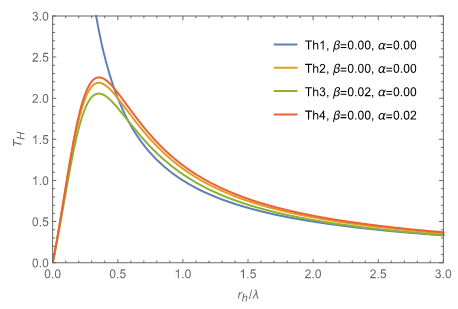
addition, we note that in both cases the Hawking temperature
reaches a maximum value before going to zero, as we can see
in Figure 1. Therefore, presenting a behavior analogous to
what happens with the corrected Hawking temperature of
the Schwarzschild black hole.
For entropy, we obtain
| 4 | π λ A |
|---|
(103) Again we find a logarithmic correction term and also the contribution of the parameter to the entropy.
Noncommutative Case: For the magnetic sector, the GUP- corrected Hawking temperature is given by
3 3 2 1 4 B T
θ $$ r ^ {\prime} = \frac {1 + 4 \theta_ {3} B _ {3}}{\pi \left[ r _ {h} - \frac {\lambda}{4} + \frac {\lambda^ {2}}{8 r _ {h}} \dots \right]} $$ (104) λ λ π
4 8 h h r r
Note that, the GUP acts as a temperature regulator
by removing the singularity when
0 hr =
. In addition, the
temperature goes through a maximum value point before
going to zero for
$$ r _ {h} = 0. $$
In this case entropy is given by
2
| 4 | π λ A |
|---|
( ) Next, for the electrical sector, we find the following GUP- corrected Hawking temperature
2 1 θ $$ r = \frac {1 + \theta \mathcal {E} _ {r}}{\pi \left[ r _ {+} - \frac {\lambda}{4} + \frac {\lambda^ {2}}{8 r _ {+}} \dots \right]} $$ (106) r T λ λ π + +
4 8 r r In terms of hr , the temperature becomes
2 1 θ $$ r = \frac {1 + \theta \mathcal {E} _ {r}}{\pi \left[ r _ {h} \left(1 + \frac {\theta \mathcal {E} _ {r}}{4}\right) - \frac {\lambda}{4} + \frac {\lambda^ {2}}{8 r _ {h}} \left(1 - \frac {\theta \mathcal {E} _ {r}}{4}\right) \dots \right]} $$ T r (107) θ θ λ λ π
1 1 4 4 8 4
r r r r h h
Hence, as has been verified in the violating-Lorentz case, here in both cases the temperature-corrected magnetic and electric sectors have the singularity removed when the horizon radius goes to zero. Also, in this case we can observe that the temperature reaches a maximum value and then goes to zero when the horizon radius is zero.
At this point, when determining the entropy, we have
| 4 | π λ | A |
|---|
( ) (108)
Result Using Modified Dispersion Relation
Near the event horizon the dispersion relation (19) becomes a E r ω = +
2 0 2 1 2 h
(109) where 0_a_ is a parameter with length dimension. By assuming $$ k \sim \Delta k \sim 1 / \Delta x = 1 / r _ {h}, $$
, we can write $$ \omega = E \left(1 + \frac {a _ {0} ^ {2} k ^ {2}}{2}\right) $$ (110) Thus, in terms of the energy difference, we have $$ \frac {\Delta E}{E} = \frac {\omega - E}{E} = \frac {a _ {0} ^ {2} k ^ {2}}{2} (1 1 1) $$ Next, by using the Rayleigh’s formula that relates the phase and group velocities $$ v _ {g} = v _ {p} + k \frac {d v _ {p}}{d k} (1 1 2) $$ where the phase velocity ( ) pv and the group velocity ( ) gv are given by $$ v _ {p} = \frac {\omega}{k} = 1 + \frac {a _ {0} ^ {2} k ^ {2}}{2} (1 1 3) $$ and $$ v _ {g} = \frac {d \omega}{d k} = 1 + \frac {3 a _ {0} ^ {2} k ^ {2}}{2} (1 1 4) $$ However, we find an expression for the velocity difference as following
2 2 0 – g p
$$ \frac {v _ {g} - v _ {p}}{v _ {p}} = a _ {0} ^ {2} k ^ {2} \tag {115} $$
p which corresponds to the supersonic case( ) g p v v > .
Furthermore, the Hawking temperature (58) can be corrected by applying the dispersion ratio (109), i.e
2 c T a r r π $$ = \frac {c _ {s} ^ {2}}{\pi \left(r _ {n} + \frac {a _ {0} ^ {2}}{2 r _ {h}}\right)} $$ s H (116)
2 0 2 n h Note that the singularity is removed, when hr and the temperature vanishes. In addition, the temperature reaches a maximum value before going to zero, as we can see in Figure 2. Now, by calculating the entropy, we find
2 0 2 2 2 ln 4 4 s s
$$ S = \frac {A}{4 c _ {s} ^ {2}} + \frac {2 \pi a _ {0} ^ {2} \ln A}{4 c _ {s} ^ {2}} \tag {117} $$ Here a logarithmic correction term arises in entropy on account of the modified dispersion relation. In order to correct the Hawking temperature and entropy for the Lorentz-violating and non-commutative cases, we will apply the modified dispersion relations obtained in Refs Anacleto MA, et al. [21, 22].
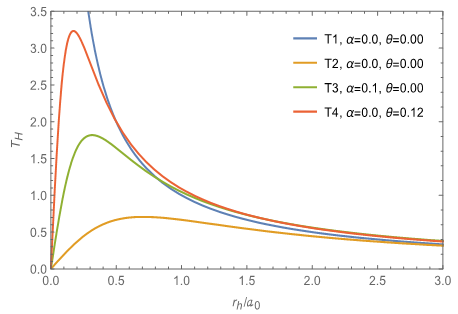
$$ \text{Figure 2: The Hawking temperature } T _ {H} \rightarrow \pi a _ {0} T _ {H} \text{ in function of } r _ {h} / a _ {0}. \text{ Note that the temperatures T2 (116), T2 (119) and T4 (122) reach maximum values and then} $$
a . Note that the temperatures T2 (116),
T3 (119) and T4 (123) reach maximum values, and then
decreases to zero as
$$ s r _ {h} / a _ {0} \rightarrow 0. $$ Violation-Lorentz Case: In the situation where
$$ \text{Violation-Lorentz Case: In the situation where } \beta = 0 \text{ and } \alpha \neq 0, \text{ we have the following dispersion relation:} $$
, we have the following dispersion relation:
$$ p = E \left(1 + \frac {\alpha}{2} + \frac {\alpha a _ {0} ^ {2}}{\tilde {r} _ {+} ^ {2}}\right) \tag {118} $$
2 0 2 1 2 a E r α α ω +
So for temperature (73), we get
1 3 / 2 α + =
T a r r (119) + +
2 0 α α π + +
2 Furthermore, the result shows that the temperature reaches a maximum point and then goes to zero when the horizon radius is zero. Moreover, entropy is given by $$ S = \left(1 - \frac {3 \alpha}{2}\right) \left[ \left(1 - \frac {\alpha}{4}\right) \frac {A}{4} + \frac {2 \sqrt {\pi} \alpha \sqrt {A}}{4} + \frac {4 \pi \alpha a _ {0} ^ {2} \ln A}{8} + \dots \right] (1 2 0) $$ Again due to the contribution of the modified dispersion relation, a logarithmic correction term arises in the entropy.
Noncommutative Case: At this point we consider the dispersion ratio for the pure electrical sector. So we have = +
2 1 0 2 1 4 a E r θ ω (121)
+
For the temperature (89), we find
$$T = \frac{(1 + \theta E_r)}{\pi \left( r_y + \frac{\theta E_1 a_0^2}{4 r_y} \right)} (122)$$
which in terms of $r_h$ becomes
$$T = \frac{(1 + \theta E_r)}{\pi \left[ \left( 1 + \frac{\theta E_r}{4} \right) r_h + \frac{\theta E_1 a_0^2}{4 r_h} \right]} (123)$$
Here, we can see that the temperature goes through a maximum value before going to zero for $r_h = 0$. Hence, the result for entropy is
$$S = \left( 1 - \theta E_r \right) \left[ \left( 1 + \frac{\theta E_r}{4} \right) \frac{A}{4} + \frac{\pi \theta E_1 a_0^2 \ln A}{4} \right] (124)$$
In the above equation a logarithmic correction term arises in entropy as a consequence of the noncommutativity effect on the dispersion relation.
**Conclusion**
In summary, in this work, we have reviewed the steps to generate relativistic acoustic metrics in the Lorentz-violating and noncommutative background. In particular, we have considered the modified canonical acoustic metric due to the contribution of terms violating Lorentz symmetry and noncommutativity; to examine Hawking radiation and entropy. Moreover, we have verified, in the calculation of the Hawking temperature, that due to the presence of the GUP and the modified dispersion relation, the singularity is removed. In addition, we have shown that in these cases, the temperature reaches a maximum value and then vanishes when the horizon radius goes to zero. Furthermore, entropy has been computed, and we show that logarithmic correction terms are generated due to the GUP and also the modified dispersion relation. Therefore, the presented results show a behavior similar to what happens in the case of the Schwarzschild black hole.
**Acknowledgments**
We would like to thank CNPq, CAPES and CNPq/PRONEX/FAPESQ-PB (Grant nos. 165/2018 and 015/2019), for partial financial support. MAA, FAB and EP acknowledge support from CNPq (Grant nos. 306398/2021-4, 312104/2018-9, 304290/2020-3).
**References**
1. Unruh WG (1981) Experimental Black-Hole Evaporation. Phys Rev Lett 46(21): 1351-1353.
2. Unruh WG (1995) Sonic analogue of black holes and the effects of high frequencies on black hole evaporation. Phys Rev D Part Fields 51(6): 2827-2838.
3. Abbott BP, Abbott R, Abbott TD, Abernathy MR, Acernese F, et al. (2016) Observation of Gravitational Waves from a Binary Black Hole Merger. Phys Rev Lett 116(6): 061102.
4. Abbott BP, Abbott R, Abbott TD, Acernese F, Ackley K, et al. (2017) GW170817: Observation of Gravitational Waves from a Binary Neutron Star Inspiral. Phys Rev Lett 119(16): 161101.
5. Akiyama K, Alberdi A, Alef W, Asada K, Azulay R, et al. (2019) First M87 Event Horizon Telescope Results. I. The Shadow of the Supermassive Black Hole. The Astrophysical Journal Letters 875(1).
6. Akiyama K, Alberdi A, Alef W, Asada K, Azulay R, et al. (2019) First M87 Event Horizon Telescope Results. VI. The Shadow and Mass of the Central Black Hole. The Astrophysical Journal Letters 875(6).
7. Visser M (1998) Acoustic black holes: Horizons, ergospheres, and Hawking radiation. Class Quant Grav 15(6): 1767-1791.
8. Barceló C, Liberati S, Visser M (2005) Analogue Gravity. Living Rev Relativ 8(1): 12.
9. Muñoz DNJR, Golubkov K, Kolobov VI, Steinhauer J (2019) Observation of thermal Hawking radiation and its temperature in an analogue black hole. Nature 569(7758): 688-691.
10. Isoard M, Pavloff N (2020) Departing from thermality of analogue Hawking radiation in a Bose-Einstein condensate. Phys Rev Lett 124(6): 060401.
11. Steinhauer J (2014) Observation of self-amplifying Hawking radiation in an analog black hole laser. Nature Phys 10: 864-869.
12. Drori J, Rosenberg Y, Bermudez D, Silberberg Y, Leonhardt U, et al. (2019) Observation of Stimulated Hawking Radiation in an Optical Analogue. Phys Rev Lett 122(1): 010404.
13. Rosenberg Y (2020) Optical analogues of black-hole horizons. Philos Trans A Math Phys Eng Sci 378(2177): 20190232.
14. Guo Y, Miao YG (2020) Quasinormal mode and stability.
of optical black holes in moving dielectrics. Phys Rev D 101(2): 024048.
15. Bera A, Ghosh S (2020) Stimulated Hawking Emission from Electromagnetic Analogue Black Hole: Theory and Observation. Phys Rev D 101(10): 105012.
16. Blencowe MP, Wang H (2020) Analogue Gravity on a Superconducting Chip. Phil Trans Roy Soc Lond A 378(2177): 20190224.
17. Lahav O, Itah A, Blumkin A, Gordon C, Rinott S, et al. (2010) Realization of a sonic black hole analog in a Bose- Einstein condensate. Phys Rev Lett 105(24): 240401.
18. Ge XH, Nakahara M, Sin SJ, Tian Y, Wu SF, et al. (2019) Acoustic black holes in curved space time and the emergence of analogue Minkowski space time. Phys Rev D 99(10): 1-11.
19. Yu C, Sun JR (2019) Note on acoustic black holes from black D3-brane. Int J Mod Phys D 28(7): 1950095.
20. Ge XH, Sin SJ (2010) Acoustic black holes for relativistic fluids. J High Energ Phys 2010.
21. Anacleto MA, Brito FA, Passos E (2011) Acoustic Black Holes from Abelian Higgs Model with Lorentz Symmetry Breaking. Physics Letters B 694(2): 149-157.
22. Anacleto MA, Brito FA, Passos E (2012) Supersonic Velocities in Noncommutative Acoustic Black Holes. Phys Rev D 85(2): 025013.
23. Anacleto MA, Brito FA, Passos E (2016) Acoustic Black Holes and Universal Aspects of Area Products. Phys Lett A 380(11-12): 1105-1109.
24. Anacleto MA, Brito FA, Passos E, Luna GC (2022) The generalized uncertainty principle effect in acoustic black holes. Annals Phys 440: 168837.
25. Bilic N (1999) Relativistic acoustic geometry. Class Quant Grav 16(12): 3953-3964.
26. Fagnocchi S, Finazzi S, Liberati S, Kormos M, Trombettoni A (2010) Relativistic Bose-Einstein Condensates: a New System for Analogue Models of Gravity. New J Phys 12: 095012.
27. Giacomelli L, Liberati S (2017) Rotating black hole solutions in relativistic analogue gravity. Phys Rev D 96(6): 064014.
28. Visser M, Molina-Paris C (2010) Acoustic geometry for general relativistic barotropic irrotational fluid flow. New J Phys 12: 095014.
29. Basak S, Majumdar P (2003) ‘Superresonance’ from a rotating acoustic black hole. Class Quant Grav 20 (18): 3907-3914.
30. Richartz M, Weinfurtner S, Penner AJ, Unruh WG (2009) General universal superradiant scattering. Phys Rev D 80(12): 124016.
31. Anacleto MA, Brito FA, Passos E (2011) Superresonance effect from a rotating acoustic black hole and Lorentz symmetry breaking. Phys Lett B 703(05): 609-613.
32. Zhang LC, Li HF, Zhao R (2011) Hawking radiation from a rotating acoustic black hole. Phys Lett B 698 (5): 438- 442.
33. Ge XH, Wu SF, Wang Y, Yang GH, Shen YG (2012) Acoustic black holes from supercurrent tunneling. Int J Mod Phys D 21(04): 1250038.
34. Zhao HH, Li GL, Zhang LC () Generalized uncertainty principle and entropy of three-dimensional rotating acoustic black hole. Phys Lett A 376(35): 2348-2351.
35. Anacleto MA, Brito FA, Passos E, Santos WP (2014) The entropy of the noncommutative acoustic black hole based on generalized uncertainty principle. Phys Lett B 737: 6-11.
36. Anacleto MA, Brito FA, Passos E, Luna C, Spinelly J (2015) Quantum-corrected finite entropy of noncommutative acoustic black holes. Annals Phys 362: 436-448.
37. Anacleto MA, Brito FA, Passos E, Salako IG (2018) The entropy of an acoustic black hole in neo-Newtonian theory. Int J Mod Phys A 33(32): 1850185.
38. Anacleto MA, Brito FA, Passos E, Garcia CV, Luna GC (2019) Quantum-corrected rotating acoustic black holes in Lorentz-violating background. Phys Rev D 100(10): 105005.
39. Cardoso V, Lemos JPS, Yoshida S (2004) Quasinormal modes and stability of the rotating acoustic black hole: Numerical analysis. Phys Rev D 70(12): 124032.
40. Nakano H, Kurita Y, Ogawa K, Yoo CM (2005) Quasinormal ringing for acoustic black holes at low temperature. Phys Rev D 71(12): 084006.
41. Berti E, Cardoso V, Lemos JPS (2004) Quasinormal modes and classical wave propagation in analogue black holes. Phys Rev D 70: 124006.
42. Chen SB, Jing JL (2006) Quasinormal modes of a coupled scalar field in the acoustic black hole spacetime. Chin Phys Lett 23(1): 21-24.
43. Guo H, Liu H, Kuang XM, Wang B (2020) Acoustic black hole in Schwarzschild spacetime: quasi-normal modes, analogous Hawking radiation and shadows. Phys Rev D 102: 124019.
44. Ling R, Guo H, Liu H, Kuang XM, Wang B (2021) Shadow and near-horizon characteristics of the acoustic charged black hole in curved spacetime. Phys Rev D 104: 104003.
45. Dolan SR, Oliveira ES, Crispino LCB (2011) Aharonov- Bohm effect in a draining bathtub vortex. Phys Lett B 701(4): 485-489.
46. Anacleto MA, Brito FA, Passos E (2012) Analogue Aharonov-Bohm effect in a Lorentz-violating background. Phys Rev D 86: 125015.
47. Anacleto MA, Brito FA, Passos E (2013) Noncommutative analogue Aharonov-Bohm effect and superresonance. Phys Rev D 87(12): 125015.
48. Anacleto MA, Salako IG, Brito FA, Passos E (2015) Analogue Aharonov-Bohm effect in neo-Newtonian theory. Phys Rev D 92(12): 125010.
49. Anacleto MA, Brito FA, Mohammadi A, Passos E (2017) Aharonov-Bohm effect for a fermion field in a planar acoustic black hole ”spacetime”. Eur Phys J C 77(4): 239.
50. Anacleto MA, Brito FA, Campos JAV, Passos E (2020) Higher-derivative analogue Aharonov–Bohm effect, absorption and superresonance. Int J Mod Phys A 35(21): 2050112.
51. Anacleto MA, Bessa CHG, Brito FA, Ferreira EJB, Passos E (2021) Stochastic motion in an expanding noncommutative fluid. Phys Rev D 103(12): 125023.
52. Anacleto MA, Bessa CHG, Brito FA, Mateus AE, Passos E, et al. (2022) LIV effects on the quantum stochastic motion in an acoustic FRW-geometry. Eur Phys J C 82(4): 352.
53. Qiao CK, Zhou M (2023) The Gravitational Bending of Acoustic Schwarzschild Black Hole. Eur Phys J C Part Fields 83(4): 271.
54. Vieira HS, Bezerra VB (2016) Acoustic black holes: massless scalar field analytic solutions and analogue Hawking radiation. Gen Rel Grav 48(7): 88.
55. Ribeiro CCH, Baak SS, Fischer UR (2022) Existence of steady-state black hole analogs in finite quasi-one- dimensional Bose-Einstein condensates. Phys Rev D 105(12): 124066.
56. Zhang B (2016) Thermodynamics of acoustic black holes in two dimensions. Adv High Energy Phys, pp: 5710625.
57. Rinaldi M (2011) Entropy of an acoustic black hole in Bose-Einstein condensates. Phys Rev D 84: 124009.
58. Steinhauer J (2015) Measuring the entanglement of analogue Hawking radiation by the density-density correlation function. Phys Rev D 92(2): 024043.
59. Giovanazzi S (2011) Entanglement Entropy and Mutual Information Production Rates in Acoustic Black Holes. Phys Rev Lett 106: 011302.
60. Anacleto MA, Brito FA, Passos E (2022) Hawking radiation and stability of the canonical acoustic black holes, pp: 1-10.
61. Bazeia D, Menezes R, Barreto MN (2006) Defect structures in Lorentz and CPT violating scenarios Phys Rev D 73: 065015.
62. Ghosh S (2005) Noncommutativity in Maxwell-Chern- Simons-matter theory simulates Pauli magnetic coupling. Mod Phys Lett A20 1227-1238.
63. Das S, Vagenas EC (2008) Universality of Quantum Gravity Corrections. Phys Rev Lett 101: 221301.
64. Das S, Vagenas EC (2009) Phenomenological Implications of the Generalized Uncertainty Principle. Can J Phys 87: 233-240.
65. Ali AF, Das S, Vagenas EC (2011) A proposal for testing Quantum Gravity in the lab. Phys Rev D 84: 044013.
66. Ali AF, Das S, Vagenas EC (2009) Discreteness of Space from the Generalized Uncertainty Principle. Phys Lett B 678: 497-499.
67. Casadio R, Micu O, Nicolini P (2014) Minimum length effects in black hole physics. In: Calmet X (Ed.), Quantum Aspects of Black Holes. Fundam Theor Phys 178: 293- 322.
68. Kempf A, Mangano G, Mann RB (1995) Hilbert space representation of the minimal length uncertainty relation. Phys Rev D 52: 1108-1118.
69. Garay LJ (1995) Quantum gravity and minimum length. Int J Mod Phys A 10: 145-166.
70. Camelia GA (2001) Testable scenario for relativity with minimum length. Phys Lett B 510: 255-263.
References
-
Unruh WG (1981) Experimental Black-Hole Evaporation. Phys Rev Lett 46(21): 1351-1353.
-
Unruh WG (1995) Sonic analogue of black holes and the effects of high frequencies on black hole evaporation. Phys Rev D Part Fields 51(6): 2827-2838.
-
Abbott BP, Abbott R, Abbott TD, Abernathy MR, Acernese F, et al. (2016) Observation of Gravitational Waves from a Binary Black Hole Merger. Phys Rev Lett 116(6): 061102.
-
Abbott BP, Abbott R, Abbott TD, Acernese F, Ackley K, et al. (2017) GW170817: Observation of Gravitational Waves from a Binary Neutron Star Inspiral. Phys Rev Lett 119(16): 161101.
-
Akiyama K, Alberdi A, Alef W, Asada K, Azulay R, et al. (2019) First M87 Event Horizon Telescope Results. I. The Shadow of the Supermassive Black Hole. The Astrophysical Journal Letters 875(1).
-
Akiyama K, Alberdi A, Alef W, Asada K, Azulay R, et al. (2019) First M87 Event Horizon Telescope Results. VI. The Shadow and Mass of the Central Black Hole. The Astrophysical Journal Letters 875(6).
-
Visser M (1998) Acoustic black holes: Horizons, ergospheres, and Hawking radiation. Class Quant Grav 15(6): 1767-1791.
-
Barceló C, Liberati S, Visser M (2005) Analogue Gravity. Living Rev Relativ 8(1): 12.
-
Muñoz DNJR, Golubkov K, Kolobov VI, Steinhauer J (2019) Observation of thermal Hawking radiation and its temperature in an analogue black hole. Nature 569(7758): 688-691.
-
Isoard M, Pavloff N (2020) Departing from thermality of analogue Hawking radiation in a Bose-Einstein condensate. Phys Rev Lett 124(6): 060401.
-
Steinhauer J (2014) Observation of self-amplifying Hawking radiation in an analog black hole laser. Nature Phys 10: 864-869.
-
Drori J, Rosenberg Y, Bermudez D, Silberberg Y, Leonhardt U, et al. (2019) Observation of Stimulated Hawking Radiation in an Optical Analogue. Phys Rev Lett 122(1): 010404.
-
Rosenberg Y (2020) Optical analogues of black-hole horizons. Philos Trans A Math Phys Eng Sci 378(2177): 20190232.
-
Guo Y, Miao YG (2020) Quasinormal mode and stability. of optical black holes in moving dielectrics. Phys Rev D 101(2): 024048.
-
Bera A, Ghosh S (2020) Stimulated Hawking Emission from Electromagnetic Analogue Black Hole: Theory and Observation. Phys Rev D 101(10): 105012.
-
Blencowe MP, Wang H (2020) Analogue Gravity on a Superconducting Chip. Phil Trans Roy Soc Lond A 378(2177): 20190224.
-
Lahav O, Itah A, Blumkin A, Gordon C, Rinott S, et al. (2010) Realization of a sonic black hole analog in a Bose- Einstein condensate. Phys Rev Lett 105(24): 240401.
-
Ge XH, Nakahara M, Sin SJ, Tian Y, Wu SF, et al. (2019) Acoustic black holes in curved space time and the emergence of analogue Minkowski space time. Phys Rev D 99(10): 1-11.
-
Yu C, Sun JR (2019) Note on acoustic black holes from black D3-brane. Int J Mod Phys D 28(7): 1950095.
-
Ge XH, Sin SJ (2010) Acoustic black holes for relativistic fluids. J High Energ Phys 2010.
-
Anacleto MA, Brito FA, Passos E (2011) Acoustic Black Holes from Abelian Higgs Model with Lorentz Symmetry Breaking. Physics Letters B 694(2): 149-157.
-
Anacleto MA, Brito FA, Passos E (2012) Supersonic Velocities in Noncommutative Acoustic Black Holes. Phys Rev D 85(2): 025013.
-
Anacleto MA, Brito FA, Passos E (2016) Acoustic Black Holes and Universal Aspects of Area Products. Phys Lett A 380(11-12): 1105-1109.
-
Anacleto MA, Brito FA, Passos E, Luna GC (2022) The generalized uncertainty principle effect in acoustic black holes. Annals Phys 440: 168837.
-
Bilic N (1999) Relativistic acoustic geometry. Class Quant Grav 16(12): 3953-3964.
-
Fagnocchi S, Finazzi S, Liberati S, Kormos M, Trombettoni A (2010) Relativistic Bose-Einstein Condensates: a New System for Analogue Models of Gravity. New J Phys 12: 095012.
-
Giacomelli L, Liberati S (2017) Rotating black hole solutions in relativistic analogue gravity. Phys Rev D 96(6): 064014.
-
Visser M, Molina-Paris C (2010) Acoustic geometry for general relativistic barotropic irrotational fluid flow. New J Phys 12: 095014.
-
Basak S, Majumdar P (2003) ‘Superresonance’ from a rotating acoustic black hole. Class Quant Grav 20 (18): 3907-3914.
-
Richartz M, Weinfurtner S, Penner AJ, Unruh WG (2009) General universal superradiant scattering. Phys Rev D 80(12): 124016.
-
Anacleto MA, Brito FA, Passos E (2011) Superresonance effect from a rotating acoustic black hole and Lorentz symmetry breaking. Phys Lett B 703(05): 609-613.
-
Zhang LC, Li HF, Zhao R (2011) Hawking radiation from a rotating acoustic black hole. Phys Lett B 698 (5): 438- 442.
-
Ge XH, Wu SF, Wang Y, Yang GH, Shen YG (2012) Acoustic black holes from supercurrent tunneling. Int J Mod Phys D 21(04): 1250038.
-
Zhao HH, Li GL, Zhang LC () Generalized uncertainty principle and entropy of three-dimensional rotating acoustic black hole. Phys Lett A 376(35): 2348-2351.
-
Anacleto MA, Brito FA, Passos E, Santos WP (2014) The entropy of the noncommutative acoustic black hole based on generalized uncertainty principle. Phys Lett B 737: 6-11.
-
Anacleto MA, Brito FA, Passos E, Luna C, Spinelly J (2015) Quantum-corrected finite entropy of noncommutative acoustic black holes. Annals Phys 362: 436-448.
-
Anacleto MA, Brito FA, Passos E, Salako IG (2018) The entropy of an acoustic black hole in neo-Newtonian theory. Int J Mod Phys A 33(32): 1850185.
-
Anacleto MA, Brito FA, Passos E, Garcia CV, Luna GC (2019) Quantum-corrected rotating acoustic black holes in Lorentz-violating background. Phys Rev D 100(10): 105005.
-
Cardoso V, Lemos JPS, Yoshida S (2004) Quasinormal modes and stability of the rotating acoustic black hole: Numerical analysis. Phys Rev D 70(12): 124032.
-
Nakano H, Kurita Y, Ogawa K, Yoo CM (2005) Quasinormal ringing for acoustic black holes at low temperature. Phys Rev D 71(12): 084006.
-
Berti E, Cardoso V, Lemos JPS (2004) Quasinormal modes and classical wave propagation in analogue black holes. Phys Rev D 70: 124006.
-
Chen SB, Jing JL (2006) Quasinormal modes of a coupled scalar field in the acoustic black hole spacetime. Chin Phys Lett 23(1): 21-24.
-
Guo H, Liu H, Kuang XM, Wang B (2020) Acoustic black hole in Schwarzschild spacetime: quasi-normal modes, analogous Hawking radiation and shadows. Phys Rev D 102: 124019.
-
Ling R, Guo H, Liu H, Kuang XM, Wang B (2021) Shadow and near-horizon characteristics of the acoustic charged black hole in curved spacetime. Phys Rev D 104: 104003.
-
Dolan SR, Oliveira ES, Crispino LCB (2011) Aharonov- Bohm effect in a draining bathtub vortex. Phys Lett B 701(4): 485-489.
-
Anacleto MA, Brito FA, Passos E (2012) Analogue Aharonov-Bohm effect in a Lorentz-violating background. Phys Rev D 86: 125015.
-
Anacleto MA, Brito FA, Passos E (2013) Noncommutative analogue Aharonov-Bohm effect and superresonance. Phys Rev D 87(12): 125015.
-
Anacleto MA, Salako IG, Brito FA, Passos E (2015) Analogue Aharonov-Bohm effect in neo-Newtonian theory. Phys Rev D 92(12): 125010.
-
Anacleto MA, Brito FA, Mohammadi A, Passos E (2017) Aharonov-Bohm effect for a fermion field in a planar acoustic black hole ”spacetime”. Eur Phys J C 77(4): 239.
-
Anacleto MA, Brito FA, Campos JAV, Passos E (2020) Higher-derivative analogue Aharonov–Bohm effect, absorption and superresonance. Int J Mod Phys A 35(21): 2050112.
-
Anacleto MA, Bessa CHG, Brito FA, Ferreira EJB, Passos E (2021) Stochastic motion in an expanding noncommutative fluid. Phys Rev D 103(12): 125023.
-
Anacleto MA, Bessa CHG, Brito FA, Mateus AE, Passos E, et al. (2022) LIV effects on the quantum stochastic motion in an acoustic FRW-geometry. Eur Phys J C 82(4): 352.
-
Qiao CK, Zhou M (2023) The Gravitational Bending of Acoustic Schwarzschild Black Hole. Eur Phys J C Part Fields 83(4): 271.
-
Vieira HS, Bezerra VB (2016) Acoustic black holes: massless scalar field analytic solutions and analogue Hawking radiation. Gen Rel Grav 48(7): 88.
-
Ribeiro CCH, Baak SS, Fischer UR (2022) Existence of steady-state black hole analogs in finite quasi-one- dimensional Bose-Einstein condensates. Phys Rev D 105(12): 124066.
-
Zhang B (2016) Thermodynamics of acoustic black holes in two dimensions. Adv High Energy Phys, pp: 5710625.
-
Rinaldi M (2011) Entropy of an acoustic black hole in Bose-Einstein condensates. Phys Rev D 84: 124009.
-
Steinhauer J (2015) Measuring the entanglement of analogue Hawking radiation by the density-density correlation function. Phys Rev D 92(2): 024043.
-
Giovanazzi S (2011) Entanglement Entropy and Mutual Information Production Rates in Acoustic Black Holes. Phys Rev Lett 106: 011302.
-
Anacleto MA, Brito FA, Passos E (2022) Hawking radiation and stability of the canonical acoustic black holes, pp: 1-10.
-
Bazeia D, Menezes R, Barreto MN (2006) Defect structures in Lorentz and CPT violating scenarios Phys Rev D 73: 065015.
-
Ghosh S (2005) Noncommutativity in Maxwell-Chern- Simons-matter theory simulates Pauli magnetic coupling. Mod Phys Lett A20 1227-1238.
-
Das S, Vagenas EC (2008) Universality of Quantum Gravity Corrections. Phys Rev Lett 101: 221301.
-
Das S, Vagenas EC (2009) Phenomenological Implications of the Generalized Uncertainty Principle. Can J Phys 87: 233-240.
-
Ali AF, Das S, Vagenas EC (2011) A proposal for testing Quantum Gravity in the lab. Phys Rev D 84: 044013.
-
Ali AF, Das S, Vagenas EC (2009) Discreteness of Space from the Generalized Uncertainty Principle. Phys Lett B 678: 497-499.
-
Casadio R, Micu O, Nicolini P (2014) Minimum length effects in black hole physics. In: Calmet X (Ed.), Quantum Aspects of Black Holes. Fundam Theor Phys 178: 293- 322.
-
Kempf A, Mangano G, Mann RB (1995) Hilbert space representation of the minimal length uncertainty relation. Phys Rev D 52: 1108-1118.
-
Garay LJ (1995) Quantum gravity and minimum length. Int J Mod Phys A 10: 145-166.
-
Camelia GA (2001) Testable scenario for relativity with minimum length. Phys Lett B 510: 255-263.
- Sense, Gravity, Parity & Chirality in Mathematical Physics
- Quantum Lattice Simulations PHYSICS: Microcircuit Particle Formation and Observable Macroscopic Irreversible Time - A Discrete Lagrangian with Cellular Automata Framework
- Quantum Biology from Biomacromolecule to Cell, and Central Dogma Described by Quantum Theory
- Focus, Agility, Speed and Technology (FAST) for Sustainability and Growth
- Square Root Metric Geometry and Pati-Salam Model in Curved Space-Time
- A Simple System Demonstrating the Mpemba Effect in Classical Mechanics