
Electro-Optic Activity of a Non-Ideal One-Dimensional Photonic Structure in the Frequency Vicinity of Excitonic Transition
The paper is devoted to electro-gyration phenomenon in a non-ideal one-dimensional photonic crystal. One of the sublattices of the considered structure includes randomly distributed foreign layers with embedded point imperfections (vacancies). Electro-gyration effect arises due to the onset of optical activity of defect layers under the action of a constant electric field. We study the dependence of the specific polarization rotation angle of light on concentrations of layer wise and point defects as well as on the light frequency and lattice parameters.
Introduction
The use of gyrotropic effects very often happens to be the only way of determination of certain stereo- and crystallochemical parameters of chiral systems as well as of investigation of corresponding structural details of dispersive media [1]. At present there are a lot of complex (ideal and otherwise) crystalline materials which are optically active either due to their structural characteristics or to the optical activity of their constituent molecules [2, 3]. A special interest lies in how structural details and spatial dispersion of various media [4] are manifested in polarization measurements of spectral characteristics. Electro-gyration is studied by observing the onset and changes of optical activity of media caused by electric field.
Paper Rybalka AE, et al. [5] presents the technique of calculation of optical characteristics of one-dimensional superlattices as functions of defect concentrations. It proved to be useful for modeling of composite materials with prescribed characteristics with neglected spatial dispersion. Taking into account the spatial dispersion permits to widen the scope of the studied phenomena which include e.g. the natural optical activity (NOA) [5, 6]. Results of Rybalka AE, et al. [5, 6] enable to investigate electro-optical activity of non- ideal crystalline systems. In the present work we concentrate on electrogyration phenomenon in a multilayer material with an arbitrary number of sublattices, one of which includes randomly distributed impurity layers with point defects (vacancies). These foreign layers exhibit optical activity when subjected to a constant electric field.
Theoretical Model
Prior to considering electrogyration in a one-dimensional superlattice in the exciton spectrum range let us dwell on the corresponding effect in a defect layer of an ideal molecular crystal. Hamiltonian ˆH of a molecular crystal subjected to an external electric field E has the form:
1 ˆ ˆ ˆ 2 H H V α α α β α α β = − + ∑ ∑ n n n m n n m p E , (1) ( ) , where ˆH α n is the Hamiltonian of an isolated molecule α n , nα p is the dipole moment operator of this molecule, ˆV α β n m is the Coulomb interaction operator of molecules α n and β m (n , m - are integer lattice vectors, , α β numerate molecules in the elementary cell). Employing the method of approximate secondary quantization [7] to the case of molecular excitons [8] let us extract the excitonic part ( ) ˆ ex H of Hamiltonian (1). Following the scheme of (References) Bogolyubov NN and Pashkevich YG, et al. [7, 9], we shall make use of the system of wave functions ( ) ( ) f α ϕn E , characterizing the states of individual molecules in the crystalline field. Their explicit form is found from the self-consistent equation:
( ) ( ) ( ) ( ) ( ) ( ) ˆ ˆ f f H W α α α α α α ϕ ε ϕ − + = n n n n n n p E E E E E , (2) where ( ) ( ) ( ) ( ) ( ) 0 0 ˆ ˆ W V β α β β β α ϕ ϕ m n m m m n E E E =∑ , ( ) α εn E is the energy of a molecule located at site α n , whose state is ( ) ( ) f α ϕn E . Using the obtained wave functions ( ) ( ) f α ϕn E to convert to the second quantization representation, we obtain the following expression for the excitonic part ( ) ˆ ex H of Hamiltonian:
1 ˆ 2
( ) ( )( )( )
∑ ∑ n n n m n n m m n n m
E E
( ) ex fg f f f f f g g f f g + + + = + + +
H E B B V B B B B
α α α α β α α β β α α β ( ) ( ) ( ) ( )
( ) ( ) ( ) ( )
ˆ
0 0 f g fg E E E E
V V
ϕ ϕ ϕ ϕ = n m m m n m m m α β α β α β α β ( ) ( ) ( )
E E E
E
ε ε = −
0 f f α α α (3) where f B α + n , f B α n are Bose creation and annihilation operators of molecular excitations. Let us note that expression (3) obtained for the considered case of a molecular crystal placed in homogeneous electric field coincides with the analogous one in (Reference) Davydov AS [8] if interpreted as an expression describing molecular crystal with Hamiltonian ˆH α α − n n p E and corresponding replacement ( ) ( ) ( ), f f α α ϕ ϕ → m m E ( ) f f α α ε ε → E . Calculations performed on the basis of micro-theoretrical approach [5, 6, 9] yield an important characteristic of electro- optic activity of the system, namely its rotatory power ( ) , , ρ ω s E :
× = + − × ⋅ + − −
l tl s t ( ) ( ) ( ) ( )
E s P E s E s E
Q s Vc i E
2 :0 0:
2 2 , , , πω ρ ω ω η η
∑ s µ µ
2 2 2 2 µ µ ( ) ( ) ( ) ( ) ( ) ( ) ( )
s E s E P E P E s s E
s E s E
Here V is the elementary cell volume, ,v µ are the numbers of exciton band, k = s k , ω is the frequency of electromagnetic field in the studied medium, ( ) , Eµ s E is the energy of Coulomb exciton of band µ , ( ) 0: µ s P E and ( ) , t Wµν s E are, correspondingly, the matrix elements (computed for Coulomb exciton states) of the crystal dipole moment operator and of the wave vector derivative of analytical part of the Fourier transform of resonance interaction matrix. The explicit form of function ( ) :0 tl s Q µ E is given in (Reference) Rybalka AE, et al. [5].
Next, using the virtual crystal approximation, let us consider the rotatory power of a non-ideal photonic crystal. This property is characterized by the specific rotation angle of polarization plane of light propagating along the crystal’s optical axiss . According to Lifshits IM, et al. [10] the required rotation angle is defined by the relation:
( ) ( ) { } ( ) ˆ , C ρ ω ρ ω ρ ω Π ≡ = ,(5)
where ˆΠ is the operator of configuration averaging [4] over all feasible variations of positions of layer and point defects applied to the configurationally dependent function ( ) ρ ω , { } 1 2 , , ..., r C C C C ≡ being concentrations of layer and point defects.
The foreign layers are assumed to be constituted by electrooptically active molecular-crystalline structures with vacancies acting as point defects. Generalizing the results of papers [9, 11, 12] to the present case of a defect containing multilayer structure we arrive (in accordance with Rybalka AE, et al. [5]) the following expression for the rotation angle ( ) , , , C ρ ω s E of light polarization plane ( ) ( ) ( ) , , , , , , , def v v C C Na C C ρ ω ρ ω = s E s E (6) Here С is the defect layer concentration, v C is vacancy concentration in a foreign layer, N is the number of elementary cells in the considered one-dimensional photonic crystal, a is the layer width, ( ) ( ) , , , def v C ρ ω s E is the specific rotation angle of light polarization plane in an impurity layer, whose explicit form is found by the above mentioned replacement using the results of Rybalka AE, et al. [5, 6], V.V. Rumyantsev, et al. [12].
In the frames of the present model let us consider linear electrogyration in a one-sublattice molecular crystal with vacancies within the one-level approximation. As follows from References Rybalka AE and Rumyantsev VV, et al. [6, 12], for such systems function ( ) ( ) , , , def v C ρ ω s E has the form:
( ) ( ) ( ) ( )
4 , , , π ρ ω def t tl V f f
s E E s p E
= × ×
C i s Q V c C E E V C
0 0 2 η η η
( ) ( ) ( ) ( )( )
2 2
1 2 , 1 ω ω − × − − −
v
E E s E
2 2 2 0 0 v (7)
Here ( ) 0 E E and ( ) , V s E are, correspondingly, the molecule excitation energy and the Fourier transform of matrix of intermolecular resonance interaction as functions of the external electric field E (for 0 = k ) acting upon an ideal crystal.
With regard to a defect containing electrooptically active photonic crystal, changing to dimensionless quantity ( ) ( ) , , v C C Na ρ ω ρ ω ≡ , within the linear approximation with respect to the field (linear electrogyration) we obtain:
( ) ( ) ( ) 1 , , , , o v C C ρ ω ρ ρ + s E (8)
The terms ( ) o ρ and ( ) 1 ρ of the specific rotation angle of light polarization plane ( ) , , , , v C C ρ ω s E in the zeroth and first order with respect to electric field have the forms, correspondingly:
( ) ( ) , , 0, , , o v C C ρ ρ ω = = s E (9)
( ) ( ) ( ) ( )( )
s + − − − = − ⋅ + − − −
tp R
E E V C C i s C E R V c ω π ρ ω η η η
v t p tp v ( ) ( )
( ) s ( ) ( ) ( )( )
s
0 2 0 ,0 1 E E V C
ω η v (10) In (10)
( ) ( ) ( ) { }
l tl fo of tp p
E s P E s
∂ × = ∂
Q R E
1 , (11) E
0 = ( ) ( ) ( ) ( )
s E s s P
2 , , 0 0 E C R Q E
∂ = × ⋅ ∂
l ex v tp tl fo of p
2 E
0 = ex E is the exciton energy, renormalized by the presence of vacancies and dependent on the electric field. The first term in expression (10) is due to electrooptic activity of molecules. By analogy with Reference Rybalka AE, et al. [5] it can be named the molecular component of electrogyration. The second term is connected to the dependence of exciton energy on electric field. By analogy with Reference Rybalka AE, et al. [5] it can be named the exciton (crystalline) component of electrogyration. In the general case within the considered one-level model both terms in Equation (10) are non-zero for dipole-active states, whereas the second term turns to zero for dipole-inactive states.
Results and Discussion
Since the considered modeling photonic one-dimensional structure exhibits electrooptic activity only under the action of a constant electric field, it makes good sense to restrict our study to frequency and concentration dependence only of the second term ( ) (1) , , , , v C C ρ ω s E in relation (8). Let us also take into account that the matrix elements of intermolecular interaction are much less than excitation energy of a crystal molecule. One must also account for the fact that matrix elements of intermolecular interaction are much less than excitation energy of crystal molecule ( ) 0 ,0 V E s = . Hence, after simple transformations formula (10) takes the form:
, ≈ − + − −
E E η η η
(1) 2 2 2 2 2 2 2 2 2 0 0
1 ( ) 1 v B C C A E E
ρ ω ω ω ( ) ( )
( ) (12) t tp p t tp p s R E B s R E = E . Figures 1a & 1b show the results where, ( ) 2
1 of numerical calculation of function (12). Relative contribution of the two terms in square brackets in (12) into electrooptic activity is defined by the values of system parameters measured in relative units based on the following replacements ( )
1 , , , , v C C A ρ ρ ω → s E E ,
( ) ( ) , 2 2 B B c → η
4 1 0 0 1,8 2,8 10 E E cm c − → = ÷ ⋅ η
.
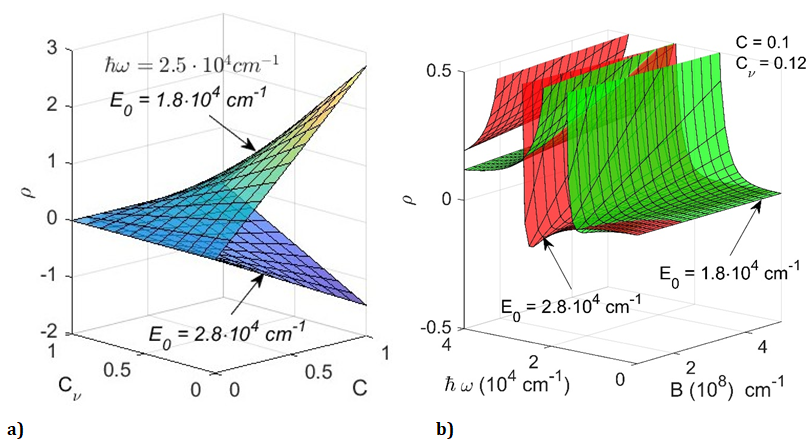
In particular, Figure 1a indicates the possibility of a sign change of the rotation angle of polarization plane for a number of values of parameter 0 E (a left-handed crystal becomes a right-handed crystal and vice versa). Figure 1b shows the dependence ( ) ( ) 1 , B ρ ω , which characterizes the relative contributions of the first and the second terms in relation (12), i.e. the “share participation” of molecular and crystalline components in the electrooptic activity in various frequency ranges.
Conclusion
A microscopic approach has been used to study electrooptic activity of a one-dimensional photonic crystal one of whose sublattices contains randomly included layers of electrooptically active molecular crystal with embedded vacancies. Particular attention is focused on the dependence of specific rotation angle ( ) , , ρ ω s E on concentration of foreign layers and on the electric field intensity in the frequency vicinity of excitonic resonance. The obtained results can facilitate design engineering of electric sensors [13] based on defect containing multilayer structures.
References
-
Fedorov FI (1976) Theory of Gyrotropy. Science and Technology, Minsk, Belarus.
-
Kizel’ VA (1985) Induction of gyrotropy as a new method of study in the physics of condensed media. Sov Phys Usp 28: 1015.
-
Mohrig JR, Hammond CN, Schatz PF (2010) Techniques in Organic Chemistry: Miniscale, Standard Taper Microscale, and Williamson Microscale. 3rd (Edn.), Freeman WH and Company, New York, USA.
-
Rumyantsev VV, Fedorov SA, Gumennyk KV (2011) Photonic Crystals: Optical Properties, Fabrication and Applications. Nova Science Publishers, Inc., New York, USA.
-
Rybalka AE, Rumyantsev VV, Fedorov SA (2020) Monitoring. Science and technologies**.** 44(2): 79-86.
-
Rybalka AE, Rumyantsev VV, Fedorov SA, Gumennyk KV (2021) Features of frequency dispersion of the natural optical activity of a nonideal molecular crystal in the excitonic region of the energy spectrum. Optics and Spectroscopy 129(7): 871-875.
-
Bogolyubov NN (1970) Selected Works in Three Volumes. Naukova Dumka, Kyiv, Ukraine.
-
Davydov AS (1971) Theory of Molecular Excitons. McGraw-Hill, Springer, New York, USA.
-
Pashkevich YG, Fedorov SA (1991) Crystallography Reports. 36(6): 1362-1264.
-
Lifshits IM, Gredeskul SA, Pastur LA (1989) Introduction to the Theory of Disordered Systems, Il Nuovo Cimento D, A Wiley-Interscience Publication. John Wiley and Sons, New York, Chichester, Brisbane, Toronto, Singapore.
-
Rybalka AE, Rumyantsev VV, Fedorov SA (2022) Mathematical modeling of gyrotropic effect. Donetsk international round table “Artificial intellect: theoretical aspects and practical application” (Donetsk, 25.05.22). Donetsk State Institute of Artificial Intelligence.
-
Rumyantsev VV, Fedorov SA, Gumennik KV, Rybalka AE (2022) Gyrotropic Features of a Nonideal Optically Active 1D Photonic Orientationally Disordered Crystal. Journal of Applied Spectroscopy 89(3): 456-461.
-
Novikov MA, Stepanov AA, Khyshov AA (2017) An electric sensor based on the electrogyration effect in a lead tungstate crystal. Tech Phys Lett 43: 372-375.
- Sense, Gravity, Parity & Chirality in Mathematical Physics
- Quantum Lattice Simulations PHYSICS: Microcircuit Particle Formation and Observable Macroscopic Irreversible Time - A Discrete Lagrangian with Cellular Automata Framework
- Quantum Biology from Biomacromolecule to Cell, and Central Dogma Described by Quantum Theory
- Focus, Agility, Speed and Technology (FAST) for Sustainability and Growth
- Square Root Metric Geometry and Pati-Salam Model in Curved Space-Time
- A Simple System Demonstrating the Mpemba Effect in Classical Mechanics