
Restructure of Quantum Mechanics by Duality, the Extensive Quantum Theory and Applications
Reconstructing quantum mechanics has been an exploratory direction for physicists. Based on logical structure and basic principles of quantum mechanics, we propose a new method on reconstruction quantum mechanics completely by the waveparticle duality. This is divided into two steps: First, from wave form and duality we obtain the extensive quantum theory, which has the same quantum formulations only with different quantum constants H; then microscopic phenomena determine H=h. Further, we derive the corresponding commutation relation, the uncertainty principle and Heisenberg equation, etc. Then we research potential and interactions in special relativity and general relativity. Finally, various applications and developments, and some basic questions are discussed.
Introduction
Because of the importance and complexity of quantum mechanics, reconstructing quantum mechanics has been an exploratory direction for physicists. One of the earliest methods is based on hydrodynamics, such as the Madelung’s fluid mechanical model of the early quantum mechanics [1, 2]. Recently, a reconstruction method of quantum mechanics is based on the probabilistic theory. Hardy proposed a specific probability rule, which is generalization and modified of the standard probability theory [3, 4, 5, 6]. This is a reformulation of quantum mechanics as a general probability theory. There are many sets of similar axioms that can produce typical quantum behavior. Bub applied a similar approach to propose that quantum mechanics is essentially a theory of the presentation and manipulation of information, rather than a theory of non-classical waves or particles, thus establishing the quantum theory [7, 8, 9]. The uncertainty principle originates from non-commutative. This can be related to that based on non-commutative, matrix, group, tensor, etc., we proposed the mathematical quantum theory and its applications [10]. Moreover, Philip Ball discussed some questions of quantum [11, 12, 13, 14, 15, 16]. In this paper, based on logical structure and basic principles of quantum mechanics, we propose a new method on reconstruction quantum mechanics by the wave-particle duality, and corresponding extensive quantum theory, and discuss their applications and developments.
Logical Structure and Basic Principles of Quantum Mechanics
Bases of reconstruction quantum mechanics must be the basic principles and structures of quantum mechanics. It is well-known that Von Neumann proposed the mathematical foundations of quantum mechanics [17]. At present, Strocchi discussed the mathematical structure of quantum mechanics [18]. Chen researched the intrinsic structure of quantum mechanics, and shown the wave function as four intrinsic relations on physical space [19]. Bowers searched the mathematical structure of quantum mechanics [20].
Based on the analysis of the logical structure of quantum
mechanics, we proposed that the wave-particle duality is
the only basic principle of quantum mechanics. Statistics
is the corresponding mathematical character [21, 22]. The
other principles [17, 23, 24, 25, 26] are all physical or mathematical
results derived from this. Duality unifies Planck formula
E=hv and de Broglie formula
$$ p = h / \lambda \text {t o} p _ {i} = h k _ {i}. $$
. Based on
the duality and symmetry between geometrical optics and
Hamilton mechanics, Schrödinger equation, Klein-Gordon
(KG) equation and Dirac equations are derived. At the same
time a represent of plane wave
0 exp( ) i i A A ik x = extends to
the wave function of free particle
$$ \mathrm {e} \psi = A \exp \left(i p _ {i} x _ {i} / h\right). \mathrm {I t s} $$
differential derives namely operator represent of physical
quantity:
$$ p _ {i} = - i h \frac {\partial}{\partial x _ {i}}. (1) $$
i The uncertainty principle has universal meaning for various waves, which explains only limit and approximation of microscopic measure and theory. From operator represent and the uncertainty principle may derive the conjugate quantities and commutation relations.
Wave property as probability wave may be exhibited only for much particle events, which obeys identical principle. From this obtains Bose-Einstein statistics and Fermi-Dirac statistics, one of whose result is Pauli Exclusion Principle. Such quantum mechanics is statistical. Mathematical basis of quantum statistics obtains necessarily the definition of average value, and Eigen equations, which combing operator represent may derive:
$$ p _ {i} \psi = - i h \frac {\partial}{\partial x _ {i}} \psi , [ 2 ] $$
i and various equations of quantum mechanics. Since physical quantities are observable, they must be real numbers, Hermitian operators, and Eigen functions are orthogonality, normalization, completeness and closed. Particle number conservation can become statistical probability is independent of time, which obtains that the wave equations are finite, continuity and single value. Complementary principle as an extensive duality is namely a symmetrical principle. The superposition principle is mathematical property of quantum mechanics. We described these conclusions as following (Figure 1) [21, 22]:
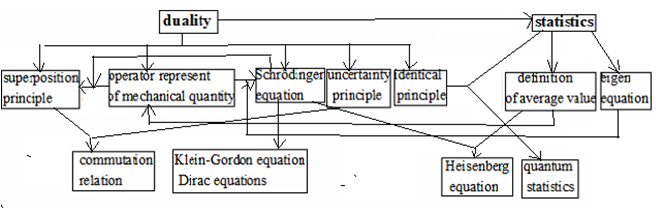
Reconstruction Quantum Mechanics by Duality
We propose a new method on reconstruction quantum mechanics based completely on the wave-particle duality. So that it will be not magical and complex.
The Extensive Quantum Theory with Wave Form of Quantum Mechanics
In geometrical optics for a plane monochromatic wave any quantity describing the field of the wave has the form [27]:
$$ \psi = f = a e ^ {i (k r - \omega t)} = a e ^ {i k _ {i} r _ {i}}, \tag {3} $$ $$ \therefore \frac {\partial \psi}{\partial r _ {i}} = i k _ {i} \psi . (4) $$ We derive an operator:
i i k i r ∂ =−∂ .(5)
If a scalar $A$ is introduces $P_i = Ak_i$ [27], so Equation (5) becomes to:
$$P_i = -iA \frac{\partial}{\partial r_i}$$ 〔6〕
This is the same with operator of four-momentum. It is a main result of wave. These are not directly related to the light velocity $c$. And it can be generalized to the general wave, the $c \rightarrow V$ here $V$ is wave velocity.
This is a remarkable analogy between geometrical optics and the mechanics of material particles [27]. Based on the relations:
$$E = \frac{P^2}{2m} + V, \text{ and } E^2 = P^2 c^2 + m^2 c^4, E = c\alpha P + mc^2 \beta, \text{ (7)}$$
These energy-momentum relations are the main properties of particles. Combined with wave (6) and particle properties (7), we derived the similar Schrödinger equation:
$$iA \frac{\partial}{\partial t} \psi(r,t) = \left( -\frac{A^2}{2m} \nabla^2 + V \right) \psi(r,t), \text{ (8)}$$
and Klein-Gordon (KG) and Dirac equations, and the extensive quantum theory [28, 29, 30, 31], in which the formulations are the same with the quantum mechanics only $A \rightarrow H$, i.e., quantum constant $h$ and corresponding basic quantum elements are different.
- Based on the black radiation, photoelectric effect and Bohr atom model, etc., microscopic quantum mechanics introduced and determined $A = \hbar$, so we derive Equation (1). $P_i = hk_i$ (h is Planck constant) includes $E=hv$ (Planck formula) and $p=h/\lambda$ (de Broglie formula) and $c^2 = uv$ (de Broglie relation, here $u$ is group velocity and $v$ is phase velocity).
For the microscopic scale, quantum mechanics is $A=H=\hbar$. Conversely, $\hbar \rightarrow H$ is namely the extensive quantum theory [28, 29, 30, 31]. As long as the wave-particle duality or the corresponding statistics holds, we must obtain the extensive quantum theory.
In a word, it is divided into two steps: First, from wave form and duality we obtain the extensive quantum theory, which has the same quantum formulations only with different quantum constants $H$, then microscopic phenomena determine $H=h$, and quantum mechanics.
- Based on the operators of momentum-energy Equation (6), we may obtain
$$r_i P_i \psi - P_i r_i \psi = r_i \left( -iA \frac{\partial}{\partial r_i} \psi \right) + iA \frac{\partial}{\partial r_i} \left( r_i \psi \right) = iA \psi, \text{ (9)}$$
and corresponding the uncertainty principle, which should hold for general wave.
Moreover, Equation (9) is also a commutation relation:
$$r_i P_j - P_j r_i = iA \delta_{ij}. \text{ (10)}$$
- From Equation (6) we derive
$$iA \frac{\partial}{\partial t} \psi(t) = H \psi(t). \text{ (11)}$$
Let $\psi(t) = U(t,0)\psi(0), U(t,0)$ is a time-evolution operator, and $U(t,0) = \exp(-iHt/A)$. From this obtains Heisenberg equation:
$$\frac{dF}{dt} = \frac{1}{iA}[F,H]. \text{ (12)}$$
It is a like Poisson bracket, and is analogue to the Liouville equation in classical mechanics. But, the quantum statistics and fermions seem to be not derived from the duality. Wetterich researched emergence of quantum mechanics from classical statistics [32].
In fact, many forms of quantum mechanics based on basic principles are already various extensive quantum theories [28, 29, 30, 31], in which the wave function has probably radiation, Doppler effect, polarization and resolution, etc [27].
Potential and Interactions in Special Relativity and General Relativity
Dirac proposed a method [23]
$$E^2 = c^2 p^2 + m^2 c^4, \text{ (13)}$$
whose extraction is
$$E = \alpha cp + \beta mc^2. \text{ (14)}$$
This obtains the famous Dirac equations in quantum mechanics. We proposed this method may be generally applied: For any square:
$$A^2 = B^2 + C^2, \text{ (15)}$$
whose extraction should be:
$$A = \alpha B + \beta C. \text{ (16)}$$
They include various four-vector.
Further, we extended the Dirac extraction to any terms $$ A ^ {2} = B ^ {2} + C ^ {2} + D ^ {2} + \dots \tag {17} $$ whose extraction should be [33]:
$$ A = \alpha B + \beta C + \gamma D + \dots \tag {18} $$
$$ \mathrm {e} \alpha^ {2} = \beta^ {2} = \gamma^ {2} = \dots = 1, \tag {19} $$
Here
$$ \mathrm {a n d} \alpha \beta = \beta \gamma = \gamma \alpha = \dots = 0. \mathrm {(2 0)} $$ For arbitrary n-power equation:
$$ A ^ {n} = B ^ {n} + C ^ {n} + D ^ {n} + \dots (2 1) $$
whose extraction of n-power may be:
$$ A = \alpha_ {0} B + \beta_ {0} C + \gamma_ {0} D + \dots (2 2) $$
$$ \mathrm {H e r e} \alpha_ {0} ^ {n} = \beta_ {0} ^ {n} = \gamma_ {0} ^ {n} = \dots = 1, \tag {23} $$ $$ , \alpha_ {0} ^ {m} = \beta_ {0} ^ {m ^ {\prime}} = \gamma_ {0} ^ {m ^ {\prime \prime}} = \dots = 0. \tag {24} $$ $$ \alpha_ {0} \beta_ {0} = \beta_ {0} \gamma_ {0} = \gamma_ {0} \alpha_ {0} = \dots = 0, \alpha $$ And n>(m,m’,m’’)>0. Various extensions may introduce various matrices. They may be some very funny matrices, even may obtain new algebra [33].
As an example, assume that
$$ E ^ {2} = \left(c p\right) ^ {2} + m ^ {2} c ^ {4} + V ^ {2}, \tag {25} $$
whose extraction is:
$$ E = \alpha c p + \beta m c ^ {2} + \gamma V. \tag {26} $$
The first and third terms in energy (23) are respectively kinetic energy and potential energy. Equation (26) agrees with Equations (13) and (14). Its square approximation is the Schrödinger equation with the potential V.
It is known that Schrödinger equations in curvilinear coordinates are:
2
| 2m | g |
|---|
In the quantum cosmic field the wave function of Universe obeys the Wheeler-de Witt equation:
$$ (\hbar^ {2} G _ {i j k l} \frac {\delta}{\delta g _ {i j}} \frac {\delta}{\delta g _ {k l}} + \sqrt {G ^ {3}} R) \psi (g) = 0. [ 2 8 ] $$
| 2 | G |
|---|
Bohm “quantum potential” is:
2 2 1 $$ Q = - \hbar^ {2} G _ {i j k l} \frac {1}{A} \frac {\delta^ {2} A}{\delta g _ {i j} \delta g _ {k l}}. \tag {29} $$ ijkl ij kl The equation may be developed to the nonlinear form:
2 2 3 2 1 | | ( ) ( ) 0 | | ijkl ijkl ij kl ij kl
$$ (\hbar^ {2} G _ {i j k l} \frac {\delta}{\delta g _ {i j}} \frac {\delta}{\delta g _ {k l}} + \sqrt {G ^ {3}} R - \hbar^ {2} G _ {i j k l} \frac {1}{| u |} \frac {\delta^ {2} | u |}{\delta g _ {i j} \delta g _ {k l}}) u (g) = 0. [ 3 0 ] $$ These are similar with the gravitational field equation:
$$ G _ {\mu \nu} = \kappa T _ {\mu \nu}. \tag {31} $$
We proposed general equations possibly are [34, 35]:
$$ G _ {\mu \nu} \psi = \kappa T _ {\mu \nu} \psi . (3 2) $$
Applications and Developments of The Extensive Quantum Theory
The basic equation of quantum mechanics is the Schrödinger equation:
$$ i \hbar \frac {\partial \psi}{\partial t} = \left(- \frac {\hbar^ {2}}{2 m} \nabla^ {2} + U\right) \psi . \tag {33} $$ The time-independent Schrödinger equation is:
$$ \Delta \psi + \frac {2 m}{\hbar^ {2}} (E - V) \psi = 0. [ 3 4 ] $$
In 1964 P. Hohenberg and W. Kohn proposed the density functional theory, in which electron is not a point, and the electron density of the material is the only known physical quantity needed to determine all the physical properties of the material [35].
In 1986 Ghirardi, Rimini and Weber (GRW) proposed a new method that adds a random collapse probability term in Schrödinger equation [36].
The double-slit interferences show that wave characters emerge gradually from particles [37, 38]. Then some big particles shown two-slit interference experiments, such as $$ 1. 2 \times 1 0 ^ {- 2 1} g [ 3 9 ], C _ {2 8 4} H _ {1 9 0} F _ {3 2 0} N _ {4} S _ {1 2}, \mathrm {m} = 1 $$ $$ = 1. 6 8 \times 1 0 ^ {- 2 0} g $$
[40], etc. Bohr explained double-slit interference is based on
motion continuity. But, motion may be discontinuous, such
as quantum hopping, space-time quantization, etc. Based
on the density functional theory (DFT), from 1998 Hofer
researched internal structure of electrons and photons [41],
to in 2021 discussed the incoming revolution in quantum
mechanics [42].
$$ C _ {6 0}, \mathrm {m} = 1 $$
For the extensive quantum theory above equations (28) (29) hold still only $\hbar \rightarrow H$. It was already applied to astronomy [28, 29], nanophysics and macroscopic quantum phenomena [30], high temperature superconductivity and BEC [43], biology [44, 45, 46, 47] and medicine [48], and sociology [49], etc. Based on the extensive quantum biology, Schrödinger equation at column coordinates and its solution may derive the double helical structure of DNA, in which quantum elements are A-T and G-C of two-body, and correspond to bosons. It is necessity mathematical conclusion that quantum mechanics has symmetry [45, 46, 47]. General drugs are always quantized. Only intravenous infusion is continuous, which corresponds to fluid mechanics.
Based on Dirac negative energy, Einstein mass-energy relation and principle of equivalence, from 2007 we proposed the negative matter as the simplest model of unified dark matter and dark energy [50, 51, 52, 53, 54, 55, 56, 57, 58, 59, 60, 61], whose main characteristics are the gravitation each other, but the repulsion with all positive matter. So all theories are known, only mass includes positive and negative. Because there is repulsion between positive matter and negative matter, so which is invisible dark matter, and repulsion as dark energy. It may explain many phenomena of dark matter and dark energy. We researched its predictions and possible tests, and derived that the rotational velocity of galaxy is approximate constant, and an evolutionary ratio between total matter and usual matter from 1 to present 11.82 or 7.88 [59, 60, 61]. We calculate the accelerated expansion at 9.760 billion years. The mechanism of inflation is origin of positive-negative matters created from nothing, whose expansion is exponential due to strong interactions at small microscopic scales. Further, we should closely observe the dark regions of the Milky Way, which could be three categories: gas cloud, black hole, or dark matter. The black holes form some spherical regions, while gas cloud and dark matter may not be completely regular. When the Earth is in different positions of the solar system throughout a year, the background stars of these regions will be respectively constant, gravitational lensing, or opposite repulsive lensing if negative matter as dark matter. The both angles of deflection are different. Many observatories should be able to observe these differences [61]. We predict that the place where negative dark matter exists most likely between visible spiral arms, and the closer to the edge, the more likely. We look forward to the early results of the astronomers. This model is not only the simplest, and is calculable, observable and testable, and may be changed and developed.
For quantum mechanics of the negative matter Schrödinger equation is different, the Dirac equations of the negative matter are [52]:
$$\gamma_{\mu} \partial_{\mu} - m) \psi = 0.$$ (32)
But, KG equation is the same. The production of mass by positive matter and negative matter formed simultaneously may be related to the Higgs mechanism.
Pauli equation with spin is:
$$(i\hbar \frac{\partial}{\partial t} + e\phi) \psi = \frac{1}{2m} (-i\hbar \frac{\partial}{\partial x_a} + \frac{e}{c} A)^2 \psi + V\psi + \frac{e\hbar}{2mc} (\sigma H) \psi.$$ (33)
It is developed to the extensive quantum theory in astronomy, and corresponds probably to the rotation of celestial bodies.
In the electromagnetic field KG equation is:
$$(-i\hbar \frac{\partial}{\partial x_\mu} + \frac{e}{c} A_\mu)^2 \psi = -(mc)^2 \psi.$$ (34)
Dirac equation is:
$$(i\hbar \frac{\partial}{\partial t} + e\phi) \psi = \alpha (-i\hbar c \frac{\partial}{\partial x_a} + eA) \psi + \beta mc^2 \psi.$$ (35)
Or $(\gamma_{\mu} \frac{\partial}{\partial x_\mu} + \frac{e}{c} A_\mu) \psi + \frac{mc}{h} \psi = 0.$$ (36)
Dirac pointed out: Wave can act as fields [62]. Such wave-particle duality can be a more general the field-particle duality, and field (wave)-quantum-chaos ternary [63] based on the soliton-chaos double solutions of nonlinear equations [63, 64].
Discussion on Some Basic Questions
General potential is:
$$V = m\phi \rightarrow V = mA_\mu.$$ (37)
The wave equation in the spherical coordinates is:
$$\Delta\phi + k^2\phi = 0.$$ (38)
It has all the quantum numbers $n, l, m$, which correspond to the hydrogen atoms. This specially holds for wave function is independent of the time. Celestial bodies are generally flat column coordinates. Both correspond to fermions and bosons, respectively. For the central symmetric field, the wave functions naturally appear as three quantum numbers.
We searched possible unified equations of fermions and bosons, both correspond to $j+(1/2)$ order Bessel equation in spherical coordinates, and $m$ order Bessel equation in column coordinates [65]. It is corresponding relation between Bessel equation and spin:
For Yang-Mills equation and various gauge fields, the corresponding fields are introduced to the strong and weak interactions, and correspond to quantum field theory and QCD. Gravitational interaction is general relativity.
Various methods can be generalized. Similar quantum mechanics can be Schrödinger form, Heisenberg form and Feynman form, etc. The square of the wave function in the extensive quantum theory shows the probability. This may be true for the evolution of the solar system [29]. It should be true in quantum biology.
This may be developed to the nonlinear quantum [21, 66], and combine the mechanical wave theory [67]. Based on the universal wave-particle duality, along an opposite direction of the developed quantum mechanics, we used a method where the wave quantities frequency $v$ and wave length $\lambda$ are replaced on various mechanical equations, and may derive some new results, such as some new operators, nonlinear equations and their solutions, etc.
Based on the complete special relativity [21, 68] and $c^2 = uv$ (de Broglie relation), we can explore the quantum mechanics and its basic equations in the spacelike interval.
We researched the fractal-dimensional and extended complex dimension [21, 69]:
$$D_z = D + iT . \tag{39}$$
We discussed the fractal relativity, which connects with self-similarity of the Universe and the extensive quantum theory [28, 29, 30, 31]. Combining the quaternion, etc., we introduced the high dimensional time:
$$ict \rightarrow ic_1t_1 + jc_2t_2 + kc_3t_3 . \tag{40}$$
So the arrow of time and irreversibility are derived. Then the fractal dimensional time is obtained, and space and time possess completely symmetry. The higher dimensional, fractal, complex and super-complex space-time theory covering all might be constructed preliminarily [70].
We investigated the evolutional physics from the irreversible physics. Various arrows of time are introduced, and their possible unification is statistical arrow of time. We researched the possible mathematical formations on the irreversibility of time, which includes semigroup and super complex time of vector. From this the semigroup physics and the semigroup science are proposed mathematically. Then we discussed vector space-time, entropy decrease and dissymmetry in different geometry [71]. Based on various types of time, we searched generalized Noether’s theorem and evolutional world [70, 71].
Nottale searched the fractal, scale relativity and microphysics from fractal dimension of quantum path to the fractal structure of quantum space-time [72]. Further, we should develop the quantum mechanics and corresponding equations of semigroup and fractal dimension. $E=hv$ may extend $h$ or $v$, as $v \rightarrow v_1 + iv_2$, or $h \rightarrow h_1 + ih_2$ and $H \rightarrow H_1 + iH_2$. Further, combination with quantum mechanical equations, $H$ can generalize to various constants $c$, $G$, $k$, parameter, and mass, etc., extend to complex, quaternion, matrices and so on.
In the extensive quantum theory double series with the same cycle, such as earthquake, can be compared to DNA [45, 46, 47]. Multiple series with the same cycle can be compared to the development of DNA. Generalization of DNA models can also describe biperiodic helical development in biology and society. General quantization may correspond to various mutations, such as gene mutations, etc., and discrete mathematics, nonstandard analysis (NSA), etc.
References
-
Jammer M (1966) The Conceptual Development of Quantum Mechanics. Dokumen.pub, McGraw Hill, New York, USA.
-
de Broglie L (1960) Non-Linear Wave Mechanics. Elsevier Publishing Co.
-
Hardy L (2001) Quantum theory from five reasonable axioms. Arxiv.
-
Hardy L (2001) Why quantum theory? Arxiv.
-
Hardy L, Spekkens R (2010) Why physics needs quantum foundations. Arxiv.
-
Hardy L (2011) Reformulating and reconstructing quantum theory. Arxiv.
-
Bub J, Demopoulos W (1974) The Interpretation of Quantum Mechanics. In: Cohen RS, et al. (Eds.), Logical and Epistemological Studies in Contemporary Physics. Boston Studies in the Philosophy of Science, Springer, Dordrecht, Netherlands, 13: 92-122.
-
Peres A (1997) Interpreting the Quantum World. Cambridge University Press, UK.
-
Bub J (2004) Quantum mechanics is about quantum information. Arxiv.
-
Yi-Fang Chang (2021) Matrix, group, tensor, etc., and corresponding mathematical quantum theory and its applications. International Journal of Modern Mathematical Sciences 19(2): 100-115.
-
Ball P (2008) Quantum all the way. Nature 453: 22-25.
-
Ball P (2013) Quantum quest. Nature 501: 154-156.
-
Ball P (2014) Questioning quantum speed. Physics World 27(1): 38-41.
-
Ball P (2017) A world without cause and effect. Nature. 546: 590-592.
-
Ball P (2017) Quantum theory rebuilt from simple physical principles. Quanta.
-
Ball P (2018) Beyond Weird: Why Everything You Thought You Knew about Quantum Physics Is Different. The University of Chicago Press, Illinois.
-
Neumann VJ (1996) Mathematical Foundations of Quantum Mechanics. Princeton University Press, USA.
-
Strocchi F (2008) An Introduction to the Mathematical Structure of Quantum Mechanics. 2nd(Edn.), A Short Course for Mathematicians. Advanced Series in Mathematical Physics, New Jersey, USA, 28.
-
Chen EK (2018) The Intrinsic Structure of Quantum Mechanics. arXiv.
-
Bowers PL (2020) Lectures on Quantum Mechanics. Cambridge University Press, UK, pp: 24-37.
-
Yi-Fang Chang (1989) New Research of Particle Physics and Relativity. Yunnan Science and Technology Press, Phys Abst 93: 1371.
-
Yi-Fang Chang (2018) Basic principles of physics and their applications, and logical structure of quantum mechanics. International Journal of Modern Theoretical Physics 7(1): 16-39.
-
Dirac PAM (1958) The Principles of Quantum Mechanics. 4th(Edn.), Oxford University Press, UK.
-
Heisenberg W (1930) The Physical Principles of the Quantum Theory. In: Eckart C, et al. Transl Into Engl University of Chicago Press, USA.
-
Pauli W (1973) Pauli Lectures on Physics: Wave Mechanics. The MIT Press, Cambridge University, USA, 5.
-
Houston WV (1948) Principles of Mathematical Physics. 2nd (Edn.), McGraw-Hill Book Company, Inc, New York, USA.
-
Landau LD, Lifshitz EM (1975) The Classical Theory of Fields. Pergamon Press, UK, 2.
-
Yi-Fang Chang (1990) Development of Titius-Bode rule and cosmic quantum theory. Publ Beijing Astron Obs 16: 16.
-
Yi-Fang Chang (2002) Development of Titius-Bode law and the extensive quantum theory. Physics Essays 15(2): 133-137.
-
Yi-Fang Chang (2013) Nanophysics, macroscopic quantum phenomena and extensive quantum theory. International Journal of Nano and Material Sciences 2(1): 9-24.
-
Yi-Fang Chang (2018) Extensive quantum theory with different quantum constants, and its applications. International Journal of Modern Mathematical Sciences 16(2): 148-164.
-
Wetterich C (2009) Emergence of quantum mechanics from classical statistics. Journal of Physics: Conference Series 174(1): 012008.
-
Yi-Fang Chang (2014) New tree-field representations in graph theory, extension of Dirac extraction, differential test for series of positive terms, complex dimension and their applications. International Journal of Modern Mathematical Sciences 9(1): 1-12.
-
Yi-Fang Chang (2017) Research of micro-relativity and macro-quantum theory and both unification. International Journal of Modern Theoretical Physics 6(1): 1-13.
-
Yi-Fang Chang (2020) Quantum time-space equations and applications, and unifying quantum theory and general relativity. International Journal of Modern Applied Physics 10(1): 16-34.
-
Ghirardi GC, Rimini A, Weber T (1986) Unified dynamics for microscopic and macroscopic systems. Phys Rev D 34: 470-491.
-
Merli PG, Missiroli GF, Pozzi G (1976) On the statistical aspect of electron interference phenomena. American Journal of Physics 44(3): 306-307.
-
Rosa R (2012) The Merli-Missiroli-Pozzi two-slit electron interference experiment. Phys Perspect 14(2): 178-195.
-
Nairz O, Arndt M, Zeilinger A (2003) Quantum interference experiments with large molecules. Am J Phys 71: 319-325.
-
Enbenberger S, Gerlich S, Arndt M, Mayor M, Tuxen J, et al. (2013) Matter-wave interference of particles selected from a molecular library with masses exceeding 10000 amu. Phys Chem Chem Phys 15(35): 14696-14700.
-
Hofer WA (1998) Internal structure of electrons and photons: the concept of extended particles revisited. Physica A 256: 178-196.
-
Hofer WA (2021) The Incoming Revolution in Quantum Mechanics. Science Press.
-
Yi-Fang Chang (2022) Research of theory on high temperature superconductivity, superfluidity and BEC. Physical Science & Biophysics Journal 6(1): 207.
-
Yi-Fang Chang (2012) Extensive quantum biology, applications of nonlinear biology and nonlinear mechanism of memory. Neuro Quantology 10(2): 183- 189.
-
Yi-Fang Chang (2014) Extensive quantum theory of DNA and biological string. NeuroQuantology 12(3): 356-363.
-
Yi-Fang Chang (2015) Some solutions of extensive quantum equations in biology, formation of DNA and neurobiological entanglement. NeuroQuantology 13(3): 304-309.
-
Yi-Fang Chang (2022) The double helical structure of DNA in quantum mechanics, and nonlinear biomechanics. Physical Science & Biophysics Journal 6(2): 223.
-
Yi-Fang Chang (2021) Nonlinear whole medicine, extensive quantum medicine and three basic origins of disease. EC Neurology SI.02: 187-194.
-
Yi-Fang Chang (2023) Nonlinear sociophysics, quantum sociology and multiply connected topological economics. Sumerianz Journal of Social Science 6(1): 1-10.
-
Yi-Fang Chang (2007) Negative matter, repulsion force, dark matter and inflation cosmos, Higgs mechanism. arXiv.
-
Yi-Fang Chang (2011) Negative matter, dark matter and theoretical test. International Review of Physics 5(6): 340-345.
-
Yi-Fang Chang (2013) Field equations of repulsive force between positive-negative matter, inflation cosmos and many worlds. International Journal of Modern Theoretical Physics 2(2): 100-117.
-
Yi-Fang Chang (2014) Astronomy, black hole and cosmology on negative matter, and qualitative analysis theory. International Journal of Modern Applied Physics 4(2): 69-82.
-
Yi-Fang Chang (2014) Optics in cosmos: dark matter, negative matter, GRB, and some problems on light. International Journal of Advanced Research in Physical Science 1(5): 11-20.
-
Yi-Fang Chang (2017) Negative matter as unified dark matter and dark energy, and possible tests. Hadronic Journal 40(3): 291-308.
-
Yi-Fang Chang (2019) Negative matter as dark matter, and its judgment test and calculation of ratio. International Journal of Modern Applied Physics 9(1): 1-12.
-
Yi-Fang Chang (2020) Negative matter as unified dark matter and dark energy: simplest model, theory and nine tests. International Journal of Fundamental Physical Sciences 10(4): 40-54.
-
Yi-Fang Chang (2021) Development of matter and testable negative matter as unified dark matter and dark energy. Philosophy Study 11(7): 517-526.
-
Yi-Fang Chang (2022) The premises and simple estimation on proof of the positive mass theorem, and negative matter as unified dark matter and dark energy. Journal of Pure and Applied Mathematics 6(6): 15-21.
-
Yi-Fang Chang (2023) Basis on negative matter as unified dark matter and dark energy. SCIREA Journal of Astronomy 5(1): 1-11.
-
Yi-Fang Chang (2023) Negative matter as unified dark matter and dark energy, distributions of dark matter- energy, and observed ways in the Milky Way. European Journal of Theoretical and Applied Sciences 1(6): 399- 410.
-
Dirac PAM (2001) Lectures on Quantum Mechanics. Dover, New York, 1.
-
Yi-Fang Chang (2022) Studies on the nonlinearity of wave-particle duality. Hadronic Journal 45(4): 455-468.
-
Yi-Fang Chang (2013) New type of soliton equation described some statistical distributions and nonlinear equations unified quantum statistics. International Journal of Modern Mathematical Sciences.
-
Yi-Fang Chang (2023) Quantum equations: Their some applications, and possible developments. International Journal of Modern Theoretical Physics 12(1): 9-22.
-
Yi-Fang Chang (2014) A possible development of nonlinear quantum theory and its tests. International Journal of Modern Mathematical Sciences 11(2): 75-93.
-
Yi-Fang Chang (2014) Mechanical wave theory, new quantum operators and nonlinear equations in quantum theory. International Journal of Modern Theoretical Physics 3(2): 98-113.
-
Yi-Fang Chang (2013) Extension and complete structure of the special relativity included superluminal and neutrino-photon with mass. International Journal of Modern Theoretical Physics 2(2): 53-73.
-
Yi-Fang Chang (1988) The fractal model of particle, the complex dimension and its meaning. Exploration of Nature, China 7(2): 963.21-23.
-
Yi-Fang Chang (2010) Fractal relativity, generalized Noether’s theorem and new research on space-time. Galilean Electrodynamics 21(6): 112-116.
-
Yi-Fang Chang (2015) Irreversible physics of evolution, arrows of time and semigroup physics. International Journal of Modern Theoretical Physics 4(1): 59-77.
-
Nottale L (1993) Fractal Space-Time and Microphysics, Towards a Theory of Scale Relativity. World Scientific, CNRS, France, pp: 348.
- Sense, Gravity, Parity & Chirality in Mathematical Physics
- Quantum Lattice Simulations PHYSICS: Microcircuit Particle Formation and Observable Macroscopic Irreversible Time - A Discrete Lagrangian with Cellular Automata Framework
- Quantum Biology from Biomacromolecule to Cell, and Central Dogma Described by Quantum Theory
- Focus, Agility, Speed and Technology (FAST) for Sustainability and Growth
- Square Root Metric Geometry and Pati-Salam Model in Curved Space-Time
- A Simple System Demonstrating the Mpemba Effect in Classical Mechanics