
Determination of Indoor Radon Concentrations: The Example of Altinbas University
Radon gas, which is one of the natural sources of radiation, is abundant in rocks and soil and enters through openings and cracks in the foundation of the building and damages the human body. It is known that radon gas is the most important cause of lung cancer after smoking. Therefore, determination of indoor radon levels becomes important. In this study, it was aimed to determine the indoor radon activity concentrations on a floor basis in Altınbaş University SHMYO campus located in Bakırköy district of Istanbul province and to determine the annual effective dose equivalent (YEDE) and lifetime cancer risk (YKBR) considering the exposure of students and academicians to radon activity. Measurements were taken from the ground, sub-floor (B2, B3, B4) and above ground floors (4, 5, 6, 7, 8) at a height of approximately 70 cm from the ground using the Airthings brand Corentium Home Radon model device for 24 hours in 10 periods for each floor. The mean, highest and lowest radon concentrations were 4.24±0.04 and 3.65±0.03 pCi/L on the B2 and 4th floors, respectively. No significant difference was found in the statistical analysis performed with t-test for radon gas level between floors (p=0.1669). The average YEDE was calculated as 5.82E-01 mSv for students and 17.80E-01 mSv for academics. According to ICRP103, BEIR VII and ICRP60 reports, the average YKBR(%) for students were 2.32E00, 2.60E00 and 2.93E00, and the average YKBR(%) for academics were 7.10E00, 7.97E00 and 8.97E00. The radon activity concentrations determined on the floors of the Altınbaş University SHMYO building in Bakırköy were below the limit value of approximately 10 pCi/L (400 Bq/m-3) set by the Turkish Atomic Energy Authority.
Introduction
All living things are exposed to natural radiation sources throughout their lives. Radon, which has the highest effect on living organisms, is one of the most important natural radiation sources. The share of radon in natural radiation to which living organisms are exposed is approximately 40% [1]. Radon is a noble gas in the VIIIA group of the periodic table. Radon with symbol Rn, atomic number 86 and atomic weight 222 is a colorless, odorless, tasteless and completely radioactive gas in nature [2]. Radon is a naturally occurring radioactive gas formed by the decay of uranium found in soil, rocks and water all over the world. Radon gas is emitted from the soil into the atmosphere.
It can enter the building through the cracks of the buildings during its spread into the atmosphere. Radon gas and its decay products are emitted into the atmosphere through the gaps between the soil and the air and from the groundwater in contact with the soil surface. Soil or rocks containing uranium under the soil or rocks where buildings are built are the main source of radon gas entering the building [3]. The entry mechanism of radon gas into the buildings is stated as the radon gas in the soil leaks through the cracks in the foundation of the building, radon gas accumulates around the buildings and enters the building through the doors and windows with the temperature-pressure difference, radon gas dissolves in the domestic water in the building and enters the building and enters the building from the radioactive elements in the materials from which the building is made [4]. One of the radon sources inside the buildings is the construction materials used during the construction of the building. Most of these materials contain uranium. This uranium is a potential radon gas emitter [5].
Since people spend most of their lives in buildings, knowing the concentration of radon gas in buildings is very important for human health. It is very important to determine indoor radon concentrations, which may reach dangerous levels in terms of health both in workplaces and homes [3, 5]. Looking at the natural radiation sources worldwide; the amount of radiation from cosmic rays is 0.39 mSv/year, the amount of radiation from gamma radiation is 0.46 mSv/year and the amount of radiation from intra-body radiation irradiation is 0.25 mSv/year, while the radiation dose to the body from radon is 1.3 mSv/year per person [6]. The biological effects of radiation on the living body vary depending on many factors such as the total dose received, the duration of the dose, the organ affected by radiation, etc [3]. The products of radon decay and radon can easily enter the body during breathing with or without clinging to dust or other particles in the air. These products enter the body and continue to decay until they reach a stable state. The energy thus released can damage lung tissue. One of the most important causes of lung cancer is radon gas [7].
The measurement methods of radon gas have been included in the literature as instantaneous, integral and continuous measurement [8]. Instantaneous measurement methods are based on the detection of the alpha particle, which is the decay product, in a very short period of time. Lucas cell is usually used in this method. In the integral measurement method, radon gas is collected for a certain period of time and measurements are made. This method takes a very long time, ranging from 10 days to 180 days. The biggest disadvantage of this method is that it is very difficult to access short-term information. Nuclear trace scraping detectors are generally used in this method. Electronic detectors are used in continuous radon measurements. In this method, measurements are made continuously in short periods (such as 10 minutes) without a break and the measurements can be recorded electronically. There are many electronic devices produced for this purpose. The main ones are the Barasol detector, the Clipperton detector and the AlphaGUARD device.
Material and Method
Technical Specifications of The Measuring Device
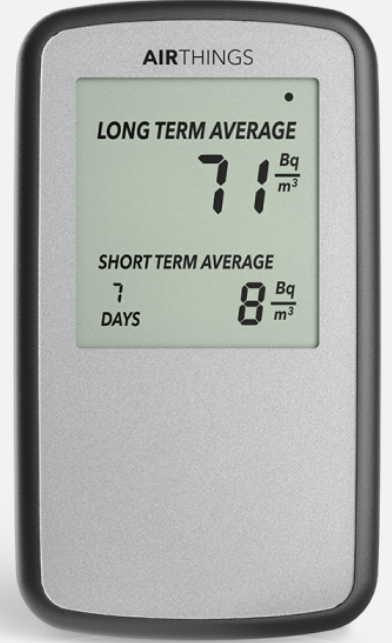
The dimensions of the Airthings brand Corentium home radon model device used in the measurements in this study are 4.7x2.7x1 (LxWxH) inches. For measurements over 7 days, the accuracy is over 90%. Although there are long and short term measurement options, the study utilized the long term measurement mode, which provides high accuracy. Radon gas concentration was obtained in units of pCi/l. A visual of the device is shown in Figure 1.
Measurements
In order to determine the indoor radiation doses in Altınbaş University Bakırköy campus, 10 measurements were taken in 1-day periods by using Airthings Corentium home radon device at a height of 1 m from the floor at the points determined at a minimum distance of 1.5 m from the ventilation on the below ground (basement 2-4), ground and above ground (4-8) floors where students and academicians were located. The radon level for each floor was calculated by taking the mean and standard deviation of 10 measurements obtained from the long-term measurement mode.
Annual Effective Dose Equivalent (YEDE) and Lifetime Cancer Risk (YKBR) Calculation
Using the dose rate of gamma radiation absorbed in the air, the YEDE and ultimately the dose to which individuals are exposed over the course of a year can be calculated. The following equation is used to calculate the YEDE: YEDE= Radon level x DCF x T Here, DCF is the dose constant and T is the time. Together with the calculation of the YEDE, the YKBR is calculated using the following equation: YBKR= YEDE x YS x RF Here, YS is the life expectancy (average 70 years) and RF is the risk factor that leads to stochastic effects. For this factor, 3 different coefficients accepted in the literature are used. ICRP 103, BEIR VII (NRC, 2006) and ICRP 60 reports use values of 0.057, 0.064 and 0.072 for RF [9].
Determination of Radon Exposure Periods
Based on the course schedules, it was determined that on average, students spend 5 hours a week below ground and 13 hours a week above ground floors, while academics spend 5 hours a week below ground and 35 hours a week above ground floors.
Statistics
Long-term radon gas levels were determined by averaging 10 measurements for each floor. The search for significant differences between radon levels on the floors was determined by t-test.
Results
The radon gas levels measured from the floors above and below ground where students and academicians are located in the university building are shown in Table 1.
| Name of Floor | B4 | B3 | B2 | GF | 4th Floor | 5th Floor | 6th Floor | 7th Floor | 8th Floor |
|---|---|---|---|---|---|---|---|---|---|
| Radon Measurement (pCi/L) | 3,81 | 3,71 | 4,32 | 3,83 | 3,68 | 3,71 | 3,84 | 4,21 | 4,12 |
| 3,62 | 3,7 | 4,22 | 3,81 | 3,61 | 3,65 | 3,88 | 4,16 | 4,15 | |
| 3,77 | 3,75 | 4,25 | 3,85 | 3,67 | 3,75 | 3,84 | 4,19 | 4,19 | |
| 3,7 | 3,68 | 4,2 | 3,79 | 3,7 | 3,67 | 3,8 | 4,21 | 4,17 | |
| 3,69 | 3,72 | 4,23 | 3,82 | 3,64 | 3,71 | 3,87 | 4,16 | 4,21 | |
| 3,78 | 3,73 | 4,23 | 3,8 | 3,63 | 3,71 | 3,86 | 4,1 | 4,14 | |
| 3,73 | 3,69 | 4,25 | 3,83 | 3,66 | 3,66 | 3,87 | 4,23 | 4,16 | |
| 3,68 | 3,74 | 4,19 | 3,77 | 3,6 | 3,71 | 3,85 | 4,18 | 4,13 | |
| 3,75 | 3,72 | 4,26 | 3,86 | 3,62 | 3,74 | 3,8 | 4,15 | 4,18 | |
| 3,71 | 3,67 | 4,28 | 3,87 | 3,69 | 3,7 | 3,89 | 4,24 | 4,17 | |
| Mean | 3,72 | 3,71 | 4,24 | 3,82 | 3,65 | 3,70 | 3,85 | 4,18 | 4,16 |
| SD (±) | 0,05 | 0,02 | 0,04 | 0,03 | 0,03 | 0,03 | 0,03 | 0,04 | 0,03 |
| 3,89 | 3,91 | ||||||||
| Mean value of under floor | Mean value of aboveground |
Table 1: Radon gas levels on different floors.
The mean radon gas levels on the below and above ground floors were 3.89 and 3.91 pCi/L, respectively. No significant difference was found between the floors in the statistical analysis performed with t-test for radon gas levels (p=0.1669). When the average radon measurements of all floors and floor information were taken into consideration, a low correlation relationship was observed (R2=0.08). Instead, when the correlation relationship between the average radon measurements and the floors below ground+ground and above ground+ground was analyzed, it was seen that there was a moderate correlation (R2=0.53) and a high correlation (R2=0.87), respectively.
Discussion
This study aimed to evaluate the exposure status of students and academicians by examining the indoor radon activity concentrations on a floor-by-floor basis in Altınbaş University SHMYO campus located in Bakırköy district of Istanbul. According to the results obtained, the average values of radon levels measured inside the building are below the limit value (400 Bq/m3) within the framework of TAEK and below the limit value (200-600 Bq/m3) within the framework of the International Atomic Energy Agency Basic Safety Standards (IAEA-BSS) [10]. The measurement results show that there is no significant difference (p=0.1669) in radon gas levels, especially between the floors of the building. This suggests that the architectural structure of the building and ventilation conditions contribute to the formation of similar radon levels on each floor. Higher radon activity concentrations were observed on the lower floors, especially on the B2 floor. This finding indicates an accumulation of radon originating from soil and rocks and entering the building from the ground floors and foundation level. The lower levels of radon detected on the other floors can be explained by the dilution of radon gas as the elevation increases. The decrease in radon concentration with increasing height is consistent with the natural ventilation conditions and the structural characteristics of the building.
In terms of YEDE, average values of 5.82E-01 mSv for students and 17.80E-01 mSv for academics were calculated. These values were found to be below the ICRP limit of 1 mSv/year. In addition, when compared with the radon dose exposures of the personnel working in Istanbul metro and Marmaray stations, it was observed that the dose exposure of students and academic staff was quite low [11]. In the study, it is noteworthy that higher YEDE values were obtained for academics than students. The fact that academics spend longer time on campus and their exposure time increases can be considered as the reason for this increase in the YEDE values. This situation reveals the necessity to protect working personnel against long-term radon exposure.
YKBR calculations were made according to the methods recommended by international organizations (ICRP103, BEIR VII, ICRP60) and the average YKBR for students was between 2.32% and 2.93% and for academics between 7.10% and 8.97%. These rates once again emphasize the importance of radon as one of the most important factors causing lung cancer after smoking. The higher YKBR rates determined for academicians indicate that the risk of radon-induced cancer is partially increased in long-term exposure. In the literature, cancer risk values due to indoor radon activity concentration for Istanbul were found between 2.8% and 11.1% [12]. The results of the study were consistent with the literature.
In conclusion, this study conducted at Altınbaş University SHMYO campus reveals that indoor radon levels are below the limit values set by TAEK and that the existing building conditions can be generally considered safe. It was observed that the radon activity concentrations determined were not of concern. More detailed studies should be carried out periodically every 5 years. However, considering that radon levels are relatively high especially on ground floors and lower levels, it may be recommended to take additional remedial measures in these areas. In addition, the comparison of students and academicians in terms of the values of the YEDE and the YKBR emphasizes that long-term exposures should be carefully evaluated. This study provides important data for regular indoor radon measurements and safety of academic environments.
Acknowledgements
This study was supported by the 2209-A University Students Research Projects Support Program carried out by the Scientific and Technological Research Council of Turkey (BİDEB) with the number 1919B012206663.
Conflict of Interest
There is no financial conflict of interest with any institution, organization, person and there is no conflict of interest between the authors.
References
-
Celińska G, Krusiński A, Mazur J, Szewczyk K, Kozak K (2020) Radon-The Element of Risk. The Impact of Radon Exposure on Human Health, Toxics 8(4): 120.
-
Li P, Zhang R, Gu M, Zheng G (2018) Uptake of the natural radioactive gas radon by an epiphytic plant. Science of the Total Environment 612: 436-441.
-
Günay O, Aközcan S, Kulalı F (2018) Determination of Indoor Radon Concentrations. European Journal of Science and Technology 13: 91-97.
-
Vasilyev AV, Zhukovsky MV (2013) Determination of mechanisms and parameters which affect radon entry into a room. Journal of Environmental Radioactivity 124: 185-190.
-
Al-Jarallah M (2001) Radon exhalation from granites used in Saudi Arabia. Journal of Environmental Radioactivity 53(1): 91-98.
-
Kürkçüoğlu M, Bayraktar G (2014) Determination of Indoor Radon Concentrations at Süleyman Demirel University Using Nuclear Track Detectors. SDÜ Fen Bil Enst Der 16(2): 167.
-
González M, Torres-Durán M, Barbosa-Lorenzo R, Provencio-Pulla M, Barros-Dios JM, et al. (2019) Radon exposure: a major cause of lung cancer. Expert Review of Respiratory Medicine 13(9): 839-850.
-
Novoa BO, Caramés TM, Lamas PM, Castedo L (2018) A Cost-Effective IoT System for Monitoring Indoor Radon Gas Concentration. Sensors (Basel) 18(7): 2198.
-
(2007) The 2007 Recommendations of the International Commission on Radiological Protection. Ann ICRP 37(2-
-
(2024) What is the Allowable Radon Concentration in the World and Turkey? TENMAK.
-
Alan HY, Akkus B, Susam LA (2019) Investigation of radon concentrations of underground metro and Marmaray stations in Istanbul. J Radioanal Nucl Chem 322(2): 291-304.
-
Otansev P (2021) Indoor Radon Activity Concentration and Cancer Risk. Bitlis Eren University Journal of Science 10(3): 3.
- Sense, Gravity, Parity & Chirality in Mathematical Physics
- Quantum Lattice Simulations PHYSICS: Microcircuit Particle Formation and Observable Macroscopic Irreversible Time - A Discrete Lagrangian with Cellular Automata Framework
- Quantum Biology from Biomacromolecule to Cell, and Central Dogma Described by Quantum Theory
- Focus, Agility, Speed and Technology (FAST) for Sustainability and Growth
- Square Root Metric Geometry and Pati-Salam Model in Curved Space-Time
- A Simple System Demonstrating the Mpemba Effect in Classical Mechanics