
Social Work Practice with the Trans Community
Gender identification relates to a person’s sense of self as being female, male, or otherwise gendered (possibly transgendered, or not gendered at all), whereas sexual orientation refers to an individual’s emotional and sexual affinities towards another person. People who identify as transgendered seek the assistance of social workers for a wide range of reasons. On a broader scale, social workers participate in political advocacy activities to guarantee that members of the transgender community have full access to their civil rights. Social workers are obligated by the NASW Code of Ethics (2000) to serve vulnerable and oppressed populations, to remove discrimination based on sex, and to pursue societal change to ensure the well-being of all persons. This article includes findings from a rapid evaluation of research that connects to trans individuals and social work. The paper’s objective is to investigate the role of transgender studies in the discourse of social work.
Introduction
The term “transgender” encompasses a spectrum of persons who express their gender in unconventional ways. In general, those who identify as transgendered feel that their sense of self as female, male, or other is in contradiction with the gender role that they were assigned at birth (which was based on their genital anatomy). Self-identified bi-genders, gender radicals, lesbians, cross-dressing married males, transvestites, intersex people, transsexuals, drag kings and queens, gender-blenders, queers, gender queers can be called transgender. The phrase “transgender community” refers to the social networks that these persons are capable of creating on their own. Gender identification relates to a person’s sense of self as being female, male, or otherwise gendered (possibly transgendered, or not gendered at all), whereas sexual orientation refers to an individual’s emotional and sexual affinities towards another person. Those who identify as transgender are members of one of the groups in our culture that are both widely misunderstood and frequently ignored. Their entire existence challenges the conventional binary of male and female, and since they deviate from these fundamental societal norms, they leave themselves open to the possibility of being subjected to discrimination and oppression. Young people who do not conform to gender norms face the difficult developmental task of constructing identities in a social environment that invalidates their reality and may even punish them for violating traditional gender roles. This presents a challenge that is unique to their developmental trajectory. It is not always possible to rely on families to provide a secure environment for transgender children and adolescents. It is common for parents to lack the tools necessary to understand their transgender child. It is possible that the families of many transgender children and teenagers are not only unable to empower them, but actively perpetuate the discrimination they face from society. For the same reason, transgender individuals can be subjected to harsh forms of societal punishment for violating gender category. These can include harassment, social and familial rejection, discrimination in the employment, denial of parental rights, as well as physical and sexual assault. Therefore, it should not come as a surprise that people who identify as transgender seek the assistance of social workers for a wide range of reasons. On the other hand, social workers could have a variety of roles to play in the lives of their transgender clients. It is possible that in child welfare or youth services, they work as case managers for transgender children and teenagers. They may take on the role of therapists in order to assist families of transgender persons in responding positively to a family member or friend who is transitioning. School social workers have the ability to build secure environments for transgender children and adolescents, and medical social workers have the ability to assist transgender patients who have undergone sex reassignment surgery in navigating the psychosocial aspects of their transition. The victims of transgender-related hate crimes may receive assistance from social workers. On a broader scale, social workers participate in political advocacy activities to guarantee that members of the transgender community have full access to their civil rights. Social workers are obligated by the NASW Code of Ethics (2000) to serve vulnerable and oppressed populations, to remove discrimination based on sex, and to pursue societal change to ensure the well-being of all persons. Burdge BJ [1] this article includes findings from a rapid evaluation of research that connects to Trans individuals and social work. The paper’s objective is to investigate the role of transgender studies in the discourse of social work.
Methodology
Searching Strategy
Publications on transgender-related subjects published after 1992 were included in our review. The subject heading “Transgender Social Work” and keywords from titles and abstracts were used to search the literature. The following transgender subject terms were included in our search: transgender people, transsexuals, social work, gender, and sex. Transgender, transsexual, LGBT, interventions, gender queer, gender nonconforming, and gender confirmation were among the keywords we looked up. We relied on a thematic analysis of the literature, wherein each theme was thoroughly discussed. The review was based on a variety of literature sources, including book chapters, online articles from databases like JSTOR, Google Scholar and PubMed.
Selection
By removing non-English publications from our search, we were able to focus on a more focused initial examination of the literature. All discussion, conclusions, and abstracts from the remaining papers that matched our search parameters were examined for content analysis. Only publications or studies that had a transgender focus, that is, papers that concentrated largely on transgender-related subjects, were chosen for final inclusion.
Sex: Biological Construct
Differences in external genitalia, hormone production, the presence of ovaries, and the generation of sperm and eggs are all indicators of a person’s sex. The binary categories of male and female can be defined by these differences, which also act as indicators of whether a person belongs to the male or female category. The identification of certain physical characteristics as the basis for categorizing people and the assignment of individuals to such categories is social process that involves evaluation. Despite the fact that the categories are seen as natural, and therefore existed before social intervention in the manner of gender, the identification of such characteristics as the basis for categorizing people is a social process. According to West, et al. [2] (in everyday life, the assignment to a category is typically decided on the presumption of biological difference based on observed apparel and conduct. This is something that was brought up in their study. The categorization of sex therefore incorporates social understandings regarding the differences between the sexes. Gender is the source of the meaning of sex, and sex can be collapsed into gender. This is not to say that sex, sexuality, and the body are not significant; rather, it is to point out that these are things that are experienced and become comprehensible through social practices and processes; these things are constituted through gender, and at the same time, they help constitute gender. The obvious difference between sex and gender disappearing also eliminates or at least weakens the implied causal relationship between the two. Although they haven’t been fully solved, the difficulties in separating gender and sex are one sign of the complexity that evolved when feminists attempted to theorize about the previously unrecognized mechanisms of the subordination of women Acker J [3].
The Gender Binary: Sociological Construct
Our experiences with gender begin as soon as our genitalia can be distinguished, which is typically while we are still in the womb. It is the very first “question” that we are provided an answer to by the grownups who are present when we are born. Identifying a baby as male or female (based on visible genitalia) is typically considered as a straightforward procedure, despite the fact that the label will be used to define the child and will have massive ramifications for the child’s life. The practice of determining a person’s gender at the time of birth has just two possible results as a result of its operation. Even when the genitalia are unclear, medical experts and families will typically attempt surgical alterations in order to make one gender fit. Infants are expected to fit neatly into one of the two categories: male or female. Our words and our deeds need to be in harmony with one another. We are unable to see any additional possibilities despite of the two given to us by the society. As people are held accountable as social actors, gender emerges as a potent ideology to which they must conform. Garfunkel came up with the concept of “Omni relevance” in order to describe the pervasive influence of gender. One aspect of the Omni relevance of gender is that any individual can be held accountable for her or his status as a woman or a man while they are doing nearly any action. This is true regardless of the context in which the activity is being carried out. In other words, we have no choice but to “engage in conduct at the risk of gender assessment” since there is no other alternative.
The result of this evaluation will determine whether or not we are rewarded or punished (for instance, whether or not we are ignored, suffer awkward stares, are threatened, or are subjected to physical abuse). According to West, et al. [2] children learn at a young age that in order to be deemed capable social players, they need to successfully perform gender roles. This ideological structure constantly reinvents itself as more and more people come to believe the idea of a gender binary and take it upon themselves to monitor and enforce the gender difference. Because gender is a product of social contexts, it can be interpreted not only as a consequence of but also as a justification for the categorization of people into male and female categories. The practice of gender relies on and also contributes to the widespread cultural notion that there are in fact two separate genders. It is stated that the disparities between the groups are “fundamental and persistent”. The subsequent social structure, which is said to reflect “natural distinctions,” serves to promote and authorize hierarchical configurations in which one gender group is regarded more highly than the other. Such a binary model, when subjected to the influence of patriarchal culture, gives birth to a hierarchy of gender categories in which the non-male category is undervalued. Patriarchal culture is characterized by a strong emphasis on male superiority. This misogyny is the gasoline that keeps sexism, homophobia, and heterosexism going strong. When viewed in this light, women, gay men, lesbians, bisexuals, and transgender people are all confined inside the same confines of the binary gender paradigm Burdge BJ [1].
Queer Theory
It is necessary to create a distinction between queer as a quality (normativity) and queer as a trait in order to comprehend or conceive of queer theory (constructionism). The former postulates that sexual orientation is fixed and unchanging across time and culture, with the idea that people have desired and engaged in sexual activity with others of the same gender throughout history. This does not necessarily imply that identity is fixed. The second asserts that sexuality ‘is a product of social interactions and, as such, suggests that the history of sexuality be viewed as ‘the history of the issue whose significance and value are in a continual process of change’. The formation of those interpretations and contents, in addition to the power that comes with them and the concurrent identification that occurs with them, is at the core of queer theory. The most prominent school of queer theory makes extensive use of post structural theory from France as well as the deconstructive method of critical analysis. A social investigation of who, why, and what generated a text is what deconstruction is all about. Deconstruction is also an examination of what is stated - and unstated - through the language, shape, structure, and style of a text (a written work, a film, art). That definition of text is expanded in queer theory to include any form(s) of communication that is used to convey an understanding of one’s world; perceptibly, it could be a book or a film, but a text could also be a discussion, a life story, a recollection, sexuality, history, a gathering place, or a social trend. Queer theory considers all of these things to be forms of communication that are used to convey an understanding of one’s world Dilley P [4]. Stein and Plummer presented an exposition of the four foundational principles of queer theory, which are as follows:
- The notion that sexual power permeates all aspects of social life and is maintained through frontiers and binary divides
- The attempts to define sexual and gender classifications as extremely unstable and fluid
- The disapproval of civil rights strategies in favour of deconstruction, decentering, revisionist readings, and anti-assimilationist politics
- A willingness to explore topics outside of sexuality If the idea of doing away with gender completely seems outlandish, you’re not alone. Risman (1998) looked at homes where gender roles were blurred and published her findings under the term Gender Vertigo. This term perfectly captures the sense of uncertainty that most of us will feel as gender roles continue to blur in our society. Nonetheless, universal freedom from punishment for gender nonconformity requires challenging oppressive gender structures and making gender rights a priority Burdge BJ [1].
Why the issue of Transgender should be studied in Social Work?
At all scales of social work practice, knowledge of transgender persons and concerns is essential. Social professionals interact with transgender people of all ages in direct practice. There is a higher likelihood of verbal and physical abuse at home and higher rates of bullying, self-destructive behavior, and suicide among transgender adolescents. Transgender adults may need advocacy to access medical, mental health, and other forms of social support. There hasn’t been enough research done on the unique requirements of transgender senior citizens. To uphold their professional and ethical standards, social workers must provide services to transgender clients and their families that are accurate, thorough, affirming, and respectful. On a more intermediate level, transgender-inclusive policies and procedures should be implemented in schools, agencies, and social service organizations, particularly those pertaining to staff training, school dress requirements, and restroom and other access concerns. Tyra Hunter, a trans woman who was killed in 1995 when paramedics refused to treat her accident injuries because they learned she was a trans woman, is an example of the dangers trans people face in today’s society. There are many macro-level legal and policy issues that affect transgender people. Now, transgender persons are officially protected by non-discrimination laws in six states. The capacity to update identification documents like birth certificates, driver’s licenses, and academic transcripts can have far-reaching consequences for a person’s quality of life and career prospects, even outside the realms of civil rights and workplace protection. The ability to make such adjustments varies by state and is frequently tied to the patient’s surgical status. Those for whom surgery is out of the question may be unfairly affected by this. Transgender people also face a high risk of discrimination in the context of parenting and custody disputes. Many transgender persons face serious dangers because of inadequate access to health care, including turning to the illicit market for hormones, becoming famished, contracting HIV, being victimized, or taking their own lives. There are unique challenges for transgender people living in poverty. Group membership and identity politics are two areas where transgender persons demand social work theory. Transgender people’s presence in society and the accompanying questions force us to re- evaluate other socially constructed categories, including those of race and ethnicity. This postmodern outlook may be at odds with ideas of social justice based on collaborative efforts to combat oppression. As a result, social workers must acknowledge identity’s role in both oppression and liberation and propose new models of empowerment Gilbert MJ [5].
Social work implication with Transgender people
Some authors have argued that the Diagnostic and Statistical Manual of Mental Disorders (4th edition, text revision) should remove the category of gender identity disorder (GID). This diagnosis is one way in which a powerful social institution (medicine) promotes overt sexism and heterosexism. By stigmatizing actions and thoughts that don’t fit neatly into either gender’s norm, GID helps perpetuate harmful stereotypes. Shortly after homosexuality was taken out of the DSM, the diagnosis made its debut in 1980. Langer and Martin hypothesized that GID was created as a covert method of treating people who were thought to be homosexuals. Nonetheless, a GID diagnosis is necessary to have sex reassignment surgery. This diagnosis, which is based on harmful gender preconceptions, is necessary for transgender people seeking surgical intervention. Proponents of eradicating GID have argued that the best way to treat clients who identify as gender nonconforming is to educate them about their options (such as hormone therapy and sex reassignment surgery) and then support them as they (and their families) come to accept and embrace their gender nonconforming identities. Hence, social workers can help transgender individuals by educating them and their families regarding the same. Cooper [6] expressed concern that transgender people internalize the socially constructed gender binary, putting them under intense pressure to choose between a male or female physique or gender identity. Social workers can assist alleviate this stress by talking to clients about the sex-gender continuum and the social construction of gender and encouraging clients to stop using the binary when referring to themselves. Professionals in the fields of health and mental health are adjusting their approach from encouraging transgender people to conform to one of two gender options to accepting transgender self-identification. More and more people are identifying as transgender today Burdge BJ [1].
One-on-one and family therapy sessions are examples of the micro level of social work. Advocacy on the micro level can consist of something as simple as asking a client what pronouns they prefer to be addressed with. This is in contrast to the more complex tasks of treating substance abuse disorders, locating housing, providing psychotherapy, and addressing the client’s concerns about coming out. Just making that effort makes a client feel valued Eiland C [7].
Macro-level social work, in contrast to its more hands- on counterpart, aims to address systemic causes of social problems and inequality. This relates to another fundamental principle of social work: Equality. Institutionally, social workers advocate for transgender equality and speak out against injustice Eiland C [7].
On top of that, social workers may help spread awareness about the value of gender equality. How exactly this is accomplished will be determined by the particulars of our community contexts and the type of coalitions we form with other entities who share our concerns. We may distribute educational materials at local LGBT Pride Festivals, write letters to the editor, meet with our representatives in government, host public lectures, organize community discussion groups, host professional development events, and more. We may also host performances that explore alternative gender identities (such as plays, films, and drag shows) and encourage audience members to discuss the social consequences of these performances Burdge BJ [1].
Conclusion & Futuristic Perspective
From here, researchers in social work can go in a variety of directions. There is a general agreement in the social work literature about what works best when dealing with transgender people, but this is largely based on anecdotal evidence. These works have developed in response to the pressing need for social workers to begin discussing gender identity and expression. Naturally, this crucial data comes from social workers who have first-hand experience with the transgender community. Profession will eventually be the results of deliberately planned research project to explore the many facets of practice with transgendered people. Mainstream social work journals also require more transgender-focused articles [8]. • Those who identify as transgender can benefit from the support, advocacy, and counseling services provided by social workers. The provision of referrals to various resources and services is another way in which social workers can assist transgender people. In addition, social workers can be of assistance to transgender persons by enlightening them regarding the rights and opportunities available to them (Figure 1).
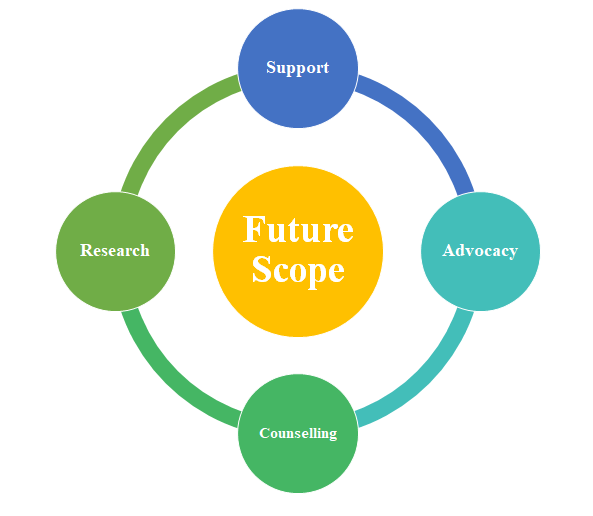
- The evolving and empirically validated conceptions of gender must be taught to social work students, according to McPhail. We must discover the most effective pedagogical strategies for educating this population about gender, gender theory, transgendered people, and cultural sensitivity.
- We could look to individuals who are redefining the gender binary in order to start understanding what a world with three or more genders (or even no genders) might look like.
- Without regard to our own preconceptions or preferences, it is our duty as social workers to offer patients with high-quality medical attention. To ensure that transgender people receive the appropriate services from providers of those services, it is essential for such individuals to obtain education about their sexuality and identity. The health insurance company has the option to either pay for or deny coverage of transition- related medical bills. Those who identify as transgender often lack the financial resources necessary to continue hormone therapy, undergo body transitioning, or make surgical selections.
- Social professionals could better comprehend the subtleties of transgendersim with the use of thorough case studies and phenomenological research, which would provide rich data. From this, we might learn how to control our own “gender vertigo” and imagine a world without gender roles.
- Providing social workers with training on transgender issues is an essential step toward recognizing the rights of transgender individuals. In advocating for the transgender community and giving assistance to transgender people and their families, social workers play an essential role. Social workers can have a better understanding of the particular problems that transgender persons encounter and how to provide the most effective assistance for them by participating in transgender training.
References
-
Burdge BJ (2007) Bending Gender, Ending Gender: Theoretical Foundations for Social Work Practice with the Transgender Community. Social Work 52(3): 243- 250.
-
West C, Zimmerman DH (1987) Doing gender. Gender Society 1(2): 125-151.
-
Acker J (1992) From Sex Roles to Gendered Institutions. Contemporary Sociology 21(5): 565-569.
-
Dilley P (1999) Queer theory: under construction. Qualitative Studies in Education 12(5): 457-472.
-
Gilbert MJ (2013) Transgender People. Encyclopedia of Social Work.
-
Cooper K (1999) Practice with transgendered youth and their families. Journal of Gay & Lesbian Social Services 10(3/4): 111-129.
-
Eiland C (2022) How Social Workers Serve Transgender Clients, Noodle.
-
Gamson J, Moon D (2004) The Sociology of Sexualities: Queer and Beyond. Annual Review of Sociology 30: 47- 64.
- The Need for Partner Education and Mental Health Support During Pregnancy and the Postpartum Period
- Application of Combined PGT-A and PGT-M for Reproductive Management in a Couple Carrying GCDH Mutations with Prior Affected Offspring: A Rare Case Report
- The Effect of Using a New Technique Karman Injector (Elif Technique) on the Healing Process of Wound Infection-Case Series
- GSM: Counseling Points to Discuss with Women Fearful of Vaginal Estrogen
- Antenatal Diagnosis of Meckel Syndrome: A Case Report
- Discrimination and Workplace Harassment (Mobbing) against Women in the Post-Pandemic Era