
Effect of Hydrochlorothiazide on Pharmacodynamics and Pharmacokinetics of Telmisartan in Human Patient Volunteers
The present study was aimed to evaluate the effect of hydrochlorthiazide on pharmacodynamics and pharmacokinetics of Telmisartan using human patients. A total of 118 hypertensive patients were included in this study. The reduction in the blood pressure in patients receiving the Telmisartan alone and in patients receiving the both Telmisartan and hydrochlorthiazide was estimated. The pharmacokinetic parameters also estimated using the plasma levels of Telmisartan in both group of patients. The findings of present investigation have concluded that the efficiency of Telmisartan along with the Hydrochlorothiazide was high when compared to that of Telmisartan alone, and preliminary pharmacokinetic data also revealed that there were no interactions with the usage of combination of drugs. Pharmacodynamics response, i.e., decrease of blood pressure was high with the usage of combination of Telmisartan along with hydrochlorothiazide, which was a combined pharmacological action exerted by both drugs individually.
Introduction
Hypertension is a major risk factor for all cardiovascular events. Of a number of risk factors that are directly responsible for an increase in the cardiovascular morbidity and mortality, high blood pressure (BP) is one of the most important and independent risk factors which affects 24-36% of the adult population in the developed countries [1]. Hypertension varies based on the population, demographic specifications, age, gender and race of populations. Epidemiologic studies have established a strong and linear relationship between BP and cardiovascular disease and randomized trials have documented that the BP reductions which are achieved by the antihypertensive drugs confer a cardiovascular protection [2].
Hypertension treatment guidelines acknowledge that blood pressure (BP) in hypertensive patients should be reduced below 140/90 mm Hg [3, 4]. Due to the multifactorial nature of hypertension, simply interrupting one of its pathophysiologic mechanisms by monotherapy is usually insufficient to control it. Actually, to achieve target BP, more than 60% of the patients will require combination therapy with two or more drugs [5]. Combining different antihypertensive agents has the potential to produce additive reduction in BP levels and minimizing dose-dependent adverse effects and, therefore, possibly improving patient compliance with treatment [6]. Hydrochlorothiazide (HCTZ), a benzothiazide diuretic, by its sodium-depletion effect results in renin- angiotensin-system (RAS) activation, which explains its beneficial therapeutic interaction with drugs acting through blockade of the RAS, including angiotensin II (Ang II) AT1-receptor blockers (ARBs) [7]. Telmisartan is a selective nonpeptide, substituted benzimidazole ARB, which has a prolonged half-life, and has been demonstrated to be effective in lowering BP values [8]. The combination with HCTZ significantly increases its antihypertensive efficacy [9]. In usual practice polypharmacy was used to treat moderate hypertension like a combination of Angiotensin Receptor Blocker like Telmisartan and a diuretic like hydrochlorthiazide. In view of its combination, it is a need to study the effect of Hydrochlorothiazide on pharmacokinetics and pharmacodynamics of telmisartan in human patient volunteers. So far no reports have been submitted on this study from India, hence we have undertaken this study. In this present work, patients suffering from Stage I Hypertension from different areas of Karimnagar, southern India, using hypertensive therapies were included. The present work had been aimed to evaluate the effect of Hydrochlorothiazide on pharmacodynamics and pharmacokinetics of Telmisartan in human patient volunteers.
Materials and Methods
Study Population
A total of 118 patients prescriptions were analysed and it was found that 40% of hypertensive patients treating with Telmisartan alone or in combination with Hydrochlorothiazide. Among them 23 patients either of the sex patients of age between 25-70 yrs participated in the study, out of patients prescriptions analysed, from out patients wards of hospitals various from the region of Karimnagar. The healthy volunteers were derived from the Karimnagar town Table 1.
| S No | . | Subjects | Numbe | r | ||||
|---|---|---|---|---|---|---|---|---|
| 1 | Patients receiving Telmisartan alone | 12 | ||||||
| 2 | Patients receiving combination of Telmisartan and Hydrochlorothiazide | 11 | ||||||
| 3 | Control (Healthy volunteers) | 13 |
Table 1: Details of subjects. 118 patient prescriptions were collected from various outpatient wards of hospitals from areas of K
Table 1: Details of subjects. 118 patient prescriptions were collected from various outpatient wards of hospitals from areas of Karimnagar and were analyzed for the hypertensive patients receiving the Telmisartan alone, and along with hydrochlorothiazide were identified and were included in the study after getting the required consent letter from the patients.
Inclusion criteria
- Patients, regardless of gender, at least 26 years of age and diagnosed with high blood pressure based on the average of two or more properly measured, seated, blood pressure readings were included for the study.
- The patients with Systolic blood pressure (SBP) ≥ 140 mmHg and/or diastolic blood pressure (DBP) ≥ 90 mmHg are considered in to study [10].
- The prescriptions of patients receiving therapies were analyzed for the diagnosis of Stage I hypertension, and cardiac atherosclerosis disease using Hydrochlorothiazide and Telmisartan for the first time usage of the drugs.
- The patients with Systolic blood pressure (SBP) ≥ 140 mmHg and/or diastolic blood pressure (DBP) ≥ 90 mmHg are considered in to study [10].
Exclusion criteria
- Patients were excluded if they had a history of kidney disease; diabetes; acute liver injury (e.g., hepatitis) or severe cirrhosis; pregnancy or breast-feeding; history of drug or alcohol abuse; or participation in a study of an investigational medication within the past 30 days.
- Before enrollment all patients were informed about the possible risks and discomfort involved in participating in the study. A voluntary consent form was taken from all the patients. The study was approved by the Institutional Human Ethical committee.
Estimation of Pharmacodynamic Parameters
The pharmacodynamics of Telmisartan i.e., reduction of the blood pressure was recorded. The blood pressure was measured by using traditional sphygmomanometer with help of paramedical staff on first day of treatment before starting of therapy which was considered as zero day, and after four hours of treatment considered as 1st day, and consecutive 15th day, 30th day of treatment.
Estimation of Pharmacokinetic Parameters
Blood Samples were collected from the patients treating with Telmisartan alone and in combination with Hydrochlorothiazide at 30th day after start of therapy at different intervals of 2hrs, 4hrs, and 8th hr respectively from the dose of drug. The collected samples are centrifuged at 3500 rpm for 10mins and plasma was collected and it was stored at -20ºc until analysis. The stored samples are analyzed for plasma Telmisartan concentration using High performance liquid chromatographic (HPLC).
Estimation for Telmisartan Concentrations using HPLC [11]
HPLC Conditions used: Phenomenex (250×4.6mm) C18 5µm reverse phase analytical column was used. The mobile phase consisted of phosphate Buffer and Acetonitrile (30Mm: pH 5.8) in the ratios of 55:45 v/v. Before Use, the mobile phase was filtered by using it through a 0.45µm filter and the filtrate is degassed by using bath sonicator. The mobile phase was pumped at an isocratic flow of 1ml/min at room temperature. The peaks were determined using a detector set at a wavelength of 282nm.All the procedures were performed at ambient temperature Table 2 & 3.
| HPLC model | Shimadzu SPD 10 UV Detector |
| Pump model | LC 10AD |
| Syringe | Reodine |
| Injector capacity | 20μl |
| Detector | Dual wavelength UV-Visible. |
| Data analyzer | N 2000 software |
Table 2: HPLC descriptions.
| Mobile phase composition | |
|---|---|
| Solvent A + Solvent B | Phosphate Buffer + Acetonitrile |
| Proportion | 55:45 V/V |
| Flow rate | 1ml/min |
| Wave length | 282nm |
| Injection volume | 20 μl |
| Column | Athena C-18 reverse phase 250x4.6mm and 5μm particle size |
| Total run time | 10 min's |
| Drug | Telmisartan |
| Retention time | 3.32 min |
Table 3: Chromatography conditions.
Table 3: Chromatography conditions. Extraction procedure: The plasma samples were collected from the patients at 30th day from both groups. In a 2ml micro centrifuge tube, 0.1ml of blank plasma and 20µl of 0.1 N hydrochloric acid added and mixed thoroughly. The plasma was spilled with standard Telmisartan to yield concentrations of 0.1-25 µg/ml of Telmisartan. The mixture was vortexes for 3 min and it was added using cyclomixer for 5 min and centrifuged for 10 min at 3500 rpm. After centrifugation, the supernatant was transferred into a new tube and allow to dryness on water bath. Add 0.2ml of methanol and centrifuged for 10 min from this 20 µl was injected into the HPLC.
Pharmacokinetic Parameters: Based on the estimated plasma Telmisartan concentration at different day, the following pharmacokinetic parameters were estimated using Ramkin software. Statistical Analysis: All the values are expressed as mean ± S.D. All the results were compared with zero day patients. T-test was used to analyse the results as p < 0.05 was considered as statistically significant. Pharmacokinetic parameters are estimated by using RAMKIN Software.
Results
In the present study, we have estimated the effect of Hydrochlorothiazide on Pharmacodynamics and Pharmacokinetics of Telmisartan in Hypertensive patients. The results of the pharmacodynamic interaction were showed in Figures 1&2.
Effect of Hydrochlorothiazide on Pharmacodynamics of Telmisartan
Systolic blood pressure: The blood pressure levels decrease was high in the patients using combination of Telmisartan and Hydrochlorothiazide when compare to Telmisartan alone as shown in Figure 1.
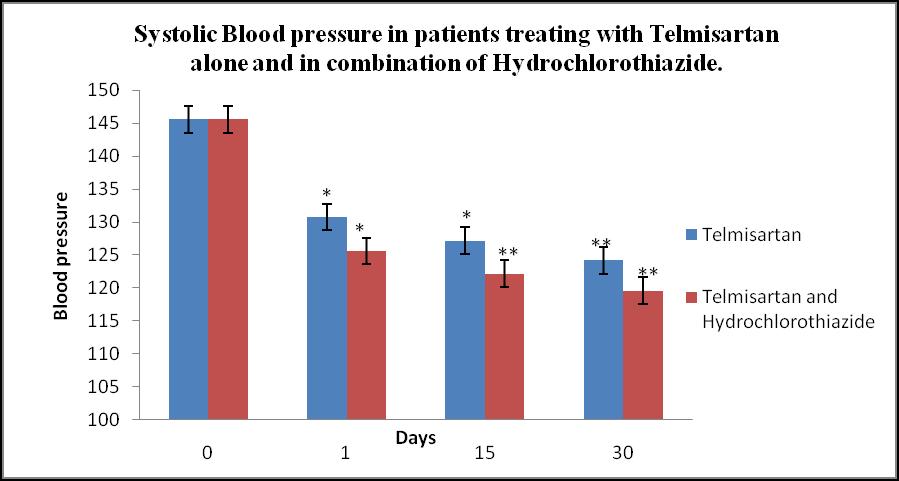
(P<0.05) and the percentage of systolic blood pressure reduced with this combination was 14% and were, 16.2%, 18.06% at 15th and 30th day of treatment respectively. Diastolic blood pressure: The diastolic blood pressure values of patients using Telmisartan alone, and combination of Telmisartan and Hydrochlorothiazide were shown in Figure 2.
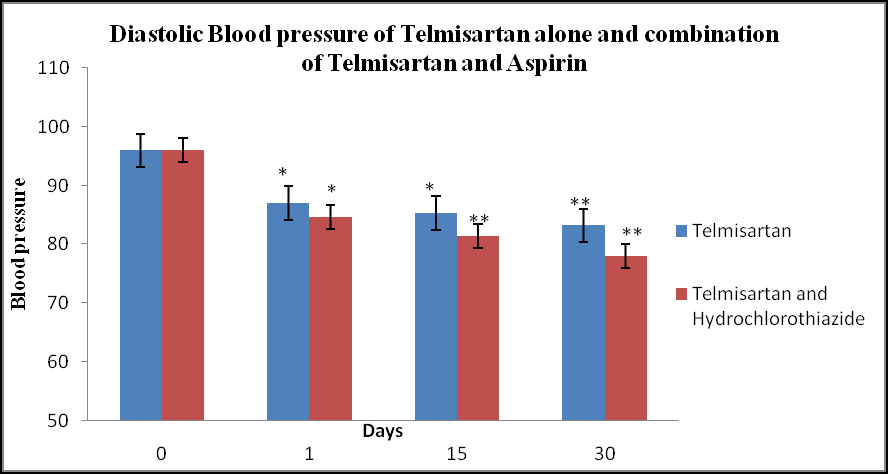
(All the values are expressed in mean±SD, ,*p<0.05, **p<0.01 vs Zero day) Figure 2: Diastolic Blood pressure of patients using Telmisartan alone and in Combination of Telmisartan and Hydrochlorothiazide.
The treatment with Telmisartan to Hypertension patients results in the significant reduction of diastolic Blood pressure (P<0.05) in patients. The % of B.P reduced with single dose of Telmisartan was 8% and were 9.6%, 12% at 15th and 30th day of treatment respectively. Whereas the treatment with Telmisartan and Hydrochlorothiazide to the hypertension patients results in the significant reduction of diastolic blood pressure (P<0.05) and the percentage of diastolic blood pressure reduced with combination was 10.4% and were, 15.2%, 19.6 at 15th and 30th day of treatment respectively Pharmacokinetic parameters: The plasma concentrations of Telmisartan from the 30th day samples of patients receiving Telmisartan alone and in combination with Hydrochlorothiazide are given in Table 4.
| Time (hr) | Telmisartan alone | Telmisartan and Hydrochlorothiazide |
|---|---|---|
| 2 | 95.6 | 93.6 |
| 4 | 55.2 | 53.2 |
| 8 | 26.5 | 23.9 |
Table 4: Plasma concentration of samples in Telmisartan alone and in combination with Hydrochlorothiazide on 30th day Table 4: Pl
Table 4: Plasma concentration of samples in Telmisartan alone and in combination with Hydrochlorothiazide on 30th day Table 4: Plasma concentration of samples in Telmisartan alone and in combination with Hydrochlorothiazide on 30th day of study. The plasma Telmisartan concentrations in patients treating with Telmisartan alone were less when compared with those of patients treating with Telmisartan and Hydrochlorothiazide, however they were insignificant statistically. The maximum plasma Telmisartan concentration was found to be at 2nd hour and was 95.6µg/ml, 93.6 µg/ml in Telmisartan alone and Telmisartan with Hydrochlorothiazide treated patients. From the estimated concentrations, the preliminary pharmacokinetic parameters were calculated using Ramkin Software, and the results were shown in Table no 4. Preliminary data of Pharmacokinetic Parameters: Preliminary data of pharmacokinetic parameters after Telmisartan alone, Telmisartan + Hydrochlorothiazide treated patients was showed in Table 5.
| PK Parameter | Telmisartan | Telmisartan + Hydrochlorothiazide | ||||||
|---|---|---|---|---|---|---|---|---|
| AUC 0-t (µg-hr/ml) | 442.5 | 437.3 | ||||||
| AUC 0-α(µg-hr/ml) | 600.1 | 582.1 | ||||||
| AUMC 0-α (µg-hr/ml) | 4101.2 | 3871 | ||||||
| t ½(hr) | 3.62 | 3.50 | ||||||
| V d (ml/µg) | 777.8 | 697.4 | ||||||
| Cl/f (mg/kg)/( µg/ml)/hr | 133.3 | 137.4 | ||||||
| MRT (hr) | 6.83 | 7.15 | ||||||
| C max (µg/ml) | 95.6 | 93.36 | ||||||
| T max (hr) | 2.16 | 2.03 |
Table 5: Preliminary data of pharmacokinetic parameters after Telmisartan alone, Telmisartan + Hydrochlorothiazide.
Table 5: Preliminary data of pharmacokinetic parameters after Telmisartan alone, Telmisartan + Hydrochlorothiazide. In Telmisartan alone group, the AUC 0-α was 442.5µg.hr/ml, where as it is in Telmisartan and Hydrochlorothiazide combination group, it was 437.5 µg.hr/ml indicates the insignificant reduction of AUC. It indicates the bioavailability of Telmisartan was not affected in presence of Hydrochlorothiazide. In Telmisartan alone group, the Clearance was 133.3(µg/ml)/hr where as it is in combination with hydrochlorothiazide group, it was 137.40(ug/ml)/hr indicating no significant changes. Hence it is confirmed that the bioavailability of Telmisartan was not affected in presence of Hydrochlorothiazide. During the past years, numerous reports have appeared in literature indicating the treatment of Hypertension, usage of Telmisartan and its combinations in blood pressure levels_._ Wang-Qing Chen (2013) studied the pharmacokinetics (PKs) and Pharmacodynamics (PDs) of Telmisartan varies among the individuals. The heterozygote’s a specific population of china showed a larger AUC and a notable BP change (%) from the baseline compared with the wild-type of Africa. In India, the prevalence of high normal blood pressure has been seen in many recent studies and was found to be around 32% in a recent urban study from Central India. In some studies from South India (Chennai) and from Delhi prevalence of high normal blood pressure has been even higher upto 36% and 44% respectively in these regions. Then main objective of the study was to find the effect of Hydrochlorothiazide on Pharmacodynamics and Pharmacokinetics of Telmisartan, in Hypertensive patient volunteers. The blood pressure reduction values were evaluated for Pharmacodynamics changes, and plasma concentrations data of Telmisartan were evaluated for changes in pharmacokinetics in the patients using Telmisartan along with Hydrochlorothiazide, when compared to Telmisartan alone.
Conclusion
The findings of present investigation have concluded that the efficiency of Telmisartan along with the Hydrochlorothiazide was high when compared to that of Telmisartan alone, and preliminary pharmacokinetic data also revealed that there were no interactions with the usage of combination of drugs. Pharmacodynamics response, i.e., decrease of blood pressure was high with the usage of combination of Telmisartan along with hydrochlorothiazide, which was a combined pharmacological action exerted by both drugs individually. By the above observations we can conclude that there are no possible pharmacokinetic interactions; however the Pharmacodynamics shows a synergetic effect on blood pressure with the usage of Telmisartan and Telmisartan along with Hydrochlorothiazide. Further studies were needed with various pharmacokinetics, and Pharmacodynamics outcomes, with a higher number of patients, and regular inpatient monitoring for the conclusion of the safety profile of the combination of drugs.
References
-
Scholze J, Bida M, Hansen A, Juncken D, Rangoonwala B, et al. (2006) Initiation of hypertension treatment with a fixed dose combination or its monocomponents -- Does it really matter? Int J Clinical Pract 60(3): 265-274.
-
Mancia G, De Backer G, Dominiczak A , Cifkova R, Fagard R, et al. (2007) 2007 Guidelines for the Management of Arterial Hypertension: The Task Force for the Management of Arterial Hypertension of the European Society of Hypertension (European Society of Hypertension) and of the European Society of Cardiology (ESC). J Hypertens 25(6): 1105-1187.
-
(2003) Joint National Committee: The Seventh Report of the Joint National Committee on Prevention, Detection, Evaluation and Treatment of High Blood Pressure. JAMA 289: 2534-2573.
-
(2003) European Society of Hypertension–European Society of Cardiology: Guidelines for the management of arterial hypertension. J Hypertens 21: 1011-1053.
-
Hansson L, Zanchetti A, Carruthers SG (1988) Effects of intensive blood pressure lowering and low-dose aspirin in patients with hypertension: principal results of the Hypertension Optimal Treatment (HOT) randomized trial. HOT Study Group. Lancet 351(9118): 1755-1762.
-
Pool JL (2003) Is it time to move to multidrug combinations? Am J Hypertens 16(11 Pt 2): 36S–40S.
-
Puschett JB (2000) Diuretics, In: Oparil S & Weber MA (Eds.), Hypertension: A Companion to Brenner and Rector’s The Kidney. Philadelphia, W.B. Saunders, pp: 584-590.
-
McClellan KJ, Markham A (1998) Telmisartan. Drugs 56(6): 1039-1044.
-
Freytag F, Schelling A, Meinicke T, Deichsel G (2001) Comparison of 26-week efficacy and tolerability of telmisartan and atenolol, in combination with hydrochlorothiazide as required, in the treatment of mild to moderate hypertension: a randomized, multicenter study. Clin Ther 23(1): 108-123.
-
Chobanian AV, Bakris GL, Black HR (2003) Seventh report of the joint national committee on prevention, detection, evaluation, and treatment of high blood pressure. Hypertension 42(6): 1206-1252.
-
Stangier J, Schmid J, Türck D, Switek H, Verhagen A, et al. (2000) Absorption, metabolism, and excretion of intravenously and orally administered telmisartan in healthy volunteers. J Clin Pharmacol 40(12 Pt 1): 1312-1322.
- Gallic and Citric Acid Present in the Peels of Tropical Fruits as an Alternative in the Fight against Cancer
- Treating the Forehead Lines with Combination of Forehead and Glabellar Botulinum Toxin Among Japanese Patients
- Clinical Evaluation of Patients Suffering from Breast Cancer & Determination of Treatment Therapies and Better Strategies Related to Breast Cancer
- Medieval Recipes by Al-Zahrāwī for Heart Palpitations Treatment
- Etiology and Prescription Errors of Myocardial Infarction in Different Health Care Systems of Azad Kashmir
- Early Diagnosis and Multidisciplinary Management of Turner Syndrome: A Paediatric Case Study