
Assessment of Drug Prescriptions at the University Hospital Center, National Center of Odontostomatology (CHU-CNOS) in Bamako, Mali
Introduction: The prescription is an order for delivery and an act by which the practitioner draws up a list of products or hygienic-dietetic measures. Methodology: This is a cross-sectional, descriptive study to assess the quality of prescriptions. It took place at the University Hospital for Odontostomatology over a period of six months, during which 870 medical prescriptions were included. Result: The most important information to figured out orders such as the prescription date, the qualification of the prescriber, the signature and stamp were not mentioned, respectively, in 3; 81; 5 and 7% of cases. Almost no prescription prescribed referred to weights (99% of cases). The duration of treatment is not specified in 99% of cases. The full name of the patient and readability of orders were still noted in all cases. Discussion/Conclusion: For a prescription, certain legal references can incriminate prescribers and lead patients into therapeutic errors
Introduction
The prescription is an order for delivery and an act by which the practitioner draws up a list of products or hygienic- dietetic measures, or other advice likely to alleviate, relieve or cure an ongoing condition in a patient [1].
The drugs necessary for dentistry are numerous, and present in 3 main therapeutic classes: Antibiotics, Analgesics, Anti-inflammatory drugs [2].
Research Paper
The practitioner has a prescription right limited to his sphere of competence. For each medical profession, prescription recommendations are published. For the dental surgeon, this right is valid only for drugs which are part of the practice of dental care. From learning pharmacology to practicing prescriptions in clinical practice, there are many varying elements (the same molecule could be used in various indications and at different dosages). These references are used to guide the practitioner by providing updated information using current scientific data, without however depriving him of his free will in this area. In order to limit the occurrence of an undesirable future and the increasingly frequent emergence of resistance by microorganisms, the prescription of the drug should be reserved for the attending physician whose patient has free choice [3, 4, 5, 6].
Thus, the prescription is both an essential information medium and a communication tool. Intended for the patient, it binds the doctor to the pharmacist and must contain the following elements: At the head: • At the top and on the left, the identification details of the prescriber (name, first name and qualification, place where he practices and possibly, professional telephone number and registration with the Order);
• At the top right, the place and date of issue of the prescription, as well as the patient’s identification details (name, first name, age and weight in the case of a child or Old person);
• In the middle, the wording “Medical prescription”.
The outline of the prescription includes the elements concerning the treatment: the numbering of the products if there are several:
• The name of the drug in INN and without abbreviation;
• The dosage (example: 100 mg);
• The pharmaceutical form (example: tablets);
• The quantity or number of therapeutic units (example: 2 boxes);
• Dosage;
• The terms of treatment (schedule, etc.);
• The duration of treatment.
• Members of the ordinance including:
• Stopping the prescription with a stroke;
• Hygienic-dietetic advice if necessary;
• Renewal of the prescription if necessary;
• The patient’s next appointment if necessary;
• The stamp and signature of the prescriber [7, 8].
In Mali, non-compliance with the rules for writing a prescription, the prescription made by unauthorized social health workers, the dispensing carried out by non- pharmacists, lead to an increase in the rate of non-compliant or poorly written prescriptions and treatment errors [8].
At CHU-CNOS, little study has been done on this subject.
The objective of this work is to assess the prescriptions prescribed and to describe the compliance of the drug prescriptions.
Methodology
1. Study framework: This work took place at the hospital pharmacy of the CHU-CNOS in Bamako; located in the district of the river (commune III) on the left bank side of the Niger River, rue Raymond Pointcarré, door N°870.
2. Type and period of study: This is a cross-sectional study with a descriptive aim of prescriptions issued to patients, who come to the Center pharmacy for the purchase of drugs. It covered a period of six months, from February 01 to July 31, 2020.
3. Inclusion criteria: the prescriptions presented for the purchase of drugs at the CHU-CNOS pharmacy and issued by the said structure have been taken into account.
4. Exclusion criterion: prescriptions issued by the facility and not presented to the pharmacy for purchase, surgical kits and prescriptions from elsewhere were not taken into account.
Data Collection and Analysis: Data was obtained from patient prescriptions and analyzed on SPSS version 20 software. The final document was entered on Microsoft office Word 2010.
Results
In the course of this work, 870 prescriptions were recorded for 2617 pre-prescribed drugs. The following table shows the summary of the characteristics of the prescribers and the patients obtained on the prescriptions (Tables 1 & 2).
| Notes on the form of Prescriptions Issued | Number of Case | Percentage (%) | |||
|---|---|---|---|---|---|
| Readability of the prescriptionUnreadable | Readable | 870 | 100 | ||
| Readability of the prescriptionUnreadable | 0 | 0 | |||
| Prescription dateNot specified | Specified | 844 | 97 | ||
| Prescription dateNot specified | 26 | 3 | |||
| Prescribers | Last name and first name | Mentioned | 163 | 19 | |
| Prescribers | Last name and first name | Not Mentioned | 707 | 81 | |
| Prescribers | Qualification | Mentioned | 163 | 19 | |
| Prescribers | Qualification | Not Mentioned | 707 | 81 | |
| Prescribers | Signature | Present | 827 | 95 | |
| Prescribers | Signature | Absent | 43 | 5 | |
| Prescribers | Stamp | Present | 812 | 93 | |
| Prescribers | Stamp | Absent | 58 | 7 | |
| Prescribers | Patients | Last name and first name | Mentioned | 870 | 100 |
| Not Mentioned | Patients | Last name and first name | 0 | 0 | |
| Sex | Patients | Mentioned | 313 | 36 | |
| Sex | Patients | Not Mentioned | 557 | 64 | |
| Age | Patients | Mentioned | 98 | 11 | |
| Age | Patients | Not Mentioned | 772 | 89 | |
| Weight | Patients | Precise | 1 | 1 | |
| Weight | Patients | Unspecified | 869 | 99 |
Table 1: Epidemiological parameters of prescribers and patients on prescriptions.
The prescription date, the prescriber’s qualification, the signature and the seal were not mentioned, respectively in 3; 81; 5 and 7% of cases.
| Quantitative Content of Prescriptions | Number of Prescriptions (%) | |
|---|---|---|
| 1 | 4 (1%) | |
| 2 | 17 (2%) | |
| 3 | 156 (18%) | |
| 4 | 261 (30%) | |
| Number of drugs per prescription | 5 | 365 (42%) |
| 6 | 20 (2%) | |
| 7 and more | 47 (5%) | |
| Oral route (A) | 772 (89%) | |
| Intravenous use (B) | 43 (5%) | |
| Administration voice | A et B | 52 (6%) |
| Dermal and A | 2 (0%) | |
| Dermal et B | 1 (0%) | |
| Duration of the treatment | Specific | 8 (1%) |
| Duration of the treatment | Not precise | 862 (99%) |
| Daily Dose | Specific | 870 (100%) |
| Daily Dose | Not precise | 0 (0%) |
Table 2: Distribution of prescriptions according to drug dispensation (substantive remark).
Prescriptions containing 5 prescribed drugs were the most represented (365 cases), or 42%. The duration of treatment is not specified in 99% of cases (Figure 1).
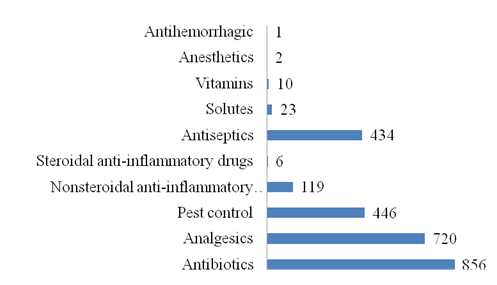
Antibiotics (856 cases) and analgesics (720 cases) were the most prescribed.
According to the following table, contraindications have been noted (Figure 2).
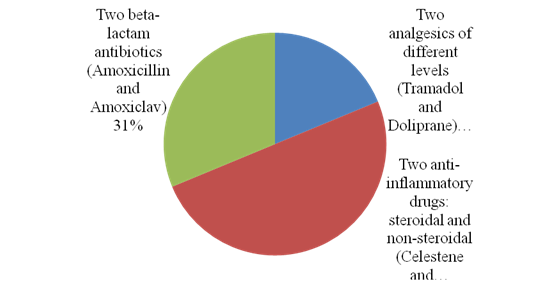
The contraindications represented 0.6% (or 16 cases). Anti-inflammatory drugs (8 cases) were the most prescribed.
Discussions
Since the prescription is the meeting point between the doctor, the pharmacist and the patient, it must be easily readable in order to reduce the risks associated with dispensing errors. According to our results, all prescriptions were readable. But the errors of omission were noted on the prescription date, the qualification of the prescriber, the signature and the seal, respectively in 3; 81; 5 and 7% of cases. These findings have medicolegal consequences, which can sometimes lead to suspension of medical activity, reprimand or even imprisonment [8, 9, 10].
In our study, as in others, age, sex and weight were only listed in 11 respectively; 36 and 1% of prescriptions. The first and last names of patients being one of the sine qua non conditions for the delivery and purchase of medicinal products, were nevertheless mentioned on all prescriptions [7, 9, 11].
In 42% of the cases, there were 5 drugs per prescription. The oral voice was the most prescribed (89% of cases). But the duration of treatment was imprecise in 99% of cases. These data are confirmed in other studies showing the average number of drugs per prescription [5, 12, 13].
According to our results, corroborated by other authors, antibiotics (856 cases) and analgesics (720 cases) were the most common, due to the high frequency of infections and pain in odontostomatological pathologies [1, 5, 14].
The contraindications represented 0.6% (ie 16 cases) relating to anti-inflammatory drugs (8 cases), beta-lactam antibiotics (5 cases) and analgesics. Ignorance or even misuse of such a notion can lead to a potentiation of undesirable effects [3, 5, 15, 16].
Conclusion
For a prescription, certain legal references (name and first name, date and stamp) can incriminate prescribers and lead patients into therapeutic errors (readability, duration of consumption and prescription, renewable or not).
Conflict of Interest: None
References
-
Guillemot D, Roget K, Zagury P, Fleurette F (2019) Direction des Etudes et de l’Information: Information Pharmaco-Economiques à l’Agence du médicament. Etude de la prescription et de la consommation des antibiotiques en ambulatoire.
-
Dajean-Trutaud Sylvie (2011) Les prescriptions médicamenteuses en pédodontie. Thèse de Médecine Dentaire. Faculté de chirurgie dentaire, Université de Nantes 1: 9.
-
Société Francophone de Médecine Buccale ET Chirurgie Buccale (2008) Recommandations pour la prescription des anti-inflammatoires en chirurgie buccale chez l’adulte. Médecine Buccale Chirurgie buccale 14(3): 130.
-
Oriane Bleu (2015) Prescriptions médicamenteuses usuelles en médecine et chirurgie orales : Etat des Lieux en 2013. Thèse de Médecine Dentaire. Faculté de chirurgie dentaire, Université de Nantes, pp: 29-30.
-
Agence Française de Sécurité Sanitaire des Produits de Santé, Juillet (2001) Prescriptions des antibiotiques en Odontologie et Stomatologie, Recommandations ET Argumentaire.
-
Siého A (2017) Problématique de la vente illicite des médicaments dans le district de Bamako. Thèse de pharmacie, Bamako, pp: 30.
-
Daou M (2014) Evaluation des ordonnances prescrites en milieu hospitalier : cas du centre national d’odontostomatologie de Bamako au Mali. Thèse de pharmacie, pp: 28.
-
Historique de l’ordonnance (2017) Consultable sur.
-
Fyrol KA (2012) Evaluation de la qualité des prescriptions médicamenteuses en milieu hospitalier : cas du CHU du Point G. Thèse de pharmacie, FMPOS, pp: 45-46.
-
Ministères de la S (2007) République du Bénin Recueil de textes législatifs et règlementaires du secteur pharmaceutique au Mali, pp: 88.
-
Sondo B, Ouedraogo V, Ouattara TF, Garane P, Savadogo L, et al. (2002) Etude de la qualité rédactionnelle des ordonnances médicales à la caisse de sécurité sociale, Ouagadougou. Santé publique 14(1): 31-36.
-
Blatt A, Chamblon R, Lemardeley P (1997) Forme légale et coût des prescriptions à l’hôpital central de Yaoundé. Médecine Tropicale 57(1): 37-40.
-
Prebet P (1994) Enquête sur l’accessibilité du médicament ET la qualité de la prescription en pharmacie privée en Mauritanie. Développement ET Santé 113: 22- 27.
-
Tangara F (2014) Evaluation sur la prescription des antibiotiques dans les services de chirurgie à l’hôpital SOMINE DOLO DE MOPTI. Thèse de pharmacie Bamako, pp: 19.
-
Resplandy F (2017) Les antalgiques.
-
Vial T, Jonville-Bera AP (2012) Médicaments et grossesse: prescrire et évaluer les risques. Issy-Les-Moulineaux: Elsevier Masson 47(4): 1-20.
- Gallic and Citric Acid Present in the Peels of Tropical Fruits as an Alternative in the Fight against Cancer
- Treating the Forehead Lines with Combination of Forehead and Glabellar Botulinum Toxin Among Japanese Patients
- Clinical Evaluation of Patients Suffering from Breast Cancer & Determination of Treatment Therapies and Better Strategies Related to Breast Cancer
- Medieval Recipes by Al-Zahrāwī for Heart Palpitations Treatment
- Etiology and Prescription Errors of Myocardial Infarction in Different Health Care Systems of Azad Kashmir
- Early Diagnosis and Multidisciplinary Management of Turner Syndrome: A Paediatric Case Study