
Influence of the Biofield Energy Treatment on the Pharmacokinetics of 25-Hydroxyvitamin D3 in Male Sprague-Dawley Rats after a Single Oral Dose of Vitamin D3
Vitamin D3 reported having many important roles in bone metabolism, osteoporosis, immunity, and useful in numerousdiseases, i.e., cardiovascular, cancers, and neurodegenerative diseases. Unexpectedly, there is little information availableabout the concentration of 25-hydroxyvitamin D3 in the blood, which is the best indicator of vitamin D3 status after itsoral absorption. However, the biological activity of vitamin D3 is mediated via the formation of the active metabolite, 1-α,25-dihydroxyvitamin D3. There are several factors that affect its absorption and first-pass metabolism that lead to havingvery low plasma concentrations of both the metabolites (25-hydroxyvitamin D3 and 1-α, 25-dihydroxyvitamin D3) followingan oral administration. Thus, the current study was executed to determine the influence of the Trivedi Effect®-ConsciousnessEnergy Treatment on vitamin D3 and rats through the measurement of plasma 25-hydroxyvitamin D3concentrations after theoral administration of vitamin D3 in male Sprague-Dawley rats. The test item, vitamin D3 was divided into two parts. One partwas denoted as the control (without Biofield Energy Treatment/Blessing), while the other part was defined as the BiofieldEnergy Treated sample, which received the Biofield Energy Treatment by renowned Biofield Energy Healer, Dahryn Trivedi.Additionally, one group of animals also received Consciousness Energy Treatment per se by the Healer under similar conditions. The Biofield Energy Healer who was located in the USA, while the test samples and animals were located in the researchlaboratory in India. Vitamin D3 oral formulations were administrated by oral gavage at a dose of 500 µg per kg in groups viz.G1 (untreated vitamin D3), G2 (Biofield Treated vitamin D3), and G3 (Biofield Treated animals received untreated vitamin D3) group. The Biofield Energy Treatment increased the maximum plasma concentration (Cmax) of 25-hydroxyvitamin D3 by 3.45% and 72.77% in the G2 and G3 groups, respectively as compared with the G1 group. The area under the plasma concentration–time curve (AUC0–t) of 25-hydroxyvitamin D3 was altered by -11.19% in the G2 group and 59.45% in the G3 group as comparedto the G1 group. After oral administration, the Tmax of 25-hydroxyvitamin D3 was altered by -62.97% in G2 and 55.56% in G3 groups compared to G1. The mean residence time (MRT) of 25-hydroxyvitamin D3 was also altered in the G2 group by -12.34% and G3 group by 0.18%, as compared to the G1. The relative oral bioavailability (Fr) of 25hydroxyvitamin D3 was significantly altered by -11.19% in the G2 group and 59.45% in the G3 group compared to the G1. Biofield Energy Treatment could be an innovative strategy that opens new avenues to overcome poorly absorbed pharmaceuticals/ nutraceuticals/herbal extractsand can also improve the therapeutic performance of orally active molecules.
Introduction
Vitamin D is an essential nutrient and a hormone that our body makes, which plays an important function in order to maintain a healthy immune system and the prevention of diseases [1]. Vitamin supplements are a good source of vitamin D, while dairy products, such as cereals, fatty fish such as salmon and tuna, are other dietary sources. Vitamin D is found naturally in two different forms viz. D2 (ergocalciferol) and D3 (cholecalciferol), while D3 form is produced by our skin after exposure to the sunlight. Ergocalciferol and cholecalciferol are the biologically inactive pro-hormones [2]. Vitamin D undergoes two biotransformation steps for activation in order to carry out their biological functions. The first transformation occurs in the liver and leads to the formation of 25-hydroxyvitamin D3 [25(OH) D3; calcidiol] via CYP2R1/ CYP27A1 pathway [3]. Thus, the amount of vitamin D3 status obtained from various sources can be best identified in the blood for a relatively long time period [4]. The second biotransformation primarily occurs in the kidney results in the formation of 1 alpha, 25-hydroxyvitamin D3 via CYP27B1 [1,25(OH)2D3; calcitriol] which is the biologically active vitamin D3 [5]. Calcitriol is not regarded as a good indicator of vitamin D3 status because before use up it doesn’t last very long in the blood [6]. Vitamin D3 improves the calcium absorption in the gut and to maintain normal levels of calcium and phosphates in the blood for bone formation and remodeling [7, 8]. It also plays an important role in sustaining the immunity, cardiovascular, and reproductive systems [9, 10]. Vitamin D and calcium deficiencies are linked and would lead to rickets, osteomalacia, breast and colorectal cancers, rheumatoid arthritis, multiple sclerosis, Parkinson’s and Alzheimer’s diseases, dementia, and diabetes [11, 12, 13, 14, 15]. There are several reports which suggest that most of the people Worldwide who are either deficient or have insufficient vitamin D3 [16, 17, 18], a problem that can be addressed by fortifying foods with vitamin D3 and calcium. The mechanism of transformation of vitamin D and absorption kinetics of active form, vitamin D3 are very complicated to be concluded. Various factors that directly affect the vitamin D3 bioavailability such as dietary fiber, genetic factors, and the effect of vitamin D3 status [19]. Therefore, it is required to know how vitamin D3 metabolism modifies the active forms of vitamin D3 that circulate in the blood. Therefore, the current study was undertaken to assess the effects of the Biofield Energy Treatment on vitamin D3 bioavailability in rats.
Complementary and Alternative Medicine (CAM) methods have been reported with many clinical beneficial effects in energy therapies. Immune system function was significantly improved after Biofield Energy Treatment in the case of cervical cancer patients [20], massage therapy [21], etc. Biofield Energy Therapy has been discovered thousands of years back, which were practiced worldwide, such as improved quality of life in the case of cancer patients [22], improved functional ability in case of arthritis patients [23], decreased pain and anxiety [24]. The National Center for Complementary/Alternative Medicine (NCCAM) has recommended with significant clinical outcome in various clinical pathogenic conditions [25, 26]. The Biofield is generated from internal human processes such as blood flow, lymph flow, brain functions, and heart function. This energy also can be harnessed and can transmit them into living organisms and non-living materials by the process of Biofield Energy Treatment. The Trivedi Effect®-Consciousness Energy Treatment had been extensively studied in the field of materials science [27, 28, 29] nutraceuticals [30, 31], genetics and biotechnology [32, 34], microbiology [35, 36, 37], agricultural science and livestock [38, 39, 40, 41], and medical science [42, 43].
It has been reported that the Trivedi Effect® has significant capability to alter the physio-chemical and thermal behavior of various pharmaceuticals, nutraceuticals, and organic compounds through the possible intervention of neutrinos [44, 45, 46]. The Trivedi Effect®-Consciousness Energy Treatment could be a useful approach for the enhancement of the bioavailability of pharmaceuticals and nutraceuticals. Thus, the aim of this study was to evaluate the effect of Biofield Energy Treatment on the plasma pharmacokinetics of 25-hydroxyvitamin D3 in rats after a single oral dose of vitamin D3.
Materials and Methods
Chemicals and Reagents
Vitamin D3, 25-hydroxyvitamin D3, and telmisartan test samples were purchased from Sigma (St. Louis, MO, USA). The reagents used for sample preparation and bioanalysis included acetonitrile (HPLC Grade, Merck), methanol (HPLC Grade, Merck), water (Milli-Q), and formic acid (LC-MS Grade, Fluka). USP grade nitrogen was used as the curtain gas, and collision gas for LC-MS/MS were supplied from air compressor (Anesta Iwata, Japan), polypropylene tubes (Tarsons, India), class-A, measuring cylinders and volumetric flasks (Borosil, Germany) and membrane filters, 0.22 μm and 0.45 µm (Millipore) were used during the study. All other reagents and solvents were of analytical grade purchased from India.
Consciousness Energy Treatment Strategies
The vitamin D3 (test item) was divided into two parts. One part was considered as the control sample, while the other part of the test item was known as the Biofield Energy Treated test sample. The treated test item group was subjected to the Trivedi Effect®-Consciousness Energy
Treatment by Biofield Energy Healer. The Biofield Energy Treatment was provided by a renowned Biofield Energy Healer, Dahryn Trivedi, USA. Moreover, one group of animals also received the Biofield Energy Treatment per se by the same Biofield Energy Healer under similar conditions at GVK Biosciences laboratory, Hyderabad, India. The Biofield Energy Healer who was located in the USA, while the test samples and animals were located in the research laboratory in India. This Biofield Energy Treatment was provided for about 3 minutes through the Biofield Energy Healer’s unique Energy Transmission process, administered to the test formulation. Similarly, the control formulation was treated with a “sham” healer for about 3 minutes under the same laboratory conditions. The sham healer did not have any knowledge about the Biofield Energy Treatment. After all, the Biofield Energy Treated and untreated test items were kept in similar sealed conditions and used for the study as per experimental design.
In Vivo Pharmacokinetics Study
Animals: Male Sprague-Dawley (SD) rats (body weight 230 to 270 grams) were procured from Liveon Biosciences, Bangalore, India. Animals were housed in polycarbonate cage. Temperature and humidity were maintained at 22 ± 3°C and 40% to 70%, respectively, and illumination was controlled to give a sequence of 12 hours light and 12 hours dark cycle. The temperature and humidity were recorded by autocontrolled data logger system. All the animals were provided a laboratory rodent diet (Vetcare India Pvt. Ltd., Bengaluru). Reverse osmosis water treated with ultraviolet light was provided ad libitum. The experiments using animals in this investigation were performed in accordance with the guidelines provided by the Committee for the Purpose of Control and Supervision of Experiments on Animals (CPCSEA) as published in The Gazette of India, January 7, 2010 and protocol approved by the Institutional (GVK Bio) Animal Ethics Committee (IAEC approval number: B-011)..
Experimental Design: Rats were divided into three groups (n=3): group 1 (Gr. 1) – per oral (p.o.) dosing of untreated vitamin D3, group 2 (Gr. 2) – per oral (p.o.) dosing of the Biofield Energy Treated vitamin D3 and group 3 (Gr. 3) – per oral (p.o.) dosing of untreated vitamin D3 in Biofield Energy Treated animals. All animals were received per oral dose at 500 µg/kg of vitamin D3 solution formulation. The dose (500 µg/kg) of the test item was chosen based on the preliminary experiments performed in our laboratory and observed the quantifiable concentration of this analyte in rat plasma.
Formulation Preparation
Solution formulations of the test item was prepared in 14% v/v propyleneglycol, 1% v/v Tween 80, 45% v/v PEG, and 40% w/v 2-Hydroxypropyl-β-cyclodextrin in distilled water. All formulations were prepared freshly prior to dosing. The dose volume for per oral route was 5 mL/kg.
Pharmacokinetic Studies
The solution of test formulations was freshly prepared for per oral dosing. All rats fasted overnight, and the fasting continued up to 4 hours post dosing with free access to drinking water. The oral test formulation was administered at 500 µg/kg dose through oral gavage using an 18G stainless steel intubation cannula. The dosing volume administered was 5 mL/kg. Blood samples (~120 µL) were collected from the jugular vein catheter of three rats from each group at each time point [pre-dose, 0.25, 0.5, 1, 2, 4, 8, 24, 36, 48, 72, and 96 hours (p.o.)]. Samples were collected into labeled micro centrifuge tubes containing 20% w/v K2EDTA as an anticoagulant. Plasma samples were separated from the blood by centrifugation at 2500 g for 10 min at 4 ± 2°C and stored below -40°C (Thermo Scientific, USA) deep freezer until bioanalysis.
LC-MS/MS Analysis
Analysis of rat plasma samples was performed using API 5500 QTRAP Applied Biosystem-Sciex LC/MS/MS (Concord, Ontario, Canada) triple quadrupole mass analyzer system with an interface connected to a Shimadzu UFLC system (Shimadzu Corp., Japan). The optimum operating parameters were determined by atmospheric pressure chemical ionization (APCI) interface in positive ion mode. Generic mass spectrometry parameters of the analyte were developed and used for the analysis. These parameters were the declustering potential range (80), collision energy range (21), collision cell exit potential range (13), curtain gas (40 arbitrary units), collisionally activated dissociation gas (medium), ion spray voltage (5500 V), source temperature (550°C), and ion source gas 1 (70, arbitrary units each). Interface heaters were kept on for the analyte. The analyte was detected by positive ion spray in the multiple reaction monitoring mode (MRM) mode using predetermined parent/product mass transition ion pairs. The parameters of the selected MRM monitoring transitions for the [M + H]+ precursor ion to selected product ion (m/z) were optimized with 383.20/365.40 (25-hydroxyvitamin D3), and 515.30/276.20 (telmisartan as an internal standard). The whole system was controlled by Analyst Classic 1.6.3® software (Applied-Biosystem-Sciex, Concord Canada). Stock solutions of 25-hydroxyvitamin D3 and telmisartan (internal standard, IS) were prepared in methanol at approximately 2.368 mg/mL and 0.98 mg/mL, respectively, and subsequently diluted which were used for the bioanalysis.
The extraction procedure for plasma samples or the
spiked into plasma calibration standards was identical. A 50 µL sample of either study sample or spiked calibration standard was added to individual pre-labeled micro-centrifuge tubes. A 50 µL sample of either study sample or spiked calibration standard/quality control samples were added to individual wells of 96 well plate with 500 µL capacity. 200 µL of internal standard (IS) prepared in acetonitrile (ACN) was added to the samples in deep well plate except for blank, where 200 µL of ACN was added and vortexed for 5 minutes. Samples were centrifuged for 10 minutes at a speed of 4000 rpm (3220 g) at 4°C. Following centrifugation, 120 µL of supernatant was transferred into 1000 µL capacity deep well plate and mixed with 120 µL of methanol: water, 50:50 v/v. The plate was kept in the auto-sampler for the LC-MS/MS analysis.
A Shimadzu LC-20AD LC system (Shimadzu Corp., Japan) was connected to a SIL -20 AC HT auto-sampler (Shimadzu Corp., Japan). The supernatant was injected (20 µL) onto a 50 x 4.6 mm (3.5 µm) Waters, X-Bridge, C18 HPLC column (Waters, Massachusetts, Ireland). Analytes were eluted using a gradient elution program with a mobile phase consists of 0.1% formic acid in water (pump A) with methanol (pump B) at a flow rate of 1.0 mL/min. The column temperature was at 40 °C, and the sample temperature was at 15°C. The following linear gradient was employed for the separation: 80% A for 0.01 min, 5% A at 2. 5 min and hold to 4.5 min, 80% A at 4.9 min, and hold to 6.0 min. The 25-hydroxyvitamin D3 and telmisartan elution times were approximately 3.61 and 2.45 min, respectively. Peak integration, regression, and calculation of analytes concentration were computed using Analyst Classic (Version 1.6.3) software. The calibration curve was performed by a linear curve fit of the peak area ratio (analyte/internal standard) as a function of the concentration in the respective matrix. A weighting of 1/x2 (where x is the concentration of a given calibration standard level) was found to be optimal. The Lower limit of quantification (LLOQ) in rat plasma was 1.09 ng/mL for 25-hydroxyvitamin D3. Analysis of 25-hydroxyvitamin D3 in plasma (1.09 to 252.65 ng/mL) showed repeatability (relative standard deviation-RSD%) of
2.2% to 9.6% and accuracy of 85.70% to 95.65%.
Pharmacokinetic Analysis
The pharmacokinetic parameters of 25-hydroxyvitamin D3 were obtained by the noncompartmental analysis module in Phoenix WinNonlin® (Version 7.0) (Pharsight, Mountain View, CA). The areas under the concentration-time curve (AUC0-t and AUC0-∞) were calculated by the linear trapezoidal rule. The terminal elimination rate constant (kel) was determined by regression analysis of the linear terminal portion of the log plasma concentration-time curve. The terminal half-life (T1/2) was estimated as 0.693/ke. The apparent oral clearance (CL/F) was calculated for per oral dose divided by AUC, respectively. Peak 25-hydroxyvitamin D3 concentrations (Cmax) and the times when they occurred (Tmax) were derived directly from the data. The relative oral bioavailability (Fr) was estimated by AUCtreated/AUCcontrol.
Statistical Analysis
All mean values are presented with their standard deviation (mean±S.D.). Data were analyzed for statistically significant differences using analysis of variance followed by the two-sided unpaired Student’s t-_test. Differences were considered to be significant at a level of _p<0.05.
Results and Discussions
In vivo Effects of Biofield Energy Treatment for 25-hydroxyvitamin D3 Pharmacokinetics in Rats
The mean pharmacokinetic parameters and profiles of 25-hydroxyvitamin D3 in the rat plasma after a single oral administration of vitamin D3 solution formulations in three different groups are summarized in Table 1.
| Parameter | Gr. 1 (Untreated Vitamin D ) 3 | Gr. 2 (Biofield Energy Treated Vitamin D ) 3 | Gr. 3 (Biofield Treated Rats + Untreated Vitamin D ) 3 |
|---|---|---|---|
| C (ng/mL) max | 61.70 ± 15.42 | 63.83 ± 16.53 | 106.60 ± 25.73 |
| AUC (ng.hr/mL) 0-t | 4828.95 ± 1574.79 | 4288.55 ± 898.45 | 7699.93 ± 2027.10 |
| T (hr) max | 36.00 ± 12.00 | 13.33 ± 9.24 | 56.00 ± 27.71 |
| MRT (hr) | 49.18 ± 2.79 | 43.11 ± 2.23 | 49.27 ± 4.45 |
| Fr (%) | 100 | 88.81 ± 18.61 | 159.45 ± 41.98 |
Table 1: Pharmacokinetic parameters of 25-hydroxyvitamin D3 after p.o. administration at 500 µg/kg vitamin D3 body weight to Spra
The data are expressed as mean ± standard deviation (SD) values. p.o.: per oral. Cmax, peak concentration; Tmax, time to reach peak concentration; AUC, area under the plasma concentration–time curve; MRT, mean residence time; Fr: relative oral bioavailability.
The pharmacokinetic parameters of 25-hydroxyvitamin D3 were studied after oral administration vitamin D3 at a dose of 500 µg/kg body weight to Sprague Dawley male rats (Table 1). The maximum plasma concentration (Cmax) of 25-hydroxyvitamin D3 was significantly increased by 3.45% and 72.77% in the G2 and G3 groups, respectively, as compared with the G1 group. The comparative mean plasma concentration vs. time profiles of 25-hydroxyvitamin D3 after per oral administration of vitamin D3 to Sprague Dawley rats was shown in Figure 1. The area under the plasma concentration-time curve (AUC0–t) of 25-hydroxyvitamin D3 was altered by -11.19% and 59.45% in the G2 and G3 groups, respectively compared to the group G1. The Tmax of 25-hydroxyvitamin D3 was altered by -62.97% in G2 and 55.56% in G3 compared to G1. The mean residence time (MRT) of 25-hydroxyvitamin D3 was also altered in the G2 group by -12.34% and G3 group by 0.18%, as compared to the G1. The relative oral bioavailability (Fr) of 25-hydroxyvitamin D3 was significantly altered by -11.19% in the group G2 and 59.45% in the group G3 compared to the G1 (Table 1).
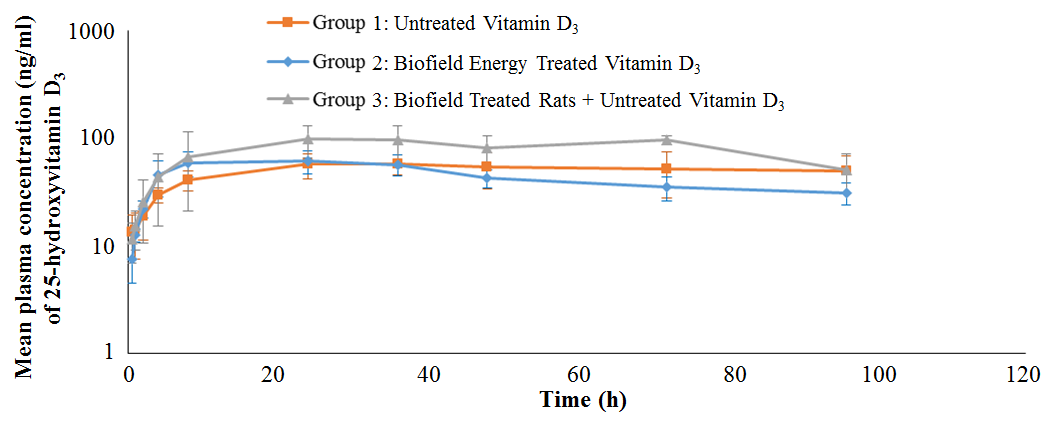
Most of the people need dietary vitamin D3 to reach the recommended serum level, i.e., > 30 ng/mL (≈ 75 nmol/L) [47]. Naturally occurring foods contain vitamin D3 are fatty fish flesh, cod liver oils, beef liver, dairy products, mushrooms, and egg yolk [48, 49, 50]. In all age groups are suffering from fat malabsorption, consumption of vitamin D3 supplements, or vitamin D3 enriched foods are required to meet the daily need, i.e., approximately 2000 IU/day to maintain serum vitamin D3 levels greater than 30 ng/mL [51, 52]. There have been numerous recent studies have suggested that vitamin D3 has roles in bone metabolism and immunity [53, 54].
The results indicated that the treated vitamin D3 and animals per se significantly altered the rate and extent of oral absorption of vitamin D3. The change in absorption may be due to the alteration of the specific surface area of the vitamin D3, or the stability of the vitamin D3 in formulation in the GIT or due to the changed vitamin D3 metabolism pathways. The Trivedi Effect® has the significant capability to transform the physicochemical properties of various nutraceutical and pharmaceutical compounds through possible mediation of neutrinos [44]. The Trivedi Effect®-Consciousness Energy Treatment altered the bioavailability of nutraceutical compounds [55, 56]. Primary pharmacokinetic parameters, i.e., oral plasma clearance in the Biofield Energy Treated groups were significantly increased. Similarly, the Cmax of vitamin D3 was also increased in G2 and G3 groups compared to G1. The significant alteration of pharmacokinetic parameters of 25-hydroxyvitamin D3 in the Biofield Energy Treated group might be translated into altering the therapeutic performance in various disease conditions. The relative oral bioavailability (Fr) of vitamin D3 was significantly increased in the G3 group as compared to the G1. The Biofield Energy Treated vitamin D3 could be useful for the treatment of hyperparathyroidism, cardio-vascular diseases, cancers, diabetes, metabolic disorders, multiple sclerosis, and neurodegenerative diseases [56, 57, 58, 59]. It might be helpful to improve the calcium absorption in the gut and to maintain normal levels of calcium and phosphates in the blood for bone formation and remodeling [60,61s].
Conclusions
The Trivedi Effect®-Consciousness Energy Treatment significantly increased the maximum plasma concentration (Cmax) of 25-hydroxyvitamin D3 by 3.45% and 72.77% in the G2 and G3 groups, respectively compared with the G1 group. The area under the plasma concentration–time curve (AUC0–t) of 25-hydroxyvitamin D3 was altered by -11.19% in the G2 group and 59.45% in the G3 group compared to the group G1. After oral administration, the Tmax of 25-hydroxyvitamin D3 was altered by -62.97% in G2 and 55.56% in G3 compared to G1. The mean residence time (MRT) of 25-hydroxyvitamin D3 was also altered in the G2 group by -12.34% and G3 group by 0.18%, as compared to the G1. The relative oral bioavailability (Fr) of 25-hydroxyvitamin D3 was significantly altered by -11.19% in the G2 group and 59.45% in the G3 group compared to the G1. Biofield Energy Treatment could be an innovative strategy that opens new avenues to overcome poorly absorbed pharmaceuticals/nutraceuticals/ herbal extracts and can also improve the therapeutic performance of orally active molecules. As a result, this Biofield Energy Treatment could be beneficial for the cardiac and kidney transplant patients, osteoporotic patients, hip fracture patients, hyperparathyroidism and cancer patient, neurodegenerative, and ischemic heart patients. It might be helpful to increase the calcium absorption in the gut and to maintain standard levels of calcium and phosphate in the blood for bone formation and remodeling.
Acknowledgements
Authors are grateful to GVK Bioscience, Trivedi Science, Trivedi Global, Inc., and Trivedi Master Wellness for their support throughout the work.
References
-
Dusso AS, Brown AJ, Slatopolsky E (2005) Vitamin D. Am J Physiol Renal Physiol 289(1): F8-F28.
-
Rajakumar K, Greenspan SL, Thomas SB, Holick FM (2007) Solar ultraviolet radiation and Vitamin D: A historical perspective. Am J Public Health 97(10): 1746- 1754.
-
Lips P (2004) Which circulating level of 25-hydroxyvitamin D is appropriate? J Steroid Biochem Mol Biol 89-90: 611-614.
-
Melamed ML, Muntner P, Michos ED, Uribarri J, Weber C, et al. (2008) Serum 25-hydroxyvitamin D levels and the prevalence of peripheral arterial disease: results from NHANES 2001 to 2004. Arterioscler Thromb Vasc Biol 28(6): 1179-1185.
-
Holick MF (2010) Vitamin D: Physiology, Molecular Biology, and Clinical Applications. Humana Press.
-
Holick MF (2009) Vitamin D status: Measurement, interpretation, and clinical application. Ann Epidemiol 19(2): 73-78.
-
Heaney RP (2003) Long-latency deficiency disease: insights from calcium and vitamin D. Am J Clin Nutr 78(5): 912-919.
-
Holick MF (2015) Vitamin D Is Not as Toxic as Was Once Thought: A Historical and an Up-to-Date Perspective. Mayo Clin Proc 90(5): 561-564.
-
Zhang R, Naughton DP (2010) Vitamin D in health and disease: Current perspectives. Nutr J 9: 65.
-
Gouni-Berthold I, Krone W, Berthold HK (2009) Vitamin D and cardiovascular disease. Curr Vasc Pharmacol 7(3): 414-422.
-
Holick MF (2004) Sunlight and Vitamin D for bone health and prevention of autoimmune diseases, cancers, and cardiovascular disease. Am J Clin Nutr 80: 1678S-1688S.
-
Hyppönen E, et al. (2001) Intake of vitamin D and risk of type 1 diabetes: a birth‐cohort study. The Lancet 358(9292): 1500‐1503.
-
Badenhoop K, Kahles H, Penna-Martinez M (2012) Vitamin D, immune tolerance, and prevention of type 1 diabetes. Curr Diab Rep 12(6): 635-642.
-
Bhargava P, Gocke A, Calabresi PA (2015) 1,25-Dihydroxyvitamin D3 impairs the differentiation of effector memory T cells _in vitro_ in multiple sclerosis patients and healthy controls. J Neuroimmunol 279: 20- 24.
-
Shirazi HA, Rasouli J, Ciric B, Rostami A, Zhang GX (2015) 1,25-Dihydroxyvitamin D3 enhances neural stem cell proliferation and oligodendrocyte differentiation. Exp Mol Pathol 98(2): 240-245.
-
Institute of Medicine (2011) Dietary reference ranges for calcium and vitamin D.
-
Van Schoor NM, Lips P (2011) worldwide vitamin D status. Best Pract Res Clin Endocrinol Metab 4: 671-80.
-
NIST/NIH (2017) Vitamin D Metabolites Quality Assurance Program.
-
Lehmann U, Hirche F, Stangl GI, Hinz K, Westphal S, et al. (2013) Bioavailability of vitamin D(2) and D(3) in healthy volunteers, a randomized placebo-controlled trial. J Clin Endocrinol Metab 98(11): 4339-4345.
-
Lutgendorf SK, Mullen-Houser E, Russell D, Degeest K, Jacobson G, et al. (2010) Preservation of immune function in cervical cancer patients during chemoradiation using a novel integrative approach. Brain Behav Immun 24(8): 1231-1240.
-
Ironson G, Field T, Scafidi F (1996) Massage therapy is associated with enhancement of the immune system’s cytotoxic capacity. Int J Neurosci 84: 205-217.
-
Giasson M, Bouchard L (1998) Effect of therapeutic touch on the well-being of persons with terminal cancer. J Holist Nurs 16(3): 383-398.
-
Peck SD (1998) The efficacy of therapeutic touch for improving functional ability in elders with degenerative arthritis. Nurs Sci Q 11: 123-132.
-
Turner JG, Clark AJ, Gauthier DK, Williams M (1998) The effect of therapeutic touch on pain and anxiety in burn patients. J Adv Nurs 28(1): 10-20.
-
Barnes PM, Bloom B, Nahin RL (2008) Complementary and alternative medicine use among adults and children: United States, 2007. Natl Health Stat Report 12: 1-23.
-
Rubik B (2002) The biofield hypothesis: Its biophysical basis and role in medicine. J Altern Complement Med 8: 703-717.
-
Nayak G, Trivedi MK, Branton A, Trivedi D, Jana S (2018) Evaluation of the effect of consciousness energy healing treatment on the physicochemical and thermal properties of selenium. Journal of New Developments in Chemistry 2: 13-23.
-
Nayak G, Trivedi MK, Branton A, Trivedi D, Jana S (2018) The physicochemical and thermal properties of consciousness energy healing treated silver oxide (Ag2O). Aspects in Mining & Mineral Science 2: 1-6.
-
Nayak G, Trivedi MK, Branton A, Trivedi D, Jana S (2018) Evaluation of the physicochemical and thermal properties of consciousness energy healing treated polylactic-co-glycolic acid (PLGA). Journal of Food Science and Technology 5: 117-125.
-
Nayak G, Trivedi MK, Branton A, Trivedi D, Jana S (2018) Evaluation of the consciousness energy healing treated berberine chloride using PXRD, PSA, and DSC Analysis. Food Sci Nutr Technol 3: 000168.
-
Nayak G, Trivedi MK, Branton A, Trivedi D, Jana S (2018) Impact of Consciousness energy healing treatment on the physicochemical and thermal properties of vitamin D3 (cholecalciferol). Food Sci Nutr Technol 3: 000162.
-
Trivedi MK, Branton A, Trivedi D, Nayak G, Mondal SC, et al. (2015) Evaluation of plant growth regulator, immunity and DNA fingerprinting of biofield energy treated mustard seeds (_Brassica juncea_). Agriculture, Forestry and Fisheries. 4: 269-274.
-
Trivedi MK, Branton A, Trivedi D, Nayak G, Bairwa K, et al. (2015) Physical, thermal, and spectroscopic characterization of biofield energy treated murashige and skoog plant cell culture media. Cell Biology 3(4): 50- 57.
-
Nayak G, Altekar N (2015) Effect of a biofield treatment on plant growth and adaptation. J Environ Health Sci 1: 1-9.
-
Trivedi MK, Branton A, Trivedi D, Shettigar H, Nayak G, et al. (2015) Antibiogram, biochemical reactions and genotyping characterization of biofield treated _Staphylococcus aureus_. American Journal of BioScience 3: 212-220.
-
Trivedi MK, Branton A, Trivedi D, Nayak G, Shettigar H, et al. (2015) Antibiogram of multidrug-resistant isolates of _Pseudomonas aeruginosa_ after biofield treatment. J Infect Dis Ther 3: 244.
-
Trivedi MK, Branton A, Trivedi D, Shettigar H, Nayak G, et al. (2015) Assessment of antibiogram of multidrug- resistant isolates of _Enterobacter aerogenes_ after biofield energy treatment. J Pharma Care Health Sys 2: 145.
-
Trivedi MK, Branton A, Trivedi D, Nayak G, Gangwar M, et al. (2015) Morphological and molecular analysis using RAPD in biofield treated sponge and bitter gourd. American Journal of Agriculture and Forestry 3: 264- 270.
-
Trivedi MK, Branton A, Trivedi D, Nayak G, Gangwar M, et al. (2015) Evaluation of vegetative growth parameters in biofield treated bottle gourd (_Lagenaria siceraria_) and okra (_Abelmoschus esculentus_). International Journal of Nutrition and Food Sciences 4: 688-694.
-
Trivedi MK, Branton A, Trivedi D, Nayak G, Mondal SC, et al.(2015) Effect of Biofield treated energized water on the growth and health status in chicken (_Gallus gallus_ _domesticus_). Poult Fish Wildl Sci 3: 140.
-
Trivedi MK, Branton A, Trivedi D, Nayak G, Mondal SC, et al.(2015) Evaluation of plant growth, yield and yield attributes of biofield energy treated mustard (_Brassica juncea_) and chick pea (_Cicer arietinum_) seeds. Agriculture, Forestry and Fisheries 4: 291-295.
-
Trivedi MK, Patil S, Shettigar H, Mondal SC, Jana S (2015) The potential impact of biofield treatment on human brain tumor cells: A time-lapse video microscopy. J Integr Oncol 4: 141.
-
Trivedi MK, Patil S, Shettigar H, Gangwar M, Jana S (2015) _In Vitro_ evaluation of biofield treatment on cancer biomarkers involved in endometrial and prostate cancer cell lines. J Cancer Sci Ther 7: 253-257.
-
Trivedi MK, Mohan TRR (2016) Biofield energy signals, energy transmission and neutrinos. American Journal of Modern Physics 5: 172-176.
-
Trivedi D, Trivedi MK, Branton A, Nayak G, Jana S (2018) Evaluation of consciousness energy healing treated pyridoxine (vitamin B6). Global Journal of Medical Research 18: 15-23.
-
Branton A, Trivedi MK, Trivedi D, Nayak G (2018) Evaluation of the physicochemical and thermal properties of the biofield energy healing treated ofloxacin. J Pharm Pharmaceutics 5: 80-87.
-
Hollis BW (2005) Circulating 25-hydroxyvitamin D levels indicative of Vitamin D sufficiency: Implications for establishing a new effective dietary intake recommendation for vitamin D. J Nutr 135: 317-322.
-
Grady L, Thakker K (1980) Stability of solid drugs: Degradation of ergocalciferol (vitamin D2) and cholecalciferol (vitamin D3) at high humidities and elevated temperatures. J Pharm Sci 69(9):1099‐1102.
-
Grossmann RE, Tangpricha V (2010) Evaluation of vehicle substances on vitamin D bioavailability: A systematic review. Mol Nutr Food Res 54: 1055-1061.
-
Barger-Lux MJ, Heaney RP, Dowell S, Chen TC, Holick MF (1998). Vitamin D and its major metabolites: Serum levels after graded oral dosing in healthy men. Osteoporos Int 8: 222-230.
-
Institute of Medicine (2010) Food and Nutrition Board. Dietary Reference Intakes for Calcium and Vitamin D. Washington, DC: National Academy Press.
-
Scragg R, Sowers M, Bell C (2007) Serum 25-hydroxyvitamin D, ethnicity, and blood pressure in the Third National Health and Nutrition Examination Survey. Am J Hypertens 20(7): 713-719.
-
Lips P (2001) Vitamin D deficiency and secondary hyperparathyroidism in the elderly: Consequences for bone loss and fractures and therapeutic implications. Endocr Rev 22(4): 477-501.
-
Smolders J, Damoiseaux J, Menheere P, Hupperts R (2008) Vitamin D as an immune modulator in multiple sclerosis, a review. J Neuroimmunol 194(1-2): 7-17.
-
Branton A, Jana S (2017) The influence of energy of consciousness healing treatment on low bioavailable resveratrol in male _Sprague Dawley_ rats. International Journal of Clinical and Developmental Anatomy 3: 9-15.
-
Branton A, Jana S (2017) The use of novel and unique biofield energy healing treatment for the improvement of poorly bioavailable compound, berberine in male _Sprague Dawley_ rats. American Journal of Clinical and Experimental Medicine 5: 138-144.
-
Pepe J, Romagnoli E, Nofroni I, et al (2005) Vitamin D status as the major factor determining the circulating levels of parathyroid hormone: A study in normal subjects. Osteoporos Int 16: 805-812.
-
Glendenning P, Chew GT, Seymour HM, Melissa JG, Peter RG, al (2009) Serum 25-hydroxyvitamin D levels in vitamin D-insufficient hip fracture patients after supplementation with ergocalciferol and cholecalciferol. Bone 45: 870-875.
-
Munger KL, Zhang SM, O’Reilly E, Hernán MA, Oleket MJ, et al. (2004) Vitamin D intake and incidence of multiple sclerosis. Neurology 62(1): 60-65.
-
Bischoff-Ferrari HA, Shao A, Dawson-Hughes B, Hathcock J, Giovannucci E, et al. (2010) Benefit-risk assessment of vitamin D supplementation. Osteoporos Int 21: 1121- 1132.
-
Reboul E, Borel P (2011) Proteins involved in uptake, intracellular transport and basolateral secretion of fat-soluble vitamins and carotenoids by mammalian enterocytes. Prog Lipid Res 50(4): 388-402.
- Gallic and Citric Acid Present in the Peels of Tropical Fruits as an Alternative in the Fight against Cancer
- Treating the Forehead Lines with Combination of Forehead and Glabellar Botulinum Toxin Among Japanese Patients
- Clinical Evaluation of Patients Suffering from Breast Cancer & Determination of Treatment Therapies and Better Strategies Related to Breast Cancer
- Medieval Recipes by Al-Zahrāwī for Heart Palpitations Treatment
- Etiology and Prescription Errors of Myocardial Infarction in Different Health Care Systems of Azad Kashmir
- Early Diagnosis and Multidisciplinary Management of Turner Syndrome: A Paediatric Case Study