
Botulinum Toxin in the Management of Post-Surgical Scarring, which Interest?
The quality of a surgical scar depends on many local and general factors. The combination of different treatment methods is necessary to obtain better results, and to avoid unsightly scars that can affect the quality of life of the patient [1]. Surgical revision of enlarged hypertrophic scars gives good results, but there is always a risk of recurrence and enlargement during the first 6 months, especially in areas subject to movement, which is why it is interesting to act early and to combine several treatments. More recently, botulinum toxin has been attributed as an interesting treatment that allows the improvement and prevention of pathological scars [2]. Several mechanisms have been suggested to explain the effect of botulinum toxin on scarring. On the one hand, it allows a temporary paralysis of the muscles, causing immobilization and therefore a reduction in tension at the wound. On the other hand, it can inhibit the proliferation of fibroblasts, promote their apoptosis and inhibit their differentiation into myofibroblasts, always with the objective of avoiding hypertrophic scarring. At the same time, botulinum toxin can modify the collagen deposit and induce its remodeling [3]. The various studies carried out have shown better and more aesthetic results after botulinum toxin injection in post-surgery scars. More recently, studies have also shown satisfactory results for the treatment of scars. Hypertrophic and keloid scars by intra-lesional injecton of botulinum toxin in comparison with other commonly used methods such as corticostéroïde injectons [1,3,4]. We report in the case of a young father with a scar at the front level that has evolved well with a combination treatment associated with the botulinum toxin.
Image Article
The quality of a surgical scar depends on many local and general factors. The combination of different treatment methods is necessary to obtain better results, and to avoid unsightly scars that can affect the quality of life of the patient [1]. Surgical revision of enlarged hypertrophic scars gives good results, but there is always a risk of recurrence and enlargement during the first 6 months, especially in areas subject to movement, which is why it is interesting to act early and to combine several treatments. More recently, botulinum toxin has been attributed as an interesting treatment that allows the improvement and prevention of pathological scars [2]. Several mechanisms have been suggested to explain the effect of botulinum toxin on scarring. On the one hand, it allows a temporary paralysis of the muscles, causing immobilization and therefore a reduction in tension at the wound. On the other hand, it can inhibit the proliferation of fibroblasts, promote their apoptosis and inhibit their differentiation into myofibroblasts, always with the objective of avoiding hypertrophic scarring. At the same time, botulinum toxin can modify the collagen deposit and induce its remodeling [3]. The various studies carried out have shown better and more aesthetic results after botulinum toxin injection in post-surgery scars. More recently, studies have also shown satisfactory results for the treatment of scars. Hypertrophic and keloid scars by intra-lesional injecton of botulinum toxin in comparison with other commonly used methods such as corticostéroïde injectons [1, 3, 4]. We report in the case of a young father with a scar at the front level that has evolved well with a combination treatment associated with Image article the botulinum toxin.
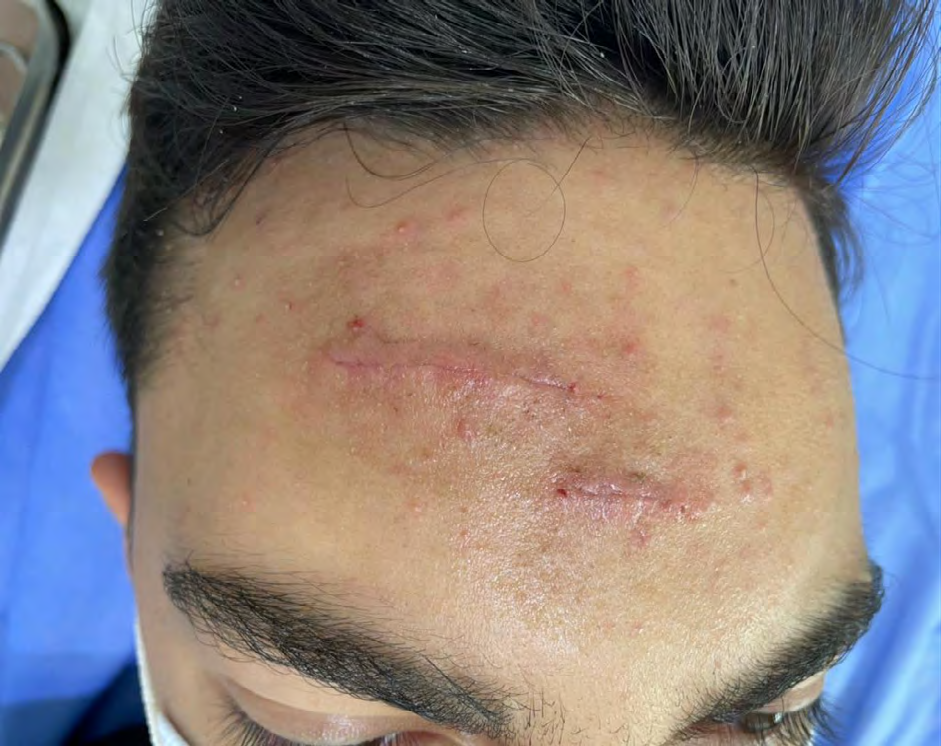
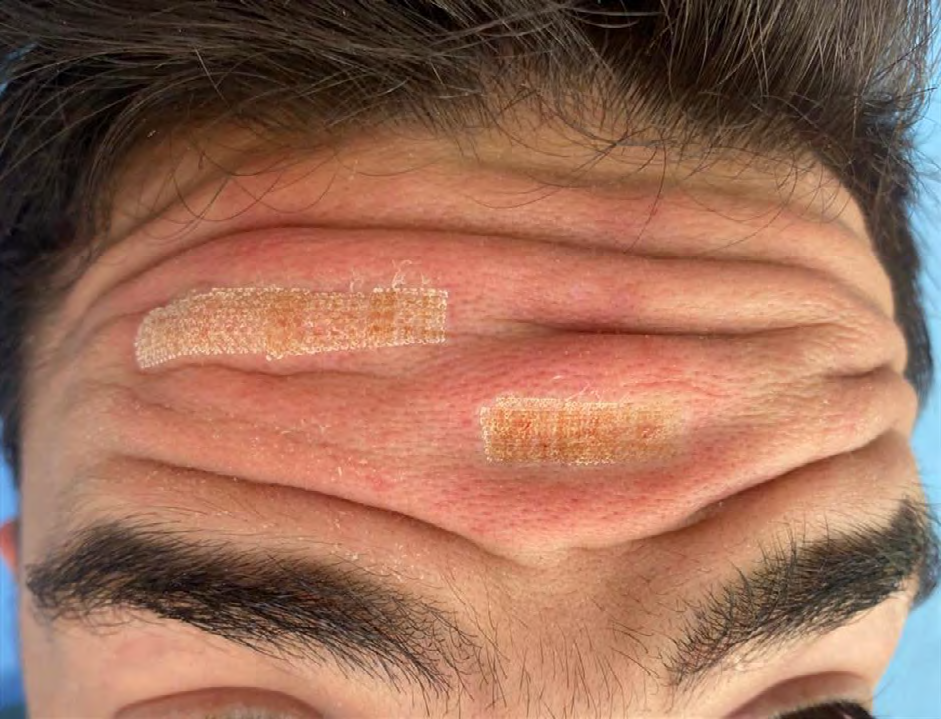
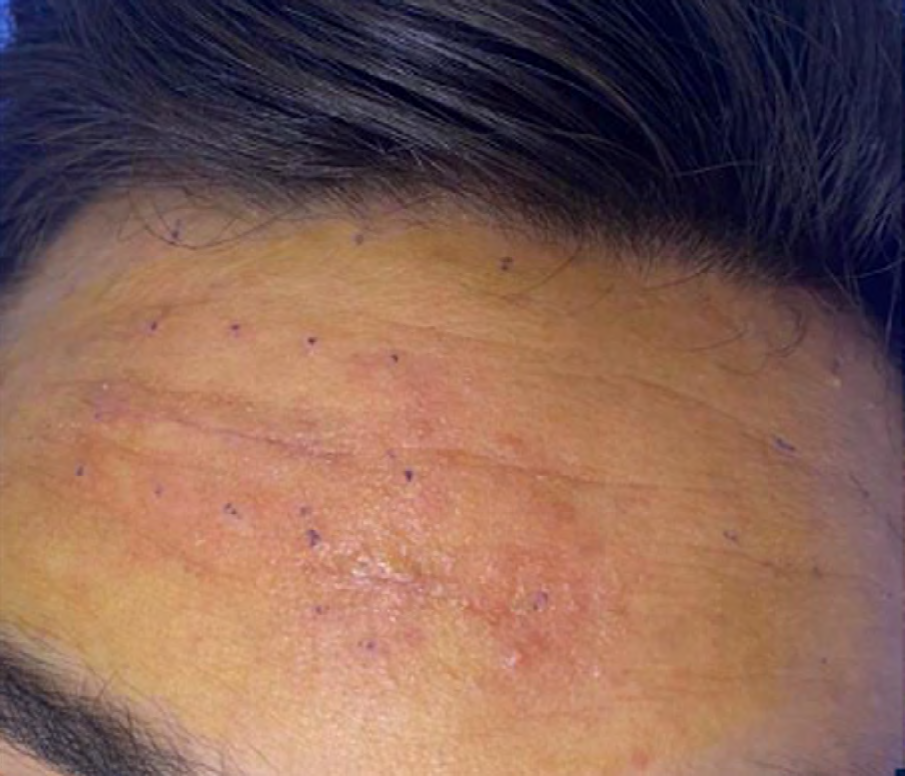
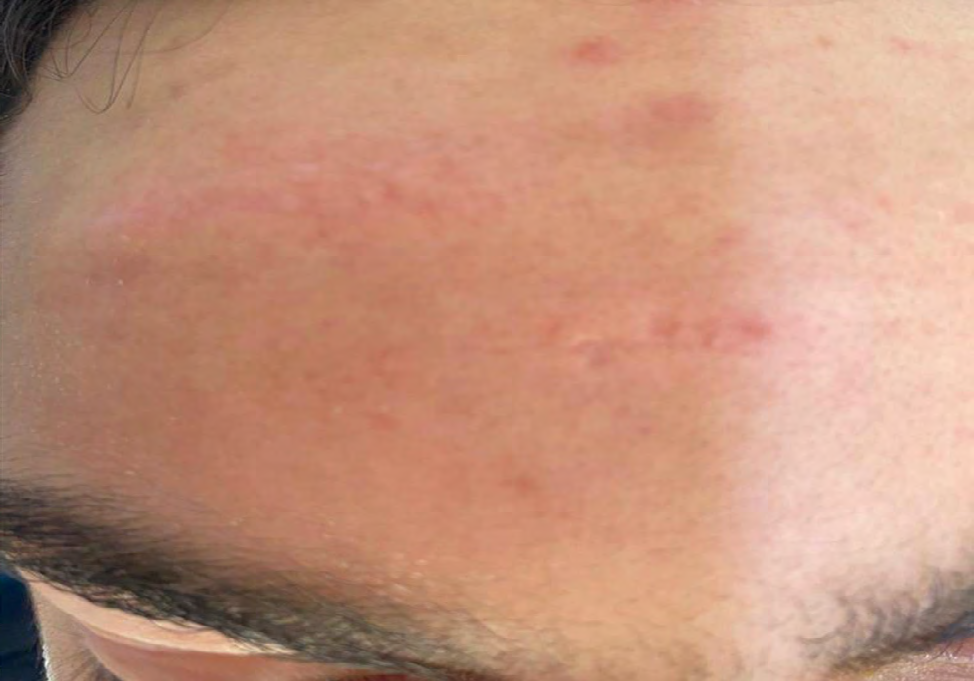
A 22-year-old patient, with no medical history, was victim of an trauma that caused a plaque on the face, with the appearance of an aesthetic hypertrophy on the front, causing discomfort to the patient. A surgical resection of the scar was performed by a plastic surgeon. On examination, we noted two erythematous horizontal linear scars on the forehead. Initially, before the removal of the threads, we opted for an antibiotic cream with an adapted armor, then after the removal of the threads we indicated a combined treatment to optimize the citation in our patient based on photo-protection with the application of a healing cream, hydration with a gel and a silicone patch. Then we proposed vascular and ablative laser sessions followed by a fractional injection of botulinum toxin at the scar and frontal level to limit mobilization and optimize healing. We injected 0.0125 CC of botulinum toxin A from 0.5 cm on either side of the symmetrical scar and 4 IU on the rest of the forehead. We obtained a thin scar tissue without fibrosis or atrophy after 4 laser sessions and 2 botulinum toxin injections 6 months intervals. The management of post-surgical scars remains a challenge for the dermatologist and the patient; Injection of the botulinum toxin has been shown to be effective with less secondary effects in the prevention and treatment of post- surgical pathological scars combined with other therapeutic modalities.
Keywords: Scars; Botulinum toxin; Management
Consent
The patient’s examination was conducted in accordance with the principles of the Declaration of Helsinki.
Conflicts of interest
The authors do not declare any conflict of interest
References
-
Abedini R, Rayeni NM, Abianeh SH, Rahmati J, Teymourpour A, et al. (2020) Botulinum Toxin Type A Injection for Mammoplasty and Abdominoplasty Scar Management: A Split-Scar Double-Blinded Randomized Controlled Study. Aesthetic Plastic Surg 44(6): 2270- 2276.
-
Qiao Z, Yang H, Jin L, Li S, Wang X (2021) The Efficacy and Safety of Botulinum Toxin Injections in Preventing Postoperative Scars and Improving Scar Quality: A Systematic Review and Meta-Analysis. Aesthetic Plastic Surg 45(5): 2350-2362.
-
Carrero KLM, Ma WW, Liu HF, Yin XF, Zhou BR (2019) Botulinum toxin type A for the treatment and prevention of hypertrophic scars and keloids: Updated review. J Cosmet Dermatol 18(1): 10-15.
-
Hen Z, Chen Z, Pang R, Wei Z, Zhang H, et al. (2021) The effect of botulinum toxin injection dose on the appearance of surgical scar. Sci Rep 11: 13670.
- Epithelioid Granuloma; 3cases with Different Clinical Features
- Advancing Representation in Dermatology Clinical Trials: Ethical, Scientific, and Regulatory Imperatives for Inclusion Across all Fitzpatrick Skin Types
- A Case of Atopic Dermatitis with Concurrent Psoriasis Vulgaris: Successful Treatment with Upadacitinib
- Innovation Lifting Eyeshadow: A Synthesis of Makeup and Optical Illusion
- Distinguishing Superficial Actinic Porokeratosis from Actinic Keratosis with UVF Dermoscopy: A Case Report
- High Mobility Group Box 1 (HMGB1) in Cutaneous Inflammation: An Immune Modulator Bridging Cellular Stress, Ferroptosis and Danger Signaling