
Relationship of Levels of Glycemia Capilar with the Maximum VO2 of Diabetic Patients Type 2 Submitted to the Ergometric Test
Diabetes Mellitus is a group of metabolic diseases characterized by hyperglycemia resulting from defects in insulin secretion and / or action. The low physical capacity obtained by the measurement of VO2max may be related to the development of metabolic diseases. The objective of the present study was to analyze the relationship of capillary glycemia levels on the maximal VO2 of type 2 diabetic patients submitted to the ergometric test. Using a sample calculation, 60 type 2 diabetic patients aged 50 to 75 years were recruited from the Pernambuco Cardiovascular Emergency Room. The participants were divided into three groups: the Diabetic Group with capillary glycemia 200) (n = 20). Exercise Test (ET), which was performed at a mean temperature between 18ºC and 22ºC in the morning, under electrocardiographic monitoring throughout the TE using the ERGO PC 13.0® system, using Modified Bruce Protocol. The nonparametric Kruskal-Wallis test was used for intergroup analysis and the Pearson Chi-square test for association between variables. In the correlation of capillary glycemia with VO2max the DG>200 presented a strong negative correlation with the variable of VO2max (blood glucose = 265,9 ± 53,7 vs VO2max.= 23,1± 7,3 r= -0,76). Elevated capillary glycemia levels correlate with the low VO2max values for this sample of type 2 diabetic patients.
Diogo Soares Menezes Lins1, Patricia Luana Barbosa da Silva
Ribeiro2, Denise Maria Martins Vancea3 and Jonathan Nícolas
dos Santos Ribeiro2,3*
Education, University of Pernambuco, Brazil
51010-140, Recife-PE, Brazil, Tel: +55 81 992213748; Email: jonathannicolas01@gmail.com the low VO2max values for this sample of type 2 diabetic patients.
Keywords: Glycemia Capilar; VO2; Type 2 Diabetic; Patients.
Relationship of Levels of Glycemia Capilar with the Maximum VO2 of Diabetic Patients Type 2 Submitted to the Ergometric Test Diabetes Obes Int J
Introduction
Diabetes Mellitus is a group of metabolic diseases characterized by hyperglycemia resulting from defects in insulin secretion and / or action [1]. The hyperglycemic state has deleterious effects on heart rate, blood pressure and the active lifestyle, favoring the state of physical inactivity [2].
The low physical capacity obtained by the measurement of VO2max may be related to the development of metabolic diseases being this parameter strongly correlated with the insulin sensitivity and endothelial dysfunction [3, 4, 5].
Therefore, the objective of the present study was to analyze the relationship of capillary glycemia levels on the maximal VO2 of type 2 diabetic patients submitted to the ergometric test.
Methodology
This quantitative trait cross-sectional study was approved by the CEP/UPE nº 775654. Using a sample calculation, 60 type 2 diabetic patients aged 50 to 75 years were recruited from the Pernambuco Cardiovascular Emergency Room.
The participants were divided into three groups: the Diabetic Group with capillary glycemia <100 mg/dL (DG <100) (n = 14), the Diabetic Group with capillary glycemia between 100 mg/dL and 200 mg/dL (DG 100-200) (n = 26) and the Diabetic Group with capillary glycemia >200 mg/dL (GD> 200) (n = 20).
Capillary glycemia was performed following the recommendations of Hortensius [6] before and after the Exercise Test (ET), which was performed at a mean temperature between 18ºC and 22ºC in the morning, under electrocardiographic monitoring throughout the TE using the ERGO PC 13.0® system, using Modified Bruce Protocol and for obtaining the maximum VO2 was predicted after the ET was used the formulas (♂ = (3,7778 x time) + 0,19 / ♀ = (3,36 x time) + 1,06) intrinsic in the system ERGO PC 13.0®.
The SPSS for windons 20.0 program was used to analyze the data. All data were expressed as means and standard deviations. The nonparametric Kruskal-Wallis test was used for intergroup analysis and the Pearson Chi- Jonathan Nícolas dos Santos Ribeiro, et al. Relationship of Levels of Glycemia Capilar with the Maximum VO2 of Diabetic Patients Type 2 Submitted to the Ergometric Test. Diabetes Obes Int J 2019, 4(1): 000193.
square test for association between variables. Those outcomes that presented significance level of p≤0.05 were considered significant.
Results
In the analysis of the capillary glycemia pre-exercise test the DG> 200 presented significantly increased glycemia compared to the other groups (DG>200 = 265,9 ± 53,7 p=0,00).
In the correlation of capillary glycemia with VO2max the DG>200 presented a strong negative correlation with the variable of VO2max (blood glucose = 265,9 ± 53,7 vs VO2max.= 23,1± 7,3 r= -0,76). The other groups presented a moderate and weak correlation, respectively, between capillary glycemia and VO2 Max (DG<100: blood glucose = 87,7 ± 13,0 vs VO2 max.= 31,1 ± 9,2 r= 0,4) (DG 100-200: blood glucose = 128,9 ± 27,7 vs VO2 max.= 28,1 ± 7,8 r= 0,2) (Figure 1).
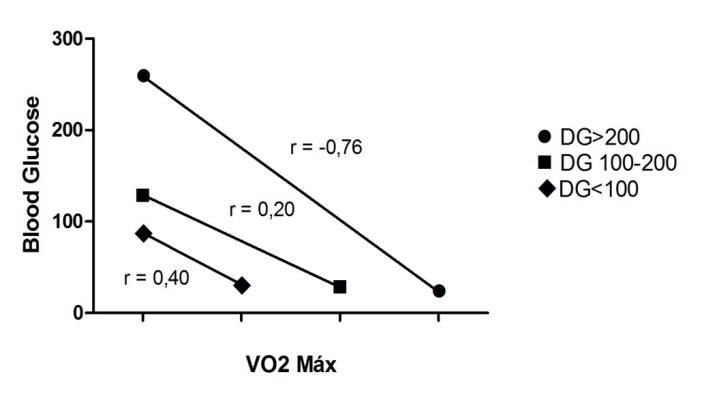
DG>200: Diabetic Group with capillary glycemia >200 mg/dL; DG 100-200: Diabetic Group with capillary glycemia between 100 mg/dL and 200 mg/dL; DG<100: Diabetic Group with capillary glycemia <100 mg/dL.
Conclusion
Elevated capillary glycemia levels correlate with the low VO2max values for this sample of type 2 diabetic patients, contributing to a weakened physical fitness favoring metabolic decompensation and sedentary lifestyle.
Copyright© Jonathan Nícolas dos Santos Ribeiro, et al.
References
-
The Expert Committee On The Diagnosis And Classification Of Diabetes Mellitus (2003) Report of the Expert Committee on the Diagnosis and Classification of Diabetes Mellitus. Diabetes Care 26(1): s5-s20.
-
Panzer C, Lauer MS, Brieke A, Blackstone E, Hoogwerf B (2002) Association of Fasting Plasma Glucose With Heart Rate Recovery in Healthy Adults A Population- Based Study. Diabetes 51(3): 803-807.
-
Leite SA, Monk AM, Upham PA, Bergenstal RM (2009) Low cardiorespiratory fitness in people at risk for Jonathan Nícolas dos Santos Ribeiro, et al. Relationship of Levels of Glycemia Capilar with the Maximum VO2 of Diabetic Patients Type 2 Submitted to the Ergometric Test. Diabetes Obes Int J 2019, 4(1): 000193. type 2 diabetes: early marker for insulin resistance. Diabetol Metab Syndr 1(1): 1-6.
-
Wajchenberg BL (2000) Subcutaneous and visceral adipose tissue: their relation to the metabolic syndrome. Endocrine Reviews 21(6): 697-738.
-
Regensteiner JG, Bauer TA, Reusch JB (2004) Rosiglitazona melhora a capacidade de exercício em diabetes tipo 2. Diabetes 52(S2): 1-8.
-
Hortensius J, Slingerland RJ, Kleefstra N, Logtenberg SJJ, Groenier KH, et al. (2011) Self-Monitoring of Blood Glucose: The Use of The First or The Second Drop of Blood. Diabetes Care 34(3): 556-560. Copyright© Jonathan Nícolas dos Santos Ribeiro, et al.
- Investigation of Polymorphisms in PPAR-Ɣ and TRHR Genes and their Impact on Turkish Diabetic and Obese Individuals
- The Impact of Aircraft Noise Exposure on the Efficacy of Empagliflozin Therapy in an Animal Model of Obesity
- Rooibos Mitigates Metabolic and Inflammatory Dysfunctions in Mice Fed a High-Carbohydrate Diet
- Synergistic Effect of Combined Leaf Extract of Vernonia amygdalina, Ocimum gratissimum, and Zingiber officinale Tuber on Phytochemical Profile, Antioxidant Activity, Serum Insulin, and Biochemical Parameters in Streptozotocin-Induced Diabetic Rats
- Investigation of Cardiovascular Responses to Aerobic Exercise in Obese University Students
- A Look at the Phase Angle Obtained by Electrical Bioimpedance