
Evaluation of the Viability of Probiotic Microorganisms in Microcapsules with Passion Fruit Pulp Resulting From the Ionic Gelation Process
One of the limiting factors of food probiotic microorganism’s addition consists in its viability. Several microencapsulation techniques were explored, the external ionic gelation proved to be viable in the preservation of probiotic cultures. The objective of this study was to evaluate the effect of the ionic gelation process of passion fruit pulp with probiotics, in order to verify the storage time of these products when submerged in their own pulp and packaged in glass containers submitted to storage refrigerated. The product submitted shelf life of 60 days and the microorganism showed feasibility during the entire period of storage studied. It is then emphasized the viability of the ionic gelification of the passion fruit pulp, as the microcapsules obtained in this process present nutritional characteristics similar to the passion fruit pulp.
Introduction
Functional foods have been of increasing concern to consumers concerned with quality of life and to maintain health, since these foods have proven clinical benefits to human health [1]. As an example, probiotic foods are the main responsible for the expansion of this market. The Food and Agriculture Organization (FAO) of the United Nations and the World Health Organization (WHO) define probiotics as live microorganisms that, when administered in adequate amounts, confer benefits to consumer health [2].
These microorganisms act in the regulation of flora and intestinal function, have been shown to have antimicrobial, anti-inflammatory and anti-osteoporotic activity, reduce weight gain, relieve clinical symptoms of lactose intolerance and reduce serum levels of glucose and total cholesterol [3, 4, 5]. The form of consumption of these products can be extended with the development of new products that allow their consumption on different occasions. In addition, the consumption of exotic fruits has great sensory acceptance due to its attractive flavor and aroma. In this context, passion fruit is a traditional fruit from the northeast region and with high acceptability, it is rich in bioactive compounds, minerals, carotenoids and vitamins C, widely consumed in the form of juices and pulps [6].
However, one of the limiting factors of the addition of probiotic microorganisms in a wide variety of foodstuffs is their viability, that is, to resist the intrinsic and extrinsic conditions to which they will be exposed, especially in the free form, without the protection of microcapsules [7]. Microencapsulation has been proposed as an effective means of protecting probiotics from degradation [8]. The external ionic gelation technique, because it is a mild method, does not confer risks to microbial viability, being a method widely used to microencapsulate probiotic cultures [9].
The microencapsulation process consists of covering tiny particles of ingredients with a material aiming at reducing the reactivity of the encapsulated material, in relation to the adverse conditions of the medium (such as light, oxygen and humidity); regulating the evaporation or the transfer rate of the encapsulated material to the medium; facilitate handling and control the release of the encapsulated material; sometimes mask undesirable flavors and also improve the homogenization of the encapsulated agent in some food preparations by dilution [10]. The gelled products currently have great prominence due to their sensorial characteristics that model the product in several different formats [9].
Based on the products obtained by the ionic gelation technique, this work aims to evaluate the effect on the ionic gelation process of passion fruit pulp with probiotics, in order to verify the storage time of these products when submerged in their own pulp and packaged in glass packagings subject to refrigerated storage 5±0.5°C.
The fruit pulp microcapsule with probiotic visually resembles spherical shaped caviar and in the center of the sphere will be the fruit pulp. This product contains versatility in application, being able to be applied in several drinks with the objective of migrating its bioactive components (phenols, vitamins and minerals), as well as the micro-encapsulated probiotic microorganisms with the pulp. This is a low-cost technology, being obtained through ionic gelling, using hydrocolloids that react with divalent cations to form a stable and resistant wall material. Gelling is a technique of molecular gastronomy and its products are served in restaurants. No published scientific studies on the process of obtaining these industrialized foods were found, which makes it original and with scientific interest.
Materials and Methods
Sample Preparation
The passion fruit pulp was prepared from the pulping process of fruit specimens, using the appropriate equipment for the extraction. The seeds with the pulp were removed from the bark, and then extracted to separate the pulp from the seeds. The passion fruit pulp was pasteurized and cooled pasteurized at 60°C for 30 minutes and stored under refrigeration at 5 ± 0.5°C. The probiotic culture used in this experiment was Lactobacillus acidophilus from the Prolive brand, owned by the company Aché - Laboratórios Farmacêuticos (Guarulhos, Brazil). The culture was dissolved in the passion fruit pulp. The final pulp concentration was complying with the legislation of ANVISA 109 UFC/g [11]. Samples were taken for microbiological analysis.
Obtaining the Passion Fruit Microcapsules with Probiotics
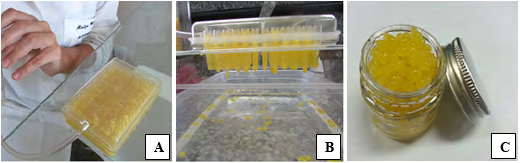
Passion fruit capsules were obtained by the ionic gelation process of the passion fruit pulp. For the ionic gelation process, the drip methodology was used with Caviar Box kit, where two solutions were used:
- Solution (1): a solution composed of sodium alginate and passion fruit pulp (1:50), a homogenizer was used to prepare this solution. After homogenization the solution was poured into the tray of the caviar boxer kit.
- Solution (2): an aqueous solution with a concentration of 1% of calcium chloride.
The solution (1) was sucked by the vacuum caused by the syringe which causes the solution 1 to penetrate into the nozzles of the upper tray of the caviar boxer kit and with the aid of the pressure exerted by the syringe was dripped onto the solution (2). The beads formed were drained and immersed in a container of passion fruit juice for the removal of some residue from solution 2. After washing, the microcapsules were placed in 30g glass packs immersed in passion fruit juice. The ionic gelation process can be seen in Figure 1.
Analyzes of Parameters Physicochemical
To determine the pH, the potentiometric method was used directly on the sample, where 10 g of the sample were diluted in 100 mL of distilled water. The mixture was then homogenized and placed in contact with the pH meter bulb, previously calibrated with buffer solution 4.7 following the methodology of IAL [12]. The total soluble solids (SST) were determined using the Abbé bench refractometer, according to the IAL (2005) method. For this, 3 to 4 drops of the homogenised sample were transferred to the prism of the refractometer duly calibrated with distilled water and the reading was carried out. SST were expressed as °Brix. The total acidity was determined by titration, using 10 g of the diluted sample in 100 ml of water, adding 3 drops of the 1% phenolphthalein indicator with standard solution of 0.1 N NaOH, with the results expressed as % citric acid. The determination of vitamin C was performed according to the method AOAC [13], modified by Benassi & Antunes [14] in which it replaces the solution of extraction of metaphosphoric acid by oxalic acid. The carotenoid contents were evaluated following the method proposed by Lichterenthal [15], with the contents expressed in μg / g.
Microbiological Parameters
Analysis of Total and Thermotolerant Coliforms (presumptive test) were performed in a series of three tubes containing Lauryl Sulfate Triptose Broth (LST), incubated in a 35ºC oven for 48 hours. Positive growth broth tubes were seeded with a platinum loop in Brilliant Bile Broth (VB) with Durhan tubes and incubated at 35°C for 48 hours for the confirmation of total coliforms and for (AU), and incubated in a water bath at 45°C±0.5°C for 24 hours [16]. Yeast and Mold Counts were by inoculation of 0.1 ml of each of the dilutions carried out in sterile petri dishes containing 15 to 20 ml of the appropriately acidified Potato Dextrose Agar (PDA) medium The plates were incubated in an oven at 25°C for 3 to 5 days for counting the colonies [16]. Lactic Bacteria Counts were aimed at verifying the viability of the probiotic microorganisms present in the passion fruit pulp and in the capsules. These were performed in triplicate at the Laboratory of Microbiological Analysis of the Food Technology Department of the Federal University of Sergipe using the Lactobacillus MRS Agar (Himedia, Mumbai, India), according to the methodology described by Silva, et al. [17] in different storage periods of the capsules (7,14,21,28 and 35 days) at 5°C in refrigerator, and incubated at 37°C.
Statistical parameters
The data were submitted to Analysis of Variance (ANOVA), to the Tukey Test at the 5% level of significance using the statistical program Statistical Analysis System (SAS).
Results and Discussion
Parameters Physicochemical
Table 1 presents the results of the physicochemical analysis of the passion fruit pulp (passiflora edulis) used in the microcapsule processing and also the physico-chemical results of the microcapsules for comparison of the changes occurred after processing. The pH of the pulp found in this study was 2.96, corroborating according to Herrera‑Ramirez, et al. [18] and De Farias Silva, et al. [19] who found values of 2.99 and 2.82 respectively. It was verified that the pulp had a smaller value of pH than the microcapsules (3.87), due to the adjustment of the pH carried out in the pulp with sodium citrate in order to carry out the ionic gelling reaction, since the sodium alginate reagent forms the coating film in pulps with a pH of above 3.6.
| Parameters | Passion fruit pulp | Passion fruit microcapsule |
|---|---|---|
| pH | 2.96 ± 0.17a | 3.87 ± 0.17b |
| Total acidity (g Citric acid /100g) | 2.53 ± 0.19a | 2.26 ± 0.19b |
| Ascorbic acid (mg/100g) | 20.94 ± 0.22 a | 16.23 ± 0.22 b |
| Soluble Solids (oBrix) | 11.80 ± 0.57a | 7.60 ± 0.57b |
| Total Carotenoids (µg /g) | 15.57 ± 0.03 a | 16.87 ± 0.03 a |
| Phenols (mg gallic acid/100g) | 34.30 ± 0.63 a | 20.43 ± 0.63 b |
| Flavonoids (mg Quercetin/100g) | 2.43 ± 0.03 a | 1.05 ± 0.03 a |
Table 1: Physicochemical characterization of the passion fruit pulp and of the passion fruit microcapsules processed.
The citrus acid value found in the pulp was 2.53 g of citric acid / 100 g (Table 1), being within the quality standards required by current legislation [20]. To perform the ionic gelation, an adjustment was made in the pH of the pulp, where sodium citrate was used and the citric acid value found after adjustment was 1.90 g citric acid / 100 g. Sodium citrate is a food additive used in the juice industry as a regulator of acidity and favors the effective reduction in acidity content, which is the minimum value required in the tables of identity and quality standards indicated by the current legislation [21]. After the ionic gelation a small decrease in acidity is observed, but it does not differ significantly from the value found in the juice.
The value found in this study for the °Brix was 11.80 (Table 1) values below that found in the studies of Klein [22] and Herrera‑Ramirez, et al. [18], 14.6 and 15.17, respectively. As used has been acquired in a pulp agroindustry it is normal to find pulps that possess soluble solids content with values close to those required by the legislation, the fit of soluble solids is carried out in the industries for obtaining higher pulp yields and maintain the standard of quality and yield of product juice for the consumer. The pulp had a higher soluble solids value than the microcapsules.
The content of ascorbic acid in the passion fruit pulp evaluated in this study was 23.94 mg / 100 g, higher than the minimum value obtained by Zhang, et al. [23]. Analyzing the Effect of Antibacterial Film PLA / PBAT on the Quality of Passion Fruit Storage, the authors found vitamin C content in passion fruit of 15 mg / 100 g. However, less than when compared to the Brazilian food composition table-Taco [24], which has a value of 30 mg / 100 g of vitamin C in the passion fruit pulp. When compared to vitamin C levels of the passion fruit pulp with the microcapsules (Table 1), it is observed that there have been decreases in the vitamin C. Ascorbic acid content is the vitamin that degrades more easily by comparing itself to other vitamins. It is stable only in acid medium, in the absence of light, oxygen and heat, being that the factors that favor its degradation are the alkali means, oxygen, heat, action of light, metals such as Fe, Cu and Zn, and the oxidase enzyme of ascorbic acid [25].
The total carotenoid content of the pulp was 15.57 μg/g (Table 1), however the carotenoid values between the passion fruit pulp and the microcapsules did not differ significantly. Silva, et al. [26] in their studies with watermelon pulp gelling, observed that the carotenoid content in the gelled product was lower than in the watermelon pulp.
The content of phenolic compounds found in this study for passion fruit pulp was 34.30 mg gallic acid / 100 g, and 2.43 mg quercetin/100 g to flavonoid content (Table 1). Cohen [27] in their studies on the quantification of flavonoids in passion fruit species observed 3.34 mg of ac. Gallic / 100 g. The phenolic content found in passion fruit microcapsules was 20.43 mg gallic acid / 100 g, which is statistically lower (at a 95% probability level) than that of passion fruit pulp, while to the flavonoid was 1.05 mg quercetin / 100 g, meaning reduction of bioactive compounds occurred due to degradation of these components during the pasteurization process (Table 1).
Data expressed on wet basis. Means followed by the same letter in the line do not differ from one another by the t test at the 5% probability level.
The results of the physicochemical analyzes of passion fruit microcapsules stored in glass packaging are presented in the Tables 2-5. Thus, Table 2 shows the pH values during the storage period of 60 days. In the storage periods from 0 to 30 days no sharp oscillations were observed in the pH values, not differing significantly. According to Reis, et al. [28] this trend is due to the buffering effect of the cellular fluid that does not allow wide variations of pH.
| Time (Days) | ||||||
|---|---|---|---|---|---|---|
| 0 | 7 | 15 | 30 | 45 | 60 | |
| pH | 3.87±0.33a | 3.87±0.33a | 3.90±0.33a | 3.92±0.33a | 4.15±0.33b | 4.50±0.33c |
| Acidity | 0.55±0.01a | 0.46±0.01ab | 0.42±0.01b | 0.42±0.01b | 0.40±0.01b | 0.36±0.01c |
| Acid Ascorbic | 16.23±3.70a | 16.20±3.70a | 15.96±3.70a | 15.23±3.70a | 14.54±3.70a | 14.48±3.70a |
| Carotenoids | 16.87±3.26a | 16.78±3.26a | 16.17±3.26a | 16.09±3.26ab | 15.80±3.26b | 15.78±3.26b |
| Phenols | 20.43±0.63a | 20.41±0.63a | 18.86±0.63b | 15.67±0.63c | 14.64±0.63cd | 13.96± 0.63d |
Table 2: pH values of passion fruit microcapsules with probiotics stored at 5 ± 0.5°C for 60 days in glass containers.
Averages followed by the same letter on the line, do not differ with each other by the t test at the 5% probability level.
| Samples | Time (Days) | |||||
|---|---|---|---|---|---|---|
| Molds and yeasts (UFC. g/l) | ||||||
| 0 | 7 | 15 | 30 | 45 | 60 | |
| passion fruit microcapsule with probiotics | <10 | <10 | 1.0x10a | 1.2x10a | 2.7x10²b | 4.2x10³c |
| passion fruit microcapsule without probiotics | <10 | 1.4x10a | 2.8x10²b | 5.7x10³c | -- | -- |
| Limit established by Brazilian Law * | 5.0 x10³ | |||||
| Samples | Time (Days) | |||||
| Total Lactobacillus (UFC. g/l) | ||||||
| 0 | 15 | 30 | 45 | 60 | ||
| passion fruit microcapsule with probiotics | 4.2x10⁹a | 2.4x10⁹a | 1.2x10⁹a | 3.8x10⁸b | 1.7x10⁷c | |
| Limit established by Brazilian Law * | 108-109 |
Table 3: Results obtained in the microbiological analysis of the passion fruit microcapsules, with and without probiotic, conditi
Averages followed by the same letter on the line, do not differ with each other by the t test at the 5% probability level. * Resolution RDC No. 02 of January 2, 2001 [29].
Table 4: Results obtained in the analysis of viable cells of total Lactobacillus of passion fruit microcapsules with probiotic conditioned in glass packaging under refrigeration for 60 days.
Averages followed by the same letter on the line, do not differ with each other by the t test at the 5% probability level. *Resolution RDC No. 02 of January 2, 2001 [29].
| Storage (days) | Passion fruit microcapsule (UFC/g) | Passion fruit juice (UFC/g) |
|---|---|---|
| 0 | 4.2x10⁹ | absent |
| 15 | 2.8x10⁹ | 1.9x10² |
| 30 | 3.8x10⁸ | 3.2x10² |
| 45 | 3.2x10⁸ | 2.4x10² |
| 60 | 2.4x10⁷ | 1.2x10² |
Table 4: Study of the migration of probiotic microorganisms from passion fruit microcapsules to passion fruit juice 5 ± 0.5°C in
It was observed an increase in the pH value from the 45th day of storage, differing significantly from the other samples, totaling an increase of 16.87% until the 60th day of storage and influencing in the shelf life of the product, since it decreases the resistance against microbial action. For the titratable acidity content it was observed a reduction of 34.54% in relation to the initial content (Table 2).
However, no significant decrease in pH and / or increase in total titratable acidity were observed in all the refrigerated storage of the samples, indicating that even the microencapsulated cells of the probiotic culture had low metabolic activity up to the 30th day of storage (Table 2). The results obtained, demonstrate how efficient out the refrigeration process in maintaining the pH values along the storage. Chitarra & Chitarra [30] state that in a range of acid concentration between 0.5 and 2.5%, the pH increases with the reduction of acidity and that this small variation in the pH is well detectable in the sensory tests.
On the other hand, Ding & Shah [31] observed a mean pH decreased from 2.81 to 2.57 in orange juice containing probiotic of free bacteria after six weeks of storage, while the pH remained almost the same in orange juice containing probiotics encapsulated after the time of storage. When was evaluated apple juice, the probiotic culture tested reduced the pH of the juice regardless of whether it was in the free or encapsulated state. However, at the end of six weeks of storage, the final pH of the juice apple inoculated with encapsulated probiotic bacteria was higher than that inoculated with probiotic of free bacteria [32].
During the storage period, the ascorbic acid content was reduced in the product, but there was no significant difference between the samples. Regarding the vitamin C content, it was found that losses occurred during the storage period of 10.78% (Table 2). Vitamin C degradation during storage is justified because ascorbic acid undergoes heat degradation, oxidation, desiccation, storage, cold application and alkalinity of the medium [33].
The loss of ascorbic acid content can be attributed as a result of the incorporation of air during the processing stages, which favor aerobic degradation reactions, as well as storage temperature [34] due to the different types of equipment used during the process and / or by the chemical oxidation of ascorbic acid and / or thermal degradation through pasteurization [35].
With respect to the total carotenoid contents, in this research, it was possible to verify that although with a small significant difference obtained over the storage time this low reduction can be justified by the fact that when using low temperatures, less thermal degradation of the carotenoids occurs, as the same are very sensitive to heat and oxidation due to their unsaturated chemical structure [36]. It was noted that passion fruit microcapsules stored in glass packaging had a loss of total carotenoids of 6.46% (Table 2).
According to the analysis of variance, there was no significant effect (p <0.05) on total phenolic content in passion fruit microcapsules during the first days of storage, and Table 2 shows significant decreases in total phenolics occurring after the 15th day storage. The average results did not reduce during the first days of storage of 20.43 mg gallic acid/100 g. Chu, et al. [37] concluded that for the phenolic compounds the antioxidant activity, measured by means of the sequester activity of 1.1-difphenyl-2-picril-hydrazyl (DPPH) radicals, from the reduction power and inhibition of linoleic acid oxidation, was best preserved at refrigerated storage conditions.
Microbiological Parameters
The pulp used as raw material for the production of passion fruit capsules presented microbiological compliance, that is, it did not present contamination by thermotolerant coliforms and total coliforms, it was also verified absence of salmonella. The pulp inoculation with lactic acid bacteria (Lactobacillus Acidophilus) was carried out in accordance with RDC 12 [29]. The pulp was inoculated with lactic acid bacteria and the application of the ionic gelation process, quality control analyses were again carried out to ensure the sanity of the final product, as well as the analysis of acid-lactic acid bacteria to verify that the product possessed probiotic characteristics as recommended by the ANVISA Legislation [29], as shown in Tables 3 and 4.
Table 3 compares the results of the microbiological analyzes performed between the passion fruit microcapsules with probiotics and the passion fruit microcapsules without the microorganisms. Passion fruit microcapsules with probiotics presented better performance in microbiological conservation. Probiotic microorganisms in this study present microbiological efficiency once they have an antimicrobial activity that inhibits or retard the development of other microorganisms in the medium, resulting in a functional product with longer shelf life. It can be seen in Table 3 that all samples up to the 30th day did not present mold and yeast contamination, according to the requirements of the Brazilian Legislation, RDC nº12 [29]. Samples of passion fruit pulp microcapsules with probiotics began to show higher contamination from 45th day of the stored samples showed contamination.
The cell viability of the probiotic culture added in the passion fruit microcapsules was monitored during refrigerated storage and the results are reported in Table 4.
It is verified that, throughout the storage, the cell viability in the microencapsulated form decreased until the 60th day. During the first 30 days, no logarithmic reduction of the cells was observed, from 45º day of storage until the end of the storage period (60 days) the reduction became more pronounced and was more evident in the control presenting significant differences (P > 0.05) in cell viability.
The survival of free and microencapsulated probiotic bacteria in orange and apple juices, using eight different strains of probiotic bacteria were investigated by Ding & Shah [31]. Encapsulated probiotic bacteria survived in fruit juices for six weeks of storage (> 105 CFU / mL), while free probiotic bacteria lost their viability in five weeks (not viable remaining bacteria). In this study, the bacteria were viable for more than 8 weeks.
In Table 5, the migration of the probiotic microorganism from the passion fruit microcapsule to the passion fruit juice can also be observed. On the 30th day a reduction of colony forming units in the passion fruit pulp capsule and an increase of these microorganisms can be observed in the passion fruit juice that can be observed until the 60th day of storage. The product retains the probiotic product characteristic up to the storage period studied, showing the viability of the encapsulation process by ionic gelation in the encapsulation and maintenance of probiotic microorganism viability at the end of shelf life.
For probiotic-containing foods, the final product should have a half-life ranging from 15 to 30 days, Brazilian legislation states that the minimum viable quantity for probiotics should be in the range of 108 to 109 UFC [11]. Studies have shown that temperature is critical for microbial survival during storage, and higher survival rates are obtained at low storage temperatures [38, 39], which corroborates the present results, where refrigerated storage ensured the maintenance of cell viability of the cultures encapsulated by ionic gelation over time.
Conclusion
The results obtained from the use of the ionic gelation process of the passion fruit pulp with probiotics, allow concluding that in some parameters of the physicochemical analysis of the recently processed passion fruit microcapsule presented significant difference when compared to the fresh passion fruit pulp. Microcapsules stored in glass containers had a shelf life of 45 days at 5°C. Probiotic microorganisms showed viability up to 60 days of refrigerated storage at 5°C. During the storage period, it was observed that the carotenoid, °Brix and vitamin C contents did not present significant differences in the time. The present work showed the viability of ionic gelation of passion fruit pulp and probiotic microorganisms, since the microcapsules obtained in this process also have similar nutritional characteristics to passion fruit pulp.
Acknowledgements
The authors acknowledge financial assistance from the Brazilian research funding agencies as CAPES (Coordination for the Improvement of Higher Education Personnel) under Finance Code 001, a Brazilian foundation within the Ministry of Education (MEC), CNPq (National Council for Scientific and Technological Development), a Brazilian foundation associated to the Ministry of Science and Technology (MCT), and FAPITEC/SE (the Foundation of Support to Research and Technological Innovation of the State of Sergipe).
References
-
Oliveira A, Amaro AL, Pintado M (2018) Impact of food matrix components on nutritional and functional properties of fruit-based products. Curr Opin Food Sci 22: 153-159.
-
FAO (2001) Food and Agricultural Organization of the United Nations and World Health Organization. Health and nutritional properties of probiotics in food including powder milk with live lactic acid bacteria.
-
Oak SJ, Jha R (2018) The effects of probiotics in lactose intolerance: A systematic review. Crit Rev Food Sci 59(11): 1675-1683.
-
Lee CS, Kim SH (2019) Anti-inflammatory and Anti- osteoporotic Potential of Lactobacillus plantarum A41 and L. fermentum SRK414 as Probiotics. Probiotics Antimicro.
-
Zommiti M, Chikindas ML, Ferchic M (2019) Probiotics- live biotherapeutics: A story of success, limitations, and future prospects-not only for humans. Probiotics Antimicro 12(3): 1266-1289.
-
Rhind JP, Law G (2018) Cooking for the senses: vegan neurogastronomy. (Single Edition). Scotland: Singin Gragon.
-
Menezes MFSC, Rodrigues LZ, Cavalheiro CP, Etchepare MA, Menezes CR (2015) Microencapsulation of probiotics by external ion gelation using pectin. Special Ed. Nano and Microencapsulation of bioactive and probiotic compounds in food. J Sci Nat 37: 30-37.
-
Sipailiene A, Petraityte S (2017) Encapsulation of Probiotics: Proper Selection of the Probiotic Strain and the Influence of Encapsulation Technology and Materials on the Viability of Encapsulated Microorganisms. Probiotics Antimicro 10(1): 1-10.
-
Krasaekoopt W, Bhandari B, Deeth H (2004) Evaluation of encapsulation techniques of probiotics for yoghurt. Int. Dairy J 13(1): 3-13.
-
Nedovic V, Kalusevic A, Manojlovic V, Levic S, Bugarski B (2011) An overview of encapsulation technologies for food applications. Procedia Food Sci 1: 1806-1815.
-
Brasil (2002) Technical Regulation of Isolated Bioactive and Probiotic Substances with Allegation of Functional and or Health Properties. RDC ANVISA.
-
Adolfo Lutz Institute (2005) Analytical Standards of the Adolfo Lutz Institute, 3rd (Edn.), Sao Paulo: IAL.
-
AOAC (1984) Official methods of analysis of the Association of Official Analytical Chemists. Arlington, pp: 1141.
-
Benassi MT, Antunes AJ (1988) A comparison of meta- phosphoric and oxalic acids as extractant solutions for the determination of vitamin C in selected vegetables. Arq Biol Tecnol 31(4): 507-513.
-
Lichtenthaler HK (1987) Chlorophylls and carot- enoids: pigments of photosynthetic biomembranes. In: Packer L, Douce R (Eds.), Methods Enzymol. Bad Honnef : Academic 148: 350-382.
-
Silva N, Junqueira VCA, Silveira NFA (1997) Manual of methods of microbiological analysis of foods. São Paulo: Varela, pp: 295.
-
Silva N, Junqueira VCA, Silveira NFA (2007) Lactic Bacterial Count. In: Silva N (Ed.), Manual of methods of microbiological analysis of foods. 3rd (Edn.), Sao Paulo: Varela 14: 183-189.
-
Herrera Ramirez J, Meneses‑Marentes N, Díaz MPT (2020) Optimizing the extraction of anthocyanins from purple passion fruit peel using response surface methodology. J Food Meas Charact 14(1): 185-193.
-
De Farias SCE, Da Silva ICC, Abud AKS (2015) Acidulants in tropical fruit pulp: Physicochemical and sensory changes. Chem Eng Trans 44: 109-114.
-
Brasil (2000) Normative Instruction No. 01 of January 7, 2000. General Technical Regulation for Setting Identity and Quality Standards for Fruit Pulp. Official Gazette of the Federative Republic of Brazil, Brasilia.
-
Brasil (2013) National Health Surveillance Agency. Technical regulation of the use of food additives for fruit and vegetable products and mocotó jelly. Official Journal of the Union. Federative Republic of Brazil. ANVISA, Resolution RDC.
-
Klein AM, Vaissière BE, Cane JH, Dewenter IS, Cunningham SA, et al. (2007) Importance of pollinators in changing landscapes for world crops. Proc R Soc B 274: 303-313.
-
Zhang R, Lan W, Ding J, Ahmed S, Qin W, et al. (2019) Effect of PLA/PBAT antibacterial film on storage quality of passion fruit during the shelf-life. Molecules 24(18): 3378.
-
Brazilian Food Composition Table (2011) Campinas, 4th (Edn.), NEPA-UNICAMP, pp: 161.
-
Oliveira MEB, Bastos MSR, Feitosa T, Branco MAC, Silva MGG (1999) Evaluation of physico-chemical quality parameters of frozen pulp of acerola, cajá and cashew. Food Sci Technol 19(3).
-
Silva DF, Favaro Trindade CS, Rocha GA, Thomazini M (2012) Microencapsulation of lycopene by gelatin- pectin complex coacervation. J food process. preserv 36: 185-190.
-
Cohen KO, Tupinambá DD, Costa AM, Junqueira NTV, Faleiro FG, et al. (2008) Phenolic Compounds and Vitamin C in Pulp Extracted from Fruits of the Passion Fruit Hybrid BRS Ouro Vermelho. Embrapa, Planaltina.
-
Reis KC, Elias HHS, Lima LCO, Silva JDS, Pereira J (2006) Japanese cucumber (Cucumis sativus L.) subjected to cassava starch treatment. Sci Agrotec 30(3): 487-493.
-
Brasil (2001) Ministry of Health, National Health Surveillance Agency (ANVISA), RDC Resolution No. 12 of January 2, 2001. Technical Regulation on Microbiological Patterns for Food. Official Journal. Brasília, DF. Brazil. Ministry of Agriculture and Supply. Secretariat of Agricultural Defense. Department of Inspection of Animal Products. Identity and Quality Standards (PIQ) of Fermented Milk.
-
Chitarra MIF, Chitarra AB (2005) Post-harvest of fruits and vegetables: physiology and handling. Lavras: ESAL, pp: 783.
-
Ding WK, Shah NP (2008) Survival of free and microencapsulated probiotic bacteria in orange and apple juice. Int Food Res J 15(2): 219-232.
-
Antunes AEC, Liserre AM, Coelho ALA, Menezes CR, Moreno I, et al. (2013) Acerola nectar with added microencapsulated probiotic. Lwt-Food Science and Technology 54(1): 125-131.
-
Franco LL (1996) The sensational 50 medicinal plants- champions of healing power, Curitiba: Editora Santa Mônica.
-
Yamashita F, Benassi MT, Tonzar AC, Moriya S, Fernandes JG (2003) Products of acerola: study of the stability of vitamin C. Cienc Tecnol Aliment 23(1): 92-94.
-
Maia GA, Ritter UG, Figueiredo RW, Oliveira GSF, Gaspar Júnior JC, et al. (2003) Obtaining and evaluation of acerola-based low-calorie drink (Malpighia emarginata D.C.) Agro Sci Mag Fortaleza 34(2): 233-240.
-
Kandansamy K, Somasundaram PD (2012) Microencapsulation of colors by spray drying-a review. Int J Food Eng 8(2): 17.
-
Chu YH, Chang CL, Hsu HF (2000) Flavonoid content of several vegetables and their antioxidant activity. J Sci Food Agric 80(5): 561-566.
-
Johnson JAC, Etzel MR (1993) Inactivation of lactic acid bacteria during spray drying. In Barbosa-Canovas GV, (Eds.), Food dehydration. Institute of Chemical Engineering, pp: 98-107.
-
Gardiner GE, Sullivan OE, Kelly J, Auty MA, Fitzgerald GF, et al. (2000) Comparative survival rates of human- derived probiotic Lactobacillus paracasei and L. salivarius strains during heat treatment and spray drying. Appl Environ Microbiol 66: 2605-2612.
- The Role of Podocyte Apoptosis and the Involvement of SIRT1 in Diabetic Nephropathy
- Dealcoholization of Beer by Osmotic Distillation for the Beverage Industry
- Biopolymer-Based Edible Packaging- Biomaterials, Methods, and Applications in Food Industry: An Updated Review
- Influence of Bioprocessing Methods on 'China Rice' (Gawal R1), and Soyabean Supplementation on the Quality of Complementary Food
- Cassava (Manihot esculenta) Varietal Growth, Yield and Cyanide Content Performance in Three Sites in the South- Eastern Semi Arid Regions of Kenya
- Food Waste Treatment, Recycling, Management and Production of Value-Products-An Update on Methodologies and Current Trends