
Determination of Aflatoxins in Dried Fruits of Afghanistan
Aflatoxins are carcinogenic and toxic to human beings. In this research work, the amount of aflatoxins contamination in seventy-two samples of dried fruits; Such as; Almonds and Raisins from processed raisins and almonds in Kabul city and Kabul customs, including twenty-one sample of almonds with shells, seven samples of pistachios with shells, six samples of almonds without shells, ten samples of pistachios without shells and twenty-eight samples of red raisins by using fluorometer is determined. Quantitative results show that 15 samples have 4 or less than 4 ppb aflatoxin, 21 samples have 5-10 ppb aflatoxin and the rest 35 samples have 10-25 ppb of aflatoxin. Similarly, in 27 samples of the almond amount of aflatoxins has been investigated, in all almond samples under investigation, none of the samples contained more than 22 ppb aflatoxin, which could be used as food. Ten samples are containing 4 ppb and less aflatoxin. Factors that play a role in the production of aflatoxins in almonds include Moisture, heat, microscopic effects of insects and organisms, storage time of almonds, infection shield and some other conditions. From the study, it was concluded that a continuous and strict national monitoring plan is needed to improve quality and safety of dried fruits supply in Afghanistan.
Introduction
Dried fruits have become an essential part of food. Healthy life style needs provision of safe and good quality food. But unfortunately, food can be easily contaminated through the environment. Aflatoxins are toxic carcinogenic secondary metabolites produced by two type of fungi called Aspergillus parasiticus and Aspergillus flavus [1, 2].
Mycotoxins are a type of chemical citrus that fungi (a type of fungus) produce it in the high growth stage on food; Such as grains of beans, peanuts, seeds of cotton, etc [3]. When foods contaminated with mycotoxins, including aflatoxins, are consumed by humans and animals they cause severe adverse health effects. Although a hundred years ago the health effects of spotted seeds caused by mycotoxins were known and the diseases caused by such seeds were partially exposed; in 1961, more information was provided about the adverse effects of aflatoxins, and the diseases caused by them were identified such as cancer of the liver and kidney etc. that are caused by aflatoxins (specifically aflatoxins mycotoxins B1) has been diagnosed, therefore; for eradication of mycotoxins and specifically aflatoxins, the attention of the international community has been paid and the export and import restrictions of food have been created between the countries of the world [4, 5].
Our country Afghanistan, which is also one of the countries that export fruits and food and imports some of them, needs to study and research food in terms of mycotoxins; Therefore, it is necessary to identify effective ways and methods of research for determining amount of aflatoxins and methods to destroy the source of aflatoxins. Unfortunately, in Afghanistan not much work has been done so far [5, 6].
Foods that are more contaminated by aflatoxins include various grains (wheat, corn, white rice, rice, mung bean, etc.), fruits (whole grains, seedless raisins, dates, etc.) Dairy products (yogurt, cheese, milk), baby food, medicines, etc [7, 8].
Aflatoxins are potent toxins and are carcinogenic agents, mitochondria, amino suppressants, which are the second metabolic product of Sparagillus yellow and Sparagillus parasiticus in various food products. Approximately 18 different types of aflatoxins have been known, the most important of which are: G1, G2 B1, B2 M1, and M2. Aflatoxin Aflatoxins M1 and M2 are more highly metabolic than aflatoxins B1 and B2. Animal milk, which is more commonly used as food, is contaminated by aflatoxins, physical properties of some aflatoxins are given in Table 1 [13].
B1 is present in adequate amounts in food products and its pure amount has a solid crystalline yellowish-white color. Aflatoxins are well soluble in methanol, acetone, chloroform, and acetonitrile. Asparagus yellow products are specifically aflatoxins B1 and B2 [9, 10]. Asparagus parasiticus aflatoxin, which is better than their B1 and B2 products. The four aflatoxins G1, B2, M1, and M2 may each be obtained separately from aspergillus yellow and asparagus parasiticus to a lesser extent than the other aflatoxins. As well as other aflatoxins; Such as M1, G1, parasitcol, and aflatoxicol are also among the products of asparagus yellow [11, 12].
| Optical reflection | Melting point | Molecular mass | Molecular Formula | Aflatoxins |
|---|---|---|---|---|
| B 1 | C H O 17 12 6 | 312 | 262 −2690C | Blue |
| B 2 | C H O 17 14 6 | 314 | 286 −289oC | Blue |
| G 1 | C H O 17 12 7 | 328 | 244 −248oC | Green |
| G 2 | C H O 17 14 7 | 330 | 237 −240oC | Green-Blue |
| M 1 | C H O 17 12 7 | 328 | 299oC | Blue-Purple |
| M 2 | C H O 17 12 7 | 330 | 293oC | Purple |
| B A 2 | C H O 17 114 7 | 330 | 240oC | - |
| G A 2 | C H O 17 14 8 | 190oC | - |
Table 1: Some physical properties of aflatoxins.
Aflatoxins are present in different concentrations in food, which are received in different quantities in food of different countries of the world depending on the environmental conditions, and generally, in countries with temperate climates, their growth and development are high [4].
In the international trade of dried fruits, nuts, legumes, wheat, barley, corn, etc., foodstuffs are exported and imported if they contain a certain amount of aflatoxin not only food-exporting countries have problems with high-dose aflatoxins, but their importing countries also face similar problems [1].
The European Community has established the norm for the repatriation of fruits and foodstuffs that contains aflatoxins in large quantities which are not accepted by them commercially as they contain excess of aflatoxins Table 2 [14].
| Number | countries | Group | Material | Amount of aflatoxin allowed | Considerations |
|---|---|---|---|---|---|
| 1 | Belgian | First | of all foods | 4ppb | European Commission Rules |
| 2 | Czechoslovakia | First | peanut | 5ppb | |
| 3 | Finland | First | Nuts and its products | 4ppb | |
| 4 | France | First | all food | 4ppb | |
| 5 | German | First | peanuts and all food | 5ppb | |
| 6 | Logranburg | First | all food | 5ppb | |
| 7 | Maldives | First | Peanuts | 5ppb | |
| 8 | Halind | First | Peanuts and all Food | 5ppb | |
| 9 | Norway | First | All food | 5ppb | |
| 10 | Polish | First | Top All Foods | 5ppb | |
| 11 | South Africa | First | all food | 5ppb | |
| 12 | Sorniam | First | Peanut and its products | 5ppb | |
| 13 | Sweden | First | all food | 5ppb | |
| 14 | Swisserland | First | Nuts and its products | 5ppb | |
| 15 | Russia | First | all food | 5ppb | |
| 16 | UK | First | Nuts and its products | 5ppb | Regulation of the European Committee |
| 17 | First | First | Peanuts | 5ppb | |
| 18 | Colombia | Second | Peanuts | 10 ppb | |
| 19 | Denmark | Second | Peanuts and Bob food | 10 ppb | Regulation of the European Committee |
| 20 | Japan | Second | Peanuts | 10 ppb | |
| 21 | Singapore | Second | Peanut Vetil | 10 ppb | |
| 22 | United States | Second | All food | 10 ppb | |
| 23 | Australia | Third | Peanut and its crop | 15 ppb | |
| 24 | Canada | Third | Peanut and its product | 15 ppb | |
| 25 | Jordan | Third | all food | 15 ppb | Export regulations |
| 26 | Hankang | Third | all food | 15 ppb | Regulation of the European Committee |
| 27 | Greece | Fourth | All food | 20 ppb | Regulation of the European Committee |
| 28 | Ireland | Fourth | All Foods | 20 ppb | Export regulations |
| 29 | Israel | Fourth | All Foods | 20 ppb | |
| 30 | Kenya | Fourth | Peanut | 20 ppb | |
| 31 | Philippines | Fourth | Peanut | 20 ppb | |
| 32 | Thailand | Fourth | edible oil | 20 ppb | |
| 33 | Zombabi | Fifth | Peanut | 25 ppb | |
| 34 | Styria | Fifth | All foods | 50 ppb | |
| 35 | Brazil | Fifth | Flour and Peanuts | 50 ppb | Export regulations |
| 36 | Italy | Fifth | Bob Food | 50 ppb | Regulation of the World Health Organization |
| 37 | China | Fifth | Peanut | 50 ppb | |
| 38 | India | Fifth | all food | 60 ppb |
Table 2: The amount of aflatoxins in food products according to the norm of the European Union.
Material and Method
Collection of Samples
In this study, seventy-two samples of dried fruits; Such as: Pistachios, Almonds and Raisins from processed raisins and almonds in Kabul city and Kabul customs, including twenty-one samples of almonds with shells, seven samples of pistachios with shells, six samples of almonds without shells, Ten samples of pistachios without shells and twenty-eight samples of red raisins during the period from June 2020 to February 2021 were obtained and all 72 samples were subjected to determinations of aflatoxins.
Obtained substance samples represent the set of materials under study for aflatoxin therefore, it is necessary to take samples from all parts of the material, for this purpose, the main lots or container should be emptied in a suitable place and its materials should be mixed. Warehouses should be divided into sub-warehouses (Table 3) the weight of each sub-warehouse should be 20% of the weight of the main warehouse. Obtained samples should be located in separate locations. Use plastic bags to transfer the amount of samples. Laboratory Standard Sample: A sub-sample weighing 10 kg shall be mixed and blended in accordance with the provisions of the 1998 (EC-53) Commission.
| Warehouse weight per ton | Number of initial samples | Number of sub-samples |
|---|---|---|
| 0.1 and more | 10 samples | 3kg |
| 0.1-0.2 | 15 samples | 4.5kg |
| 0.2-0.5 | 20 samples | 7kg |
| 0.1-0.5 | 30 samples | 8kg |
| 1-2 | 40 samples | 12kg |
| 2-5 | 80 samples | 18kg |
| 5-10 | 80 samples | 24kg |
| 10-15 | 80 samples | 30kg |
Table 3: Number of initial samples taken from dried fruits.
Aflatoxins are light-sensitive; therefore, the exposure of the samples and the sample extracts to direct light was avoided before the preparation steps. First of all, the samples were divided to subsamples according to Table 3 and were ground as finely as possible to produce a homogeneous particle size by means of a high-speed blender [15].
Chemical and Apparatus
Dry fruits samples were obtained from the Kabul customs, Methanol and NaCl were purchased from Sigma Aldrich, distilled water obtained from a water purification system (Millipore Milli-Q Plus), methanol-water (60:40, v/v) solution was prepared, VICAM series-4 fluorometer was used for aflatoxins amount determination and Extracts were filtrated by a Whattman filter paper No. 4.
Extraction Procedure
Pour 25 g of the finely-ground test sample into an Erlenmeyer flask and add 5 g of NaCl. In Erlenmeyer flask, 125 mL methanol-water (60:40, v/v) solution is added. Close the lid of the Erlenmeyer flask and place it in a high place for one minute. The lid of the Erlenmeyer flask is then opened again and the solution is filtered through a prefolded filter paper. The resulting pure filtrate is collected, which is the extract. 20 ml of the pure extracted material is taken in a clean container, and was diluted with 20 ml of pure water, shaken vigorously to dissolve properly. 10 ml of dilute filtrate of the extracted material is poured into a Kuwait of fluorometer for aflatoxins detection [3, 7, 16].
Fluorometric Analysis
Then, a 10 mL of diluted filtrate was passed through an internal column of fluorometer at a flow rate of about 1-2 drops per sec. Then 10 mL of ultrapure water was passed through column at flow rate of 2 drops per sec. after that 1 mL methanol was passed through the column of fluorometer.
The 1 mL extracted and diluted sample is placed in fluorometer cuvette and fluorometer is turned on after 60 min. the concentration and amount of aflatoxin was recorded. In this research paper, the amount of aflatoxins in 72 sample of dried fruits of Afghanistan has been determined by a device called fluorometer [17, 18].
Result and Discussion
Infection of fruits by aflatoxins (sparagillus fungi) and production of aflatoxins in fruits; for example, almonds, red raisins, etc. occur during the harvest and it comes after collecting and storing them. The degree of contamination of fruits by phoenixes is related to the condition of their storage such as temperature, humidity etc.
In this research work, seventy-two samples of dried fruits (raisins five samples, peeled almonds eight samples, without peel almonds two samples, peeled Pistachios one sample, a total of fifteen samples, contained 4_ppb_ of aflatoxin and according to the norm set by the European Union Which are listed in Table (2), these materials can be exported to all countries of the world. The results are listed in Table 4.
Fifty-eight other samples by type of fruit (red raisins (16), peeled almonds (16), peeled almonds (2), without peel Pistachios (5) and peeled Pistachios (7) sample contained less than 15 ppb aflatoxins, which is according to the norm set by EU (2-8) and can be exported to the European Union to the countries of Hankang and New Zealand. From the total samples under study, three samples of fruits can be exported to the Gulf countries.
As can be seen, of the seventy-two samples of dried fruits, none contain more than 25 ppb of aflatoxin.
| Fruits under study | Number of sample | Aflatoxin in ppb | The number of groups in the country that accept this amount of aflatoxin in fruits | ||||
|---|---|---|---|---|---|---|---|
| 1 | 2 | 3 | 4 | 5 | |||
| Red raisins | 1 | 1 ppb | A | A | A | R | R |
| Red raisins | 2 | 7ppb | A | A | A | A | R |
| Red raisins | 3 | 12 ppb | A | A | A | A | |
| Red raisins | 4 | 18 ppb | R | R | A | A | A |
| Red raisins | 5 | 2ppb | A | A | A | A | A |
| Red raisins | 6 | 2ppb | A | A | A | A | A |
| Red raisins | 7 | 1ppb | A | A | A | A | A |
| Red raisins | 8 | 16 ppb | R | R | R | A | A |
| Red raisins | 9 | 2ppb | A | A | A | A | A |
| Red raisins | 10 | 1 ppb | R | R | A | A | A |
| Red raisins | 11 | 9ppb | R | A | A | A | A |
| Red raisins | 12 | 4.8 ppb | A | A | A | A | A |
| Red raisins | 13 | 22 ppb | R | R | R | R | A |
| Red raisins | 14 | 18 ppb | R | R | R | R | A |
| Red raisins | 15 | 11 ppb | R | R | A | A | A |
| Red raisins | 16 | 0.13 ppb | A | A | A | A | A |
| Red raisins | 17 | 11 ppb | R | R | A | A | A |
| Red raisins | 18 | 13.5 ppb | R | R | A | A | A |
| Red raisins | 19 | 16 ppb | R | R | A | A | A |
| Red raisins | 20 | 11 ppb | R | R | A | A | A |
| Red raisins | 21 | 18 ppb | R | R | R | A | A |
| Red raisins | 22 | 12.5 ppb | R | R | A | A | A |
| Red raisins | 23 | 10 ppb | R | A | A | A | A |
| Red raisins | 24 | 7.8 ppb | R | A | A | A | A |
| Red raisins | 25 | 18 ppb | R | R | R | A | A |
| Red raisins | 26 | 9.6 ppb | R | A | A | A | A |
| Red raisins | 27 | 9 ppb | R | A | A | A | A |
| Red raisins | 28 | 7.8 ppb | R | A | A | A | A |
| Almonds with shells | 29 | 4ppb | A | A | A | A | A |
| Almonds with shells | 30 | 2 ppb | R | R | R | R | A |
| Almonds with shells | 31 | 18 ppb | R | R | R | A | A |
| Peeled almonds | 32 | 4ppb | A | A | A | A | A |
| Peeled almonds | 33 | 1ppb | A | A | A | A | A |
| Almonds with shells | 34 | 13 ppb | R | R | A | A | A |
| Almonds with shells | 35 | 16 ppb | R | R | A | A | A |
| Peeled almonds | 36 | 4ppb | A | A | A | A | A |
| Peeled almonds | 37 | 4ppb | R | R | A | A | A |
| Almonds with shells | 38 | 4ppb | R | A | A | A | A |
| Almonds with shells | 39 | 4ppb | R | A | A | A | A |
| Almonds with shells | 40 | 4.5 ppb | A | A | A | A | A |
| Almonds with shells | 41 | 11 ppb | A | A | A | A | A |
| Almonds with shells | 42 | 0.4 ppb | A | A | A | A | A |
| Almonds with shells | 43 | 0.7 ppb | A | A | A | A | A |
| Almonds with shells | 44 | 10 ppb | R | A | A | A | A |
| Almonds with shells | 45 | 6 ppb | R | A | A | A | A |
| Almonds with shells | 46 | 17.5 ppb | R | R | R | A | A |
| Almonds with shells | 47 | 10 ppb | R | A | A | A | A |
| Almonds with shells | 48 | 13 ppb | R | R | A | A | A |
| Almonds with shells | 49 | 3.4 ppb | A | A | A | A | A |
| Almonds with shells | 50 | 6.5 ppb | R | A | A | A | A |
| Almonds with shells | 51 | 12 ppb | R | R | A | A | A |
| Almonds with shells | 52 | 11 ppb | R | R | A | A | A |
| Almonds with shells | 53 | 8 ppb | R | A | A | A | A |
| Almonds with shells | 54 | 14 ppb | R | R | A | A | A |
| Almonds with shells | 55 | 6.7 ppb | R | A | A | A | A |
| Skinless pistachios | 56 | 12 ppb | R | R | A | A | A |
| Pistachio with skin | 57 | 8ppb | R | R | R | A | A |
| Pistachio with skin | 58 | 12 ppb | A | A | A | A | A |
| Pistachio with skin | 59 | 10 ppb | A | A | A | A | A |
| Pistachio with skin | 60 | 8ppb | A | A | A | A | A |
| Pistachio with skin | 61 | 8ppb | R | R | R | A | A |
| Pistachio with skin | 62 | 3ppb | A | A | A | A | A |
| Skinless pistachios | 63 | 25 ppb | R | R | A | A | A |
| Skinless pistachios | 64 | 16 ppb | R | A | A | A | A |
| Skinless pistachios | 65 | 1 ppb | A | A | A | A | A |
| Skinless pistachios | 66 | 1 ppb | R | R | R | R | A |
| Skinless pistachios | 67 | 14 ppb | R | R | R | A | A |
| Skinless pistachios | 68 | 17 ppb | A | A | A | A | A |
| Skinless pistachios | 69 | 10 ppb | A | A | A | A | A |
| Skinless pistachios | 70 | 10 ppb | R | R | A | A | A |
| Skinless pistachios | 71 | 10 ppb | R | A | A | A | A |
| Skinless pistachios | 72 | 19 ppb | A | A | A | A | A |
Table 4: Shows the results of the determination of aflatoxins in researched seventy-two samples of fruits with the groups of coun
Quantity Analysis of Aflatoxins in Raisins
The main factors of the presence of aflatoxins in raisins are related to carbohydrates, humidity, heat, air impact, and insect attack, etc., which are the fungi’s that produce aflatoxins. If the humidity of the raisin storage environment reaches 20%, then the attack of the phoenixes will increase and the amount of aflatoxin will increase.
Table 5 shows the quantitative results of eleven samples of raisins. Five samples had less than 4 ppb of aflatoxin, seven samples 5-10 ppb of aflatoxin, and rest samples contain 10- 22 ppb aflatoxin.
| Fruits under study | Sample number | The amount of aflatoxin to ppb |
|---|---|---|
| Red raisins | 1 | 11 |
| Red raisins | 2 | 7 |
| Red raisins | 3 | 12 |
| Red raisins | 4 | 18 |
| Red raisins | 5 | 2 |
| Red raisins | 6 | 2 |
| Red raisins | 7 | 1 |
| Red raisins | 8 | 16 |
| Red raisins | 9 | 2 |
| Red raisins | 10 | 11 |
| Red raisins | 11 | 9 |
| Red raisins | 12 | 4.8 |
| Red raisins | 13 | 22 |
| Red raisins | 14 | 18 |
| Red raisins | 15 | 11 |
| Red raisins | 16 | 0.13 |
| Red raisins | 17 | 11 |
| Red raisins | 18 | 13.5 |
| Red raisins | 19 | 16 |
| Red raisins | 20 | 11 |
| Red raisins | 21 | 18 |
| Red raisins | 22 | 12.5 |
| Red raisins | 23 | 10 |
| Red raisins | 24 | 7.8 |
| Red raisins | 25 | 18 |
| Red raisins | 26 | 9.6 |
| Red raisins | 27 | 9 |
| Red raisins | 28 | 7.8 |
Table 5: Amount of aflatoxins in raisin samples under investigation.
Considering Table 5 a graph of the suitability of raisin samples and the amount of aflatoxins in the raisin samples under study can be obtained Figure 1.
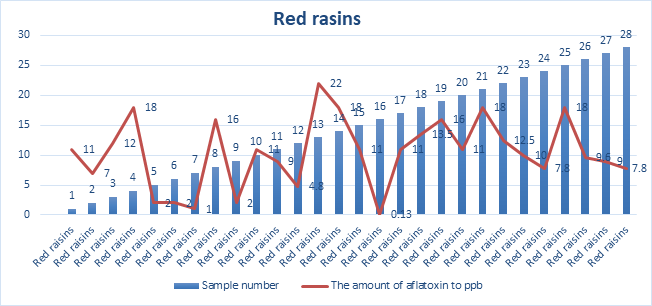
The graph of red raisin shows peaks with different ups and downs that reveal the amount of aflatoxin in red raisins is relatively high. Five samples have the lowest aflatoxin content and sample number 13 contains 22 ppb of aflatoxin. All of these samples are washed from raisins. The main reason for the high presence of aflatoxins in these samples is their high humidity and lack of attention to their storage after washing.
Quantity Analysis of Aflatoxins in Almonds
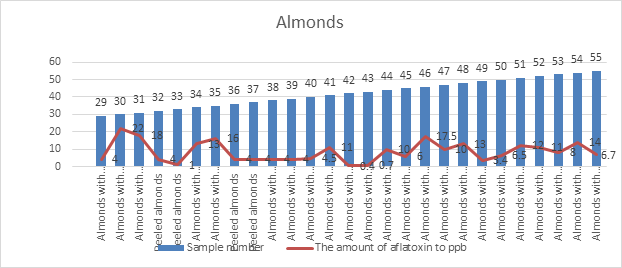
In the ten almond samples, Table 6. Three samples contain 10-20 ppb aflatoxin, and in all almond samples under investigation, none of the samples contain more than 22 ppb aflatoxin, which can be used as food. In six samples 4 ppb or less of aflatoxin was found.
Factors that play a role in the production of aflatoxins in almonds include humidity, heat, airborne effects of microscopic insects and organisms, storage time of almonds, infestation spores, and other conditions of the almond.
| Fruits under study | Sample number | The amount of aflatoxin to ppb |
|---|---|---|
| Almonds with shells | 29 | 4 |
| Almonds with shells | 30 | 22 |
| Almonds with shells | 31 | 18 |
| Peeled almonds | 32 | 4 |
| Peeled almonds | 33 | 1 |
| Almonds with shells | 34 | 13 |
| Almonds with shells | 35 | 16 |
| Peeled almonds | 36 | 4 |
| Peeled almonds | 37 | 4 |
| Almonds with shells | 38 | 4 |
| Almonds with shells | 39 | 4 |
| Almonds with shells | 40 | 4.5 |
| Almonds with shells | 41 | 11 |
| Almonds with shells | 42 | 0.4 |
| Almonds with shells | 43 | 0.7 |
| Almonds with shells | 44 | 10 |
| Almonds with shells | 45 | 6 |
| Almonds with shells | 46 | 17.5 |
| Almonds with shells | 47 | 10 |
| Almonds with shells | 48 | 13 |
| Almonds with shells | 49 | 3.4 |
| Almonds with shells | 50 | 6.5 |
| Almonds with shells | 51 | 12 |
| Almonds with shells | 52 | 11 |
| Almonds with shells | 53 | 8 |
| Almonds with shells | 54 | 14 |
| Almonds with shells | 55 | 6.7 |
Table 6: Amount of aflatoxins in almond samples under investigation.
The following graph shows the relationship between almond samples and the amount of aflatoxins in them Figure 2.
Quantity Analysis of Aflatoxins in Pistachios
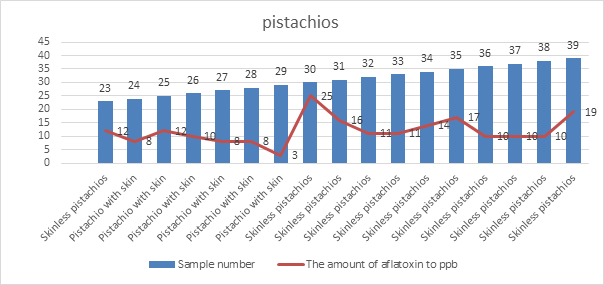
In seventeen samples of pistachios Table 7, one sample containing 4 ppb, three samples less than 10 ppb and twelve samples containing 10-20 ppb aflatoxins which can be used as food (Figure 3).
| Fruits under study | Sample number | The amount of aflatoxin to ppb |
|---|---|---|
| Skinless pistachios | 23 | 12 |
| Pistachio with skin | 24 | 8 |
| Pistachio with skin | 25 | 12 |
| Pistachio with skin | 26 | 10 |
| Pistachio with skin | 27 | 8 |
| Pistachio with skin | 28 | 8 |
| Pistachio with skin | 29 | 3 |
| Skinless pistachios | 30 | 25 |
| Skinless pistachios | 31 | 16 |
| Skinless pistachios | 32 | 11 |
| Skinless pistachios | 33 | 11 |
| Skinless pistachios | 34 | 14 |
| Skinless pistachios | 35 | 17 |
| Skinless pistachios | 36 | 10 |
| Skinless pistachios | 37 | 10 |
| Skinless pistachios | 38 | 10 |
| Skinless pistachios | 39 | 19 |
Table 7: Amount of aflatoxins in pistachios samples under investigation.
Comparative Analysis of Aflatoxins in Raisins, Almonds and Pistachios
Contamination of raisins, almonds and pistachios by aflatoxins- toxic secondary metabolites in Afghanistan has been a dangerous phenomenon; food can be easily contaminated through the environment their consumption can lead to serious health damage. Graph Figure 4 below shows the Comparative contamination of raisins, almonds and pistachios by aflatoxins.
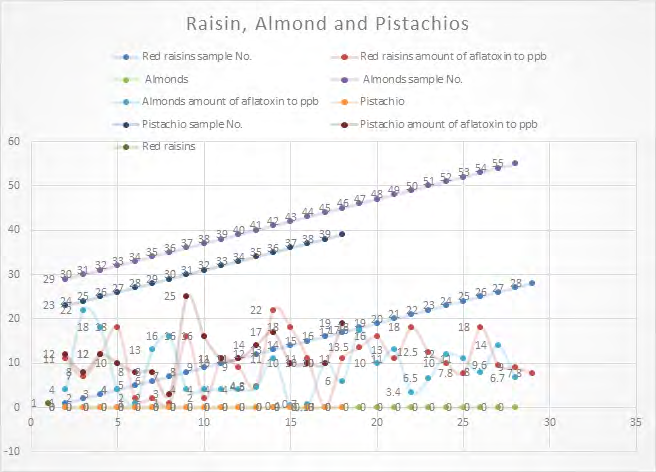
The Comparative graph of aflatoxins Contamination in fruits; Such as: Almonds, pistachios and raisins reveals the amount of aflatoxin that in pistachios is more than almonds and raisins and in raisins the amount of aflatoxin is less than almonds.
Conclusion
72 samples of dried fruits; Such as Almonds and red raisins that were investigated for amount of aflatoxine; shows that contamination of aflatoxins in raisins, Almonds and pistachios is in different quantities, aflatoxin contamination is high in pistachios than almonds and raisins, in raisins it is less than almonds. The amount of aflatoxin in almonds with shell is less than peeled almonds. The amount of aflatoxin in skinned pistachios is less than skinless pistachios; because pistachio cover prevents pistachio kernel contamination.
The factors that cause increase of aflatoxin in fruits are humidity and heat; therefore, dried fruits should be protected from moisture, if dried fruits are washed, they should be dried completely. In seventy-two researched samples (raisins, almonds and pistachio) that were processed for export, which were taken from Kabul customs, the amount of aflatoxins in them was determined; It was found that the amount of aflatoxin in none of samples was more than 25 ppb; Contamination of dried fruits, nuts, and legumes occurs in farms, during harvests and their untimely collection in these cases the amount of aflatoxin in them is observed in large quantities. The increase amount of aflatoxins from the norm set by international organizations and the European Union for fruits causes liver and kidney cancer.
The amount of aflatoxins in different quantities in food products is related to physical and chemical treatment and is also related to how they are kept from moisture, heat during collection and storage in warehouses.20 of barley, and 20 of wheat
References
-
Singh U, Gupta S, Gupta M (2021) A Review Study on Biological Ill Effects and Health Hazards of Aflatoxins 3: 1-8.
-
Folmert K, Monks K (2006) Determination of aflatoxins in dried fruit samples-from extraction to high efficient detection Determination of aflatoxins in dried fruit samples-from extraction to high efficient detection, pp: 1-6.
-
Bircan C, Barringer SA, Ulken U, Pehlivan R (2008) Aflatoxin levels in dried figs, nuts and paprika for export from Turkey. Int J Food Sci Technol 43(8): 1492-1498.
-
Moslehi Z, Mohammadi AN, Moslehi M, Jafarzadeh S (2021) Aflatoxin, microbial contamination, sensory attributes, and morphological analysis of pistachio nut coated with methylcellulose. Food Sci Nutr 9(5): 2576- 2584.
-
Wacoo AP, Wendiro D, Vuzi PC, Hawumba JF (2014) Methods for Detection of Aflatoxins in Agricultural Food Crops. J Appl Chem 2014: 1-15.
-
Kurtulus YB, Bakircioglu D, Kuscu M, Topraksever N, Destanoglu O (2021) Investigation of aflatoxin and metal concentrations in animal feeds and feed ingredients from Turkey 15: 1.
-
Juan C, Zinedine A, Moltó JC, Idrissi L, Mañes J (2008) Aflatoxins levels in dried fruits and nuts from Rabat-Salé area, Morocco. Food Control 19(9): 849-853.
-
Cano-Sancho G, Marin S, Ramos AJ, Sanchis V (2009) Survey of patulin occurrence in apple juice and apple products in Catalonia, Spain, and an estimate of dietary intake. Food Addit Contam Part B Surveill 2: 59-65.
-
Luttfullah G, Hussain A (2011) Studies on contamination level of aflatoxins in some dried fruits and nuts of Pakistan. Food Control 22: 426-429.
-
Herrera M, Bervis N, Carramiñana JJ, Juan T, Herrera A, et al. (2019) Occurrence and exposure assessment of aflatoxins and deoxynivalenol in cereal-based baby foods for infants. Toxins (Basel) 11(3): 150.
-
Aiko V, Mehta A (2015) Occurrence, detection and detoxification of mycotoxins. J Biosci 40: 943-954.
-
Cano-Sancho G, Marin S, Ramos AJ, Peris-Vicente J, Sanchis V (2010) Incidencia de aflatoxina M1 y evaluación de la exposición en Cataluña (España). Rev Iberoam Micol 27: 130-135.
-
Van Egmond HP (1989) Current Situation on Regulations for Mycotoxins. Overview of Tolerances and Status of Standard Methods of Sampling and Analysis. Food Additives & Contaminants 6(2): 139-188.
-
Creppy EE (2002) Update of survey, regulation and toxic effects of mycotoxins in Europe. Toxicology Letters 127: 19-28.
-
Macri AM, Pop I, Simeanu D, Toma D, Sandu I, et al. (2021) The occurrence of aflatoxins in nuts and dry nuts packed in four different plastic packaging from the romanian market. Microorganisms 9: 1-12.
-
F Kilicel (2017) Quantitation of Aflatoxins in Food Materials Using HPLC-FLD Method. Sci J Anal Chem 5(6): 90-97.
-
Malone BR, Humphrey CW, Romer TR, Richard JL (2000) Determination of Aflatoxins in Grains and Raw Peanuts by a Rapid Procedure with Fluorometric Analysis. J AOAC Int 83(1): 95-98.
-
Chiavaro E, Dall’Asta C, Galaverna G, Biancardi A, Gambarelli E, et al. (2001) New reversed-phase liquid chromatographic method to detect aflatoxins in food and feed with cyclodextrins as fluorescence enhancers added to the eluent. J Chromatogr A 937(1-2): 31-40.
- The Role of Podocyte Apoptosis and the Involvement of SIRT1 in Diabetic Nephropathy
- Dealcoholization of Beer by Osmotic Distillation for the Beverage Industry
- Biopolymer-Based Edible Packaging- Biomaterials, Methods, and Applications in Food Industry: An Updated Review
- Influence of Bioprocessing Methods on 'China Rice' (Gawal R1), and Soyabean Supplementation on the Quality of Complementary Food
- Cassava (Manihot esculenta) Varietal Growth, Yield and Cyanide Content Performance in Three Sites in the South- Eastern Semi Arid Regions of Kenya
- Food Waste Treatment, Recycling, Management and Production of Value-Products-An Update on Methodologies and Current Trends