
Production of Biscuit Mixed with Date Powder
Dates (Pheonix dactylifera L.) are high in essential nutrients and have potential health benefits whilst biscuits form the most popular snacks among all ages from children until the elderly in Malaysia. Hence, it is worth developing biscuits mixed with date powder which are easy and light to carry around, tasty, ready and easy to be consumed. The main objective of this study is to develop the best formulation for biscuit mixed with date powder (DP). DP was used at 10%, 20%, 30%, 40% and 50% replacement levels of sugar for the production of biscuits. Biscuit made from 100% sugar was used as control. Results of hedonic sensory test showed that F3 biscuit with incorporation of 30% DP had the highest mean score for overall acceptance of 7.20, thus placing F3 biscuit as the best formulation. Addition of DP more than 30% showed a significant difference (p < 0.05) on the sensory quality of the biscuits. Therefore, the addition of date powder should not exceed 30%. The physical analysis revealed that F3 biscuit had a darker and more red colour than the control besides having a softer texture. Meanwhile, proximate analysis showed that F3 biscuits contained 3.60% moisture, 0.84% ash, 0.30% crude fiber, 7.57% protein, 21.90% fat, 65.80% carbohydrate and energy value of 491.13 kcal. The addition of DP significantly increased the moisture, ash and crube fiber content (p <0.05) in the biscuits but showed no significant decrease (p> 0.05) for the protein content than the control. Microbiological tests proved that total microbial count of F3 biscuits which stored for six weeks is less than the maximum count as stated in the literature. In conclusion, DP has the potential to be used as a sweetener and for fibre enrichment purpose in biscuit production.
Introduction
Biscuits form the most popular snacks among all ages from children until the elderly in Malaysia [1]. MANS reported in 2014 [2] that biscuits is the top ten foods being consumed by the public every day in Malaysia. Biscuits are popular because they are easy and light to carry around, tasty, ready and easy to be consumed, has long shelf-life and their costs is reasonable [1, 3].
Dates or its scientific name Phoenix dactylifera L. [4] are sweet fruits from the family of Arecaceae. They are high in
- carbohydrate content due to its glucose and fructose presence apart from high content in fibre, vitamins and minerals but low in fats and proteins, as listed below in Table 1 [5].
- Composition
- Percentage (%)
- Carbohydrate
- 44-88
- Protein
- 1.8-5.6
- Fats
- 0.2-0.5
- Fibre
- 6.4-11.5
Table 1: Composition of Dates in Percentage.
Problem Statement
Biscuits are in general are high in sugar and fat content [6]. Use of dates syrup or paste in pastry making gives negative impact on its texture and colour [7]. Dhankar [6] found that nutrient and fibre content in biscuits were low. Hence, this addition of date powder to the formulation of the biscuits is hoped to increase its moisture content which will influence the shel-life of the biscuits.
Importance of the Study
This new biscuits has good potential to become a healthy snack where dates are ideal to be used as sugar replacer in the formulation. This is because dates form a natural replacer for sugar. Addition of date powder showed low effect on physical characteristics of biscuits particularly its colour compared to addition of date paste and syrup. Dates contain high content in terms of nutrients and fibre which can increase the nutritional value of the biscuits. Date powder can increase the shelf-life of biscuits in comparison to those biscuits using date paste and date syrup.
Objectives of the Study
1. To determine and produce the best formulation for biscuits mixed with date powder through sensory analysis.
2. To investigate the effect of date powder on physical characteristics of the biscuits mixed with date powder from the best formulation.
3. To conduct proximate analysis on the best formulation biscuit mixed with date powder.
4. To conduct analysis on storage on the best formulation biscuit mixed with date powder.
Literature Review
Alsenaien, et al. [8] studied the replacement of sucrose with date powder at the ratio of 25%, 50%, 75% and 100% in biscuit making. They found out that biscuits added with 50% and above formulations is favoured by the panellists. Kenawi, et al. [9] studied the differences in substitution powdered dates from El Sakkoti and Tamr el Wadi types, each at substitution rate of 10%, 20%, 30%, 40% and 50% from sugar that was used in the biscuit formulation. They found that the panellists selected biscuits with 30% substitution. Amin, et al. [5] studied substitution of sucrose with date powder (5%, 10% 20%, 40%) to the quality of biscuits. They reported that the panellists selected biscuits with 10% substitution was their choice.
Dhankar [6] studied the effect of composite flour mixed with wheat flour, tepung kacang kuda and date powder at the flowing ratios: 100:0:0, 80:10:10, 60:20:20, 40:30:30 and 20:40:40 on the expansion process of the biscuits. Sugar powder was also used as a sweetener in the biscuit production. He found that the substitution rate of 30% is most suitable. Ikechukwu, et al. [10] studied the ratio of whole wheat flour with date powder as substitution for sucrose suitable to produce biscuits with acceptable quality. They found out that the ratio of whole wheat flour with date powder was voted to be the best at 70:30.
Methodology
Preparation of powdered dates followed the method by Ikechukwu, et al. [10] with a little bit of change from Alsenaien, et al. [11] and Amin, et al. [5]. First the dates were cleaned by using a wet cloth followed with deseeding. Then the dates were cut into small pieces and dried in a vacuum oven at 75˚C for 24 hours followed with further drying in the electric cabinet dryer for another 12 hours at 80˚C. Then they were cooled down before they were grounded into powder by a Mixer Grinder which after that they were being sieved by a filter with 0.35 mesh.
The preparation of basic biscuits was following the Ikechukwu, et al. [10] formulation, which is as in Table 2
| Weight (g) | Percentage (%) | |
|---|---|---|
| Sugar | 60 | 14 |
| Butter | 80 | 18.6 |
| Wheat floor with low protein | 200 | 46.6 |
| Egg | 50 | 11.7 |
| Water | 30 | 7 |
| Baking powder | 2 | 0.5 |
| Salt | 2 | 0.5 |
| Vanilla essence | 5 | 1.2 |
| Total | 429 | 100 |
Table 2: Basic biscuit formulation based from Ikechukwu, et al. [10].
Five formulations (F1, F2, F3, F4 and F5) were developed by replacing sugar with date powder (DP) according to the research conducted by Kenawi, et al. [9]. The replacements were done at the ratio of 10%, 20%, 30% 40% and 50% as in Table 3.
- Replacement ratio of sugar with date powder (DP) in biscuits
- Material
- Control
- F1
- F2
- F3
- F4
- F5
- Sugar
- 60 g (100%)
- 54 g (90%)
- 48 g (80%)
- 42 g (70%)
- 36 g (60%)
- 30 g (50%)
- DP
- 0 g (0%)
- 6 g (10%)
- 12 g (20%)
- 18 g (30%)
- 24 g (40%)
- 30 g (50%)
- Total
- 60 g (100%)
Table 3: Ratio of sugar replacement in biscuit formulation.
The biscuits were made by creaming step the butter with sugar (control) and DP in other formulations, before the dried material such as floor, salt and baking powder being added to it, followed with eggs and vanilla essence. The mixture was kneaded until it turned into a dough. Then the dough was rolled out to a thickness of 3.5mm and a round cutter with a diameter of 35cm was used to make the biscuits. Next, the biscuits were heated in the oven for 10-15 minutes at a temperature of 150˚C, which after that they were taken out to cool down on the wire racks.
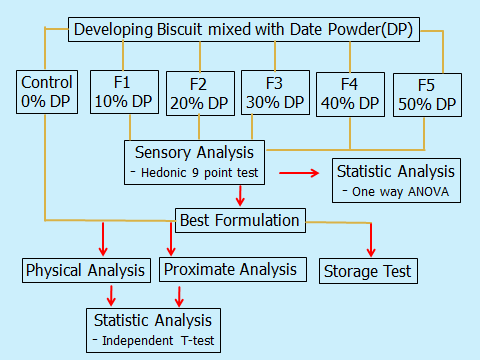
After the biscuits were cooled down, the sensory analysis was conducted through the 9 point hedonic scale test. 40 panellists were invited to evaluate all five formulations except the control for their colour, aroma, texture, taste and overall acceptance. Panellists were not trained so was advised to take 2-3 bites of the biscuits and chew the sample slowly and continue after 2-3 minutes rest with rinsing with water between each sample of formulation. The data obtained will be processed by using SPSS Version 28.0 through one- way analysis of variance (ANOVA) to find out about the significant difference between the five formulations. If there is a significant difference then Turkey HSD post-hoc test will be conducted.
Next is the physical analysis which will be conducted on the control and the best formulation biscuit. The physical analysis parameters will cover diameter, weight, thickness, spread ratio, surface colour, density, mass loss and texture profile analysis. The texture profile analysis was conducted last as the sample was destructive in manner. All parameters for each biscuit were done in triplicates except for texture profile analysis. All data from the physical analysis will be analysed by using Independent T-test under the SPSS Version 28.0 to determine the differences in significance between mean values.
Next is the biscuit proximate analysis to be conducted on control and the best formulation biscuits. The objective of this analysis is to identify the nutrient composition of the formulation biscuits mixed with DP. The proximate analysis will cover moisture, ash, coarse fibre, protein and fat based on AOAC method. The carbohydrate content will be calculated as the difference from food composition values. All analysis will be conducted in triplicates and the values will be averaged. All data from the proximate analysis will be expressed in means and standard deviation which will be analysed by using independent T-test under the SPSS Version 28.0 to determine the differences in significance between mean values.
The best formulation biscuit with mixed DP will be tested for its shelf-life analysis. The analysis to be conducted is the microbiological test. In this analysis, the test to be conducted will require 6 weeks starting from the day the biscuits had been produced (Week 0) followed with Week 3 and Week 6. For six weeks storage, biscuit samples were packed in Low Density Polyethylene (LDPE) bags and stored at hermetic container at room temperature. Microbiology test is one of the most important factors in guaranteeing safety and product quality for consumer confidence. The microbiology test to be conducted is the Total Plate Count (TPC) which involves bacteria, yeast and mould count. Plate count agar is utilised to determine the presence of bacteria whilst the Potato dextrose agar (PDA) is used to determine yeast and mould.
Results and Discussion
Sensory Analysis
Sensory analysis was conducted to determine product characteristics and consumer acceptance. The best formulation biscuit mixed with DP was analysed through sensory analysis by using the hedonic test. The best selected biscuit was utilized to undergo proximate analysis, physical test and study on storage quality.
Table 4 showed mean score values for all parameters for hedonic sensory analysis on all biscuit formulations of F1, F2, F3, F4 and F5 by the 40 panellists. The attribute having the highest mean score value showed the most favourite by the panellists and likewise the opposite. Mean score value for overall acceptance will determine the best formulation. The formulation F3 gave the mean score of 7.20 which is the highest, in which is accepted as the best formulation. It was noted that the mean scores for every attributes for biscuits F2 and F3 are not very much different and there was no significant difference between them. However, the panellists’ most favourite is F3.
As for the sensory analysis in terms of colour attribute, it reflects the usage of suitable ingredient, the formulation information and product quality. The colour attributes for biscuits mixed with DP showed significant difference (p<0.05) between the tested formulations. Based on Table 4, F2 (20% DP) has the highest mean score value, that is 6.98 ± 1.82 followed with F3 (30% DP) (6.93 ± 1.59) and F1 (10% DP) (6.90 ± 1.34). However, through the Turkey HSD test, it was found that these three formulations did not give any significant difference (p>0.05) whereby they were in the same subset. But it was noted there was significant difference (p<0.05) between F2, F3 and F1 with F4 and F5. This difference proved that with the additional DP up to 30% showed the acceptable level by the panellists, whilst addition of more than 30% as in F4 and F5 were lest favoured by the panellists. Feedback from some of the panellists was that biscuits F4 and F5 were too dark like they were over baked. There was no significant difference (p>0.05) between F4 and F5 but F4 manifested the lowest mean score value of 5.13 ± 1.67 compared with F5 5.78 ± 1.99. Both mean score values showed score values of five scale, which is neutral, whether you like or dislike.
In general, dates with higher sugar content will interact with heat during baking (maillard reaction) in so doing produce brownish biscuits [10] which are liked by many people compared to pale-like biscuits. Hence, addition of too much of DP meaning higher sugar and the higher was the maillard reaction and so produced with dark brown colour which was disliked by many people. The results of this study is in contrast with Ikechulwu, et al. [10] whereby biscuits mixed with 50% DP obtained the highest mean score for colour attribute. Furthermore, the study conducted by Alsenain, et al. [8] found that the addition up to 50% of DP to the formulation biscuit did not give negative effect on the biscuit sensory quality. Whilst the results of the study conducted by Amin, et al. [5] showed the addition of more than 20% DP gave low value for its mean score for colour attribute. The differences in the results of these studies maybe due to types of dates being used. This is due to different types of dates have different sugar content which would influence the maillard reaction.
According to table 4, the results of the hedonic test showed biscuits F2 (20% DP) has the highest mean score value that is 6.90 ± 1.72 which concluded that the aroma for formulation F2 is the most favoured by the panellists. Whilst aroma from F4 (40% DP) was found to be the lowest, that is 6.60 ± 1.77. It was also observed that these five formulations mixed with DP did not show any significant difference between the mean scores (p>0.05) for aroma attribute. These results on aroma attribute were in line with the study done by Ikechukwu [10]. Some panellists left some comments that the aroma for these formulation biscuits mixed with DP was very good.
The aroma of the dates themselves formed the main contributor to the aroma of the biscuits besides the use of the butter. There were 71 aroma compounds being identified in dates [11]. These aroma compounds can be classified into five main classes, that is alcohol, esther, carbonyl compounds, terpene, carboxylic acid and long chain hydrocarbons. In addition these aroma compounds forms the components that evaporates. Hence, drying dates and processing biscuits such as baking will results in the loss of this aroma compound and affect the sensory quality in particular aroma [12, 13].
One of the most important characteristics of biscuits required by consumers when they want to purchase biscuits is its texture [10, 14]. From table 4, the highest mean score value was obtained by F2 (20% DP), that is 7.28 ± 1.34. The second highest mean score values were obtained by F1 (10% DP) and F3 (30% DP) with their mean score values of 7.10 ± 1.61 and 7.10 ± 1.28 respectively. These three formulations have score of seven which indicated score of like. Out of the five formulations, F4 (40% DP) has the lowest mean score which is 6.53 ± 1.54. It was also observed that the values for mean score for texture attribute reduced with the incremental addition of DP. The same results were observed by studies done by Alsenaien, et al. [8] Ikechukwu, et al. [10] and Amin, et al. [5]. The reduction of this texture attribute could relate to high sugar content in dates that can affect the interaction of gluten with other ingredients in the formulation biscuits Alsenaien, et al. [8]. However, there was no significant difference (p>0.05) between the five formulation biscuits.
A very important parameter to ascertain acceptability of consumers towards a food product is taste. According to Saha, et al. [15] even though a product contains a high nutrient content, good for the health of a human body, but without a good taste, the product will not be favoured among consumers. Sweetness always linked to the main taste of a biscuit because sugar forms to be one of the main ingredients in making biscuits. In this study, sweetness is measured because the nature of biscuits is always linked with sweetness besides the different levels of sweetness contributed by the formulations of different mixing of DP. The date fruits themselves contains natural sugar content which is high in glucose, fructose and sucrose particularly at the mature stage of the dates [16]. So, the dates can influence and provide sweetness to the biscuits.
| Attributes | |||||
|---|---|---|---|---|---|
| Formulation | Colour | Aroma | Texture | Taste (Sweetness) | Overall Acceptance |
| F1 | 6.90 ± 1.34a | 6.65 ± 1.42a | 7.10 ± 1.61a | 6.53 ± 1.80ab | 7.08 ± 1.49ab |
| F2 | 6.98 ± 1.82a | 6.90 ± 1.72a | 7.28 ± 1.34a | 6.93 ± 1.58a | 7.08 ± 1.65ab |
| F3 | 6.93 ± 1.59a | 6.80 ± 1.40a | 7.10 ± 1.28a | 6.85 ± 1.66a | 7.20 ± 1.20a |
| F4 | 5.13 ± 1.67b | 6.60 ± 1.77a | 6.53 ± 1.54a | 5.35 ± 2.20c | 5.83 ± 1.66c |
| F5 | 5.78 ± 1.99b | 6.78 ± 1.67a | 6.75 ± 1.48a | 5.70 ± 1.88bc | 6.23 ± 1.44bc |
Table 4: Mean score values of Hedonic test on all five formulations biscuits.
- The values are expressed in the form of mean score ± standard deviation.
- Mean value that follows different numbers in the same lane showed values with significant difference (p<0.05).
- Hedonic scale Nine Points was utilized: 1=very very dislike, 2= really do not like, 3= do not like, 4= rather dislike, 5= neutral, 6= quite like, 7= like, 8= very like, 9= very very like.
Formulation
F1 = 10% date powder F2 = 20% date powder F3 = 30% date powder F4 = 40% date powder F5 = 50% date powder All biscuits formulation mixed with DP showed significant different (p<0.05) for taste attribute. Biscuits having the highest mean score value is F2 (20% DP) which is at 6.93 ± 1.58 whilst the lowest mean score value went to F4 (40% DP) with its value at 5.35 ± 2.20. Biscuit from formulation F3 (30% DP) formed to be the second highest mean score value at 6.85 ± 1.66 followed with formulation F1 (10% DP) with a value of 6.53 ± 1.80. The mean score values for F1, F2 and F3 showed no significant difference (p>0.05) but F1, F2 and F3 has significant difference with F4 (p<0.05). While F5 with the mean value score of 5.70 ± 1.88 is not significant different with F4 and F1. The significant difference (p<0.05) for sweetness from F2 and F3 with biscuits from F4 and F5 might be related to mailarrd reaction and caramelization which is due to high sugar content mixed with DP besides mineral and protein contents which might leave a bitter taste [17], which affect the sweet taste of the biscuits.
The score for overall acceptance is utilized to evaluate the level of liking among the panellists on overall attributes which covers colour, aroma, texture and taste (sweetness). The result of one-way ANOVA showed that there is significant difference (p<0.05) for mean score for overall acceptance. From table 4, it was found that all attributes for formulation F2 (20% DP) has the highest mean score value compared to other samples. But F3 (30% DP) has the highest mean score value for overall acceptance, that is 7.20 ± 1.20 followed with F2 and F1. The mean score for overall acceptance for these three samples did not show any significant difference (p>0.05). Based from table 4, mean score for every attributes for F2 and F3 were not much different, whereby mean score values for F3 obtained the second highest value after F2. But the panellists still prefer F3 (30% DP) as the best sample for overall acceptance. The results of this study is in line with the study conducted by Ikechukwu, et al. [10] whereby the sample with 30% DP formed the most favoured sample for parameter on overall acceptance among the panellists. But this finding and results from Ikechukwu, et al. [10] is in contradiction to study done by Alsenaien, et al. [8] and Amin, et al. [5]. Biscuits mixed with 50% DP from Alsenaien, et al. [8] formed the highest mean score value for overall acceptance whilst for Amin, et al. [5], the biscuits with 10% DP obtained the highest mean score value for overall acceptance.
In this study, the overall acceptance for F4 (40% DP) is the lowest at 5.83 ± 1.66 meaning it is the most disliked by the panellists. It also applies to other parameters as well. The One-way ANOVA test showed that there is significant difference (p<0.05) between F4 (40% DP) with the three samples F1, F2 and F3. However, the F4 sample can still be acceptable among the panellists because its mean score value is not less than 4, which reflected neutral acceptance. This results is in line with the study done by Amin, et al. [5] where by biscuits mixed with 40% DP obtained the lowest value for its overall acceptance.
Physical Analysis
This analysis was conducted to determine the effect of addition of date powder (DP) on the biscuit’s physical characteristics. This physical analysis is only conducted on the control sample and the best formulation biscuit samples which is F3 (30% DP). The analysis conducted covers determination of diameter, weight, thickness, spread ratio, density, mass loss, surface colour and profile texture analysis. The results of physical analysis on both samples, the control and F3 sample, was analysed by using independent T-test. Table 5 showed the results for physical analysis for both samples on their diameter, weight, thickness, spread ratio, density, mass loss and profile texture analysis.
| Physical Analysis | Control Biscuit | Biscuit Mixed with 30% DP, F3 |
|---|---|---|
| Diameter (mm) | 35.83 ± 0.29a | 35.58 ± 0.14a |
| Weight (g) | 6.22 ± 0.03a | 6.27 ± 0.06a |
| Thickness (mm) | 8.17 ± 0.29a | 8.33 ± 0.29a |
| Spread ratio | 4.39 ± 0.18a | 4.28 ± 0.14a |
| Mass Loss (%) | 16.28 ± 0.38a | 15.28 ± 0.05b |
| Density (g/cm3) | 0.29 ± 0.02a | 0.36 ± 0.01b |
Table 5: Results of Physical Analysis for parameter diameter, weight, thickness, spread ratio, mass loss and density for control
• Values displayed in the form of mean ± standard deviation (n = 3). Mean value which followed with different numbers in the same line shows values of significant difference (p < 0.05).
The spread of biscuit occurs when sugar was dissolved during baking. Before baking, sucrose in general did not dissolve fully and would only dissolve during baking process which resulted biscuits in bigger size [8]. With reference to Table 5, diameter for control biscuits is bigger (35.83mm ± 0.29) in diameter compared to F3 biscuits which was 35.58mm ± 0.14, but no significant difference was observed (p>0.05). This study justified that with the addition of 30% DP did not affect its parameter on diameter even though it was observed that there was reduction in reading the diameter size. The reduced diameter in F3 biscuits could relate to its solubility characteristics of DP which is low and to maintain this solubility for longer period during baking which blocked the dough flow and so resulting in biscuits with smaller size. This study is in line with results from study conducted by Alsenaien, et al. [8]. In contrast with the study conducted by Ikechukwu, et al. [10] whereby the biscuit mixed with DP is bigger in diameter size compared to its control biscuits.
In this study, the weight of biscuits increases with addition of DP. However, there is no significant difference (p>0.05) obtained from both samples. From Table 5, the weight of control biscuits had average value of 6.22 ± 0.03 g., whereby F3 biscuits had 6.27 ± 0.06 g. This result is in contrary to Ikechukwu, et al. [10] study because of its control biscuits were heavier than biscuits mixed with DP because the utilization of wheat flour is reduced in biscuits mixed with DP resulting in less formation of gluten and so reduced the weight of the biscuits. The increase in biscuit weight with addition of DP is in line with the study done by Kenawi, et al. [9]. This was so because the increasing moisture content in biscuits mixed with DP [17] had led to the increase of weight in biscuits. The same observation was also noted in the study conducted by Bornare and Khan [18] which studied the effect of additional honey as sugar replacer on physical characteristics of biscuits. The incremental replacement of sugar with honey had increased the weight of biscuits [18].
According to Table 5, biscuits mixed with 30% DP is thicker (8.33 ± 0.29 mm) compared to the control biscuits (8.17 ± 0.29 mm). By logic, when diameter of biscuits reduces, the thickness of biscuits will increase [19]. Ikechukwu, et al. [10] mentioned that as the thickness of biscuits increases, the higher the ability to withstand pressure. However, there was no significant difference (p>0.05) on the effect of additional DP on the thickness of biscuits was noted in this study. This result is in line with findings of Alsenaien, et al. [8]. In the study conducted by Amin, et al. [5] in looking at the effect of sugar replacement with 5-40% of DP, the biscuit’s thickness reduces with the increasing addition of DP, but there was no significant difference. There is no explanation to the non-significant difference with the presence of high sugar in biscuits which can compete with protein gluten to withdraw water first [8]. In general, gluten contributes to the expansion of the biscuits’ thickness. Without enough water, the development of gluten would be arrested and hence biscuit expansion would be slow. And so the biscuit’s thickness will not increase suddenly.
However, the biscuit’s spread ratio in this study did not show any significance in the reduction of (p>0.05) between control and F3 biscuits, which is in line with the study of Amin, et al. [5]. Even though, the results of Alsenaien, et al. [8] indicated there is reduction in spread ratio from control biscuits versus biscuits mixed with DP, but the reduction is significant. The opposite trend is noted by Ikechukwu, et al. [10] whereby biscuits mixed with DP obtained higher value on spread ratio. The higher value of spread ration was noted among control biscuits might be due to higher solubility of sucrose [5]. Hence, the addition of DP having lower solubility in the biscuit dough reduces its diameter and so the spread ratio. According to Alsenaien, et al. [8], the reduction of the spread ratio might be due to the fact that DP is able to increase the number of hydrophilic sites which is available to compete to obtain the limited water in the biscuit dough as also mentioned by Hooda and Jood [20]. This occurred rapidly during the mixing of the biscuit dough and increase in viscosity of the dough. Hence, limiting the spread of the biscuits during baking [8], results in biscuits with low spread ratio.
Results for mass loss in Table 5 showed that there is significant difference (p<0.05) between control and F3 biscuits. Control biscuits gave higher value in mass loss at 16.28 ± 0.38 % compared to F3 biscuits (15.28 ± 0.05 %). Mass loss during baking can be defined as loss of certain amount of water and organic materials during baking Alvarez-Jubete, et al. [21] as quoted from Rojo-Poveda, et al. [22]. Mass loss was due to evaporation of water from the biscuits after being exposed to heat during baking. Hence, percentage of mass loss can relate to moisture content in biscuits [22]. In this study, it could be noted that the higher the mass loss in biscuits, the lower was the moisture content in biscuits.
According to Mamat and Hill [23] and Majzoobi, et al. [17], biscuits with lower density would have a crispier texture or higher texture value, which is favoured by many consumers. According to Table 5, F3 biscuits (30% DP) (0.36 ± 0.01 g/cm3) is more significantly (p<0.05) dense than control biscuits (0.29 ± 0.02 g/cm3). This result showed that control biscuits were crispier than F3 biscuits. This result is in line with Majzoobi, et al. [17] whereby the higher density of the biscuits the less is sugar being used. There were several factors that can influence biscuit’s density. Among them is the rheology characteristic of the biscuit dough, gelatinization of the starch and moisture content [17]. In this study, moisture content of F3 is due to addition of DP might be the main contributor to increase in biscuit density.
The colour of biscuits play important role because it influences perception and consumer acceptability. Mean values for surface colour (L*, a* and b*) for control and F3 biscuits are shown in Table 6. Values for each L*, a* and b* refers to measuring of brightness, redness and yellowing colour for biscuits.
| Colour Analysis | Control Biscuits | Biscuits mixed with 30% DP |
|---|---|---|
| L* | 60.59 ± 0.98a | 53.59 ± 0.70b |
| a* | 3.93 ± 0.85a | 6.98 ± 0.74b |
| b* | 19.63 ± 0.26a | 18.58 ± 0.81a |
Table 6: Values for each L*, a* and b* refers to measuring of brightness, redness and yellowing colour for biscuits.
The results of the analysis showed that the value for L* in control biscuits is significantly different (p<0.05) with F3 biscuits mixed with 30% DP. According to Table 6, the value for L* for control biscuits is 60.59 ± 0.98 which is higher than F3 biscuits at 53.59 ± 0.70. This shows that biscuits mixed with DP are clearly darker in colour from control biscuits as indicated by the low value of L*. Value of a* which indicated the redness colour also showed significant difference (p<0.05) between control biscuits and F3 biscuits. Value of a* for F3 biscuits is 6.98 ± 0.74, which is higher compared to control biscuits (3.93 ± 0.85). This results also indicate that both samples produced red colour at different levels following to a* values which are positive. The lower value of L* and the higher value of a* is observed in biscuits mixed with DP is due to the presence of dates with dark reddish brown colour. In addition, this may relate to Maillard reaction that happens during baking process [8] which depends on degrading sugar content and amino acid or protein, temperature and time of baking [24]. In this study, the temperature and baking time for both samples were the same, so the main factor is the degrading sugar content and amino acid or protein. According to Assirey [25], Mabroom dates has quite high degrading sugar level, that is 71.2 ± 0.2 g for every 100 grams, while sugar used in control biscuits only comprised of sucrose, which is not degrading sugar [22]. This can make the surface of biscuits mixed with 30% DP is browner because of Maillard reaction may occur between degrading sugar and protein which are contained in the dough of the biscuits as reported by Rojo-Poveda, et al. [22].
The b* value for control biscuits showed there is no significant difference with F3 biscuits. The mean value of b* for control biscuits is 19.63 ± 0.26, whilst F3 biscuits is 18.58 ± 0.81. Positive data for b* values for both samples showed yellow in colour. Mixed date powder has low polyphenol oxidase and peroxidase activities [8]. Besides that, mixed date powder is also rich in polypherol which forms the substrate for enzyme which had been mentioned earlier [8]. Hence, due to the reaction of enzymatic browning, the reduction of brightness and yellowing of biscuits mixed with date powder occurred [8].
The analysis on Texture Profile (TPA) forms one of the techniques used to measure food texture following its texture characteristics [26] including biscuits. The parameter being analysed (TPA) are hardness and fragility. The hardness and fragility forms important texture properties to determine the quality of biscuits [27]. Table 7 showed the results of TPA for control and F3 biscuits together with its statistical analysis.
| Control Biscuit | Biscuit Mixed with 30% DP, F3 | |
|---|---|---|
| Hardness (g) | 4361.59 ± 10.91a | 3130.21 ± 1.28b |
| Fragility (mm) | 7.60 ± 0.20a | 7.85 ± 0.10a |
Table 7: Texture Values for Control and F3 Biscuits (30% DP).
• Values expressed in mean ± standard deviation (n = 3). Mean values followed with different numbers in the same line which showed values with different significance (p < 0.05).
Hardness can be defined as the peak force which is needed by cutting probe to crack the biscuit [27]. Hence, it can be said that it is the effort needed to bite the biscuits [22]. For the results of the texture profile analysis for hardness is clearly showed that there is significant difference (p < 0.05) between control and F3 biscuit mixed with 30 % DP. Values of hardness for control biscuit (4361.59 ± 10.91 g) is higher than F3 biscuit (3130.21 ± 1.28).
According to Jauharah, et al. [28] as more effort is needed, the harder is the structure of the biscuits. The hardness of the biscuits can be influenced by the quantity and type of sucrose sugar in the biscuit making. As less use of sucrose sugar in the biscuit making, the lesser the hardness of the biscuits [17]. In addition, the rate of sucrose crystallization during cooling of biscuits is higher compared with fructose and glucose found in the F3 biscuits (30% DP) which also results in control biscuit become harder in nature [17].
Besides that, the high moisture content of date powder is the contributing factor to reduction of hardness in biscuits [17]. As the moisture of biscuits gets higher, the lesser the hardness of the biscuits. This explains how control biscuits are harder compared to biscuits mixed with DP because a control biscuit is made of 100% sugar while F3 biscuits are made of a mixture of 70% sugar and 30% DP. Results of this study is in line with the results obtained by Ikechukwu, et al. [10] whereby the hardness of biscuits with mixed DP is lower compared with control biscuits.
Based on Table 7, the control biscuit obtained mean score value of 7.60 ± 0.20 mm while F3 biscuit (30% DP) with mean score value of 7.85 ± 0.10 mm. This results showed that control biscuits is more crispy compared to F3 biscuits (30% SBK). Nonetheless, there is no significant different (p > 0.05) being observed between both biscuit samples in this study. The hardness and fragility of biscuits is related to the formation of gluten and the interaction between various ingredients in this biscuit making Khouryieh dan Aramouni [8] as quoted from Alsenaien, et al. [29]. F3 biscuit (30% DP) has higher fragility due to mixing of DP which contain more sugar and also fibre content which reduces the formation of gluten, which affect the interaction between gluten and other ingredients [8, 30].
Proximate Analysis
Proximate analysis is a food analysis which is performed to determine the percentage of moisture content, ash, protein, crude fiber fat and carbohydrate in a food product. According to Owusu-Apenten [31], information gathered through proximate analysis is required for labelling purpose and food quality. However, similar to physical analysis, proximate analysis is conducted on control biscuit and the best formulation biscuit, which is F3 (30% DP). As such, this analysis is implemented to compare the proximate composition between the control and F3 Biscuits. The results of this proximate analysis using independent T test. Table 8 showed data obtained through proximate analysis which was done on both control and best formulation biscuits.
| Control Biscuit | Biscuit Mixed with 30% Date Powder, F3 | |
|---|---|---|
| Misture (%) | 3.60 ± 0.05a | 4.84 ± 0.09b |
| Ash (%) | 0.84 ± 0.02a | 1.06 ± 0.01b |
| Crude Fiber (%) | 0.30 ± 0.02a | 0.51 ± 0.03b |
| Protein (%) | 7.57 ± 0.02a | 7.55 ± 0.01a |
| Fat (%) | 21.90 ± 0.15a | 22.15 ± 0.17a |
| Carbohydrate (%) | 65.80 ± 0.16a | 63.89 ± 0.22b |
| Calorie (kcal) | 491.13 ± 0.72a | 486.12 ± 0.72b |
Table 8: Comparison on Proximate Analysis for Control and F3 Biscuits (30% DP).
• Values expressed in mean ± standard deviation (n = 3). Mean values followed with different numbers in the same line which showed values of significant difference (p < 0.05).
The moisture content is usually used as an important parameter in determining the quality of the biscuit due to the big changes in moisture content can affect the sensory and physical aspects of the biscuits for example the crack on the surface of the biscuits Cronin and Preis [32] as quoted from Šarić, et al. [33]. Based on Table 8, the moisture content of control biscuit (3.60 ± 0.05 %) is very much lower compared to F3 biscuit (4.84 ± 0.09 %). This result is similar to the report by Sulieman, et al. [34] and Amin, et al. [5] whereby biscuit mixed DP has higher moisture level if compared to control biscuit. Based on this analysis, the percentage of mean values on moisture in control and F3 biscuits showed differences which is significant because value of p < 0.05.
The moisture content in biscuits could be due to two main factors, which is heating during baking and the range of moisture content in the raw ingredient used [35]. During baking process, heating can result in reduction of moisture range in biscuits. The higher the temperature and the longer time used during baking, the lower the moisture content [33]. But, the temperature and time for baking both biscuits are the same, which is 150 °C for 20 minutes. Hence, it can be concluded that the differences on moisture content between biscuits is due to the second factor, which is the range of moisture content of raw ingredients being used. The use of dates in F3 biscuits forms the main factor which contributes to high moisture content compared with the control biscuits which is not mixed with date powder. Dates used in this study is dates of Mabroom type which has quite high moisture level, which is 21.3 g per 100 g based on dry weight basis [25]. Furthermore, the high moisture content in the F3 biscuits is also due to high sugar content in Mabroom dates, which is 76.4 g per 100g [25] which can bind water in the biscuits [5]. According to Taiwo, et al. [36], in general, biscuits has lower moisture content less than 10% and hence, the moisture in biscuits will not affect the quality of the biscuits. So, it can be concluded that even though there is significant difference between control and F3 biscuits, the addition of 30% DP does not affect the biscuit quality in view of moisture in F3 biscuits is less than 10%.
The F3 biscuit has high average value of ash content which is significant (p < 0.05), that is 1.06 ± 0.01 % compared to the control biscuit (0.84 ± 0.02 %). The same results is also obtained by Kenawi, et al. [9], Ikechukwu, et al. [10] and Amin, et al. [5]. The high ash content in F3 biscuit maybe due to addition of DP which contain high mineral content [5, 10] for example calcium triphosphate, iron [9] and potassium [37] which is important for the human body. It is justified that F3 biscuits has high mineral content.
According to Table 8, the total average of crude fiber in both biscuits showed significant differences (p < 0.05) whereby the control biscuits and F3 biscuit has 0.30 ± 0.02 % and 0.51 ± 0.03% crude fiber respectively. The increase in total crude fiber in F3 biscuits had also been reported by Kenawi, et al. [9], Ikechukwu, et al. [10] and Amin, et al. [5].
The high crude fiber content in F3 biscuits is maybe due to addition of DP into the formulation. According to Aljaloud, et al. [38], dates with crude fiber content between two to six percent is considered is of high quality. Fiber helps in reducing the blood cholesterol level and slows down the absorption process of glucose and so assists in maintaining the blood glucose level in the body [39]. It also ensures the smooth functioning of the intestines and so helps in removing the waste products from the body, increase the satiety feeling and affect to some levels of weight loss [40]. Attention on crude fiber content should be made in this study because of the importance on health to diabetics [39].
High fat content in both biscuit samples in this study is influenced by the addition of animal fat such as butter and egg Astrini [41] as quoted from Saleh, et al. [35]. However, the fat content in F3 biscuits is a bit higher from the control biscuits, maybe because the amount of fat found in dates in view of butter and egg are added to control and F3 biscuits are the same. According to Assirey [25], 100 g of mabroom dates contain fat content as much as 0.27 g. Nevertheless, the fat content in dates does not give significant difference (p > 0.05) between control and F3 biscuits which may be due to too little addition of DP.
In general, biscuits contain high carbohydrate content [10]. High carbohydrate content is also observed in both samples in this study. The sources of carbohydrate in both biscuit samples are from the wheat flour and sugar and also the date powder. Table 8 showed average mean score for carbohydrate in control biscuits is 65.80 ± 0.16 %, which is higher compared with F3 biscuits (63.89 ± 0.22 %). The results are similar with Kenawi, et al. [9] and Amin, et al. [5]. However, the results from the analysis showed there is significant difference (p > 0.05) between carbohydrate content of control and F3 biscuits.
In this study, usage of sugar is higher in control biscuits compared to F3 biscuits. This may results in reduction of carbohydrate content in F3 biscuits. This is because 100 g sugar contains high carbohydrate content which is 99.4 g per 100 g [42] compared with dates itself (80.6 g/100g) [43]. Carbohydrate content reduces in F3 biscuits maybe due to low carbohydrate level in the date powder, but also maybe because the carbohydrate content is calculated by difference and influenced by other nutrient components such as moisture content, ash, protein, fat and crude fiber [44]. Hence, it can be concluded that the higher the other nutrient component, the less is the carbohydrate content and vice versa [35, 44]. So, this is not the true measurement of carbohydrate content in F3 biscuits.
There is significant difference (p < 0.05) for energy value between control and F3 biscuits. Based on Table 8, F3 biscuits is mixed with 30% DP which showed low energy value, which is 486.12 ± 0.72 kcal for 100 g compared with control biscuits (491.13 ± 0.72 kcal per 100 g). This result is in contrary with the results reported by Ikechukwu, et al. [10]. The differences in the results of studies are maybe due to different techniques being used to calculate the energy value. In the study conducted by Ikechukwu, et al. [10], calculation of the energy value only involves three nutrient components, which are carbohydrate, protein and fats while in this study the calculation of energy value is obtained from the Nutrition Guide to Nutrition Labelling and Claims with applications which also involves crude fiber content apart from the three nutrient components.
Shelf Life Test
The shelf life test had been conducted on the best formulation biscuit mixed with DP which had been kept in airtight container for six weeks at room temperature. The test had been conducted on biscuits at storage week-0, week-3 and week-6. There are four main agents which can damage to food products, that is enzyme activities in food, microbiology activities, chemical activities and physical activities [45, 46]. In this study, only microbiological test had been conducted to determine the shelf life of biscuits.
The total microbial counts reflected the situation whereby food being produced is kept or handled wrongly during processing or during storage [10]. As such, microbiological test can be used to predict the shelf life and quality of biscuits during storage [10]. The cause of microbial damage in bakery products is due to bacteria, yeast and fungus [46]. Hence, in this microbiological test, Plate Count Agar (PCA) and Potato Dextrose Agar (PDA) each had been used to count bacteria, yeast and fungus. Table 9 showed the total plate count, yeast and fungus count for F3 biscuits.
| Storage Period | Bacteria Count (cfu/g) | Yeast and Fungus Count (cfu/g) | |
|---|---|---|---|
| F3 | Week - 0 | 2.2 × 10³ | 4.1 × 10² |
| F3 | Week - 3 | 1.7 × 10⁵ | 8.0 × 10⁵ |
| F3 | Week - 6 | 3.1 × 10⁴ | 4.6 × 10⁴ |
Table 9: Total Plate Count and Yeast and Fungus Count (cfu/g) for F3 Biscuits (30% DP). *F3 = Biscuit mixed with 30% DP.
For week-0, microbiological test is conducted on the day the biscuits are being produced, just after the biscuits are being cooled down after baking. The total bacteria count is 2.2 × 10³ cfu/g while the yeast count is 4.1 × 10² cfu/g. This showed that there is contamination in F3 biscuits at the early part of storage. This contamination may occur due to unclean and improper preparation and processing during biscuit making. However, the biscuit had been exposed to heat during baking [33]. So, the main source of contamination is from handling of biscuits after baking (post-handling) which resulted to exposure of environmental air contamination and also in contact with other appliances [46]. For example, the grinder jar used to crush the biscuit sample was not sterilised earlier maybe the source of contamination. Not only that, non-aseptic handling such as negligence in preparing media, method of sample transfer to media and the equipments being used are also contamination factors in week-0.
For week – 3, total plate counts for bacteria, yeast and fungus had suddenly increased to 1.7 × 10⁵ cfu/g and 8.0 × 10⁵ cfu/g. But even at week – 6, the total count for bacteria, yeast and fungus had reduced to 3.1 × 10⁴ cfu/g and 4.6 × 10⁴ cfu/g (Table 9). This is important because at week – 3, maybe contamination occur from other samples like bread due to sharing of cabinet of lamina flow in view insufficient number of cabinets available in the laboratory apart from negligence during handling of microbiological test as mentioned earlier. The increase of total colony count at week-3 and week-6 compared with week-0 also showed the lowering of biscuit quality. From the content aspect of the biscuit itself, the increased in microbial count maybe due to the increasing moisture content during storage period besides the presence of nutrients in the biscuits [10] as to encourage the growth of microbes. Furthermore, there is no added preservative into the biscuit formulation to avoid the growth of microbes besides the characteristics of biscuits which is usually low in acid content [10]. The results on total counts of bacteria, yeast and fungus in this study is higher than being reported by Sulieman, et al. [34] and Ikechukwu, et al. [10]. According to Centre for Food Safety [47], the count which is larger or the same with 106 cfu/g is assumed as unsatisfactory level for bakery products. In other words, bakery products will be damaged on reaching count 106 cfu/g Ray and Bhunia [48] as quoted from Ikechukwu, et al. [10]. Therefore, it can be concluded that F3 biscuits at week-6 is still in acceptable period and safe for consumption even though there is reduction in the quality of biscuits.
Conclusion
In conclusion, date powder can be used in producing biscuits to reduce usage of sucrose sugar. From the hedonic sensory test being conducted, F3 biscuits containing 30% DP and 70% sugar were chosen as the best formulation because they have the highest mean score values for overall acceptance. The addition of more than 30% of DP will affect the sensory quality of biscuits particularly from colour and taste (sweetness) attributes. From the physical aspect, addition of 30% DP in biscuits did not show significant difference with control biscuits which is 0% of DP mixture except for parameter with mass loss, density, colour and hardness. F3 biscuits have darker colour and redness compared with control biscuits apart from having softer texture. Whilst the proximate composition of F3 biscuits (30% DP) such as moisture content, ash content and crude fibers increased significantly from the control biscuits, vice versa for the protein content and carbohydrate. However, the reduction of protein content in F3 biscuits did not show any significant difference with control biscuits. In conclusion, addition of 30% DP can increase the nutritional quality of the biscuits particularly in fiber content. This study also proved that F3 biscuits (30% DP) which are kept for six (6) weeks has low microbial total count from the maximum count state din the literature. Hence, it is clear that DP has the potential to be used a replacement for sugar in producing quality biscuits and as a sweetener in other bakery products. Furthermore, the increasing fiber composition also showed that DP mixture has potential to develop biscuits rich in fiber to fulfil the requirements for fiber among the Malaysian people.
Funding Statement: Employed by Universiti Malaysia Sabah.
Conflict of Interest: The author has no conflict of interest with this manuscript.
References
-
Norhayati MK, Mohd Fairulnizal MN, Zaiton A, Wan Syuriahti W Z, Rusidah S, et al. (2015) Nutritional composition of selected commercial biscuits in Malaysia. Sains Malaysiana 44(4): 581-591.
-
Aris T, Ahmad NA, Hiong TG (2014) National Health and Morbidity Survey 2014: Malaysian Adult Nutrition Survey (MANS). Vol I, Institute for Public Health, Kuala Lumpur, Malaysia.
-
Bala A, Gul K, Riar CS (2015) Functional and sensory properties of cookies prepared from wheat flour supplemented with cassava and water chestnut flours. Cogent Food Agric 1(1): 1019815.
-
Ghnimi S, Umer S, Karim A, Kamal-eldin A (2017) Date fruit (Phoenix dactylifera L.): An underutilized food seeking industrial valorization. NFS Journal 6: 1-10.
-
Amin AAEN, Abdel Fattah AFAK, El kalyoubi M, El Sharabasy SF (2019) Quality attributes of Cookies Fortified with Date Powder. Arab Universities Journal of Agricultural Sciences 27(5): 2539-2547.
-
Dhankhar J, Vashistha N, Sharma A (2021) Development of biscuits by partial substitution of refined wheat flour with chickpea flour and date powder. Journal of Microbiology, Biotechnology and Food Sciences 8(8): 1093-1097.
-
Manickavasagan A, Thangavel K, Dev SR, Delfiya DA, Nambi E, et al. (2015) Physicochemical characteristics of date powder produced in a pilot-scale spray dryer. Drying Technology 33(9): 1114-1123.
-
Alsenaien WA, Alamer RA, Tang ZX, Albahrani SA, Al Ghannam M A, et al. (2015) Substitution of sugar with dates powder and dates syrup in cookies making. Advance Journal of Food Science and Technology 8(1): 8-13.
-
Kenawi MA, Fawzy AH, Sokkary El, Mohamed N, Mostafa TM, et al. (2016) Chemical, Physical and sensory evaluation of biscuit supplemented with date powder. Minia J of Agric Res & Develop 36(2): 215-227.
-
Ikechukwu PA, Okafor DC, Kabuo NO, Ibeabuchi JC, Odimegwu E, et al. (2017) Production and Evaluation of Cookies from Whole Wheat and Date Palm Fruit Pulp as Sugar Substitute. International Journal of Advancement in Engineering Technology, Management and Applied Science (IJAETMAS) 4(4): 1-31.
-
Ali Haimoud S, Allem R, Merouane A (2016) Antioxidant and Anti Inflammatory Properties of Widely Consumed Date Palm (Phoenix Dactylifera L) Fruit Varieties in Algerian Oases. Journal of Food Biochemistry 40(4): 463-471.
-
Raisi A, Aroujalian A, Kaghazchi T (2008) Multicomponent pervaporation process for volatile aroma compounds recovery from promegranate juice. Journal of Membrane Science 322(2): 339-348.
-
Tripathi J, Chatterjee S, Gamre S, Chattopadhyay S, Variyar PS, et al. (2014) Analysis of free and bound aroma compounds of pomegranate (Punica granatum L.). LWT-Food Science and Technology 59(1): 461-466.
-
Lusas EW, Rooney LW (2001) Snack Foods Processing. 1st (Edn.) Boca Raton, CRC Press.
-
Saha S, Gupta A, Singh SRK, Bharti N, Singh KP, et al. (2010) Compositional and varietal influence of finger millet flour on rheological properties of dough and quality of biscuit. Food Science and Technology 44(3): 616-621.
-
Munawwarrah H (2015) Hubungan Pemberian Kurma (Phoenix Dactylifera L) Varietas Ajwa Terhadap Kadar Kolesterol Total Darah. Thesis Sarjana Kedoktoran, Universiti Islam Negeri Syarif Hidayatullah, Nigeria.
-
Majzoobi M, Mansouri H, Mesbahi G, Farahnaky A, Golmakani MT (2016) Effects of sucrose substitution with date syrup and date liquid sugar on the physicochemical properties of dough and biscuits. Journal of Agricultural Science and Technology 18(3): 643-656.
-
Bornare D, Khan K (2015) Physical and sensory evaluation of cookies incorporated with oats and honey. International Journal of Engineering Research and Technology 4(8): 407-411.
-
Shabnam S, Dar AH, Aga MB, Khan SA (2020) Effect of date powder and peach pomace powder on the microstructure and functional attributes of cookies. Journal of Postharvest Technology 8(3): 37-49.
-
Hooda S, Jood S (2005) Organoleptic and Nutritional Evaluation of Wheat Biscuits Supplemented with Untreated and Treated Fenugreek Flour. Food Chemistry 90(3): 427-435.
-
Alvarez-Jubete L, Arendt EK, Gallagher E (2010) Nutritive value of pseudocereals and their increasing use as functional gluten-free ingredients. Trends in Food Science & Technology 21(2): 106-113.
-
Rojo-Poveda O, Barbosa-Pereira L, Orden D, Stévigny C, Zeppa G, et al. (2020) Physical properties and consumer evaluation of cocoa bean shell-functionalized biscuits adapted for diabetic consumers by the replacement of sucrose with tagatose. Foods 9(6): 814.
-
Mamat H, Hill SE (2018) Structural and functional properties of major ingredients of biscuit. International Food Research Journal 25(2): 462-471.
-
Pereira D, Correia PM, Guine RP (2013) Analysis of the physical-chemical and sensorial properties of maria type cookies. Acta Chimica Slovaca 6(2): 269-280.
-
Assirey EAR (2015) Nutritional composition of fruit of 10 date palm (Phoenix dactylifera L) cultivars grown in Saudi Arabia. Journal of Taibah University for science 9(1): 75-79.
-
Sahid MIH, Khalid K, Ayob N (2015) Kaedah analisis tekstur produk makanan. Buletin Teknologi MARDI 7: 19-23.
-
Adeola AA, Ehimen RO (2018) Physical, chemical, and sensory properties of biscuits prepared from flour blends of unripe cooking banana, pigeon pea, and sweet potato. Food Sci Nutr 6(3): 532-540.
-
Jauharah MA, Rosli WW, Robert SD (2014) Physicochemical and sensorial evaluation of biscuit and muffin incorporated with young corn powder. Sains Malaysiana 43(1): 45-52.
-
Khouryieh H, Aramouni F (2012) Evaluation of sorghum flour functionality and quality characteristics of gluten- free bread and cake as influenced by ozone treatment. Food Sci Technol Int 21(8): 631-640.
-
Singh S, Riar CS, Saxena DC (2013) Effect of incorporating sweet potato flour to wheat flour on the quality characteristics of cookies. Afr J Food Sci 2(6): 065-072.
-
Owusu-Apenten RK (2004) Introduction to food chemistry. Boca Raton, CRC Press.
-
Cronin K, Preis CA (2000) Statistical Analysis of Biscuit Physical Properties as Affected by Baking. Journal of Food Engineering 46(4): 217-225.
-
Šarić BM, Nedeljković NM, Šimurina OD, Pestorić MV, Kos JJ, et al. (2014) The influence of baking time and temperature on characteristics of gluten free cookies enriched with blueberry pomace. Food and Feed Research 41(1): 39-46.
-
Sulieman AM, Masaad M, Ali A (2011) Effect of partial substitution of wheat flour with date powder on biscuit quality. Gezira Journal of Agricultural Science 9(2).
-
Saleh RH, Ronitawati P, Sitoayu L (2019) Pengaruh Subtitusi Tepung Sukun (Artocarpus Altilis) Dan Buah Kurma (Phoenix Dactlifera) Terhadap Daya Terima Pada Cookies Sebagai PMT-Balita. Tesis Sarjanamuda, Universitas Esa Unggul Jakarta Barat.
-
Taiwo EO, Sekinat AA, Adegbola DO, Arise AK, Sotunde AJ (2017) Chemical composition and sensory qualities of wheat-sorghum date cookies. Croatian Journal of Food Technology, Biotechnology and Nutrition 12 (1-2): 71- 76.
-
Badarusham K, Sabri NE, Salvamani S, Hassan MS, Hassan Z, et al. (2019) Chemometric research of minerals and trace elements in selected Malaysian local fruits using inductively coupled plasma optical emission spectroscopy (ICP-OES). International Journal of Recent Technology and Engineering (IJRTE) 8(2S3): 197-204.
-
Aljaloud S, Colleran HL, Ibrahim S A (2020) Nutritional value of date fruits and potential use in nutritional bars for athletes. Food and Nutrition Sciences 11(6): 463-480.
-
Yu K, Ke MY, Li WH, Zhang SQ, Fang XC (2014) The impact of soluble dietary fibre on gastric emptying, postprandial blood glucose and insulin in patients with type 2 diabetes. Asia Pacific Journal of Cinical Nutrition 23(2): 210-218.
-
Anderson GH (2019) Role of single serving form of dairy on satiety and postprandial glycaemia in young and older healthy adults. Applied Physiology Nutrition Metabolism 44(12): 1289-1296.
-
Astrini NJ, Rakhmawati T, Sumaedi S, Bakti IGMY (2020) Identifying objective quality attributes of functional foods. Journal on Quality Assurance and Safety of Crops & Foods 12(2): 24-39.
-
MyFCD (1997) 1997 FCD Listing. Malaysian Food Composition Database.
-
Al Farsi MA, Lee CY (2008) Nutritional and functional properties of dates: a review. Crit Rev Food Sci Nutr 48(10): 877- 887.
-
Barimah J, Laryea D, Okine UNK (2015) Date fruit powder as sugar replacer in rock buns. Nutrition Food Science 45(6): 920-929.
-
In’t Veld JHH (1996) Microbial and biochemical spoilage of foods: an overview. International Journal of Food Microbiology 33(1): 1-18.
-
Saranraj P, Geetha M (2012) Microbial spoilage of bakery products and its control by preservatives. International Journal of Pharmaceutical & Biological archives 3(1): 38- 48.
-
Centre for Food Safety (2014) Microbiological Guidelines for Food for Ready to Eat Food in General and Specific Food Items. Centre for Food Safety Food and Environmental Hygiene Department, Queensway, Hong Kong.
-
Ray B, Bhunia A (2007) Fundamental food microbiology. CRC press, Boca Raton, USA.
- The Role of Podocyte Apoptosis and the Involvement of SIRT1 in Diabetic Nephropathy
- Dealcoholization of Beer by Osmotic Distillation for the Beverage Industry
- Biopolymer-Based Edible Packaging- Biomaterials, Methods, and Applications in Food Industry: An Updated Review
- Influence of Bioprocessing Methods on 'China Rice' (Gawal R1), and Soyabean Supplementation on the Quality of Complementary Food
- Cassava (Manihot esculenta) Varietal Growth, Yield and Cyanide Content Performance in Three Sites in the South- Eastern Semi Arid Regions of Kenya
- Food Waste Treatment, Recycling, Management and Production of Value-Products-An Update on Methodologies and Current Trends