
General Features of Food Import in Burkina Faso
The flow of food goods from producers and importers to consumers is ensured by a large number of traders, including wholesale and retail. Food imports are a socio-economic fact in Burkina Faso. Due to the structural but also cyclical inadequacy of national production to meet the population’s needs for food, it has seen a significant rise in recent years. The purpose of this study was to investigate the traits of imports and the actor typology. From February to April 2020, 245 freight forwarders, 60 importers of placali and attiéké, and 57 phytosanitary inspectors were interviewed at 19 border crossings in Burkina Faso. The results showed that the import is formal (97.14%) and that the freight forwarders were mostly men (88.67%) who were mostly without proper training (57.33%) and who had an average age of 33 years with 59.18% who had secondary level. However, 90% of importers of attiéké and placali were women working in the informal sector (100%). In addition, 39.67% of the profits of these actors were intended for the maintenance of families and 37.38% for savings. Given the sector’s social and economic significance, greater supervision is necessary to ensure a healthy diet.
Introduction
The globalization of trade is transforming the world into a vast supermarket and increases the risk of transmission of infectious agents from producer countries to consumer countries [1]. The geographic spread of infectious disease has significantly increased over the past few decades. The resulting health crises have been an opportunity for in-depth reflection on the causes and circumstances of the appearance and development of these pathogens [2]. Foodstuffs of animal or plant origin are often subject to physical, chemical, and microbiological contamination. The
Burkinabe authorities have established formal checkpoints and appointed certified agents to them in order to reduce the health risks associated with imported food, enhance trade relations, and safeguard consumers. The risk management measures already implemented at these borders are intended to evaluate the compliance of imported foods and examining the admissibility of products. Indeed, imports contribute to food security by increasing the availability of food products on the markets. According to the Burkina Faso Ministry of Commerce, the nation imported food items worth 235 billion FCFA in 2017 (in decreasing order of importance in terms of quantities: rice, wheat, flour, sugar, oil, etc.) and exported goods worth 215 billion FCFA [3]. Despite a decade of steady economic growth in Burkina Faso of roughly 5% annually, 83% of its people still live in poverty [4]. In this Sahelian country, agricultural and food crises are frequent when rainfall threats are combined with the generalized and ancient low fertility of cultivated soils and the low development of irrigated areas. In addition to this long-standing observation, there has been a security crisis in recent years that has gotten worse since mid-2019 and is marked by vast areas in the north and east of the country controlled by terrorist groups [5]. As a result, it is necessary to import food for mass consumption, while adhering to sanitary quality standards for better management of health risks. A crucial component of Burkina Faso’s food supply is imported. These imported foods include cassava and its byproducts (pressed cassava dough, gari, tapioca and attiéké), which are supplied by importing traders, the majority of whom are women [6]. Indeed, cassava products are imported from neighboring coastal countries. The attiéké and fermented dough, which are the main imported products, come mainly from Côte d’Ivoire, and are usually transported by train.
Gari, cassava flour, and tapioca are imported mainly from Togo, Ghana and Benin by land [6]. Importers of attiéké are organized at the level of the association of traders of railway stations. Neither the National Institute of Statistics and Development nor representatives of the Ivorian Burkinabe Transport Company, which is currently in charge of running the Sitarail passenger train, had information on the quantities of cassava products imported.
The food supply system generally lacks modern logistical capabilities (packaging, storage, and refrigeration, and transport, sales areas) to ensure a smooth and hygienic delivery of food. The nature of the actors in this system (not very specialized, poorly organized, and often informal) prevents large-scale investments in distribution infrastructure. The objective of this study is to examine the characteristics of imports, the typology of their actors and the regulatory framework.
Materials and Methods
Study Area
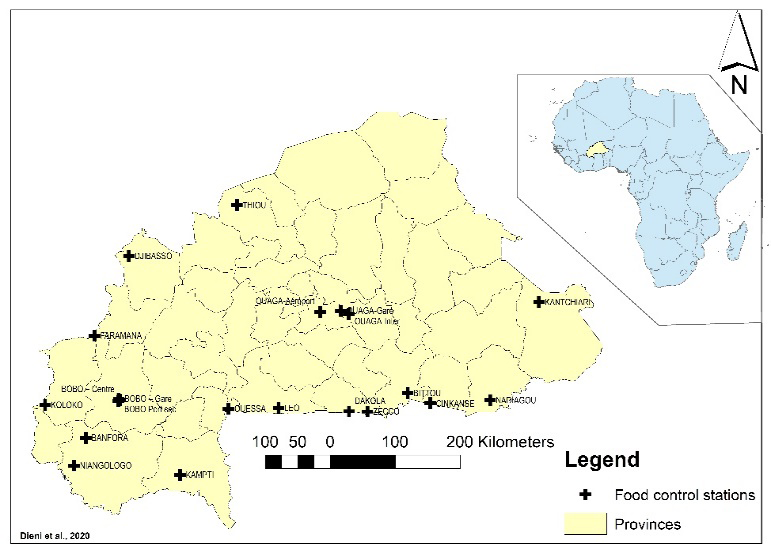
This study was conducted from mid-February 2020 to early April 2021, in nineteen (19) checkpoints in Burkina Faso including Bitou, Cinkansé, Kantjari, Léo, Dakola, Zeko, Ouessa, Nadiagou, Kampti, Faramana, Niankoloko, Koloko, Djibasso, Ouaga Gare, Ouaga Inter, Ouaga Aéroport, Bobo Gare, Bobo dry port and Bobo centre (Figure 1). The choice of these borders is justified by the fact that they are areas with high food import potential.
Survey
The methodological approach adopted consisted of the identification of study areas, the development of the data collection tool and the collection of data in the form of a survey/interview. The questionnaire survey was conducted among importers, freight forwarders and food inspectors at the nineteen (19) border crossings selected for the study. The questions addressed aspects relating to the types of food imported, origin and provenance, import procedures, conditions used (storage and transport conditions), capital availability, the uses of profits, and import license. At the end of the questionnaire, respondents’ socio-demographic characteristics were collected, including gender, age, Good Hygiene Training, and education level. The survey’s goal was to gather data for an evaluation of how import pattern affect food quality. A total of 362 persons, including two hundred and forty-five (245) freight forwarders, fifty-seven (57) food inspectors and 60 importers of dough and attiéké were interviewed. The individuals surveyed were randomly selected from each locality since we did not have a sampling frame.
Data Analysis
Data collected from survey and interview sheets were manually tabulated. Descriptive statistics were performed for all variables using the statistic software package (SPSS) version 20.0 and Microsoft excel version 2016.
Results and Discussion
Characteristics of food imported into Burkina Faso Our investigations revealed that the two border countries, Togo and Côte d’Ivoire, were the main food entry points into Burkina Faso due to the existence of their respective autonomous ports very beneficial for Burkina Faso. During the investigation period, products derive from plant, animal and fisheries were encountered (Table 1). As for imported fishery products, they were divided into three main categories: frozen or fresh natural products, semi-processed products and processed products represented by canned food. The main countries of supply were Mali, Senegal and Côte d’Ivoire. This could be explained by the fact that fisheries are one of the key sub-sectors of the Malian economy, as Mali is among the first African countries to produce freshwater fish [7]. With an estimated fish production of 118, 000 tons/year [7], Mali exported an average of 424 tons of fish to Côte d’Ivoire, Burkina Faso and Ghana [8]. Fishing plays a significant role in the economies of Côte d’Ivoire and the Senegalese as it is a great source of foreign exchange. The main fish product exported is fresh fish followed by canned and processed products [9].
| Examples | Origin/Provenance | |
|---|---|---|
| Imported crop products | ||
| Cereals and derivatives | Wheat seeds, wheat flour, Popcorn, corn gritz, malt, corn seeds, corn flour, rice seeds | France, Spain, Netherland, China, Japan, Vietnam / Côte d'ivoire, Mali, Togo, Ghana, Bénin |
| Fruits | Pineapple, Avocados, Bananas, Plantains, Strawberries, Dried Mango, Oranges, Apples, Grapes, Olives, Dates, Coconut, Kola Nuts, Papaya, Watermelons, Monkey Bread | Arabie Saoudite, Ghana / Côte d'ivoire, Mali, Togo, Bénin |
| Vegetables and derivatives | Tomato concentrates, Tomatoes, Garlic, Eggplant, Cabbage, Green beans, Lettuce, Onions, chillies, Canned vegetables, Tomato powders | Italie, Indonésie/Côte d'ivoire, Mali, Togo |
| Tubers and derivatives | Fresh cassava, cassava flour, fresh yam, potatoes, tigernuts, gari, attiéké, placali | Côte d'ivoire, Ghana, Togo, Mali |
| Legumes and derivatives | Lentils, Cowpea, Soybeans, peas | Côte d'ivoire, Togo |
| Oilseeds and derivatives | Peanuts, Vegetable oils, palm oil, margarine, sesame | Côte d'ivoire, Mali, Togo, Bénin |
| Drinks | Water, fruit juices, Alcoholic beverages, mango puree, ethyl alcohol | Nigéria, Ghana/ Bénin, Côte d'ivoire, Togo |
| Manufactured products | Coffee, couscous, Broths, Glutamate, mayonnaise, Food paste, juice powder, sugar, coffee, canned vegetables, Mustard, Liquid flavor, Confectionery (candy, biscuit, yeast, chocolate) | Côte d'ivoire, Mali, Togo |
| Animal and fishery products | ||
| Processed products (Preserves) | Sardines, Tuna | Europe, Afrique du Nord/ Côte d'ivoire, Togo |
| Meat and meat products | Red, white, Ox skin, tail meats | Côte d'ivoire, Mali, Togo |
| Milk and milk products | Milk powder, condensed milk, fresh milk, yogurt | Côte d'ivoire, Mali, Togo |
| Fishery products | Smoked fish, fresh fish, salted fish, dried, seafood, mackerel, tilapia | Sénégal / Côte d'ivoire, Mali, Togo |
| Poultry | Eggs | Mali, Togo, Ghana |
Table 1: Main foodstuffs imported into Burkina Faso and inspected by the inspectors.
Examination of the packaging of imported food revealed that it was mainly made of cardboard, propylene bags, jute bags, baskets, plastic bags, tanks, cans, plastic film and plastic bags (Table 2). The study also identified packaging glasses including vials, jars, jars used as packaging for jams, vegetables, fruit juices, oils, soft drinks and milk.
| Food | |
|---|---|
| Paper and cardboard | Fish products, poultry, processed products, fruit, beverages |
| Propylene bags | Drinks |
| Jute bags | Kola |
| Baskets | Tubers, roots |
| Plastic bags | Fermented dough, attiéké, Gari, dates |
| Tanks | Soft wheat, corn grit, malt |
| cans, drums | Foods oils |
| Plastic film, boxes | Fruits, vegetables |
| Packaging glass (bottles, pots, jars) | jams, fruit juices, oils, drinks, milk |
Table 2: Types of packaging identified.
Socio-demographic features of actors and regulatory framework Freight forwarders in the 31-50 age group had a proportion of 93.88%. This result could be explained by the fact that the activity requires a lot of physical effort, mobility and of course, it is the age group where Man is physically very fit and resistant. These findings align with those of numerous previous studies [10, 11, 12]. The results of our survey revealed the strong presence of men among food importing freight forwarders in Burkina Faso with a proportion of 96.73%. Only eight (8) women were among the two hundred and forty-five (245) freight forwarders surveyed, i.e. 3.27%.
The study also found that only 7.35% of freight forwarders were out of school compared to 92.65% of educated. Most freight forwarders had an acceptable level of education. The survey revealed that 59.18% had a higher level and 33.47% of freight forwarders had only completed elementary school. As for importers of cassava products, the majority of women 54 (90%) played the role of wholesaler and supplied the retailers who distributed the products concerned [6]. They were between the ages of 21 and 50, with an average age of 26. Only 9(15%) of importers of dough and attiéké had completed secondary education. As for food inspectors (n=57), their mission was to inspect, monitor and implement national standards to limit the risks of introducing the community of animal or plant diseases that could have disastrous economic and social consequences [13]. The proportion of inspectors in the 31-50 age group was 87.72%. The lowest level of education recorded at the level of screening officers was secondary school. Eighty-two decimal forty-seven percent (82.47%) of respondents had the secondary level and 17.54% had the higher level (Table 3). The acceptable level of study of the controllers could be explained by the fact that the recruitment by the Burkinabe civil service of the agents assigned to these controls is conditioned at least by the middle school degree. Sixty-six decimal sixty-six percent (66.66%) of men compared to thirty-three decimal thirty-four percent (33.34%) of women were surveyed.
| Freight forwarders (n=245) | Importers of cassava derivatives (n=60) | Inspectors (n=57) | |
|---|---|---|---|
| Age group | |||
| 21 - 30 | 15(6.12%) | 17(28.33%) | 7(12.28%) |
| 31 - 50 | 230 (93.88%) | 43(71.67%) | 50(87.72%) |
| Sex | |||
| Male | 237(96.73%) | 6(10%) | 38(66.66%) |
| Female | 8 (3.27%) | 54(90%) | 19(33.34%) |
| Education level | |||
| Illitterate | 18(7.35%) | 13(21.67%) | 0(0%) |
| Primary school | 82 (33.47%) | 35(58.33%) | 0(0%) |
| Secondary school | 145 (59.18%) | 9(15%) | 47(82.47%) |
| Higher education | 0(0%) | 3(5%) | 10 (17.54%) |
Table 3: Typology of food import actors.
The survey revealed that only 4.9% of importing freight forwarders had received training in good import procedures compared to 95.10% who worked in the trade with no real training basis (Table 4). Similarly, among importers of cassava derivatives, 25% had benefited from training compared to 75% who had not. Our results corroborate those of the study of the FAO [14] which found that most of the operators were very limited because of the limited resources they had. And yet, they are primarily responsible for the safety of the food they import [13]. In this study, it was found that the level of education was not related to the application of good hygiene practices. Importers of cassava derivatives were in the majority (56.67%) without adequate means of transport. Also, the study found that the food was often mixed with other products (miscellaneous products) often toxic because the majority of importers did not have vehicles suitable for transporting food. This constant mixing of individuals and commodities could promote the spread of many infectious diseases [15]. Indeed, the first thing that strikes you when you enter a place of unloading goods (bus station and railways), is the lack of hygiene. Overall, these are dilapidated places. These import routes need to be given particular attention in anticipation of possible epidemics [16]. Indeed, foodborne diseases could be contracted through the consumption of imported food, as international food trade diversifies with increasing involvement of emerging countries, such as China and Brazil.
| Freight forwarders (n=245) | Importers of attiéké and dough (n = 60) | |
|---|---|---|
| Food hygiene training | ||
| Yes | 12 (4.9%) | 15(25%) |
| No | 233(95.10%) | 45(75%) |
| Application of good import practices | ||
| Yes | 15(6.12%) | 26(43.33%) |
| No | 230 (93.88%) | 34 (56.67%) |
Table 4: Training in food hygiene and good import practices for stakeholders.
Ninety-seven decimal fourteen percent (97.14%) of freight forwarders interviewed held authorizations and/ or a Prior Import Declaration (PID) to practice the trade compared to 2.86% who did not (Table 5). This can be understood by the fact that the PID is payable for any import with a value greater than or equal to 500,000 FCFA [17]. This could also be explained by the fact that this sector is highly formal. Therefore, the majority has recourse to an authorization to operate. However, no importer of fermented cassava dough or attiéké held a PID. This second situation could be explained by the fact that these products are loaded into passenger trains and that their values are generally less than 500,000 FCFA. In general, six decimal ninety- four percent (6.94%) of the actors had stated that they did not have the capital to carry out their activities (Table 5). However, the social importance of this activity is confirmed by the fact that 39.67% of the actors said they devoted the profits to the maintenance of their respective families. These profits also allowed 37.38% of the actors to save to face the various projects that consist of improving their activities and 18.03% to maintain their trucks.
| Freight forwarders | Importers | |
|---|---|---|
| Licensure | ||
| Prior Import Declaration | 238 (97.14%) | 0(0%) |
| No Prior Import Declaration | 7(2.86%) | 60(100%) |
| Availability of capital | ||
| Available capital | 228(93.06%) | 48 (80%) |
| No capital | 17 (6.94%) | 12(20%) |
| Uses of benefits | ||
| Personnel care | 12 (4.90%) | 3(5%) |
| Family care | 75(30.61%) | 46(76.67%) |
| Savings | 103(42.04%) | 11(18.37%) |
| Truck maintenance | 55 (22.45%) | 0(0%) |
Table 5: Regulatory and organizational parameters of import actors in Burkina Faso.
Conclusion
This study, although very partial, shows the adaptive capacities for healthy and sustainable food security. Good hygiene and import procedures are accessible to everyone, but it is the responsibility of governments to provide the framework and the necessary preliminary conditions. The importance of complying with food hygiene regulations must be promoted among importers, who are mostly men. However, these campaigns must be coordinated by government agencies; they require collaboration and communication between the different services involved in food safety. It is therefore more effective to broadcast a message with a socially desirable content to obtain a change in behavior than to be satisfied with a message on health. These findings suggest that to safeguard consumer health and safety, it is essential to set up in the nation an efficient system of actor capacity building and food control.
Author Contribution
Traoré Kuan Abdoulaye, Djibrine Mayoré Atéba, Bako Evariste, Soro Daniel Karna, Nikiema Marguerite Edith Malatala, Tapsoba François, Zongo Oumarou, and Savadogo Hymeya Eric: writing original draft and visualization; Bagré Touwendsida Serge: Conceptualization and visualization of manuscript; Barro Nicolas: data analysis, graphing, writing the production data, and final approval of the version to be published; Diéni Ibonyé: Conceptualization and editing of manuscript.
Conflict of Interest
We confirmed that there is no potential competing conflict of interest. Knowledge The authors would like to thank the “Direction Générale des Services Vétérinaires” (DGSV) and the “Direction de la Protection des Végétaux et du Conditionnement” (DPVC) of Burkina Faso as well as the border inspectors for their collaboration in the collection of statistical data during this research work. We also thank all importers and freight forwarders who freely agreed to participate in this study.
References
-
Tchékémian A (2022) Le localisme face aux crises liées à la Covid-19: les défis sociétaux de l’agriculture française pour une alimentation durable et une santé globale. Environement, Risques & Santé 21(5): 367-374.
-
Coste C (2011) Dispersion de pathogènes en relation avec la mobilité animale. Mémoire de master 2, Surveillance épidémiologique des maladies humaines et animals, Paris, pp: 53.
-
Agrisud International (2020) L’agriculture familiale agro-écologique pour des systèmes alimentaires durables. RMT Alimentation Locale.
-
Banque mondiale (2020) Burkina Faso, vue d’ensemble.
-
Dugué P, Kohio EN, Tiemtoré J (2021) L’agriculture burkinabè face à la crise de la Covid-19 : cas des régions du Yatenga et des Hauts-Bassins. Cah Agric 30(16): 10.
-
Guira F (2016) Potentialités technologiques des racines de manioc à travers la production de l’attiéké: aspects nutritionnels, biochimiques, microbiologiques et moléculaires. Thèse de Doctorat Unique, Université OUAGA I Professeur Joseph KI-ZERBO, Ouagadougou, pp: 198.
-
Journées du poisson au Mali: Une nouvelle ère pour les acteurs du secteur , Economie, Elévage/Péche.
-
Food and Agriculture organization of the United Nations (2007) The Republic of Mali Economic Data Wales.
-
Export S (2021) Fishing and fisheries resources in Senegal. Fisheries resources.
-
Drabo KM, Toe LP, Savadogo LGB, Zongo I, Tarnagda Z, et al. (2009) Caractéristiques de l’alimentation de rue dans la ville de Bobo-Dioulasso, Burkina Faso. Bull Soc Pathol Exot 102(1): 36.
-
Bhat GM, Nengroo AH (2013) Urban Informal Sector: A Case Study of Street Vendors in Kashmir. Int J Manag Bus Stud 3(1): 112-115.
-
Tavonga N (2014) Nature, Operations and Socio- Economic Features of Street Food Entrepreneurs of Harare, Zimbabwe. IOSR J Humanities Soc Sci 19(4): 49- 58.
-
FAO (2017) Manuel sur le contrôle des importations alimentaires fondé sur les risques. Food Safety and Quality, Rome, Italy, pp: 186.
-
FAO (2022) La situation des marchés des produits agricoles. La géographie du commerce alimentaire et agricole: quelles politiques pour un dévelopement durable? Rome, Italy.
-
Danis M (2022) Les maladies du voyage et d’importation. Editorial . Actualité et dossier en santé publique n° 76, Doc Francaise, Paris, France.
-
Bovet P, Gédéon J, Louange M, Durasnel P, Aubry P, et al. (2012) Situation et enjeux sanitaires aux Seychelles en 2012. Med Sante Trop 23(3): 256-266.
-
UPJ (2013) Loi n° 012-2013/AN portant régime général des importations et des exportations au Burkina Faso. President du conseil des ministres.
- The Role of Podocyte Apoptosis and the Involvement of SIRT1 in Diabetic Nephropathy
- Dealcoholization of Beer by Osmotic Distillation for the Beverage Industry
- Biopolymer-Based Edible Packaging- Biomaterials, Methods, and Applications in Food Industry: An Updated Review
- Influence of Bioprocessing Methods on 'China Rice' (Gawal R1), and Soyabean Supplementation on the Quality of Complementary Food
- Cassava (Manihot esculenta) Varietal Growth, Yield and Cyanide Content Performance in Three Sites in the South- Eastern Semi Arid Regions of Kenya
- Food Waste Treatment, Recycling, Management and Production of Value-Products-An Update on Methodologies and Current Trends