
Effect of Screen Time on Compulsive Eating Behavior and Nutritional Status of Children
Objectives: A study to assess the correlation between screen time exposure and nutritional status and compulsive eating behaviors. Background: Screen time is a sedentary activity that affects child’s physical and mental development. Eating behavior research focuses on the prevention and treatment of obesity and eating disorders. Restrained or emotional eating in children and adolescents suggests relationships with body weight or obesity. Childhood overweight and obesity can lead to many health-related conditions, including cardiovascular disease, diabetes, sleep apnea, arthritis, and cancer. Method: The sample was composed of 100 subjects ranging from 5-12 years old. A growth chart from the IAP (Indian Academy of Pediatrics) was used to record nutrition status. Kagan et al. Compulsive eating was examined with a questionnaire. Screen time was assessed by AAP (American academy of paediatrics) screen time by age guidelines. All data were analysed through probability value, correlation was done by Pearson’s correlation and chi-square test. Result: The result showed that out of 100, 14 % of participants had moderately used screens and 86% had excessive use of screens. 38% of participants had low- compulsive eating, 48% of participants had moderate compulsive eating and 14% of participants had high-compulsive eating. Conclusion: The correlation between screen time, compulsive eating, and junk food consumption showed that participants who had higher screen time had higher compulsive eating, lower physical activity, and more junk food consumption.
Introduction
Screen Time
The amount of time a person spent using a device with a screen such as a smartphone, computer, video game, or Commentary television console. It’s a sedentary activity, meaning you are not being physically active. Energy used during screen time is very less [1]. Screen time directly affects child’s physical and mental development [2, 3]. The screen time influence shows positive and negative impact on child’s health. The positive or negative health effects of screen time are influenced by levels and content of exposure [4, 5].
Global Scenario: The American Academy of Pediatrics recommends that children between 2 and 5 years of age should restrict their screen time exposure to 1h per day of high-quality programs. The committee discourages media use in children below 2 years of age. Video-chatting is allowed in children above 18 months [6].
According to the American Academy of Child and Adolescent Psychiatry [6] children of 8 -12 years in united states on an average spends 4-6 hours a day watching or using screens and teens spend up to 9 hours.
Increased screen time during the COVID-19 pandemic is associated with negative lifestyle behaviors among Indian adolescents. The results are consistent with previous studies that have shown a negative association between screen time and physical activity, sleep, and dietary habits in adolescents [7, 8], positive association between overall TV viewing and commercial TV viewing with addictive-eating and addictive phone use [9, 10, 11, 12].
Compulsive Eating
Behavioral patterns of compulsive eating, defined as repetitive bouts, without homeostatic function, with adverse consequences, and as ways to relieve stress, are common across several eating-related conditions [13]. Binge eating in children has increased while watching television, and this includes consuming more high-fat, high-sugar and carbohydrate meals and beverages on an ongoing basis, as well as fewer fruits and vegetables [14]. Although these changes in intake are negligible, their combined impact could help explain why eating while watching television is associated with a higher risk of childhood obesity. Eating behavior research focuses on the etiology prevention, and treatment of obesity and eating disorders [15, 16].
In the Preadolescence developmental period many eating problems are appearing. Restrained or emotional eating in children and adolescents suggests relationships with body weight or obesity, and the development of eating disorders (anorexia, bulimia). The study also confirms the childhood overweight and obesity association and psychological factors (from compulsive eating behavior) [17, 18, 19, 20, 21].
Materials & Methods
Study Type
The cross-sectional observational study was conducted on children of Ahmedabad, Gujarat.
Study Period
This study was conducted from January 2021 to march 2021.
Sampling Type
100 subjects and with age range of 5-12 were selected through random sampling technique. Such selection allowed distribution of participants from various socio- economic groups. Only those children who came under the following criteria were selected in the study. Demographic and anthropometric data were collected from the subjects. This study was approved by the professor of Gujarat university, Ahmedabad, Gujarat.
Sampling Technique
The snowball sampling technique was used for the Sample size: sample size was calculated based on the following parameters: Assessment of screen time, food frequency and compulsive eating.
Inclusion Criteria
The subjects were aged 5 – 12 years. Healthy subjects both male and female were part of the study. Exclusion Criteria: the subjects possess a history of any disease conditions, age group less than 5 and more than 12 were excluded.
The structured survey questionnaire was developed to asses screen time, food frequency, eating behavior. The review of questionnaires was done by professional guide of Gujarat university department. The reliability, and correlation score of pilot study using 10 participants was 0.99. The questionnaires were prepared using previous literature papers and briefing out the common.
The questionnaires were consisting of demographic data, anthropometry evaluation, screen time, food frequency and compulsive eating.
The demographic data were collected including: Age, gender, education, family background, number of family members, parent’s occupation and food habits. For the anthropometric assessment height, weight and BMI was calculated and Nutritional status was recorded using IAP (Indian Academy of Pediatrics) growth chart [22].
Screen time was assessed by AAP (American academy of pediatrics) screen time by age guidelines and a questionnaire was designed, where use of screen time was categorized in 3
categories: limited, acceptable and excessive [23].
Nutritional Evaluation was assessed by the Food Frequency Questionnaire (FFQ). where a checklist of foods and beverages with a frequency response section for subjects to report how often each food item was consumed over a specified period [24]. For every food different frequency was prepared and scoring of 0 to 4 was given Binge eating assessment was done by compulsive eating questionnaire designed by kagan and squires were used. The questionnaire was modified as per need with the guidance of professional guide [3, 25, 26]. The multiple-choice options were scored from 0 to 3. Where each question’s maximum scoring will be 1, 2 or 3 that basis researchers conclude the severity of compulsive eating.
Statistical Methods
Mean average values were calculated for anthropometric measures and daily equivalent for food frequency and compulsive eating. Standard deviation (SD) and standard error mean (SEM) was calculated for background information, anthropometric measures, screen time and compulsive eating.
Pearson’s correlation and non-parametric correlation was performed for checking significant correlation between screen time, compulsive eating, fruits and vegetables and junk food. Chi- square test was done to know the statistical difference of the different parameters of background information, anthropometric measures and screen time.
Ethical Approval
The study was approved by the school of science, GU, Navarangpura, Ahmedabad, Gujarat, India with reference number IECHR- GU (2021/03) dated 15/03/2021. All the study subjects verbally explained the study’s intention, motive and future scientific publication.
Results
In this observational study 100 patients were included. The patients had mean age of (7.31+12.66) years. Of the participants 54% were girls and 46% were boys. There was a significant difference in age, education level and family background of subject and no significant difference in gender, no. of family members, occupation, and food habits. There was no significant difference in BMI of the subjects and their total screen time.
| SD | SE | P Value | |
|---|---|---|---|
| Age | 12.66 | 7.31 | 0.008 |
| Gender | 5.65 | 9 | 0.424 |
| Education level | 17.03 | 9.83 | 0.0002 |
| Family background | 19.79 | 14 | 0.005 |
| No. Family members | 2.88 | 1.66 | 0.778 |
| Occupation | |||
| • Father | 52.57 | 30.35 | 8.869 |
| • Mother | 69.29 | 49 | 1.125 |
| Food habits | 29.39 | 16.95 | 5.669 |
| Height | - | 11.66 | - |
| Weight | - | 5.28 | - |
| BMI | - | 0.535 | - |
| BMI Categories | |||
| • Acceptable | 2.08 | 1.2 | 0.067 |
| • Excessive | 23.27 | 11.63 | 1.306 |
| Total screen time | 50.91 | 36 | 6.021 |
| Compulsive eating | 17.47 | 10.08 | - |
Table 1: SD and SE values of background information, anthropometric data, total screen time and compulsive eating.
As per the use of screen time subjects were divided into categories - limited, acceptable and excessive screen time. It showed 86% had excessive screen time. Compulsive eating was observed in categories - low (0-5), moderate (6-11) and high (12-17) as per their daily equivalence score. Where 48% of participants had moderate compulsive eating and 14% ng. (SD=17.47, SEM=10.08)
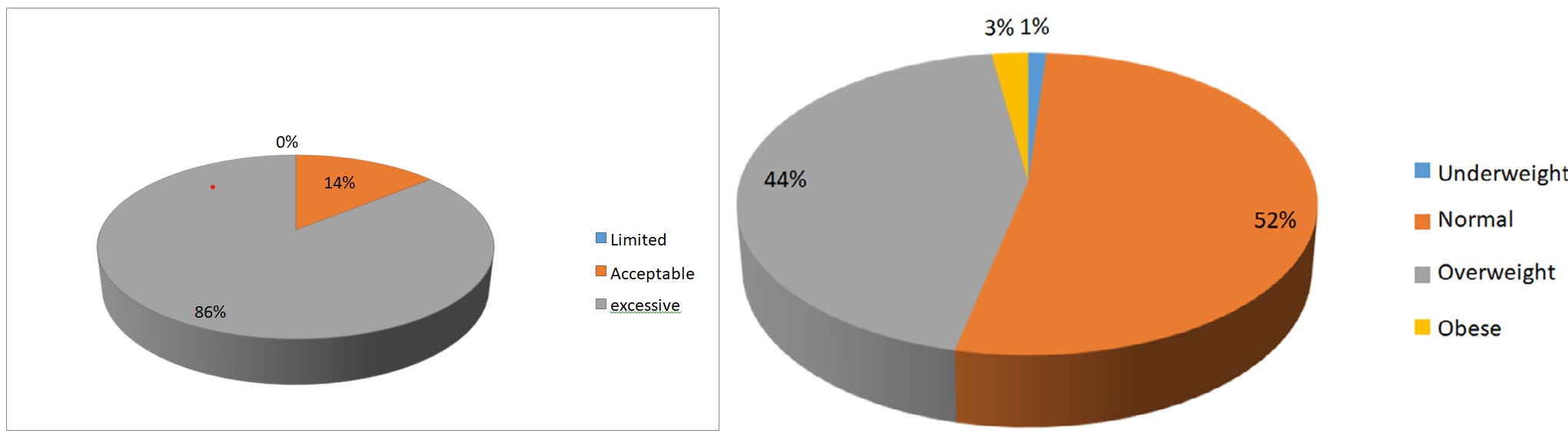
Screen Time Subjects into Categories
Percentage Distribution of Subjects as per BMI
The individuals were separated into four groups based on their BMI: underweight, normal, overweight and obese. out of which 44% were overweight and 3% were obese.
Percentage Distribution of Subjects
There exists a significant relationship between compulsive eating (CE) and screen time (ST) and junk food (JF) These studies demonstrate a rise in screen time increases respondents’ compulsive eating (CE), increases their consumption of junk food, and increases their screen time respondents with higher Compulsive eating also consume more junk food. Fruits and vegetables and junk food do not significantly correlate with one another, despite respondents’ high overall food consumption.
| CE | ST | FV | JF | ||
|---|---|---|---|---|---|
| CE | Pearson Correlation | 1 | .173* | -0.101 | .372** |
| CE | Sig. (1-tailed) | 0.043 | 0.159 | 0 | |
| CE | N | 100 | 100 | 100 | 100 |
| ST | Pearson Correlation | .173* | 1 | -0.057 | .273** |
| ST | Sig. (1-tailed) | 0.043 | 0.287 | 0.003 | |
| ST | N | 100 | 100 | 100 | 100 |
| FV | Pearson Correlation | -0.101 | -0.057 | 1 | .339** |
| FV | Sig. (1-tailed) | 0.159 | 0.287 | 0 | |
| FV | N | 100 | 100 | 100 | 100 |
| JF | Pearson Correlation | .372** | .273** | .339** | 1 |
| JF | Sig. (1-tailed) | 0 | 0.003 | 0 | |
| JF | N | 100 | 100 | 100 | 100 |
Table 2: Pearson’s cross correlation values of screen time with compulsive eating, fruits and vegetables and junk food.
* Correlation is significant at the 0.05 level (1-tailed). ** Correlation is significant at the 0.01 level (1-tailed). Table 2: Pearson’s cross correlation values of screen time with compulsive eating, fruits and vegetables and junk food.
Table 2 shows There was a significant difference in age, education level and family background of subject and no significant difference in gender, no. of family members, occupation, and food habits. There was no significant difference in BMI of the subjects and their total screen time.
Discussion
In this study, a food frequency questionnaire was created to assess the subjects’ nutritional status. It asked about the frequency with which they consumed foods from all food groups, including cereal, pulses, fruits, vegetables, nuts, milk products, and junk food, on a scale of daily to fortnightly to weekly to never [27].
For the assessment of their screen among individuals, different types of questions were framed related to their gadgets, screen time, their behavior [28]. The different screen-time-related questions were explained to the participants’ parents. The American Academy of Pediatrics’ (AAP) age-specific recommendations for screen time were used to determine scoring [29], where the amount of screen time was divided into three categories—limited, reasonable, and excessive obese.
For the assessment, compulsive eating questionnaire designed by Kagan and squires was used. The questionnaire was modified as per need with the guidance of professional guide [5]. The questionnaire included a psychological factor that influences dietary habits of respondents [30].
It was a close ended multiple-choice questionnaire. It was used to measure uncontrollable eating patterns of participants. The scale has 12 items that asses the inability to control one’s eating behavior in terms of overeating and eating when not hungry among the children of Ahmedabad city.
According to this study, children’s development, physical health, and mental health are all negatively impacted by their increasing use of screens during the COVID19 pandemic [18], the statistical analysis for the demographic data was done with standard deviation and mean and there were no significant differences in the individuals’ gender, number of family members, occupation, or eating habits. Out of 100 individuals, 86 per cent reported having excessive use of screens. the Pearson’s correlation and daily equivalent showed with regard to acceptable and excessive screen time, participants on average consumed food at levels between moderate and high, and those with more screen time consumed more junk food than fruits and vegetables. Screen time and compulsive eating were significantly positively correlated, with excessive use being associated with higher levels of compulsive eating.
Conclusion
This study’s findings suggest a strong link between children’s excessive screen time and their consumption of junk food as well as the emergence of obsessive eating habits. According to the findings, kids who spent too much time in front of screens— including television, laptops, smartphones, and video games—exhibited a higher intake of harmful, nutrient-poor meals. The study also discovered a connection between excessive screen usage and compulsive eating habits. In contrast to physiological hunger, compulsive eating refers to the practice of eating in response to emotional impulses. Increased emotional arousal in children who spend more time in front of screens may increase their propensity to use compulsive eating as a coping technique.
References
-
Canadian Paediatric Society (2017) Screen time and young children: Promoting health and development in a digital world. Paediatrics & Child Health 22(8): 461-468.
-
Stiglic N, Viner RM (2019) Effects of screentime on the health and well-being of children and adolescents: a systematic review of reviews. BMJ Open 9(1).
-
Domingues SM (2017) Clinical and psychological effects of excessive screen time on children. J Paediatric Child Health 53(4): 333-338.
-
Sanders T, Parker PD, Cruz BDP, Noetel M, Lonsdale C (2019) Type of screen time moderates’ effects on outcomes in 4013 children: evidence from the Longitudinal Study of Australian Children. Int J Behav Nutr Phys Act 16: 117.
-
Indian psychiatric society (2020) Recommendations for Screen Use.
-
American Academy of Child & Adolescent Psychiatry (2020).
-
Moitra P, Madan J (2022) Impact of screen time during COVID-19 on eating habits, physical activity, sleep, and depression symptoms: A cross-sectional study in Indian adolescents. PLoS One 17(3).
-
Sanders T, Parker PD, Cruz BDP, Noetel M, Lonsdale C (2019) Type of screen time moderates’ effects on outcomes in 4013 children: evidence from the Longitudinal Study of Australian Children. International Journal of Behavioural Nutrition and Physical Activity 16(1): 1-10.
-
Munkholm A, Olsen EM, Rask CU, Clemmensen L, Rimvall MK, et al. (2016) Eating behaviours in preadolescence are associated with body dissatisfaction and mental disorders - Results of the CCC2000 study. Appetite 101: 46-54.
-
Twenge JM, Campbell WK (2018) Associations between screen time and lower psychological well-being among children and adolescents: Evidence from a population- based study. J Prev Med Rep 12: 271-283.
-
Kaur N, Gupta M, Kiran T, Malhi P, Grover S (2021) Development and evaluation of the digital-screen exposure questionnaire (DSEQ) for young children. PLoS One 16(6): e0253313.
-
Stiglic N, Viner RM (2019) Effects of screen time on health and well-being of children and adolescents: a systematic review. BMJ open 9(1): e023191.
-
Domoff SE, Sutherland E, Yokum S, Gearhardt AN (2021) The association of adolescents’ television viewing with Body Mass Index percentile, food addiction, and addictive phone use. Appetite 157: 104990.
-
Scaglioni S, Cosmi VD, Ciappolino V, Parazzini F, Brambilla P, et al. (2018) Factors Influencing Children’s Eating Behaviours. Nutrients 10(6): 706.
-
Avery A, Anderson C, McCullough F (2017) Associations between children’s diet quality and watching television during meal or snack consumption: A systematic review. Matern Child Nutr 13(4): e12428.
-
McCuen-Wurst C, Ruggieri M, Allison KC (2018) Disordered eating and obesity: associations between binge-eating disorder, night-eating syndrome, and weight-related comorbidities. Ann N Y Acad Sci 1411(1): 96-105.
-
Kakoschke N, Aarts E, Verdejo-García A (2019) The Cognitive Drivers of Compulsive Eating Behavior. Front Behav Neurosci 12: 338.
-
Madhava KC, Sherchand SP, Sherchan S (2017) Association between screen time and depression among US adults. Preventive medicine report 8: 67-71.
-
Mitariu L, Maniu GC (2018) Obesity and Emotional Arousal and Control in Children Aged 8 To 11 Years. SEA: Practical application of science 6(17): 163-169.
-
Moore CF, Sabino V, Koob GF, Cottone P (2017) Pathological overeating: emerging evidence for a compulsivity construct. Neuropsychopharmacology 42(7): 1375-1389.
-
Ranjani H, Mehreen TS, Pradeepa R, Anjana RM, Garg R, et al. (2016) Epidemiology of childhood overweight & obesity in India: A systematic review. Indian journal of medical research 143(2): 160-174.
-
Kaur N, Gupta M, Malhi P, Grover S (2019) Screen Time in Under-five Children. Indian Pediatr 56(9): 773-788.
-
AAP (2016) Media and Young Minds. Pediatrics 138(5): e20162591.
-
Vijay A, Mohan L, Taylor MA, Grove JI, Valdes AM, et al. (2020) The Evaluation and Use of a Food Frequency Questionnaire Among the Population in Trivandrum, South Kerala, India. Nutrients 12(2): 383.
-
Mostafavi SA, Keshavarz SA, Mohammadi MR, Hosseini S, Eshraghian MR, et al. (2016) Reliability and Validity of the Persian Version of Compulsive Eating Scale (CES) in Overweight or Obese Women and Its Relationship with Some Body Composition and Dietary Intake Variables. Iran J Psychiatry 11(4): 250-256.
-
Anitha GFS, Narasimhan U (2020) Coronavirus disease 2019 and the inevitable increase in screen time among Indian children: Is going digital the way forward. Indian Psychiatry Journal 29(1): 171-175.
-
Dy ABC, Dy ABC, Santos SK (2023) Measuring effects of screen time on the development of children in the Philippines: a cross-sectional study. BMC Public Health 23: 1261.
-
Altena E, Baglioni C, Espie C, Ellis J, Gavriloff D, et al. (2020) Dealing with sleep problems during home confinement due to the COVID-19 outbreak: Practical recommendations from a task force of the European CBT-I Academy. J Sleep Res 29(4): e13052
-
Ng CSM, Ng SSL (2022) Impact of the COVID-19 pandemic on children’s mental health: A systematic review. Front Psychiatry 13: 975936.
-
LeBlanc AG, Katzmarzyk PT, Barreira TV, Broyles ST, Chaput JP, et al. (2015) Correlates of Total Sedentary Time and Screen Time in 9–11-Year-Old Children around the World: The International Study of Childhood Obesity, Lifestyle and the Environment. PLOS ONE 10(6): e0129622.
- The Role of Podocyte Apoptosis and the Involvement of SIRT1 in Diabetic Nephropathy
- Dealcoholization of Beer by Osmotic Distillation for the Beverage Industry
- Biopolymer-Based Edible Packaging- Biomaterials, Methods, and Applications in Food Industry: An Updated Review
- Influence of Bioprocessing Methods on 'China Rice' (Gawal R1), and Soyabean Supplementation on the Quality of Complementary Food
- Cassava (Manihot esculenta) Varietal Growth, Yield and Cyanide Content Performance in Three Sites in the South- Eastern Semi Arid Regions of Kenya
- Food Waste Treatment, Recycling, Management and Production of Value-Products-An Update on Methodologies and Current Trends