
Adopting Lewin’s Force Field Analysis as Sustainable Tool to Reduce over Maize Dependence in Malawi
This study has found out that Malawi is currently entrenched in maize consumption while disregarding other healthier and cheaper food alternatives such as orange sweet potatoes, cassava and irish potatoes. This is leaving more Malawians malnourished while the country is suffering from massive forex drainage inhibiting the country from importing essential drugs and petroleum products. Continued over reliance on maize is therefore both an economic challenge and health hazard. Changing the current status quo however requires substantial commitment and Lewin’s Force Field Analysis was adopted to provide a platform to look at ways of redressing the current situation. There is a possibility of changing the current scenario through deliberate approaches in the school feeding programme.
Introduction
Food sufficiency at household level remains a far-fetched dream despite the country registering significant production levels over the past thirty years or so. Consequently, the rates of stunting and anaemia remain high and obesity amongst women is rising [1]. This is principally attributed to erratic maize production which is considered the staple food of the country. World Food Programme Malawi (2022:3) recommended that the Government of Malawi should strike a balance in the matters of land and agricultural policies to enhance and bolster the productivity of other food- security crops and ensure consumption of nutrient dense foods. Food is considered a basic necessity [2]. It was also declared a universal human right [3]. It is also considered a physiological need under motivational theories [4]. It is also a national security issue [5]. Food is also at the core of human development and it therefore falls under Sustainable Perspective Development Goal 2 (End hunger, achieve food security and improved nutrition and promote sustainable agriculture) of the United Nations Sustainable Development Goals by 2030 [6].
Malawian Food Industry
Malawi is situated in Southern East Africa and has an estimated population of 21,279,597 [7]. Malawi cultivates a lot of food crops such as maize, groundnuts, sweet potatoes as per Government of Malawi Annual Economic Outlook Report [8] with quantities of such food crops provided in appendices 1 and 2 attached hereto for ease of reference. Maize is however considered the staple food for the general populace and therefore foundation of the agrifood system [9]. The Government of Malawi promotes buying and selling of maize through its wholly owned company simply known as ADMARC.
Synopsis of ADMARC
ADMARC is acronym for Agricultural Development and Marketing Corporation and is a state owned enterprise and established in 1971 [10] under ADMARC Act but later incorporated as a private limited company in preparation for its privatization [11]. ADMARC is charged with buying maize from farmers at a minimum support price [12] and at the same time improving food security of vulnerable Malawian households [13]. ADMARC has been rocked with underfunding and inefficiencies such that despite having large networks of depots, certified warehouses and widespread existence of farmers’ association in Malawi, only a few traders made purchases from or sold to those outlets [14]. Problem Statement Government of Malawi Economic Annual Report (2021:11) and Government of Malawi Economic Report (2022:22) indicated that Malawi registered bump yield at a country level yet almost half the Malawian population was food insecure in 2022/2023 as per the IPC Acute Food Insecurity Analysis Malawi [15] which noted that only about 8,809,000 Malawians would be food secure between October 2022 and March 2023 while about 6,673,000 would be food stressed while about 3,822,000 would be people in food crisis. Famine Early Warning Systems Network [16] indicates that Malawi’s food production for 2023 will be significantly lower with an estimated 30 - 35 percent below the normal levels due to reduced access to fertilizer/inputs and the impacts of Tropical Cyclone Freddy in Southern Malawi such that it estimated that Malawi will register a negative net maize stock for the 2023/2024 consumption season with maize prices expected to ten times the price of the past five years exposing millions of poor people into acute food shortage.
While the focus is on maize, the annual production for sweet potatoes, cassava and irish potatoes is almost four times as much as that of maize and therefore Malawians should not be expected to starve in 2023/2024 period but this is exactly what is being feared for. Malawi was the second biggest world producer of sweet potatoes in 2019 - FAOStat (2019) cited in Cook R [17]. There is something really wrong with Malawians as they purport to starve when other food crops are in abundance.
Food and Malawi Development Agendas
Kampanje BP [18] noted that food security has been part of the fabric of the Malawi’s development agendas such as the Malawi Vision 2020 launched in 1998, Malawi Growth and Development Strategy (2006-2011), Malawi Economic Recovery Plan (2012), Malawi Growth and Development Strategy II (2011-2016) and the Sustainable Development Goals (SDGs) which Malawi adopted in 2015 to run up to 2030. Malawi is therefore committed to end hunger under Sustainable Development Goal Number 2. It could be argued that Malawi might not be far from achieving this goal if the tubers in the form of cassava, sweet potatoes and irish potatoes are factored in. This is not however the perception of the general populace as food is only equated to maize and that has serious implications on the fiscal and monetary regimes as the inflation index is pegged to maize prices generally and no other foods.
Malawi adopted the Vision 2063 which is being implemented in phases with the first ten year plan running from 2021 through 2030 which is known as MIP 1 [19]. The MIP 1 noted prolonged politicization of maize as a staple food. This problem suggests that maize dependence has been used in the political environment leading to dysfunctional activities of ADMARC as noted above. There is a general notion that maize is at the core of the Malawian local culture and that a majority of the rural population now believes that the human kind will not survive if maize is scarce. This was not the case in the seventies as different parts of the country were consuming more cassava along the lake shores of Lake Malawi in the Northern Region. Sorghum was very popular in the Southern Region but all is long gone as the input subsidy programmes made it easier to harvest more maize at a household level much cheaper in view of the reduced maize cultivation costs. Food security is less prominent in the MIP 1 although there is promotion for consumption of highly nutritious foods as alternatives to maize.
Can Malawi be freed from Shackles of Maize?
There are currently no indications that maize overdependence will be resolved in the medium to long term as substantial budgetary support is channelled towards the maize taking as much eighty percent of the Ministry of Agriculture budget and yet no real tangible benefits are observable. While MIP 1 one propagates about mindset change as a catalyst for development (being the first enabler) of the country’s long term development agenda. The issues of promoting other foods as alternatives to maize were not considered as part of the mindset change and therefore a lost opportunity.
Lewin’s Field Force in Malawi’s Maize Industry
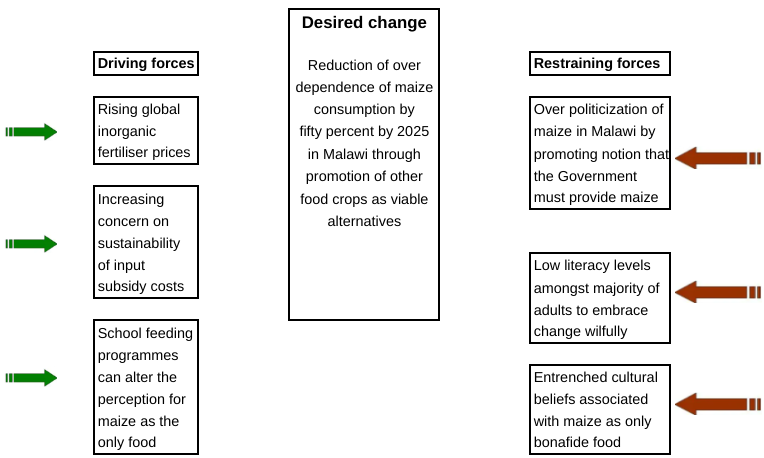
It is not going to be easy to convince a majority of Malawians that maize is not the only viable food crop as it is now deeply entrenched in the adult population. It is therefore important to adopt the Lewin’s as shown below.
Driving Forces
The driving forces to potential decrease in the overdependence of maize as staple food in Malawi rests with unsustainable increase in the global prices of inorganic fertilisers which is increasing the cost of maize. The farmgate price for maize in Malawi in the 2023 harvesting season which started in March 2023 has been pegged at MWK500.00 per kilogram which is a 100 percent rise from 2022 which was about MWK250.00 per kilogram. This is a result of substantial increase in global prices of the inorganic fertiliser which in part is as result of the conflicts in Eastern Europe. There is also growing public outcry in Malawi that equal priority must be given to animal production by subsidising domesticated animals such as goats, sheep etc. This is because other areas are not suitable for growing maize and they can rear animals which can be sold and buy maize thereafter.
The school feeding programme is a suitable platform to expose children to other alternatives such as cassava and sweet potato products. The children are more likely to accept such foods as long as they are tasty. Parents’ consent is still required to fully implement such programmes. Buying from the surrounding communities can give parents a chance to be involved in economic activities of selling such foods to be consumed by their children and therefore enabling children to have alternative foods.
Restraining Forces
Over politicization of maize is still a major problem as the rural masses truly believe that it is the role of the Government of Malawi to provide them with subsidised inorganic fertilisers and hybrid seeds to grow enough maize to feed their families and have surplus for sale. They also believe that it is the role of the Government of Malawi to provide them with free maize whenever their crops fail especially due to drought and famine. Consequently, the role of maize in the communities will continue to grow and any change in such policies will be seen as not being populist approach thereby reducing the chances of political victory. Any change in the current policy could be deemed political suicide. School feeding programmes could however be an agent of change if properly laid out.
Low literacy levels especially amongst the adults prevent them from understanding that maize has lower nutrients (vitamins and minerals) than orange sweet potatoes and are therefore likely to cling to beliefs that maize is much healthier than other food crops. Entrenched cultural beliefs such as wedding ceremonies, funerals, initiations and others promote consumption of maize in the form of starchy food, sweet local beer and indeed the local beer such that patrons would not be impressed if maize was not in abundance in such ceremonies. The youth and children can however change such perceptions if promoted.
Conclusion
It is widely believed that change is ubiquitous but that is certainly not the case with maize production and consumption in Malawi in view of being a geopolitical factor in Malawi. The cost of overreliance of maize in Malawi is quite intriguing but the possible change in perception requires substantial investment in mindset change programmes which are not currently running. The false belief that only maize is nutritious and affordable to majority rural masses needs intensive civic education to be eradicated. Malawi’s economy is currently suffering from a substantial inorganic fertiliser import bill and there appears to be no solution in sight. The consequences for the current status quo is acute shortage of forex which is hampering other essential services such as health and education as critical supplies are being sacrificed to eat maize.
Recommendations
The current situation has several downside risks which can trigger economic and social disturbances in Malawi. It is therefore recommended as follows:
- The Ministry of Finance and Economic Planning and Development should take a keen interest to evaluate the real economic risks posed by the countries over reliance on maize as staple food so that all relevant stakeholders can appreciate the current exposure. Food is life indeed but other important sectors such as health, water and sanitation development as well as education is equally important so that equitable distribution of resources will ensure good health of the citizenry. Malawians can do without maize. This must be reinforced through well- crafted messages over the radios, community meetings, political rallies and religious groupings.
- Innovation in the food industry is urgently required. The focus for Malawi should be on the production and promotion of highly nutritive foods with known tangible benefits and not merely make people have full stomachs. Food fortification at community level should be encouraged through well designed products to guarantee full adoption of such programmes.
- Encouragement of consumption of alternative products such as sweet potatoes and cassava in a tastier form especially among the toddlers and youth in the education system means that not only that food is wasted but that consumers enjoy them while having proven substantial benefits. This is a source of industrialization as food has an already established market. Children are easy to change and willing to embrace other forms of foods as long as they are tasty.
References
-
Harris J, Chalemera J, Nowa M, Mhango B, Lupafya P, et al. (2023) Malawi stories of change in nutrition: Overview, International Food Policy Research Institute, USA, pp: 6.
-
Hossain K, Raheem D, Cormier S (2018) Food Security: A Basic Need for Humans. In: Food Security Governance in the Arctic-Barents Region. Springer, Cham, pp: 142.
-
Harris J, Gibbons S, Kaaba O, Hrynick T, Stirton R (2022) A ‘Right to Nutrition’ in its Social, Legal, and Political Context: How International Human Rights Translate to Zambian Realities. Journal of Human Rights Practice 14(3): 879-903.
-
Wangina N (2021) Food Aid in the Form of Food for Education - A Critical Analysis between the Food for Schooling Programme and the School Feeding Programme in Maslow’s and Dependency Theorist’s Perspectives. Advance social science & humanities.
-
Kip T (2023) Opinion: Food security supports our national security. Agri Pulse.
-
Giuseppe G, Mateo A, Rangelov N, Buzeti T, Birt C (2022) Nutrition in the context of the Sustainable Development Goals. European Journal of Public Health 30(Supp_1): i19-i23.
-
CIA Factbook (2023) Malawi.
-
(2022) Government of Malawi Annual Economic Report.
-
White S (2019) A TEEBAgrifood Analysis of the Malawian Maize Agri-food system, The Future of Food: True Cost Accounting for Transformative Change, Brussels, Belgium.
-
Chinsinga B (2018) The political economy of agricultural commercialisation in Malawi, Centre for Social Concern, Centre for Social Research (CSR) Chancellor College, University of Malawi, Malawi.
-
African Development Fund (2006) Project Implementation Report-Structural Adjustment Loan: Republic of Malawi.
-
Mckee D (2022) Malawi seeking agricultural diversity. World-Grain.
-
Benson T (2021) Disentangling Food Security from Subsistence Agriculture in Malawi, International Food Policy Research Institute, Washington DC, USA, pp: 4.
-
Ochieng DO, Botha R, Baulch B (2019) Structure, conduct and performance of Maize Markets in Malawi: Synopsis. IFPRI Malawi, Policy Note 35.
-
World Food Programme Malawi (2022) IPC Analysis Report on the Chronic Food Insecurity Situation.
-
Famine Early Warning Systems Network (2023) Malawi Food Security Outlook, June 2023 - January 2014.
-
Cook R (2023) Ranking of countries that produce the most sweet potatoes (FAO). Beef2Live.
-
Kampanje BP (2017) Unlocking Mysteries Surrounding Development in Malawi. SSRN Development Economics: Regional and Country Studies eJournal 2(1).
-
Kampanje BP (2022) Malawian Parliamentary Oversight on Economy could be the sustainable solution to the acute forex shortage in the country thereby guarantee success of MIP 1 of Vision 2063. Munich Personal RePEc Archive.
- The Role of Podocyte Apoptosis and the Involvement of SIRT1 in Diabetic Nephropathy
- Dealcoholization of Beer by Osmotic Distillation for the Beverage Industry
- Biopolymer-Based Edible Packaging- Biomaterials, Methods, and Applications in Food Industry: An Updated Review
- Influence of Bioprocessing Methods on 'China Rice' (Gawal R1), and Soyabean Supplementation on the Quality of Complementary Food
- Cassava (Manihot esculenta) Varietal Growth, Yield and Cyanide Content Performance in Three Sites in the South- Eastern Semi Arid Regions of Kenya
- Food Waste Treatment, Recycling, Management and Production of Value-Products-An Update on Methodologies and Current Trends