
Effect of Air-Drying Temperature on Phenol Compound and Essential Oils Content in Lemon Leaves
The aim of this workis to study the effect of temperature on the drying kinetics, total phenolic and flavonoid compounds and finally on essential oils existing in lemon leaves. The experimental kinetics data isdivided into five empirical models and the best description is given by Logarithmic equation. For essential oil extraction, the highest yield was obtained at a drying temperature of 24.0°C, an extraction time of 125 min and at a water/vegetable matter ratio of 3.4. Volatile components were identified by GC-MS technique. The outcomes of the experiment indicate that temperature has a significant impact on the components of lemon leaves especially on essential oils. A temperature of 23.7°C produced the highest proportions main compounds (89.26%: Limonene, Monoyloxid, β-pinene). A queous extracts were prepared from the leaves of this plant dried at 30, 40, 50 and 60°C. The quantitative estimation of polyphenols and flavonoids by the UV. Visible spectrophotometer method revealed that the variation in the drying parameters has an influence on the content of these compounds.
Introduction
The vegetarian world is wealthy with investment and virtues; from which human beings extract not only nutritional ingredients, but also active substances, which are frequently an asset to the body once in a while touched by an insidious disorder. Tunisia is rich in virtuous plants that are usually used for anym purposes: medicines and nutrition [1]. Lemon leaves, which are unfortunately thrown away as agricultural waste, contain significant amounts of valuable components such as essential oils and phenolic compounds. The lemon tree is the most beneficial citrus species compared to orange and mandarin, with a production rate of 4.4 million tons in 2002. Argentina, with a production of 1.2 million tonnes, is now the most productive country of Citrus lemon in the world [2].
Enjoying an exceptional subtropical climate, with the most flourishing and beautiful orchards of the world, Tunisian citrus growers have developed their plantations.
Citrus production has increased sharply in the last two decades to reach one 100 Million tons. In Tunisia, the existing citrus area is about 21,000 ha planted by 6.4 million feet of different varieties compared to 16,100 ha in 1999, which is an increase of 26%.
The Tunisian citrus production holds the 9th position in the Mediterranean area with 220,000 tons per year, which represents approximately 1,2% of Mediterranean production and of which lemon trees represents 16% of the total citrus fruit [3].
In Tunisia, the citrus area is about 21,000 ha (6.4 million feet of different varieties) against 16,100 ha in 1999, hence an increase of 26%. Tunisian citrus production ranks 9th in the Mediterranean, with 220,000 tonnes on average per year in recent years, accounting for almost 1.2% of Mediterranean production and for which lemon trees cover 16% of total citrus fruit [4].
Lemon leaves are an inherent derivation of dietary fiber as well as a source of essential oil. The difference between the amount of water and moisture activity provides the necessary facts for lemon leaves treatment, especially for drying and storage [1]. The influence of temperature on the components of lemon leaves such as essential oils and phenol contents is explained in this research.
Chemical compositions of these plants are classified as primary and secondary metabolites. This research paper will focus on Secondary metabolites including essential oils and phenolic compounds, which are very important natural substances with several therapeutic and biological activities.
Polyphenols are quantitatively the most important secondary metabolites of plants. They have a wide variety of structures ranging from components containing a single phenolic nucleus (phenolic acid) to complex polymeric components such as tannins (catechin polymers and epicatechin having several tens of units). In addition, several forms of polyphenols are recognized for their antioxidant, anti-inflammatory, antifungal, antiviral and anticancer properties [5].
These plants are used in the fresh condition, but they undergo physical, chemical and microbiological changes caused by product water content, moisture activity and preservation condition [1]. This will bring about degradation of the product quality for a short storage period, that’s why the unique solution to avoid the wasting of these treasures is to dry the plant before storage.
Some studies revealed decay in EO (essential oil) efficiency and a modification in their chemical composition after a heat treatment [6]. Indeed, according to Ghanem, et al. [7], drying of aromatic plants is a solution to cover the needs of pharmaceutical industries that cannot use these plants in their fresh state. EOs of aromatic plant are the most supersensitive constituents to heat treatment. Their super- sensitivity determines the drying temperature because rather high values of the temperature can cause a loss by evaporation or damage of active ingredients [8].
Soares, et al. [9] investigate the impact of four drying temperatures (40, 50, 60 and 70°C) on essential oil concentration in Brazilian linalol. They concluded that the highest EO yield was achieved during a drying process that reached 40°C.
Traditionally, lemon leaves oils have been introduced in food products in view of their beneficial health properties. Dabbah, et al. [10] their exploitation as antimicrobial agents in chemicals is a former concept. In fact, they have been applied for therapeutic aims since antiquity and several academic projects have been carried out in order to defend their bioactivity on bacteria, yeasts and mildew. Essential oils extracted from citrus have frequently a pleasant scent and sometimes an original taste. They are therefore exploited with large quantities in aroma and perfume industries [11].
Despite the health-related properties of lemon leaves, little effort has been made in their chemical characterization. Indeed, lemon leaves are rich with phenols, flavonoids and essential oils [12]. In addition, few research projects have examined the impact of heat treatment on polyphenolic, flavonoid and essential oil content of lemon leaves.
Nowadays, the application of these compounds has aroused considerable interest as food additives and nutraceuticals in food and pharmaceutical industries [13]. Numerous techniques have been practiced for the extraction of phenolic compounds from lemon leaves [14]. On the other hand, to achieve a higher extraction yields, it is essential to reduce the water content of the samples before extraction. This study demonstrates the feasibility of using oven drying as a promising technique compared to other methods of lemon leaves’ drying.
In this context, this research paper aims at empowering lemon leaves by extracting their essential oil and determining their chemical composition, their polyphenols and flavonoids content as a function of air-drying temperature is fundamental.
It should be mentioned that the current research is an innovative work. First of all, a new and a useless co-product are valued in everyday life in this paper. Secondly, the external transfer has been also proved by studying the influence of the air velocity on the drying kinetics. Finally, this article is favored by the use of a simple and affordable method to extract essential oils from lemon leaves.
Materials and Methods
Biological Material
The leaves of Citrus Limon were collected in March 2017 from the governorate of Gabes (Tunisia), located in the arid bioclimatic stage characterized by annual precipitation between 88 and 230 mm/year and an average temperature of 18.5°C.
• Essential oil Extraction: Lemon leaves used to extract essential oil were cut into small pieces and then dried at different drying temperatures.
Drying Process
Fresh lemon leaves were cut manually with stainless steel knife into rectangular samples.
Drying experiments were performed in a laboratory scale, convective and horizontal (designed and constructed in the Applied Thermodynamics laboratory, National Engineering School of Gabes). This dryer is worked in closed loop and is equipped with a programmable controlling system for drying air parameters.
The convective drying kinetics was measured at four temperature levels (30, 40, 50 and 60°C). The choice of these drying temperatures is justified by the fact that it is proven in the literature that plant products cannot withstand sufficiently high drying temperatures. Indeed, a temperature above 60°C can lead to the loss of the quality of our product such as the loss of volatile compounds (essential oils and aromas) [15].
The air velocity was set at 1m/s as measured by digital anemometer. The loss of weight of the sample was recorded automatically every 2 or 5 minutes. Finally, the dry solid was placed in an oven at 105°C for 24 hours to obtain its dry mass.
Drying Kinetics Expressed in Terms of Empirical Models
Five mathematical models (Table 1) were applied to establish a drying law characteristic of the treated product. These models provide the expression of the dimensionless variable moisture ratio, Xr, as a function of the drying time.
The parameters were identified directly on the raw data using a nonlinear regression program (“lsqcurvefit”) with MATLAB software.
The plotting of various curves appearing in this manuscript was carried out using SigmaPlot 12.5 software.
The correlation coefficient, R2,is one of the testimonies to analyze model precision which describes the drying curves which expression is:
n ∑
2 exp 2 1 ( ) 1 ( )
X X R X X − = − −
ipre i i n = ∑
2 exp 1 i i =
In addition to R2, the RMSE mean square error is used to study the smoothing precision. This static parameter is calculated as follows:
2
1 n ( ) i pre i i RMSE X X n = = − ∑
exp, , 1
Estimation of Diffusion Coefficient
The water diffusion coefficient D is currently identified from experimental drying kinetics by fitting the experimental curves to the simplified solution of the Fick’s differential equation. The simplest and most often used solution is the one corresponding to a slab which surface water content is supposed equal to the equilibrium product water content (Xeq) forgiven air parameters [16]. It is important to note that this assumption is valid when the drying rate is fully controlled by internal water transfer. In this case, the Fick’s equation solution averaged over the sample thickness L2 and truncated to the first term (meaningful for largetimes) is:
2 X X e X X
2 4 2 8 Dt eq L
− − = − Where D is the water diffusivity (m2/s) and L is the thickness of the product (m).
π π cr eq
Hydro Distillation (HD)
Several factors may affect essential oils’ productivity and chemical formula; among them we find the drying temperature and extraction technique.
Efficiency Improvement Simplex method: To reduce the number of experiments demonstrating how the factors affecting the experiments influenced the results of the experiments alone or in combination with other factors, Simplex method was employed.
This optimization of extraction efficiency was done with via factors:
The hydro-distillation is the most widely used process in the extraction of active ingredients from the aromatic plants in spite of its high-energy cost and its negative impact on the environment.
In this extraction process, the product to be treated is fully immersed in water, which is then boiled. Starting up of the heater is carried out with an optimal adjustment of the heating power to allow a stability of the extraction at a constant speed. The water and water vapors pass through the plant material and are mixed with the volatile essential oil molecules which then are recovered after condensation. The installations used for the management of this process are very simple to build. In fact, the need to heat large amounts of water and consequently increased energy extraction cost are the major disadvantages of this process.
The cohobating can be present in this process to send all aromatic waters back to the boiler, which is separated from the essential oil by simple settling [17].
Chemical Composition of EOs of Lemon Leaves (GC- MS): Chromatographic analyses were performed on a gas chromatograph electronically controlled of pressure type Agilent (series HP 6890) fitted with a capillary column HP-5 (5% diphenyl-dimethyl siloxane); (30 m x 0.25 mm, thickness: 0.25 µm).
Detection was assured by a flame ionization detector (FID) at 250°C, supplied by a mixture of gases (H2/Air). Nitrogen was used as a carrier gas with a flow of 1.7 ml/min. This unit is equipped with a split less type PTV injector with a split injection mode (split ratio: 1/50, flow: 66 ml / min, injected volume: 1 µl). The programming of the temperature ranged from 50 to 200°C, during 5 min, with a gradient of 4°C/min.
The essential oil components are identified by comparing the mass spectrum of each peak separated by CG with those reported as references in specialized mass spectrometry libraries.
Reagents
The reagents used in this research are:
- Distilled water;
- Folin-Ciocalteu reagent (2M);
- Sodium carbonates(7%);
- Sodium nitrite (5%);
- Aluminum chloride (AlCl3, 6H2O);
- Sodium hydroxide (1M).
Experimental Techniques
Extraction of essential oil is accomplished by hydro distillation technique (equipment designed and constructed in the Applied Thermodynamics laboratory, National Engineering School of Gabes). The different dispensing of polyphenols and flavonoids were performed using a UV- visible spectrophotometer (brand Genesys 10S UV.VIS).
Total Phenol Quantification
Harvested plant was dried at 30, 40, 50 and 60°C. Total phenol was extracted by mixing 3 g of the dry leaf powder in 30 ml of water. After 12h, the solution was centrifuged at 5000 rpm for 15 minutes. The upper phase was recuperated for later use.
Absorption in the visible domain is common and results in staining of the sample [18].
Total Phenolic Content Determination
A volume of 125 μl of extract prepared in distilled water was addedto 125 μl of Folin-Ciocalteu reagent (diluted 10 times) [19]. After 3 minutes, a volume of 1250 μl of Na2CO3 (70 mg/ml) is added to the solution, and then the total is adjusted to 3 ml with distilled water. After 90 minutes of incubation, the total phenolic content (TPC) was analyzed spectrophotometrically using the Folin_Ciocalteu method at awavelength of 760 nm. The TPC of lemon leaves was expressed as equivalents of Gallic acid/g of dried leaves (mg- GAE/g-DL). Flavonoid Content Quantification A volume of 250 µl of extract is combined with 75 µl of NaNO2 (5%). 6 minutes later, 150 μl of (AlCl3, 6H2O) are added to the solution. After 5 minutes, 500 μl NaOH (1 M) will be added and the total will be adjusted to 2500 μlbyH2O. The total flavonoid content (TFC) of the extracts was determined at 510 mns. The amount of TFC was reported based on mg- cateching equivalent per g of dried leaves (mg-CE/g-DL) [20].
Error Estimation
Using basic error propagation rules, the errors on the measured and calculated parameters can be calculated in the following way:
The relative error of the water content measurement: ΔX/X= Δm/m where m is the sample mass and Δm/m is the relative error of mass on line and in situ measurement. This relative error is strongly dependent on the balance precision and weighing conditions (perturbations induced by the air flow). In the case of this study, the value of 0.06 will be used.
- The relative error of the drying rate determination: Δ(dX/dt)/(dX/dt) = 2 ΔX/X. This error will thus equal 0.12.
- The relative error of the water diffusivity calculation: ΔD/D = 3 ΔX/X. This error will thus equal 0.18.
Results and Discussion
Drying Curves
The initial moisture content of lemon leaves is about 1.8 ± 0.1 g water /g dry matter. Figure 1 shows the results of drying experiments on thin layers in a laboratory dryer with continuous measurement of the sample mass. The drying temperature varies within a range of 30 to 60° C (V = 1 m / s, RH = 60%).
As shown in Figure 1, at constant relative humidity and air velocity, increasing the temperature will decrease the drying time as expected.
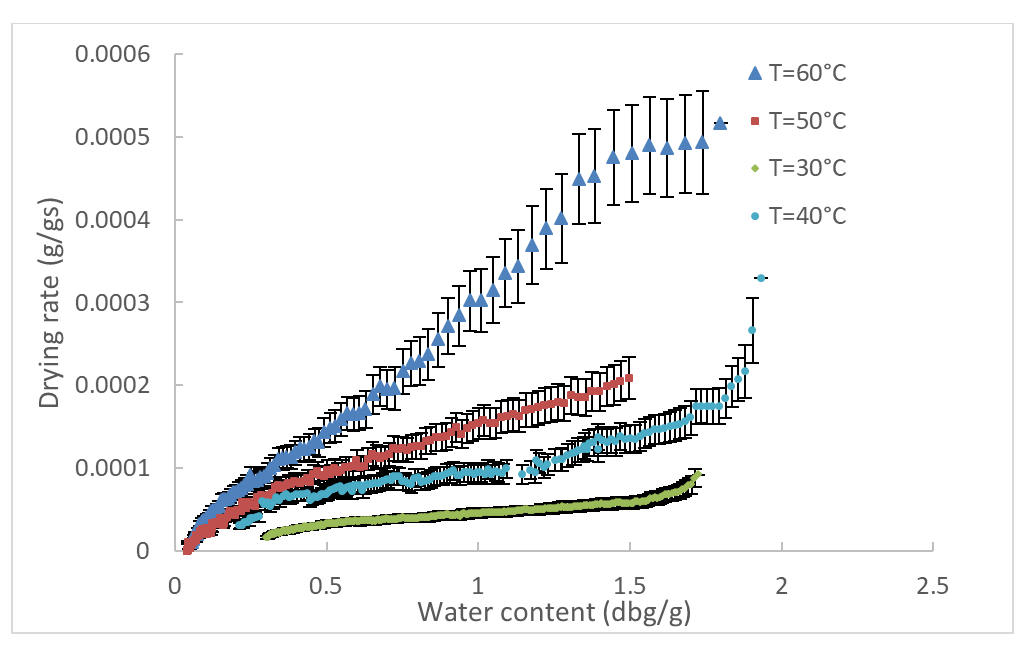
The temperature showed a very clear influence. Indeed, by increasing the temperature, the drying time has decreased exponentially (the drying time is reduced from about 10 h at 30°C to 3 h at 60°C). Reducing the drying time under the effect of the air temperature is desired in practice, since the capacity of a dryer will be increased and will allow a considerable reduction in drying costs. The response of the drying rate to the temperature is a characteristic property of medicinal plant species. In similar experiments with Chamomilla recutita flowers, the drying time was reduced from 52 h at 30°C to 1.6 h at 60°C [21]. For the roots of Echinacea angustifolia, the relationship was 56 h at 30°C to 6.5 h at 60°C.
The absence of the initial phase and the constant rate phase completely conforms the literature. Indeed, Sghaier, et al. [22] pointed out that when the product is in the form of thin leaves the heating up and the constant rate period are not visible.
Modelling of Drying Curves
The drying kinetics data obtained for the four temperatures was fitted to five empirical kinetic models (Table 1).
| Model | Citrus limon | |||
|---|---|---|---|---|
| 60°C | 50°C | 40°C | 30°C | |
| Page X =exp(−ktn) r | ||||
| K | 0.01594 | 0.003641 | 0.001604 | 0.000561 |
| n | 1.06 | 1 | 1.298 | 1.338 |
| R2 | 0.9979 | 1.226 | 0.9864 | 0.988 |
| RMSE | 0.01253 | 0.9973 | 0.03353 | 0.03171 |
| 0.0149 | ||||
| Newton X =exp(−kt) r | ||||
| K | 0.02037 | 0.01068 | 0.007149 | 0.003779 |
| R2 | 0.9968 | 0.9851 | 0 .9642 | 0.9604 |
| RMSE | 0.01555 | 0 .03511 | 0.05419 | 0.05743 |
| Logarithmique X =aexp(−kt)+c r | ||||
| a | 1.038 | 1.104 | 1.576 | 1.668 |
| K | 0.01842 | 0.009293 | 0.003248 | 0.001629 |
| C | -0.04038 | 3 | -0.5953 | -0.6796 |
| R2 | 0.9996 | -0.0735 | 0.9988 | 0.9998 |
| RMSE | 0.005708 | 0.9976 | 0.009865 | 0.003748 |
| 0.0142 | ||||
| Henderson and Pabis X =aexp(−kt) r | ||||
| a | 1.02 | 1.07 | 1.064 | 1.078 |
| K | 0.02078 | 0.01138 | 0.007633 | 0.004093 |
| R2 | 0.9972 | 0.9893 | 0.9698 | 0.9685 |
| RMSE | 0.01459 | 0.02978 | 0.04993 | 0.05132 |
| Two_term X =aexp(−kt)+bexp(−kt) r | ||||
| a | 1.024 | 1.076 | 1.068 | 1.081 |
| K0 | 0.02085 | 0.01144 | 0.007664 | 0.004103 |
| b | -0.02405 | -0.07618 | -0.06831 | -0.08053 |
| K1 | 12.16 | 9.854 | 8.483 | 9.144 |
| R2 | 0.9973 | 0.9897 | 0.9702 | 0.9687 |
| RMSE | 0.01456 | 0.02943 | 0.04997 | 0.05128 |
Table 1: Statistical indices upon modelling the drying of lemon leaves at a range of temperatures.
It was noted that the R2 values (Table 1) ranged from 0.9604 to 0.9996. The temperature dependence of the drying kinetics can be drawn from the fact that the value of the parameter “k” (Table 1) increased for all models with the increase in the drying temperature.
The results given in Table 1 show that the Logarithmic model has the highest values of R2 as well as the lowest values of RMSE compared to the other models for all temperature levels.
Estimation of Diffusion Coefficient
The diffusion coefficient De was derived from the drying curves recorded during hot air drying trials in the pilot dryer by fitting method. The influence of temperature was deduced from these data (Table 2).
| Temperature (°C) | De (m2/s) | Absolute error |
|---|---|---|
| 60 | 1,12410-10 | 0,202310-10 |
| 50 | 0,59610-10 | 0,107310-10 |
| 40 | 0,38410-10 | 0,06910-10 |
| 30 | 0,210-10 | 0,03610-10 |
Table 2: Estimation of diffusion coefficient for lemon leaves drying between 30 and 60°C.
Effect of Drying on Essential Oils Extraction
Essential Oils Yield: Essential oil extraction yield is defined as follows:
in (%) 100 Mass of essential oil theorganic phase Initial mass of dry plant material η = The operating conditions for essential oil extraction from lemon leaves by hydro distillation technique are optimized by simplex method in order to minimize the extraction time and the water/plant material ratio and increase the yield.
The 3-dimensional simplex for lemon leaves is given in Table 3.
| Variable | Drying temperature (°C) | Extraction time (min) | Water / plant ratio | Response (%) |
|---|---|---|---|---|
| Exp1 | 30 | 90 | 4 | 0.3158 |
| Exp2 | 39.428 | 97.071 | 4.4714 | 0.3663 |
| Exp3 | 32.357 | 118.284 | 4.4714 | 0.5225 |
| Exp4 | 32.357 | 97.071 | 5.8856 | 0.5835 |
| Exp5 | 39.428 | 118.284 | 5.8856 | 0.5205 |
| Exp6 | 24 | 125.355 | 3.357 | 0.598 |
| Exp7 | 25.4999 | 108.856 | 5.614 | 0.444 |
| Exp8 | 40.357 | 125 | 5.992 | 0.3822 |
Table 3: Optimization of the operating parameters for a maximum yield of essential oil in Lemon leaves.
The analysis of this experimental design shows that the essential oil yield varies between 0.3158% and 0.598%, which confirms that the factors studied have reduced the essential oil yield.
Optimum conditions giving a better yield of essential oil of lemon leaves (0.6%) are an air-drying temperature of 24°C, a handling time of 125 min and a water /vegetable matter ratio of 3.357.This indicated that significant loss or degradation of EOs occurred during the drying process [23]. Dorneles, et al. [24] also demonstrated that drying air temperature resulted in the decreasing the content of essential oil from leaves. However, according to Xing, et al. [25], oven drying showed the highest EO yield of Purple Perilla Leaves.
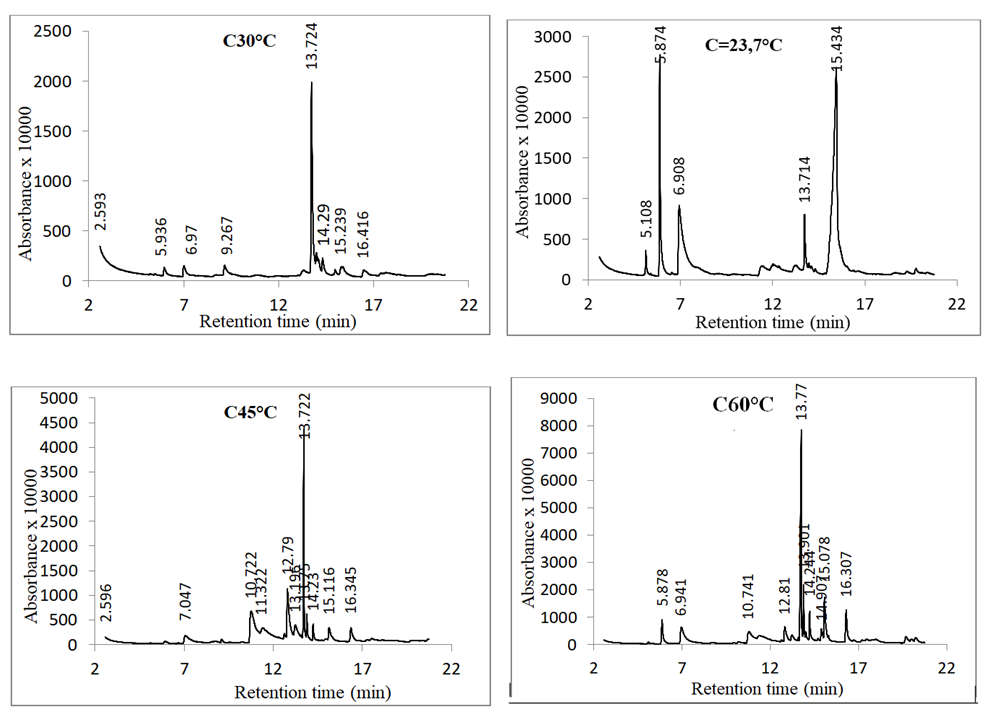
Chemical Composition of EOs from Citrus Limon: The chemical composition of EOs from Citrus limon at different air-drying temperatures is observed and showed in Figure 2.
The essential oil of lemon leaves includes 12 major components with a total of 89.26%, 77.08%, 79.19%, 72.86% respectively for the drying temperatures of 23.7, 30, 45 and 60°C.
Figure 2 shows the chromatogram obtained by GC / MS
giving the retention time as a function of absorbance.
Chemical formula of EOs of citrus limon is influenced by the heat treatment of the plant material. Indeed, for a temperature of 23.7˚C, the majority peak corresponds to the compound manoyloxid (44.05%), then limonene (18.97%) and beta-pinene (11.15%). While at 30˚C, the maximum level corresponds to beta-caryophyllene (46.06%) with the disappearance of limonene and the remarkable decrease in beta-pinene content (2.9%). The increase of the drying temperature up to 45˚C induces a chemical composition rich mainly in nerol (26.3%), neryl acetate (20.2%) and beta-caryophyllene (15.31%) with a further appearance of limonene. Finally, the qualitative analysis of the essential oils of the product dried at 60°C gives a majority beta- caryophyllene content which reaches 21.29% with a presence of limonene and beta-pinene. These show that there is a significant effect of air-drying temperature on the perfection of EOs of_citrus limon_.
Rocha, et al. [26] have shown that raising the drying temperature above 40°C reduces the fractions of the main compounds of Ocimum Selloi Benth essential oil (elimicine, trans-caryophyllene, germacrene-D, cyclobermacrene).
Essential oils of lemon leaves are valued mainly in the aromatherapy, perfumery and cosmetics markets. They are sought after for their fragrant or therapeutic properties. The main consumer markets are the developed countries (Europe, Japan, North America), which represent 80% of the world’s markets.
Effect of Heat Treatment on Phenolic Concentration in Citrus Limon
Table 4 shows that raising the drying temperature induces the increase in the concentration of phenolic compounds. In fact, it goes from 33.83 mg of mg-GAE/g-DL at 30˚C to 51.97 mg of mg-GAE/g-DL at 60˚C.
This can be explained by the fact that in the case of this plant, the heat treatment promotes evacuation of phenolic compounds from the solid form. These results agree with those found by Boudhioua, et al. [27] who studied the impact of heat treatment process on total phenolic rate of four varieties of olive leaves.
| Drying temperature | Flavonoids rate Concentration (mg-CE/g-DL) | Polyphenol rate Concentration (mg-GAE/g-DL) |
|---|---|---|
| 30°C | 0.655 | 33.83 |
| 40°C | 1.041 | 39.82 |
| 50°C | 0.754 | 40.63 |
| 60°C | 0.63 | 51.97 |
Table 4: Temperature influence on polyphenol and flavonoids content.
Impact of Drying on Flavonoid Rate
The method using AlCl3 allows the estimation of flavonoid contents in extracts of the plant studied, by measuring their absorbance by means of UV / visible spectrophotometry (Table 4).
For the lemon leaves, the flavonoid content reaches its optimum at 40˚C (it goes from 0.655 mg of mg-CE/g-DLto 1.041 mg of mg-CE/g-DL at 40˚C to decrease again until 0.63 mg mg-CE/g-DLat 60˚C). These results show that the drying temperature could alter the active constituents of plant products, such as flavonoids. Hence the recommendations that require the drying of plants should not be at high temperatures to avoid the loss of active constituents.
Zhishen, et al. [28] quantified flavonoids in mulberry leaves by applying different modes of drying. They found that the fresh leaves contain more flavonoids than those dried in the air or in the oven.
Chen, et al. [29] found that the concentration of flavonoids in orange peel extracts declined with a drying temperature below 80°C and improved at anutmost drying temperature. Ho, et al. [30] reported that the flavonoid content of lemon leaves increased with drying time.
Conclusion
This study shows that the drying kinetics of lemon leaves can be accurately implemented using the empirical model of Logarithmic.
An air-drying temperature of 23.7˚C seems suitable for drying lemon leaves for better quality essential oil’s extraction. The optimal operating conditions that provide a better yield of essential oils are: a drying temperature of 24°C, an operating time of 125 minutes and a water/vegetable matter ratio of 3.4. However, the values recommended in the literature and those actually experimented are often very far apart, which requires the urgent need for further research on this subject. Future studies should focus on the effectiveness of essential oils in different food matrices. The synergy among essential oils and other products or with other treatment techniques should as well be studied in order to be commercially feasible.
Lemon leaves’ exposure to oven thermal treatment might be the main reason for the remarkable loss of phenolic compounds. Indeed, the quantification of the total phenols by the Folin-ciocalteu method, flavonoids using the aluminum chloride method allows us to confirm the significant influence of air-drying temperature of this plant on polyphenols and flavonoids content. References
1. Lahsasni S, Kouhila M, Mahrouz M, Kechaou N (2002) Experimental study and modeling of adsorption and desorption isotherms of prickly pear peel (Opuntiaficusindica). Journal of Food Engineering 55: 201-207.
2. (2003) Food Agriculture Organisation of the United Nations.
3. Lebdi GrissaK (2010) Etude de base sur les cultures d’agrumes et de tomates en Tunisie. Regional Integrated Pest Management Program in the Near East GTFS, pp: 92.
4. Calabrese F, Di Marco L (1981) Trees Researches on the ’forzatura’ of lemon. In Proc Int Soc Citriculture 2: 520- 521.
5. Boudhrioua N, Bahloul N, Slimen IB, Kechaou N (2009) Comparison on the total phenol contents and the color of fresh and infrared dried olive leaves. IndCropsProd 29(2-3): 412-419.
6. Valifard M, Mohsenzadeh S, Kholdebarin B, Rowshan V (2014) Effects of salt stress on volatile compounds, total phenolic content and antioxidant activities of Salvia mirzayanii. S Afr J Bot 93: 92-97.
7. Ghanem N, Mihoubi D, Bonazzi D, Kechaou N, Boudhrioua N (2020) Drying Characteristics of Lemon By-product (Citrus limon. v. lunari): Effects of Drying Modes on Quality Attributes Kinetics’. Waste Biomass Valor 11: 303-322.
8. Venskutonis R, Poll L, Larsen M (1996) Influence of drying and irradiation on the composition of volatile compounds of thyme (thymus vulgaris l.). FlavourFragr J 11(2): 123-128.
9. Soares RD, Chaves MA, Silva AAL da, Silva MV, Souza BS (2007) Influence of temperature and SPEED da do naarrsecagem of Manjericao (Ocimumbasilicum L.) com Relaçao years essencia is Theory of oils and linalool. Sci Agrotechnol 31(4): 1108-1113.
10. Dabbah R, Edwards VM, Moats WA (1970) Antimicrobial action of some citrus fruit oils on selected food-borne bacteria. J Appl Microbiol 19(1): 27-31.
11. Burt S (2004) Essential oils: their antibacterial properties and potential applications in foods-a review. Int. J. Food Microbiol 94(3): 223-253.
12. Esparza-Martínez FJ, Miranda-López R, Guzman- Maldonado SH (2016) Effect of air-drying temperature on extractable and non-extractable phenolics and antioxidant capacity of lime wastes. Ind Crops Prod 84: 1-6.
13. Kedik SA, Yartsev EI, Stanishevskaya IE (2009) Antiviral activity of dried extract of Stevia. PharmChem J 43(4): 198-199.
14. Tadhani MB, Patel VH, Subhash R (2007) In vitro antioxidant activities of Stevia rebaudiana leaves and callus. J Food Comp Anal 20(3-4): 323-329.
15. Braga NP, Cremasco MA, Valle RCCR (2005) The effects of fixed-bed drying on the yield and composition of essential oil from long pepper (Piper hispidinervium c. dc) leaves. Braz J Chem Eng 22(2): 257-262.
16. Coulson JM, Richardson JF, Backhurst JR, Harker JH (1987) Chemical engineering, unit operation. 3rd (Edn.), Pergamon Press Ltd, UK, pp: 717-718.
17. Clevenger JF (1912) Apparatus for the determination of volatile oil. J Am Pharm Assoc 17: 345-349.
18. Justesen U, Knuthsen P, Leth T (1998) Quantitative analysis of flavonols, flavones and flavanons in fruits, vegetables and beverages by HPLC with photo diode array and mass spectometic detection. J Chromatogr A 799(1-2): 101-110.
19. Taga MS, Miller EE, Pratt DE (1984) Chia seeds as a source of natural lipid antioxidants. Journal of the American Oil Chemists Society 61: 928-931.
20. Liu SC, Lin JT, Wang CK, Chen HY, Yang DJ (2009) Antioxidant properties of various solvent extracts from lychee (Litchi chinenesis Sonn.) flowers. Food Chemistry 2009 114(2): 577-581.
21. Müller J, Köll-Weber M, Kraus W (1996) Trocknungsverhaltenvon Kamille (Chamomillarecutita (L.) Rauschert). Zeitschriftfür Arznei- undGewürzpflanzen 1: 104-110.
22. Sghaier K, Peczalski R, Bagane M (2018) Water sorption equilibria and kinetics of Henna leaves. HAMT 54: 1545- 1554.
23. Jumepaeng T, Jantayota R, Hemmood S, Komolwanich S, Wuthisarn S, et al. (2014) Determination and Comparison of Volatile Aroma Compounds in Fresh and Dried Leaves Samples of Citronella Grass, Lemongrass, and Citronella Incense Products by Micro Hydrodistillation. Acta Chromatographics 26(1): 177-190.
24. Dorneles LNS, Goneli ALD, Cardoso CAL, Silva CB, Hauth MR, et al. (2019) Effect of air temperature and velocity on drying kinetics and essential oil composition of Piper umbellatum L. leaves. Industrial Crops & Products 142: 111846.
25. Xing Y, Lei H, Wang J, Wang Y, Wang J, Xu H (2017) Effects of Different Drying Methods on the Total Phenolic, Rosmarinic Acid and Essential Oil of Purple Perilla Leaves. Journal of Essential Oil Bearing Plants 20(6): 1594-1606.
26. Rocha R, Melo EC, Radunz LL (2011) Influence of drying process on the quality of medicinal plants: A review. J Med Plant Res 5(33): 7076-7084.
27. Boudhioua N, Slimen IB, Bahloul N, Kechaou N (2008) Etude du séchage par infrarouge de feuilles d’olivier d’origine tunisienne. Revue des Energies Renouvelables SMSTS’Alger, pp: 53-59.
28. Zhishen J, Mengcheng T, Jianming W (2001) The determination of flavonoid contents in mulberry and their scavenging effects on superoxide radicals. Food Chemx 64(4): 555-559.
29. Chen ML, Yang DJ, Liu SC (2011) Effects of drying temperature on the flavonoid, phenolic acid and antioxidative capacities of the methanol extract of citrus fruit (citrus sinensis (l.) osbeck) peels. Int J Food SciTechnol 46(6): 1179-1185.
30. Ho SC, Lin CC (2008) Investigation of heat treating conditions for enhancing the anti-inflammatory activity of citrus fruit (citrus reticulata) peels. J Agric Food Chem 56(17): 7976-7982.
- The Role of Podocyte Apoptosis and the Involvement of SIRT1 in Diabetic Nephropathy
- Dealcoholization of Beer by Osmotic Distillation for the Beverage Industry
- Biopolymer-Based Edible Packaging- Biomaterials, Methods, and Applications in Food Industry: An Updated Review
- Influence of Bioprocessing Methods on 'China Rice' (Gawal R1), and Soyabean Supplementation on the Quality of Complementary Food
- Cassava (Manihot esculenta) Varietal Growth, Yield and Cyanide Content Performance in Three Sites in the South- Eastern Semi Arid Regions of Kenya
- Food Waste Treatment, Recycling, Management and Production of Value-Products-An Update on Methodologies and Current Trends