
Chemical and Physical Characterization of Post-Harvested Cocoa Beans from Patanemo, Carabobo State, Venezuela
By consensus, all Venezuelan cocoas are the unique and unparalleled cocoa type that yields intense and distinct flavors, exclusively grown in Venezuelan plantations. Therefore, Venezuelan cocoas are considered fine-flavored cocoas. From a genetic point of view, these cocoas belong to the Criollo and hybrid (Criollo modern) types. Patanemo is located in Carabobo State, Venezuela. The cocoa plantations of Patanemo are within the San Esteban National Park, which is typified as a tropical rainforest. The rainforest is the ideal clime to produce cocoas. Despite, the cocoa from Patanemo is an internationally recognized fine-flavored valuable commodity, information regarding cocoa from this region is scarce. Therefore, the goal is the chemical and physical characterization of cacaos beans from Patanemo, once they have been treated with post-harvest procedures (harvested, selected, fermented, and dried) for national commercialization, and exportation. Representative samples of cocoas fruits from Patanemo plantations, and its beans; once applied the postharvest treatment, were analyzed according to their morphologic characteristic, proximate composition, chemical (polyphenol, cadmium concentration), antioxidant capacity, and physical characteristics (bean index, dimensions, and fermentation percent) using the methodologies approved by national and international norms, and official methods. It also analyzed the sensorial properties of the cacao beans, and cocoa paste (liquor). Data reveals that Patanemo cocoas are an ideal commodity to produce derivatives with high quality, and the industry could benefit from the proposed research here approach to accurately determine the grade of quality of cocoas.
Introduction
In Venezuela, the farmers classify cocoa as a function of the region where they are growing. Therefore, depending on the grown region, and its environment, each variety of cocoa is associated with a specific flavor. Consequently, cocoa fruits give Venezuela its importance as fine aromatic cocoas. Furthermore, a clear definition exists for Venezuelan fine- flavored cocoa, delineating it as a unique and unparalleled cocoa type that yields intense and distinct flavors, exclusively grown in Venezuelan plantations.
The gastronomic characteristics of Venezuelan cocoas fruits are due to their genetic composition, which is amplified by the ecological conditions of their cultivation, post- harvest management, and the transformation processes into derivative products [1]. In summary, the complex composition of cocoas bean fine- flavored not only depend on bean genotype and its growing environment, but also the type of soil and age of the cocoa tree, postharvest treatments such as pulp pre-conditioning, fermentation, and drying, as well as, industrial processes such as roasting.
As reported by Álvarez, et al. [2] and Guzmán, et al. [3], the fermentation, drying, and roasting processes are the most influential factors in chocolate flavor formation. Therefore, the chemical composition and its volatiles and nonvolatiles of cocoas from different origins must be identified.
The Patanemo region in Carabobo state is located within the San Esteban National Park, a tropical rain forest. Additionally, to the climatic characteristics of the forest such as; humidity, illumination, and fauna and flora, its soil has a specific mineral composition, partly by the contribution of two seasonal winds input, which comes from the sea, called “Calderetas”. These Calderetas winds are charged with minerals from the ocean and improve the mineral composition of the forest soil, helping alongside the fertilization of the flowers, because of the movement action by the wind on the trees. Due to these effects, this region produces cocoas with a specific flavor.
In a previous study, the morphology, hybridization percentage, and sensorial descriptors of the pods of cacao from Patanemo were reported by Pérez, et al. [4] in 2023; consequently, the goal of this study is the characterization of the chemical, physic, and physicochemical properties of post-harvested cacaos beans from Patanemo, Carabobo State, Venezuela.
Materials and Methods
Materials
Raw Material: Samples of cocoa fruits and their fermented and dried (post-harvested beans) beans were obtained from Patanemo plantations. Samples of whole, unroasted cocoa beans, from the main Patanemo farms of farmers who fer- ment with good agricultural practices, were evaluated us- ing the quartering technique. The samples were extracted in situ from complete batches from each farm to determine the external appearance, external defects, internal defects, and sensory evaluation of external olfactory, internal smell, and taste.
Equipment and Utensils: Camera from Samsung Galaxy S9+ Plus (64GB, 6GB RAM)phone Precision balance, Cutter Knife, Munsell color chart, Digital caliper with a precision of 0.001 mm, CocoaT Bean Cutter; Rule Metric tap
Methods
Proximate Chemical Composition Analysis
The moisture content was measured according to the AOAC [5] method 970-20, crude protein percentage was measured by the micro-Kjeldahl AACC, 2000 , method 46.13 ( N×6.25), and ash following the AOAC, 1974 ; 972-15 method. Content crude fat was determined following method No. 1697, COVENIN [6] 1981. The pH and total acidity determination were performed following the methods described in AACC, 2000 02-31.01 The total carbohydrates were calculated by difference from 100 % - (%mositure + %crude protein + %crude fat, and %ash). The cadmium concentration expressed as mg/kg in the postharvested beans was determined following Baldini, et al. [7] 2096 procedure.
Antioxidant Capacity By The DPPH (2,2-Diphenyl-1-Picrylhydrazyl) Assay
DPPH radical scavenging assay. The Antioxidant capacity of the cocoa mucilaginous extracts was determined using the DPPH radical scavenging assay described by Brand- Williams, et al., 1995, with some modifications. It is based on the measurement of the absorbance of the DPPH radical. 100 µM (3.9 mL) dissolved in 80% methanol, at the wavelength of 517 nm. 0.1 mL of the sample or standard is added, and the mixture is carefully homogenized and kept in the dark for 30 minutes. Absorbance measurements at 517 nm are carried out before adding the sample (A0), and after 30 and 60 minutes (Af). The concentration of DPPH in the reaction medium is calculated from a calibration curve obtained by linear regression.
The free radical scavenging capacity using the free DPPH radical was evaluated by measuring the decrease of absorbance at 517 nm every 2 min until the reaction reached its ‘‘plateau” state. Antioxidant capacity was expressed as mmol/L Trolox equivalents, using the calibration curve of Trolox (0–1000 lM), a water-soluble vitamin E analogue. The results are expressed in TEAC, that is, activity equivalent to Trolox (µM/g of fresh weight sample). The reference synthetic antioxidant Trolox, at a concentration of 0.08-1.28 mM in 80% methanol solution, is tested under the same conditions, with the results expressed in TEAC and VCEAC.
Polyphenols
Determination of polyphenols as mg gallic acid/100g according to the Follin Ciocalteu procedure described by García Martínez, et al. [8].
Typification and Cut Test
The protocol of external analysis of grains, dimensions and weight average, number of grains/100 g sample, and internal appearance by following the cut test quality was carried out according to Cocoa of Excellence [9] (Cocoa Guide), 2023 , COVENIN Nº 50 and COVENIN Nº 442 in its second review [10, 11].
Grain count (/100g) (results expressed as the average of three replicates): The counting of 100 grams of grains was carried out with the help of a semi-analytical balance. 100 grams of fermented, dry, unroasted cocoa were weighed counted, and compared with the bean count in ranges defined by ISO 2451:201 [12], standard beans (<100), medium beans (101-110), small beans (111-120), and quite small grains (>120). The number of grains/100 grams of sample was determined by accounting for 100 beans and weighing it, then counting the number of beans in 100 grams.
The cocoa bean index for marketing was determined by the average bean weight in grams, from a sample of 100 g of postharvested cocoa beans and classified as; high index >1.7 g/gram, medium 1.4-1.7g/grain, and low <1.7g/grain, according to the Colombian Fedecacao, 2016.
The individual bean weight (g) is the result of weighting each bean from a sample of 30 individuals and calculating the sample’s average and standard deviation. The same procedure was performed to measure the bean’s dimension using the caliper.
Sensory Evaluation of the Beans and the Cocoa Paste (Liquor)
The Sensory evaluation of cacao beans and cacao paste (liquor) was determined by 8 trained judges using a descriptive analysis and test of aroma and taste profile. The Venezuela Institutional Cacao of Excellence (COEX) Board trained the eight judges following the norm ISO 8586:2023 [13]. This board reviewed the project, and an informed consent statement was lectured, discussed, and accepted by the 8 judges before the sensory analysis.
The average of the two replicates was represented in the radial graph. The glossary of terms used for the evaluation of cocoa beans, and in liquor form is available at: www. cocoaofexcellence.org/info-and-resources.
The protocol for elaborate cocoa paste (liquor) was as follows: Roasting was carried out in a Binder FD56 forced convection oven, balanced at the required temperature (116°C, 28 min). The lot of grains (800 g) was placed in a single layer deep, on two mesh trays (0.6 cm, open area greater than 85%), following the procedure described in the Guide for Quality Assessment and the Flavor of Cocoa, chapter 11 “Roasting of cocoa beans”, available on the website: Cocoa Guide Cocoa of Excellence.
The moisture content and bean count were used to adjust the basic roasting conditions initially as reported in the Guide for the Evaluation of Quality and Flavor of Cocoa, Section 11.4.1 “Selecting roasting conditions”, available on the website, details the roasting procedure, and the selection of roasting conditions: Cocoa Guide from Cacao de Excellence.
Statistic Analysis
The physical-chemical analyses were carried out in triplicate, and in some cases used n=30. The mean and standard deviation were calculated for all parameters.
Results and Discussion
Morphologic Characteristics of the Fruits
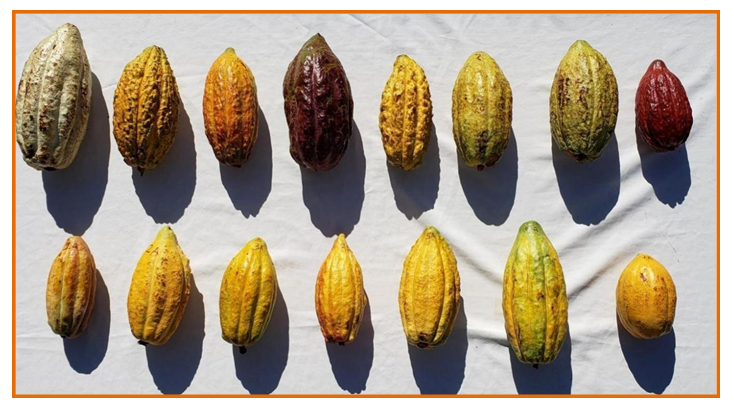
As can be seen Figure 1, the fruits from Patanemo cocoa plants, are mainly type Trinitario (hybrid), with natural hybridization of the same fruit, ranging from 50% to 56.5 % Criollo cotyledons. The fruits are quite variable in size, texture, and color of the peel. Their weights varied from 0.520 to 1,560 g, with an average of 1,023 g. Their average length, width, and thickness were 23 cm; 11 cm, and 2.0 cm, respectively. The Angoleta type (oblong) was the most predominant shape, with one cantaloupe-shaped fruit [4]. Peel varies from smooth to wrinkled and the color from light green to dark purple.
The dried and fermented bean of “CACAO DE PATANEMO” is a fine cocoa with aroma attributes of cocoa, with moderate astringency and bitterness and a notable volatile acidity.
Proximate Chemical Composition Analysis, and Polyphenol Concentration
Table 1 shows the chemical composition of the postharvest cocoa beans from Patanemo, all parameters agreed with those reported in literature for cocoas from Aragua [14], Carabobo [15], Miranda [16, 17] states and others places in Venezuela [14, 18, 19].
| Parameters | Average | |
|---|---|---|
| Moisture (%) | 6.6±0.30 | |
| Crude Protein (%) Nitrogen x 6.25 | 15.0±0.20 | |
| Crude Fat (%) | 50.5±2.09 | |
| Ash (%) | 3.3±0.04 | |
| Total Carbohydrates (%) | 29.6 | |
| Polyphenol (mg/100g)* | Fermented | 162.6±0.02 |
| Polyphenol (mg/100g)* | Unfermented | 3722.31±0.004 |
| Antioxidant capacity (unfermented) | TEAC (μmol/100g)VCEAC (g/100g)* | 1045.24±0.004 |
| VCEAC (g/100g)*** | 24.17±0.22 | |
| Cadmium ppm | 0.104 | |
Table 1: Proximate chemical composition analysis and polyphenol concentration of the cocoa postharvest beans. *Expressed in galli
Table 1: Proximate chemical composition analysis and polyphenol concentration of the cocoa postharvest beans. *Expressed in gallic acid equivalent per 100 g of sample) Activity equivalent to a Trolox * Activity equivalent to vitamin C By consensus the higher the amounts of polyphenols in the cocoa product, t(the greater benefit it will have for the consumer’s health. Moreover, polyphenols shape antioxidant properties and affect sensory properties such as color and taste. During all stages of processing, the polyphenols present in cocoa beans may undergo many transformations, including polymerization, hydrolysis, or reactions with proteins [20]. Polyphenol compounds in cacao beans are mostly dominated by flavonoid groups, consisting of ±58 % proanthocyanidin group, ±37 % flavan-3-ol/flavanol, ±4 % anthocyanidin and ±1 % flavonol glycoside. Moreover, the monomeric flavan-3-ol compounds (+)- catechin, (-)- epicatechin, and (−)- epicatechin gallate content have antioxidant, anti-inflammatory, hypocholesterolemic and vasodilatory actions [21].
As consensus, polyphenol compounds in cacao beans after fermentation decreasing, due to the oxidation by polyphenol oxidase enzymes, diffusion of polyphenols from cotyledons to the skin layer, and polymerization of polyphenol compounds, especially epicatechin, and proanthocyanidin to form tannic compounds and the formation of complexes with proteins and polysaccharides [22].
Urbańska and Kowalska [20] also pointed out that the lowest total polyphenol content in unroasted cocoa beans originating from Venezuela was 1034 mg/100 g of cacao. There are differences in the cacao of Patanamemo analyzed in this study, in contrast with the data of (996 and 1034 mg/100 g of product, expressed in gallic acid equivalent per 100 g of sample) reported by Urbańska and Kowalska [20] for Venezuelan cocoas. The above results can be explained by several factors, such as; plant variety, geographical region, degree of maturity, and post-harvest conditions of the evaluated cacao beans, and mainly that the cacaos analyzed by these authors were unfermented beans. Table 1 shows Patanemo cacao unfermented and fermented data confirm the fermentation process’s effect on the total polyphenol content.
Reactive oxygen species (ROS) are involved in the pathogenesis of several human diseases. However, from nature, antioxidant agents such as polyphenols, implied in plant defense, can prevent or heal various pathologies in human beings in which ROS are implicated [23]. Due the antioxidant activity analysis can be obtained by using the DPPH method, which is based on the ability of compounds to act as free radical scavenging or hydrogen donors [24] in this study this method was used. Therefore, the antioxidant capacity obtained in the mucilaginous of the cacao beans unfermented from Patanemo was 1045.24 TEAC (µmol/100g); as equivalent to Trolox, and 24.17±0.22 (g/100g) as equivalent to a Vitamin C, as is shown in Table 1.
Cadmium content reported in this study from the Patanemo cocoa beans are according to specific cocoa and chocolate products listed by the regulation from the EU N° 488/2014 of May 12, 2014 [25].
Physicochemical Characteristics
Table 2, shows that physicochemical characteristics are according to those reported in literature for postharvested cacaos [14, 18].
| Average | |
|---|---|
| pH | 5.2±0.2 |
| Titratable acidity (as percent of acetic acid) | 2.07±0.1 |
Table 2: pH and titratable acidity of the cocoa postharvest beans.
Typification (Bean Sizes and Uniformity)
The determination of the physical characteristics of cocoa such as the bean index is a parameter of interest in the marketing of dry cocoa. The bean index must be >1g to processing and market requirements. Smaller beans have higher testa contents and, consequently, less nib, which may also have a lower percentage of fat. Moreover, smaller beans will require equipment adjustment, which increases cost and time, causing a reduction in plant throughput. The Patanemo sample shows a high percentage of large beans, with an average weight of Patanemo cocoa beans, are > 1.30± 0.16 (bean index) (Table 3).
| Parameters | |
|---|---|
| Bean individual weight (g) | 1.30±0.16 |
| Average grain dimensions Large (cm) Wide (cm) Wide (cm) | 2.28±0.07 |
| 1.25±0.04 | |
| 0.79±0.05 | |
| Number of beans/100 grams of sample | 73±1 |
| Minimum weight of 100 dried beans (g). | 136.4±0.40 |
| Large (cm) Wide (cm) Thickness (cm) | 2.28±0.07 |
| 1.25±0.04 | |
| 0.79±0.05 |
Table 3: Typification (size and uniformity) of the cocoa postharvest beans.
Future markets contemplate the assignment of a discount, if the count is greater than 100 beans/100g; while lots with counts greater than 120 beans/100g are not considered biddable. The data of the Patanemo sample analysis were compared with bean counts in ranges defined by ISO 2451: 201, standard beans (<100), medium beans (101-110), small beans (111-120), and quite small beans (> 120). The Patanemo cocoas beans show a count of beans/100g of 73±1. Therefore, Patanemo beans can be considered standard beans for commercialization. Furthermore, the minimum weight of 100 Patanemo beans is 136.4±0.4g, required to cover the international norms requirement, that is above 100g [26].
Manufacturers also require beans to be reasonably uniform in size because it is difficult to achieve effective bean cleaning in a parcel containing beans, that are very variable in size. A general guideline is that no more than 12% of the beans should be outside the range of plus or minus one-third of the average weight. If through informal visual inspection of a random sample of intact beans; For example, 72 of the smallest looking beans, taken from a 600-gram batch made up, of 600 beans, weigh less than 24 grams, there is a problem. Similarly, if 72 of the largest-looking grains together weigh more than 96 grams, a mixture is suspected. Patanemo cocoa beans look like not a mixture.
Despite the cocoa beans from the Patanemo plantations being a mix due to the diversity of the fruits shown in Figure 1, the uniformity of the beans can be classified as standard, which means that are adequate for processing.
External Defects
The surface of the beans is smooth with easy detachment of the testa. The presence of foreign matter also influences material performance, thus reducing the value of cocoa for the chocolate maker; also can affect the flavor and act as a source of product contamination. The presence of impurities or foreign matter is not evident, because Patanemo has less than 5% of “Waste of Cacao” as a foreign matter (Table 4).
| External Defects | Average | |
|---|---|---|
| Wide (cm) | 1.25±0.04 | |
| Wide (cm) | 0.79±0.05 | |
| Number of beans/100 grams of sample | 73±1 | Foreign matter % < 5 |
| Minimum weight of 100 dried beans (g). | 136.4±0.40 | Beans cluster 1 |
| Large (cm)Wide (cm)Thickness (cm) | 2.28±0.07 | Broken or flat beans 2 |
| Large (cm)Wide (cm)Thickness (cm) | 1.25±0.04 | Mold-damaged beans 0 |
| Large (cm)Wide (cm)Thickness (cm) | 0.79±0.05 | Insect-damaged beans 1 |
Table 4: External defects of the Patanemo cocoa postharvest beans.
Double or multiple beans are an index of agglomerated grains because of deficiencies in the protocol of fermentation and drying (failure to shake adequate numbers of times on the bean’s mass during the fermentation and/or drying). The number of broken beans, external infections (molds), and infestation (insects) are indexes of failures in the Good Manufacturing Practice during storage or transportation Table 4.
Cutting Test (Internal defects)
Cut tests are an effective way to check for internal defects, and evaluate the level of fermentation, and the health standards in a batch of cacao beans. Therefore, cocoa beans were classified as; fully fermented, partially fermented (partially purple), unfermented (purple and smooth), slaty (not grooved, but slick and greyish), germinated beans (the germ and/or cotyledon are still present), beans with internal infections (molds), and infestation (insects).
The Patanemo cocoas show some beans with dark brown and other beans with brown high-light internal color. Cotyledons of the first type in the fresh state show purple or light purple cotyledons. The second one comes from a fresh bean with white and ivory cotyledons. There is a commercial denomination for the internal color of the fermented beans;
if the color is light brown, the grain is called “light breaking”, if the color is darker, it is considered “dark breaking” or dark meat. The light-fleshed beans are from the Criollo type, corresponding to a cocoas fine flavored. Those with dark breaking usually are Trinitarian ( Criollo Moderno) or Forastero type. The Patanemo cacao postharvest is considered a mix of Criollo and Criollo Moderno (Pérez et al, 2023). It is also evidenced in Figure 1.
Data on fermentation shows that the process was efficiently performed. The level of slaty grains was within the acceptable limit as was the humidity without other defects. Without infection or infestation, or germinated beans (Table 5). It is important to emphasize that partially fermented samples are not considered commercial defects [27].
| Beans Number | |
|---|---|
| Unfermented (purple or violet on at least half of the surface of the cotyledons exposed by the cut test) | 13±3 |
| Slaty | 6±2 |
| Germinated | 0 |
| Internally moldy and/or insect-damaged | 0 |
| Smoky (cocoa beans with a smoke-off flavor) | 0 |
| Fermented | 84±5 |
Table 5: External defects of the Patanemo cocoa postharvest beans.
After the analysis on the cut test, the cocoas from Patanemo are classified as Cacao or first class fine, and extra fine, without smoke flavor. Moreover, all of the physical results presented agreed with those in the study performed on the Patanemo region to obtain the PGI certification [15, 28, 29, 30, 31].
Sensory Evaluation of the Beans
The Patanemo is a first-class and extra-fine cocoa bean with clear and balanced flavor attributes thereof. They show strong notes of cocoa and are very harmonious. The aromas of brown, green, and earthy fruit, dark wood and spices (pepper) are present in low intensity, and the nutty note stands.
Sensory Evaluation of the Cocoa Paste (Liquor)
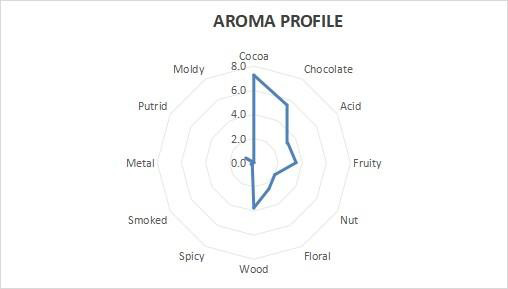
The dried and fermented Patanemo cocoas, after the roasting show strong cacao and chocolate, acid, fruit, and wood aroma notes (Figure 2).
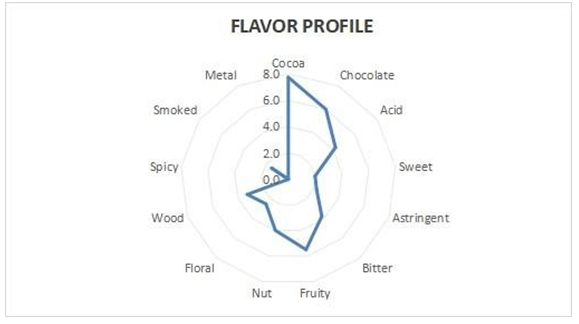
In regards to the taste, the paste shows cacao chocolate followed by acidic and astringent, nutty, fruity, and wood notes (Figure 3).
Conclusion
The current results show that Patanemo post-harvested beans are smooth with an easy detachment of the testa, without obvious foreign matter, or occurrence of the smoked bean, and moldy or insect contamination. The occurrence of dark brown and high-light beans is evidence of the cacao criollo and hybrid occurrence. Classified as Cacao first-class fine, and extra fine, flavor, with a standard grains index, without a toxic concentration of Cadmium, as regulated by national and international norms. Also, it has polyphenol and antioxidant capacity occurrence and quite particular fine flavored characteristics.
Since the cocoa industry and its food research field claim product quality, the data of the chemical, physic, and physicochemical characteristics, of this study shows that Patanemo cacao is an ideal commodity to produce its derivatives with high quality. Moreover, the industry could benefit from the proposed approach to accurately determine the grade of quality of cocoa.
Acknowledgments
Acknowledgments to the Cocoa Share Company for supporting the present research financially.
Conflict of Interest
The author(s) declare no conflict of interest.
Funding
There are no sources of funding to declare
Author Contributions
Authors’ contributions statement to specify the work of each author: Conceptualization, Elevina Pérez, and Clímaco Álvarez; methodology, Elevina Pérez and Climaco Alvarez; software, Elevina Perez.; validation Elevina Pérez and Clímaco Álvarez and Angélica Pavani.; formal analysis, Elevina Pérez and Clímaco Álvarez, Angélica Pavani, and Víctor Márquez; investigation, Elevina Pérez and Clímaco Álvarez, and Víctor Márquez.; resources, Angélica Pavani; data curation, Elevina Pérez and Víctor Márquez; writing— original draft preparation, Elevina Pérez.; writing—review and editing, Elevina Pérez.; visualization, Elevina Pérez and Clímaco Álvarez, Angélica Pavani, and Víctor Márquez; supervision, Elevina Pérez and Clímaco Álvarez, Angélica Pavani, and Víctor Márquez; project administration, Angélica Pavani,.; funding acquisition, Elevina Pérez and Angélica Pavani, All authors have read and agreed to the published version of the manuscript.”
References
-
Pérez (2020) Venezuelan Fine-Flavored Cocoas. In: Løvstrøm M (Ed.), Theobroma cacao: Production, Cultivation and Uses. Nova Science, New York.
-
Alvarez C, Pérez E, Lares M (2020) Volatiles compounds of fermented, dried, and roasted Venezuelan fine- flavored cocoa. In: Løvstrøm M (Ed.), Theobroma cacao, Plantae.
-
Guzmán R, Pérez E, Raymundez M (2020) Structural and chemical changes during the fermentation of cocoa beans. In: Løvstrøm M (Ed.), Theobroma cacao: Cultivation, production, and uses. NOVA Science Publisher, USA.
-
Pérez EE, Álvarez CO, Pavani A (2023) Morphology, Hybridization Percent, and Sensorial Notes of Fruits of Cacao from Two Plantations of Patanemo, Carabobo State, Venezuela. ECNutrition 18(1): 41-59.
-
AOAC (2000) American Official Methods of Analysis. 17th (Edn.), The Association of Official Analytical Chemists, USA.
-
COVENIN (1995) Venezuelan Convention on Industrial Standards.
-
Baldini M, Fabietti F, Giammariolli S, Onori R, Orefici, et al. (1996)Metodi di analisi utilizzati per il controllo chimico degli alimenti. Rapporti Istisan 96/34. Institute Superiore di Sanita, Italy.
-
García Martínez E, Fernández Segovia I, Fuentes López A (2015Determinación de polifenoles totales por el método de FolinCiocalteu. ETSIAMN. Universitat Politècnica de València, Spain.
-
Cacao of Excellence (2023) Guide for the Assessment of Cacao Quality and Flavour. Compiled by the Cacao of Excellence program of the Alliance of Bioversity International and CIAT, in collaboration with the members of the Working Group on the development of the International Standards for the Assessment of Cocoa Quality and Flavour (ISCQF). Bioversity International, pp: 216.
-
(2016) Venezuelan Commission of Industrial Standards. Cocoa beans: Cutting test, No. 50 (3rd Revision). Backgroundnorm.
-
(2016) Venezuelan Commission of Industrial Standards. Cocoa beans: Cutting test, No. 442 (2nd Revision). Backgroundnorm.
-
ISO 2451 (2017) Cocoa beans — Specification and quality requirements. 3rd (Edn.), ISO, pp: 19.
-
ISO 8586 (2023) Sensory analysis and training of sensory assessors. 2nd(Edn.), International Standard, pp: 38.
-
Pérez E (2015) Chocolate: Cocoa Byproducts Technology, Rheology, Styling and Nutrition. NOVA Publisher.
-
SAPI (2023) Autonomous Intellectual Property Service. Technical Report Geographical Indication (GI) “Cacao DE Patanemo”.
-
Guzmán R (2007) Evaluation of the changes that occurred during the processing of cocoa (Theobroma cacao L) through morpho-anatomical, physicochemical and nutritional parameters. Master’s Thesis, Postgraduate in Food Science and Technology, Faculty of Sciences, Central University of Venezuela, Venezuela.
-
Álvarez C, Pérez E, Cros E, Lares M, Davrieux F, et al. (2012) The use of near-infrared spectroscopy to determine the fat, caffeine, theobromine, and (-) epicatechin, contents in unfermented and sun-dried Criollo cocoa. JNIRs 20(2): 307-315.
-
Pérez E, Cañas I (2017) From cocoa to chocolate. A booming industry. Bellisco Virtual Editions Spain, Spain.
-
Pérez E (2018) The Use of Cocoa and Copoazú in Industry, Health and Gastronomy. NOVA. 2 0 . U r b a ń s k a B, Kowalska J (2019) Comparison of the total polyphenol content and antioxidant activity of chocolate obtained from roasted and unroasted cocoa beans from different regions of the world. Antioxidants 8(8): 283.
-
Indiarto R, Pranoto Y, Santoso U, Supriyanto (2019) In vitro Antioxidant Activity and Profile of Polyphenol Compounds Extracts and their Fractions on Cacao Beans. PJBS 22(1): 34-44.
-
Brito ESD, Garcia NHP, Gallao MI, Cortelazzo AL, Fevereiro PS, et al. (2001) Structural and chemical changes in cocoa (Theobroma cacao L) during fermentation, drying, and roasting. J Sci Food Agric 81: 281-288.
-
Schinella G, Mosca S, Cienfuegos-Jovellanos E, Pasamar MA, Muguerza B, et al. (2010) Antioxidant properties of polyphenol-rich cocoa products industrially processed. Int Food Res 43: 1614-1623.
-
Hatano T, Miyatake H, Natsume M, Osakabe N, Takizawa T, et al. (2002)Proanthocyanidin glycosides and related polyphenols from cacao liquor and their antioxidant effects. Phytochem 59: 749-758.
-
Commission Regulation (2014) (EU) N° 488/2014, which modifies Regulation (EC) No 1881/2006 concerning the maximum cadmium content in food products (Text relevant for EEA purposes).
-
FCC (2015) Norms of Cocoa Commerce. In: End MJ, et al. (Eds.), CAOBISCO/ECA/FCC Cocoa Beans: Chocolate and Cocoa Industry Quality Requirements.
-
(2005) CAOBISCO/ECA/FCC. In: MJ End, et al. (Eds.), Cocoa Beans: Chocolate and Cocoa Industry Quality Requirements.
-
Brand-Williams W, Cuvelier ME, Berset C (1995) Use of the free radical method to evaluate antioxidant activity. LWT 28(1): 25-30.
-
(2012) Technical Guide for the cultivation of cocoa from Fedecacao of 2016. Edition Q. Technical Guide for the Cultivation of COCOA.
-
Gutiérrez T, Pérez E (2015) Significance quality factors in the chocolate processing: Cocoa Post Harvest, and in Its Manufacture. In: Perez ( Ed.), Chocolate: Cocoa byproducts Technolog, Rheology, Styling, and Nutrition. Nova Science Publisher, pp 1-47.
-
Pérez E, Álvarez C, Lares M (2002) Physical and chemical characterization of fermented, dried and roasted cocoa beans from the Chuao Agron region. Trop 52(2): 161-172.
- The Role of Podocyte Apoptosis and the Involvement of SIRT1 in Diabetic Nephropathy
- Dealcoholization of Beer by Osmotic Distillation for the Beverage Industry
- Biopolymer-Based Edible Packaging- Biomaterials, Methods, and Applications in Food Industry: An Updated Review
- Influence of Bioprocessing Methods on 'China Rice' (Gawal R1), and Soyabean Supplementation on the Quality of Complementary Food
- Cassava (Manihot esculenta) Varietal Growth, Yield and Cyanide Content Performance in Three Sites in the South- Eastern Semi Arid Regions of Kenya
- Food Waste Treatment, Recycling, Management and Production of Value-Products-An Update on Methodologies and Current Trends