
Dangers of Street Food
Street food sustains a lot of people. It is cheap, affordable, tasty and somewhat nutritious also, and yet can be very dangerous to consume. For safe consumption, street food should be safe and free from chemical, physical and biological hazards. If not prepared or stored well, street food can lead to many infections and other ailments, and may also cause long term adverse effects on health. Safe street food should be sought for, in order to lessen adverse health effects of street food on the general public.
Introduction
Street food is very popular in India. Many people of low socioeconomic status depend on street food for survival. Different types of street foods are available in India, and vary according to geographical location and extant food habits and preferences of the resident people. For example, in Eastern India, tea, phuchkas/crispy waterballs, momos and chowmein are the most commonly available street food. However, street food may be adulterated with artificial colours and microbes or their toxins, which raise several health concerns. Vendors often little care in preparing and handling street food . These things are of tremendous public health concern, since eating out of eating street food is seen across all age groups. In this article the authors have discussed these aspects of street food.
Why Street Food is So Popular?
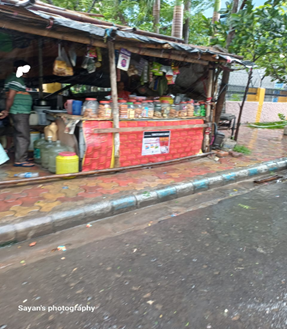
Street food lures people since it is easily available and affordable. Increased urbanization has led to more and more stalls of street food coming up in cities. Office goers in urban and periurban locales also dote on street food. People in their busy schedules now, have less time to cook and carry food to their workplaces. Preparing and selling street food is also relatively easy. These are the reasons why young people are heavily dependent on street food for survival. In and around offices, schools and colleges, street food stalls are to be found in plenty nowadays, as depicted in Figure 1 below.
Dangers of Street Food
All types of microbes like bacteria and parasites may be found in street food. Studies have shown that street foods like samosa and jhalmuri have high load of microbes and their toxins which can cause foodborne illnesses. Cut fruits and salads, sold on streets also have high load of enteropathogenic bacteria like Escherichia coli and Salmonella spp. Salads also have high burden of ova of Taenia spp. Salmonella spp. is able to survive and grow very fast on water melon held at room temperature, and the level of contamination does not change if the melon is stored at refrigeration temperature [1]. In a study in Hyderabad, 74% and 56% samples had Staphylococcus aureus in carrots and onions, respectively. Fifty-eight percent of carrots and 45% of onion samples had Salmonella, 68% of carrots and 24% of onions had Yersinia spp [2]. Various studies have identified the sources of food safety issues involved in street foods to be microorganism belonging to the genus Bacillus spp., Staphylococcus spp., Clostridium spp., Vibrio spp., Campylobacter spp., Listeria spp. and Salmonella spp [3]. The preparation techniques used in street-vended foods include frying, baking, fermenting, boiling, braising, roasting, or juicing. Street food vendors often serve food without further reheating. In this way, the aforementioned microorganisms gain access to these foods. Listeria spp. and Yersinia enterocolitica can be found in cold or refrigerated food and drinks also , since they can grow well at 4 -10 degrees C. Food vendors can also be carriers of pathogens like E. coli, S. aureus and Salmonella, Shigella and Campylobacter spp.
Contamination or adulteration of street food or other types of food may be intentional or unintentional.
The following hazards can contaminate street foods:- Artificial Colours
Many artificial colours are added to foods. Red chilli powder, for instance, can be contaminated with brick powder, which can cause stomach disorders, or coloured sawdust [4, 5]. Turmeric powder can be intentionally contaminated by metanil yellow and lead chromate, and all these chemicals can be carcinogenic. Street foods may commonly be made by adding artificial colours to the foods. Physical Hazards Physical hazards like pieces of trimmed nails of fingers, pieces of glass, pins of stapler or other objects can fall on street foods.
Biological Hazards
Microbial Toxins: Mycotoxins are produced by molds commonly, and may be present in food items like old rotten apples and maize [6]. Important mycotoxins are Aflatoxin, fumonisin and Patulin. Long term intake of Aflatoxins can cause hepatitis and even hepatocellular Carcinoma. Most mycotoxins are chemically stable and survive food processing. Vendors should know about mycotoxins and avoid preparing food with stale grains which can grow mycotoxins. Bacterial toxins are also important since they cause food poisoning. Staphylococcus aureus expresses enterotoxins A to E which cause nausea and vomiting [7]. This pathogen is present on external nares and by habits like unclean hands and nose-picking, enters the food handling and distribution system. Mostly sweet and creamy foods get contaminated easily by Staphylococcus aureus Bacillus cereus is present commonly in ambient air, and gets mixed easily with food items or dishes like fried rice, chilli chicken and chowmein available on the streets and kept open after boiling, for drying. It causes nausea and vomiting if cereulide or emetic toxin is there, and diarrhoea and dysentery if enterotoxin or cytotoxins are produced. In coastal areas, seafood is the most common available street food and one can incur invasive diarrhoea due to Vibrio parahemolyticus by eating this type of food. Even viruses like Hepatitis A, E and Rotavirus may be transmitted by unsafe drinking water. Water as a vehicle may also transmit pathogens causing watery diarrhoea, like Vibrio cholerae and Enterotoxigenic Escherichia coli (ETEC). Watery street foods like Golgappa may be loaded with these pathogens. Thus food poisoning and foodborne illnesses are rampant after eating street foods. Even parasites like Entamoeba histolytica, Blastocystis hominis, Cystoisospora belli, Diphyllobothrium latum, Ascarsis lumbricoides, Hymenolepis diminuta, Hymenolepis nana, Enterobius vermicularis, Trichuris trichiura and Ancylostoma duodenale have been found in street foods available in and around schools in Dhaka, Bangladesh [8].
Other Biological Hazards: Cockroaches, insects or lizards may fall on the food matter and contaminate the food. This renders the food unsuitable for consumption.
Flavour Enhancers
Flavour enhancers like Ajinomoto (Monosodium glutamate) are frequently used in fast food available on street, especially Chinese food. It is harmful since it causes headaches and migraine. MSG is actually an excitatory neurotransmitter which causes the fifth taste sensation called ‘Umami’, and this creates an urge to eat more such fast food, thus creating a vicious cycle [9].
Rancid Oil
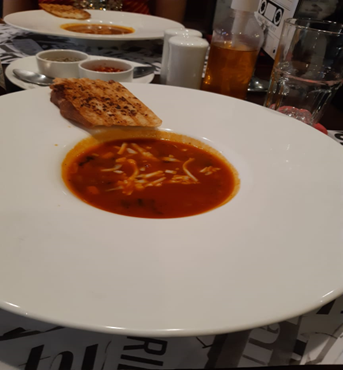
Instead of discarding used oil, it is just topped up by street food vendors as the level comes down. The burnt sediment settles in the oil and changes colour. It then starts to boil and smokes at lower temperatures. This affects the cooking. Sometimes the oils may change in colour and composition and become rancid to produce harmful and carcinogenic chemicals as well [10]. It is interesting to note here that not only proper street food, but even foods in restaurants may be cooked very carelessly and may contain many pathogens. Poor hand hygiene and food handling put consumers of restaurant and street food at risk of acquiring gastrointestinal infections, particularly in low-income countries [11]. An image of a prepared dish of a restaurant is shown below in Figure 2.
Prevention and Control Measures
Artificial colours in food or spices can be detected easily by simple methods like putting a pinch of turmeric powder or red chilli powder in a glassful of water. Pure turmeric or red chilli powder will never yield a uniform suspension, and instead will settle at bottom [12]. Microbes can be detected in food by culture of suspension of food materials. The following control measures may be instituted to ensure safety of street foods:-
- Street food vendors need to be educated about safe food handling and processing techniques.
- Street food vendors should wash their hands in 6 steps as per norms of social hand washing, and should clean their utensils well with soap and water. If needed disposable plates and cups should be used. Their nails should be trimmed.
- Cooked food should always be kept covered after cooking and not exposed to air, to mitigate chances of contamination by Bacillus cereus. Vendors should be taught about these things.
- Artificial colours should be avoided in foods whenever possible.
- Vendors should use safe and potable water to prepare the foods. The coliform levels of the water they are using should also be checked for this purpose.
- They should cover cooked food properly so that flies and cockroaches that serve as mechanical vectors of foodborne pathogens, have least access to food.
Discussion
Street food is appreciated everywhere for its flavour, variety and availability at low cost [13]. The street food industry has now shed its disorganized, lower class image and is fast becoming a viable and important informal-sector business [14]. However, street food may be quite harmful at times but is the major reliable and affordable food source for a majority of people of middle and low income groups, being cheap, culturally enriching and yet nutritious [15]. In spite of numerous advantages of street-vended foods, they have been documented to pose serious safety and health concerns to consumers and food handlers. This is due to their diversity, insufficient food safety knowledge and practices, insufficient basic hygiene, and lack of public awareness about food safety. It may easily be contaminated by physical, chemical and biological hazards. Microbes also assume importance from this context. Steps should be taken to ensure the safety of street food, from chemical, physical and microbiological viewpoints. HACCP (Hazard Analysis and Critical Control Point)-like measures have also been adopted to eliminate pathogens in street food [12]. Consumers should also become more aware of the risks of consuming street food and take necessary measures thereof. These are somewhat neglected areas of public health which should be addressed to ensure safe street food.
Conclusion
Street food is popular among the masses, but needs to be prepared and consumed with utmost care and precaution. Safety measures should be adopted wherever possible, to mitigate the dangers present in street food.
References
-
Edeghor U, John GE, Origbu C (2019) Bacteriological profile of cut fruits sold in Calabar Metropolis. World News Natural Sci 23: 43-55.
-
Sabbithi A, Kumar RN, Kashinath L, Bhaskar V, Rao VS (2014) Microbiological Quality of Salads Served along with Street Foods of Hyderabad, India. Int J Microbiol 2014: 1-6.
-
Rane S (2011) Street Vended Food in Developing World: Hazard Analyses. Indian J Microbiol 51(1): 100-106.
-
Sen S, Mohanty PS, Suneetha V (2017) Detection of Food Adulterants in Chilli, Turmeric and Coriander Powders by Physical and Chemical Methods. Research J Pharm Tech 10(9): 1-4.
-
WHO (2023) Mycotoxins.
-
Pinchuk IV, Beswick EJ, Reves VE (2010) Staphylococcal enterotoxins. Toxins 2(8): 2177-2197.
-
Barua P, Banik KS, Saha S, Musa S (2023) Parasitic Contamination of Street Food Samples From School- Based Food Vendors of Dhaka City, Bangladesh. Bangladesh J Zool 51(2): 217-229.
-
Manikandan H (2023) ‘Umami’- The Fifth Taste Sense of Ajinomoto Persuades to Eat Fast Food. Medindia.
-
Mathai G (2023) Street eats and tummy woes. The Telegraph online.
-
Nizame FA, Alam MU, Masud AA, Shoab AK, Opel A, et al. (2019) Hygiene in Restaurants and among Street Food Vendors in Bangladesh. Am J Trop Med Hyg 101(3): 566- 575.
-
Sachdev N, Mathur P (2017) Evaluation of safety of street foods in Delhi using a HACCP approach. Int J Curr Microbiol Appl Sci 6(1): 948-955.
-
Rane S (2011) Street Vended Food in Developing World: Hazard Analyses**.** Indian J Microbiol 51(1): 100-106.
-
Solomons N (2013) Urban Nutrition. In: Caballero (Ed.), Encyclopedia of Human Nutrition. 3rd (Edn.), Elsevier, pp: 311-315.
- The Role of Podocyte Apoptosis and the Involvement of SIRT1 in Diabetic Nephropathy
- Dealcoholization of Beer by Osmotic Distillation for the Beverage Industry
- Biopolymer-Based Edible Packaging- Biomaterials, Methods, and Applications in Food Industry: An Updated Review
- Influence of Bioprocessing Methods on 'China Rice' (Gawal R1), and Soyabean Supplementation on the Quality of Complementary Food
- Cassava (Manihot esculenta) Varietal Growth, Yield and Cyanide Content Performance in Three Sites in the South- Eastern Semi Arid Regions of Kenya
- Food Waste Treatment, Recycling, Management and Production of Value-Products-An Update on Methodologies and Current Trends