
Rapid Detection of Aflatoxin Production by Aspergillus Flavus Using Coconut Agar Medium
Certain fungal species develop toxic substances called aflatoxins, which are extremely dangerous to both human and animal health. This study focuses on the identification and detection of fungi that produce aflatoxin, which is a serious health danger because of its carcinogenic and poisonous qualities. Using both macroscopic and microscopic techniques, fungal isolates were collected and described in accordance with the taxonomic standards established by Klich & Pitt. Fluorescence under UV light, which revealed the presence of aflatoxins, demonstrated the usefulness of the study's use of coconut agar medium (CAM) for the quick analysis of aflatoxin production. The detrimental consequences of aflatoxins are emphasized in the conclusion, along with the significance of creating quick and precise detection techniques to reduce the hazards involved
Introduction
Aflatoxins are toxic compounds produced by several fungal species. Certain strains of Aspergillus flavus, Aspergillus parasiticus, and Aspergillus nomius develop aflatoxins, which are mycotoxins having extremely harmful and carcinogenic characteristics. Foodstuffs and animal feeds often contain these fungus. They can contaminate crops including corn, peanuts, cottonseed, and tree nuts and are among the most powerful mycotoxins, which are poisonous compounds made by fungi [1]. Aflatoxin contamination may result from the establishment of these fungi in these crops if they are erroneously retained or exposed to wet environments. The use of screening for aflatoxin production capabilities has been promoted by the fact that not all strains are capable of producing aflatoxins [2]. This survey’s standard methodology entails cultivating strains in an appropriate liquid or solid medium, then extracting and analyzing the strains using chromatographic techniques to check for aflatoxins. Aflatoxins poisonous and carcinogenic characteristics constitute a major health risk to both people and animals. The International Agency for Research on Cancer (IARC) has categorized them as Group 1 carcinogens, which means there is adequate research to determine they cause cancer in people. High doses of aflatoxins can cause acute aflatoxicosis, a disease that damages the liver and can result in liver failure and, in extreme situations occurs death [3]. Liver cancer is associated with chronic exposure, even at low levels, particularly in those who have hepatitis B or C. Aflatoxin B1, B2, G1, and G2 are the most prevalent and investigated of the various forms of aflatoxins [4]. AFB1 is the most harmful and carcinogenic. Public health requires that aflatoxin levels in food and animal feed be monitored and controlled, which is why many nations have stringent laws governing the acceptable levels of aflatoxin in consumable goods. In food safety and public health, aflatoxins must be screened for, particularly in foods that are susceptible to contamination, such as grains, nuts, and animal feed. Effective screening methods assist in identifying aflatoxins and reducing their presence to acceptable levels because they are dangerous even at low concentrations [5]. Aspergillus flavus and Aspergillus parasiticus are the primary producers of aflatoxins, which are extremely harmful to both human and animal health [6]. Proper screening techniques are crucial to reducing exposure because even trace levels of these can cause cancer. A wide range of screening techniques have been developed for the direct visual evaluation of aflatoxin production. In order to directly detect a blue green or brilliant blue fluorescence region around the colonies under UV light, these techniques employ increasingly complex growth conditions with additives to increase the formation of aflatoxins [7]. Developing rapid and accurate methods for the detection and screening of aflatoxins is crucial to mitigate the risks associated with aflatoxin contamination. One promising approach for the detection of aflatoxins is the use of coconut agar medium, which has been reported to effectively support the Aspergillus growth and aflatoxins production. This method exploits the characteristic fluorescence of aflatoxins under ultraviolet light, allowing for the expeditious identification of aflatoxin-producing strains. In a study by the researchers reported a simplified method for the detection of aflatoxin-producing strains of Aspergillus flavus using coconut agar medium. The presence of aflatoxin was confirmed by thin-layer chromatography of chloroform extracts from the fluorescing agar, demonstrating the effectiveness of this approach [8]. Another study by the researchers investigated the prevalence of aflatoxin contamination in various carbohydrate-rich foods, legumes, and vegetables, and the potential of milling, fermentation. Therefore, there is currently a complex agar medium called coconut agar medium, coconut cream agar, and coconut extract agar that has media containing coconut is used.
Materials and Methods
Fungal Isolates and Cultures
Fungi were isolated from bakery food products collected from rural areas by direct plate method and spread plate method. After isolation of fungi, was identified by macroscopic and microscopic characteristics, according to the description of macroscopic and microscopic characteristics of fungal isolates by Domsch and Gams and Klich [9, 10].
Cultivation of Fungal Cultures
Fungal cultures were maintained on PDA plates and PDA slants for further analysis. All these isolates were identified as A. flavus using the taxonomic criteria described by Klich, et al. [11].
Preparation of Media
100 g of shredded coconut was mixed with 200 ml of hot distilled water for five minutes to make a coconut agar medium. The resulting homogenate was then filtered through four layers of cheesecloth, and its pH elevated to 7. After adding 20 g of agar (20 g/liter), the mixture was brought to a boil and allowed to cool to approximately 50°C. After cooling to around 40 to 45°C and autoclaving for 18 minutes at 15 lb, the sterilized mixture was poured onto sterile petri dishes [5].
Analysis of Aflatoxins
Aspergillus flavus was inoculated onto previously prepared, sterilized coconut agar medium plates to determine its production of aflatoxin. Upon inoculation, the plates were cultured for seven days at room temperature. After growing the isolates on coconut agar medium, which is inductive of aflatoxin formation, plates were examined under UV light stimulation at 365 nm. Fluorescence on the back of the culture CAM in glass Petri dishes can be used to identify production [2, 12].
Results and Discussion
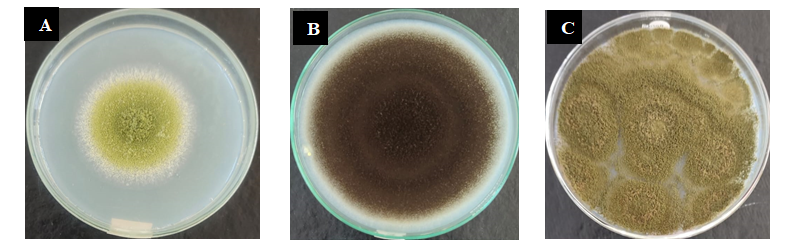
Total 19 Aspergillus species were isolated from 25 different bakery food products collected from rural areas using potato dextrose agar medium. Fungal species were identified as Aspergillus flavus, Aspergillus niger and Aspergillus paraciticus based on macroscopic and microscopic observation in accordance with the key descriptions provided by Domsch KH, et al. [9, 13, 14, 15, 16] (Figure 1).
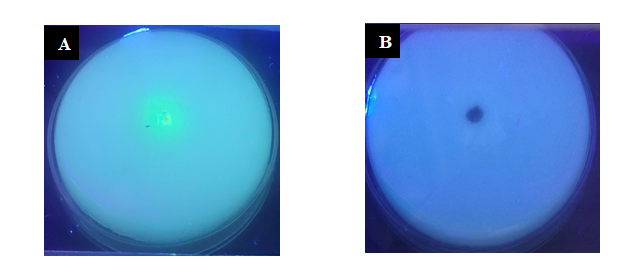
Screening of aflatoxin production was performed by using coconut agar medium by point inoculation at the center of the plate. All the isolated Aspergillus species was tested for the production of aflatoxins. After 7 days of incubation, plates were observed for the production of florescence around the colony. Out of 19 isolates 6 isolates were showed the fluorescence around the colony, indicates the production of aflatoxins from the identified Aspergillus species (Figure 2).
De Vogel, et al. [17] described a screening test which employs a complex agar medium that contains sucrose, various salts, and an aqueous extract of groundnuts (peanuts) free of aflatoxin. Before the medium was poured into plates, a thin layer of Hyflo Supercel was applied to the lower lid of the petri dishes. When plates were analyzed under UV light (350–370 nm) after inoculation and 48–72 hours of incubation, a vivid blue fluorescence suggested the presence of aflatoxin. A slightly comparable technique without the need for the groundnut extract was reported by Hara, et al. [18] Aflatoxin-producing-ability (APA) media, a modified Czapek agar medium containing corn steep liquor, was employed. Compared to the De Vogel et al., media, the APA medium required fewer efforts to prepare. Lin, et al. [19] was described a coconut agar medium (CAM) for the quick detection of aflatoxins. When exposed to long-wave UV radiation, the reverse side of colonies that produce aflatoxin showed blue fluorescence. This approach was quicker and easier than those that had been previously reported. Nevertheless, they made use of commercial coconut extracts, which are unavailable in the US. There are circumstances in which using APA for screening would be advantageous, even though we discovered that screening on CAM was generally preferred. In the initial experiments APA agar medium was tested but the results were not satisfactory because of the omission of corn steep liquor which was not available [20]. Coconut reported to be an excellent substrate for aflatoxin production. Although growth on other screening medium is slower than on CAM, where colony expansion fills the plate more quickly and obstructs fluorescence, the final intensity of the blue fluorescence obtained on other media is noticeably higher than that acquired on CAM. But for the majority of uses, we discovered that the CAM screening approach was easier, quicker, and less costly than any of the other approaches we looked at.
Conclusion
Aflatoxins are toxic compounds produced by certain fungal species and pose a significant health risk to humans and animals. The research outlines the importance of screening for aflatoxin production in food due to its harmful and carcinogenic effects. The research work developed a simplified method for detecting aflatoxin-producing strains using coconut agar medium and confirmed the presence of aflatoxin through fluorescence production on coconut agar medium plates and also identified various fungal isolates and cultures and highlighted the effectiveness and importance of developing rapid and accurate methods for the detection of aflatoxins to mitigate the risks associated with aflatoxin contamination in food.
Conflict of Interest
The authors declare that there is no Conflict of Interest.
References
-
Sowmya KL, Ramalingappa B (2022) Detection of Aflatoxigenic producing strains of Aspergillus flavus from bakery products by UV light and ammonia vapor test. International Journal of Research and Analytical Reviews 9(4): 671-679.
-
Fente CA, Ordaz JJ, Vazquez BI, Franco CM, Cepeda A (2001) New additive for culture media for rapid identification of aflatoxin producing Aspergillus strains. Applied and environmental microbiology 67(10): 4858- 4862.
-
Richard JL (2007) Some major mycotoxins and their mycotoxicoses-An overview. International Journal of Food Microbiology 119(1-2): 3-10.
-
Sowmya KL, Ramalingappa B (2023) Characterization and Determination of aflatoxigenic and Non-aflatoxigenic Aspergillus flavus Isolated from Bakery Food Products from Frontier around Davangere District. Indian Journal of Pure and applied biosciences 11(1): 32-42.
-
Davis ND, Iyer SK, Diener UL (1987) Improved method of screening for aflatoxin with a coconut agar medium. Applied Environmental Microbiology 53(7): 1593-1595.
-
Aycicek HA, Aksoy, Saygi S (2005) Determination of aflatoxin levels in some dairy and food products which consumed in Ankara, Turkey. Food control 16(3): 263- 266.
-
Sowmya KL, Ramalingappa B (2023) Morphological Characterization and Determination of Mycotoxigenic and Non-mycotoxigenic Producing Penicillium SP from Bakery Food Products by UV Light and Ammonia Vapor Test. Innovations 73: 1867-1875.
-
Sowmya KL, Ramalingappa B (2024) Qualitative Analysis of Mycotoxins by Thin Layer Chromatography (TLC). Frontiers in Environmental Microbiology 10(1): 1-5.
-
Domsch KH, Gams W, Anderson TH (1980) Compendium of soil fungi. Academic press, London, UK, pp: 1264.
-
Dyer SK, Mccammon S (1994) Detection of toxigenic isolates of Aspergillus flavus and related species on coconut cream agar. Journal of Applied Bacteriology 76(1): 75-78.
-
Klich MA, Pitt JI (1988) Differentiation of Aspergillus flavus from A. parasiticus and other closely related species. Transactions of the British Mycological Society 91(1): 99-108.
-
Sowmya KL, Ramalingappa B (2024) A review Mycotoxins: Extraction, characterization and analysis. International Journal of Biotechnology and Microbiology 5(3): 61-66.
-
Subramanian CV (1983) Hyphomycetes, taxonomy and biology. Academic press, London, New York, pp: 502.
-
Ellis MB, Ellis JP (1997) Microfungi on Land plants: An Identification Handbook. Richmond Publishers, pp: 1-868.
-
Gilman JC, Joseph C (2001) A manual of soil fungi. 2nd(Edn.), Daya Books, New Delhi, India, pp: 1-392.
-
Nagamani A, Kunwar IK, Manoharachary C (2006) Hand book of soil fungi. I K International Pvt Ltd, New Delhi, India, pp: 1-811.
-
Vogel PD, Rhee RV, Blanche-koelensmid WAA (1965) A rapid screening test for aflatoxin-synthesizing aspergilli of the flavus-oryzae group. Journal of Applied Bacteriology 28(2): 213-220.
-
Hara S, Fennel DI, Hesseltine CW (1974) Aflatoxin- producing strains of Aspergillus flavus detected by fluorescence of agar medium under ultraviolet light. Applied Microbiology 27(6): 1118-1123.
-
Lin MT, Dianese JC (1976) A coconut-agar medium for rapid detection of aflatoxin production by Aspergillus spp. Phytopathology 66: 1466-1469.
-
Wicklow DT, Shotwell 0L, Adams GL (1981) Use of aflatoxin-producing-ability medium to distinguish aflatoxin producing strains of Aspergillus flavus. Applied Environmental Microbiology 41(3): 697-699.
- The Role of Podocyte Apoptosis and the Involvement of SIRT1 in Diabetic Nephropathy
- Dealcoholization of Beer by Osmotic Distillation for the Beverage Industry
- Biopolymer-Based Edible Packaging- Biomaterials, Methods, and Applications in Food Industry: An Updated Review
- Influence of Bioprocessing Methods on 'China Rice' (Gawal R1), and Soyabean Supplementation on the Quality of Complementary Food
- Cassava (Manihot esculenta) Varietal Growth, Yield and Cyanide Content Performance in Three Sites in the South- Eastern Semi Arid Regions of Kenya
- Food Waste Treatment, Recycling, Management and Production of Value-Products-An Update on Methodologies and Current Trends