
Isolation and Sensory Evaluation of High Nattokinase-Producing Strains from Guizhou Douche, A Traditional Chinese Fermented Soybean
Nattokinase (NK) has become the focus of recent research on thrombolytic products. The preliminary screening got 361 strains with hydrolyzed circles in casein plates from douche, a traditional fermented soybeans by native microorganisms. Then, NKproducing isolates 5 and 7 with high NK activity and excellent sensory score in fermented soybean were further screened from the 361 strains through casein hydrolysis cycle area and fibrin plate methods and sensory evaluation of solid-state fermentation with principal component analysis. The NK activity of the two strains was around 6000 IU g-1. The fermented soybean by the two strains was yellow in color, moist in texture, unique in taste, and rich in mucus and sticky silk, which indicated the excellent performance of the two strains. Through morphological, physiological and 16S rDNA analysis, isolates 5 and 7 were identified as Bacillus amyloliquefaciens and Bacillus subtilis, respectively. This study laid a foundation for the potential application of the two strains in the modern fermentation control of traditional Guizhou fermented soybean and the production of NK products.
Introduction
Douche is a traditional fermented soybean by native microorganisms in ancient China, originated in the Qin and Han Dynasties, was brought to Japan by monks in the Tang Dynasty, and gradually evolved into natto following Japanese customs. The food is considered a Japanese longevity “secret” and has been eaten for more than 1000 years [1]. Japanese Investigation Paper scholars first studied its enzyme extract. The enzyme extract significantly affects thrombolysis and is a serine protease with strong fibrinolytic activity, known as nattokinase (NK) [2]. NK presents a thrombolytic effect and not only can reduce fibrinogen but also can promote catalytic conversion of plasminogen to plasmin in vivo [3, 4].
Thrombosis often leading to cardiovascular diseases (CVDs) [5]. According to statistics, at least 17.7 million patients die from thrombotic diseases worldwide every year [6]. Thus, the development of thrombolytic drugs has become a major topic. The commonly used thrombolytic and anti-thrombotic drugs contain streptokinase, urokinase, and tissue-type plasminogen activator; however, these drugs cause pain and exhibit side effects when administered and are costly contrary to NK that can be taken orally and is safe, low cost, and with fibrinolytic advantages [3, 4, 7]. NK can also effectively shrink nasal polyp tissues and decrease mucus viscosity [8]. Therefore, development of NK has become the focus of recent research on thrombolytic products, especially the isolation of NK-producing strains [4, 5, 6, 7, 8, 9, 11].
Guizhou douche is a typical Chinese flavored douche, such as Laoganma’s flavored douche [12] and Dafang County’s Doucheba [13]. So, new excellent microbial strains for high producing NK in Guizhou douche may be screened and should be develop to promote the popularity of Guizhou douche to the world. However, not all high NK-producing bacteria from douche is good in flavor; some douche is poor in sensory qualities, such as producing serious ammonia odor and poor flavor and color.
Therefore, this study aimed to screen the high NK activity of strains from Guizhou douche by casein plate and sensory evaluation to obtain high-quality douche. Enhancing the flavor of fermented beans can ease human consumption of them and can in turn help prevent thrombosis, prolong life, and meet people’s demand of high-quality food.
Materials and Methods
Experimental Materials
The strains were screened from 18 douche samples from Guizhou Province, China, and soybeans were purchased from the local market. Bovine thrombin (1000 U) and bovine fibrinogen were purchased from Shenyang Baiying Biological Technology Co., Ltd. Urokinase biological standards (1240 IU bottle-1) were purchased from China Institute for Drug Control. Other agents were of analytical grade.
Medium
Details of the media used were as follows. Casein plate medium (g l-1): 5 casein, 1 glucose, 1 yeast extract, 1 K2HPO4, 0.5 KH2PO4, 0.1 MgSO4, 20 agar, pH 7-7.5. Liquid seed medium (g l-1): 10 glucose, 5 yeast extract, 10 beef paste, 5 NaCl, pH 7-7.5. Solid fermentation medium: Soybeans were soaked in three times the volume of deionized water immersion at room temperature for 14–18 h and sterilized at 121°C for 20 min.
Method
Isolation of NK-Producing Strains: The douche sample was shredded, diluted, and then spread on the casein plate at 37 °C for 24 h. Single colonies with obvious clear circles were inoculated into the liquid seed medium and cultured at 37 °C and 180 r min-1 for 24 h. Thereafter, the culture was centrifuged at 4 °C and 10000 g for 10 min to obtain the crude enzyme solution. Then, 10 μL centrifugal crude enzyme solution was added into the plate hole and incubated at 37 °C for 18 h. Finally, the hydrolysis transparent circle area of the hole was measured, and the strains with an area > 200 mm2 were selected for the subsequent experiments. Preparation of Crude Enzyme and Measurement of NK: The pre-screening strains were inoculated into the liquid seed medium and cultured at 37°C and 180 r min-1 for 18 h and then inoculated into sterilized solid state medium. The culture was incubated at 37°C for 36 h and stirred once every 12 h for preparation of douche. A total of 2 g of douche was soaked in 4 mL sterile saline at 4°C for 24 h. Subsequently, the douche was crushed and centrifuged. Then, 2 mL physiological saline was again added to the centrifuge tube, and the douche was crushed again and centrifuged to obtain the supernatant. The supernatant was crude NK solution, which contained NK and some components of soybeans. Following Astrup’s report [14], NK activity was measured in the supernatant. Solid Fermentation Sensory Evaluation: The newly screened strains were inoculated into sterilized soybean medium and incubated at 37°C for 24 h and stirred once every 12 h. Then sensory evaluation was carried out by food experts focusing on stringiness and mucus, color, odor, and morphology; each index was divided into five grades (Table 1).
| Scores | Color | Odor | Stringiness and mucus | Texture |
|---|---|---|---|---|
| 1 | Dark brown | Strong ammonia odor | No stringiness and mucus | Dry |
| 2 | Brown | Heavy ammonia odor | 6–8 cm stringiness, a small amount of mucus | Full and dry |
| 3 | Dark yellow | Ammonia odor | 6–8 cm stringiness, a few amounts of mucus | Full and moist |
| 4 | Yellow with slight luster | Slight ammonia odor | 8–10 cm stringiness, a large amount of mucus | Full and moist, soft |
| 5 | Golden with full luster | Unique douche odor | Above 10 cm stringiness, rich in mucus | Full and moist, soft |
Table 1: Scoring standard of douche for sensory evaluation.
Identification of High NK-Producing and Excellent Sensory Characteristic Strains Cell Morphology: Two strains with high NK activity and good sensory scores in solid fermentation of soybean were Gram stained to observe the single-cell morphology. 16S rRNA Gene Sequence Identification: 16S rRNA gene sequence of isolates 5 and 7 was determined by Sangon Biotech, China. Then, the phylogenetic trees were constructed by neighbor-joining method using MEGA 5.0 [15].
Results and Discussion
Isolation of NK-Producing Strains
The preliminary screening produced 361 strains hydrolyzed from casein. To simplify the subsequent test, 72 strains with casein hydrolysis cycle area larger than 200 mm2 were used in measuring the NK activity. The protease activity (hydrolysis of casein expressed in area) and high NK activity of 15 isolates are presented (Figure 1).
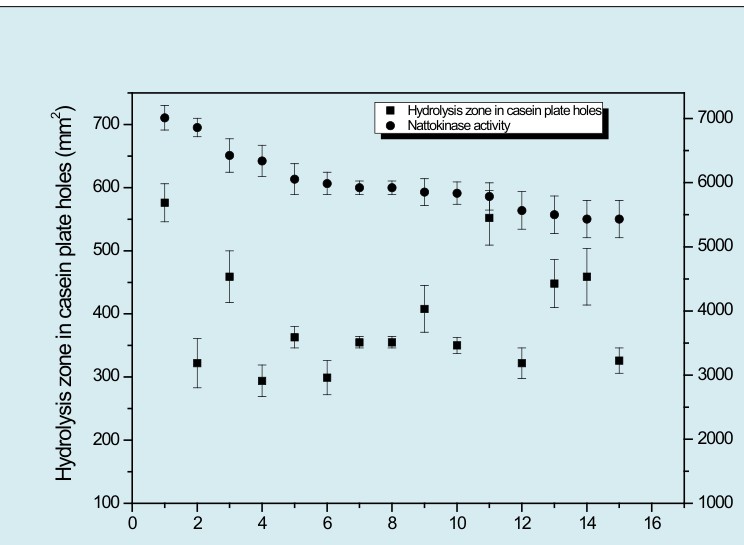
Figure 1 shows that the strain with the largest casein hydrolysis area did not show the highest NK activity. The reason was that NK had protease activity that did not benefit from NK activity. Therefore, NK activity should be measured, all of which were higher than 5400 IU g-1. The highest one was 7012.5 IU g-1. The reported NK activities of screened strains were mostly 100-3000 IU g-1, and the highest NK activity was 3000-5000 IU mL-1 [16, 17]. So, the 15 isolates may be considered as high-yield NK strains. Thus, the corresponding 15 strains were used to ferment soybean for sensory evaluation.
Sensory Evaluation of Solid Fermentation
Current commercially available fresh douche products have high nutritional value and health function. However, gaining domestic consumer acceptance is difficult because of its special taste, thereby limiting the application of douche products. Thus, screening of strains with excellent sensory scores plays an important role in developing NK products. Sensory score is a key index in preparing oral NK food, such as douche. Enzyme activity also plays a crucial role because high NK activity is conducive to treating thrombotic diseases.
The 15 strains in Figure 1 were inoculated into a solid fermentation medium and cultured under the same fermentation conditions. After the fermentation, the length, color, and odor of the fermented products were recorded and calculated. The overall scores are shown in (Table 2).
| Color | odor | Stringiness and mucus | morphology | |
|---|---|---|---|---|
| 1 | 3 | 3 | 3 | 4 |
| 2 | 4 | 4 | 3 | 4 |
| 3 | 5 | 4 | 4 | 5 |
| 4 | 4 | 3 | 4 | 4 |
| 5 | 4 | 4 | 5 | 5 |
| 6 | 4 | 3 | 3 | 3 |
| 7 | 5 | 4 | 5 | 5 |
| 8 | 4 | 4 | 4 | 4 |
| 9 | 3 | 4 | 3 | 4 |
| 10 | 4 | 4 | 4 | 5 |
| 11 | 4 | 4 | 3 | 4 |
| 12 | 3 | 3 | 3 | 3 |
| 13 | 4 | 4 | 3 | 3 |
| 14 | 4 | 4 | 4 | 4 |
| 15 | 4 | 3 | 2 | 2 |
Table 2: Sensory evaluation of solid state fermentation of soybean by 15 strains.
The colors of most douche strains were good; those of isolates 3 and 7 were the best whereas those of isolates 1, 9, and 12 were the worst. Japan’s fresh natto is generally golden brown. The colors of isolates 3 and 7 were gold, and most strains were yellow in color. Therefore, the target strains must be in these strains. With regard to odor, the 15 strains exhibited ammonia odor. However, the ammonia odor for most trains (10 strains) was slight.
The length of stringiness and the amount of mucus reflect the production of γ-polyglutamic acid and mucopolysaccharide in the fermentation [18, 19, 20]. γ-Polyglutamic acid promotes the absorption of calcium, and mucopolysaccharide presents various pharmacological activities, including anti-coagulant, hypolipidemic, anti-virus, anti-tumor, and anti-radiation. Moreover, mucin and mucopolysaccharides play a role in helping escort NK into the intestinal tract. Thus, the more the mucus, the higher the nutritional value. Table 1 shows that 7 strains were good in producing stringiness and mucus by solid fermentation of soybean, and isolates 5 and 7 obtained the best scores (5 scores).
Douche of full and moist texture indicates good morphology. Texture is also an important index for evaluating douche. Table 2 shows that most strains (11 strains) were good. The best isolates were 3, 5, 7, and 10 whereas the worst isolate was 15 (2 scores).
From the above-mentioned analysis, no single indicator was found to determine the best strains. Therefore, the best integrated strains were still uncertain. Principal component analysis (PCA) is a multi-index statistical analysis and can find the best strains. Thus, the NK activity of 15 strains (Figure 1) and sensory evaluation index (Table 2) were analyzed by PCA. The results are shown in (Figure 2).
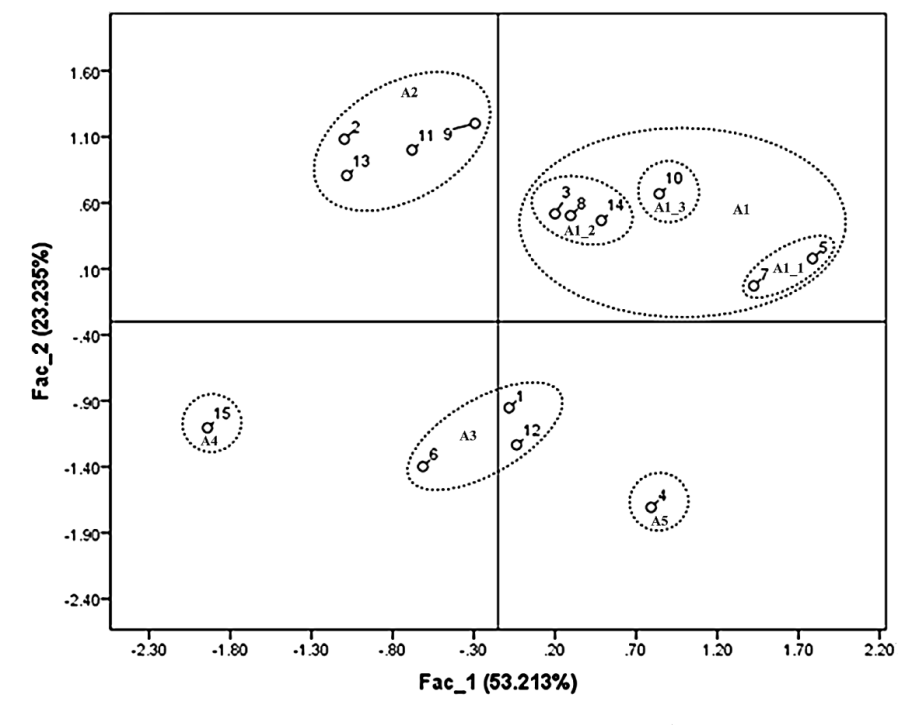
PCA, which is a sort of multivariate statistical analysis and an effective approach for isolating the mostoptimal strains Zeng X, et al. [21], was conducted in this study (Figure 2). As shown in Figure 2, 76.448% of the variability was explained, which indicated significant differences for the isolates. The strains were divided into groups A1, A2, A3, A4, and A5 depending on the position of the variables in the factorial space of PCA. Group A1 with isolates of 3, 5, 7, 8, 10, and 14 was the most promising in terms of NK, color, odor, stringiness and mucus, and morphology. The group was further divided into three subgroups: A1_1 (isolates 5 and 7), A1_2 (isolates 3, 8, and 14), and A1_3 (isolate 10). Subgroup A1_1 was better than A1_3, and A1_3 was better than A1_2. Therefore, the most promising isolates in terms of NK activity and sensory scores by PCA were 5 and 7. Accordingly, they were used in the subsequent experiments.
Identification of Excellent NK-Producing Strains
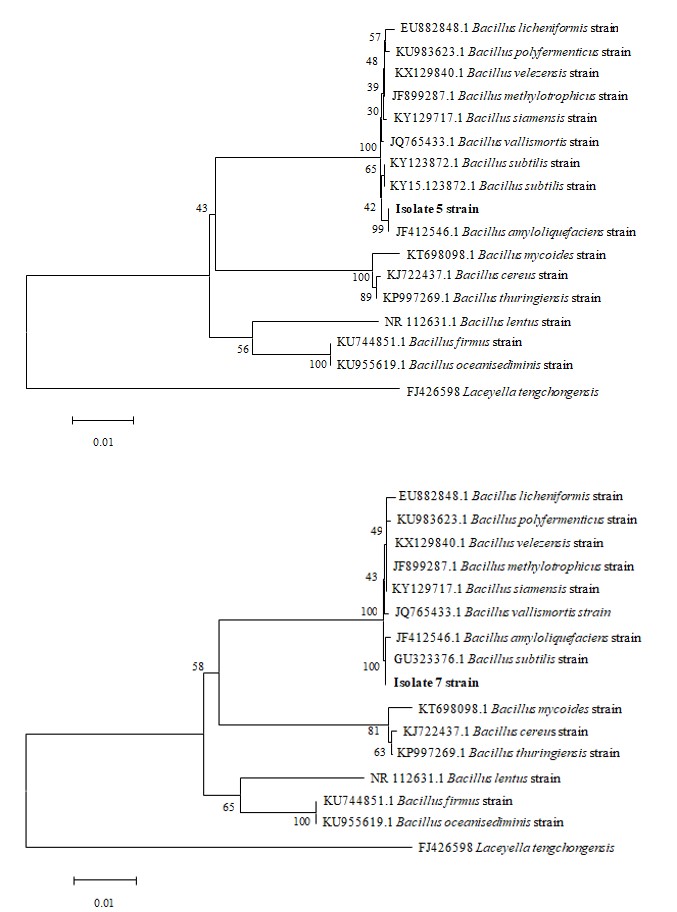
Morpholog Identification: Morphology shows that isolates 5 and 7 were Gram-positive Bacillus species. Sequence and Phylogenetic Analysis of 16S rRNA Gene: The sequencing results showed that the lengths of 16S rRNA gene of isolates 5 and 7 were 1458 and 1465 bp, respectively. The phylogenetic trees were constructed using MEGA version 5 (Figure 3). Combined with cell morphology, physiological and biochemical identifications, and phylogenetic analysis, isolates 5 and 7 were identified as Bacillus amyloliquefaciens and Bacillus subtilis, respectively.
(A)
(B) Figure 3: Neighbor joining phylogenetic trees of isolates 5 and 7 derived from partial 16S rRNA gene sequences. The numbers at the nodes represent percentage bootstrapvalues based on 1000 replicates. The horizontal scale bar indicates a distance of 0.01.
Conclusion
Three hundred and sixty-one strains with hydrolysed circles in casein plates were got from douche. Then, Isolates 5 and 7 with high NK activity about 6000 IU g-1and excellent sensory score in fermented soybean were screened by casein hydrolysis cycle area and fibrin plate, sensory evaluation and principal component analysis. The isolates 5 and 7 were identified as Bacillus amyloliquefaciens and Bacillus subtilis by morphological and 16S rDNA analysis, respectively. The two strains can be used for intensive vaccination for control of douche quantity with high NK activity.
Acknowledgement
This work was financially supported by the Key Agricultural Project of Guizhou Province (QKHZC- [2021]278, QKHZC- [2021]184, QKHZC- [2021]142, QKHZC- [2019]2382, High-level innovative talents training project of Guizhou province (QKHPTRC-GCC[2022]026-1), and QKHZC- [2016]2580), Natural Science Foundation of China (31870002 and 31660010), Qiankehe talents project ([2018]5781 and [2017]5788-11).
Conflict of Interest
No conflict of interest declared.
References
-
Haritha M, Meena V (2011) Nattokinase: A review of fibrinolytic enzyme. IJCEPR 2(1): 61-66.
-
Sumi H, Hamada H, Tsushima H, Mihara H, Muraki H (1987) A novel fibrinolytic enzyme (nattokinase) in the vegetable cheese Natto; a typical and popular soybean food in the Japanese diet. Experientia 43(10): 1110- 1111.
-
Weng Y, Yao J, Sparks S, Wang KY (2017) Nattokinase: An Oral Antithrombotic Agent for the Prevention of Cardiovascular Disease. Int J Mol Sci 18(3): 523.
-
Dabbagh F, Negahdaripour M, Berenjian A, Behfar A, Mohammadi F, et al. (2014) Nattokinase: production and application. Appl Microbiol Biotechnol 98(22): 9199- 9206.
-
Kamiya S, Hagimori M, Ogasawara M, Arakawa M (2010) In vivo evaluation method of the effect of nattokinase on carrageenan-induced tail thrombosis in a rat model. Acta Haematol 124(4): 218-224.
-
WHO (2021) Cardiovascular diseases (CVDs).
-
Cai D, Zhu C, Chen S (2017) Microbial production of nattokinase: current progress, challenge and prospect. World Journal Of Microbiology and Biotechnology 33(84).
-
Takabayashi T, Imoto Y, Sakashita M, Kato Y, Tokunaga T, et al. (2017) Nattokinase, profibrinolytic enzyme, effectively shrinks the nasal polyp tissue and decreases viscosity of mucus. Allergol Int 66(4): 594-602.
-
Mahajan PM, Nayak S, Lele SS (2012) Fibrinolytic enzyme from newly isolated marine bacterium _Bacillus_ _subtilis_ ICTF-1: Media optimization, purification and characterization. Journal of Bioscience and Bioengineering 113(3): 307-314.
-
Wei X, Luo M, Xu L, Zhang Y, Lin X, et al. (2011) Production of Fibrinolytic Enzyme from _Bacillus amyloliquefaciens_ by Fermentation of Chickpeas, with the Evaluation of the Anticoagulant and Antioxidant Properties of Chickpeas. J Agric Food Chem 59(8): 3957-3963.
-
Lu M, Gao Z, Xing S, Long J, Cuiqin Li, et al. (2021) Purification, characterization, and chemical modification of Bacillus velezensis SN-14 fibrinolytic enzyme. Int J Biol Macromol 177: 601-609.
-
Qin L, Zeng H, Ding X (2006) Study on traditional household methods and identifications of dominant microflora for processing long-ripened Douchiba (in chinese). Food Science 27: 118-123.
-
Astrup T, Mullertz S (1952) The fibrin plate method for estimating fibrinolytic activity. Archives of Biochemistry & Biophysics 40(2): 346-351.
-
Kumar S, Nei M, Dudley J, Tamura K (2008) MEGA: a biologist-centric software for evolutionary analysis of DNA and protein sequences. Briefings in bioinformatics 9(4): 299-306.
-
Weng M, Deng X, Bao W, Zhu L, Wu J, et al. (2015) Improving the activity of the subtilisin nattokinase by site-directed mutagenesis and molecular dynamics simulation. Biochemical And Biophysical Research Communications 465(3): 580-586.
-
Feng C, Jin S, Luo M, Wang W, Xia XX, et al. (2015) Optimization of production parameters for preparation of natto-pigeon pea with immobilized Bacillus natto and sensory evaluations of the product. Innovative Food Science & Emerging Technologies 31: 160-169.
-
Saito T, Iso N, Mizuno H, Kanhda H, Suyama Y, et al. (1974) Conformational Change of a Natto Mucin in Solution. Agricultural & Biological Chemistry 38(10): 1941-1946.
-
Zhou J, Guo H (2003) Analysis of natto mucus composition (in Chinese). Science and Technology of Food Industry 24: 32-34.
-
Ren X, Gao H (2006) Natto slime hypha and its preparing method and application.
-
Zeng X, He L, Guo X, Deng L, Yang W, et al. (2017) Predominant processing adaptability of Staphylococcus xylosus strains isolated from Chinese traditional low- salt fermented whole fish. International Journal of Food Microbiology 242: 141-151.
- Superposition of Cryo-EM and AlphaFold Predictions of Dengue Antigen-Antibody Complexes
- Jugular-Applied Coherent Low-Level Laser Therapy Enhances Systemic Mitochondrial Metabolic Function and Antioxidant Response
- Role of OMC32 Polypeptide in Acrosin-Mediated Exocytosis during the Bovine Sperm Acrosome Reaction
- Association of Galectin-3 but not Laminin in Tamoxifen-Induced Growth Suppression in Breast Cancer MCF-7 Cells
- Effect of Different Wavelengths of Light on the Rate of Photosynthesis
- Nutritional, Therapeutic, and Environmental Effect of Oyster Mushrooms: An Editorial