
Physical Properties and Identification of Flavonoids by Ultraviolet-Visible Spectroscopy
Flavonoids are major functional components of many vegetable or animal preparations with medical uses. Flavonoids are also used in the treatment of numerous diseases, inhibiting specific enzymes, stimulating hormones and neurotransmitters and reducing the activity of free radicals. Due to the fact that flavonoids contain a variable number of phenolic groups in their chemical structure and due to their excellent properties to form chelates with iron and other transition metals, they have a high antioxidant capacity. For the human body, the antioxidant activity is highlighted due to the fact that they protect the cells of the body from free radicals that are formed as a result of numerous processes that use oxygen as an energy source and thus play an essential role in the protection of oxidative degradation phenomena. Their antiradical properties are due to hydroxyl and superoxide radicals, reactive groups that are involved in the initiation of lipid peroxidation processes, their ability to modify the synthesis of eicosanoids, to prevent platelet aggregation (antimicrobial effect) and to protect basic lipoproteins from oxidation. Although some studies indicate that some flavonoids possess a pro-oxidative action, this occurs only at high doses, and most investigations show the existence of anti-inflammatory, antiviral and anti-allergic effects, as well as the protective role in various pathologies.
Introduction
In 1930, Albert Szent-Gyorgi isolated from lemon peel, a substance called citrine, with a role in capillary permeability; for this reason, flavonoids were initially named “Vitamin P” (for permeability), respectively vitamin C2, because it has been shown that they favour the function of vitamin C, improving its absorption and protecting oxidation. Flavonoids are a subject of wide interest and as a result of research in the field, their number is constantly increasing. Thus, if in 1976 around 800 different flavonoids were cited in the literature, starting from 1990, the number of reported flavonoid structures increased to 4000, and today almost 8000 flavonoids are known [1].
The term flavonoids (lat. flavus = yellow) was first used for flavones, and later this name was extended to various plant polyphenols, including the less intensely coloured flavones, the colourless flavan-3-ols that give coloured compounds in red and blue-anthocyanidins. The structural differences between each group result from the variation in the number and positions of the hydroxyl groups as well as the acylation and/or glycosidation of these groups [2].
Due to some physico-chemical and physiological properties, flavonoids are included in the class of vegetable polyphenols, but due to their specific, especially pharmacological properties, they form a separate class. Flavonoids include various classes of natural substances, many of which give flowers their yellow, orange, red, or blue colour, respectively, to flowers and fruits in particular. As natural pigments present in plants, in addition to being substances that change colour and decorate plants throughout their life, they also constitute a protection against the harmful effects produced by oxidizing agents, such as ultraviolet rays, environmental pollution, etc [3].
Flavonoids are present in plants, especially in the systematic group of Angiosperms, and only a few have been detected in fungi and algae, so there are no representatives of the plant kingdom that do not contain constituents from the class of flavonoids [4].
All the organs of the plant, especially the young ones and especially the epidermis, young leaves, buds, buds or barely opened flowers are rich in flavonoids. The heteroside (water- soluble) forms accumulate in vacuoles and concentrate in the epidermis of the leaves, and in the case of flowers they are stored in the epidermal cells, while the aglycones are distributed in the cuticle of the leaves and in the wood. Flavonoids are also present in the animal kingdom, but they are considered to come from the vegetable kingdom, being brought in through food [5].
The results of numerous researches carried out on plant materials containing flavonoids show that they can be used not only as a new medicine, but also as an extract prepared for use in food (the daily requirement of flavonoids from food, especially fruits and vegetables being 1 -2 g) and in the cosmetic industry.
Physical Properties of Flavonoids
The physical properties depend on the class of flavonoids and the form in which they are found (free, glycosidic or sulphated). For example, flavones, flavonols and aurones due to the conjugated system are solid substances with a colour from very weak yellow to red. Glycosides (glycosides) are generally amorphous solids, while aglycones and methoxylated compounds are crystalline. Anthocyanidins are deep red, dark purple, purple and blue in colour. The colour of flavonic derivatives is due to the chromophoric groups -C=C-C=. The hydroxyl group in position 3 contributes to the yellow colour, and the groups in positions 3’ and 4’ to the dark yellow colour. The presence of OH groups in position
3, 3’ and 4’ accentuates the yellow colour. The solubility of flavonoids depends on the characteristic structure and the numbers of substituents present (number of polar groups). Flavonoids are hardly soluble in water, and aglycones are practically insoluble in water, instead they are soluble in ethyl ether. Rutin dissolves 1:20 in hot water and 1:10000 in cold water. For preparative purposes, this difference in solubility at different temperatures is used, as well as the solubility of aglycones in ethyl ether, to separate them from flavonoids [6].
Glycosides, anthocyanins and sulphates are soluble in water and alcohol (methyl alcohol and ethyl alcohol). The aglycones of flavonoids, especially the hydroxylated ones, are soluble in alcohol (methyl alcohol, ethyl alcohol and n-butanol), and the methoxylated aglycones are soluble in less polar solvents, such as petroleum ether and chloroform. Flavonoids with phenolic hydroxyl are soluble in alkaline solutions, and the hydroxylated ones decompose under the action of strong bases, which allows recognition and differentiation from the others, a method used to elucidate the structure [7].
Flavones, tasteless and odourless substances, are soluble in alcohol, acetone and acetic acid, hardly soluble in ethyl ether and practically insoluble in chloroform, benzene and petroleum ether. Anthocyanins are soluble in water and alcohol, hardly soluble in ether, benzene and chloroform. In filtered ultraviolet light, flavonoids exhibit characteristic fluorescence. Flavonoid aglycones, or flavonoids containing a free hydroxyl in position 3, have a golden to greenish-yellow fluorescence. When the hydroxyl in position 3 is missing or is blocked by glycosidation, the fluorescence is brown, and if the hydroxyls are methylated, with the increase in the degree of methoxylation, the fluorescence shade turns towards bright blue. in acidic solutions, in daylight, fluorescence is greenish yellow with hydrochloric acid and blue with concentrated sulphuric acid solution, as a result of the formation of flavyl salts [8].
Ultraviolet-Visible Spectroscopy of Flavonoids
The ultraviolet spectrum of flavonoids in methanol shows characteristic bands, which depend on the conjugation system of the aromatic rings. Flavones and flavonols usually absorb in the 240-400 nm region. It is observed as a characteristic in this region, the presence of two bands, currently called Band I (frequently between 300-390 nm) associated with the absorption given by the cinnamon radical (cycle B) of the flavonoid structure and Band II (between 240-280 nm) associated with the absorption given by the benzoic radical (cycle A) [9] according to Figure 1.
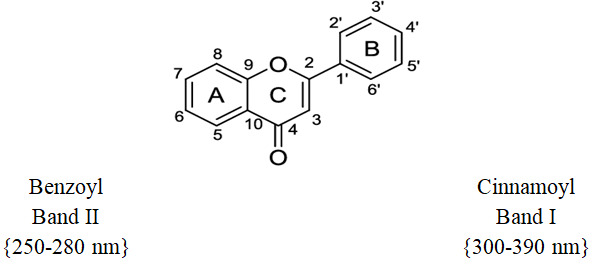
The position of band I depend on the type of flavonoid: flavones absorb at 310-350 nm, 3-O-substituted flavonols at 330-360 and flavonols at 350-385 nm. Sometimes an additional maximum is possible, Band III, around 330 nm, especially characteristic of hydroxylated flavones [10]. The characteristic absorption bands of flavonoids in the ultraviolet-visible spectrum are shown in Table 1.
| Band I | Band II | |
|---|---|---|
| Flavones | 310 - 350 nm | 250 - 280 nm |
| Flavonols (3-OH-substituted) | 330 - 360 nm | 250 - 280 nm |
| Isoflavones (5-deoxy-6,7-dioxy) | 310 - 330 nm | 245 - 295 nm |
| Isoflavones, dihydroflavonols | 300 - 330 nm | 275 - 295 nm |
| Chalcones | 340 - 390 nm | 230 - 270 nm |
| Auron | 380 - 430 nm | 230 - 270 nm |
| Anthocyanins, Anthocyanins | 310 - 350 nm | 270 - 280 nm |
| Flavones | 310 - 350 nm | 250 - 280 nm |
Table 1: Characteristic absorption bands of flavonoids in the UV-VIS spectrum.
Oxidation in the B cycle leads to a bathochrome effect, respectively to a shift of the absorption in Band I to higher wavelengths, an additive process with the increase in the number of hydroxyls [11] according to Table 2.
| Compound | Oxidation at nm | Band I | ||
|---|---|---|---|---|
| Cycle A | Cycle B | |||
| Galangina | 3,5,7 | - | 359 | |
| Kaempferol | 3,5,7 | 4’ | 367 | |
| Quercetin | 3,5,7 | 3’,4’ | 370 | |
| Myricetin | 3,5,7 | 3-, 4’, 5’ | 374 | |
| Name of the Substance | Specific Reagents | |||
| MeOH | CH3ONa | AlCl3 | CH3COONa | |
| Kaempferol | 253;266;294 322;367 | 278;316 416 | 260;268;303 350;424 | 274;303;387 |
| Luteolin | 242;253;267 291;349 | 266;329 401 | 247;300 328;426 | 269;326; 384 |
| Quercetin | 255;269; 301;370 | 247;321; | 272;304;333 458 | 257;274; 329; 390 |
| Routine | 259;266 299;359 | 272;327 410 | 275;303 433 | 271;325 393 |
| Myricetin | 254;272 301;374 | 262;285 322;423 | 271;316 450 | 269;335 |
Table 2: Displacement of UV absorption depending on the degree of oxidation in cycle B.
The presence of phenolic hydroxyls in different positions of the molecule can be determined by the comparative study of the UV spectrum in methanol after the addition of different reagents: sodium methoxide (NaOMe), sodium acetate (NaOAc), aluminium chloride (AICl3) with and without HCl and boric acid (H3BO3) [12] according to Table 3.
Sodium methoxide is a strong base that ionizes the phenolic hydroxyls present in the molecule and thus allows the recognition of the existence of hydroxyl groups in position 3 and 4’. When NaOMe is added, the intensity of the band decreases, 4’-hydroxy flavones showing a bathochromic shift of 45-65 nm compared to band I. Flavonols (or 3-hydroxyflavones) with hydroxyl in position 4, also show a bathochromic shift of 45-65 nm, but the intensity of the band will decrease. In the case of 3, 4’-dihydroxylated, o-dihydroxylated flavonols, respectively those with 3 hydroxyl groups, two of which in the ortho position, the spectrum is strongly modified after a few minutes after the addition of sodium methoxide. The appearance of a band around 330 nm (Band III) is characteristic for 7-hydroxylated flavones [13].
Sodium acetate is a weaker base than sodium methoxide and ionizes only the more acidic phenolic hydroxyls 3, 4’ and 7. Ionization of the hydroxyl of 7 affects band II and therefore sodium acetate is a reagent used to determine their presence. When sodium acetate is added, a bathochromic shift of 5-20 nm of band II is observed in the case of a flavone or flavonol-7-hydroxylated. 5-hydroxylated flavanones show a bathochromic shift of 35 nm. Flavononols (also with 5 OH) show a bathochromic shift of 60 nm [14].
With anhydrous aluminium chloride, chelates are also formed with ortho-dihydroxylated, 3-hydroxylated and 5-hydroxylated flavonoids. Compared to those presented previously, when determining the spectrum with AICI3 and HCl, a bathochromic shift of 35-55 nm of band I is obtained (compared to the methanolic one) in the case of a flavone or flavonol-5-hydroxylate. A shift of 17-20 nm occurs in the case of a flavone or flavonol-5-hydroxylated and 6-oxygenate, and a shift of 50-60 nm is observed in the case of a flavone or a 3-hydroxylated flavonols (with or without 5 -OH). In the case of flavonoids (flavones and flavonols) ortho-hydroxylated at ring B (without 3-OH, without 5-OH) upon addition of AICI3, a bathochromic shift of band I is obtained by 30-40 nm, which is lost upon addition of HCl. Flavonols ortho-dihydroxylated at ring A (without 3 OH and without 5 OH) show a shift of the same band by 20-25 nm, which is also lost upon addition of HCl. Other flavonoids, such as flavanones, Isoflavones and flavonols, show a bathochromic shift of band II. Aarons, Chalcones and anthocyanidins also present a bathochromic shift of band I [15].
Flavonoids as natural pigments present in vegetables protect against the harmful effects produced by oxidizing agents, such as ultraviolet rays. Due to the presence in their structure of a variable number of phenolic groups, they have the property of forming chelates with iron and other transition metals, which gives them a high antioxidant capacity and therefore play an essential role in the protection of oxidative degradation phenomena and have an effect therapeutically relevant for a large number of diseases. Their antiradical properties are due to the inhibition of hydroxyl and peroxide radicals, reactive groups that are involved in the initiation of lipid peroxidation processes and describe their ability to modify the synthesis of eicosanoids (with anti-prostanoid and anti-inflammatory response), to prevent platelet aggregation (antimicrobial effect) and protecting lipoproteins.
Conclusion
To identify the different flavonoids, different colour reactions can be performed both on the extracts and directly on the plant tissue. The colour reactions performed directly on the plant tissue give a valuable orientation for the subsequent processing of the material. Numerous articles from the literature attest that UV spectroscopy is a method most frequently used to identify or confirm the structure of flavonoids and their glycosides from plant extracts, biological materials and pharmaceutical preparations. Although the exact role played by flavonoids in plants is still unknown, there is some experimental evidence that suggests it:
- Their ability to absorb ultraviolet radiation to protect plant tissue from harmful radiation
- Their varied colours and their presence in tissues, as for example in flowers, suggest participation in reproductive processes, favouring the attraction of pollinating insects.
- The differences in biological activity discovered on some of the flavonoids (antimicrobial, antimycotic, etc.) and the experimental findings for some of them explain the resistance of some plants against various infections and diseases; it can therefore be stated that flavonoids act like phytoalexins, a term that suggests that these substances present a chemical plant defence mechanism.
- The ability to inhibit some plant hormones shown by some flavonoids suggests that they act as plant growth regulators. Among the pharmacological effects of flavonoids, the most representative are: activity on the central nervous system, cardiotonic activity, antilipemic activity, antiulcer activity, hepatoprotective activity, anti-inflammatory activity, antitumor activity and antineoplastic activity.
References
-
Shen N, Huang XD, Li ZW, Wang YC, Qi L (2015) Yao xue xue bao = Acta pharmaceutica Sinica 50(5): 547-551.
-
Li H, Tan X, Huang W, Shen Y, Yan R, et al. (2023) Enzymatic Acylation of Flavonoids from Bamboo Leaves: Improved Lipophilicity and Antioxidant Activity for Oil- Based Foods. J Agric Food Chem 71(12): 4817-4824.
-
Terahara N (2015) Flavonoids in foods: a review. Nat prod commun 10(3): 521-528.
-
Corradini E, Foglia P, Giansanti P, Gubbiotti R, Samperi R, et al. (2011) Flavonoids: chemical properties and analytical methodologies of identification and quantitation in foods and plants. Nat Prod Res 25(5): 469-495.
-
Hernandez I, Alegre L, Breusegem F, Bosch MS (2009) How relevant are flavonoids as antioxidants in plants? Trends in plant science 14(3): 125-132.
-
Peterson J, Dwyer J (1998) Taxonomic classification helps identify flavonoid-containing foods on a semiquantitative food frequency questionnaire. J Am Diet Assoc 98(6): 677-684.
-
Hassanpour SH, Doroudi A (2023) Review of the antioxidant potential of flavonoids as a subgroup of polyphenols and partial substitute for synthetic antioxidants. Avicenna J phytomed 13(4): 354-376.
-
Guimaraes M, Mateus N, Freitas V, Cruz L (2018) Improvement of the Colour Stability of Cyanidin-3- glucoside by Fatty Acid Enzymatic Acylation. J Agric Food Chem 66(38): 10003-10010.
-
Leonarski E, Cesca K, Oliveira D, Zielinski AF (2023) A review on enzymatic acylation as a promising opportunity to stabilizing anthocyanins. Cri Rev Food Sci Nutr 63(24): 6777-6796.
-
Apam YJ, Uscanga, AD, Gonzalez AH, Contreras J, Mojica L, et al. (2023) Pharmacological Activities and Chemical Stability of Natural and Enzymatically Acylated Anthocyanins: A Comparative Review. Pharmaceuticals 16(5): 638.
-
Karabin M, Hudcova T, Jelinek L, Dostalek P (2015) Biotransformations and biological activities of hop flavonoids. Biotechnol Adv 33(6 Pt 2): 1063-1090.
-
Bartmanska A, Tronina T, Poplonski J, Huszcza E (2013) Biotransformations of prenylated hop flavonoids for drug discovery and production. Curr drug metab 14(10): 1083-1097.
-
Chen L, Ding L, Yu A, Yang R, Wang X, et al. (2007) Continuous determination of total flavonoids in Platycladus orientalis (L.) Franco by dynamic microwave- assisted extraction coupled with on-line derivatization and ultraviolet-visible detection. Analy Chim Acta 596(1): 164-170.
-
Lunte SM (1987) Structural classification of flavonoids in beverages by liquid chromatography with ultraviolet- visible and electrochemical detection. J Chromatogr 384: 371-382.
-
Kim JS (2020) Study of Flavonoid/Hydroxypropyl-β- Cyclodextrin Inclusion Complexes by UV-Vis, FT-IR, DSC, and X-Ray Diffraction Analysis. Prev Nutr Food Sci 25(4): 449-456.
- An Efficient and Affordable Method for Isolating Bone Marrow- Derived Mesenchymal Stem Cells from Swiss Albino Mice
- Superposition of Cryo-EM and AlphaFold Predictions of Dengue Antigen-Antibody Complexes
- Jugular-Applied Coherent Low-Level Laser Therapy Enhances Systemic Mitochondrial Metabolic Function and Antioxidant Response
- Role of OMC32 Polypeptide in Acrosin-Mediated Exocytosis during the Bovine Sperm Acrosome Reaction
- Association of Galectin-3 but not Laminin in Tamoxifen-Induced Growth Suppression in Breast Cancer MCF-7 Cells
- Effect of Different Wavelengths of Light on the Rate of Photosynthesis