
Balancing Sustainability of Environmental Impact of Nanomaterials: An Overview
Nanomaterials, with their exclusive properties and multipurpose applications, hold incredible potential across various industries, ranging from electronics to healthcare. However, the environmental impact of these materials remains a critical apprehension as their usage booms up. This overview explores the complex association between nanomaterials and sustainability, directing to unravel their environmental implications even though advocating for a balanced approach towards their utilization. The environmental footmark of nanomaterials integrates their entire lifecycle-from synthesis to discarding. Vibrant considerations encompass the energy-intensive production developments, the latent release of nanoparticles into the environment, and their persistence and bioaccumulation. Although nanomaterials offer pioneering solutions, their unchecked propagation could exaggerate ecological degradation and posture risks to human health. Achieving sustainability in nanomaterials necessitates a many-sided tactic. This imitates integrating environmental considerations into the design and synthesis stage, implementing green manufacturing practices, and employing robust regulations to lessen latent hazards. This overview provides new insights to establish a strong embracing sustainability principle that can reveal the wide-ranging potential of nanomaterials however shielding ecological integrity for future generations.
Abbreviations
NMs: Nanomaterials; MFA: Material Flow Analysis; EFM: Environmental Fate Models; LCA: Life Cycle Assessment; ISO: International Organization for Standardization; EHS: Environmental, Health, and Safety.
Introduction
The seriousness to discourse demanding environmental issues has never been more evident in this promptly changing world. s Our planet faces unparalleled challenges, from pollution and climate change to resource depletion, demanding pioneering solutions because these pollutants can enter the food chain, posing health risks and environmental apprehension [1, 2, 3, 4, 5]. The risk of nanomaterials (NMs) is strong-minded by factors like their environmental concentrations, linked contaminants, transformations, consumption, bioaccumulation, and ecotoxicity [3, 4, 5]. Nanotechnology and nanomaterials are often employed in evolving technologies pointed at environmental sustainability and addressing these existing challenges.
The exceptional possessions of nanomaterials, such as high surface-to-volume ratios, increased reactivity, and quantum effects, make them remarkably valuable for endeavoring a wide range of issues. Therefore, nanotechnology has the potential to meaningfully contribute to attaining sustainable progress goals and nurturing a sustainable society.
Environmental Impacts Apprehensions
The environmental impact of nanomaterials is a growing apprehension because of their exclusive features and extensive applications.
Toxicity and Bioaccumulation: There is growing apprehension about the toxicity and exposure of nanomaterials (NMs), as they can infiltrate and be absorbed by the cell membranes of mammals. The rate at which NMs are absorbed by cells depends solely on their size, aggregation, and sedimentation properties. The small size of nanoparticles permits them to permeate the physiological barriers of living organisms, leading to injurious biological reactions. Nanoparticles can pass in the human body through the lungs, intestinal tract, or skin, and they can possibly be toxic to the brain, result in lung inflammation, and induce cardiac problems [6]. Due to their size and conformation, certain nanoparticles have been discovered to induce permanent cell damage by triggering organ injury and oxidative stress [7, 8, 9, 10] (Figure 1).
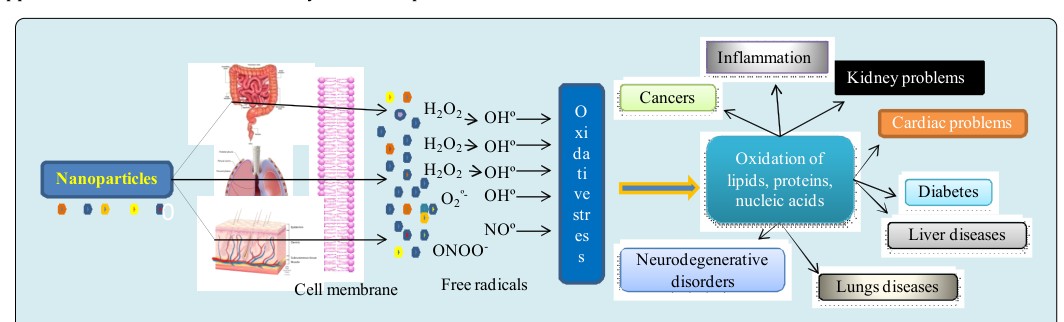
Several studies conducted by Sahu et, al. highlight that size is the most critical factor in the genotoxicity and cytotoxicity of silver nanomaterials (Ag NMs) on human liver cells. These studies found that the toxic effects of Ag NMs varied according to their size, with smaller NMs having a more potent impact [11]. Likewise, gold nanomaterials (Au NMs) are widely considered in several medical applications but are famed to affect human embryonic stem cells, primarily depending on their size. Stem cells exposed to 1.5 nm gold NMs showed decreased cohesiveness and detachment, pointing cellular death, while larger NMs at 4 nm and 14 nm showed no signs of toxicity [12]. In addition to size, nanomaterials (NMs) shape can importantly influence their effects on human health. Fibroblast cells showed higher toxicity to gold nanospheres approximately 61.5 nm in size compared to nanostars with a smaller diameter of about 33.7 nm [13].
Research on the phytotoxicity of nanoparticles has exposed both beneficial and detrimental effects on higher plants. TiO2 nanoparticles have been reported to heighten photosynthesis and nitrogen metabolism, thus advancing the growth of spinach at optimal concentrations. In contrast, alumina nanoparticles have been noticed to have no adverse effects on the growth of Phaseolus vulgaris and Lolium perenne [14]. Nevertheless, these nanoparticles were registered to suppress root elongation in Zea mays, Cucumis sativus, Glycine max, Brassica oleracea, and Daucus carota [15]. Moreover, high concentrations of nano-sized ferrophase particles have been observed to inhibit the growth of popcorn [16]. In spite of these findings, the mechanism behind phytotoxicity remnants unclear, and there is limited information on the uptake of nanoparticles by plants and their fate within food chains. The internalization and upward movement of ZnO nanoparticles has been successfully examined in Lolium perenne [17]. Employing light, scanning electron, and transmission electron microscopy, they observed root uptake and phytotoxic effects. Their results disclosed that exposure to ZnO nanoparticles significantly reduced Lolium perenne biomass, caused root tips to shrink, and resulted highly vacuolated or collapsed root cortical and epidermal cells. Although, the translocation of Zn from root to shoot was marginal under ZnO nanoparticle treatments.
The aggregation process of nanoparticles is highly affected by many factors including ionic strength, pH levels, the presence of divalent ions, the type, and the concentration of organic matter in the environment, as well as the overall quantity of engineered nanoparticles present [18, 19]. Moreover, SP-ICP-MS analysis renders insights into nanoparticle behavior, suggesting complex relationships between their number concentration, mass, and dissolution dynamics. This analytical approach underscores how aggregation and dissolution dynamics are intricately linked to nanoparticle concentration and size variations [20]. In addition, studies have indicated that nanoparticle aggregation can intensify particle accessibility to biomass or ingestion rates, possibly leading to increased bioaccumulation within ecosystems [21, 22]. Invertebrates show the ability to bioaccumulate nanoparticles. For example, silver nanoparticles were found to be internalized into the gut epithelial cells of the estuarine polychaete Nereis diversocolor [23]. Khan, et al. further analyzed the bioaccumulation designs of silver nanoparticles functionalized with PVP, PEG, and citrate, compared to dissolved silver, in Daphnia magna and Lumbriculus variegatus [24].
When engineered nanomaterials are introduced into the environment, they can interact with the food or diet of animals and other organisms by binding with food material through aggregation and sorption processes.
Therefore, assessing the dietary exposure of nanomaterials and their biological effects is correspondingly important for assessing ecological and human health risks. Croteau, et al. found that isotopically labeled foodborne zinc oxide nanoparticles were effectively assimilated by freshwater snails. Bioaccumulation and toxicity remained unaffected inspite of agglomeration, resulting in reduced food consumption and impaired digestion. Accordingly, developmental processes such as growth and reproduction were impacted, possibly leading to population and community changes [25]. Additionally, Croteau, et al. reported the bioaccumulation and toxicity of copper oxide nanoparticles in the freshwater invertebrate Lymnaeastagnalis following both waterborne and foodborne exposure. They concluded that copper oxide nanoparticles ingested through diet are more straightaway harmful compared to those absorbed through water exposure [21]. This study spotlighted the importance of chronic toxicity assessments in evaluating the environmental risks of nanoparticles. This study highlighted the importance of chronic toxicity assessments in evaluating the environmental risks connected with nanoparticles [26].
Environmental Continuity and Mobility: Nanomaterials are extremely resistant to degradation, allowing them to continue in the environment for prolonged periods. Their small size and unique properties enable them to move easily through the air, water, and soil, alleviate widespread distribution and thus increasing the potential for environmental contamination. Once released, nanomaterials can travel long distances, spreading their impact far from the source and complicating efforts to include and rationalize their effects. The environmental durability of nanomaterials, meaning their resistance to modification and degradation, is influenced by the chemical constitution of both their core and surface materials. While many nanomaterials may continue in their original particulate form for prolonged periods, this should not be universally assumed. Sulfidation of nanoparticles, for instance, modifies their surface chemistry, aggregation state, and charge, which in turn affects their ability to liberate toxic Ag+ ions [27].
This process directly impacts their durability and toxicity, demonstrating how chemical interactions can change the behavior of nanomaterials in the environment. In addition, nanomaterials interact with humic substances and natural organic matter, resulting in a nanoscale coating akin to protein coronas observed in mammalian systems [28]. This coating importantly changes the aggregation, deposition, and toxic characteristics of nanomaterials, further perplexing their environmental and biological interactions [29]. Furthermore, aggregation can influence the persistence of nanomaterials by potentially revealing their dissolution or degradation, although taking place under various environmental conditions compared to when the nanoparticles are dispersed. This interaction between aggregation and environmental persistence highlights the complexness of anticipating nanomaterial behavior. The solubility of many nanoparticles is also critical, as it determines their interaction with biological systems like bulk chemical agents. Hence, toxicological testing procedures suitable for soluble nanoparticles can be efficaciously applied, while recognizing the unparalleled challenges posed by less soluble or degradable nanoparticles.
The biological effects of biodegradable nanoparticles depend on their structural wholeness and degradation byproducts. In contrast, nanoparticles with very low solubility or degradability may accumulate within biological systems, elevating concerns about elongated retention [30]. In humans, nanoparticles are excreted via the renal and hepatobiliary systems that must operate expeditiously within clinical approval timelines. Therefore, engineered drug-conjugated nanoparticles must be configured to evade speedy elimination and ascertain sustained residence in the body, balancing affectivity and safety in medical applications [31]. This interrelated understanding of nanomaterial behavior in different concerns is pivotal for processing efficacious environmental and health risk assessments.
It has been overviewed that nanoparticles can swiftly enter the aquatic environment via mechanisms like industrial discharges, the release of wastewater treatment effluents, or runoff from soil surfaces [32]. Once introduced into water bodies, the fate of these nanomaterials is controlled by multiple factors. These include their inclination to aggregate, accumulate, diffuse, and interact with various compounds, including aquatic organisms. Furthermore, biodegradation processes namely, aerobic and anaerobic degradation, photolysis, and hydrolysis also play pivotal roles in deciding their environmental behavior and impact [33]. In freshwater environments, nanoparticles incline to aggregate and settle into sediment layers, projecting risks to sediment-dwelling organisms.
Meantime, in marine ecosystems, nanoparticles may accumulate at certain interfaces between cold and warm currents, potentially endangering species such as tuna [34]. These finding also highlighted how engineered nanoparticles such as TiO2 and silver nanoparticles, can follow aquatic organism feeding patterns and adhere to algal cell walls [35]. The destiny and transport of engineered nanomaterials in water depend importantly on their stability: larger aggregates settle quickly, reducing mobility and availability, whereas a smaller, well-dispersed aggregate airs higher risks because of increased mobility. Though research on engineered nanomaterials forms in natural water systems is restricted, aggregation remains a common phenomenon that reduces surface area and thus limiting reactivity. Factors like natural organic matter content and pH levels are crucial in influencing engineered nanomaterials behavior in an aqueous environment [36].
Lifecycle Environmental Footprint
A new conception to environmental impact is introduced because of the typical characteristics of nanomaterials. The physico-chemical reactivity of these nanostructures are crucial and project possible risks to human health and the environment. These nano entities are produced for a wide range of devices and systems, including electronics, sensors, and nanomedicine, which have acquired from advanced technological applications via novel synthesis and fabrication methods. Fundamentally, the widely used synthesis techniques are categorized into two main types, namely top-down and bottom-up. The top- down conceptualization involves fragmentation of larger bulk materials into nanoparticles through physical or mechanical way. On the other hand, bottom-up conceptualization involves controlled growth of nanoparticles from atomic or molecular precursors. In this method, nanoparticles are formed by assembling atoms and molecules from smaller building blocks. Typically, these approaches can be categorized into three main methods: solid-phase, gaseous-phase, and liquid- phase techniques. Among these, the wet chemical method or liquid based methods are advantageous for producing a wide range of nanomaterials with precise control over their size, shape, and morphology [37]. These techniques importantly spread out the practical implementation of nanotechnology, excavating a wide range of prospective applications.
Hydrothermal Synthesis: The hydrothermal synthesis involves formation of especially metal oxide nanoparticles with high purity and specific properties. The technique is valued for its ability to precisely control crystal structure and growth, making it ideal for several advanced applications [38].
Chemical Reduction Technique: This is an effective wet chemical tool, which utilizes a chemical reducing agent for synthesizing zero-valent nanoparticles. The aim of reducing agent is to reduce metal ions from their salt forms to their metallic state. The technique is widely popular in both research and industry for synthesizing nanoparticles because of its effectiveness, ease of use, and ability to produce nanoparticles with specific properties customized for various applications [39].
Sol-Gel Technique: This is a versatile chemical technique for producing metal oxides and polymers from liquid solutions. During this process, a controlled chemical reaction gradually transforms a solution (sol) into a solid state (gel). The ability to finely tune material properties makes the sol-gel method essential in modern materials science and engineering, with applications in catalysis, optics, and battery technologies [40]. Therefore, several techniques like chemical vapour deposition, hydrothermal synthesis, chemical reduction, sol- gel method and others are capable of producing materials with improved electrical conductivity, large surface area, and optimal ion diffusion and allow for precise control over the formation of nanostructures. The chemicals utilized during the synthesis of nano entities can pose risk through inhalation, skin contact, or ingestion as well as can contaminate ecosystems, affecting aquatic life and soil quality. In contrast, using chemicals during synthesis process is essential for advancing technology and achieving specific material properties [40].
The unique features of nanomaterials enable their release into the environment at different stages and via various pathways. Additionally, the risks connected with the use of nanomaterials are ascertained by the processes that control their transport between installations and areas, their movement through the food chain, and the transformations they go through once released [41]. Thence, it is indispensable to evaluate the life cycle of nanoparticles, from production to disposal, to interpret their environmental impact comprehensively.
Models for Assessment of Nanoparticle Emission: The evaluation of contaminants in the environment has been directed by various environmental models and tactics. Among the most frequently utilized models are Material
Flow Analysis (MFA) and Environmental Fate Models (EFM). MFA examines emissions during the product lifecycle and their final deposition locations, while EFM explains how NPs are transported, transformed, and degraded when emitted into different environmental compartments [42].
- Material Flow Analysis (MFA) Material Flow Analysis (MFA) purposes as a technical system to trail the flow of nanomaterials from their production stage via their final lifecycle stage. MFA envisages the environmental impact projected by emissions into many compartments such as water treatment plants, recycling facilities and others [41]. Although this model symbolizes nanoparticles by their shape and size, it does not provide definite information about nanoparticle concentrations in the environment [43].
- Environmental Fate Model (EFM) Environmental Fate Models (EFM) envisage the behavior of substances within environmental compartments, including air, water, and soil. The EFM model integrates numerous models, one of that is equilibrium model and is observed as an extension of the Material Flow Analysis (MFA) model. This model discourses engineered nanoparticles and organic chemicals in both solid-liquid and liquid-liquid phases, where a partition happens between dissolved molecules and particle deposition. For instance, in water partitioning, small particles dissolve more readily in solvents liable on the solvent selected for the nanoparticles [44].
Hazards and Challenges
The speedy progression and extensive application of nanomaterials bring potentials and noteworthy concerns vis-à-vis their impact on ecosystems and human health. One of the prime risks is the latent aggravation of ecological degradation. Because of their small size and exceptional properties, nanomaterials can accumulate in soil, water, and air, continuing for prolonged periods and possibly disrupting natural ecosystems. Their existence may vary soil fertility, affect plant growth, and thus harm beneficial organisms indispensable for ecological balance. In aquatic environments, nanomaterials can bioaccumulate organisms, projecting threats to aquatic life and thus impacting food chains.
It has been suggested that certain nanomaterials may persuade oxidative stress, inflammation, and cellular damage, contributing to respiratory disorders, skin disorders, and other health problems. Furthermore, the extensive use of nanomaterials in consumer products and industrial applications rises the likelihood of human exposure without an adequate understanding of their cumulative health impacts. Addressing these risks requires comprehensive research to assess the environmental fate and toxicological profiles of nanomaterials, alongside robust regulatory frameworks to manage their production, use, and disposal. Proactive measures are essential to mitigate potential ecological harm and safeguard human health in the face of rapid technological advancement.
Sustainability in Nanomaterials
Notwithstanding distinctive physical and chemical properties of nanomaterials, they have the latent to adversely affect humans and the environment. The physical and chemical means for producing nanoparticles are often discouraged because of significant energy losses, the generation of large amounts of bio-waste and the production of harmful chemicals. Likewise, it is a complex challenge to assess and comprehend the effects of nanomaterials against ecosystem. This challenge necessitates the efforts of material scientists and physicists to understand particle structure, toxicologists and biologists to assess bioavailability and toxicity across different trophic levels and chemists to examine behaviour. Ecotoxicologists frequently treat nanomaterials as traditional chemicals assuming their behaviour is alike to that of soluble contaminants. Nevertheless, quantifying the behaviour of nanomaterials in organisms and environmental media has confirmed more challenging employing traditional procedures. Moreover, the speedy pace of nanomaterial risk research generates difficulties in providing a vibrant image of the current state of science and the inability to precisely evaluate environmental acquaintance concentration tends to high ambiguity levels in risk assessment.
Biogenic synthesis of nanoparticles is an environmentally friendly and workable approach of synthesising nanoparticles that eradicates the use of hazardous chemicals. This eco-friendly tactic utilizes bio-based materials like plants, microorganisms, and agro- waste for nanoparticle production [45]. The conversion of agricultural residues and agro-industrial bio-waste into bio-nanocatalysts, bio- nanosorbents, and other beneficial products is highly tempting [46]. Moreover, it has been revealed that green synthesis systems efficiently produce nanoparticles with desirable properties. These eco-friendly nanomaterials play a critical role in environmental remediation as antimicrobial agents, air pollution controllers, and in the purification of water and soil [47, 48]. Their competence to eradicate contaminants and increase remediation processes pays significantly to environmental sustainability and hygiene. Furthermore, they hold considerable potential for cancer treatment, drug delivery systems, enlightening storage device efficiency, and reinforcing agricultural sustainability via crop shielding [49, 50].
Environmental Remediation
Water pollution signifies a noteworthy threat to worldwide environmental health. The operative approaches for water remediation include precipitation, catalysis, adsorption, ozonation, and coagulation. The qualities of low toxicity, high efficiency reflected by catalysis and adsorption practices make them necessary for wastewater treatment. Biogenic synthesized nanoparticles play a vital role in eliminating harmful pollutants from industrial sources because of remarkable adsorption and catalytic competences.
Soil Remediation
Soil pollution has been disadvantageous to human health and ecosystems. Numerous approaches including excavation and ex situ treatment have been employed to discourse soil pollution. Though, due to the time-consuming and toxic nature of these systems, in situ treatments have been accepted to remediate contaminants, namely, dyes and heavy metals in the soil. Moreover, challenges facing Nano Environmental, Health, and Safety (EHS) research comprise recognizing nanomaterials in biological and environmental matrices, predicting their environmental fate, evaluating their threats, and eventually formulating quantitative risk evaluations [51].
Life Cycle Assessment Methodologies
An effective tool like Life Cycle Assessment (LCA) can offer a profound apprehension of potential environmental issues and help ensure the ecological sustainability of nanomaterials [52, 53, 54]. By providing a comprehensive framework for evaluating the environmental impacts of a product throughout its life cycle, LCA identifies the materials used-up, energy utilized, and emissions released into the environment [55, 56]. LCA is an internationally standardized methodological analysis, established by the International Organization for Standardization (ISO) 14040, comprising four phases: (a) Goal and scope definition, (b) life cycle inventory analysis, (c) life cycle impact assessment, and (d) life cycle interpretation. This methodology was developed to measure the environmental impact of products and related processes [57, 58]. This assessment comprehends various scopes viz. cradle-to-gate (from raw materials to factory gate), gate-to-gate (focusing solely on manufacturing processes), or cradle-to-grave (from raw materials to disposal).
The aim and scope definition outlines crucial determination that can frequently be subjective. This includes ground for conducting the LCA, an accurate definition of the product and its life cycle, and a description of the system extremities. System extremities represent what is enclosed in the assessment and what is excluded.
For example, minor ingredients that have nominal impact on the overall footmark may be excluded from the study scope, hence defining the system extremities. During the inventory analysis of extractions and emissions, all environmental inputs and outputs connected to a product or service are examined [59].
Conclusion and Future Perspectives
The environmental impact of nanomaterials cannot be disregarded despite their technological progressions in numerous sectors. It is indispensable to address apprehensions like nanoparticle release, persistence, and bioaccumulation to prevent ecological degradation and latent health risks. Nanomaterials offer noteworthy advantages across various industries due to their exceptional properties and multipurpose applications. The factors like potential release of nanomaterials into the environment, and their persistence and bioaccumulation highlight the dual- edged nature of nanomaterials. Life cycle assessment (LCA) practices provide valuable insights into the environmental hotspots of nanomaterial production. By evaluating the environmental impacts at each stage of the lifecycle, LCA can guide strategies for improvement and thus help identify areas where intercessions can be most effective. Hence, the incorporation of environmental considerations from the design and synthesis stage through to the adoption of green manufacturing procedures and stringent regulations necessitates attaining sustainability in nanomaterials. This balanced tactic will enable to harness the benefits of nanomaterials while conserving ecological integrity and protecting human health for forthcoming generations.
Acknowledgments
This overview is resultant of joint venture between Halberg Hospital and Research Centre, Moradabad, U.P., India, Era University and SR Institute of Management and Technology, Lucknow, U.P. India. Throughout moral support and cooperation from Chairman Mr. Pawan Singh Chauhan, Vice Chairman Mr. Piyush Singh Chauhan and the Board of Directors of S.R. Institute of Management and Technology, Lucknow, U.P., India, for accomplishing the present piece of work, is duly acknowledged.
Competing Interests
The authors declare no competing interests.
References
-
Talwar A, Anand S, Nayyar A, Fatima F, Zahera M (2024) Hybrid Nanomaterial’s: A sustainable tool to detect environmental problems. IGI Global pp: 34.
-
Sharma A, Chauhan AK, Kataria N, Garg VK (2023) Hybrid nanomaterials for the removal of organic pollutants from wastewater. Hybrid Nanomaterials for Sustainable Applications pp: 71-102.
-
Mudgal V, Madaan N, Mudgal A, Mishra S (2010) Dietary polyphenols and a human health. Asian Journal of Biochemistry 5(3): 154-162.
-
Mishra S, Dwivedi SP, Singh RB (2010) A review on epigenetic effect of heavy metal carcinogens on human health. The Open Nutraceuticals Journal 3: 188-193.
-
Mudgal V, Madaan N, Mudgal A, Singh RB, Mishra S (2010) Effect of toxic metals on human health. The Open Nutraceuticals Journal 3: 94-99.
-
Oberdorster G, Oberdorster E, Oberdorster J (2005) Nanotoxicology: an emerging discipline an evolving from studies of ultrafne particles. Env Health Perspect 113(7): 823-839.
-
Mishra S (2018) Oxidative stress versus cardiovascular complications: Editorial. Journal of Clinical Science & Translational Medicine 1(1): 000101.
-
Mishra S, Tiwari AKM, Mahdi AA (2017) Physiological, biochemical and molecular role of oxidative stress in cardiovascular disease: A comprehensive study. Current Research in Cardiovascular Pharmacology 6(1): 1-16.
-
Mishra S, Dwivedi SP, Singh RB, Shastun S, Abramova M, et al. (2015) Role of Oxidative stress in the pathogenesis and progression of coronary artery disease: An overview. World Heart Journal 6(4): 283-302.
-
Sharma V, Kalim S, Srivastava MK, Nanda S, Mishra S (2009) Oxidative stress and coxsackievirus infections act as mediators of beta cell damage: a review. Scientific Research and Essay 4(2): 042-058.
-
Ferdous Z, Nemmar A (2020) Health impact of silver nanoparticles: A review of the biodistribution and toxicity following various routes of exposure. Int J Mol Sci 21(7): 2375.
-
Senut MC, Zhang Y, Liu F, Sen A, Ruden DM, et al. (2016) Size-dependent toxicity of gold nanoparticles on human embryonic stem cells and their neural derivatives. Small 12(5): 631-646.
-
Favi PM, Gao M, Arango LJS, Ospina SP, Morales M, et al. (2015) Shape and surface effects on the cytotoxicity of nanoparticles: Gold nano spheres versus gold nano stars. J Biomed Mater Res A 103(11): 3449-3462.
-
Doshi R, Braida W, Christodoulatos C, Wazne M, Connor G (2008) Nano-aluminum: transport through sand columns and environmental effects on plants and soil communities. Environ Res 106(3): 296-303.
-
Yang L, Watts DJ (2005) Particle surface characteristics may play an important role in phyto-toxicity of alumina nanoparticles. Toxicol Lett 1558(2): 122-132.
-
Racuciu M, Creanga DE (2007) TMA-OH coated magnetic nanoparticles internalized in vegetal tissue. Rom J Phys 52(3-4): 395-402.
-
Lin D, Xing B (2008) Root uptake and phytotoxicity of ZnO nanoparticles. Env Sci Technol 42(15): 5580-5585.
-
Bian SW, Mudunkotuwa IA, Rupasinghe T, Grassian VH (2011) Aggregation and dissolution of 4 nm ZnO nanoparticles in aqueous environments: influence of pH, ionic strength, size, and adsorption of humic acid. Langmuir 27(10): 6059-6068.
-
Baalousha M, Cornelis G, Kuhlbusch TAJ, Lynch I, Peijnenburgfg W, et al. (2016) Modeling nanomaterial fate and uptake in the environment: current knowledge and future trends. Environ Sci Nano 3: 323-345.
-
Croteau MN, Misra SK, Luoma SN, Jones EV (2014) Bioaccumulation and toxicity of CuO nanoparticles by a freshwater invertebrate after waterborne and diet borne exposures. Environ Sci Technol 48(18): 10929-10937.
-
Merrifield RC, Stephan C, Lead JR (2017) Single-particle inductively coupled plasma mass spectroscopy analysis of size and number concentration in mixtures of monometallic and bimetallic (core-shell) nanoparticles. Talanta 162: 130-134.
-
Ward JE, Kach DJ (2009) Marine aggregates facilitate ingestion of nanoparticles by suspension-feeding bivalves. Mar Environ Res 68(3): 137-142.
-
Garcia AJ, Khan FR, Misra SK, Turmaine M, Smith BD, et al. (2011) Cellular internalization of silver nanoparticles in gut epithelia of the estuarine polychaete Nereis diversicolor. Environ Sci Technol 45(10): 4630-4636.
-
Khan FR, Paul KB, Dybowska AD, Valsami JE, Lead JR, et al. (2015) Accumulation dynamics and acute toxicity of silver nanoparticles to daphnia magna and Lumbriculus variegatus: implications for metal modeling approaches. Environ Sci Technol 49(7): 4389-4397.
-
Croteau MN, Dybowska AD, Luoma SN, Valsami JE (2011) A novel approach reveals that zinc oxide nanoparticles are bioavailable and toxic after dietary exposures. Nanotoxicol 5(1): 79-90.
-
Zhao CM, Wang WX (2011) Comparison of acute and chronic toxicity of silver nanoparticles and silver nitrate to Daphnia magna. Environ Toxicol Chem 30(4): 885- 892.
-
Levard C, Reinsch BC, Michel FM, Oumahi C, Lowry GV, et al. (2011) Sulfidation processes of PVP-coated silver nanoparticles in aqueous solution: Impact on dissolution rate. Environ Sci Technol 45(12): 5260-5266.
-
Diegoli S, Manciulea AL, Begum S, Jones IP, Lead JR, et al. (2008) Interaction between manufactured gold nanoparticles and naturally occurring organic macromolecules. Sci Total Environ 402(1): 51-61.
-
Fabrega J, Fawcett SR, Renshaw JC, Lead JR (2009) Silver nanoparticle impact on bacterial growth: Effect of pH, concentration, and organic matter. Environ Sci Technol 43(19): 7285-7290.
-
Osman NM, Sexton DW, Saleem IY (2020) Toxicological assessment of nanoparticle interactions with the pulmonary system. Nanotoxicol 14(1): 21-58.
-
Kalliny E, Amer S, Mahmoud S, Abdel W, Adel A, et al. (2023) Nanomaterials: a review of emerging contaminants with potential health or environmental impact. Discover Nano 18(1): 68.
-
Kabir E, Kumar V, Kim KH, Yip AC, Sohn JR (2018) Environmental impacts of nanomaterials. J Environ Managem 225: 261-271.
-
Abbas Q, Yousaf B, Ali MU, Munir MAM, Naggar A, et al. (2020) Transformation pathways and fate of engineered nanoparticles (ENPs) in distinct interactive environmental compartments: A review. Environ Int 138: 105646.
-
Hyseni S (2016) Toxicological effects of nanomaterials on aqueous and terrestrial ecosystems. Cent Dev Strategy 2016(1).
-
Nam DH, Lee BC, Eom IC, Kim P, Yeo MK (2014) Uptake and bioaccumulation of titanium-and silver-nanoparticles in aquatic ecosystems. Mol Cell Toxicol 10(1): 9-17.
-
Lin D, Tian X, Wu F, Xing B (2010) Fate and transport of engineered nanomaterials in the environment. J Environ Qual 39(6): 1890-1898.
-
Rizvi M, Gerengi H, Gupta P (2022) Functionalization of nanomaterials: Synthesis and characterization. ACS Symposium Series 1418(1): 1-26.
-
Darr JA, Zhang J, Makwana NM, Weng X (2017) Continuous hydrothermal synthesis of inorganic nanoparticles: applications and future directions. Chemical Reviews 117: 11125-11238.
-
Aashritha S (2013) Synthesis of silver nanoparticles by chemical reduction method and their antifungal activity. Int Res J Pharm 4: 111-113.
-
Lee S, Cho IS, Lee JH, Kim DH, Kim DW, et al. (2010) Two-step sol-gel method based TiO2 nanoparticles with uniform morphology and size for efficient photo-energy conversion devices. Chemistry of Materials 22(6): 1958- 1965.
-
Mitrano DM, Motellier S, Clavaguera S, Nowack B (2015) Review of nanomaterial aging and transformations through the life cycle of nano-enhanced products. Environ Int 77: 132-147.
-
Nowack B (2017) Evaluation of environmental exposure models for engineered nanomaterials in a regulatory context. NanoImpact 8: 38-47.
-
Salieri B, Turner DA, Nowack B, Hischier R (2018) Life cycle assessment of manufactured nanomaterials: Where are we. NanoImpact 10: 108-120.
-
Karim N, Liu S, Rashwan AK, Xie J, Mo J, et al. (2023) Green synthesis of nanolipo-fibersomes using Nutriose RFB 06 for delphinidin-3-O-sambubioside delivery: Characterization, physicochemical properties, and application. Int J Biol Macromol 247: 125839.
-
Rashwan AK, Bai H, Osman AI, Eltohamy KM, Chen Z, et al. (2023) Recycling food and agriculture by-products to mitigate climate change: a review. Environ Chem Lett 21(6): 3351-3375.
-
Sayes CM (2014) Relationships among structure, activity, and toxicity of engineered nanoparticles. KONA Powder and Particle Journal 31:10-21.
-
Kalaba MH, Moghannem SA, Hawary AS, Radwan AA, Sharaf MH, et al. (2021) Green synthesized ZnO nanoparticles mediated by Streptomyces plicatus: characterizations, antimicrobial and nematicidal activities and cytogenetic effects. Plants 10(9): 1760.
-
James J, Ahmad M, Gupta UK, Jha P, Maurya S (2022) A review on succession of bioremediation including microbial interventions for reducing heavy metal ions contamination of natural environment. Journal of Microbes and Research 1(2): 12.
-
Barzinjy AA, Hamad SM, Aydin S, Ahmed MH, Hussain FH (2020) Green and eco-friendly synthesis of nickel oxide nanoparticles and its photocatalytic activity for methyl orange degradation. J Mater Sci Mater Electron 31: 11303-11316.
-
Devanesan S, Salhi MS (2021) Green synthesis of silver nanoparticles using the flower extract of Abelmoschus esculentus for cytotoxicity and antimicrobial studies. Int J Nanomedicine 16: 3343-3356.
-
Klaine SJ, Koelmans AA, Horne N, Carley S, Handy RD, et al. (2012) Paradigms to assess the environmental impact of manufactured nanomaterials. Environ Toxicol Chem 31(1): 3-14.
-
Martins F, Machado S, Albergaria T, Delerue-Matos C (2017) LCA applied to nano scale zero valent iron synthesis. The International Journal of Life Cycle Assessment 22(5): 707-714.
-
Rajkovic S, Bornhoft NA, van der Weijden R, Nowack B, Adam V (2020) Dynamic probabilistic material flow analysis of engineered nanomaterials in European waste treatment systems. Waste Manag 113: 118-131.
-
Aziz NIHA, Hanafiah MM, Gheewala SH (2019) A review on life cycle assessment of biogas production: Challenges and future perspectives in Malaysia. Biomass and Bioenergy 122: 361-374.
-
Ismail H, Hanafiah MM (2019) An overview of LCA application in WEEE management: Current practices, progress and challenges. Journal of Clean Production 232: 79-93.
-
Tavker N, Yadav VK, Yadav KK, Cabral-Pinto MM, Alam J, et al. (2021) Removal of cadmium and chromium by mixture of silver nanoparticles and nano-fibrillated cellulose isolated from waste peels of citrus sinensis. Polymers (Basel) 13(2): 234.
-
Temizel-Sekeryan S, Hicks AL (2020) Global environmental impacts of silver nanoparticle production methods supported by life cycle assessment. Resources Conservation and Recycling 156: 104676.
-
Madaan N, Mudgal V, Mishra S, Srivastava AK, Singh RB (2011) Studies on biochemical role of accumulation of heavy metals in safflower. The Open Nutraceuticals Journal 4: 199-204.
-
Arora R, Roy T, Adak P (2024) A review of the impact of nanoparticles on environmental processes. BIO Web of Conferences 8601001.
- An Efficient and Affordable Method for Isolating Bone Marrow- Derived Mesenchymal Stem Cells from Swiss Albino Mice
- Superposition of Cryo-EM and AlphaFold Predictions of Dengue Antigen-Antibody Complexes
- Jugular-Applied Coherent Low-Level Laser Therapy Enhances Systemic Mitochondrial Metabolic Function and Antioxidant Response
- Role of OMC32 Polypeptide in Acrosin-Mediated Exocytosis during the Bovine Sperm Acrosome Reaction
- Association of Galectin-3 but not Laminin in Tamoxifen-Induced Growth Suppression in Breast Cancer MCF-7 Cells
- Effect of Different Wavelengths of Light on the Rate of Photosynthesis