
DNA Barcoding Results for Some Southern African Elephantfish, Guitarfish, Rattails, Rays, Sharks and Skates
Sharks and their fins have been targeted increasingly. Fishermen can sell fins for a much higher price than they are able to sell shark meat; shark fin soup is an expensive delicacy. This results in a wasteful and inhumane practice of finning (fins are cut off sharks that are often still alive). Countries such as South Africa have banned finning. This study of two out group species (bony fishes), species from the subclasses Elasmobranchii (rays, sharks and skates) and Holocephali (elephantfish and rattails) indicate the individuals’ phylogenetic relationships for the first time. Twenty species from 17 genera and 13 families were analysed and all the individuals have never been DNA barcoded in the HVDBE project. It reveals most of the groups of fishes to be monophyletic (as also reported in previous studies, but for different individuals and mostly other species). However, the Elasmobranchii are polyphyletic. Average K2P intraspecies distances between the fishes range from zero to 14.65%. The focus of this study is on the correct identification of the individuals, contributing to the DNA sequence library for use in species identification; it can be used for law enforcement (i.e. even for individuals lacking diagnostic body parts).
Introduction
The Chondrichthyes (cartilaginous fishes) comprising chimaeras, rays, sharks, and skates are the oldest living group of jawed vertebrates that diverged in the early DNA Barcoding Results for Some Southern African Elephantfish, Guitarfish, Rattails, Rays, Sharks and Skates Silurian about 420 Ma from a common ancestor of bony fishes (Osteichthyes: coelacanths, lung-, ray-finned fishes and tetrapods) [1, 2]. Representatives from all 13 orders of cartilaginous fishes (with 49 families and 111 genera) are included in the southern African chondrichthyofauna [3]. “Approximately 204 species occur in southern Africa, representing 20% of all known chondrichthyans with 117 shark, 79 batoid and 8 chimaera species and 13% of those endemic to the region” [3]. The Holocephali share many Int J Oceanogr Aquac
features with the Elasmobranchii, but elephantfish have only a single gill opening on each side as opposed to 5-7 gill slits in rays and sharks (without gill covers), and four gill slits in rattails (with gill covers). The floppy proboscis on its snout is characteristic for elephantfish [4]. DNA barcoding is the sequencing of a region of the mitochondrial cytochrome c oxidase 1 gene (CO1). It has many advantages including life stage, product and species identification, and even system level phylogeographic resolution, with very few disadvantages [e.g. see reviews in 5-15]. The aim of this study is to compile a reference library for the identification of species (e.g. from body parts such as shark fins confiscated in the illegal trade).
Material and Methods
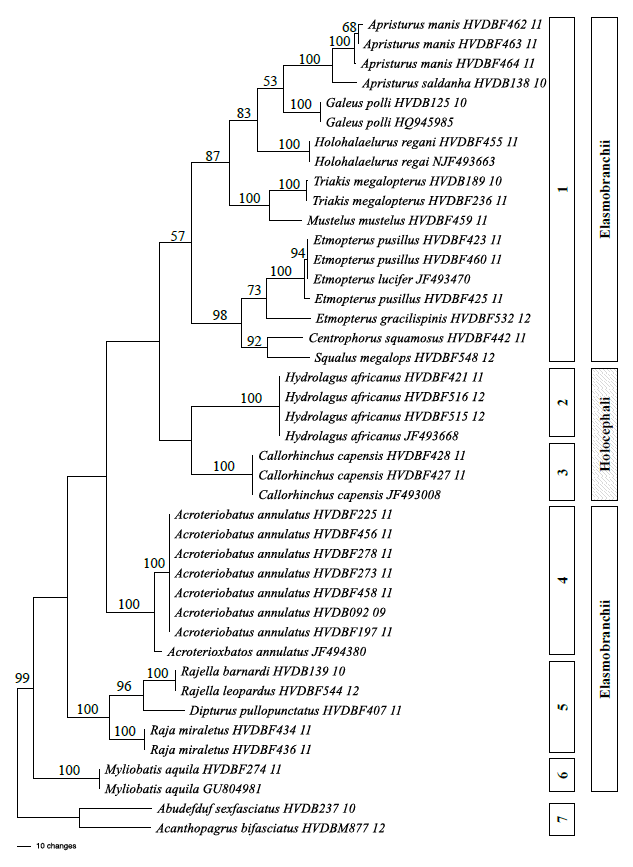
A phylogenetic tree (Figure 1) was also generated using maximum parsimony (MP) [18] in PAUP* v. 4.0b1 [19]. Abudefduf sexasciatus and Acanthopagrus bifasciatus were used as outgroups. Tree searches were conducted using 1 000 replicates of random taxon addition, retaining 10 trees at each step, with tree-bisection-reconnection (TBR) branch swapping and MulTrees in effect. Support for clades was estimated using bootstrap analysis [20] with 1 000 replicates. Seven additional sequences were mined from GenBank (not HVDB numbers) to improve bootstrap support values.
Authorities, localities, GenBank accession and process, dates of collections, localities, museum voucher numbers, images, measurements, barcodes, percent nucleotide composition, and detailed laboratory protocols for the specimens processed will be freely accessible from the BOLD system (www.barcodinglife.org) project code ‘HVDBE’ after publication. BOLD system analyses were used throughout this study.
DNA extraction, PCR and sequencing were done at the Canadian Centre for DNA Barcoding (CCDB) for CO1 using the primer pair dgLCD-1490/dgHCO-2198. The following parameters were selected: DNA alignment using MUSCLE [16], exclude contaminants, records with stop codons and flagged as misidentified or with errors. The kimura 2- parameter (K2P) model [17] was selected to calculate sequence divergence as implemented in the ‘Sequence analysis module of BOLD. DNA sequences, diagnostic characters, pair-wise genetic distances, DNA barcode gap and many other analytical data can be extracted from BOLD. See Figure S1 for arguably a similar tree as Figure 1, which was generated by more advanced techniques as explained below.
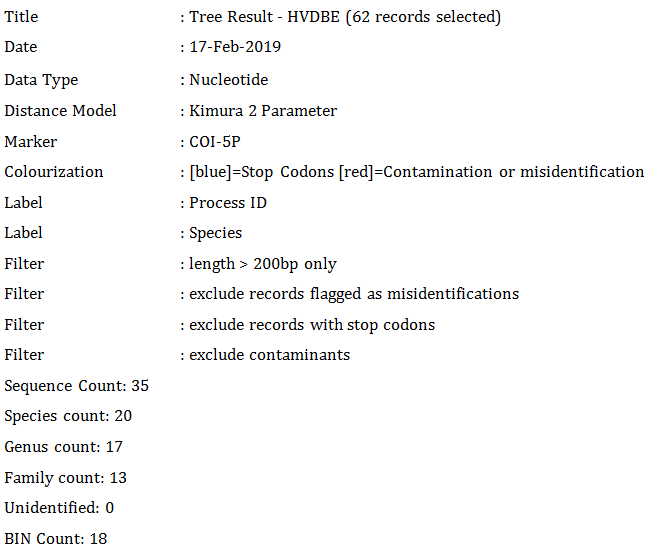
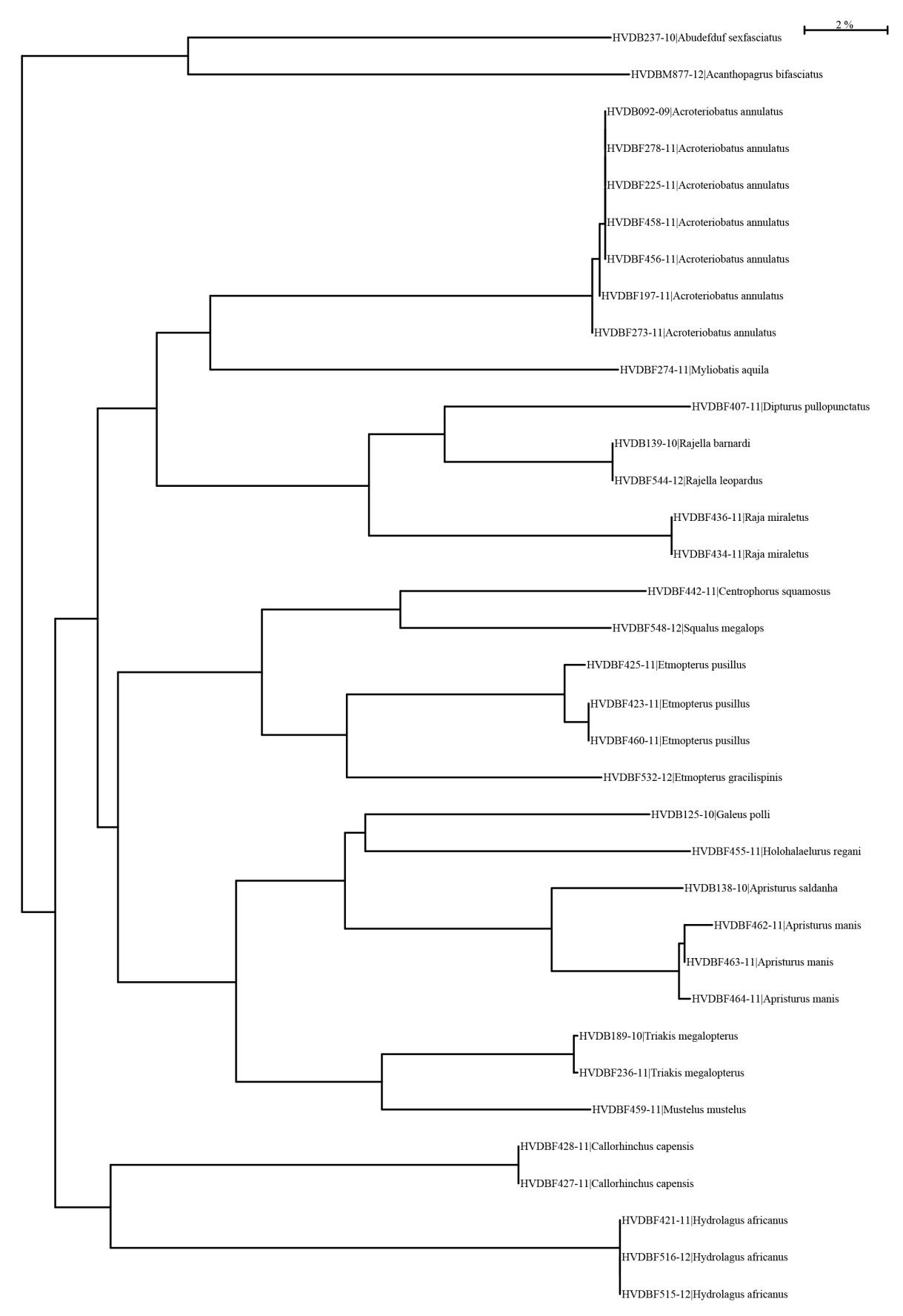
Supplementary Figure 1: Taxon ID tree generated using BOLD Systems
Results and Discussion
with the ghost sharks (rattails), although not supported – both from the subclass Holocephali. Rhinobatos annulatus (mined from GenBank number JF494380) is Acroteriobatus annulatus on BOLD. Data for one individual of this species was published, and for A. manis [10], with no support. Also, see [2] for similar phylogeny for similar genera (Callorhinchus, Hydrolagus and Squalus). Guitarfish (Order: Rhinopristiformes) are a link between sharks and rays, and are named for their guitar shaped body. Skates (Order: Rajiformes) and rays (Order: Actinopterygii) are cartilaginous fish, like sharks and chimaera, which all make up the class Chondrichthyes. Fishes from other orders are grouped (e.g. Etmopterus (Order : Squaliformes), Galeus (Order : Carcharhiniformes) and Triakus (Order: Carcharhiniformes)). The species studied here should be subjected to detailed taxonomic examination to confirm or refute its taxonomic positions because proper bootstrap support was not achieved at all nodes in this study.
The minimum base pair lengths = 221, maximum = 652 and average = 614. Average K2P intraspecies distances in this fish DNA barcoding study range from 14.65% to zero (e.g. for A. annulatus and the skates). As expected, the bony fishes are basal (cartilaginous fishes: class Chondrichthyes). There is a sister-group relationship between the holocephalans and the elasmobranchs (group 1 on Figure 1), but with no support. The trees strongly support (96-100%) a basal divergence between guitarfish, skates, sharks and rays (Figure 1). The groups are monophyletic, as also reported on similar genera, but for mostly other species and different individuals (see introduction). Accurate identification of the sequences was achieved and compared to those available in BOLD and GenBank.
It is not surprising that the elephantfish is grouped
DNA barcoding of specimens, even lacking diagnostic body parts, is a highly effective and fast tool for species identification and can be used for law enforcement. This reference sequence library on BOLD can be used to identify and monitor catches from legal and illegal shark fisheries, because illegal trade of threatened shark species is a worldwide conservation problem [6]. For example, Callorhinchus capensis is on the IUCN red list of threatened species. Sharks not only have a spiritual appeal for several Indo-Pacific cultures, but the Chinese believe consuming their fins give them strength and health, and it signals wealth and prosperity. Molecular methods provide a valuable option for the identification of shark meat and body parts such as fins [21]. Acknowledgements: I am grateful to the CCDB (University of Guelph, Canada) for the DNA sequencing. This part of the project was funded by the Government of Canada through Genome Canada and the Ontario Genomics Institute (2008-OGI-ICI-03). The research was funded by the National Research Foundation, South Africa. Thanks to Ronnie van Rooyen, Stephanus Voges and Johnny Gamatham (Ministry of Marine Fisheries, Namibia) for assistance with sample collections.
References
-
Benton MJ, Donoghue PCJ, Asher RJ (2009) Calibrating and constraining molecular clocks. In: Hedges SB & Kumar S (Eds.), Timetree of life. Oxford: Oxford University Press, pp: 35-86.
-
Inoue JG, Miya M, Lam K, Tay BH, Danks JA, et al. (2010) Evolutionary origin and phylogeny of the modern Holocephalans (Chondrichthyes: Chimaeriformes): A mitogenomic perspective. Molecular Biology & Evolution 27(11): 2576-2586.
-
Ebert DA, Van Hees KE (2015) Beyond Jaws: rediscovering the ‘lost sharks’ of southern Africa. African Journal of Marine Science 37(2): 141-156.
-
Branch GM, Griffiths CL, Branch ML, Beckley, LE (2010) Two Oceans: A guide to the marine life of southern Africa. Struik Nature, Cape Town. pp: 456.
-
Bunholia IV, Ferrettea BL, De Biasia JB, de Oliveira CM, Rotundo MM, et al. (2018) The fishing and illegal trade of the angelshark: DNA barcoding against misleading identifications. Fisheries Research 206: 193-197.
-
Feitosa LM, Martins APB, Giarrizzo T, Wagner Macedo, Monteiro IL, et al. (2018) DNA-based identification reveals illegal trade of threatened shark species in a global elasmobranch conservation hotspot. Science Report 8: 3347.
-
Holmes BH, Steinke D, Ward RD (2009) Identification of shark and ray fins using DNA barcoding. Fisheries Research 95(2-3): 280-288.
-
Kolmann MK, Elbassiouny AA, Liverpool EA, Lovejoy NR (2017) DNA barcoding reveals the diversity of sharks in Guyana coastal markets. Neotropical Ichthyology 15(4): 170097.
-
Liu SV, Chan CC, Lin O, Hu C, Chen CA (2013) DNA barcoding of shark meats identify species composition and CITES-listed species from the markets in Taiwan. PLoS One 8(11): 79373.
-
Prehadi, Sembiring A, Kurniasih EM, Rahmad, Arafat D, et al. (2015) DNA barcoding and phylogenetic reconstruction of shark species landed in Muncar fisheries landing site in comparison with Southern Java fishing port. Biodiversitas 16(1): 55-61.
-
Sembiring A, Putu N, Pertiwi D, Mahardini A, Wulandari R, et al. (2015) DNA barcoding reveals targeted fisheries for endangered sharks in Indonesia. Fisheries Research 164: 130-134.
-
van der Bank FH, Greenfield R, Daru BH, Yessoufou K (2012) DNA barcoding reveals micro-evolutionary changes and river system level phylogeographic resolution of African silver catfish, _Schilbe intermedius_ (Actinopterygii: Siluriformes: Schilbeidae) from seven populations across different African river systems. Acta Ichthyologica et Piscatoria 42: 307-320.
-
Ward RD, Holmes BH, White WT, Last PR (2008) DNA Barcoding Australian Chondrichthyans: results and potential uses in conservation. Marine Freshwater Research. 59: 57-71.
-
Wong HK, Shivji MS, Hanner RH (2009) Identifying sharks with DNA barcodes: assessing the utility of a nucleotide diagnostic approach. Molecular Ecology Resources 9(1): 243-256.
-
Hubert N, Meyer CP, Bruggemann HJ, GuerinF, Komeno RJ, et al. (2012) Cryptic diversity in Indo- pacific coral-reef fishes revealed by DNA-barcoding provides new support to the centre-of-overlap hypothesis. PLoS One 7(3): 28987.
-
Edgar RC (2004) MUSCLE: Multiple sequence
-
Swofford DL (2002) PAUP*: phylogenetic analysis alignment with high accuracy and high throughput. Nucleic Acids Research 32(5): 1792-1797.
-
Kimura M (1980) A simple method for estimating evolutionary rate of base substitutions through comparative studies of nucleotide sequences. Journal of Molecular Evolution 16(2): 111-120.
-
Farris JS (1972) Estimating phylogenetic trees from distance matrices. The American Naturalist 106(951): 645-668.
-
Felsenstein J (1985) Confidence limits on phylogenies: an approach using the bootstrap. Evolution 39(4): 783-791.
-
Amaral CRL, Silva DA, Amorim A, de Carvalho EF (2017) Shark finning and the molecular identification of shark species: review and perspectives. Journal of Oceanography and Marine Research 5: 3.
- Genetic Improvement of Nile Tilapia (Oreochromis niloticus): Advances in Selective Breeding and Genomic Approaches for Sustainable Aquaculture
- Microplastics, Contaminants, and Waste Hotspots: Divergences and Faults in Prioritizing Control Efforts
- Creating a Healthier, More Vibrant Open and Closed Aquatic Environment. A Submersible, Centrifugal Magnetically Affixed Current Changing Aquarium Pump
- An Attempt to Assess Alpha Diversity and Sample Size: Using the Ostracod Assemblages off Kumamoto Port, Japan
- Assessment of the Efficiency of Common Fishing Gears and Crafts Used at Mohananda River of Chapai Nawabganj, Bangladesh
- Fish Productivity and Biodiversity Status of Sundarban Mangrove in Bangladesh