
Genetic Improvement of Nile Tilapia (Oreochromis niloticus): Advances in Selective Breeding and Genomic Approaches for Sustainable Aquaculture
Nile Tilapia (Oreochromis niloticus) is a cornerstone of global aquaculture, providing a vital source of protein and economic livelihood. The rapid expansion of tilapia farming necessitates continuous genetic improvement to enhance productivity, sustainability, and resilience against environmental challenges and diseases. This review synthesizes the significant advancements in genetic improvement strategies for Nile Tilapia, focusing on both traditional selective breeding programs and cutting-edge genomic approaches. We discuss the historical impact of initiatives like the Genetically Improved Farmed Tilapia (GIFT) project, highlighting their contributions to growth rate and feed efficiency. Furthermore, the review delves into the transformative potential of genomic tools, including Marker-Assisted Selection (MAS), Genome-Wide Association Studies (GWAS), and Genomic Selection (GS), in accelerating genetic gains for complex traits such as disease resistance, fillet yield, and environmental tolerance. The integration of these advanced technologies promises to overcome limitations of conventional breeding, offering more precise and efficient selection processes. Finally, explore future directions, emphasizing the role of phenomics, low-cost sequencing, functional genomics, and gene editing in shaping the next generation of sustainable Nile Tilapia aquaculture.
Ramzy A Yousif* and Fouzi A Mohamed
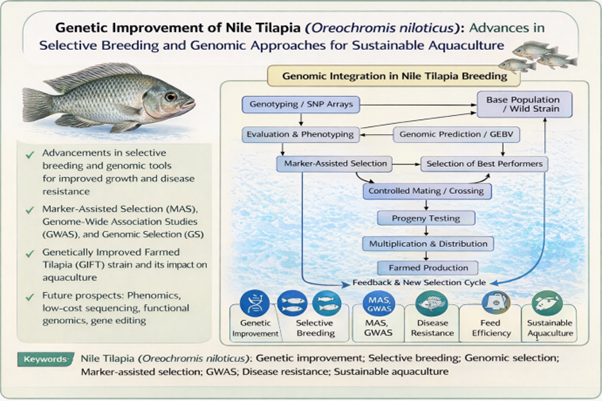
Graphical Abstract
Keywords: Nile Tilapia; Genetic Improvement; Selective Breeding; Genomic Selection; Sustainable Aquaculture
Abbreviations
GIFT: Genetically Improved Farmed Tilapia; MAS: Marker- Assisted Selection; GWAS: Genome-Wide Association Studies; GS: Genomic Selection; FCR: Feed Conversion Ratios.
Introduction
Aquaculture has emerged as a critical sector in global food production, addressing the increasing demand for aquatic protein. Among the diverse array of farmed species, Nile Tilapia (Oreochromis niloticus) stands out as one of the most important freshwater fish, widely cultivated across tropical and subtropical regions [1]. Its popularity stems from desirable characteristics such as rapid growth, adaptability to various farming systems, tolerance to a broad range of environmental conditions, and efficient conversion of diverse feed inputs [2]. The global production of tilapia has seen exponential growth, with projections indicating a continued upward trend, underscoring its significance in food security and economic development [3]. However, the intensification of aquaculture practices brings forth challenges, including disease outbreaks, environmental concerns, and the need for enhanced production efficiency. Genetic improvement programs are pivotal in addressing these issues by developing superior strains that exhibit faster growth, improved feed utilization, increased disease resistance, and better adaptation to changing environmental conditions. Historically, selective breeding has been the primary driver of genetic gains in aquaculture species, including Nile Tilapia [4]. The success of programs like the Genetically Improved Farmed Tilapia (GIFT) project exemplifies the profound impact of systematic selection on economically important traits [5]. In recent decades, the advent of molecular genetics and genomics has revolutionized animal breeding. These advanced tools offer unprecedented opportunities to accelerate genetic progress by enabling more accurate selection decisions and the identification of genes underlying complex traits. For Nile Tilapia, the application of genomic approaches, such as Marker-Assisted Selection (MAS), Genome-Wide Association Studies (GWAS), and Genomic Selection (GS), is rapidly gaining traction, promising to overcome the limitations of traditional pedigree-based selection [6].
This review aims to provide a comprehensive overview of the genetic improvement strategies employed in Nile Tilapia aquaculture. Firstly examine the foundational role of selective breeding programs, detailing their methodologies and achievements. Subsequently, explore the integration of genomic technologies, discussing their current applications, advantages, and challenges. Finally, highlight emerging trends and future prospects for sustainable genetic improvement in Nile Tilapia, emphasizing the synergistic potential of combining conventional and cutting-edge approaches.
Traditional Selective Breeding Programs in Nile Tilapia
Historical Perspective and Major Programs
Selective breeding for growth and other economically important traits in Nile tilapia began in the late 20th century. One of the most successful initiatives is the Genetically Improved Farmed Tilapia (GIFT) program, initiated in the Philippines in 1988. The GIFT strain demonstrated substantial improvements in growth and survival compared to local stock, driving adoption and contributing to increased productivity across Southeast Asia and beyond [7, 8].
Genetic Gains from Selective Breeding
Classical breeding programs have yielded significant improvements in growth traits and overall performance. Genetic gains in body weight ranging from 20% to 90% have been reported over several generations of selection [7]. Selective breeding typically involves identifying superior broodstock based on phenotypic traits, such as fast growth and high survival, and using them to produce the next generation. This approach fundamentally relies on additive genetic variance and consistent selection pressure.
Challenges in Conventional Breeding
Despite demonstrated benefits, conventional breeding has drawbacks. It often requires extensive time and resources to achieve measurable gains, and phenotypic selection can be inefficient for traits with low heritability. Additionally, inbreeding and genetic bottlenecks can arise without careful management of broodstock, reducing long-term genetic diversity and performance.
Selective Breeding Programs: Foundations of Genetic Improvement
Selective breeding has been the cornerstone of genetic improvement in aquaculture for decades, leading to substantial gains in productivity and efficiency. The
principle involves identifying individuals with desirable traits and using them as parents for the next generation, thereby increasing the frequency of favourable genes within a population. For Nile Tilapia, several prominent selective breeding programs have been established globally, each contributing significantly to the species’ aquaculture potential [6]. Genetic improvement involves manipulating heritable traits to increase performance and efficiency (Table 1). In aquaculture, such improvements can lead to higher growth rates, better feed conversion ratios (FCR), and enhanced resistance to diseases, thereby improving farm profitability and sustainability. For Nile tilapia, genetic improvement is particularly essential because conventional systems often rely on uncontrolled breeding and wild broodstock [7], leading to slow growth and inconsistent performance. Systematic breeding programs can create strains with superior traits suited for commercial production.
| S.No. | Program/Strain | Origin | Primary Traits | Reported Genetic Gain | References |
|---|---|---|---|---|---|
| 1 | GIFT | Philippines (WorldFish) | Growth, Survival | 10-15% per generation | [9] |
| 2 | GenoMar Supreme | Commercial (GIFT- derived) | Growth, Fillet Yield, Disease Resistance | High (Commercial standard) | [6] |
| 3 | Abbassa | Egypt (WorldFish) | Growth in local conditions | ~10% per generation | [7] |
| 4 | Akosombo | Ghana | Growth in cage systems | ~5-10% per generation | [7] |
| 5 | GIANT | Uganda | Growth, FCR, Survival | 28% faster growth rate | [7] |
| 6 | GST (GenoMar) | Philippines/Norway | Growth, Robustness | Continuous improvement | [6] |
Table 1: Major Selective Breeding Programs for Nile Tilapia.
The Genetically Improved Farmed Tilapia (GIFT) Project
The GIFT project, initiated in 1988 by the WorldFish Center (formerly ICLARM) in collaboration with national and international partners, stands as a landmark achievement in aquaculture breeding [5]. The program focused on improving the growth rate of Nile Tilapia through a multi-trait selection approach. By systematically selecting the fastest-growing individuals from diverse wild and farmed populations, the GIFT strain demonstrated remarkable genetic gains. Studies have consistently reported a 10-15% improvement in growth rate per generation, alongside enhanced survival and feed conversion efficiency [9]. The success of GIFT not only provided a superior strain for farmers worldwide but also served as a model for subsequent aquaculture breeding programs.
Other Notable Breeding Programs
Following the success of GIFT, various other selective breeding programs have been developed for Nile Tilapia, often tailored to specific regional needs and environmental conditions. These include commercial strains like GenoMar Supreme Tilapia, which originated from GIFT and further improved for traits such as fillet yield and disease resistance. Regional programs, such as the Abbassa strain in Egypt and the Akosombo strain in Ghana, have focused on optimizing growth and performance under local farming conditions [7]. The GIANT strain in Uganda, for instance, reported a 28% faster growth rate, improved feed conversion ratio, and higher survival rates compared to other commercial strains [7]. These diverse initiatives collectively underscore the efficacy of selective breeding in enhancing the economic viability and sustainability of Nile Tilapia aquaculture.
Key Traits under Selection
While growth rate remains the primary target for most breeding programs, the scope of selection has expanded to include a range of other economically important traits. These include: • Disease Resistance: With the rise of intensive farming, resistance to common pathogens like Streptococcus and Tilapia Lake Virus (TiLV) has become a critical selection objective [10].
• Feed Efficiency: Improving the ability of fish to convert feed into biomass reduces production costs and environmental impact, making it a key focus for sustainable aquaculture [11].
• Fillet Yield and Quality: For processing markets, traits related to carcass composition, fillet yield, and meat quality are increasingly important.
• Environmental Tolerance: Selection for tolerance to varying salinity, temperature, and dissolved oxygen levels enhances the adaptability of tilapia to diverse farming environments and climate change impacts [12].
• Reproductive Traits: Traits such as age at first maturity and fecundity are also considered to optimize breeding cycles and seed production.
Genomic Approaches: Accelerating Genetic Gains
The integration of genomic technologies into Nile Tilapia breeding programs represents a paradigm shift, offering unprecedented precision and efficiency in genetic improvement. These approaches leverage high-throughput genotyping and advanced statistical methods to identify genetic markers associated with desirable traits, enabling more accurate selection decisions, especially for traits that are difficult or expensive to measure using traditional methods (Table 2). Advances in genomics have revolutionized breeding efficiency by enabling direct selection at the DNA level.
| S.No. | Study/Trait | Approach | Key Findings | References |
|---|---|---|---|---|
| 1 | Feed Efficiency | GWAS/GS | Accuracy up to 34% higher than pedigree | [10] |
| 2 | Growth & Fillet Yield | GWAS/GS | Imputation is cost-effective for GS | [13] |
| 3 | Sex Determination | MAS | LG1 and LG23 markers identified | [14] |
| 4 | Disease Resistance | GWAS | SNPs for Streptococcus resistance | [14] |
| 5 | Salinity Tolerance | GWAS | Candidate genes on LG16, LG19 | [12] |
Table 2: Key Genomic Studies and Applications in Nile Tilapia.
Marker-Assisted Selection (MAS)
MAS involves using DNA markers that are closely linked to genes controlling specific traits to select individuals. This approach is particularly valuable for traits that are expressed late in life, are sex-limited, or have low heritability. In Nile Tilapia, MAS has been successfully applied for sex determination, allowing for the production of all-male populations which exhibit faster growth rates and prevent uncontrolled reproduction [14]. Markers linked to disease resistance and other production traits are also being increasingly utilized, providing a more efficient alternative to phenotypic selection alone.
Genome-Wide Association Studies (GWAS)
GWAS involves scanning the entire genome to identify genetic variants (e.g., Single Nucleotide Polymorphisms - SNPs) that are statistically associated with a particular trait. By analyzing thousands of SNPs across a population, GWAS can pinpoint genomic regions and candidate genes influencing complex traits. For Nile Tilapia, GWAS has been instrumental in dissecting the genetic architecture of traits such as growth, feed efficiency, disease resistance, and environmental stress tolerance [10]. The insights gained from GWAS are crucial for understanding the genetic basis of these traits and for developing more effective breeding strategies. Genome-wide association studies have identified quantitative trait loci (QTL) associated with growth, feed efficiency, and survival. For example, genomic regions associated with feed efficiency traits such as feed conversion ratio and residual feed intake have been identified through GWAS, enhancing breeding decisions [15]. Studies have also identified specific polymorphisms in growth hormone-related genes that correlate with improved growth performance, supporting the potential for molecular selection strategies to improve growth and resilience in various environments [8].
Genomic Selection (GS)
Genomic selection entails using dense genome-wide markers to predict breeding values with higher accuracy than conventional pedigree-based methods. Bayesian genomic models have demonstrated marked improvements in predicting survival to Streptococcus agalactiae infection, with prediction accuracy significantly increased compared to traditional models [16]. Such models leverage SNP arrays and high-throughput genotyping to capture a greater portion of genetic variation, making selection decisions more precise and efficient. Additionally, genomic prediction can enhance selection for complex traits influenced by many genes, such as feed efficiency and disease resistance (Figure 1).
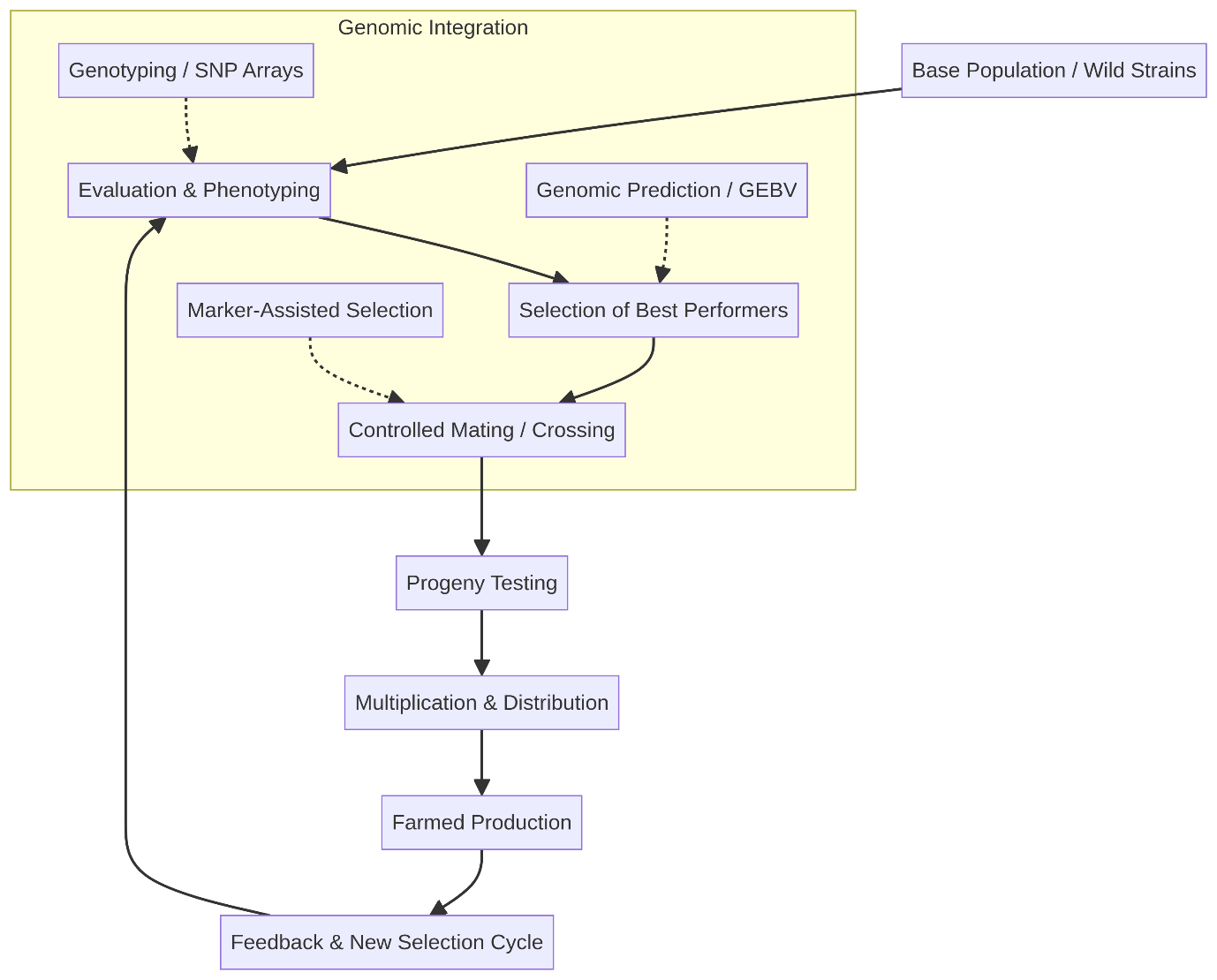
Genomic Selection (GS) represents a significant advancement over MAS, as it utilizes information from a large number of genetic markers distributed across the entire genome to predict an individual’s Genomic Estimated Breeding Value (GEBV). Unlike MAS, which focuses on a few significant markers, GS captures the cumulative effect of all genetic variants, including those with small effects. This leads to higher prediction accuracies, especially for complex traits controlled by many genes [6].
GS has shown immense promise in Nile Tilapia breeding programs, offering several advantages: • Increased Accuracy: GEBVs are generally more accurate than traditional pedigree-based breeding values, leading to faster genetic gains.
• Early Selection: Individuals can be selected at a younger age, reducing generation intervals and accelerating the breeding cycle.
• Selection for Difficult Traits: GS enables effective selection for traits that are hard to measure directly on selection candidates, such as disease resistance or fillet yield, or those expressed only in one sex.
• Cost-Effectiveness: While initial genotyping costs can be high, advancements in sequencing technologies and imputation methods are making GS more cost-effective over time [13].
Studies have demonstrated that GS can increase the accuracy of breeding value prediction by up to 34% compared to pedigree records in Nile Tilapia, particularly for traits like feed efficiency [10]. The implementation of GS is expected to further enhance the rate of genetic improvement, contributing to more sustainable and profitable tilapia aquaculture.
Major Selective Breeding Programs and Genomic Applications
Genetic improvement programs must balance selection gains with preserving genetic diversity to ensure long-term sustainability. Monitoring genetic variability and using strategic mating designs can mitigate inbreeding while maximizing genetic gain. Recent long-term evaluations of Nile tilapia breeding programs have highlighted both the success in trait improvement and the importance of managing inbreeding through careful breeding strategies [17]. Conservation of genetic resources ensures that useful alleles remain available for future breeding, particularly as environmental conditions and market demands shift. The following tables summarize the key selective breeding programs and genomic studies that have significantly contributed to the genetic improvement of Nile Tilapia (Table 3).
| S.No. | Year | Milestone |
|---|---|---|
| 1 | 1988 | Launch of the GIFT project (WorldFish) |
| 2 | 1997 | Formation of the International Network on Genetics in Aquaculture (INGA) |
| 3 | 2011 | First draft genome assembly of Nile tilapia published |
| 4 | 2014 | Increasing application of MAS for sex determination |
| 5 | 2019 | First reports on large-scale genomic selection implementation |
| 6 | 2021 | Advanced GWAS for complex traits like feed efficiency |
| 7 | 2025 | High-quality genome assembly for specific strains (e.g., Abbassa) |
Table 3: Milestones in _Nile Tilapia_ Genetic Improvement.
Case Study: Nile Tilapia Breeding Programs in Africa
While Asia has led in systematic tilapia breeding programs, African efforts have been varied. In Uganda, for example, hatcheries often rely on random broodstock and experience inbreeding issues. Efforts to establish structured breeding programs are gaining momentum, emphasizing the need for improved seed quality to enhance aquaculture productivity sustainably [7]. Conservation and genetic characterization of local populations are also vital, given the unique genetic diversity present in wild African tilapia stocks. Such diversity can be harnessed for future genetic improvement initiatives.
Future Directions and Emerging Technologies
The future of Nile tilapia genetic improvement lies in integrating genomics, bioinformatics, and precise breeding technologies. Challenges include the high cost of genomic tools, limited infrastructure in developing regions, and the need for capacity building in fisheries genetics. However, collaborative efforts between research institutions, aquaculture industries, and governments can accelerate adoption. Emerging technologies such as CRISPR-based genome editing and high-density genomic selection platforms may further transform breeding strategies, enabling targeted trait modifications with rapid results.
Phenomics and High-Throughput Phenotyping
Phenomics, the large-scale measurement of phenotypes, is becoming increasingly important in breeding programs. High-throughput phenotyping technologies, utilizing imaging, sensors, and automation, can rapidly and accurately collect data on a wide range of traits. This will provide richer datasets for genomic analyses, improving the accuracy of GEBVs and enabling selection for more nuanced traits [18].
Low-Cost Sequencing and Imputation
The continuous reduction in sequencing costs is making whole-genome sequencing and high-density SNP arrays more accessible. This will facilitate the widespread adoption of GS, even in resource-limited settings. Furthermore, advanced imputation methods allow for the use of lower-density SNP panels, reducing genotyping costs while maintaining high prediction accuracy [13].
Functional Genomics and Gene Editing
Functional genomics aims to understand the function of genes and their regulatory networks. By elucidating the biological pathways underlying economically important traits, functional genomics can identify prime targets for genetic manipulation. Gene editing technologies, particularly CRISPR/Cas9, offer the potential for precise and targeted modifications to the Nile Tilapia genome. This could lead to rapid improvements in specific traits, such as enhanced growth through myostatin gene editing or precise sex determination, although ethical and regulatory considerations need careful evaluation [19].
Conclusion
The genetic improvement of Nile Tilapia has undergone a remarkable evolution, from foundational selective breeding programs to the sophisticated integration of genomic technologies. Selective breeding initiatives, exemplified by the GIFT project, have laid the groundwork for significant gains in productivity and sustainability. The advent of MAS, GWAS, and GS has further accelerated this progress, offering powerful tools for enhancing complex traits and optimizing breeding efficiency. As aquaculture continues to expand, the synergistic application of traditional breeding methods with cutting-edge genomic and gene editing technologies will be crucial for developing resilient, high-performing Nile Tilapia strains. These advancements are vital for ensuring the long- term sustainability of tilapia aquaculture, contributing to global food security and economic prosperity.
References
-
FAO (2019) The State of World Fisheries and Aquaculture 2018. Food and Agriculture Organization of the United Nations.
-
El-Sayed AFM (2019) Tilapia Culture. Academic Press.
-
FAO (2018) The State of World Fisheries and Aquaculture 2018. Food and Agriculture Organization of the United Nations.
-
Ponzoni RW, Nguyen HN, Khaw HL, Hamzah A, Abu Bakar KR, et al. (2011) Genetic improvement of Nile tilapia (_Oreochromis_ _niloticus_) with special reference to the work conducted by the WorldFish Center with the GIFT strain. Review in Aquaculture 3(1): 27-41.
-
Barría A, Peñaloza C, Papadopoulou A, Mahmuddin M, Doeschl-Wilson A, et al. (2023) Genetic differentiation following recent domestication events: A study of farmed Nile tilapia (_Oreochromis_ _niloticus_) populations. Evol Appl 16(6): 1220-1235.
-
Yáñez JM, Joshi R, Yoshida GM (2020) Genomics to accelerate genetic improvement in tilapia.Animal Genetics 51(5): 658-674.
-
Abaho I, Kwikiriza G, Atukwatse F, Izaara AA, Ekwangu J, (2025) Selective Breeding for Genetic Improvement of Nile tilapia (_Oreochromis_ _niloticus_ Linnaeus, 1758) in Uganda: Current Status, Challenges, and Future Perspectives. Animals 15(2): 142.
-
Ali FS, Awad ST, Ismail M, Hemeda SA, El Nahas AF, et al. (2025) Selection for Growth Performance in Oreochromis niloticus Across Different Aquatic Environments Using Growth Hormone Gene Polymorphisms. Animals 15(14): 2097.
-
Genetically Improved Farmed Tilapia (GIFT).
-
Barría A, Benzie JAH, Houston RD, De Koning DJ, de Verdal H (2021) Genomic Selection and Genome-wide Association Study for Feed-Efficiency Traits in a Farmed Nile Tilapia (_Oreochromis_ _niloticus_) Population. Front Genet 20(12): 737906.
-
de Verdal H, Vandeputte M, Mekkawy W, Chatain B, Benzie JAH (2018) Quantifying the genetic parameters of feed efficiency in juvenile Nile tilapia _Oreochromis_ _niloticus_. BMC Genet 19(1): 105.
-
Moses M, Chauka LJ, de Koning DJ, Palaiokostas C, Mtolera MSP (2021) Growth performance of five different strains of Nile tilapia (_Oreochromis_ _niloticus_) introduced to Tanzania reared in fresh and brackish waters. Sci Rep 11(1): 11147.
-
Yoshida GM, Lhorente JP, Correa K, Soto J, Salas D, et al. (2019) Genome-Wide Association Study and Cost- Efficient Genomic Predictions for Growth and Fillet Yield in Nile Tilapia (_Oreochromis_ _niloticus_). G3 (Bethesda) 9(8): 2597-2607.
-
Yue GH (2014) Recent advances of genome mapping and marker‐assisted selection in aquaculture. Fish and Fisheries 15(3): 376-396.
-
Ansah YB, Frimpong EA, Hallerman EM (2014) Genetically-Improved Tilapia Strains in Africa: Potential Benefits and Negative Impacts. Sustainability 6(6): 3697-3721.
-
Joshi R, Skaarud A, Alvarez AT, Moen T, Ødegård J (2021) Bayesian genomic models boost prediction accuracy for survival to _Streptococcus_ _agalactiae_ infection in Nile tilapia (_Oreochromus_ _nilioticus_). Genet Sel Evol 53(1): 37.
-
Santos R (2025) Long-term assessment of genetic variability and selection efficiency in a Nile tilapia (_Oreochromis_ _niloticus_) breeding program. Aquaculture 613: 743365.
-
Song H, Dong T, Yan X, Wang W, Zhang Q, Hu H (2025) Advancing aquaculture breeding through genomic selection: models, tools, and challenges. Water Biology and Security 5(2).
-
Zenger KR, Khatkar MS, Jones DB, Khalilisamani N, Jerry DR, et al. (2019) Genomic Selection in Aquaculture: Application, Limitations and Opportunities With Special Reference to Marine Shrimp and Pearl Oysters. Front Genet 23(9): 693.
- Microplastics, Contaminants, and Waste Hotspots: Divergences and Faults in Prioritizing Control Efforts
- Creating a Healthier, More Vibrant Open and Closed Aquatic Environment. A Submersible, Centrifugal Magnetically Affixed Current Changing Aquarium Pump
- An Attempt to Assess Alpha Diversity and Sample Size: Using the Ostracod Assemblages off Kumamoto Port, Japan
- Assessment of the Efficiency of Common Fishing Gears and Crafts Used at Mohananda River of Chapai Nawabganj, Bangladesh
- Fish Productivity and Biodiversity Status of Sundarban Mangrove in Bangladesh
- Assessment of Population Growth and Fishing Vulnerability of Helicolenus dactylopterus along the Syrian Coast (Eastern Mediterranean Sea)