
Fish Productivity and Biodiversity Status of Sundarban Mangrove in Bangladesh
The Bay of Bengal's Sundarbans, the biggest area of mangrove forest, are home to a diverse range of plant and animal species that serve the local community on an ecological, environmental, and economical level. Increased human activity, industrialization, and climate change have all had a major impact on the Sundarbans' biodiversity in recent years. They have also changed the natural equilibrium and endangered the ecosystem and its species. The goal was to assess the impact of climate change on the yearly fish productivity and overall fish biodiversity by comparing the changes in the physico-chemical characteristics of the Sundarbans waters. Between 2018 and 2023, titrimetric kits were used to assess the chemical-physical characteristics in the research area. Three coastal regions were used to gather and estimate the total amount of fish produced, including shrimp and crab. Using digital techniques, literature searches, and both published and unpublished reports, the secondary data was gathered. Fish biodiversity was measured using scientific literature, and dichotomous key analysis was used to identify the species. Poison fishing and hazardous fishing gear and nets pose a harm to the Sundarbans' aquatic life. The findings indicate that between 2018 and 2023, as temperatures rise, total fish output and chemical-physical parameters rise but total biodiversity falls. The aforementioned evidence underscores the necessity of implementing strategic interventions in the Sundarban region to mitigate the harm caused by climate change on biodiversity reduction.
Chakraborty BK¹* and Das PR²
¹Department of Fisheries, Bangladesh & Swami Vivekanand Subhertyi University, India ²NATP-2 Project, Department of Fisheries, Bangladesh
Introduction
The Bay of Bengal in Bangladesh is home to the extremely productive mangrove forests known as the Sundarbans. They include to a wide variety of plant and animal species and contribute significantly to the nation’s economy by providing socioeconomic, ecological, and environmental advantages to the local populace [1]. They are essential for maintaining water quality, emptying aquifers, saving nutrients, safeguarding coastal people from cyclonic storms, and maintaining habitats, biodiversity, productivity, and resilience [2, 3]. Our objective was to investigate how climate change has affected the physico-chemical characteristics of the waters in the Sundarbans and assess the impact on both yearly fish productivity and overall fish biodiversity. Because the health of the Sundarbans has been under stress in recent years due to human activities, industrialization, and climate change.Our goal was to compare changes in the physico-chemical parameters of the Sundarbans’ waters in relation to climate change and evaluate their effects on annual fish productivity and total fish biodiversity, as the health of the Sundarbans has been strained in recent years by industrialization, anthropogenic activities, and climate change.
Materials and Methods
Water sampling was performed in three sites located in Sundarban: 1) 21°30’33’’N, 88°07’57’’E; 2) 21°44’25’’N, 87°59’26’’E; 3) 21°33’13’’N, 89°41’05’’E; 4) 21°41’07’’N, 89°31’38’’E from 2018 to 2023. The sample of physico- chemical parameters were collected from three coastal districts of Satkhira, Khulna and Bagherhat. Water temperature, dissolved oxygen and pH were measured at spot by using a Celsius thermometer, digital electronic oxygen meter (YSI, Model 58, USA) and an electronic pH meter (Jenway, Model 3020, UK) and salinity and turbidity tested in the laboratory [4, 5]. The data of total fish production was collected directly from the field level and interviews with individual respondents (FGD). Secondary data was collected through literature searches, digital methods and reports from published and unpublished literature. Biodiversity was assessed through data obtained from the scientific literature, through morphological identification and using specific atlantes for the recognition of fish species. In addition, dichotomous keys were searched for each species to assign family-related characteristics to genus and species. The data was analyzed through using one way Annova MSTAT followed by Duncan’s New Multiple Range test [6].
Results
Physico-Chemical Parameters Analysis
Table 1 displays the chemical-physical parameter data. Twenty-nine degrees Celsius was the highest recorded temperature in 2023, and twenty-eight degrees Celsius was the lowest. Between 2020 and 2023, the highest and lowest pH values were 8.10±0.18 and 7.80±0.3, respectively. 2022 had the lowest salinity ever recorded (17.6±4.1 ppt), whereas 2023 had the highest (18.50±7.0 ppt). 2018 had the highest average dissolved oxygen (DO) reading (7.92±1.07 mg/l), while 2023 had the lowest (5.50±1.2 mg/ml). The greatest measured turbidity was 65.06±40.2 NTU in 2020, while the lowest was 50.02±37.08 NTU in 2021.
| Year | Water Temperature (oC) | pH | Salinity (ppt) | Dissolved Oxygen, DO (mg/l) | Turbidity, NTU |
|---|---|---|---|---|---|
| 2023 | 29.80± 3.5 | 7.80±0.3 | 18.50±7.0 | 5.50±1.2 | 60.03±15 |
| 2022 | 29.74±3.50 | 8.02±0.17 | 17.64±4.18 | 7.75±1.07 | 59.60±39.78 |
| 2021 | 29.22±3.45 | 7.99±0.20 | 18.01±4.55 | 7.82±1.07 | 50.02±37.08 |
| 2020 | 28.87±3.34 | 8.10±0.18 | 17.72±5.03 | 7.70±1.07 | 65.06±40.26 |
| 2019 | 29.68±3.52 | 8.08±0.18 | 18.50±4.35 | 7.80±1.07 | 54.88±38.12 |
| 2018 | 28.80±3.34 | 7.87±0.16 | 17.77±4.66 | 7.92±1.07 | 63.03±40.23 |
Table 1: Yearly variation of water physico-chemical parameters in Sundarban.
Total Fish Production
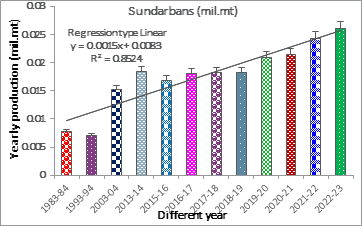
From 2017-18 to 2022-23 (Figure 1) an increasing trend of total fishes’ production of Sundarban Mangrove was recorded (0.0018 to 0.026 mill.mt). The regression type is linear and the regression’s equation is Y = 0.0015x + 0.0062 (R2 = 0.0083).
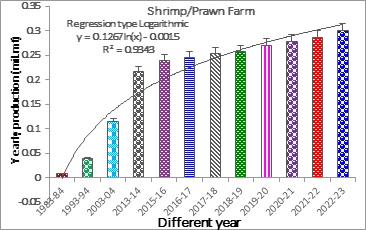
A normal trend of total production of Shirmp/prawn in Sundarban mangrove area was recorded (0.0082 - 0.3011mill.mt) during 2083-84 to 2022-23 (Figure 2). The regression type is logarithmic and the regression’s equation is Y = 0.1267In(x)-0.0015 (R2 = 0.9343).
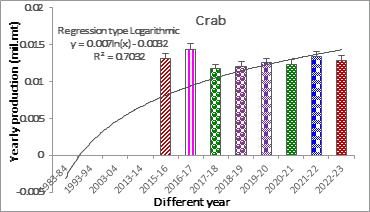
The total production of crab in Sundarban was recorded (0.01316 - 0.01288 mill.mt) during 2017-18 to 2022- 23 (Figure 3). The regression type is logarithmic and the regression’s equation is Y = 0.007In(x)-0.0082 (R2 = 0.7032).
Total Fish Biodiversity
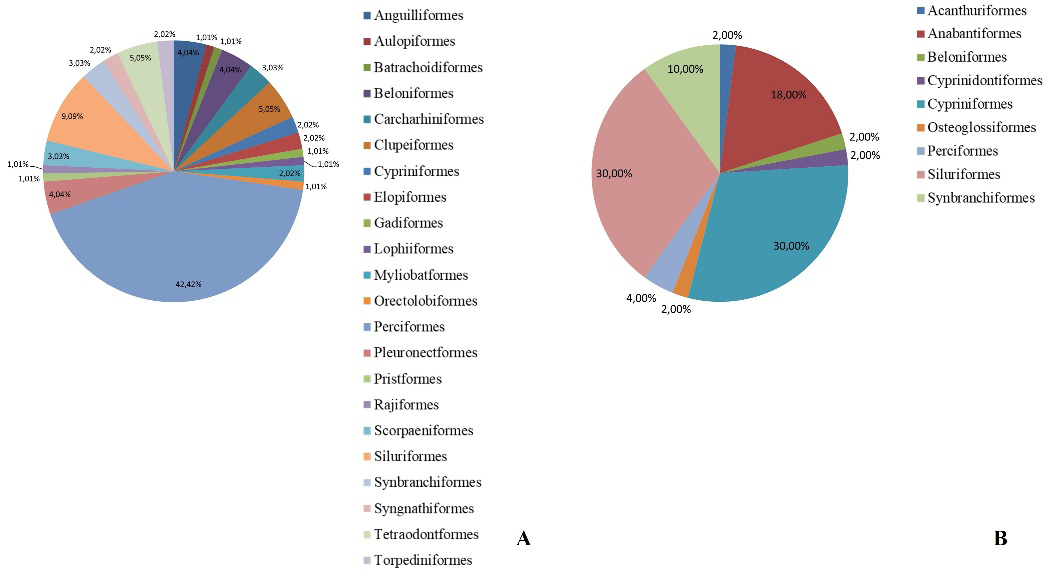
Figure 4 reports the fish species examined in 2018 and in 2023. As shown on the pie chart in 2018 are present 22 orders while the fish species of 2023 belong to 9 orders of which four orders are new entry.
In the Sundarbans, fishermen utilize hazardous nets and equipment that imperil aquatic life. Identification of monofilament gill nets, sometimes known as current Jal, kills little fish and other aquatic wildlife. Pull and push nets (Thela Jal), fine-mesh set bag nets (Behundi Jal), long shore nets (Khuti Jal), and fine-mesh mosquito nets (Chingri Pona Jal) have been shown to be the most dangerous fishing gear in the Sahara. In these nets, the catch fatality rate is very high.
Other Findings
Another destructive method that jeopardizes the ecosystem is poison fishing. Some fishermen use fatal poison in the Sundarbans waterways to illegally catch fish, including shrimp and crabs. They collect the dying fish and release toxins into the water. With just a few drops of snake poison, many fish were killed. It also pollutes water, planktons, and mangrove tree roots. As toxic water from canals finds its way into large rivers, not only are fish species being exterminated, but the entire aquatic ecosystem is at risk. The flora and animals of the Sundarbans are endangered by such dangerous operations, which may also have long-term negative effects on the environment.
Discussion
Fisheries and production in Sundarban mangroves are threatened by illegal and commercial hunting, fishing resource exploitation, increased upstream land use (irrigation, dams), pollution, pesticides, and mineral gas exploitation [7].
In addition to providing jobs, money, and food security, mangrove habitats also help tourism, science, and mineral exploitation [8, 9, 10]. The findings of the study published in Chakraborty [7] were comparable to the chemical- physical parameter values. The year 2023 saw the hottest temperature ever recorded in Sundarban mangroves. The study’s monitoring of chemical and physical characteristics revealed that the region’s temperatures are rising between 2018 and 2023, and that these changes are accompanied by changes in associated factors including pH and salinity, as indicated in Table 1.
According to data, the total amount of fish produced increased significantly between 2018 and 2023 (Figures 1-3). Linear regression reveals a positive trend in the species productivity data. 0.954 is the regression’s value.
For the first time, the composition of the fish orders analyzed Figure 4 showed that 17 fish orders-Aulopiformes, Batrachoidiformes, Carcharhiniformes, Clupeiformes, Elopiformes, Gadiformes, Lophiiformes, Myliobatiformes, Orectolobiformes, Pleuronectiformes, Pristiformes, Rajiformes, Scorpaeniformes, Syngnathiformes, Tetraodontiformes, and Torpediniformes were lost in 2023 compared to 2018. It’s also important to note that the four orders from 2023-Acanthuriformes, Anabantiformes, Cyprinidontiformes, and Osteoglossiformes are new entries as they weren’t there in 2018. Specifically, the Perciformes order had a 42.42% share in 2018 and a 4% share in 2023 (data not provided). In 2018, the Siluriformes order has a 9.09% percentage, which rises to 30% (data not shown).
Approximately four species (1.24%) are listed as “Endangered” on the global Red List: Glyphis glyphis, Sphyrna lewini, Eusphyra blochii, and Anoxypristis cuspidata?
Commonly found in the Sundarbans are Himantura uarnak, Glyphis glyphis, Sphyrna lewini, and Eusphyra blochii, all of which are recognized on the Red List as threatened worldwide [11]. Together with the disruption of breeding habitats brought on by climate change, the continuous rapid changes in biodiversity may jeopardize successful reproduction and survival, which in turn may jeopardize fish species’ ability to conserve their eggs and human sustainability [12].
In addition to adult fish, set bag nets used to harvest shrimp fry also catch eggs, spawn, and larvae of all species in the Sundarbans’ rivers and estuaries. According to observations, around 99 fin fish and the fry of other shrimp species must be discarded in order to harvest a single shrimp post larva [13, 14]. A rule that reads, “No person shall catch or cause to be caught fry or post larvae of fish, shrimp, and prawns of any kind in any form and in any way in the estuary and coastal waters of Bangladesh” [15] was created by the Bangladeshi government in 2000 in reaction to this negative impact. Regretfully, post-larval shrimp, prawns, and fish are nonetheless harvested and sold.
Poison fishing is a destructive practice that uses lethal poison to unlawfully catch fish, crabs, and shrimp in Sundarbans canals. This pollutes water, plankton, and mangrove plants, endangering the local flora and wildlife and perhaps having long-term harmful effects [16].
Conclusions
Through sustainable management, we must actively engage with the Sundarbans Peninsula’s flora and wildlife, which is a treasure trove of natural biodiversity. In fact, the loss of 17 fish orders in this study demonstrates that higher production does not always translate into greater biodiversity. Finding a balance between water parameters, boosting livelihoods, and protecting biodiversity requires effective communication to persuade the indigenous people of the growing understanding of poisoning from fishing and the harm caused by excessive anthropogenic activity.
References
-
Husain P, Al Idrus A, Ihsan MS (2020) The ecosystem services of mangroves for sustainable coastal area and marine fauna in Lombok, Indonesia: A review. Jurnal Inovasi Pendidikan dan Sains 1(1): 1-7.
-
Bimrah K, Dasgupta R, Hashimoto S, Saizen I, Dhyani S (2022) Ecosystem services of mangroves: A systematic review and synthesis of contemporary scientific literature. Sustainability 14(19): 12051.
-
Bhowmick D (2024) Political ecology of climate change in Sundarbans, India: Understanding well‐being, social vulnerabilities, and community perception. Environmental Quality Management 33(3): 371-382.
-
Clesceri LS, Greenberg AE, Trussell RR (1989) Standard Methods of the xamination of Water and Wastewater. In: 17th (Edn.), American Public Health Association, American Water Works Association and Water Pollution Control Federation, 1015 Washington D. C., USA 20036: 10-203.
-
APHA (1998) Standard methods for the examination of water and wastewater. In: 20th (Edn.), American Public Health Association, Washington DC, USA.
-
Zar JH (1984) Biostatistics. Prentice-Hall, Inc. Englewood Cliffs, New Jersey, USA, pp: 718.
-
Chakraborty BK (2021) Production of aquatic lives and biodiversity status of Ubdhakhali River in Bangladesh. Progressive Research: An International Journal 16(2): 83-90.
-
Habib KA, Neogi AK, Nahar N, Oh J, Lee YH, Kim CG (2020) An overview of fishes of the Sundarbans, Bangladesh and their present conservation status. Journal of Threatened Taxa 12(1): 15154-15172.
-
Moustafa AA, Abdelfath A, Arnous MO, Afifi AM, Guerriero G, et al. (2023) Monitoring temporal changes in coastal mangroves to understand the impacts of climate change: Red Sea, Egypt. Journal of Coastal Conservation 27(5): 37.
-
Parisi C, De Marco G, Labar S, Hasnaoui M, Grieco G, Caserta L, et al. (2022) Thermophilic and Tropical Fish Species vs. Endemic Commercial Species at Mellah Lagoon (Mediterranean, Algeria). Water, 14(4): 635.
-
Habib KA, Neogi AK, Nahar N, Jina O (2020) An overview of fishes of the Sundarbans, Bangladesh and their present conservation status. Journal of Threatened Taxa 12(1): 15154-15172.
-
Mitra A, Abdel-Gawad FK, Bassem S, Barua P, Assisi L, et al. (2023) Climate Change and Reproductive Biocomplexity in Fishes: Innovative Management Approaches towards Sustainability of Fisheries and Aquaculture. Water 15(4): 725.
-
Rashid MH (2000) Report on Strengthening of Coastal and Marine Fisheries Management Project, Department of Fisheries (DoF), Matshya Bhaban, Ramna, Dhaka, Bangladesh.
-
Azad AK, Lin CK, Jensen KR (2007) Wild shrimp larvae harvesting in the coastal zone of Bangladesh: socio- economic perspectives. Asian Fisheries Science 20: 339-
-
MoFL Protection and Conservation of Fish Rules, 1985 Revised (2000) Ministry of Fisheries and Livestock (MoFL), Fisheries 5 Section S.R.O. No. 287/2000.
-
Bari JBA (2024) Seafood Network Bangladesh. Sundarbans ecosystem faces serious crisis: poison fishing demands urgent action before it’s too late!.
- Genetic Improvement of Nile Tilapia (Oreochromis niloticus): Advances in Selective Breeding and Genomic Approaches for Sustainable Aquaculture
- Microplastics, Contaminants, and Waste Hotspots: Divergences and Faults in Prioritizing Control Efforts
- Creating a Healthier, More Vibrant Open and Closed Aquatic Environment. A Submersible, Centrifugal Magnetically Affixed Current Changing Aquarium Pump
- An Attempt to Assess Alpha Diversity and Sample Size: Using the Ostracod Assemblages off Kumamoto Port, Japan
- Assessment of the Efficiency of Common Fishing Gears and Crafts Used at Mohananda River of Chapai Nawabganj, Bangladesh
- Assessment of Population Growth and Fishing Vulnerability of Helicolenus dactylopterus along the Syrian Coast (Eastern Mediterranean Sea)