
Assessment of the Efficiency of Common Fishing Gears and Crafts Used at Mohananda River of Chapai Nawabganj, Bangladesh
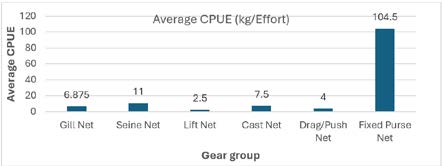
The study was conducted to have knowledge regarding the artisanal fishing in the Mohananda River adjacent to Chapai Nawabgonj district of Bangladesh understanding the efficiency of fishing gears and techniques as well as fishing craft. A survey of 30 artisanal fishermen from 2 unions (Alinagar and Sontospur) of Gomostapur upazila Chapai Nawabgonj was conducted to address as well as collected the data from September, 2024 to February, 2025. A total of 13 fishing gears, among them 6 types of fishing nets (gill net, seine net, lift net, cast net, drag net, fix purse net) 2 types of hooks and lines (sip borshi and daun), 4 types of fishing trap (kholsun, bitte, polo and dohair) were observed in the present study. In case of fishing nets, the highest construction cost is found in purse nets (BDT 5 lakhs), and lowest cost in gill nets (BDT 8500). The catch per unit effort (CPUE) also varied among gears, with values recorded as: gill nets (3–8.75 kg/effort), seine nets (5–12), lift nets (1–1.5), cast nets (2.5–10), drag/push nets (1–3), and fixed purse nets (5.6–11.6). In case of trap, the highest construction cost is observed in kholsun (BDT 4000), and lowest cost in dohair (BDT 800). The corresponding CPUEs ranged from 1.5–2 kg (Bitte), 2–3 kg (Kholsan, 1–2.5 kg (Polo), and 2–2.5 kg (Dohair), respectively. In case of hooks and lines the highest construction cost is BDT 800 and CPUE is 400-800 gm (daun) and lowest cost is BDT 300 and CPUE is 400-700 gm (sip borsi). The making cost of daun is BDT 400-800 and CPUE is 1-1.5 kg. The making cost of traps are ranged from BDT 500-1000 to BDT 1000-4000. The main craft of the study area is non-motorized boats which ownership varies among the fisherman. Two types of fishing boats (Kosa boat and dingi boat) are observed in the study area. The construction cost are ranged between BDT 7000-1200.
Nusrat Jahan S*, Islam J, Mezbah Ahmed M and Mazedul Islam M
Introduction
Fishing plays an important role in Bangladesh, a country blessed with rivers, wetlands, and diverse aquatic ecosystems. With its vast network of inland water bodies, Bangladesh holds a strong position in the global fisheries sector. The country is rich in fish biodiversity and has long- standing traditions of artisanal fishing. The sector also plays a vital role in poverty alleviation, employment generation, the supply of animal protein (contributing 63%), and earning foreign currency [1]. Various fishing methods have been developed over time, using both traditional knowledge and practical experience. In different regions, fishermen apply a variety of gears and crafts suited to their local water conditions and target species. These include nets, traps, hooks and lines, and boats designed for river and floodplain use. Most important among these fishing gears are trawls, purse seines, lines, gillnets and entangling nets and traps [2]. In Bangladesh, fishermen use over 100 types of fishing gears of 9 categories [3]. One of the major causes of this loss is indiscriminate harvesting of fishes using illegal fishing gears and methods [4]. The Mohananda River flowing through Chapai Nawabganj district is one of the main river in Rajshahi division of Bangladesh. This is a transboundary river that flows through both India and Bangladesh. The river plays a crucial role in the livelihoods of the local fishing communities. According to Galib, et al. [5], the Mohananda River is home to many fish species like Labeo rohita, Catla catla and Cirrhinus cirrhosus. Fishing in the Mohananda River contributes significantly to the local economy and provides an important source of protein for the surrounding population. It supports employment and sustains the daily lives of many families. Comprehensive knowledge of fishing gears, crafts, and operational methods is essential for making evidence-based decisions regarding their regulation and appropriate use. This study aims to investigate the existing status of fishing gears and crafts in the study area, document their operational mechanisms, and identify the major fish species commonly harvested through these methods. The findings are expected to contribute to sustainable fisheries management and informed policy development. There is no or little research such as Ahmed [6], Khaleque, et al. [7], Dewan, et al. [8], Chakrabarti, et al. [9] and Galib, et al. [4] efforts in this respect have been found in Bangladesh but proper information about fishing gears regarding this river are very rare. This study is the first attempt to systematically document and analyze the fishing methods practiced by local fishermen in the Mohananda River.
Materials and Methods
Location of the Study Area and Duration
The present study was conducted in two selected unions Alinagar and Sontospur under Gomostapur Upazila of Chapai Nawabganj District, located in the northwestern region of Bangladesh. These areas are situated adjacent to the Mohananda River. Data collection for the study was carried out over a period of six months, from September 2024 to February 2025.
Data Collection Method
Survey method: Systematic and regular field visits were conducted in the selected riverine areas of the Mohananda River. During these visits, detailed information was gathered regarding the types and usage patterns of fishing gears and crafts employed by local artisanal fishermen. Observations were complemented by direct interactions with the fishermen to ensure accuracy and reliability of the collected data.
Photography: Photography was used as a supplementary tool to document fishing gears, crafts, and fishing activities during the field survey.
Cross check interview: To ensure the accuracy of the collected data, interviews were held with Upazila Fisheries Officers (UFOs) and other relevant stakeholders, including fishermen, focusing on the types, usage patterns, and intensity of various fishing gears in the water body. These discussions served as a means to confirm and cross-verify the field information. Moreover, secondary sources such as research reports from the Department of Fisheries (DoF), relevant case studies, books, academic journals, and materials from government and non-government organizations were thoroughly examined to support and corroborate the study findings.
Data processing and analysis: The information was organized and analyzed using Microsoft Excel and the results were presented in both textual and graphical formats to clearly illustrate the current status.
Results and Discussions
Fishing Gears Available in the Mohananda River
The study revealed that a diverse range of fishing gears are used year-round in the Mohananda River in Chapai Nawabganj district, for commercial fishing. A total 13 types of fishing gears, among them 6 types of fishing nets (gill net, seine net, lift net, cast net, drag net and fix purse net) 2 types of hooks and lines (sip borshi and daun), 4 types of fishing trap (kholsun, bitte, polo, dohair) were observed in the present study. Some gears target specific fish species, while others catch multiple species, reflecting the multispecies nature of the fishery. In the present study it was observed that among all the nets, 4 gill net (chandi jal, fash jal, punti jal,current jal), 1 seine net, 1 lift net, 1 cast net, 3 drug/push net (duba jal ,chani jal, ring jal), 3 fix purse net (suti jal, kotch jal, katamara jal), four type of fishing traps were identified (kholsun, polo, dohair and bitte) and 2 type of hooks and lines were found (chip borshi, daun). Sultana, et al. [10] reported a total 18 types of fishing gears from Payra River which have been categorized under nine major groups described as gill nets (5), seine net (1), fixed purse net (2), lift nets (1), push net (2), cast net (1), traps (2), hooks and lines (2) and wounding gears (2). Rahman, et al. [11] found a total of 17 different types of fishing gears under 8 major groups such as gill nets (6), seine net (1), fixed purse nets (2), cast nets (1), trawl net (1), lift nets (3), push nets (2) and hook and line (1) from Santahar, Bogura. Hasan, et al. [12], recorded a total 15 types of gears among them 11 types of fishing net, 2 types of fishing trap and 2 types of hooks and lines are identified with their characteristics during the study period from the Meghna River. Rubel, et al. [13] found a total of 8 types of nets and
2 types of traps from Lohalia river of Bangladesh. Siddiqu, et al. [14] observed 5 gill nets, 2 seine nets, 1 fixed purse net, 1 cast net, 1 dip net, 1 lift net and 2 drag nets, 6 traps, 7 hooks and lines and 3 wounding gears from the Meghna River estuary of Chandpur Region, Bangladesh. Flowr, et al. [15] observed 16 types of fishing gears to harvest fish in the Baral River, Natore, Bangladesh. Galib, et al. [4] recorded a total of 27 fishing gears from Chalan Beel. Fishing gears were categorized as nets (12), traps (5), hooks and lines (6) and wounding gears (4). Azadi, et al. [16] recorded a total of 28 types of fishing gears belonging to 13 categories in the Halda River. Jewel [17] identified 6 types of net, 4 types of traps and 1 type of wounding gear in Padma River adjacent to Boalia Thana under the district of Rajshahi, Bangladesh. Ahmed [18] found a total of 35 different kinds of fishing gears from Titas Floodplain in Brahmanbaria, Bangladesh and these were categorized into 7 types. Rahman. et al. [19] recorded a total of 23 types of the fishing gear from BSKB beel, Khulna, Bangladesh of which 7, 8, 4 and 4 are nets, traps, hooks and lines, and hand harpoon respectively. Chakraborty, et a. [9] described the structural designs of various fishing gears used in inland water of Bangladesh which have been classified into 9 major categories. These are dragged nets, seine net, bag nets or scoop nets, falling gear, lift nets or dip nets, drift or gill nets, hook for line fishing, wounding gear, and fish traps. Chong [20] studied the fishing gears in Chandpur, Muhuri, Halda and Ichamati project area and recorded 21 different types of gears within the area. BCAS [21] recorded 13 types of fishing gears used in 4 beels of Netrokona and Sunamganj districts. From the above study it was observed that the maximum study revealed more fishing gear than the present study and the gears are gradually decreasing day by day.
Description of the fishing gear of the study area: Nets: In the present study, 6 types of fishing nets (gill net, seine net, lift net, cast net, drag net and fix purse net) are observed which are described below-
Gill Net
Gill net is a passive fishing gear widely used in rivers and estuaries, where fish are caught by their gills in the mesh. In the study area, four main types of gill nets were identified: Chandi Jal, Fash Jal, Punti Jal, and Current Jal, each differing in size, mesh, and fishing technique.
Chandi Jal is a large drift gill net measuring 650–700 meters in length and 10–12 meters in width, made of nylon or polyamide monofilament. Construction cost of this net is BDT 250000-500000 (Table 1). Operated by 10–12 people from boats, it catches 9–15 kg of fish daily. Main species caught Hilsa (Tenualosa ilisha), Rui (Labeo rohita), Katla (Catla catla), Chital (Chitala chitala).
Fash Jal ranges from 20–200 meters in length and is set vertically in shallow river edges using bamboo poles. Construction cost of this net is BDT 15000-80000 (Table 1). It is operated by 1–2 people and yields 2–3 kg of fish per day. Main caught species are Pangus (Pangasius pangasius), Bata (Labeo bata), Ayre (Mystus aor).
Punti Jal ranges from 10-30 meters in length and height is 0.5-1 meters. Construction cost of this net is BDT 1000- 6000 (Table 1). It is operated by 1–2 people and yields 2–3 kg of fish per day. Target species are Punti (Puntius spp.) Bele (Glossogobius giuris), Gulsha (Mystus cavasius), Bata (Labeo Bata), Koi (Anabas testudineus).
Current Jal ranges from 20–100 meters in length and height 1-2 meters is set vertically in shallow river edges using bamboo poles. Construction cost of this net is BDT 6000-15000 (Table 1). It is operated by 1 people and yields 2–3 kg of fish per day, target species small and medium-sized fish (mesh size can vary by species).
| Gear type | Gill net | Seine net | Lift net | Cast net | Drag/push net | Fix purse net | |
|---|---|---|---|---|---|---|---|
| Mesh size (cm) | 4 - 5.5 | 0.5 - 2.5 | 0.5 - 1 | 02-Mar | 0.75 - 1.5 | 1.5 - 2.5 | |
| Catch/day | 4.75 - 8.75 | 10-Dec | 02-Mar | 05-Oct | 2.5-6.33 | 38 - 106 | |
| CPUE catch/effort | 3 - 8.75 | 05-Dec | 1 - 1.5 | 2.5 - 10 | 01-Mar | 5.6 - 11.6 | |
| Fishing effort /day | 1.5 - 2 | 01-Feb | 2 | 01-Feb | 02-Mar | 04-Jun | |
| Life span/year | 1.5 | 01-Feb | 03-Apr | 01-Feb | 1 - 1.5 | 1 | |
| Modification | Yes (shape) | No | No | Yes (size) | No | Yes | |
| Catch time | All year and also post monsoon | All year | Pre monsoon | Catch only 3 month monsoon | All year | All year | |
| Operational Fisherman | 01-Feb | 05-Jul | 03-Apr | 01-Feb | 1.5 - 3 | 08-Oct | |
| Construction Cost | 2500-8500 | 50000-150000 | 20000-25000 | 5000-15000 | 5000-22000 | 4-5 lacs |
Table 1: Illustration of available fishing nets with their fishing effort, catch composition and major species caught from Mohana
Seine Net
Seine net, locally known as Ber Jal, is a surrounding net with long wings and towing ropes, used to encircle fish by dragging both ends toward a fixed point on land or boat. Larger versions are referred to as Jagot Ber. The net is operated by 5–7 fishers, the net encircles an area and then both ends are drawn together while lifting the bottom rope to collect the fish. Due to its small mesh size, it catches fish indiscriminately, including juveniles and non-target species, and can damage river habitats. For this reason, its use is banned during the spawning season (June–October). The cost ranges from BDT 50000 to 150000 and it is mainly used to catch juvenile Pangas (Pangasius pangasius) (Table 1).
C. Lift Net: Lift net, locally called Bhasal Jal, is a manually or mechanically operated gear used in shallow river zones to catch small fish. The net opens upward and is submerged before being lifted vertically to trap fish inside.
Bhasal Jal is typically square-shaped and attached to bamboo crossbars connected at each corner, with a lever system to raise the net. The mesh size ranges from 0.5 to 1 cm. This gear is mainly used in the post-monsoon season and is sometimes installed in fixed locations. Construction cost is about BDT 20,000 to 25,000 (Table 1). Common catches include Bele (Glossogobius giuris), Taki (Channa punctatus), Shoal (Channa striatus), Punti (Puntius spp.), Koi (Anabas testudineus), Gulsha (Mystus cavasius), and Baim (Mastacembelus armatus).
D. Cast net: Cast net, locally known as Chati Jal, Jhaki Jal or Khapla Jal is a circular, conical net commonly used in the Mohananda River and across Bangladesh. The net has lead weights at the edges and is manually thrown over shallow waters to trap fish. Jhaki Jal or Khapla Jal is 3–6 meters long with a mouth diameter of 6–12 meters and mesh size of 2–3 cm. It is operated by a single fisher, weighs 3–6 kg, and has a daily catch of 5–10 kg. Construction cost is about BDT 5000 to 15000 (Table 1). Main species include Bata (Labeo bata), Baim (Mastacembelus armatus), Koi (Anabas testudineus), Chela (Chela cachius), Kuchia (Ophichthys cuchia) and small prawns.
E. Drag/Push Net: Drag and push nets are manually operated gears used in shallow rivers, floodplains and beels, where nets are pulled or pushed across the bottom to collect fish. These are simple and traditional gears used mostly during the monsoon.
Duba Jal is a triangular push net used by 1–2 people in shallow water during the rainy season. With a mesh size of 0.5–1.5 cm, it catches 2–3 kg/day and costs BDT 10,000– 12,000 (Table 1). Target species are Bacha (Eutropiichthys vacha), Boal (Wallago attu), Rita (Rita rita) and Aier (Mystus aor).
Chani Jal is a sieve-type push net, costing BDT 16,000– 22,000 (Table 1), with mesh size 1–1.5 cm and daily catch of 5–6 kg (Table-1). It lasts 1–2 years and target fish species are like Bacha (Eutropiichthys vacha), Boal (Wallago attu), Rita (Rita rita) and Aier (Mystus aor).
Ring Jal acts like a hybrid purse seine with a mesh size of 0.5–1.5 cm and central bunt. Operated by 1–2 people, it catches 2–10 kg/day and costs around BDT 5,000–6,000 (Table 1). It targets all types of river species including small prawns, Koi (Anabas testudineus), and Baim (Mastacembelus armatus).
F. Fixed Purse Net: Fixed purse nets are stationary gears anchored in riverbeds or shallow waters to passively trap fish. These nets are set for extended periods and monitored regularly, requiring group operation.
Suti Jal is a large, fixed net (50–60 m long, 18–35 m wide) made of monofilament or nylon, installed with bamboo or iron poles. It is left in place for up to three months, requires 15-20 people, and costs BDT 8–10 lakhs (Table 1). Common catches include Bata (Labeo bata), Kuchia (Monopterus cuchia), Koi (Anabas testudineus) and Bashpata (Ailia coila).
Kochal Jal is a knotless fixed net, around 20-30 m in length and 8–12 m wide, with a mesh size of 3–4 cm. Operated by 8–10 people using two large boats, it lasts 5–7 years and costs BDT 1.5–2 lakhs (Table 1). It mainly targets Bacha (Eutropiichthys vacha), Boal, (Wallago attu), and Tengra (Myatus vittatus).
Katamara Jal is a durable net left in the river for 8–9 months, made of strong nylon or synthetic fiber with a mesh size of 0.5–1 cm. It needs 7–8 people and costs around BDT 2–3 lakhs (Table 1). Keystone species include Bele Glossogobius giuris), Rui (Labeo rohita), Katla (Catla catla), Koi (Anabas testudineus), and Tilapia (Oreochromis niloticus).
Fishing Traps
Fishing traps are mostly bamboo and wooden made mechanical devices used in shallow water by both professional and non-professional fishermen. Four types of fishing traps were identified in the study area viz., Kholsun Bitte, polo and dohair.
Kholsun (Box-shaped Bamboo Fishing Trap): Locally known as Kholsun, this trap is made of split bamboo tied with jute rope or cane and it is box shaped. It measures about 0.75–1 m in height, 1–1.25 m in length, and 0.3–0.5 m in width, with a mesh gap of 0.5–1 cm. Set in shallow estuarine waters using bamboo poles, it is operated mainly from January to July during early morning or evening by one person. The trap lasts 1–2 years, costs around BDT 1000– 4000 (Table 2), and targets species like Baim (Macrognathus aculeatus), Koi (Anabas testudineus), Punti (Puntius sp.), Tengra (Mystus tengara), Katchki (Corica soborna), Mola (Amblypharyngodon mola), Chanda (Chanda nama), Khalisha (Colisa fasciata), Small prawns (Macrobrachium sp.).
Bitte (Basket-shaped Fishing Trap): Bitte is a bamboo- made basket shaped fishing trap with 2–3 funnel-shaped entrances and a top opening for fish collection. Dimensions range from 0.25–0.5 m in height, 0.25–1 m in length, and 0.1–0.5 m in width, with 0.5–1 cm mesh gap. It is placed in shallow flowing water (0.1–0.75 m depth) and operated during morning and evening, checked every 1–2 hours by one person. With a durability of 1–2 years and a cost of BDT 1500–3000 (Table -2). The targeted fish species are Baim (Mastacembelus armatus), Koi (Anabas testudineus) Punti / Puti (Puntius sophore) and Tengra (Mystus tengara).
Polo (Conical Bamboo Trap): Locally known as Polo, this trap is made from split bamboo. It is conical in shape with a height of 0.3 to 0.5 meters. Operated by hand in shallow water, especially during the dry season. Typically used by one person. The costing of the trap is ranges from around BDT 500-100 (Table 2). It mainly catches Shing (Heteropneustes fossilis), Magur (Clarias batrachus), Guchi (Macrognathus pancalus) and Baim (Mastacembelus armatus).
Dohair (Rectangular Bamboo Trap): Dohair is a rectangular bamboo fish trap made of bamboo sticks. Its dimensions are approximately 2.91–0.4 m in height, 1–1.5 m in length, and 0.5–0.3 m in width. It is set in shallow water and operated manually, often by one person. The costing of the trap is ranges from around BDT 600-800 (Table 2). Commonly caught species include Baim, (Mastacembelus armatus). Guchi, (Macrognathus pancalus), Puti, (Puntius sophore) and Bele (Glossogobius giuris).
- Name of Traps
- Size of trap (Approximately)
- Made with
- CPUE
- Constriction
- Height
- Length
- Width (Kg/effort)
- Cost(BDT)
- Kholsun
- 0.75 to 1 m
- 1 to 1.25 m
- 0.3 to 0.5 m
- Bamboo stick
- 02-Mar
- 1000-4000
- Bitte
- 0.25 to 0.5 m
- 0.25 to1 m
- 0.1 to 0.5 m
- Bamboo split
- 1.5-2
- 1500-3000
- Polo
- --
- 0.3 to 0.5 m
- --
- Bamboo split
- 1-2.5
- 500-1000
- Dohair
- 2.91 to 0.40 m
- 1 to 1.5 m
- 0.5 to 0.3 m
- Bamboo stick
- 2-2.5
- 600-800
Table 2: Different Types of Traps used for Fishing in Mohananda River.
Hooks and Lines
Hooks are manufactured in a wide range of size, and the gap between the point and the shank appears to be the dimension, which determines the size range of fish caught by a particular hook. Two types of hooks and lines were found in the study area.
Sip Borshi
Local name Chip or Borshi, consists of a single barbed hook tied to a fishing line attached to a bamboo stick with a float. Operated by one person, it lasts 1-2 years and costs about BDT 100–300 per hook (Table-3). Commonly caught species are Kalibaus (Labeo calbasu), Koi (Anabas testudineus), Shing (Heteropneustes fossilis), Punti (Puntius sophore), Tengra (Mystus cavasius) and some carp species.
Daun
Daun borshi uses a 46–450 m main line with approximately 500 baited hooks (each 0.45–1m long) made of nylon twine, sinkers, and floats. Set across shallow waters using bamboo poles and operated by 2–3 persons. Durability is 1–2 years; cost ranges from 1000–2500 BDT per line (Table 3). Target species are Baim (Mastacembelus armatus), Shol (Channa striata), Taki (Channa punctate), Gazar (Channa marulius).
| Name of gear | No. of hooks | Person needed | Boat needed | Construction Cost (BDT) | |
|---|---|---|---|---|---|
| Hook and line | Sip borshi | 1 | 1 | No Boat Needed | 100-300 |
| Hook and line | Daun | 200-500 | 01-Feb | Boat Needed | 1000-2500 |
Table 3: Different types of hooks and line used for fishing in the Mohananda River.
Fishing Crafts
Different types of fishing crafts like kosa boat, dingi boat, and rafts were dominantly used for fish capture (Table 4) [22]. Commonly used crafts were of various types, sizes and designs. The construction cost are ranged between BDT 7000- 12000 (Table 4). Ahmed [6] and Hussain [23] described the utilization of traditional craft. Different types of crafts are also essential to assure a good and effective fishing. The fresh water fishing craft and gears are of traditional types, using from long times without any modifications. Same observation or results are found in the study area. Most of the fishing gears have to break off operations after a certain period of activity, for rest and repair [22, 23].
| Craft Name | Measurement of the craft | Gear used in craft | Man power needed | Construction cost | |
|---|---|---|---|---|---|
| Length(m) | Wide(m) | ||||
| Kosa boat | 3-5 | 1-2 | Khepla jal, ber jal etc. | 1-4 | 8000-10000 |
| Dinghi boat | 4-10 | 2-3 | Ber jal, fash jal, veshal jal | 1-6 | 7000-12000 |
Table 4: Different types of crafts used for fishing in the Mohananda River.
Conclusion
The present study focused on the efficiency of fishing gears and crafts used in the Mohananda River of Chapai Nawabganj district. The findings revealed that a variety of traditional and modern fishing gears such as gill nets, cast nets, lift nets, push nets, fixed purse nets, traps, and hooks are commonly used depending on the target species, water depth, and seasonal variations. The number of the fishing gears are decreased gradually compare to other rivers and beels. Most fishermen frequently shift between gear types depending on the season and fish availability. However, their access to improved boats and modern technologies is limited due to financial constraints. Although motorized crafts offer better efficiency, their high cost makes them unaffordable for most local fishers. In the study area, ensuring responsible fishing, providing eco-friendly gear, supporting fishers through training, credit, and infrastructure, and enforcing regulations can play a vital role in sustaining fish populations and improving the livelihoods of riverine communities. This research highlights the importance of combining traditional knowledge with modern techniques to ensure sustainable utilization of fishery resources in the Mohananda River.
References
-
DoF (2005) National Fish Week 2005 Compendium (in Bangla). Department of Fisheries Ministry of Fisheries and Livestock, Bangladesh pp: 152.
-
Hameed MS, Boopendranath MR (2015) Modern fishing gear technology. In: 3rd (Edn.), Daya Publishing House. New Delhi, India, pp: 186.
-
Alam MF, Bashar MA (1995) Structure of cost and profitability of small scale riverine fishing in Bangladesh. Bangladesh Agricultural University. Mymensingh Res Prog 9: 235-241.
-
Galib SM, Samad MA, Kamal MM, Haque MA, Hasan MM (2009) A study on fishing gear and methods in the Chalan Beel of north-west Bangladesh. Journal of Environmental Science and Natural Resources 2(2): 213-218.
-
Galib SM, Rashid MA, Chaki N, Mohsin ABM, Joadder MAR (2016) Seasonal variation and community structure of fishes in the Mahananda River with special reference to conservation issues. Journal of Fisheries 4(1): 325-334.
-
Ahmed N (1954) Fishing crafts of East Pakistan. Proceedings of the Indo-Pacific Fisheries Council. IPFC/ C54/Tech 20: 1-9.
-
Khaleque MA, Islam MR (1985) The relative use and efficiency of common commercial and subsistence fishing gears in Bangladesh. Bangladesh Journal of Aquaculture (Bangladesh) 6: 1.
-
Dewan S, Mazid MA (1994) Productivity, exploitation, and fishing technology of inland open water fisheries, Bangladesh: A report prepared for the project on assistance to Fisheries Research Institute (BGD/89/OV) FRI/FAO/UNDP pp: 1-35.
-
Chakraborty SC, Hossain MA, Hoq ME (1995) Traditional inland fishing methods in Bangladesh. Journal of the Asiatic Society of Bangladesh, Science 21(1): 19-27.
-
Sultana MA, Mazumder SK, Kunda M (2016) Fishing gears and crafts used in Payra River, Bangladesh. European Journal of Applied Sciences 8(6): 337-346.
-
Rahman S, Chakraborty B, Razzak A, Paul SK, Chuta (1993) The fishing gear selectivity study: Preliminary progress report (May 1993), Fisheries Research Institute, TFP, Santahar, Bogura pp: 1-27.
-
Hasan SJ, Haidar MJ, Rahman MA, Bosu A, Mahmud Y (2016) Fishing gears in Meghna River: Threatening or sustainable for fisheries. International Journal of Business, Social and Scientific Research 4(4): 303-306.
-
Rubel MRI, Hashem S, Hasan SM, Rahmatullah SM, Ferdousi K, et al. (2014) Catch composition of fishes by using different types of fishing gear in Lohalia River of Bangladesh. International Journal of Research in Fisheries and Aquaculture 4(4): 161-170.
-
Siddique AB, Saha D, Rahman M, Hossain BM (2013) Fishing gears of the Meghna River estuary of Chandpur region, Bangladesh. Trends in Fisheries Research 2(1): 1-8.
-
Flowra FA, Islam MA, Jahan SN, Samad MA, Alam MM (2011) Status and decline causes of fishing activities of the Baral River, Natore, Bangladesh. Journal of Science Foundation 9(1-2): 115-124.
-
Azadi MA, Arshad-Ul-Alam M (2008) Fishing gears of the Halda River, Chittagong, Bangladesh. In Book of Abstracts, 3rd Fisheries Conference and Research Fair 2008. Bangladesh Fisheries Research Forum (BFRF), Chittagong, Bangladesh pp: 89.
-
Jewel MAS (2006) Study on fishing gears and socioeconomic conditions of fishermen of the Padma River. In Abstracts, 2nd Fisheries Conference and Research Fair, Bangladesh Fisheries Research Forum (BFRF), Dhaka, Bangladesh pp: 61.
-
Ahmed MS (2008) Assessment of fishing practices on the exploitation of the Titas floodplain in Brahmanbaria, Bangladesh. Turkish Journal of Fisheries and Aquatic Sciences (8): 329-334.
-
Rahman S, Mazid MA, Kamal M, Hossain MA, Hossain MS (1999) Study on fishing gears, species selectivity toward gears and catch composition of BSKB Beel, Khulna, Bangladesh. Bangladesh Journal of Fisheries Research 3(1): 25-32.
-
Chong KC (1979) An economic appraisal of the fisheries in the Chandpur, Muhuri, Halda and Ichamati project areas (Working Document No. 13). Irrigation Fishery Development Project, Directorate of Fisheries, Government of Bangladesh; in collaboration with Snell Environmental Group, Inc., U.S.A. pp: 19.
-
Bangladesh Center for Advanced Studies (BCAS) (1989) Final report, ENIMOF Project. Department of Fish, Ministry of Fish and Livestock, Government of Bangladesh pp: 3-8.
-
Khanna SS (1989) An introduction to fishes. In: 2nd (Edn.), Central Book Depot, Allahabad, pp: 486.
-
Hussain M (1977) Design of two standard steel body fishing crafts for all season’s operation in the Bay of Bengal. In: Bhuiyan AL, Chowdhury AK (Eds.), Proceedings of the National Marine Fisheries Seminar.
- Genetic Improvement of Nile Tilapia (Oreochromis niloticus): Advances in Selective Breeding and Genomic Approaches for Sustainable Aquaculture
- Microplastics, Contaminants, and Waste Hotspots: Divergences and Faults in Prioritizing Control Efforts
- Creating a Healthier, More Vibrant Open and Closed Aquatic Environment. A Submersible, Centrifugal Magnetically Affixed Current Changing Aquarium Pump
- An Attempt to Assess Alpha Diversity and Sample Size: Using the Ostracod Assemblages off Kumamoto Port, Japan
- Fish Productivity and Biodiversity Status of Sundarban Mangrove in Bangladesh
- Assessment of Population Growth and Fishing Vulnerability of Helicolenus dactylopterus along the Syrian Coast (Eastern Mediterranean Sea)