
Assessment of Population Growth and Fishing Vulnerability of Helicolenus dactylopterus along the Syrian Coast (Eastern Mediterranean Sea)
Between July 2023 and September 2024, 647 distinct Helicolenus dactylopterus specimens were captured in the coastal waters of Syria in the eastern Mediterranean Sea. Advanced analysis techniques, such as artificial neural networks and fuzzy logic, were applied to these samples. During the study, the largest captured individual was 35.35 cm long and was estimated to be 26 years. By applying the von Bertalanffy growth equation to the total length data, had derived the formula TLt =45.806 (1- e-0.05 (t + 4.144)), which indicates negative allometric growth (b = 2.93). The growth performance index (Φ’) was calculated as 2.01, providing a measure of growth efficiency. The study also estimated various mortality coefficients for Helicolenus dactylopterus. The coefficients were as follows: Z = 0.52 y-1 (total mortality rate), F = 0.31 y-1 (fishing mortality rate), M = 0.21 y-1 (natural mortality rate), and E = 0.60 y-1 (exploitation rate). The survival coefficient (S) was determined to be 0.59 y-1. Analysis of the population growth (FP) of Helicolenus dactylopterus from the Syrian coast, a value of 58.2, indicated a large growth rate within the local marine environment. However, the study also found that fisheries were exploited at a fishing vulnerability of 51.5. The population dynamics of Helicolenus dactylopterus in Syrian seawater can be gleaned from the findings of this study. The sustainable management of this species requires the implementation of conservation measures, according to them. In addition, the results enrich our knowledge of Helicolenus dactylopterus’ growth, mortality, and vulnerability to fishing, creating the basis for future research and management strategies.
Introduction
Helicolenus dactylopterus is a marine fish from the Sebastinae subfamily of the Scorpaenidae family, known for its cryptic coloration and sit-and-wait predation [1]. It is found throughout the Atlantic Ocean, from Nova Scotia to Venezuela and from Iceland and Norway to South Africa, including the Mediterranean Sea. Adults inhabit soft bottom areas on the continental shelf and upper slopes, while larvae and juveniles are pelagic, typically at depths of 150 to 600 meters (up to 1,100 meters) [1, 2].
This species is the most commercially important scorpionfish in the Mediterranean and is listed as Least
Concern by The IUCN Red List as of 2013 [3, 4].
Determining fish age through traditional methods is challenging and requires skilled analysis of annual growth rings. However, recent studies show that convolutional neural networks (CNNs) can accurately predict fish age by analyzing otolith images [5].
In the northwest Atlantic, high-resolution X-ray computed tomography has been used to examine vertebral centra for age estimation, alongside various growth models to analyze growth patterns [6].
The age and maturity of species such as Epinephelus aeneus, Thunnus thynnus, and others were effectively estimated using a Multilayer Perceptron neural network model [7, 8, 9, 10, 11, 12, 13, 14, 15, 16]. Modern methodologies, including expert systems, have also been employed to assess fish vulnerability and conservation risks.
These include fuzzy logic expert systems for estimating intrinsic vulnerability to extinction, evaluating species risks from fishing, and assessing vulnerability to climate change [17, 18, 19, 20]. Additionally, a model based on fuzzy logic has been proposed to estimate fishery population growth [21].
The biological characteristics of Helicolenus dactylopterus along the Syrian coast have not been thoroughly studied. This research aims to address this gap by examining the growth dynamics and susceptibility of this scorpionfish species to fishing practices.
To achieve this, the researchers utilized advanced methodologies, such as artificial neural networks and fuzzy logic, within an expert system framework. This study marks a significant effort to enhance our understanding of Helicolenus dactylopterus and its relationship with fishing activities.
Materials and Methods
Between July 2023 and September 2024, a thorough collection of 769 specimens of Helicolenus dactylopterus, known as the Blackbelly rosefish, was carried out along the Syrian coast. Various fishing techniques, including the use of trawl nets, were employed to gather these specimens (Figure 1).
![Figure 1: A. Helicolenus dactylopterus. B. Syrian coast (Eastern Mediterranean Sea). Age and Maturity The study conducted by Hamwi [7,8] employed a Multilayer Perceptron artificial neural network model configured as (1, 10, 2) to estimate the maturity and age of the _Helicolenus_ _dactylopterus_ species. This revised network model used the fish’s total length as the input parameter (Figure 2).](/fulltextimages/13746/fig_1.jpeg)
Figure 1: A. Helicolenus dactylopterus. B. Syrian coast (Eastern Mediterranean Sea). Age and Maturity The study conducted by Hamwi [7, 8] employed a Multilayer Perceptron artificial neural network model configured as (1, 10, 2) to estimate the maturity and age of the Helicolenus dactylopterus species. This revised network model used the fish’s total length as the input parameter (Figure 2).

Fishing Population Growth (FP)
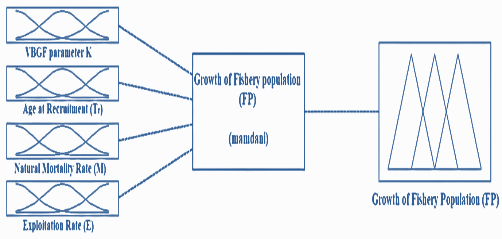
Hamwi, et al. [21] created an expert system model utilizing fuzzy logic to estimate the growth of the Helicolenus dactylopterus population along the Syrian coast. This model incorporated specific parameters (K, Tr, M, E) as inputs and employed fuzzy logic techniques for data analysis and interpretation (Figure 3).
The von Bertalanffy equation was used to identify the parameters (K, TL∞), while the Akaike Information Criterion (AIC) [AIC = N ln (WSS) + 2M] facilitated the selection of the most suitable growth model. In this context, N refers to the number of data points, WSS indicates the weighted sum of squares of residuals, and M represents the number of parameters in the model. The research aimed to compare various growth models that characterize the fish species [22]: TLt = TL∞ / [1 + e-K(t-t0)].
TLt refers to the total length of the fish at a given age (t), while TL∞ indicates the theoretical maximum total length (in cm) that the fish could attain. The growth coefficient is represented by K, and t0 is the theoretical age at which the fish’s length is assumed to be zero.
To estimate the total mortality rate (Z), the Ricker method [23] was applied, which involved calculating the regression equation for the catch curve (ln Nt = a - Zt) across the entire population.
The natural mortality rate (M) was calculated using a specific formula: Log M = -0.0066 - 0.279 log TL∞ + 0.6543 log K + 0.4634 log T [24]. The von Bertalanffy parameters TL∞ and K were utilized, along with the average surface water temperature (T) of 25.11 °C in the fishing area.
The fishing mortality rate (F) was calculated by finding the difference between the total mortality rate (Z) and the natural mortality rate (M) [25]: F = Z - M. The exploitation rate (E) was then determined using the formula E = F / Z [26]. The survival rate (S) was derived from the equation S = e-Z [23].
To calculate the total length (TLc) and age (Tc) at first capture, equations proposed by Beverton and Holt were utilized [27]: TLc = TL’ - [ K (TL∞ - TL’) / Z ]; Tc = - (1/K) * ln (1 - TLc / TL∞) + t0.
In these equations, TL’ represents the average total length of the captured fish.
The total length (TLr) and age (Tr) at recruitment were calculated using the equations formulated by Beverton and Holt [27]: TLr = TL’ - [ K (TL∞ - TL0) / Z ]; Tr = - (1/K) * ln (1 - TLr / TL∞) + t0.
Here, TL0 denotes the total length of the fish at the time of hatching or at age zero.
The growth performance index (ΦTL`) was computed using the equation proposed by Pauly and Munro [28]: ΦTL` = logK + 2logTL∞.
The relative yield-per-recruit (Y’/R) model, based on the Beverton and Holt framework [28], is expressed as: Y’/R = [E * U(M/K)] * [ 1 – (3U / (1 + m) + (3U² / (1 + 2m) – (U³ / (1 + 3m) ]. In this equation, U = 1 - (Lc/L∞), m = (1-E) / (M/K) = (K/Z), and E = F/Z.
The estimation of relative biomass-per-recruit (B’/R) is derived from the following relationship [25]: B’/R = (Y’/R)/F.
Fishing Vulnerability (FV)
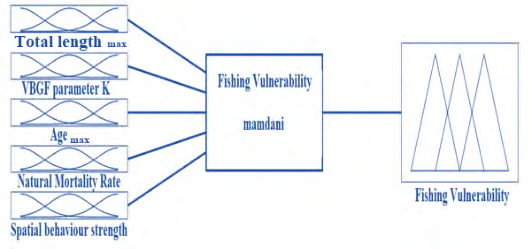
To assess the vulnerability of Helicolenus dactylopterus to fishing, the model created by Hamwi, et al. [20] was applied. This expert system incorporated specific parameters (TLmax, K, Tmax, M, S) as inputs and utilized fuzzy logic techniques to analyze and evaluate the species’ fishing vulnerability (Figure 4).
Results
The analysis of the age structure of the Helicolenus dactylopterus population identified 26 distinct age groups. The eight-year age group was the most prevalent, comprising
13.26% of the total population. In contrast, the age groups of twenty-one, twenty-two, twenty-three, twenty-four, twenty- five, and twenty-six accounted for just 0.13% each of the overall catch, suggesting that this species has a long lifespan along the Syrian coast (Figure 5).
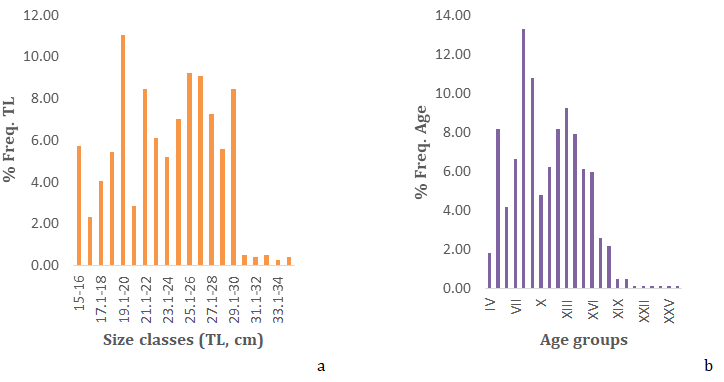
When examining the distribution of individuals within various total length (TL) categories, it was found that the most common size classes were those measuring between 19.1 and 20 cm, which constituted 11.05% of the population. In contrast, individuals in the 33.1 to 34 cm range were the least represented, accounting for only 0.26% of the total.
The data gathered in this study indicated that the maximum total length achieved by Helicolenus dactylopterus along the Syrian coast was 35.35 cm, observed in individuals aged 26 years. Conversely, the smallest recorded total length was 15 cm, corresponding to an age of 4 years.
The parameters for the von Bertalanffy growth equation for total length were calculated as follows: TLt = 45.806 (1 - e-0.05 (t + 4.144)).
The statistical analysis of this growth model produced the following results: AIC = -83.6341; WSS = 0.0203; and a 95% Confidence Interval of 4.55 for L∞ and 0.012 for K. The growth coefficient (k) obtained from the von Bertalanffy equation for Helicolenus dactylopterus was determined to be 0.05.
Additionally, the length-weight relationship demonstrated a negative allometric growth pattern, with a value of b = 2.93 for Helicolenus dactylopterus. The average age and total length of individuals at first capture were 12.11 years and 25.15 cm, respectively. For recruitment, the average age and total length were 10.46 years and 23.41 cm, respectively. Finally, the growth performance index (Φ’) for the total length growth of Helicolenus dactylopterus was calculated to be 2.01.
The total mortality coefficient (Z) for Helicolenus dactylopterus was estimated at 0.52 per year. The fishing mortality coefficient (F) and natural mortality (M) were calculated to be 0.31 per year and 0.21 per year, respectively, leading to a survival rate (S) of 0.59 per year. The exploitation mortality coefficient (E) was determined to be 0.60 per year.
Figure 6 illustrates the relationship between exploitation rates (E), relative yield per recruit (Y’/R), and relative biomass per recruit (B’/R). The exploitation rates analyzed ranged from 0.05 to 1.00.
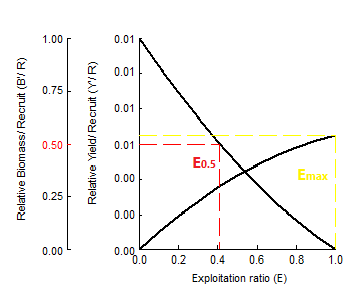
The analysis revealed several important values: Emax, the exploitation rate that maximizes yield per recruit, was determined to be 1 y⁻¹. The exploitation rate E0.1, where the marginal increase in relative yield-per-recruit equals one-tenth of its value at E = 0, was also calculated as 1 y⁻¹. E0.5, the exploitation rate at which the stock’s biomass is reduced to 50% of its unexploited level, was found to be 0.41 y⁻¹.
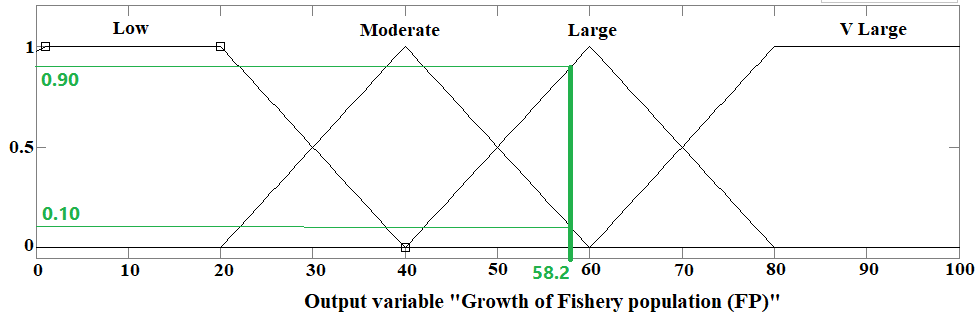
Additionally, the fuzzy logic-based expert system developed by Hamwi, et al. [21] produced a growth value of 58.2 for the Helicolenus dactylopterus population along the Syrian coast. This value indicates a moderate growth of 0.10 and a large growth of 0.90, based on a maximum fishery population growth (FP) value of 100 (Figure 7).
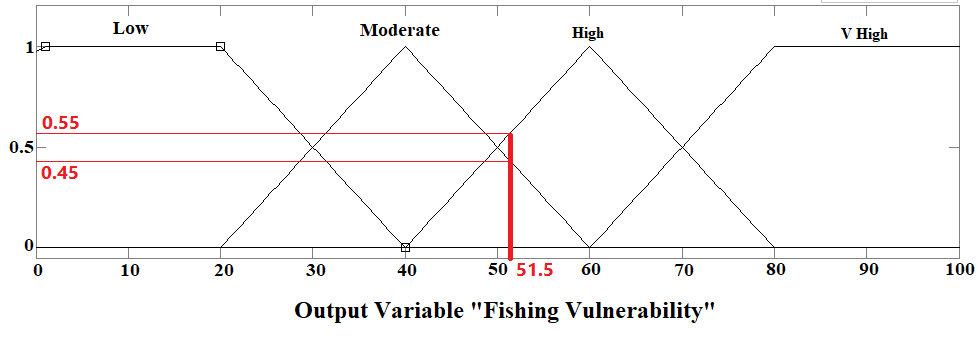
Based on the fuzzy logic expert system created by Hamwi, et al. [20], Helicolenus dactylopterus exhibited a fishing vulnerability of 51.5 FV, where the maximum vulnerability value (FV) is 100. This indicates a high vulnerability level of 0.55 and a moderate vulnerability level of 0.45 (Figure 8).
Discussion
This research indicated that Helicolenus dactylopterus specimens collected from the Syrian coast were larger than those found in the north-eastern and western Mediterranean Seas (Alborean Sea). The total lengths varied from 9.3 cm to 21.9 cm for individuals aged eight years [29], and from 2 cm to 30 cm for those aged twenty-four years [30]. In comparison, Helicolenus dactylopterus from the Portuguese continental slope exhibited even greater lengths, with a maximum total length of 37 cm recorded in a 27-year-old specimen [31] (Table 1).
| Location and author | Age | Total length (TL, cm) | |
|---|---|---|---|
| min | max | ||
| north-eastern Mediterranean Sea [29] | 8 | 9.3 | 21.9 |
| Syrian coast [(present study] | 26 | 15 | 35.35 |
| western Mediterranean Sea (Alborean Sea) [30] | 30 | 3 | 36 |
| Portuguese continental slope [31] | 27 | 5 | 37 |
Table 1: Maximum-minimum total length and age of Helicolenus dactylopterus from different water bodies.
The estimated hypothetical maximum or asymptotic total length for this species appears to differ across geographical locations. According to Abecasis, et al. [32], the estimate in the Azores is 59.06 cm, whereas Demirhan, et al. [29] reported a lower estimate of 35.419 cm for the north-eastern Mediterranean Sea. In this study, the determined asymptotic total length for the species was found to be 45.806 cm.
These variations in the estimated asymptotic total length could be influenced by several factors, including environmental conditions, habitat traits, fishing pressures, and genetic variations among local populations. The growth rate of total length in Helicolenus dactylopterus was evaluated using the growth coefficient (k) derived from the von Bertalanffy equation, which was calculated to be 0.05. This value is notably lower than the 0.07 reported for the Azores [32]. Interestingly, the growth coefficient of 0.05 is consistent with the k value of 0.064 recorded in the north- eastern Mediterranean Sea [29].
The lower growth coefficient of 0.05 found in this study indicates a slower rate of total length growth for Helicolenus dactylopterus compared to the faster growth rate suggested by the higher coefficient of 0.07 from the Azores. This highlights possible regional variations in the growth patterns of this species.
This study offers valuable insights into the growth characteristics of the Helicolenus dactylopterus species, particularly regarding its total length. The data analysis indicated a negative allometric growth pattern, reflected by a growth coefficient (b) of 2.93. This finding implies that the fish’s total length increases at a slower rate compared to other morphological dimensions.
Notably, similar negative allometric growth patterns have been observed in other regions. Specifically, growth coefficient (b) values of 2.71 and 2.92 have been recorded for Helicolenus dactylopterus populations in the north-eastern Mediterranean Sea and along the Portuguese continental slope, respectively [29, 31].
The ratio of the length at first capture to the asymptotic length (Lc/L∞) acts as a measure to determine whether the harvested fish are mainly juveniles or adults. A ratio exceeding 0.5 indicates that most of the catch consists of mature individuals [33]. In this study, the estimated (Lc/L∞) ratio was found to be 0.55, suggesting that the catch in the Helicolenus dactylopterus fishery is primarily composed of mature fish.
Conclusions
This study provides valuable insights into the population dynamics of Helicolenus dactylopterus along the Syrian coast, highlighting the importance of conservation efforts for the sustainable management of this species. The results enhance our understanding of the growth patterns, mortality rates, and fishing vulnerability of Helicolenus dactylopterus, laying the groundwork for future research and management initiatives.
The findings have significant implications for managing the Helicolenus dactylopterus fishery in the region. Overfishing can severely impact the population’s ability to maintain its numbers, leading to reduced abundance. Therefore, it is crucial to implement management strategies that limit the catch of Helicolenus dactylopterus to ensure the long-term sustainability of the fishery.
Acknowledgments
The authors would like to express their gratitude to Latakia University for their support and assistance in conducting this research, as well as extend a great appreciation to the artisanal fishermen, particularly the professional fisherman Abu Bassam.
References
-
Wikipedia (2024) Helicolenus dactylopterus. In: Wikipedia. The Free Encyclopedia.
-
Froese R, Pauly (2024) FishBase. World Wide Web electronic publication.
-
Nunoo F, Bannermann P, Russell B, Poss S (2015) _Helicolenus_ _dactylopterus_. The IUCN Red List of Threatened Species 2015: e.T195093A15592445.
-
IUCN (2025) The IUCN Red List of Threatened Species. Version 2024-2022.
-
Ordoñez A, Eikvil L, Salberg AB, Harbitz A, Murray SM, Kampffmeyer MC (2020) Explaining decisions of deep neural networks used for fish age prediction. PloS one 15(6): e0235013.
-
Parsons K T, Maisano J, Gregg J, Cotton CF, Latour RJ (2018) Age and growth assessment of western North Atlantic spiny butterfly ray _Gymnura_ _altavela_ (L. 1758) using computed tomography of vertebral centra. Environmental biology of fishes 101: 137-151.
-
Hamwi N (2024a) Predicting age and maturity of endangered Spiny butterfly ray, _Gymnura_ _altavela_ (Linnaues 1758) using artificial neural network (multilayer perceptron). Damascus University Journal for the basic sciences 40(1).
-
Hamwi N (2024b) Population Growth of _Thunnus_ _thynnus_ and Vulnerability to Fishing along the Syrian Coast (Eastern Mediterranean Sea). International Journal of Oceanography & Aquaculture, 8(2): 000311.
-
Hamwi N (2024c) Population Assessment of White Grouper _Epinephelus_ _aeneus_ Using Specialist Technical Methods Along Coastal Syrian Waters in The Eastern Mediterranean. Journal of Marine Science and Research 3(1).
-
Hamwi N (2024d) Population growth of _Katsuwonus_ _pelamis_ and vulnerability to fishing along the Syrian coast (Eastern Mediterranean Sea). International Journal of Oceanography & Aquaculture 8(4): 000342.
-
Hamwi N, Ali-Basha N (2024) Growth of Spiny Butterfly Ray _Gymnura_ _altavela_ Population and Vulnerability to Fishing along the Syrian Coast (Eastern Mediterranean Sea). International Journal of Oceanography & Aquaculture 8(3): 000326.
-
Hamwi N, Ali-Basha N, Altajer H, Salem J (2024a) Assessment of Dusky Spinefoot _Siganus_ _luridus_ Population Dynamics along the Syrian Coast (Eastern Mediterranean Sea) Utilizing Different Expert System Techniques. International Journal of Oceanography & Aquaculture 8(3): 000329.
-
Hamwi N, Ali-Basha N, Altajer H, Salem J (2024b) Population assessment of greater amberjack _Seriola_ _dumerili_ along the Syrian waters in the eastern Mediterranean Sea using expert systems. Journal of Marine Science and Research 3(1).
-
Hamwi N, Ali-Basha N, Altajer H, Salem J (2024c) Assessment of Population Growth and Fishing Vulnerability of _Pomadasys_ _stridens_ along the Syrian Coast (Eastern Mediterranean Sea). International Journal of Oceanography & Aquaculture 8(3): 000333.
-
Hamwi N, Ali-Basha N, Altajer H, Salem J (2024d) Population assessment of Brond-snout _Chondrostoma_ _regium_ using specialist technical methods in Orontes River (Syria). International Journal of Oceanography & Aquaculture 8(4): 000339.
-
Hamwi N, Ali-Basha N, Altajer H (2024) Population Growth Assessment of Common Guitarfish _Rhinobatos_ _rhinobatos_ and Vulnerability to Fishing along the Syrian Coast in the Eastern Mediterranean Sea. International Journal of Oceanography & Aquaculture 8(4): 000344.
-
Cheung W W, Pitcher T J, Pauly D (2005) A fuzzy logic expert system to estimate intrinsic extinction vulnerabilities of marine fishes to fishing. Biological conservation 124(1): 97-111.
-
Cheung WL (2007) Vulnerability of marine fishes to fishing: from global overview to the Northern South China Sea (Doctoral dissertation, University of British Columbia) pp: 354.
-
Jones MC, Cheung WW (2018) Using fuzzy logic to determine the vulnerability of marine species to climate change. Global change biology 24(2): e719-e731.
-
Hamwi N, Ali-Basha N (2019) Estimation of the vulnerability of some Sparidae species to fishing in the Eastern Mediterranean Sea (Syrian coast) by fuzzy logic method. Journal of Al-Baath University 41(10): 129-160.
-
Hamwi N, Ali-Basha N, Altajer H, Farah T (2022) A proposed model to estimate the growth of the fishery populations by expert system. Journal of Hama University 5(9): 92-106.
-
Hamwi N (2018) Use Akaike (AIC) and Schwartz (SC) information criterions in the differentiation between nonlinear growth models of different fish species. Journal of Al-Baath University 40(3): 45-66.
-
Ricker WE (1975) Computation and interpretation of biological statistics of fish populations. Fish. Res. Board Can Bull 191: 1-382.
-
Pauly D (1980) A new methodology for rapidly acquiring basic information on tropical fish stocks: growth, mortality and stock-recruitment relationships. Stock assessment for tropical small-scale fisheries pp: 154- 172.
-
Pauly D, Munro JL (1984) Once more on the comparison of growth in fish and invertebrates. Fishbyte, 2(1): 1-21.
-
Sparre P, Venema SC (1998) Introduction to tropical fish stock assessment-Part 1: Manual. FAO Fisheries Technical Paper 306/1. 2: 407.
-
Beverton RJH, Holt SJ (1957) On the dynamics of exploited fish population. Fishery Investigations, Series II (London) 19: 1-533.
-
Berverton RH, Holt SJ (1966) Manual of methods for fish stock assessment. Part II. Tables of yield function. FAO Fish Biology Technical Paper 38(10): 1-67.
-
Demirhan SA, Akbulut F (2015) Age and growth of the bluemouth rockfish, _Helicolenus_ _dactylopterus_ (Delaroche 1809) from the north-eastern Mediterranean Sea, Turkey. Pakistan Journal of Zoology 47(2).
-
Massutí E, Moranta J, De Sola LG, Morales-Nin B, Prats L (2001) Distribution and population structure of the rockfish _Helicolenus_ _dactylopterus_ (Pisces: Scorpaenidae) in the western Mediterranean. Journal of the Marine Biological Association of the United Kingdom 81(1): 129-141.
-
Sequeira V, Neves A, Vieira AR, Figueiredo I, Gordo LS (2009) Age and growth of bluemouth, _Helicolenus_ _dactylopterus_, from the Portuguese continental slope. ICES Journal of Marine Science 66(3): 524-531.
-
Abecasis D, Costa AR, Pereira JG, Pinho MR (2006) Age and growth of bluemouth, _Helicolenus_ _dactylopterus_ (Delaroche, 1809) from the Azores. Fisheries Research 79(1-2): 148-154.
-
Pauly D, Soriano ML (1986) Some practical extensions to Beverton and Holt’s relative yield-per-recruit model. In The first Asian fisheries forum. Manila: Asian Fisheries Society pp: 491-496.
- Genetic Improvement of Nile Tilapia (Oreochromis niloticus): Advances in Selective Breeding and Genomic Approaches for Sustainable Aquaculture
- Microplastics, Contaminants, and Waste Hotspots: Divergences and Faults in Prioritizing Control Efforts
- Creating a Healthier, More Vibrant Open and Closed Aquatic Environment. A Submersible, Centrifugal Magnetically Affixed Current Changing Aquarium Pump
- An Attempt to Assess Alpha Diversity and Sample Size: Using the Ostracod Assemblages off Kumamoto Port, Japan
- Assessment of the Efficiency of Common Fishing Gears and Crafts Used at Mohananda River of Chapai Nawabganj, Bangladesh
- Fish Productivity and Biodiversity Status of Sundarban Mangrove in Bangladesh