
Formulation of Tenebrio Molitor (Mealworm) Larvae Pellet for Oreochromis Niloticus (Nile Tilapia) Feed Production
Mealworms are larval stages of darkling beetles (Tenebrio molitor) which are considered major agricultural pests; however, recently, they are seen as potential fish feeds in the field of aquaculture. This present study aimed to determine the effect of the varying feed formulation of Tenebrio molitor (mealworm) larvae on the growth performance of Oreochromis. niloticus (nile tilapia) and to produce a mealworm pellet out of the study. One hundred eighty (180) juvenile nile tilapia were assigned in net cages in a Randomized Complete Block Design (RCBD) and were fed thrice daily (6:00AM; 12NOON; 6:00PM) for a month with different feed formulations. The formulations were: treatment 1 (T1) = 25g mealworm larvae + 40g cassava starch + 33 ml water; treatment 2 (T2) = 50g mealworm larvae + 40g cassava starch + 38 ml water; treatment 3 (T3) = 75g mealworm larvae + 40g cassava starch + 46 ml water; and treatment 4 (T4) as the control (commercial fish pellets). One-way Analysis of Variance (ANOVA) revealed that there is a highly significant difference (p value: 0.000) in the mean gain weight of O. niloticus between and within groups after being fed with the different feed formulations with T1 obtaining the highest mean weight gain (13.62grams). Post Hoc Analysis (LSD) revealed that the weight gain of O. niloticus (nile tilapia) of T1 was highly significant at α ≤ 0.001. In terms of the storability of the pellet, it did not disintegrate within the time span and can be stored up to six (6) months. Considering that the Philippines imports almost half a billion dollars’ worth of other fish meals such as soybean meal at all seasons of the year, treatment 1 (25g mealworm larvae, 40g cassava starch and 33 ml water) has the potential as an alternative protein feed material in the country.
Introduction
The supply of fish in the world’s vast oceans once seemed sustainable. However, in the past three decades, unregulated harvesting and trade have increased dramatically, leading to lower supply in response to its demand [1]. According to Makkar, et al. (2014) as cited in Thevenot [2], as the human population tends to increase, greater demand occurs for food and other resources, particularly animal protein.
Aquaculture, which aims to target food sustainability, plays significant role in many countries by providing a higher income, better nutrition and better employment opportunities. It has attempted to fill the gap between supply and demand. But as the global appetite for fish continues to increase, current trends such as overfishing and large commercial industry in the fish sector pose serious risks to the environment, to the well-being of people and to the viability of the fish sector itself [1].
In the Philippines, the current condition of fisheries is at threat. Increased demand for fish and population growth continue to drive lesser production in fisheries. Protein deficiency among fishing communities is now increasing at an alarming rate [3]. The Philippine Council for Agriculture, Aquatic and Natural Resources Research and Development (PCAARRD) under the Department of Science and Technology (DOST) recognized this problem through its SIPAG (Strategic Industry S&T Program for Aquaculture) program. Accordingly, feed production plays a very important role in the field of aquaculture as it reduced the natural food in the hatchery.
Currently, practical formulations containing golden apple snail, local meal, copra and cassava meal and rice bran are currently being evaluated in field trials to compare performance with commercial feed as well as to determine the appropriate ingredients and composition. This is due to the expected higher cost and future disruptions in the supply of feed ingredients in the feed industry [2]. Thus, aquaculture studies are focus on alternative sources of feeds that are cheaper and comparable in terms of nutritive value to other commonly used one such as soymeal and fishmeal [4].
Mealworms are larval stages of darkling beetles (Tenebrio molitor) which are considered major agricultural pests; however, recently, they are seen as potential fish feeds in the field of aquaculture. According to Hussain [4], mealworms have high potential as valuable protein feed ingredient with protein content of
44-70%. Moreover, mealworm having better nutrient profile and digestibility could be used to produce economical fish meal feed formulation. Considering that the Philippines imports almost half a billion dollars’ worth of other fish meals such as soybean meal at all seasons of the year, other alternative fish feed formulations can replace up to 50% of other protein feed material in the country (DOST- PCAARRD, 2017).
Nile tilapia (Oreochromis niloticus) is a predominant fish and second most important cultured fish in the Philippines. About 259, 045 metric tons of tilapia was produced annually (SSA 2017 in Seafood Trade Intelligence Portal). Commercial tilapia aquaculture has improved being aware of the importance of adopting innovative husbandry technologies. These include the use of novel feed ingredients, improving the quality of industrial aqua feeds and adopting cost-effective feeding strategies [5].
| O. niloticus juveniles are omnivorous. | In most tilapia | |||
|---|---|---|---|---|
| farms where pellets are dry or moist feeds are used, | ||||
| spreading by hand is the preferred method of feeding. | ||||
| Being active swimmers, tilapia will readily swim to the | ||||
| edge of the pond or cage where the feed is being spread | ||||
| [6]. | With the expansion in intensified aquaculture, | |||
| interest for more proficient aqua-feed is rising. This | ||||
| involves the principle operating cost in fish generation | ||||
| [7]. | With these, this study was conceptualized which |
Materials and Method
Research Samples
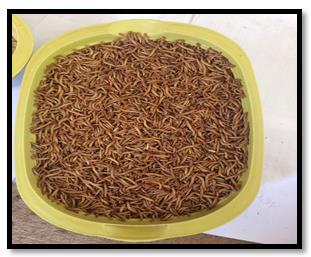
Tenebrio molitor larvae (mealworm) were formulated as feed pellet (Figure 1).
The test organism used in the study to determine the effectiveness of the different mealworm larvae feed formulations is the Oreochromis niloticus (nile tilapia). This test organism was selected knowing it is the second highly consumable fish in the Philippines, yet there is still a need of improvement in terms of feeding techniques.
Research Design and Layout
Randomized Complete Block Design (RCBD) was used as the research design. The assigning of specimens was through fish bowl method. Since the samples are mobile, assigning of the fish to the different treatments in each block followed immediately after each pick of random numbering. There were three (3) replicates employed, represented by blocks and 15 subsamples in the following four (4) treatments as modified from Dedeke, et al. [8]. Thus, a total of 180 juvenile nile tilapia were utilized in the study.
Preparation of Powdered Mealworm
Dried mealworm larvae were induced with 5% salt solution, followed by sun-drying method for 2 days. After which, grinding process was conducted by the use of grinding machine and was placed in a clean container.
Optimization of Pellets
For treatment 1, a total of 25 grams of powdered mealworm were mixed with 40 grams of cassava starch in a clean bowl. The mixture was added with 33 ml of water while being introduced to low fire. Then mixture was set to create dough like appearance. After which, the mixture was placed in a clean plate (if necessarily). The procedure done same goes with treatment 2 (with 50 grams of powdered mealworm and 38 ml of water) and treatment 3 (with 75 grams of powdered mealworm and 46 ml of water) except treatment 4 because T4 served as the positive control (commercial fish pellets). Thereafter, the formed mixture was fashioned on its designated shape. Electric meat grinder with 5-mm diameter in size extruded the dough and the extruded dough was cut using knife manually. Then, the processed pellets were placed on a dry flat plate and allowed to cool in an air-dry manner. Lastly, the formulated mealworm fish pellet was placed in its corresponding container [9].
Experimental Set-up
A total of 12 net cages were installed in the pond having the size of 1.5 x 1.5 meter. Walkways were also placed in between cages to facilitate the feeding [10]. The following feed formulations were administered to the nile tilapia separated by net cages: T1= 25g mealworm larvae + 40g cassava starch + 33 ml water T2= 50g mealworm larvae + 40g cassava starch + 38 ml water T3= 75g mealworm larvae + 40g cassava starch + 46 ml water T4= commercial fish pellets (control) O. niloticus were fed thrice daily (6:00AM; 12NOON; 6:00PM) for a month with these treatments.
Results and Discussion
Mean weight gain is the commonly used measure in evaluating the growth performance in aquaculture industry [11]. Table 1 shows the mean weight (grams) gain of O. niloticus fed with different feeding formulas of T. molitor (mealworm) larvae.
| Treatments | Mean | N | Std. Deviation |
| Treatment 1 | 13.6222 | 45 | 8.18268 |
| Treatment 2 | 10.2556 | 45 | 6.33409 |
| Treatment 3 | 7.3778 | 45 | 4.67969 |
| Treatment 4 | 8.4667 | 45 | 5.85274 |
| Total | 9.9306 | 180 | 6.76414 |
Table 2: Mean weight (grams) gain of O. niloticus fed with different feeding formulas of T. molitor (mealworm) larvae.
Treatment 1 has the highest mean gain weight among all treatments. Thus, this implies that O. niloticus fed with 25g mealworm larvae + 40g cassava starch + 33 ml water (T1) is the preferred formulation in terms of evaluating the growth performance. Further, a grand total of 9.93 grams of the mean justified that all O. niloticus have gained weight when treated with different T. molitor feeding formulations (T1= 25g mealworm larvae + 44g cassava starch + 33 ml water T2= 50g mealworm larvae + 40g cassava starch + 38 ml water T3= 75g mealworm larvae + 40g cassava starch + 46 ml water).
| Sum of Squares | df | Mean Square | F-statistic | p-value | |
|---|---|---|---|---|---|
| Between Groups | 1007.715 | 3 | 335.905 | 8.231 | .000** |
| Within Groups | 7182.167 | 176 | 40.808 | ||
| Total | 8189.882 | 179 |
Table 3: ANOVA results in terms of the mean gain weight (grams) of O. niloticus (nile tilapia) fed with different feed
Table 2: ANOVA results in terms of the mean gain weight (grams) of O. niloticus (nile tilapia) fed with different feed formulations. **highly significant at α ≤ 0.001 There is a highly significant difference (p value: 0.000) in the mean gain weight (grams) of O. niloticus between and within groups after being fed with the different feed formulations. These results are supported by the Food and Agriculture Organization [6], where it stated that nile tilapia greater than 25 grams would require less dietary protein for growth and can utilize even higher levels of carbohydrates as a source of energy. With this, compared to formulated feeds, T1 (25 grams of mealworm larvae (as Table 3 shows the Post Hoc Analysis (Least Significant Difference - LSD) on the treatment effects on O. niloticus (nile tilapia) fed with T. molitor (mealworm) larvae feed formulations.
a source of protein) and 40 grams of cassava starch (as a source of carbohydrate other than as binding agent) supplied the approximate amount of nutrition that the O. niloticus (nile tilapia) requires.
| 95% Confidence Interval Lower Bound Upper Bound | 95% Confidence Interval | ||||||||||||||
|---|---|---|---|---|---|---|---|---|---|---|---|---|---|---|---|
| Treatments | Mean Difference (Final – Initial) | S | td. Erro | r | Sig. | ||||||||||
| Upper Bound | |||||||||||||||
| Treatment 1 | Treatment 2 | 3.36667 | 1.34673 | .013* | 0.7089 | 6.0245 | |||||||||
| Treatment 3 | 6.24444 | 1.34673 | .000** | 3.5866 | 8.9023 | ||||||||||
| Treatment 4 | 5.15556 | 1.34673 | .000** | 2.4977 | 7.8134 | ||||||||||
| Treatment 2 | Treatment 3 | 2.87778 | 1.34673 | .034* | 0.22 | 5.5356 | |||||||||
| Treatment 4 | 1.78889 | 1.34673 | 0.186 | -0.8689 | 4.4467 | ||||||||||
| Treatment 3 | Treatment 4 | -1.08889 | 1.34673 | 0.42 | -1.5689 | 3.7467 |
Table 4: Post Hoc Analysis (LSD) on the Treatment Effects on O. niloticus (nile tilapia) fed with T. molitor (mealworm) Table 3:
Table 3: Post Hoc Analysis (LSD) on the Treatment Effects on O. niloticus (nile tilapia) fed with T. molitor (mealworm) Table 3: Post Hoc Analysis (LSD) on the Treatment Effects on O. niloticus (nile tilapia) fed with T. molitor (mealworm) larvae feed formulations. **significant at alpha=0.001; *significant at alpha= 0.05 Table 3 showed that 25g MW + 40g CS + 33 ml of water (T1) feed formulation yielded the highest mean weight gain of O. niloticus (nile tilapia). Further, the weight gain of O. niloticus (nile tilapia) for 25g MW + 40g CS + 33 ml of water (T1) was highly significant at α ≤ 0.01.
The number of live O. niloticus (nile tilapia) in Table 4 showed the percent survival of juvenile O. niloticus (nile tilapia) fed with T. molitor (mealworm) larvae pellet.
| Percent Survival (%) | |
|---|---|
| T1 (25g mealworm larvae + 44g cassava starch + 33 ml water) | 100% |
| T2 (50g mealworm larvae + 40g cassava starch + 38 ml water) | 100% |
| T3 (75g mealworm larvae + 40g cassava starch + 46 ml water) | 100% |
| T4 (Commercial fish pellets) | 100% |
Table 5: Percent survival of juvenile O. niloticus (nile tilapia) fed with T. molitor (mealworm) larvae feed formulations.
the experiment conducted was delimited to 5.5 hours’ time as new feeds will be introduced after.
According to Garcia-Maraver, et al. [12], pellet quality depends on the properties of the feedstock itself such as the biomass type, particle size, and binding agent. Suitable condition of these factors is necessary to obtain a good quality pellet. In addition, according to Agriculture Information, a factor such as temperature and humidity, storage conditions, and even oxygen pressure contributes to the viability of the pellet.
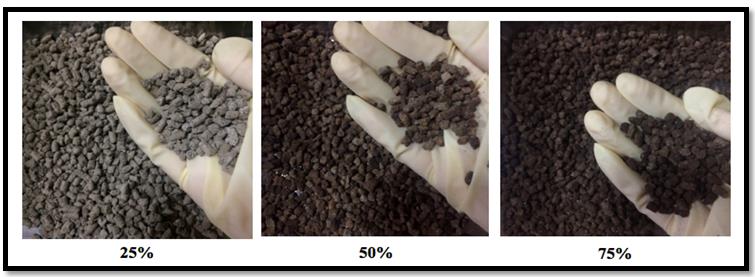
Figure 2 shows the condition of the different formulated pellets after 6 months’ time stored at room temperature.
The calculation of the cost of investment (COI) revealed that the O. niloticus harvested at its 30th day is not yet profitable and harvestable at 30 days. However, in terms of the income, treatment 1 (25g MW + 40g CS + 33ml of water) obtained the highest income (P100.18) and the minimal expenses (P46.47). This is supported by Food and Agriculture Organization [6] which states that it will take 5 months for the O. niloticus (nile tilapia) to reach its marketable size (300-500 g). Accordingly, nile tilapia that is greater than 25 grams requires approximately 28-30% protein for optimum growth. Mealworm larvae contain approximately 49.1 of protein along with its essential amino acids in their body [4, 13]. With this, Tenebrio molitor (mealworm) larvae can provide the necessary requirement to allow the O. niloticus (nile tilapia) achieved better gain weight.
Conclusion and Recommendations
There is a highly significant difference in terms of the mean gain weight (grams) of O. niloticus (nile tilapia) between and within groups after being fed with the different feed formulations and treatment 1 with 25% mealworm larvae, 40g cassava starch and 33ml water showed the most efficient feed formulation. There was 100% survival of O. niloticus fed with T. molitor larvae feed formulation and the formulated feeds did not disintegrate in the pond water in 5 to 6 hours’ time. However, at 30 days’ feeding trial, 2 months old O. niloticus is not yet profitable. It is recommended to conduct a 5 month-feeding trial to clearly see the difference of O. niloticus (nile tilapia) growth performance on 25% T. molitor (mealworm) larvae feed formulation and to further validate its cost of investment (COI). A proximate analysis on the 25% T. molitor (mealworm) larvae feed formulation is also recommended.
References
-
Delgado C, Wada N, Rosegrant M (2003) World Fish. International Food Policy Research Institute.
-
Thevenot A, Rivera J, Wilfart A, Maillard F, Hassouna M, et al. (2017) Mealworm meal for animal feed: Environmental assessment and sensitivity analysis to guide future prospects. Journal of Cleaner Production 170: 1260-1267.
-
(2004) Department of Agriculture, Bureau of Fisheries and Aquatic Resources (DA-BFAR).
-
Hussain I, Khan S, Sultan A, Chand N, Khan R, et al.(2017) Mealworm (_Tenebrio molitor_) as potential alternative source of protein supplementation in broiler. International Journal of Biosciences 10(4): 255-262.
-
Romana-Eguia MRR, Larona MA, Catacutan MR (2013) On-farm feed management practices for Nile tilapia (_Oreochromis niloticus_) in the Philippines. SEAFDEC Aquaculture Department (SEAFDEC/AQD).
-
(2018) Food and Agriculture Organization of the United Nations.
-
Nakkina M (2016) Study of Growth Rate in Nile Tilapia (_Oreochromis_ _niloticus_). Journal of Aquaculture Research and Development 7(8): 440.
-
Dedeke GA, Owa SO, Olurin KB, Akinfe AO, Awotedu OO, et al. (2013) Partial replacement of fish meal by earthworm meal (_Libyodrilus violaceus_) in diets for African catfish, Clarias gariepinus. International Journal of Fisheries and Aquaculture 5(9): 229-233.
-
Royes J, Chapman F (2015) Preparing your own Fish Feeds. Fisheries and Aquatic Sciences Department, university of Florida.
-
Pucher J, Ngoc TN, Thi Hanh Yen T, Mayrhofer R, El- Matbouli M, et al. (2014) Earthworm Meal as Fishmeal Replacement in Plant based Feeds for Common Carp in Semi-intensive Aquaculture in Rural Northern Vietnam. Turkish Journal of Fisheries and Aquatic Sciences 14: 557-565.
-
Panase P, Mengumphan K (2015) Growth performance, Length-Weight Relationship and Condition Factor of Backcross and Reciprocal Hybrid Catfish reared in Net Cages. International Journal of Zoological Research 11(2): 57-64.
-
Garcia-Maraver A, Rodriguez ML, Serrano-Bernardo F, Diaz LF (2015) Factors affecting the quality of pellets made from residual biomass of olive trees. Fuel Processing Technology 129: 1-7.
-
Dalzell P, Corpuz P, Ganaden R, Pauly D (1987) Estimation of Maximum Sustainable Yield and Maximum Economic Rent from the Philippine Small Pelagic Fisheries. BFAR Technical Paper Series 10(3): 23.
- Genetic Improvement of Nile Tilapia (Oreochromis niloticus): Advances in Selective Breeding and Genomic Approaches for Sustainable Aquaculture
- Microplastics, Contaminants, and Waste Hotspots: Divergences and Faults in Prioritizing Control Efforts
- Creating a Healthier, More Vibrant Open and Closed Aquatic Environment. A Submersible, Centrifugal Magnetically Affixed Current Changing Aquarium Pump
- An Attempt to Assess Alpha Diversity and Sample Size: Using the Ostracod Assemblages off Kumamoto Port, Japan
- Assessment of the Efficiency of Common Fishing Gears and Crafts Used at Mohananda River of Chapai Nawabganj, Bangladesh
- Fish Productivity and Biodiversity Status of Sundarban Mangrove in Bangladesh