
A Note on Occurrence of Four Sea Cucumbers (Echinodermata: Holothuriidae) from Vellar Estuary, Southeast of India
This present study documents the occurrence of four sea cucumber species from Vellar estuary, South-East India. Occurrence of Holothurians from oyster beads and sea grass meadows of Vellar estuarine waters significantly extends the knowledge about the distributional range of this species. Detailed morphological features and colour patterns of the above species is described. The study suggests the need for more taxonomical and conservational studies for this type of vulnerable species for better understanding its diversity, conservation and geographical distribution pattern.
Introduction
Almost 1400 holothurian species were reported from various parts of World. In Indian waters, about 200 species which belongs to 6 orders and 16 families are recognized. Holothurians are primarily distributed in the Indian coastal states in scattered numbers as well as prominent resources along the Andaman and Nicobar Islands, Lakshadweep, the Gulf of Kutch and around 39 species reported from the Gulf of Mannar and Palk Bay [1]. One of the most important non-finfish sources of income for coastal populations in the Indian Ocean, Southeast Asia, and the Pacific is sea cucumber fishing. Over the past two to three decades, sea cucumber fisheries have increased in capture and value around the world [2, 3, 4]. Overexploitation of this resource is a result of poor fishing management and certain ecological characteristics. Sea cucumbers play a pivotal role in sustaining the marine ecosystem by effectively consuming decomposing organic matter and subsequently converting it into usable and recyclable nutrients, which ultimately benefit other forms of marine life [5]. The feeding and excretion of sea cucumbers also contribute to the elevation of the alkalinity of the seawater, thus protecting the ocean from the effects of acidification. James DB [6, 7, 8, 9] has given for the first time an account of the holothurian resources of India chiefly based on the intensive surveys along the Gulf of Mannar and Palk Bay and the Andaman and Nicobar Islands.
The estuarine oyster beds have acted as a dam on the strong current along the river shoreline, providing some protection against coastal erosion and creating a shallow bay with elevated sediment levels [10].
The juveniles of the species were found in an intertidal zone, which is characterized by its abundance of algae and sparse seagrass beds. It is possible that sea cucumbers may appear to congregate in shallow grass beds prior to migrating to deeper water as they reach sexual age. During our survey on estuarine faunal diversity [2, 5, 11, 12, 13, 14] of Tamil Nadu coast, we recorded the four species of sea cucumbers for first time from oyster and seagrass beds of the Vellar estuary, Southeast India.
Material and methods
Weekly field survey on intertidal estuarine faunal
composition was conducted at Vellar estuary, Southeast India over a period of 16 months, from April 2022 to August 2023. Faunal surveys were conducted during the low and inter-tide. Visual surveys were used to describe different biotopes of the estuary and composition of substrate in terms of percent of sand, small stones, seagrasses, algae, rocks, creeks, dead and live oysters.
Results
Systematics
Order: Aspidochirotida, Grube, 1840 Family: Holothuriidae Burmeister, 1837 Genus: Actinopyga Bronn, 1860 Actinopyga lecanora (Jaeger, 1833) Type species: Holothuria (Holothuria) lecanora Jaeger, 1833 by original description. Common name: White tipped sea cucumber Description (Figure 1A & B): The size of the specimen about 180 mm in length. Elongated robust body, like long sausage shaped, or contracted into a rounded loaf-shaped or even into a globular oval shape. The spicules are composed of small rods. Smooth surface with long, thin tube feet, sparsely distributed all over. Sometimes, the sea cucumber is seen with many tube feet on the ventral side. Distinguishing character is the distinct white or greyish region around the rear end. The cloacal region protected by five calcareous yellowish teeth-like structures. Cuvierian tubules absent. Colour: The colour range is variable from light grey/brown to golden yellow with light coloured patches, particularly around the slightly reduced posterior end. Habitat: It is often concealed among the coral or debris of reef formations. Presently, from Vellar estuary it is observed among the intertidal sea grass meadows (Halodule sp.; Figure 2C&D) (11°29’32” N, 79°46’06” E). Distribution: India: Andaman and Nicobar Islands; Elsewhere: East Africa, Eastern Africa, Kenya, Madagascar, Mauritius, Mozambique, Somalia and Tanzania. Genus: Holothuria Linnaeus, 1767 Sub genus: Holothuria (Microthele) Brandt, 1835 Holothuria (Microthele) fuscogilva Cherbonnier, 1980 Type species: Holothuria nobilis (Selenka, 1867) by original description. Common name: White Teatfish Description (Figure 1C&D): The size of the sea cucumber specimen about 155 mm in length. Six to eight teats like structures are present on each side of the body. Those teats are clearly visible only in live specimens in water. Cuvierian organs absent. Colour: Brown colored body and it is covered with a fine coat of sand. Habitat: It occurs in slightly deeper waters usually found at depths ranging from 10 - 40 m. According to Conand (1990) the preferred habitat for this species are coral slabs near reef passages or clean sand at the foot of reef slopes or seagrasses (Figure 2C&D). Distribution: It is common to the seas around India from the Lakshadweep. Recently it has been recorded in the Gulf of Mannar. And this is the first record from estuarine ecosystem.
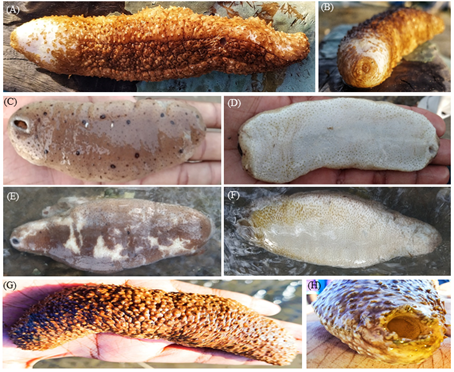
Holothuria nobilis (Selenka, 1867) Type species: Muelleria nobilis Selenka, 1867 by original description. Common name: Black teat fish Description (Figure 1E&F): Loaf-shaped body with both the ends blunt. Similarly, six to eight teat like projections are seen on each side of the body in live specimens. The dorsal side, convex with flat ventral side. The skin is thick and supple to the touch. There are numerous small papillae on the dorsal side, which are mostly sparse and often undetectable. The pedicels are uniformly distributed on the ventral surfaces. Each dark dot on the ventral surface constitutes one pedicel.
Cuvierian organs presents. Colour: The living condition is characterized by a brown coloration on the dorsal side and a white coloration on the ventrally exposed area. The body is coated with a fine layer of sand and is cream in colour with black spots. Habitat: It inhabits shallow waters in muddy-sandy and reef bottoms areas and prefers waters with a lower salinity. Juveniles may inhabit the sea grass beds (Figure 2C&D). Distribution: In Indian waters: Andaman and Nicobar Islands, Gulf of Mannar and Palk Bay. Sri Lanka, Maldives, Red Sea, East Indies, Arabia, Persian Gulf, Philippines, China, South Japan, South Pacific Island, Northern Australia and Hawaii.
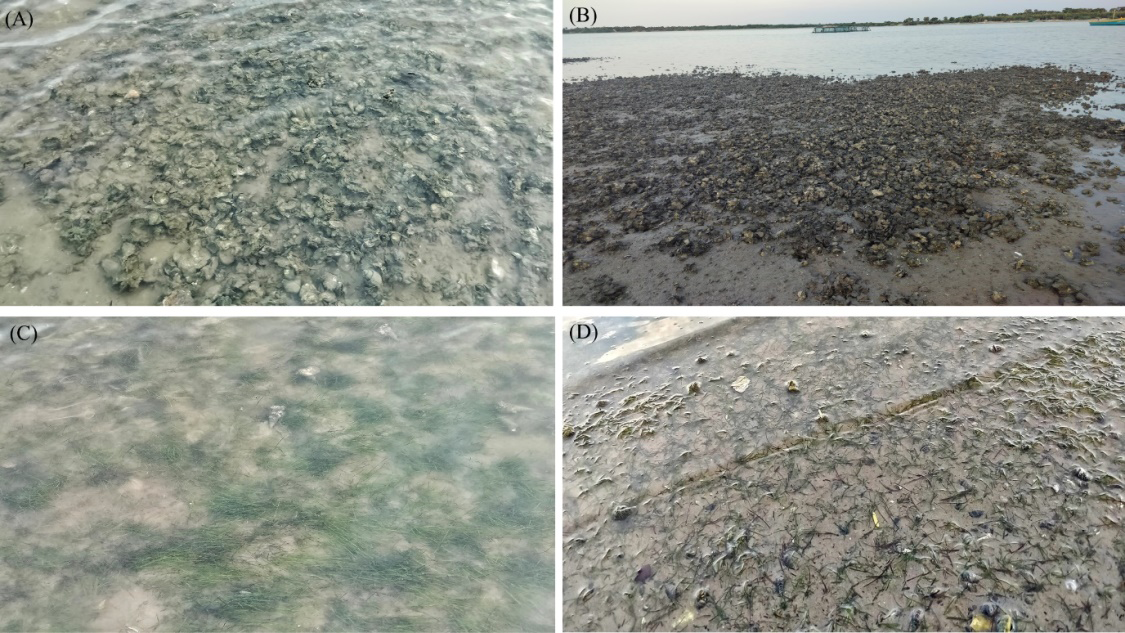
Sub genus: Holothuria (Theelothuria) Deichmann, 1958 Holothuria (Theelothuria) spinifera Théel, 1886 Common name: Brown Sandfish Description (Figure 1G&H): Cylindrical body, rounded at both ends. The mouth has a ring of small bumps called papillae, and there are 20 flap like tentacles around it. Anus has five round bumps around it. Colour: The upper part is all one shade of brown, and there are little pointy things all over the body. The bottom part is usually a lighter colour. Habitat: This species is never found in the area where the tide reaches. It can be found in clean sand in somewhat deeper waters. Current report from oyster banks of Vellar estuary (Figure 2A&B). Distribution: This species is only found in the Gulf of Mannar and the Palk Bay in the Indian seas. It is reported to occur in Sri Lanka, Philippines, China and north Australia, Red Sea, Persian Gulf.
Discussion
This report is the first attempt to confirm the sea cucumber species in the mud flats of Vellar Estuary. The nature of bottom sediment composition is the most important factor which determine the sea cucumber habitat selection [12]. It has been noted that sea cucumber habitat preferences vary between species and even during life stages within the same species [12].
Holothurians are often referred to as the sea earthworms. They are responsible for the large-scale movement and mixing of the substrate and the recycling of the detrital mass into animal tissue as well as nitrogenous waste that can be digested by algae or sea grass [12, 15, 16]. The mudflats are the most suitable habitat for sea cucumbers due to the fact that they feed on detritus and consume organic matter in the mud [12, 15].
Based on the perception of Vellar estuary clam or oyster hand pickers and inland fishers divulges that the status of sea cucumber population has extremely sparse in estuaries as well as along the coromandel coast as they are ubiquitous only along the Gulf of Mannar and Palk Bay region [13]. The inland fishers of Vellar estuary are aware that the fishing of holothuroids is illegal and punishable in India, and therefore they are engaged in sustainable fishing of molluscs, crustaceans and other finfishes [10].
Raghunathan C, et al. [13] reviewed echinoderms from India and concluded that there are nearly 200 species of holothurians in the seas around India. This occurrence of holothurians in Vellar estuary reported in this study might be incidental, possibly introduced through salinity variations, clarified by the proximity of high salinities in the sampling location during the summer and pre monsoon seasons.
Conclusion
India is home to a population of approximately 200 species of sea cucumbers. All of these species are protected from collection, trade, or any form of exploitation under the Wildlife Protection Act, 1972. Furthermore, above two species, Holothuria fuscogilva and H. nobilis, have been listed in Appendix II to CITES since 2023, which governs their international trade.
Distribution of sea cucumbers in estuarine muds flats is rare and the study we have reported the occurrence of four holothurian in Vellar estuary might be due to the favourable environment conditions. Possibly, the present report of four holothurians in Vellar estuary confirms and expands its range towards the estuaries of coromandel coast of India. We suggest further studies required for better understanding of ecology and conservation of sea cucumbers in estuarine contexts.
Acknowledgements
The authors are thankful to the Director and Dean of the Faculty of Marine Sciences, Annamalai University, for providing necessary facilities.
Conflict of Interest
All the authors confirmed that the content of this manuscript has no conflict of interest.
References
-
Asha PS, Vinod K, Ranjith L, Johnson B, Vivekanandan E (2017) Conservation and sustainable use of sea cucumber resources in India: Suggestions and way forward. CMFRI Marine Fisheries Policy Series (7): 80.
-
Chryso RB, Ragul S (2023) Occurrence of ragged sea hare, Bursatella leachii Blainville, 1817 (Gastropoda: Heterobranchia: Aplysiidae) from Vellar Estuary, Tamil Nadu, India. Species 24(73): e49s1544.
-
Conand C (1990) The Fishery Resources of Pacific Island Countries. Part 2: Holothurians. FAO Fisheries Technical Paper, No. 272.2, pp: 141.
-
Conand C (2004) Present status of world sea cucumber resources and utilisation: an international overview. In: Lovatelli A, Conand C, et al. (Eds.), Advances in sea cucumber aquaculture and management. FAO Fisheries Technical Paper No. 463, pp: 425.
-
Iyyappan S, Subramaniyan M, Ragul S, Thangaraj M (2023) First occurrence of two Blennidae fishes from Vellar Estuary, Southeast coast of India. International Journal of Environmental Research and Education 3(2): 17-26.
-
James DB (1982) Ecology of Intertidal Echinoderms of the Indian Seas. Journal of the Marine Biological Association of India 24 (1&2): 124-129.
-
James DB (1983) Sea cucumber and sea urchin resources. CMFRI Bulletin 34: 85-93.
-
James DB (1994) Holothurian resources from India and their exploitation. Bulletin of the Central Marine Fisheries Research Institute 46: 27-31.
-
James DB (1995) Taxonomic studies on the species of Holothuria (Linnaeus, 1767) from the seas around India. J Bombay nat Hist Soc 92: 190-204.
-
Kinch J, Purcell S, Uthicke S, Friedman K (2008) Population status, fisheries and trade of sea cucumbers in the Western Central Pacific. Sea cucumbers. A global review of fisheries and trade. FAO Fisheries and Aquaculture Technical Paper 516: 7-55.
-
Larson HK, Murugan A, Ragul S, Mahadevan G (2022) Resolution of the identity of the goby Glossogobius mas Hora, 1923 (Perciformes: Gobiidae) described from Chilka Lake, Odisha, India. Zootaxa 5213(5): 596-600.
-
Massin C (1982) Effects of feeding on the environment: Holothuroidea. In Echinoderm Nutrition, Jangoux M, Lawrence JM (Eds.), Rotterdam: AA Balkema, pp: 493- 497.
-
Raghunathan C, Venkataraman K (2014) Status Survey of Holothurians (Sea Cucumber) in the Territorial waters of Andaman and Nicobar Islands. Zool Surv India, pp: 1-96.
-
Ragul S, Subramaniyan M, Mahadevan G, Murugan A, Larson H (2021) First distributional record of the goby Mangarinus waterousi (Perciformes: Gobiidae) from Vellar estuary, southeast India. Cybium 45(4): 297-301.
-
Uthicke S (2001) Nutrient regeneration by abundant coral reef holothurians. Journal of Experimental Marine Biology and Ecology 265(2): 153-170.
-
Wolkenhauer SM, Uthicke S, Burridge, C, Skewes T, Pitcher R (2010) The ecological role of Holothuria scabra (Echinodermata: Holothuroidea) within subtropical seagrass beds. Journal of the Marine Biological Association of the United Kingdom 90: 215-223.
- Genetic Improvement of Nile Tilapia (Oreochromis niloticus): Advances in Selective Breeding and Genomic Approaches for Sustainable Aquaculture
- Microplastics, Contaminants, and Waste Hotspots: Divergences and Faults in Prioritizing Control Efforts
- Creating a Healthier, More Vibrant Open and Closed Aquatic Environment. A Submersible, Centrifugal Magnetically Affixed Current Changing Aquarium Pump
- An Attempt to Assess Alpha Diversity and Sample Size: Using the Ostracod Assemblages off Kumamoto Port, Japan
- Assessment of the Efficiency of Common Fishing Gears and Crafts Used at Mohananda River of Chapai Nawabganj, Bangladesh
- Fish Productivity and Biodiversity Status of Sundarban Mangrove in Bangladesh