
Study on Induced Breeding in Oreochromis niloticus (Nile Tilapia) through Hypophysation Technique
Producing fish to spawn by artificial methods is called induced breeding. Oreochromis niloticus (Nile tilapia) are induced to spawn by the injection of pituitary extract, a process called Hypophysation. Hypophysation is a technique of induced breeding in Oreochromis niloticus by injecting pituitary gland extract. In hypophysation, the pituitary gland extract is injected into intramuscular/pectoral fin region of fish. The gland induces the fish to breed. When the pituitary gland of the same species is used, the hypophysation is called homoplastic. Induced breeding is practised in a wide variety of species, with Hypophysation we can get pure seeds in large number in all seasons. With this technique we can produce hybrid varieties of species. This technique shows high fertilization rate (~85%) and Hatching rate (~80%) this study explodes about procedure and result of hypophysation technique.
T Jagadeeshwara chari*, D Ram Kumar, P Ayodhya Reddy and B Saikumar
Government Degree & PG College (Autonomous), India *Corresponding author: T Jagadeeshwara chari, Government Degree & PG College (Autonomous), Siddipet, Telangana state, India, Email: drtjcou@gmail.com Keywords: Pituitary Gland; Oreochromis niloticus; Fertilization; Hybrid Varieties; Homoplastic
Introduction
Oreochromis niloticus it is also known as the Nile tilapia. The global population is increasing and, in order to maintain at least the current level of per-capita consumption of aquatic foods (20.2 kg in 2020, FAO, 2020), total fisheries and aquaculture production reached all time record of 214 million tonnes in 2020, slight increase (3%)from the previous 2018 record (213 million tonnes). Oreochromis niloticus is also a subject of renewed interest in Malaysian folk medicine in the search for a better cure for diseases and ailments. Amino acids and fatty acids, found in high concentrations in the fish, might have contributed to its pharmacological properties [1]. Oreochromis niloticus is a predacious, ambush feeding fish that has a carnivorous - specifically omnivorous - diet. It is a generalist species that preys on any available source of food that is attainable. The skin of tilapia used to cure burns [2].
Materials and Methods
Materials Required
Healthy tilapia fish, Acetone, Sterile blade, syringe, Distilled water, Cotton, Centrifuge, alcohol.
Method
This research study done at Government Degree and PG College (A), Siddipet (Department of M.Sc Fisheries) of Telangana state. This paper presents around four month study i,.e from (May-2023 to September-2023).
Hypophysation Involves the Following Steps
- Collection of pituitary gland
- Preparation of pituitary extract
- Selection of breeders
- Injection of pituitary extract
- Breeding
- Hatching
Collection of Pituitary Gland
In the first step in hypophysation is the collection of pituitary gland. The gland is collected from mature Tilipia (Oreochromis niloticus) fishes. The pituitary gland is located on the ventral side of the brain. Then the head is dissected out to expose the brain. The pituitary gland is isolated from the ventral side of the brain. The pituitary glands are stored in alcohol for better use (Figure 1) [3, 4].
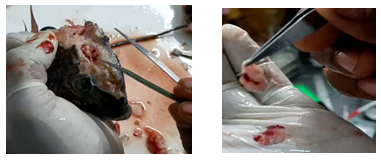
Preparation of Pituitary Extract
The glands are macerated in a tissue homogenizer with a little distilled water. The homogenate is diluted with distilled water. The preparation is centrifuged at about 1000rpm for 5 minutes. The supernatant is the pituitary extract. It is preserved in glycol [5].
Selection of Breeders
Mature males and females are selected and stocked for hypophysation. Two males and one female form one unit for hypophysation [6].
Ratio of Male and Female is 2:1
Injection of Pituitary Extract
The selected males and females are kept on a table, the extract is injected intramuscularly at the base of the pectoral fin or pelvic fin or caudal fin. About 0.5 to 2ml of extract is given for breeders weigh-ing upto 10 kg. The female is given two doses, namely the first dose is preparatory dose and second one resolving dose. About 4 hour’s interval is given between the two doses. The male is given only one dose (Figure 2) [7].
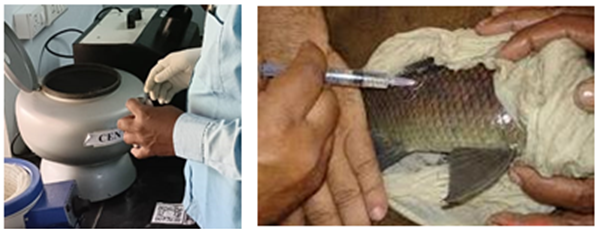
Breeding
After injection of the pituitary extract the breeders are introduced into a breeding hapa. The breeding hapa is a rectangular mosquito net cloth enclosure. The breeding hapa is built at our college premises. It is suspended in a pond water with the help of four poles. To provide the running water similar to river conditions is maintained in the hapa with the help of electric motors. The breeders mate in the hapa. They breed in 14-17 hours [8].
Hatching
In 18-25 hours, the eggs are fertilized. The fertilized eggs are transferred to a hatching hapa which is at our PG Department. The hatching hapa is made up of two rectangular mosquito nets. It is suspended in water. The hatching hapa consists of an inner hapa and an outer hapa. The eggs are hatched in the inner hapa. The hatchlings wriggle out through meshes of the inner hapa and reach the outer hapa. The shells and dead eggs present in the inner hapa a are removed. The hatchlings are kept in the outer hapa. Hapa for three days. Then they are transferred to nursery ponds at behind our college premises in cement tanks and reared the seeds till they attained fingerling stage. The remained hypophysation extract is stored in the refrigerator (Figure 3) [9]. Fertilization rate=Number of fertilized eggs/Number of estimated eggs x 100
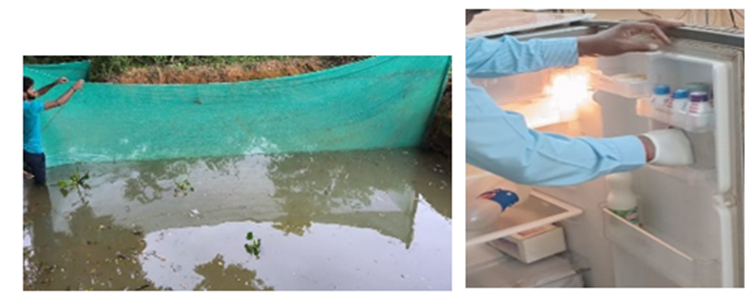
Precautions for Induce Breeding
- To avoid diseases and parasitic infections, breeders should be properly washed with KMnO4 solution (0.5 g in 100 liters of water) for a few minutes. After this they should be kept in formalin (200 mg/ It of water) for one hour.
- Breeder should be protected from mechanical injuries during handling.
- Water condition should be favorable having temperature about 24 to 31°C and turbidity about 100 to 1000 ppm. Flowing water with higher O2 content is of great use. The intensity and duration of light also affect the induced breeding and spawning. Pituitary glands taken from the same or related species as the recipient species are said to be more effective [10, 11, 12, 13, 14, 15].
Result & Discussion
Here we can get best quality of fish seeds. Several advantages are there in induced breeding. A high quality fish seed of a particular species can be produced. The fish with maximum growth rate can be produced by genetic manipulations. Huge number of seeds can be produced i.e. 5,00,000 to 1 million at a time. At a time, several breeders can be bred at a single location with different species types. Induced breeding with Hypophysation we can get pure seeds in large number in all seasons. With this technique we can produce hybrid varieties of species. This technique shows high fertilization rate (~85%) and Hatching rate (~80%) this study explodes about procedure and result of hypophysation technique. Hybrids with high growth rate can be produced by artificial inducement and by applying several genetic techniques like gynaegenesis, androgenesis, sex reversal etc. By hastening reepithelialization, improving burn-related pain, and decreasing treatment-related costs, Nile tilapia fish skin could benefit the resource-poor public health systems of developing countries [1]. It is a fact that the first and foremost prerequisite for successful intensive fish cultivation and development of Inland Fisheries is an assured supply of pure quality of fish seed. This method should profitably be utilized in making the important economic estuarine varieties of fishes to breed and obtain seed for brackish water fish farming [3, 15, 16, 17, 18, 19, 20].
Conclusion
The breeding technique is most effective where we can get desired quality of seeds with almost same size so that we can get huge crop by culturing. Tilapia is a lean source of protein that is full of various vitamins and minerals. The skin of tilapia is used to cure burns and wounds [21, 22, 23, 24].
Acknowledgement
I express my deep sense of gratitude to supervisor Dr. P. Ayodhya Reddy sir, HOD Zoology & Fisheries, Prof Ch. Prasad Principal-Government Degree and PG College (A) Siddipet, Telangana, India 502103. Sincere thanks to Abdel-Fattah M. El-Sayed et all (2019) Elsevier author of fish breeding second edition.
References
-
Lima Júnior EM, de Moraes Filho MO, Costa BA, Fechine FV, Vale ML, et al. (2021) Nile Tilapia Fish Skin-Based Wound Dressing Improves Pain and Treatment-Related Costs of Superficial Partial-Thickness Burns: A Phase III Randomized Controlled Trial. Plast Reconstr Surg 147(5): 1189-1198.
-
Sasmita Panda (2016) A review on induced breeding in fishes. International Journal of Bioassays 5(5): 4579.
-
Fisheries and Aquaculture Department Statistics. UN Food and Agriculture Department.
-
Dunz AR, Schliewen UK (2013) Molecular phylogeny and revised classification of the haplotilapiine cichlid fishes formerly referred to as Tilapia. Molecular Phylogenetics and Evolution. 68 (1): 64-80.
-
(2017) Tilapia. Seafood Health Facts.
-
Gay Robin (1993) Women in ancient Egypt. British museum press, pp: 188.
-
Matthew 17: 24-27
-
Baker Jenny (1988) Simply Fish. London: Faber & Faber, pp: 197.
-
Rosencrans Joyce (2003) Tilapia is a farmed fish of biblical fame. The Cincinnati Post. EW Scripps Company.
-
Chapman Frank A (1992) Culture of Hybrid Tilapia: A Reference Profile. Circular 1051. University of Florida, Institute of Food and Agricultural Sciences.
-
Eschmeyer WN (2007) Catalog of Fishes. California Academy of Sciences. FishBase.
-
Loiselle PV (1994) The Cichlid Aquarium. Tetra Press, pp: 447.
-
(2017) What Is the Origin of Tilapia Fish?.
-
(2014) Science and the CSU The Salton Sea: Fishing for Answers Archived 2014-04-22 at the Wayback Machine A half-century later, a few species of fish have been hearty enough to survive. One of them is the tilapia and its key to the survival of the Salton’s ecosystem, which includes millions of birds that depend on them for food... The salinity level of the Salton Sea is about 45 parts per thousand (ppt), which is about 30% saltier than the ocean.
-
(2007) Oreochromis. Integrated Taxonomic Information System.
-
(2007) Sarotherodon. Integrated Taxonomic Information System.
-
Sandra N, Tichy H, Mayer WE, Samonte IE, McAndrew BJ, et al. (2001) Classification and Phylogenetic Relationships of African Tilapiine Fishes Inferred from Mitochondrial DNA Sequences. Molecular Phylogenetics and Evolution 20(3): 361-374.
-
John W Cross (2013) Aquatic Weed Control. Mobot.org.
-
Petr T (2000) Interactions between fish and aquatic macrophytes in inland waters. A review. FAO Fisheries Technical Papers, pp: 396.
-
(2015) Oreochromis aureus.
-
(2012) Global Invasive Species Programme, Invasive Species Information, Tilapia.
-
(2012) 100 of the World’s Worst Alien Invasive Species. Invasive Species Specialist Group. IUCN Species Survival Commission.
-
(2014) NAS – Nonindigenous Aquatic Species. USGS.
-
(2012) Oreochromis mossambicus (fish). Global Invasive Species Database. IUCN Species Survival Commission.
- Genetic Improvement of Nile Tilapia (Oreochromis niloticus): Advances in Selective Breeding and Genomic Approaches for Sustainable Aquaculture
- Microplastics, Contaminants, and Waste Hotspots: Divergences and Faults in Prioritizing Control Efforts
- Creating a Healthier, More Vibrant Open and Closed Aquatic Environment. A Submersible, Centrifugal Magnetically Affixed Current Changing Aquarium Pump
- An Attempt to Assess Alpha Diversity and Sample Size: Using the Ostracod Assemblages off Kumamoto Port, Japan
- Assessment of the Efficiency of Common Fishing Gears and Crafts Used at Mohananda River of Chapai Nawabganj, Bangladesh
- Fish Productivity and Biodiversity Status of Sundarban Mangrove in Bangladesh