
The Determination of Economic, Cultural and Environmental Sustainability of Fish Farming Culture in Nigeria
The study was conducted in North East Zone of Nigeria where fishing has been the occupation of the inhabitants. The study focused on the determination of economic, cultural and environmental sustainability of fish farming culture in the study area. Data for the study was obtained from both primary and secondary sources through a public participation and stakeholders’ interview with the application of focus group discussion. The data collection for the research work was carried out within the period of 1st to 31st March 2023. Primarily, conservative qualitative method with snow-ball technique was applied and information was elicited from the cultural fish farmers on economic, cultural and environmental sustainability of fish farming culture. The study revealed the culture of fish farming did not attained true sustainability and the operation was not in a true circular economy. Recommendation were made for the community attainment of true sustainability and equally to operate in a true circular economy.
Introduction
Globally, scientific developments of the last 50 years have led to a much-improved understanding of the functioning of aquatic ecosystems, and to global awareness of the need to manage them in a sustainable manner. Twenty – five years after the adoption of the Code of Conduct for Responsible Fisheries (the Code; FAO, 1995), the importance of utilizing fisheries and aquaculture resources responsibly is now widely recognized and prioritized. The Code has informed the development of international instruments, policies and programs to support responsible management efforts globally, regionally, and nationally. These efforts have been consolidated and prioritized since 2015 to particularly address, in a coherent and coordinated manner, Sustainable Development Goal (SDG) 14 – Conserve and Sustainably use of the Oceans, Sea and Marine Resources for sustainable development and other Sustainable Development Goals (SDGs) relevant to fisheries and fish farming. Therefore, the implementation of Science – based fisheries and aquaculture management policies, couple with predictable and transparent regimes for international fish utilization and trade, are widely accepted as minimum substantive criteria for sustainable fisheries and fish farming [1].
All the African Chad Basin countries are affected to varying degrees by the degradation of its productive ecosystems caused by the lake’s natural variability, climate change and human actions. Close to fifty (50) million people now live in precarious and increasingly vulnerable conditions in the region. As fisherfolk migrate with their families towards the lake in search of arable land and livelihood, it results in disputes and culminates in social conflicts [2]. Desertification has further increased the drying up of rivers in the northern parts of Nigeria and other riparian countries. As a result, communities that depended on it for fishing activities and other economic activities are now left with few jobs and migrating to more hospitable regions. Though the lake has dried out several times in the past, the trend has been severely exacerbated now by the construction of dams upstream of the catchment, without considering its impact on the people and ecosystems downstream. The lake’s receding shoreline has severely affected people living in its basin, turning the custodians of one of the Globally important Agricultural Heritage Systems in to food insecure refugees [3].
Fishing Communities are often threatened by poverty because fisheries are susceptible to over-exploitation, typically, due to the impact of increased fishing effort within an open-access fishery or within a fishery which is not manage effectively. As catch returns fall with increasing over-exploitation, fishermen are unable to realize sufficient income to maintain an acceptable standard of living, unless they can find alternative employment [4]. It may be contented that in practice it is the lack of alternative employment, which is the principal cause of poverty amongst fishermen, rather than the over-exploitation of fisheries resources. However, there is no denying that the dissipation of economic surplus (resource rent) which commonly attends over – exploitation means that an important source of relief from poverty has effectively been lost. Fisheries have suffered due to a combination of upstream damming, shrinkages of the lake, drought and overfishing [5].
In the last decade 90th the Nigerian fishing industry provided direct and indirect employment for residents in Borno State, North-East, Nigeria; fishers, fish processors, marketers, retailers, and many other actors earned their living from fish production and its value chains. Income from the industry contributed significantly to the market performance of other goods and services like food items, household needs, school fees etc. The declining of the Lake Chad date back 1972/73, the unethical cultural practice of fish farming and the I don’t care attitudes of relevant bodies and other regulatory authorities and adverse effects of the conflict in North-East, Nigeria has further affected the fish industry consequently substantial loss of rural livelihoods. Fishing activities in the state were disrupted. Supply of fish gradually became irregular that at some point fish sellers rarely had fish to sell [6].
Problem Setting and Research Objectives
To attained economic, cultural and environmental sustainability of fish farming culture in Mile 3 fishing community, Kukawa Local Government Area, Borno State, North-East, Nigeria requires sustainable utilization of the existing fish farming culture or learn how to sustainably utilize new fishing method and know-how. The introduction of new method requires changes in the organization of the fishing effort which entails changes in the community social organization and patterns of interpersonal relations. It is important to note that the prevailing norms of social organization, social relations, and social behaviour of fish farming culture communities are influenced by the norms of larger society which the Mile 3 fishing community formed a part and incorporate adaptive responses to the requirements of fish farming culture activities. On the other hand, what is known concerning how to incorporate and apply fish farming culture knowledge in to modern fisheries management remains mostly theoretical and still in the experimentation stage. This is because fish farming culture knowledge at the fishing community is transmitted orally and rarely written down, making it difficult to transfer in a systematic manner to modern fish farming for possible incorporation in to formal fisheries-management practices and policies. Therefore, there is the problem of bringing changes in the fish farming culture management of the adapted regime of Mile 3 fishing community; without having full knowledge of the adaptive experience, without appreciating and accepting the experience for the change and without acquainting with the contemplated possible consequences that may erupt in an attempt to incorporate changes in to the fish farming culture of Mile 3 community social norms. To avoid aggravating to a very serious problem the need to determine the economic, cultural and environmental sustainability fish farming culture of the fishing community.
Therefore, this study was undertaken to determine the economic, cultural and environmental sustainability of fish farming culture in Mile 3 community of Lake Chad Basin, Kukawa Local Government Area of Borno State, North-East, Nigeria for proper recognition of the status of cultural fish farmers in an economically, culturally and environmentally sustainable manner. Identification of relevant policy strategies that would suite the peculiar problems of cultural fish farmers and fish farming culture communities in such a way that the agreed goal of each policy met the adequate condition required for the attainment of economic, cultural, and environment sustainability in the study area. The outcome of this research work will enable government, individual farmers and other enterprises to make investment at a large-scale production for the attainments of self- sufficiency at economically, culturally, and environmentally sustainable level.
Data collection for the research work was carried out within the period of 1st to 31st March, 2023, there was high demand for fish as a result of religious events such as “Month of Ramadan Fasting, Good Friday, Holy Saturday, Easter Sunday, and Easter Monday” people from all over the world make preparation for these events. Thus, majority of the fish farmers embarked on harvest as pre-planned for intensive fish marketing. Data collection was carried out in a facilitated manner as a result of the easy accessed to the fish farmers and the required information was obtained adequately.
Methodology and Data
Kukawa local government area is domicile in Borno State, North-east geographical zone of Nigeria. Kukawa Local Government Area is part of the prestigious Borno Emirate and consist of several towns and villages such as Alagarno, Yoyo, Kekeno, Kauwa, Baga Kauwa, Mile 3, Doron Baga among others. The kanuri language is widely spoken in the Local Government Area, while the religions of Islam and Christianity are practiced in the Local Government Area. Kukawa Local Government Area is situated on the shores of the Lake Chad and has an average temperature of 32 degrees centigrade. The area experiences two major seasons which are the dry and the rainy seasons. The average wind speed in the area is put at 11 kilometres per hour [7]. The study area is Mile three (03) Baga fishing community of Lake Chad Basin, Kukawa Local Government Area of Borno State, North- East, Nigeria. It is in the semi- arid plain between latitude 12o 18’ – 13o 48’ N and longitude 13o 18’ – 14o 48’ East of the Greenwich Mean Time (G.M.T) [8]. During the “Normal Chad” (stabilization of the Lake at normal size as a result of the influence of rainfall and volume of water flow in the major rivers that feed the basin), the composition of Lake Chad Basin comprised of Chad 11,000km2 (50%), Nigeria 5,500km2 (25%), Niger 3900km2 (17%), and Cameroon 1800km2 (8%), during the “Little Chad” the open water is shared only between Chad 1200km2 (60%) and Cameroon 800km2 (40%), the Nigerian and Niger portion are liable to complete drying, e.g. Sahelian drought of 1968 [9]. The study area has a population of about two hundred and three thousand, three hundred and forty-three (203,343) inhabitants with a land area covering about 4,901km2, National Population Commission of Nigeria [10]. Fishing is an important economic activity in Kukawa Local Government Area as the residents of the area take advantage of the enormous sea food found in the area’s water bodies. Trade also flourishes in Kukawa Local Government Area. The fisheries of the Lake Chad employ about 10,000 fishers including about 150,000 persons associated with the fisheries business [11]. The major tribes from Nigeria include the Agatu, Hausa, Jukun, Kanuri, Ijaw, Shuwa, Urhobo, Nupe, Ilaje and Ijebu and foreigners like Malian, Kotoko, Masaca, Buduma, Kanumbu. The Hausa constitutes the majority (19%) fishermen on the Nigerians part followed closely by the Jukun (16%), Agatu (11%), Malians constitute majority of the foreign fishers on the Lake. Fishing is their major occupation consisting of fisheries activities including processing, preservation, transportation and marketing. Other economic activities are farming, Cattle herding and trading, Federal Department of Fisheries (FDF) [12].
Out of the study area total population of 203,343 inhabitants, the study targeted population of approximately 6000 to 7000 FGD, FCFFT, Mile 3, Baga, 2023 fishers and persons associated with the fisheries activities from the study area and other relevant individuals and groups that were considered important in the study area for the purpose of this research work were used for the study.
Data for the was obtained from primary and secondary sources. Both the primary and the secondary data were obtained through a public participation and stakeholders’ interview with the application of focus group discussion with minimum of seven respondents and maximum of nine constituting representative of each relevant group. Primarily conservative qualitative method relied on focus group discussion was applied with snow ball technique to elicit information from the respondents on the determination of economic, cultural and environmental sustainability of fish farming culture in Mile 3, Fishing Community of Baga, Kukawa Local Government Area, Borno State, North-East of Nigeria.
Focus Group Discussion
Multi stage sampling technique was employed for the selection of the respondents. In the first stage Mile 3 Fishing Community of Baga town Kukawa Local Government Area predominantly fishing community was purposively selected. Secondly, stakeholders and other relevant public individuals members of the community were selected and thirdly, Snowball method was used in the selection of other respondents with sea and fisheries related cultural activities in the fishing community, people from ministries, state and local government agencies, stakeholders and other local interest groups that are directly linked with the fishing community were also selected. Interviews were analysed with conventional qualitative content analysis that disclosed result relevant to cultural sustainability in the context of fisheries of local cultural community which has provided insights in to the fundamentals of the study with the aim of determining the economic, cultural and environmental sustainability of fish farming culture in the study area.
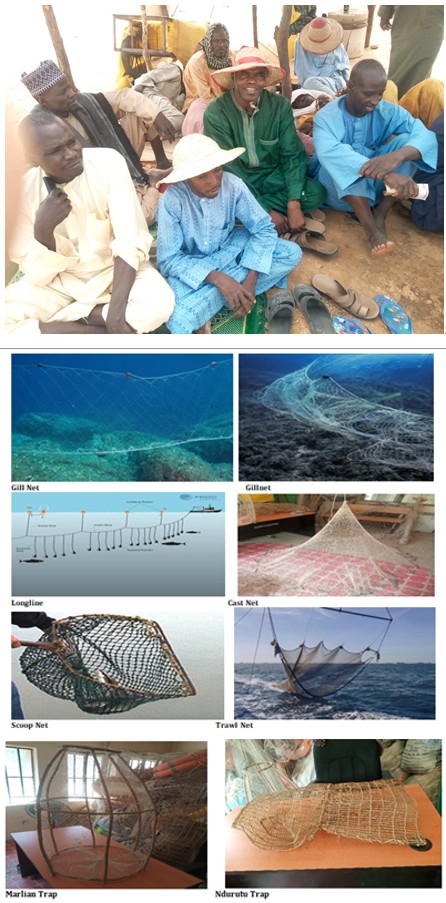
Source: FGD Mile 3, Baga, Fishing Community, 2023 [13].
Results and Discussions
Determination of Economic, Cultural and Environmental Sustainability of Fish Farming Culture in Borno State, North-East of Nigeria.
The practice of cultural fish farming in Mile 3 fishing community shows not in line with the principle of sustainable development such as the application of obnoxious fishing practice (Dumba Fishing) the excessive application of the unorthodox method of fishing by the fish farmers of Mile
Cultural Inland Fishing Gears
3 fishing community with the used of fences made from rows of traps across the water to form a barrier for fish passages. This practice of fishing termed unsustainable as its indiscriminately without selection of species and sizes catches the fish. Thus, juvenile and small size fish were catched thus deplete the lake fish stock without taking time. Regardless of the depleting consequence of the Dumba fishing method, the cultural fish farmers practiced the Dumba cultural method of fish farming and other fishing gears that were considered unethical to the principles of sustainable development goals as a result of its inefficiency and state of age long inheritance.
Source: Gear Technology Unit, FCFFT, Mile 3, Baga, 2023 [14].
This result shows inconsistency with the findings of Bermeo-Almeida O, et al [15] Sustainable Development Goal 14 (Conserve and sustainably use the oceans, and marine resources for sustainable development) has clear and important implications for fisheries and aquaculture; by extension, achievement of its objective will bring progress across other Sustainable Development Goal (SDG) objectives. Enhanced fisheries management, policy, practices and technology are pivotal in providing quality food to ever more people while ensuring that practices are ethical and sustainable.
The environmental degradation of Mile 3 cultural fish farming community as a result of cultural fish farming method and the used of other age long inherited fishing gears should be avoided by the use of less damaging methods of fishing and application of improved fishing gears in line with the culture of the community that will support healthy lake should be accommodated by the cultural fish farmers and accept change. The less damaging methods and improved cultural fishing gears as the use of beach and boat seines nets, bottom trawls nets, gillnets, handlines and jigs gear, harpoons spear gear, long lines gear, midwater trawls gear, trolling lines gear, pots, poles and lines gears. These less harmful methods and improved fishing gears are more economically, culturally and environmentally sustainable as a result of their advantage over the age long inherited cultural method of fishing as follows:
- Beach and Boat Seines Nets; the catch of unwanted species can be conserved in these methods via the net that have smaller mesh bag called a Cod end which retains the catch.
- Bottom Trawls Net; the variety and amount of bycatch in the cultural method of bottom trawl fisheries is a pervasive problem and heaviness of the crude cultural gear can as well damage sensitive habitants which is avoided in the improved system of operation.
- Gillnets; in case of crude cultural method of application the vulnerable animals in the community ocean can be caught. Such an impacts is reduced in the improved application of the gillnets by setting the netting deeper in the water column to allow animals to swim over and lingers to warn passing sea mammals.
- Handlines and Jigs Gears; the improved application of handlines and jigs gear is considered a more environmentally responsible because there is very little catch of unwanted sea life as a result of the high level of modification on the age long culturally inherited handlines and jigs gears.
- Harpoons Spear Gear: the improved harpoons spear gears are shot with guns. The catch of unwanted sea life is not a concern because fishermen identify the species and size of the fish before it is caught.
- Long Lines Gear; under this improved very important method of gear modification it reduces impacts on other sea life for example sinking drifting longlines deeper allows many animals to swim over them and adding streamers above the water scares away seabirds. And a specially designed fishing hook called a circle hook can make it easier to release other animals that have been accidentally caught.
- Midwater Trawls Gear; the gear does not contact the sea floor when it is used in the midwater zone as well it functions well even without contacting sea floor. It also uses streamer lines to scare away seabirds and avoiding areas with an abundance sea mammal can reduce the amount of bycatch.
- Trolling Lines Gear; under this improved method fishermen can quickly release unwanted species because the lines are reeled in soon after fish take the baits.
- Pots Gears; may have an opening that allows undersized or non-targeted sea life to escape easily. Under this method unwanted species can be released alive and habitant impacts tend to be minimal.
- Pole and Lines Gears; in this case harmful impacts on other species tend to be minimal because fishermen can release unwanted sea life [16].
Less Damaging Fishing Gears
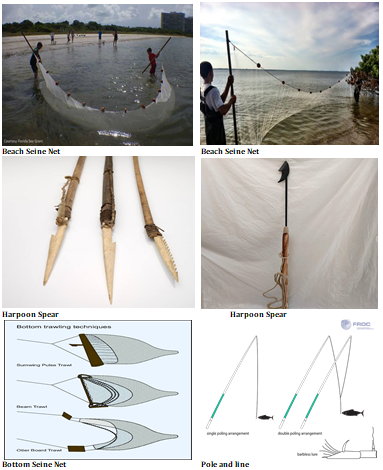
Source: Library, Information & Documentation Unit, FCFFT, Mile 3, Baga, 2023.
This result confirmed that of Le –Sann A [17] small- scale fishers in fishing communities are sustained by fishing livelihoods, which require community members sustained access to fisheries capital, such as:
- Natural capital, that is marine ecosystems and the living species they support
- Physical capital, including fishing vessels, gear, landing sites, and processing and marketing facilities;
- Financial capital for sustaining operations, provisions of various items of physical capital and supporting other social and economic activities and sometimes for sustaining or enhancing natural capital as well;
- Human social and cultural capital which involves human skills and information utilized in fisheries activities as well as broader accumulated knowledge containing guidance for how to go about living in general.
The agricultural production processes of the cultural fish farmers of mile 3 fishing community in the cultivation of crops such as millets, cowpea, sorghum and maize in addition to other vegetables and tubes were cultivated when the lake contracted based on receding moisture. Although, the lake chad area was believed to be highly fertile but yet notwithstanding, the natural highly fertile land was applied with other substance such as human and animal excrete in form of fertilizer in addition to the nutrient composition of the soil which actually does not demand artificial nutrient in form of human ideological applications. The surplus nutrient drained in to the lake resulted in fish habitant destructions and emergenced of human infectious deadly diseases most common in the area was the cholera. The Mile 3 cultural fish farmers also engaged in livestock production as secondary livelihood activities such as the donkeys, horses and camels also served as their means of transportation and other species which involved; cattle, sheep and goats were well adapted to the area going by the natural environmental suitability of the lake chad for livestock production. The rearing of the livestock brought about unnecessary grazing of trees, vegetal and grassland cover in most cases emanated to conflict between farmers and herdsmen although livestock production form another important aspect of agricultural sector of the economy but the practiced by the cultural fish farmers of Mile 3 fishing community was not in accordance to the attainment of sustainable development goals. Nevertheless, the fish farmers of Mile 3 cultural fishing community predominantly depended on fire wood for cooking and other fire demanding economic activities. The lake chad is endowed with trees, shrubs and swamp grasses with which the cultural fish farmers used as their local fuel for cooking, fish smoking, making of ropes, constructions of fishing gears, canoes, mats, baskets, paddle poles, thatch canoe, shelter, weapons and many others. The unmonitored and uncontrollable harvests of trees, shrubs and swamp grasses for fire wood and other economic activities by the cultural fish farmers resulted in overexploitation consequently some trees and plant species had vanished in the long run.
This result shows inconsistency with the finding of Fisher WJ [18] the Environmental Sustainable Development Goals; the use of natural resources and the principles of sustainable food systems permeate all of the Sustainable Development Goals, being particularly pertinent to Sustainable Development Goal 12 (Ensure sustainable consumption and production patterns) and Sustainable Development Goal 13 (Take urgent action to combat climate change and its impacts). The output of fisheries and aquaculture produces lower greenhouse emissions for the equivalent nutrition than do most agricultural food systems. At the same time, there are environmental challenges relating to fisheries management, climate change and preventing illegal exploitation. Properly managed fisheries combined with aquaculture practices that foster the sustainable use of resources while preserving aquatic biodiversity are needed to ensure the future of the sector. The role of new technologies in minimizing food loss and waste across the fish value chain will allow for the more efficient use of resources and move towards more complete utilization of fish, thereby reducing the need to extract further resources.
The realization of the cultural fish farmers of Mile 3 fishing community that some resources in the fishing community were in abundance while others were scarced has been considered paramount important in their day to day economic activities to earn a living. This should have guided the cultural fish farmers in how resources were utilized in the process of material extraction as such damages to the environment would have been minimized. The fish farmers of Mile 3 fishing community were unaware that land resources such as lake for fishing and land for cultivation were in abundance relatively not in direct proportion to other land resources as the fisheries, maize, sorghum, vegetable and other trees. Human capital and manmade capital were also scarced in relation to the natural resource endowment of Mile 3 fishing community such as the farming entrepreneurship skills, technical know how of producing an aid for production as mending of fishing gears, craft fabrications, canoe, fishing net, fishing boat, weaving of mats and baskets, construction of smoking kiln, racks and many others. The labour required to harness the community resources endowment too was inadequate as unskilled labour supplied was in higher proportion to the skilled and semiskilled labour in the community. The fish farmers did not realize that some resources in the community were in abundance while others were scarced thus the cultural fish farmers of the community engaged in production processes inconsiderate of the relative scarcity of the factors of production (land, labour, capital and entrepreneur) their focused were the immediate benefit derived. Therefore, the fish farmers were inefficient in the resource utilization of the community hence the operational benefit should not adequately on continual basis even if the community produced operational benefits constantly in the short-run.
This result shows inconsistency with the finding of GFCM [19] the Economic Sustainable Development Goals promote inclusive and sustainable economic growth that can guarantee decent employment and reduce social and gender inequality. The fisheries and aquaculture sector encompass numerous opportunities to enable sustainable development and income enhancement, especially in the achievement of Sustainable Development Goal 1 (End poverty in all forms everywhere) and Sustainable Development Goal 8 (Promote sustained, inclusive and sustainable economic growth, full and productive employment and decent work for all). The fisheries and aquaculture value chain extend from harvesting through to processing and marketing. The sector provides income and employment for an estimated 250 million people, it is the central for ensuring the livelihoods of a substantial proportion of the world’s population. In some instances, small-scale and subsistence fisheries may provide the principle source of income for entire communities, providing economic resilience where often sources of alternative employment are limited or non-existent The cultural fish farmers of Mile 3 fishing community did not achieve a good social well-being of the community as the fish farmers failed in accommodating changes in line with new technology, population increased and urbanization, increased in demand for fish, the market structure has expanded and other infrastructural and social amenities requirements in general. Even if the social well-being was achieved the fish farmers did not cope with the changes through adaptation to the changed for example the new production techniques for the system to be stable in the short-run and to maintained the social well-being achieved for a long term period the community must possessed the capacity to accommodate sudden or unexpected changes with fairness among the members of the community with respect to production inputs and outputs. The cultural fish farmers of Mile 3 fishing community did not achieve adequate social-well-being of the community in the short-run, did not accommodated changes in response to the modern world phenomena not to talk of coping with the changes and maintenance of the changes in line with the community adaptation for long term period for the attainment of the social well-being of the community.
This result confirmed that of Pomeroy RS, et al. [20] the fisheries of the North east Nigeria at present are generating benefits for rural communities but there are also strong indications from the current research that the fisheries systems will have to face a range of threats soon. For example, it has been recorded that traditional management systems can breakdown under pressures such as urbanization and environmental change. It seems likely that such trends will increasingly affect other rural communities in the future. It is appropriate therefore that the need to plan is recognized by government in order to anticipate and react to potentials problems.
Although, the Mile 3 cultural fishing community were able to accommodate sudden change as a result of inevitable condition (war and other natural disasters) the Mile 3 fishing community was displaced as a result of insurgent attacked in the year 2015 but the community was a able to resettled back to their ancestral location and continued with their cultural fishing practice. But the community resettled in a nearby fishing town called Baga as a result of the destruction encountered as structures were structures and other essentials were all destroyed. The cultural fish farmers of Mile 3 fishing community still undertake their fishing practice in the same ancestral fishing lakes, zones and fishing spaces as culturally inherited from their ancestors The determination of cultural fish farmers of Mile 3 fishing community to have attained economic, cultural and environmental sustainability in fish farming culture should balanced economic, social and environmental pillars of sustainability there by the culture of fish farming in Mile 3 fishing community said to have achieved true sustainability and a true circular economy. In the case of the community; the culture of fish farming in Mile 3 fishing community did not achieved true sustainability and did not operates in a true circular economy because the economic, social and environmental pillars of sustainability of the cultural fish farming community was not balanced.
This result confirmed that of Sodagar B [21] to achieve true sustainability the need to balance economic, social and environmental sustainability factors in equal harmony.
On the other hand if the Mile 3 cultural fishing community have achieved two (2) pillars of sustainability out of the three (3) pillars of sustainability then the culture of fish farming in Mile 3 fishing community said to have achieved either (1) equitable sustainability, (2) bearable sustainability and (3) viable sustainability depending on the combination of the two (2) pillars out of the three (3) pillars as explained below:
- If the Mile 3 cultural fishing community have attained social and economic sustainability then the cultural fish farming in the community has attained equitable sustainability.
- If the Mile 3 cultural fishing community have attained social and environmental sustainability then the cultural fish farming in the community has attained bearable sustainability.
- If the Mile 3 cultural fishing community have attained economic and environmental sustainability then the cultural fish farming in the community has attained viable sustainability.
The economic of sustainable fish farming culture in Mile 3 fishing community of Borno State, North-East Nigeria has not attained truly sustainable, neither equitably sustainable nor bearably sustainable or viably sustainable.
The outcome of this research work shows consistency with the findings of Thomas DHL [22] review of the concept of sustainability with reference to African flood plain fisheries. Thomas identified three (3) tiers to the use of the sustainability concept with the application of multi-dimensional approach to sustainability to examine the fisheries system in the North-East Nigeria; three key points arise from the result of the present study:- firstly, the underlying environmental fluctuation which characterize the Sahel-savanna region; make any prediction of the size and status of fish resources from year to year very difficult. In other words, it is difficult to judge how sustainable any resource level will be in either space or time. Secondly, the traditional management systems, which have evolved in the North east Nigeria, appear to incorporate ecological, economic and social dimensions. The fishers have an indigenous knowledge of the dynamics of the fisheries resources (ecology), which ensure that a level of fishing activity (economic) is undertaken to achieve a catch and integrate in to local farming systems. In turn, the integration of fishing and other activities, ensures that the local fish farmers have a secure livelihood upon which communities can be maintained (social). Thirdly, the sustainability of the fisheries systems, which have been built upon the institutional arrangements within communities and between communities (and which, define the relationship between resources-users and the resources), are now threatened by various factors. Rapid population growth, increase demand for access to resources, and the redefinition of resource use rights by government or private individuals without the involvement of the local communities, have meant that the delicate balance between ecological, economic and social aspects of resource usage in the Sahel-savanna has been disrupted in certain locations in unsustainable resource usage patterns and tile dissolution of traditional management system.
Summary and Conclusion
The study concerned with the determination of economic, cultural and environmental sustainability of fish farming culture in Mile 3, Baga, fishing community, Borno State, North-East Zone, Nigeria. The outcome of the study indicates that the culture of fish farming in Mile 3 fishing community was truly not sustainable. Given the analysis presented and taking in to account the performance of fish farming culture in the context of economic, cultural and environmental sustainability. The current phase of cultural fish farming was interpreted in the evolution of fisheries management system from cultural fisheries management system, traditional management system to modern management system respectively with regards to it sustainability. This shows that theoretically the cultural fishing community was regulated by modern fisheries management but practically in real world situation the cultural fishing community was regulated by both the traditional fisheries management system and the modern fisheries management system characterized by unjust treatment and consequently impoverishment of the vulnerable members of the Mile 3 cultural fishing community. The study recommends that the government and non- governmental agencies with community level participation should jointly formulate a robust policy framework that will transform the cultural method of fish farming through objective fisheries management system to ensure economic, cultural and environmental sustainability of fish farming culture and uplift the socio-economic wellbeing of the fish farmers for the attainment of truly sustainable cultural fish farming community.
Acknowledgement and Conflict of Interest
Contributions; Conceptualization: Babagana Zanna, writing original draft preparation: Babagana Zanna, Writing – review and editing; Mohammed Musa and Babagana Zanna, Supervision: Mohammed Musa. The authors have read the manuscript and agreed for onward vetting, corrections, guidance for further consideration and approval and subsequent publishing of the final version of the manuscript accordingly. The research work was carried out by Babagana Zanna without any financial support from any agency or individual and finally the research work has no any conflict of interest.
References
-
FAO (2018) The State of World Fisheries and Aquaculture; Meeting the Sustainable Development Goals. Food and Agricultural Organization of the United Nation (FAO), Rome, pp: 224.
-
World Bank (2014) African Region Reversal of Land and Water Degradation Trends in the Lake Chad Basin Ecosystem Project. World Bank Group.
-
WFP (2016) World Food Programme Report. Office for the Coordination of Humanitarian Affairs (OCHA), Food Security and Nutrition Problem as a result of Insurgency in the Lake Chad Basin. Insecurity in the Lake Chad Basin Regional Impact: Situation Report.
-
Smith LR (1979) A Research Framework for Fisheries Development: ACLARM Studies and Reviews 2. International Centre for Living Aquatic Resources Management (ICLARM).
-
Wright CS (1990) Is Poverty in Fishing Communities a Matter of Tragedy or Choice?. Paper Presented at the Biennial Conference of the International Institute for Fisheries Economics and Trade, Santiago, Chile, Mimeo.
-
Opeyemi O (2020) Aquaculture Opens Up New Market Opportunities for Conflict Affected Fisher-Folks in Borno State. Food and Agricultural Organization of the United Nations (FAO), Nigeria.
-
OCHA (2018) Office for the Coordination of Humanitarian Affairs (OCHA) United Nations, Nigeria - Administrative Boundaries (Levels 0–3).
-
Agbelege OO, Ipinjolu JK (2001) An Assessment of the Exploitation and Management Techniques of the Fishery Resources in the Nigerian Portion of Lake Chad. Journal of Arid Zone Fisheries (JAZFI).
-
Welcome RL (1972) The Inland Waters of Africa. CIFA Technical Paper, pp: 117.
-
NPC (2016) National Population Commission of Nigeria, 2006 Census Report.
-
Sule OD, Ovie SI, Ladu BMB (2001) Marketing and Distribution of Fish from Lake Chad. Fisheries Society of Nigeria, (FISON) 2001. National Institutes of Freshwater Fisheries Research New Bussa, Niger State of Nigeria.
-
Olaosebikan BD, Raji A (1998) Field Guide to Nigerian Freshwater Fishes. Food and Agriculture Organization of the United Nations (FAO).
-
FGD Mile 3, Baga, Fishing Community (2023) Focal Group Discussion with Mile 3 Baga Community, Community Community Members, Baga, Borno State of Nigeria.
-
FCFFT, Mile 3, Baga (2023) Focal Group Discussion with the Staff of Gear Technology Unit, Federal College of Freshwater Fisheries Technology, Mile 3, Baga. Borno State of Nigeria.
-
Bermeo-Almeida O, Cardenas-Rodriguez M, Samaniego- Cabo T, Ferruzala-Gamez E, Cabezas-Cabezas R, et al. (2018) Black Chain in Agriculture a Systematic Literature Review. In: Valencia R, Garcia G, et al. (Eds.), Technologies and Innovation: 4th International Conference, Springer International Publishing, pp: 316.
-
FCFFT, Mile 3, Baga (2023) Focal Group Discussion with the Staff of Library, Information and Documentation Unit, Federal College of Freshwater Fisheries Technology, Mile 3, Baga. Borno State of Nigeria.
-
Le-Sann A (1998) A Livelihood from Fishing: Globalization and Sustainable Fisheries Policies. London: Intermediate Technology Publications.
-
Fisher WJ (2015) Review and Refinement of an Existing Qualitative Risk Assessment Method for Application within an Ecosystem-Based Management Framework. ICES Journal of Marine Science 72(3): 1043-1056.
-
General Fisheries Commission for the Mediterranean (GFCM) (2020) Regional Plan of Action for Small Scale Fisheries in the Mediterranean and the Black Sea–RPOA– SSF.
-
Pomeroy RS, Williams MJ (1994) Fisheries Co- management and Small-Scale Fisheries: A Policy Brief. International Centre for Living Aquatic Resources Management.
-
Sodagar B (2022) Introduction to Sustainability and Sustainable Development; Article by Principal Sustainability Consultant Circular Ecology. International Energy Agency (IEA) Energy in Buildings and Communities Programmes (EBC) Annexes 21, 71 and 80.
-
Thomas DHL (1996) Sustainable Harvest from Flood Plain Fisheries in Africa: Looking Beyond Maximum Sustainable Yield (Discussion Paper) Edinburgh: University of Edinburgh.
- Genetic Improvement of Nile Tilapia (Oreochromis niloticus): Advances in Selective Breeding and Genomic Approaches for Sustainable Aquaculture
- Microplastics, Contaminants, and Waste Hotspots: Divergences and Faults in Prioritizing Control Efforts
- Creating a Healthier, More Vibrant Open and Closed Aquatic Environment. A Submersible, Centrifugal Magnetically Affixed Current Changing Aquarium Pump
- An Attempt to Assess Alpha Diversity and Sample Size: Using the Ostracod Assemblages off Kumamoto Port, Japan
- Assessment of the Efficiency of Common Fishing Gears and Crafts Used at Mohananda River of Chapai Nawabganj, Bangladesh
- Fish Productivity and Biodiversity Status of Sundarban Mangrove in Bangladesh