
Assessment of Avifauna and Flora Diversity in Degraded Mangrove Ecosystems on Eagle Island, Niger-Delta Rivers state, Nigeria
The study investigated the impact of degradation on the ecological richness and composition of both avian and plant communities in this specific coastal environment of Eagle Island in the Niger-Delta. The Line Transects method was employed for gathering data on the diversity and abundance of bird species in the designated research area. A total of 20 transect lines, each measuring 1000 meters, were randomly positioned. The ecological survey for the floristic investigation took place in March 2022 as documented In this research, a total of 20 study plots, each measuring approximately 25 m × 25 m (500 sq m), were established. The PAST model was employed to assess species diversity, while quantitative and qualitative indices were utilized to measure floristic composition and similarity. The results revealed that though the study area is degraded was able to support bird species diversity. In all a total of 174 bird species belonging to forty two families were recorded a and 55 plant species belonging to 33 families were recorded in the study area see appendix 1and 2. Shannon diversity in the study area indicates that it was higher in the dry season 5.017 than wet season 5.01. The result of the Pyto-sociological Parameters of tree species study area shown that Ceiba pentandra has the highest DBH and MT (139 and 27), this followed Diallum guineese (117 and 26) ,why Rhizophora mangle has the highest frequency of 13.
Introduction
Mangroves in Nigeria are predominantly found in the Niger Delta, which is a vast network of rivers, creeks, and estuaries [1]. This region includes states like Delta, Bayelsa, Rivers, Akwa Ibom, and Cross River. The mangrove vegetation forms a crucial part of the delta’s coastal and estuarine landscapes. Nigeria hosts various species of mangroves, each adapted to thrive in the brackish water conditions of coastal areas [2]. Common mangrove species in Nigeria include, Rhizophora spp. (Red mangroves, Avicennia spp. (Black mangroves) Sonneratia spp. (White mangroves) Lumnitzera spp. (Bruguiera mangroves) [2]. The mangrove ecosystems in Nigeria play vital roles in the environment, offering a range of ecological services. Mangroves serve as habitats for diverse flora and fauna, including fish, crabs, mollusks, and various bird species [3]. The dense root systems of mangroves act as natural buffers against erosion and storm surges, providing protection to coastal communities [4]. Mangroves are efficient carbon sinks, helping to mitigate climate change by capturing and storing large amounts of carbon in their biomass and soils. The mangroves serve as breeding and nursery grounds for many commercially important fish species, supporting local fisheries [5].
Mangrove wood is used for various purposes, and non- timber products like honey, medicinal plants, and traditional construction materials are sourced from mangrove ecosystems [6]. Despite The Niger Delta has experienced oil spills, which can have devastating effects on mangrove vegetation, aquatic life, and the overall ecosystem. Human activities such as logging, urban development, and agriculture contribute to the degradation and loss of mangrove habitat .Rising sea levels, changes in temperature, and extreme weather events pose challenges to the health and distribution of mangrove forests [4]. Birds have played a crucial role in shaping various theories within community ecology, mangrove biogeography, and conservation biology. This is due to their well-defined taxonomy, extensive research, and the ease with which they can be observed and studied. In the realm of community ecology, the focus has been on deciphering patterns in species associations and distributions, as well as identifying the underlying processes that contribute to these patterns and facilitate species coexistence [7]. A significant contribution to island biogeography comes from MacArthur, et al. [8] dynamic equilibrium theory. According to this theory, the richness of species on islands is the outcome of a dynamic equilibrium maintained through the interplay of area- dependent extinction and isolation-dependent immigration of species. This theory has provided valuable insights into understanding the intricate dynamics of species diversity on mangroves. This research is aims to investigate and analyze the diversity of bird species (avifauna) and plant life (flora) within degraded mangrove forests situated on Eagle Island, located in Niger-Delta
Materials and Method
Study Area
Eagle Island is located in river state and has coordinates of (4°47’N and 6°58’E) with landmass of 62.36ha in the Niger Delta [9]. The mangrove forest in the Niger Delta of Rivers State, Nigeria, experiences a tropical climate with unique ecological characteristics. The Niger Delta region generally has a high mean annual rainfall due to its tropical climate. The average annual rainfall in mangrove forests can range from 2,000 to 4,000 millimeters, fostering the growth of diverse plant and animal species [10]. The rainfall is influenced by the region’s proximity to the Atlantic Ocean and the Intertropical Convergence Zone (ITCZ). The region experiences a consistently warm climate throughout the year, typical of tropical areas. Mean annual temperatures in the Niger Delta typically range from 25 to 28 degrees Celsius. The proximity to the equator contributes to the stability of temperatures, with minor variations between seasons. Mangrove forests are distinctive ecosystems characterized by the presence of salt-tolerant trees and other vegetation [10]. Common mangrove tree species in the Niger Delta include Rhizophora spp, Avicennia spp, and Sonneratia spp. The vegetation forms a crucial buffer between the marine and terrestrial environments, providing a habitat for diverse flora and fauna. Mangrove ecosystems are vital for coastal protection, acting as a natural barrier against erosion and storm surges. Largely, the mangrove forest in the Niger Delta of Rivers State, Nigeria, experiences a tropical climate with high mean annual rainfall, warm temperatures, and a unique vegetation composition dominated by salt-tolerant mangrove species. These ecological factors contribute to the rich biodiversity and ecological significance of the region [11].
Data Collection
The study area was divided into two blocks for the purpose of this study. The Line Transects method, as described by Sutherland WJ [12], was employed for gathering data on the diversity and abundance of bird species in the designated research area. A total of 20 transect lines, each measuring 1000 meters, were randomly positioned. Within each transect, there were 200-meter sections, and each block contained 10 transects randomly distributed. The data collection involved walking along these transect lines three times a week for a period of three months during both the wet season (May, July, and September) and the dry season (November, January, and March) in the year 2022. The survey was conducted between 0.600 hours and 10.00 hours, and from 1600 hours to 1800 hours. To minimize the impact of daylight, the survey intentionally avoided extending beyond 10.00 hours in the morning. Transects were traversed at an average speed of 1.5 kilometers per hour, a pace adjusted based on the terrain and the observed number of bird species. All birds, whether on the ground, in vegetation, or flying, were identified, and the group size was recorded. Birds of the same species within a 10-meter radius were tallied as part of the same group. Bird species identification was facilitated using a pair of binoculars with 7x50 magnification, and distance estimates were acquired through the use of a digital range finder. The physical characteristics of birds observed but not promptly identified were documented, and the field guidebook for West African birds by Burrow N, et al. [13]
was consulted for species identification. Additionally, bird calls were employed to verify the presence of nocturnal bird species within the study sites. The data collection spanned six months, comprising three months in the dry season (November, February, and March) and three months in the wet season (June, August, and September) in the year 2014. Avian species diversity was computed from the gathered data using the Shannon diversity index, employing the PAST model for the calculation (Figure 1).
![Figure 1: Map of the study area [9].](/fulltextimages/12200/fig_1.png)
Habitat Survey
The ecological survey for the floristic investigation took place in March 2022 as documented by Ogunjemite BG, et al. [14]. In this research, a total of 20 study plots, each measuring approximately 25 m × 25 m (500 sq m), were established. Within each plot, all woody plants with stems independently rooted and with a diameter at breast height (measured at 1.3 m above the ground for all life forms) equal to or exceeding 2.5 cm were measured, inventoried, and identified at the species level. Multiple stems were measured individually, while all stems originating from the same location were considered as a single individual. In April and May of 2019, specimens were collected. All collected specimens were categorized to the species level and identified by cross-referencing them with vouchers recognized by specialists or professional botanists. The diameter at breast height (DBH) was measured using a simple tape measure, and the height of trees was determined using a Haga Altimeter.
Data Analysis
The PAST model was employed to assess species diversity, while quantitative and qualitative indices were utilized to measure floristic composition and similarity. The frequency of a species within each habitat type is determined by the number of (25x25m) plots in which it is observed, with the total sum of all frequencies representing the overall number of plots per site. Species diversity values were articulated in relation to species richness within each habitat type. The Past Model was utilized to analyze and quantify the floristic composition, enabling a comparison between different habitats.
Results
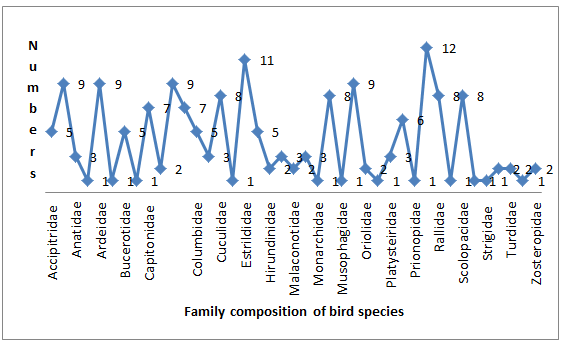
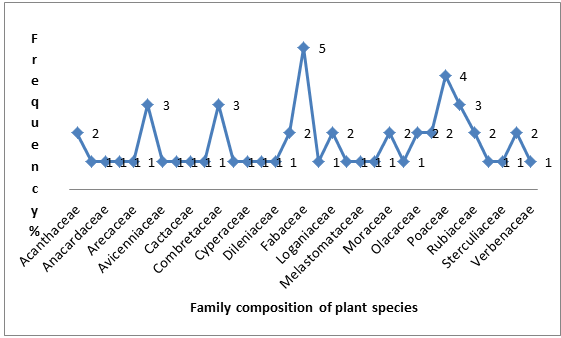
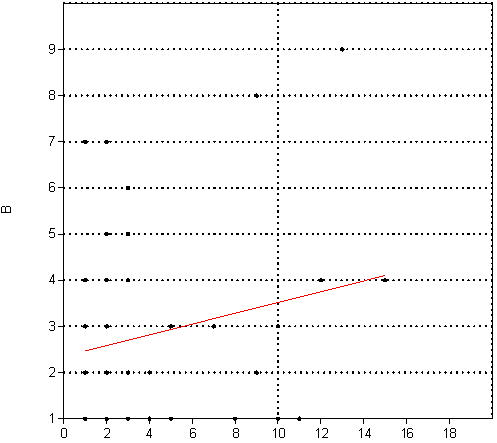
The results revealed that though the study area is degraded is able to support bird species diversity. In all a total of 174 bird species belonging to forty two families were recorded and 55 plant species belonging to 33 families were recorded in the study area see appendix 1and 2. Shannon diversity in the study area indicates that it was higher in the dry season 5.017 than wet season 5.01 (Table 1). The result of the family composition revealed that revealed that Pycnonotidae has 12 bird species, this followed by Estrididae with 11 bird species, Alcedinidae 9 bird species (Figure 2). The result of the Pyto-sociological Parameters of tree species study area shown that Ceiba pentandra has the highest DBH and MT (139 and 27), this followed Diallum guineese (117 and 26) , why Rhizophora mangle has the highest frequency of 13 (Table 2). The result of family composition of the tree species composition indicates that Fabaceae has 5 plant species which is the highest, this is followed by Poaceae with 4 plant species (Figure 3). The result of the Shannon H of plant species diversity index indicates that it was block A has 3.676 and Block B 3.567. The result of the anthropogenic changes in the study area hava impact on the Avifauna and flora diversity in the study area (Figure 4).
| Diversity Index | Dru Season | Lower | Upper | Wet Season | Lower | Upper |
|---|---|---|---|---|---|---|
| Taxa_S | 174 | 164 | 174 | 153 | 137 | 149 |
| Individuals | 482 | 482 | 482 | 287 | 287 | 287 |
| Dominance_D | 0.006 | 0.00735 | 0.00819 | 0.00676 | 0.00858 | 0.00994 |
| Shannon_H | 5.131 | 4.941 | 5.017 | 5.01 | 4.765 | 4.872 |
| Evenness_e^H/S | 0.9728 | 0.8379 | 0.8822 | 0.9802 | 0.8424 | 0.8889 |
| Brillouin | 4.619 | 4.468 | 4.525 | 4.348 | 4.173 | 4.244 |
| Menhinick | 7.925 | 7.47 | 7.925 | 9.031 | 8.087 | 8.795 |
| Margalef | 28 | 26.38 | 28 | 26.86 | 24.03 | 26.15 |
| Equitability_J | 0.9946 | 0.9655 | 0.9755 | 0.996 | 0.9654 | 0.9763 |
| Fisher_alpha | 97.74 | 87.6 | 97.74 | 133.1 | 102.8 | 124.8 |
Table 1: Diversity index of bird species in the study area.
| Name of Plant Species | DBH (cm) | MT (m) | Frequency % |
|---|---|---|---|
| Ceiba Pentandra | 139 | 27 | 11 |
| Dialium guineese | 117 | 26 | 10 |
| Rhizophora mangle | 101 | 24 | 13 |
| Nypa fruticans | 100 | 21 | 12 |
Table 2: The Pyto-sociological Parameters of tree species study area.
| Diversity Index | Study Area | Lower | Upper | Diversity Index | Study Area |
|---|---|---|---|---|---|
| Taxa_S | 55 | 54 | 55 | Taxa_S | 54.66667 |
| Individuals | 225 | 225 | 225 | Individuals | 225 |
| Dominance_D | 0.03265 | 0.0294 | 0.0389 | Dominance_D | 0.039943 |
| Shannon_H | 3.676 | 3.567 | 3.732 | Shannon_H | 3.714333 |
| Evenness_e^H/S | 0.7179 | 0.6489 | 0.763 | Evenness_e^H/S | 0.755033 |
| Brillouin | 3.327 | 3.231 | 3.379 | Brillouin | 3.364333 |
| Menhinick | 3.667 | 3.6 | 3.667 | Menhinick | 3.644667 |
| Margalef | 9.97 | 9.786 | 9.97 | Margalef | 9.908667 |
| Equitability_J | 0.9173 | 0.8918 | 0.9323 | Equitability_J | 0.9288 |
| Fisher_alpha | 23.21 | 22.53 | 23.21 | Fisher_alpha | 22.98333 |
Table 3: Shannon diversity of plant species in the study area.
Discussion
It is of utmost significance to oversee the species composition, proportionate prevalence, diversity, and environments of birds reliant on wetlands. This monitoring is crucial for analyzing population patterns, enabling the identification, and emphasis on the primary factors contributing to the decline of species, mainly attributed to the escalating impact of human activities [15]. The area supports a rich diversity of avifauna and flora. A total of 174 bird species from 41 families and 55 plant species from 33 families were identified in the study area. These findings align with the research conducted by Okosodo and Sarada P, et al. [16], who reported similar results in the Ado-Odo mangrove wetland, recording 120 bird species in 39 families during their field survey. Notably, only 34% of these were hydrophilic species. This outcome corresponds with the findings of Komar O [17], who emphasized that wetland bird species exhibit adaptations to a semi-aquatic lifestyle, playing crucial roles in aquatic ecosystems. Komar further highlighted their dependence on water-rich environments for food, which includes insects, worms, snails, amphibians, toads, lizards, snakes, mice, and fish. Bos MM, et al. [18] also supports these observations. Bos MM, et al. [18] conveyed that wetlands are recognized for their abundance of bird life. He went on to explain that the utilization of wetlands and their resources is widespread among various bird taxa worldwide, with avian adaptations for utilizing wetlands and other aquatic systems manifesting through diverse anatomical, morphological, and behavioral changes. The results of the phyto-sociological parameters study in the designated area indicated that the forest is secondary in nature, resulting from human activities. This discovery aligns with the findings of Gundlach ER, et al. [19], who highlighted the significant rate of forest destruction in the country. They emphasized the necessity for ensuring sustainable conservation of the forest area to prevent further degradation. To achieve this, providing alternative means of livelihood for the local population is crucial to reduce their dependence on these forests. The estimation of relative abundance of bird species was notably high in the study area throughout both seasons, with a greater prevalence observed during the dry season. This trend corresponds with findings from other studies that have proposed an ample availability of preferred food in the wetland forest. The arable land in the region offers crucial foraging opportunities for numerous European farmland birds, as indicated by Robinson RA, et al. [20]. In the study fields, non-crop vegetation serves as a significant source of seeds, and equally importantly, it attracts insects, as noted by Marshall EJP, et al. [21]. The analysis of land usage reveals distinct responses among different groups of bird species. Insectivores exhibit noticeable responses to land use, as highlighted by Matlock EB, et al. [22]. The Shannon diversity index, indicating a measure of biodiversity, was found to be high throughout both seasons of the year, with most resident species being consistently present throughout the entire period. The slight variations in the diversity index were attributed to the presence of intra-Africa and Palearctic migrants. This observation aligns with Lindenmayer DB, et al. [23] findings, indicating that diversity tends to increase with the number of layers in the vegetation. Furthermore, Pearson (2011) reported that tropical wet evergreen forests provide support for a higher number of rare bird species compared to other habitats. Metcalfe K [24] added that birds select vegetation variables based on how a particular habitat influences access to food, mates, or vulnerability to predators. This aligns with the observation that modifying habitats and altering population structures have an impact on avian populations. The study reveals a positive correlation between the recorded bird species and the percentage of various land use types. The researchers identified oil spillage, intensified farming practices, and urbanization as the primary threats to the island, as reported by Ikezam P, et al. [6].
Conclusion and Recommendations
The investigation indicated that human activities have impacted the study area, and although it can sustain various bird species, only 34.32% of them belong to the category of wetland birds.
- Planting new mangrove trees in areas where the forest has been degraded can help restore the ecosystem. Careful selection of suitable species and proper planting techniques are crucial for successful reforestation efforts.
- Engaging local communities in restoration efforts is important for the long-term success of mangrove restoration projects. Involving local stakeholders in planning and implementation can help ensure that restoration efforts are sustainable and aligned with local needs and priorities.
- Implementing measures to improve the habitat for mangrove-dependent wildlife, such as creating nesting sites for birds or artificial structures for fish and crustaceans, can help accelerate the recovery of degraded mangrove ecosystems.
- Addressing sources of pollution and sedimentation in mangrove areas is crucial for restoring degraded mangrove forests. Implementing measures to improve water quality, such as reducing runoff from agricultural areas and managing wastewater, can help support the recovery of mangrove ecosystems.
- Restoring mangrove forests can provide natural coastal protection from erosion and storm surges. Integrating restoration efforts with coastal management strategies can help maximize the benefits of mangrove rehabilitation for both the environment and local communities.
- Regular monitoring of restored mangrove areas is essential to assess the effectiveness of restoration efforts and make adjustments as needed. Adaptive management approaches can help ensure that restoration activities are responsive to changing conditions and new information. By implementing these recommendations, it is possible to rehabilitate and restore degraded mangrove forests, benefiting the avifauna, flora, environment and the communities that depend on these valuable ecosystems.
Acknowledgement
The researchers are grateful to the staff and management especially the director of forestry for given the permission to carry out the research work. we are squarely to the village and youth leaders for their assistance
References
-
Bunting P, Rosenqvist A, Hilarides L, Lucas RM, Thomas N (2022) Global Mangrove Extent Change 1996–2020: Global Mangrove Watch Version 3.0. Remote Sens 14(15): 3657.
-
Alongi DM (2002) Present state and future of the world’s mangrove forest. Environmental Conservation 29(3): 331-349.
-
Nelson IU, Udoakpan UI, Jacob DE (2015) Population density and diversity of plants species in Ikot Efre Itak community forest, Akwa Ibom State, Nigeria. International Journal of Molecular Ecology and Conservation 5(5).
-
Numbere AO (2019) Mangrove habitat loss and the need for the establishment of conservation and protected areas in the Niger Delta, Nigeria. In: Muscarella CM, Ortiz AC, Canas RQ (Eds.). Habitats of the World-Biodiversity and Threats, IntechOpen, UK.
-
Zabbey N, Tanee BG (2022) A Training Manual on Mangrove Restoration in Coastal Communities of the Niger Delta Nigeria. CEHRD, Port Harcourt Nigeria: Mobility Concept Press, pp: 1-38.
-
Ikezam P, Elenwo EI, Oyegun CU (2021) Effects of artisanal refinery on the environment, public health and socio-economic development of communities in the Niger Delta region. Environmental Management and Sustainable Development 10(3): 97-111.
-
Lewinsohn TH, Prado PI, Jordano P, Bascompte J, Olesen JM (2006) Structure in plant-animal interaction assemblages. Oikos 113(1): 174-184.
-
MacArthur RH, MacArthur JW, Preer J (2007) On bird species diversity II prediction of bird cencus from habitat measurements. American Naturalist 96(888): 167-774.
-
Abbey CIW, Numbere AO, Ohia PK (2023) Impact of Mangrove Deforestation on Fiddler Crab Distribution and Soil Physico-chemistry at Eagle Island, Rivers State. Asian Journal of Research in Zoology 6(4): 122-133.
-
Asanebi, Henry D (2016) A Concise view of Niger Delta region of Nigeria: An interpretation of a Nigeria historian. International Research Journal of Interdisciplinary & Multidisciplinary Studies (IRJIMS) 2(10): 56-63.
-
Isebor CE, Ajayi TO, Anyanwu A (2011) The incidence of Nipa Fruticans and its impact on fisheries production in the Niger Delta Mangrove ecosystem. 16th Annual Conference of the Fisheries Society of Nigeria (FISON) pp: 13-16.
-
Sutherland WJ (2009) From Individual Behaviour to Population Ecology. In: Oxford Series in Ecology and Evolution (Edn.). Oxford University Press, pp: 224.
-
Nik B, Ron D (2012) A guide to the birds of western Africa. In: Princeton Field Guides (Edn.). Princeton University Press, 2: 592.
-
Ogunjemite BG, Afolayan TA, Agbelusi EA (2005) Habitat Structure of Chimpanze 52. Community in Ise Forest Reserve, Ekiti State, South-western Nigeria. Afr J Ecol 43: 396-399.
-
Arijesuyo AE, Olusanya OO (2011) Theoretical perspective on campus cultism and violence in Nigeria Universities: a review and conceptual approach. International Journal of Psychological Studies 3(1): 106- 112.
-
Okosodo E, Sarada P (2021) Diversity of Bird species and conservation strategies in mangrove ecosystem in ado Odo wetland ogunnstate southwest nigeria. European Journal of Research Development and Sustainability 2(9): 54-66.
-
Komar O (2006) Ecology and conservation of birds in coffee plantations: a critical review. Bird Conservation International 16(1): 1-23.
-
Bos MM, Steffan Dewenter I, Tscharntke T (2009) The contribution of cacao 10. Agro-forests to the conservation of lower canopy and beetle diversity in Indonesia. Biodiversity Conservation16: 2429-2444.
-
Gundlach ER, McArthur A, Iroakasi O, Bonte M, Giadom FD, et al. (2021) Cleanup and restoration of 1000-ha of oiled Mangroves, Bodo, Eastern Niger Delta, Nigeria. IOSC Proceedings 1: 1-25.
-
Robinson RA, Wilson JD, Crick HQP (2001) The importance of arable habitat for farmland birds in grassland landscapes. Journal of Applied Ecology 38(5): 1059-1069.
-
Marshall EJP, Brown VK, Boatman ND, Lutman PJW, Squire GR, et al. (2003) The role of weeds in supporting biological diversity within crop fields. Weed Research 43(2): 77-89.
-
Matlock RB, Rogers D, Edwards PJ, Martin SG (2002) Avian communities in forest fragments and reforestation areas associated with banana plantations in Costa Rica. Agriculture, Ecosystems and Environment 91(1-3): 199- 215.
-
Lindenmayer DB, Wood JT, McBurney L, Michael D, Crane M, et al. (2010) Comparing bird species richness and assemblage composition between montane ash eucalypt forest and cool temperate rainforest—An empirical study from Victoria, south-eastern Australia. Emu- Austral Ornithology 110(2): 109-117.
-
Metcalfe K (2007) The Biological Diversity, Recovery from Disturbance and Rehabilitation of Wetland in Darwin Harbour, Northern Territory. Charles Darwin University, Darwin, Australia.
- Genetic Improvement of Nile Tilapia (Oreochromis niloticus): Advances in Selective Breeding and Genomic Approaches for Sustainable Aquaculture
- Microplastics, Contaminants, and Waste Hotspots: Divergences and Faults in Prioritizing Control Efforts
- Creating a Healthier, More Vibrant Open and Closed Aquatic Environment. A Submersible, Centrifugal Magnetically Affixed Current Changing Aquarium Pump
- An Attempt to Assess Alpha Diversity and Sample Size: Using the Ostracod Assemblages off Kumamoto Port, Japan
- Assessment of the Efficiency of Common Fishing Gears and Crafts Used at Mohananda River of Chapai Nawabganj, Bangladesh
- Fish Productivity and Biodiversity Status of Sundarban Mangrove in Bangladesh