
Condition of Coral Reefs in the Ciletuh Geopark Area, SukabumiIndonesia
Ciletuh Geopark has unique natural resources, namely the natural beauty of the sea. Coral reefs are one of the most productive marine ecosystems with diverse biodiversity. Data and information regarding coral reefs in the south of Java Island, especially in the Ciletuh Geopark area, Sukabumi is still minimal, and their existence is rarely exposed. Therefore, we carry out research activities related to the condition of coral reefs using the underwater photo transect method. Data were taken at a depth of 6 meters with a transect length of 50 m and analyzed using CPCe 4.1 and Microsoft Excel 2010 software. Observations of the condition of coral reefs at Pasir Putih Beach in the Ciletuh Sukabumi Geopark area show that the percentage of cover is in the criteria of quite good (25-49.9%) and poor (0-24.9%). The observation results show that the percentage of coral reef cover at station I (28.88%) is quite good, station II (35.75%) is quite good, and station III (22.48%) is in the poor category. The highest diversity index (1.68) and Variety Index (0.25) was found at station II and the lowest was at station I with a diversity value of 1.07 and a diversity value of 0.16.
Introduction
Coral reefs are understood to be a collection of several coral colonies on the seabed, composed of calcium carbonate (CaCO3) deposits produced by invertebrates or spineless corals from the phylum Coelenterata [1]. Coral reefs are one of the biodiverse ecosystems that play an important role in the ocean and can maintain the stability of the survival of marine biota.
According to Prasetiadi A, et al. [2] coral reef ecosystems are habitats for various species of marine animals and managers of marine biodiversity. This aquatic ecosystem is a place where various species live and breed, from small fish to predators that link the marine food chain. Coral reefs are underwater ecosystems consisting of a collection of coral animals that form calcium carbonate or limestone structures. Coral reef ecosystems found in tropical waters are generally very sensitive to changes in their environment.
Coral reefs have ecological and economic functions. The ecological functions of coral reefs include providing nutrition for marine biota, providing physical protection (from waves), a place to lay eggs, a place to play, and nurturing marine biota. Its economic function is as a habitat for coral fish, crabs, algae, sea cucumbers and shellfish [3].
The current damage to coral reefs will of course reduce the economic value of coastal communities, but at the same time the high economic value of coral reef ecosystem components has led to excessive or destructive exploitation of coral reef ecosystems. Coral reefs are a freely accessible resource, meaning anyone can use them. This encourages humans to behave greedily or carelessly towards coral reef ecosystems [4].
If the degraded status of coral reefs in an area persists without being properly controlled or managed, it is feared that the ecosystem will be disturbed and destroyed. Therefore, efforts are needed related to coral reef management to preserve coral reef resources [4].
Efforts that can be made are by carrying out management activities through coral reef rehabilitation which aims to restore damaged corals with young corals which are then transplanted back to certain locations, using artificial structures as places for corals to attach [5]. Several coral reef restoration efforts carried out in Indonesia include the development of coral transplantation techniques and artificial coral reefs [6].
Methods
Study Site
The research was conducted in the Ciletuh Sukabumi Geopark area, South Coast of Java, West Java. The research was carried out from March to April 2023.
Data Collection
The data used is primary data produced based on field observations, including collecting data on the condition of coral reefs and environmental conditions around the area where the coral reef is located.
Data collection was carried out at 3 observation stations. The data collection method was carried out using the UPT (Underwater Photo Transect) method [7].
The UPT (Underwater Photo Transect) method is a method of collecting coral reef data in the form of transect photos using the help of an underwater camera. The photo results were then processed into CPCe 4.1 software and then analyzed in accordance with the coral reef health monitoring guidelines-LIPI [8].
The work procedure uses the UPT method which is carried out by taking pictures as far as the transect line using a frame measuring 55 cm x 60 cm then the frame is placed on the transect line at points one to 50 meters which are placed at each meter, the position of the first frame is placed to the left of the transect or facing land, after that in the second meter the frame is placed to the right of the transect and so on in a zigzag manner as in the picture below [9, 10].
Data Processing and Analysis
Data processing was carried out using CPCe 4.1 software. This software was developed by the National Coral Reef Institute and Oceanographic Center, Nova Southeastern University. Coral type and cover data can be analyzed using software (CpCe 4.1). Analysis of 50 photos, using 50 points on each photo (frame 55 x 60 cm) randomly, each point coded according to the code for each group of biota and substrate located at the random point [8].
To carry out observations and process data on coral reef conditions, observations were made at three (3) observation station points, namely station I, station II and station III using the UPT method at a depth of 6 m and a transect length of around 50 m. From the results of observations and data processing, coral reef cover and diversity index results were obtained.
Results and Discussion
Coral Reef Cover
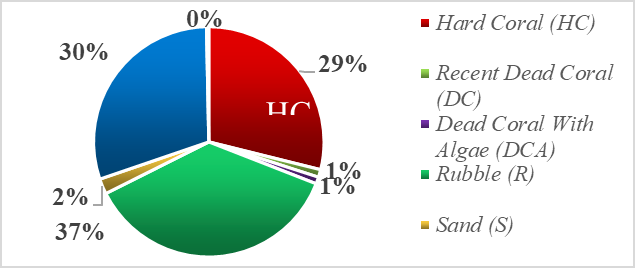
At Station I, the results of observations of coral reef conditions showed that there was 7 coral reef substrate cover at a depth of 6 m. The percentage of live coral cover obtained through observations is around 29%, which is classified as quite good criteria based on the Decree of the Minister of the Environment in 2001 (Figure 1).
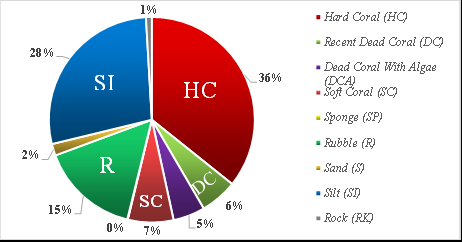
At Station II, the coral reef substrate cover is 9 pieces at a depth of 6 m. The percentage of live coral cover obtained through observations is around 36%, which is classified as quite good criteria based on the Decree of the Minister of the Environment in 2001 (Figure 2).
At Station III, the results of observations of coral reef conditions at Station III were 2500 pieces with a coral reef cover substrate of 8 pieces at a depth of 6 m. The percentage of live coral cover obtained through observations is around 23%, which is classified as poor criteria based on the Decree of the Minister of the Environment in 2001 (Figure 3).
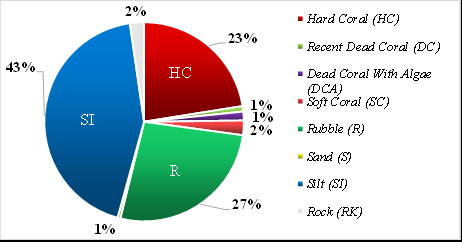
Based on the results of observations of the condition of coral reefs at Pasir Putih Beach, it was found that the percentage of cover fell into the criteria of quite good (25-49.9%) and poor (0-24.9%) according to Minister of Environment Decree No. 4 of 2001. The observation results were proven by the percentage of coral reef cover at station I (28.88%), station II (35.75%), and station III (22.48%).
The condition of live coral cover at each station shows different values. Judging from this comparison, the highest percentage level of live coral cover is at station II. This is because the observation location is far from residential areas or other activities that can damage coral reefs, so the condition of the observation location area is still in fairly good condition [11].
The highest abiotic component in the form of coral fractures is at station I, this occurs based on environmental factors. Judging from field observations, Station I is an area that is often used as a recreational destination for tourists to carry out snorkeling activities. This could be a factor causing coral fractures to occur due to the anchoring of tourist boats and activities carried out by tourists such as stepping on coral intentionally or not.
The lowest percentage of live coral cover was at station III, this happened because the data collection location was almost close to the sea chart area. According to Sulaiman, et al. [12] sea charts are a type of fishing gear that uses light as a fishing aid used in muddy water areas. So the area approaching the sea chart is only mud deposits and coral reefs are rarely found.
Coral Reef Diversity and Variety Index
At Station I, based on the results of observations to determine the diversity of coral reefs at a depth of 6 m, a Diversity Index (H’) of 1.07 and Variety Index (E) of 0.16 were obtained. At Station II, a Diversity Index of 1.68 was obtained and a Variety Index of 0.25. At Station III, the Diversity Index was 1.19 and the Variety Index was 0.19. In general, the prices for the Diversity Index (H’) and Variety Index (E) for coral reefs are in Table 1.
| Location | Index Diversity (H’) | Index Variety (E) |
|---|---|---|
| Station I | 1,07 | 0,16 |
| Station II | 1,68 | 0,25 |
| Station III | 1,19 | 0,19 |
Table 1: Diversity Index, Variety Index.
Based on the explanation from Nurcahyanto, et al. [13] that the diversity index (H’) is defined as a systematic representation of community structure to simplify the process of analyzing a number of organisms. The results of observations of the coral reef diversity index (H’) that have been carried out are influenced by the diversity of coral reefs, the high distribution of species and the formation of coral reef communities [14].
The diversity index for each research station is classified in the same category, namely in the medium category (1<H’<3). The highest value is at Station II with a coral reef diversity index (H’) value of 1.68.
This value shows that diversity at Station II in conditions of distribution and stability is higher compared to other stations. The highest uniformity index is at Station II at 0.25. This shows that the condition of the community in these waters is in a low level of distribution [15, 16, 17, 18, 19, 20, 21, 22].
Conclusion
Based on the results of observations, measurements and data analysis related to the condition of coral reefs in the Ciletuh Sukabumi Geopark area, West Java, it can be concluded:
The condition of coral reefs in the Ciletuh Sukabumi Geopark area, using the UPT (Underwater Photo Transect) method, produces different results at each observation station. The highest percentage level of live coral cover was at station II, this is because the area is far from residential areas or other activities that could damage coral reefs, so the condition of the observation area is still in fairly good condition. The diversity and variety index on coral reefs showed that the highest was obtained at station II with a diversity index value of 1.68 and a variety index value of 0.25. This shows that the condition of the community in these waters is in a low level of distribution.
References
-
Timotius S (2003) Coral Biology. Training Course Paper: Biological Characteristics of Corals. PSK-UI Yayasan Terangi. Jakarta.
-
Prasetiadi A, Ramdani C (2020) Analysis of Coral Reef Health Based on River, Sea and Population Characteristics of Residential Areas Using Machine Learning. IJIS- Indonesian on Information System 5(2).
-
Tuwo A (2011) Coastal and Marine Ecotourism Management - Ecological, Socioeconomic, Institutional and Regional Facilities Approaches. Surabaya Brilian Internasional.
-
Ikawati Y, Hanggarawati PS, Parlan H, Handini, dan Siswodihardjo HB (2001) Coral reefs in Indonesia. Society of Science and Technology Writers (MAPPIPTEK), Indonesia.
-
Dan Kleine AD (2012) Coral Reefs and Climate Change. University of Queensland, Australia.
-
Pasaribu RP, Djari AA, Rahman A, Kabul A, Sagala HA (2023) Analysis of transplanted coral growth using the rock pile method in Karimunjawa National Park, Central Java, Indonesia. AACL Bioflux 16(1): 546-554.
-
Pasaribu RP, Larasati RF, Saragih MS (2022) Analysis of coral reef cover in the waters of Panjang Kecil and Kelapa Islands, the Seribu Islands. Jurnal Kelautan dan Perikanan Terapan 5(2): 99-108.
-
Giyanto, Abrar M, Hadi TA, Budiyanto A, Hafizt M, et al. (2017) Status of Indonesian Coral Reefs. Indonesia: Puslit Oseanografi – LIPI 30 hlm.
-
Giyanto (2013) Underwater Photo Transect Method for Assessing Coral Reef Condition. Oseana 38(1): 47-61.
-
Cahyo A (2017) Identification of Diseases on Coral Reefs Using Ripple Down Rules. JUTEI 1(2): 165-174.
-
Pasaribu RP, Djari AA, Pranoto AK, Rahman A, Panjaitan PST, et al. (2023) Comparison of Coral Propagation Growth by Using Coconut Shell Media and Paralon Concrete Media on Wangi-Wangi Island, Wakatobi Regency, Indonesia. International Journal of Oceanography & Aquaculture 7(3): 1-10.
-
Sulaiman M, Mulyono SB, Am Azbas T, Sugeng HW, dan Roza Y (2015) Fish behavior in the Chart Pete Pete fishery using LED lights. J Ilmu dan Teknologi Kelautan Tropis 7(1): 205-223.
-
Nurcahyanto T, Muliadi, Nurrahman YA (2021) Coral Reef Community Structure in the Waters of East Melanau Bay, Lemukutan Island. Jurnal Laut Khatulistiwa 4(1): 22-28.
-
Nurhaliza S, Muhlis M, Imam B, dan Didik S (2019) Community Structure of Hard Coral (Scleractinia) in the Intertidal Zone of Mandalika Beach, Central Lombok. Jurnal Biologi Tropis 19(2): 302-308.
-
Wicaksono GG, Restu IW, Ernawati NM (2019) Condition of the Coral Reef Ecosystem in the Western Part of Pasir Putih Island, Sumberkima Village, Buleleng Regency, Provinsi Bali. Curr Trends Aquat Sci II 2(1): 37-45
-
Adi ND, Damar A, Adrianto L, Soedharma D, Solihin A (2017) Coral reef management strategy in the Seribu Islands. Natural Resources and Environmental Management 7(3): 244-250.
-
Barus TA (2018) Forms of Coral Reef Growth in Lampung Bay Waters. Journal of Tropical Marine Science and Technology 10(3): 699-709.
-
Coremap Cti (2017) Megabenthos Monitoring Guide. Science Research Institute. Jakarta, Indonasia.
-
State Ministry of the Environment (2001) Decree of the State Minister for the Environment Number 04 of 2001 concerning Standard Criteria for Coral Reef Damage, Indonesia.
-
State Ministry of the Environment (2004) Decree of the State Minister for the Environment Number 51 of 2004 concerning Sea Water Quality Standards for Marine Biota, Indonesia.
-
Kusumo S (2012) Guide to Using CPCe 4.1 for Observing Coral Growth (Ornamental Coral Transplantation Trial), Indonesia.
-
Suharsono, Budiyanto A, Hadi TA (2018) Status of Indonesian Coral Reefs. Pusat Penelitian Oseanografi LIPI, Indonesia, pp: 1-59.
- Genetic Improvement of Nile Tilapia (Oreochromis niloticus): Advances in Selective Breeding and Genomic Approaches for Sustainable Aquaculture
- Microplastics, Contaminants, and Waste Hotspots: Divergences and Faults in Prioritizing Control Efforts
- Creating a Healthier, More Vibrant Open and Closed Aquatic Environment. A Submersible, Centrifugal Magnetically Affixed Current Changing Aquarium Pump
- An Attempt to Assess Alpha Diversity and Sample Size: Using the Ostracod Assemblages off Kumamoto Port, Japan
- Assessment of the Efficiency of Common Fishing Gears and Crafts Used at Mohananda River of Chapai Nawabganj, Bangladesh
- Fish Productivity and Biodiversity Status of Sundarban Mangrove in Bangladesh