
Quality Assessment of Oven Dried Fish at Three Different Temperature
The present study was to assess the organoleptic quality and chemical composition of oven dried Puntius sophore at three different temperature during July 2019 to February, 2020 at department of Fisheries, University of Rajshahi, Bangladesh. Puntius sophore, the most available fish species of Bangladesh in dried and fresh condition was selected for the study. The species was collected (fresh condition) from the Chalan beel area, Shingra bazar of Shingra Upazila, Natore and brought into the laboratory of department of fisheries, University of Rajshahi. After collection the fishes were processed and dried in the oven at 50ºC, 60ºC and 65ºC temperature, respectively and time duration of oven drying were 11.30±0.14 (50ºC), 11.33±0.15 (60ºC) and 10.32±0.13 (65ºC) hour, respectively. Organoleptic and chemical test (protein, lipid, ash and moisture) were also done. The appearance, odor, color, taste, texture, flavor and overall acceptability of oven dried fishes were 7.08±0.52, 6.67±0.26, 6.96±1.40, 6.75±0.65, 6.63±0.33, 6.54±0.26 and 7.00±0.12 at 50ºC temperature, 6.58±1.37, 6.58±0.83, 6.00±0.78, 6.19±1.09, 6.06±0.22, 6.19±0.97 and 6.65±0.78 at 60ºC temperature and 6.21±1.18, 6.59±0.56, 6.85±0.51, 6.58±1.37, 6.40±0.85, 6.38±0.66 and 6.69±0.72 at 65ºC temperature, respectively. All the values were significantly varied among 50ºC, 60ºC and 65ºC temperature for the mean values of organoleptic quality. In case of chemical composition, the lowest protein content was found 66.94±1.46 (65ºC) and highest protein content was found 69.72±1.00 (50ºC). The lowest lipid content was found 9.40±3.12 (65ºC) and highest was 10.75±1.00 (60ºC). The lowest ash content was found 9.20±1.00 (50ºC) and highest was 9.50±1.00 (60ºC). The lowest moisture content was found 9.23±2.11 (65ºC) and highest was 10.46±1.56 (60ºC). Accept protein contents all the parameters were significantly (p<0.05) differ from each other but those are belongs in acceptable range.
Introduction
Sun drying method has been practiced since time immemorial. It is one of the low cost, easy and ancient fish preservation technique in Bangladesh. Dried fish is very pleasant and palatable food item in Bangladesh especially in the coastal, central and north-eastern districts [1]. It is considered a good source of many micronutrients of significance such as essential minerals and might contribute to meet the nutritional needs of poor, vulnerable groups, particularly in area with limited dietary diversity and malnutrition. The nutritional quality of dried fish remains intact, sometimes retains higher quality standards compared to fresh fish [2]. It is also a rich source of protein, lipid, fatty acid, mineral, calcium, zinc and iron [3]. It contains different component in their body such as moisture (18.23 to 24.46%), protein (40.69 to 68.09%), lipid (2.97to 26.13%) and ash (5.08 to 16.02%) [4]. Usually traditional sun drying entirely depends on weather and climate. This problem of drying is especially severe during the rainy season. Because in rainy season, the dried fish processors face problem due to lack of sufficient sun rays, huge rain and huge humid air. Another major problem associated with sun drying is insect infestation by mites, beetles, blowflies and their larvae and to solve this problem, dry fish processors use insecticides. As a result, the physical and organoleptic characteristics and also the chemical quality of traditional sun-dried products are unhealthy for human consumption in many cases [1]. In these cases, oven drying can be a good alternative way to solve this problem. When oven can be used in large scale of fish drying and developed industry on the basis of oven drying, it will be the big source of income and can solve the sunlight related problems. Unemployed people can also be involved with this process and the unemployment problem will also be reduced.
Materials and Methods
The present study conducted during July 2019 to February, 2020. Puntius sophore the most available
freshwater fish species in both fresh and dried condition was selected for the study and collected in fresh condition from the Chalan beel area, Shingra bazaar of Shingra Upazila under Natore district. Chalan beel is the big reservoir of freshwater fish situated in northern part of Bangladesh near Rajshahi district. The fish from Chalan beel both fresh and dried condition are very tasty, delicious, renowned and popular. After collection the fishes were brought into the quality control laboratory at the department of Fisheries, University of Rajshahi for further processing.
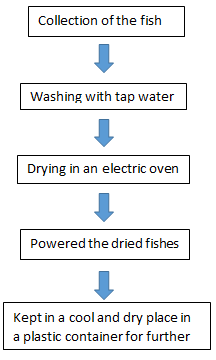
Processing: Fishes were washed with tap water properly that removed the slime, blood, dirt and unwanted particles from the body.
Drying: After fine washing fishes were dried in the electric oven in the laboratory of department of Fisheries, University of Rajshahi, Bangladesh at 50°C, 60°C and 65°C temperature for different hours in an electric oven (Model, SLN 53 STD, Made in Poland). Then dried fishes were kept at natural room condition in plastic container and then powdered with the help of electric blender and then organoleptic and biochemical test were carried out.
The processing methods are also presented in the following flowchart.
Organoleptic Test
Dried fishes were assessed by organoleptic test by a test panel of eight members including teachers, students and general people. All the dried fishes were served to the test panel (8 members) and appearance, odour, color, texture, flavour and overall acceptability were determined by using hedonic scale of 1 to 9 and dried fishes were rated as 9 for excellent, 7 for good, 6 for acceptable and below 4 for poor or unacceptable [5].
Estimation of Chemical Composition
Estimation of Protein: Protein content was determined by the method of Lowry OH, et al. [6].
Estimation of Lipid: Lipid content of the dried fish was estimated by the method of Bligh EG, et al. [7].
Estimation of Ash: Ash content was determined according to Association of Official Analytical chemists [8].
Estimation of Moisture: moisture content was determined according to Association of Official Analytical chemists [8].
Data Analysis
Data was expressed as mean and standard deviation and ANOVA was done for the determination of level of significance with the support of the computer Software SPSS (statistical package for social sciences 20.0 software) and the significance level was defined at P< 0.05.
Results and Discussion
Oven Drying
Oven drying was done at 50ºC, 60ºC and 65ºC temperature at hygienic condition in the oven of the laboratory of department of fisheries at the University of Rajshahi. The average drying period of P. sophore was 11.30±0.14 (50ºC),
11.33±0.15 (60ºC) and 10.32±0.13 (65ºC) hour, respectively.
Organoleptic Test
Organoleptic quality represents the perception of the consumer. According to the test panel the score of organoleptic quality are presented below- Appearance: The lowest value of appearance of oven dried P. sophore was 5.21±1.186 (50ºC) which indicate acceptable result and the highest value was 7.08±0.520 (65ºC) which indicate good result. Significant difference (p<0.05) was found among the 50ºC, 60ºC and 65ºC temperature oven dried fish for the mean values of appearance.
Odour: It was observed that in case of the odour, lowest value was 5.58±0.832 (60ºC) and the highest value was 6.67±0.260 (65ºC). No significant difference was found between 50ºC, 60ºC and 65ºC temperature oven dried fish for the mean values of odour. The mean value of odour was in acceptable limit for oven dried P. sophore.
Color: The lowest value of color was found as 5.85±0.512 (50ºC) which indicate acceptable limit and the highest value was 6.96±0.144 (65ºC) (Table 1) which indicate good result. Significant difference was found among the mean values of color.
Texture: In case of texture the mean lowest value was 5.06±1.220 (60ºC) which indicate acceptable limit and the highest value was 6.63±0.331 (65°C) that indicate good result. Significant difference (p<0.05) was found between 60ºC and 65ºC oven dried fish for the mean values of texture (Table 1).
Flavor: The lowest value of flavor was 5.19±0.970 (60ºC) and the highest value was 6.54±0.260 (65ºC). Significant difference was found between 60ºC and 65ºC oven dried fish for the mean values of flavor (Table 1).
| Temperature º (C) | Appearance | Oduor | Color | Texture | Flavor | Overall Acceptability |
|---|---|---|---|---|---|---|
| 50 | 5.21±1.186a | 5.59±0.566a | 5.85±0.512a | 5.40±0.850a | 5.38±0.661a | 5.69±0.720a |
| 60 | 5.58±1.377c | 5.58±0.832b | 6.00±0.781b | 5.06±1.220a | 5.19±0.970a | 5.65±0.781a |
| 65 | 7.08±0.520b | 6.67±0.260c | 6.96±0.144c | 6.63±0.331b | 6.54±0.260b | 7.00±0.125b |
Table 1: Average score of organoleptic test of the oven dried P. sophore. Data are expressed as mean ± standard deviation. Same l
Overall Acceptability
The lowest value of overall acceptability was 5.65±0.781 (60ºC) and the highest value was 7.00±0.125 (65ºC). No significant difference was found between 60ºC and 65ºC oven dried fish for the mean values of overall acceptability (Table 1).
The organoleptic characteristics of the dried fishes are more or less similar to the solar dried [9], that the excellent products were produced without any infestation with firm and flexible texture and natural odours.
Chemical Composition
Protein, lipid, ash and moisture were determined for the chemical quality assessment which are presented in Table 2.
Protein Content
The lowest protein content was found 66.94±1.00 (65ºC) and highest protein content was found 69.72±1.00 (50ºC) (Table 2). Protein contents were not significantly differ from each other. Normally the sun dried fishes contain 60-80 % protein [10]. The result is also agreed with Mustapha MK, et al. [11] who showed that oven dried C. gariepinus contain 64.62% protein. Aberoumand A, et al. [12] found that the protein content varied from 72.49± 0.39 % (Zeminkan) to 85.66 ± 0.26 % (Hamoor). Jahan SN, et al. [13] worked on 5 selected oven dried freshwater species and observed the values of protein ranged from 63.52±0.63 (Channa punctatus) to 77.12±0.36 (M. pancalus) which is strongly agreed with the present study.
Lipid Content
In case of lipid, the lowest lipid content was found 6.94±1.00 (50ºC) and highest lipid content was found 10.75±1.00 (60ºC) (Table 2). Lipid contents are significantly (p<0.05) differ from each other among three different temperature. Oparaku NF, et al. [14] showed that 8.34% lipid in oven dried Synnodontis clarias. The lipid content of the present study was very near to Mustapha MK, et al. [11] who showed that oven dried Oreochromis niloticus contain 7.01% lipid. Fatty fish contains more fat than other fish [11]. Jahan SN, et al. [13] observed lipid content ranged from 7.26±0.89 (C. sriatus) to 11.32±0.76 (W. attu) which is strongly agreed with the present study.
| Temperature | Proximate composition | |||
|---|---|---|---|---|
| Protein | Lipid | Ash | Moisture | |
| 50ºC | 69.72±1.00a | 6.94±1.00a | 10.20±1.00a | 11.30±1.00a |
| 60ºC | 67.12±1.00b | 10.75±1.00b | 9.50±1.00b | 10.46±1.56b |
| 65ºC | 66.94±1.00c | 9.40±1.00c | 9.25±1.00c | 9.23±2.11c |
Table 2: Proximate composition of oven dried fish at three different temperatures. Data are expressed as mean ± standard deviatio
Ash Content
In case of ash, highest ash content was found 10.20±1.00 (50ºC) and the lowest ash content was found 9.25±1.00 (65ºC) (Table 2). Ash contents were significantly differ from each other. Islam MT, et al. [15] worked on nutritional and food quality assessment of dried fishes at Shingra Upazila under Natore district of Bangladesh and stated that sun dried Channa punctatus contains 31.63% ash. Islam MT, et al. [15] found that sun dried Mastacemmbelus pancalus (Guchi) contains 26.1% ash. On the other hand, the ash content of oven dried Channa punctatus was 13.00±1.50%. According to Jahan SN, et al. [13], the range of ash content varied from 4.34±0.23 (M. pancalus) to 18.43 (C. punctatus) among 5 oven dried freshwater fish species.
Moisture Content
In case of moisture, the lowest moisture content was found 9.23±2.11(65ºC) and highest moisture content was found 11.30±1.00 (50ºC) (Table 2). Moisture contents were significantly differ from each other. The moisture of all living systems contributes as much to the essential properties of life. According to Haque E, et al. [10] the sun dried fish normally contain an average of 10-20% moisture. The present findings is strongly agreed with the findings of Jahan SN, et al. [13] who found the moisture ranged from 6.25±0.24 (M. cavasius) to 13±0.57 (C. punctatus) among 5 freshwater oven dried species. Low moisture content is very important because the low moisture content increase the protein content in fish species by coagulating the crude protein. Clucas JJ, et al. [16] reported that a fish with moisture content reduced to 25% is well dried and if further reduced to 15% growth of mould will cease and shelf life will be increased [17].
Conclusion
The present study provides a possible application of electric oven drying as an efficient drying as well as to find out the optimum temperature for drying fish in oven. It is concluded that on the basis of nutritional compositions among three temperature (50°C, 60°C, 65°C), 50°C showed better result. It can be also concluded that oven drying is the suitable method to dry fish which will be more suitable for dry fish processors if it will be taken in large scale and establish large industry because chemical characteristics of oven dried fishes were higher. So dry fish processor can be benefited more and a large amount of people can also be employed to involve with this work and can get quality dried fish product.
References
-
Nowsad AKM (2007) Participatory Training of Trainers: A new Approach Applied in Fish processing. Bangladesh, pp: 328.
-
Jahan SN, Bayezid MA, Islam B, Siddique MAB, Karmokar PK, et al. (2017) Biochemical Quality Assessment of fish powder. American Journal of Food and Nutrition 5(3): 110-114.
-
Basu S, Khasim I, Rao PS (1987) Comparative efficiency of different surfaces for drying of fish. Fishery Technol 24(1): 37.
-
Azam K, Basher MZ, Asaduzzaman M, Hossain MH, Ali MY, et al. (2003) Biochemical quality assessment of fourteen selected dried fishes. Univ Journal of zoology 22: 23-26.
-
Lilabati H, Vishwanath W, Singh MS (1999) Changes in bacterial and fungal quality during storage of smoked Esomusdanricus of Manipur. Fish Technol 36(1): 36-39.
-
Lowry OH, Roserbrough NJ, Farr AL, Randall RJ (1951) Protein measurement with the Folin phenol reagent. The journal of biological chemistry 193(1): 265-275.
-
Bligh EG, Dyer WJ (1959) A rapid method for total lipid extraction and purification. Canadian journal Biochemistry Physiology 37: 911-917.
-
AOAC (1980) Official method of analysis 13th(Edn.), Association of Official Analytical Chemist, Washington D.C, USA.
-
Mehbub MF (2004) Community participatory research of the production of high quality marine dried fish products by a low cost solar tunnel drier. Bangladesh Agricultural University, Mymensingh, Bangladesh, pp: 169.
-
Haque E (2004) Bangladeshi Chhoto Mach (A book on small indigenous fish species of Bangladesh). Graphic Sign, Mymensingh, Bangladesh, pp: 81-84.
-
Mustapha MK, Ajibola TB, Ademola SK, Salako AF (2014) Proximate analysis of fish dried with solar driers. Italian Journal of Food Science 26(2): 221-226.
-
Aberoumand A, Abad MKR (2015) Influences of drying methods processing on nutritional properties of three fish species Govazym stranded tail, Hamoor and Zeminkan. International Food Research Journal 22(6): 2309-2312.
-
Jahan SN, Chhabi IJ, Samad MA, Hossain MI (2018) Comparative study on nutritional quality of sun- Dried fish and oven dried fish. International Journal of Advances in Science Engineering and Technology 6(4): 108-118.
-
Oparaku NF, Nawaka FC (2013) Effect of processing on the nutritional quality of fresh species (Synodontis clarias, Trachurus trecae and Clarias gariepinus). International Journal of Biology and Biological Sciences 2(10): 143-149.
-
Islam MT, Ahmed S, Sultana MA, Tumpa AS, Flowra FA, et al. (2013) Nutritional and food quality assessment of dried fishes in Singraupazila under Natore district of Bangladesh. University of Rajshahi, Bangladesh, pp: 15.
-
Clucas JJ (1982) Fish handling Processing and Preservation in the tropics. In: 2nd (Edn.), Products Institute, UK, pp: 144-145.
-
Mansur MA, Rahman S, Khan MNA, Reza MS, Uga S, et al. (2013) Study on nutritional quality and safety aspect of three sun dried fish. African Journal of Agricultural Research 8(41): 5149-5155.
- Genetic Improvement of Nile Tilapia (Oreochromis niloticus): Advances in Selective Breeding and Genomic Approaches for Sustainable Aquaculture
- Microplastics, Contaminants, and Waste Hotspots: Divergences and Faults in Prioritizing Control Efforts
- Creating a Healthier, More Vibrant Open and Closed Aquatic Environment. A Submersible, Centrifugal Magnetically Affixed Current Changing Aquarium Pump
- An Attempt to Assess Alpha Diversity and Sample Size: Using the Ostracod Assemblages off Kumamoto Port, Japan
- Assessment of the Efficiency of Common Fishing Gears and Crafts Used at Mohananda River of Chapai Nawabganj, Bangladesh
- Fish Productivity and Biodiversity Status of Sundarban Mangrove in Bangladesh