
Application of Astaxanthin-Added Feed in Macrobrachium nipponense Culture
To investigate the effects of astaxanthin-supplemented feed on the growth performance, hatching success, and coloration of Macrobrachium nipponense, two types of feed were evaluated: one with added astaxanthin (experimental group) and one regular (control group). Two separate aquaculture trials were conducted—one in autumn (August 2023) and another in spring (March 2024). In the autumn experiment, the experimental group prawns at Canlin Family Farm exhibited a 3.6% increase in average body length compared to the control group. At Jiangsu Provincial Breeding Base for M. nipponense, the experimental group showed a 10.3% increase in average body weight relative to the control group. Additionally, the experimental group prawns demonstrated a 1.8% increase in average body length and a 10.3% increase in average body weight compared to the control group. In the spring experiment, after one month of feeding, the experimental group prawns exhibited significantly greater body length and weight compared to the control group (P < 0.05), with an average body length increase of 4.6% and an average body weight increase of 11.0% . After two months of feeding, the experimental group showed even more pronounced differences, with an average body length increase of 15.9% and an average body weight increase of 63.7% compared to the control group. The prawns in the experimental group exhibited a deeper coloration compared to those in the control group, indicative of increased pigment accumulation. Furthermore, the experimental group had a higher proportion of brooding females and a greater broodiness rate than the control group. The results indicate that the inclusion of astaxanthin in the feed can increase its nutritional content, enhance the weight gain rate and broodiness rate of the M. nipponense prawn, and significantly improve the coloration of the prawn.
Introduction
Macrobrachium nipponense is naturally distributed across several regions in East Asia, including China, Japan, Korea, Vietnam, Myanmar, and Taiwan [1, 2, 3]. Its culture began in Southeast Asian countries in the 1990s.Macrobrachium nipponense has a high consumption in China because of its good taste and high nutritional value. Despite its small size, Macrobrachium nipponense exhibits notable adaptability to environmental stressors, which contributes to its viability in aquaculture [4].
According to statistics, the production of Macrobrachium nipponense in 2021 was approximately 230 thousands tons in China, making it the greatest among the world. Currently, however, aquaculture farmers usually use feeds for Macrobrachium rosenbergii or Litopenaeus vannamei to culture Macrobrachium nipponense, resulting in problems such as weak palatability and low absorption [5].
Astaxanthin is a ketone carotenoid with strong biological activities such as antioxidant, anti-inflammatory, anti-tumor, neuroprotective, and coloring properties [6]. It widely presents in the bodies of prawn and crabs and plays a very important role. It cannot be synthesized and can only be obtained through dietary intake. Studies have shown that adding astaxanthin to feed has positive effects on crustaceans, such as improving pigmentation, reproductive ability, and immunity [7, 8, 9]. At the same time, astaxanthin has a coloring effect, which can improve the muscle and skin color of farmed fish, enhance meat quality and commercial value, and is widely used in ornamental fish feed to meet the demand of ornamental fish for bright body colors [10]. Wang JH, et al. [11] stated that adding 400 mg/kg astaxanthin to feed can effectively enhance the growth performance, coloring effect, and antioxidant capacity of Cyprinus carpio. Li, et al. [12] found that supplementing astaxanthin in the feed can improve the growth performance and antioxidant capacity of blood parrots. The study by Cheng Y, et al. [13] indicates that adding 400 mg/kg astaxanthin to feed can significantly improve the growth performance and non-specific immunity of Procambarus clarkii.
Former research on Litopenaeus vannamei has shown that adding 50mg/kg astaxanthin to feed can enhance the stress response of juvenile prawns, promote their growth rate, survival rate, and feed conversion rate [14]. The study by Jian X, et al. [15] showed that adding astaxanthin to the feed of Penaeus vannamei can result in an increase in survival rate, as well as a significant increase in weight gain rate, specific growth rate, and phenoloxidase activity. However, the effect of astaxanthin-added feed on Macrobrachium nipponense remains unknown.
The aim of this study was to investigate the effects of astaxanthin-supplemented feed on the growth performance, hatching success, and coloration of Macrobrachium nipponense, providing insights for its application in compound feed.
Materials and Methods
Experimental Site
Aquaculture experiments were conducted at the Jiangsu Provincial Breeding Base for M. nipponense and at Canlin Family Farm, Hushu Street, Nanjing City. Two comparable ponds, each measuring 5 mu with flat bottoms, leveled and disinfected silt, and separate water intake and drainage systems, were designated as the experimental and control ponds.
Experimental Animals
The M. nipponense prawns used in this experiment were all from the same batch, with body lengths of 3.6-3.8 cm and weights of 0.7-0.9 g, belonging to the “Taihu No.2” M. nipponense prawns. Healthy juvenile prawns with plump bodies, translucent appearance, firm and elastic muscles, strong activity, swift swimming, smooth body surfaces, and no injuries or diseases were randomly selected. Approximately 50,000 prawns were collected from each group. The autumn breeding experiment began in early July 2023, and the spring breeding experiment in late February 2024.
Experimental Feed
The control group feed was a regular M. nipponense prawn compound feed from Jiangsu Changshou Group Nanshan Feed Co., Ltd., with the main components including imported fish meal, imported fish oil, prawn meal, fermented soybean oil, high-gluten flour, yeast extract, soybean phospholipid oil, vitamins, and trace elements. The composition of the feed is listed in Table 1.
| Nutrient Composition | Regular M. nipponense prawn compound feed (%) |
|---|---|
| crude protein | ≥38.0 |
| crude fat | ≥5.0 |
| Ash | ≤18.0 |
| Crude fiber | ≤6.0 |
| total phosphorus | ≥1.0 |
| Lysine | ≥1.9 |
| water | ≤12.0 |
Table 1: Content of feed ingredients.
The experimental group feed was the “Taihu No.2” M. nipponense prawn specialty feed developed by the Freshwater Fisheries Research Center of Chinese Academy of Fishery Sciences,this feed adds astaxanthin on top of the regular M. nipponense compound feed (containing 0.2% astaxanthin-rich Phaffia rhodozyma, with an astaxanthin content of 0.5%) [16].
Feeding
The experimental group was fed the diet, while the control group was fed regular M. nipponense prawn feed. Both groups strictly adhered to the experimental requirements for feeding, with daily feeding amounts ranging from 5% to 8% of body weight (adjusted based on feeding and growth conditions, to be fully consumed within 1 h). Feeding was also adjusted according to weather and water quality factors. The autumn breeding experiment began in August 2023 and the spring breeding experiment in March 2024.
Daily Management
Ponds were inspected daily and oxygenation equipment was promptly activated to prevent oxygen deficiency. Potassium bisulfate was used every 20 days for substrate improvemen to enhance the bottom environment and reduce the risk of parasites. Lactobacillus was added once or twice to the entire pond to regulate water quality and maintain water stability.
Collection of Growth Parameters
After the aquaculture experiments, M. nipponense prawns were fasted for 24 h before sampling. Thirty prawns were randomly selected for each pond to measure body length and weight, and growth parameters were collected for both the experimental and control groups. Each prawn was placed on filter paper for several minutes (to remove excess water) and then weighed with an accuracy of 0.1 g (Weight).
Subsequently, we measured the carapace length and width of each individual using a vernier caliper (accuracy ±
0.01 mm). The body length is the length of the prawn from the base of the eyestalk to the end of the caudal segment of the prawn.
The autumn breeding experiment collected data on November 21, 2023, and the spring breeding experiment began sampling on March 27, with subsequent sampling every week eight times.
Statistical Analysis
T-test were employed to compare the differences between the experimental and control group. A difference of P < 0.05 was considered to be of significance. All statistical analyses were carried out with SPSS 20.0 (SPSS Inc., Chicago, IL, USA).
Results and Discussion
Growth Performance
The autumn breeding experiment: the body length and weight of M. nipponense prawns in the experimental group at Canlin Family Farm were higher than those in the control group (P>0.05). The average body length (5.7±0.5 cm) of the experimental group was 3.6% higher than that of the control group (5.5±0.8 cm), and the average weight (3.2±0.9 g) was 10.3% higher. Similarly, at the Jiangsu Provincial Breeding Base for M. nipponense, the experimental group’s average body length (5.6±0.8 cm) was 1.8% higher, and the average weight (3.2±1.5 g) was 10.3% higher (Table 2).
| Canlin Family Farm | Jiangsu Provincial Breeding Base for M. nipponense | |||
|---|---|---|---|---|
| Experimental group | Control group | Experimental group | Control group | |
| Body Length/cm | 5.7±0.0.5a | 5.5±0.8a | 5.6±0.8c | 5.5±0.8c |
| Weight/g | 3.2±0.9a | 2.9±1.2a | 3.2±1.5c | 2.9±1.3c |
Table 2: Comparison of average body length and weight of M. nipponense prawns in the autumn breeding experiment.
Note: Different letters of the same row indicate significant differences (P<0.05), while the same letter indicates no significant differences (P>0.05). Table 2: Comparison of average body length and weight of M. nipponense prawns in the autumn breeding experiment.
The spring breeding experiment: Initial sampling showed no significant difference in body length and weight between the experimental and control groups. However, by the third sampling (one month after feeding), the experimental group’s body length and weight were significantly higher than the control group’s (P < 0.05). The average body length (5.05±0.71 cm) was 4.6% higher, and the average weight (2.43±1.37 g) was 11.0% higher. By the final sampling (two months after feeding), the experimental group’s body length (6.18±0.67 cm) was 15.9% higher, and the weight (5.32±1.90 g) was 63.7% higher (Table 3).
| Sampling stage/number | Body length/cm | Weight/g | ||
|---|---|---|---|---|
| Experimental group | Control group | Experimental group | Control group | |
| 0 | 3.80±0.43a | 3.59±0.48a | 0.70±0.26c | 0.71±0.32c |
| 1 | 3.81±0.41a | 3.75±0.42a | 0.84±0.33c | 0.85±0.41c |
| 2 | 3.96±0.78a | 3.98±0.71a | 1.09±0.70c | 1.08±0.56c |
| 3 | 5.05±0.71a | 4.83±0.62b | 2.43±1.37c | 2.19±0.91d |
| 4 | 5.52±0.69a | 5.19±0.67b | 3.36±1.25c | 2.69±1.14d |
| 5 | 5.44±0.66a | 5.31±0.73b | 3.02±1.24c | 2.75±1.30d |
| 6 | 5.67±0.60a | 5.33±0.61b | 3.88±1.43c | 2.96±1.24d |
| 7 | 6.18±0.67a | 5.33±0.98b | 5.32±1.90c | 3.25±1.97d |
Table 3: Comparison of average body length and weight of M. nipponense prawns in the spring breeding experiment.
Note: Different letters of the same row indicate significant differences (P<0.05), while the same letter indicates no significant differences (P>0.05). Table 3: Comparison of average body length and weight of M. nipponense prawns in the spring breeding experiment.
Research has shown that astaxanthin has a promoting effect on the growth of aquatic animals and can be used as a feed additive [17]. When astaxanthin is added to the feed, compared to the control group, the experimental group’s feed coefficient significantly decreases, and both body length and weight increase. This is consistent with the findings in studies on Litopenaeus vannamei [18] and Penaeus japonicus [19], where the addition of astaxanthin in feed can enhance the antioxidant capacity of cultured animals and promote growth. The significant impact of astaxanthin in this experiment may be due to the relatively high dosage added, with an optimal addition level of 400 mg/kg for astaxanthin in feed for Procambarus clarkii [20], while this experiment added 1000 mg/kg of astaxanthin. However, this does not prove that higher astaxanthin content leads to faster prawn growth. Excessive doses of astaxanthin may not necessarily benefit growth performance, as they can inhibit the expression of certain crucial genes or promote abnormal expression of other important genes, potentially disrupting normal growth metabolism [21].
Color
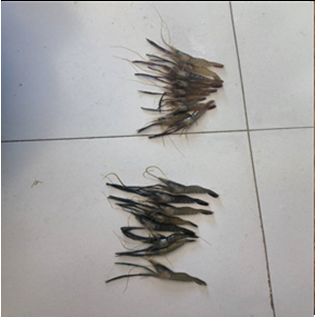
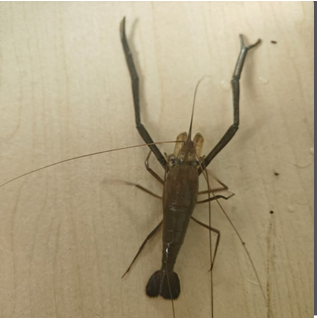
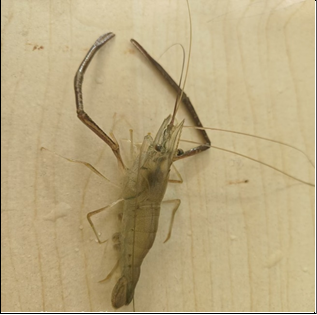
Upon observation of various groups of M. nipponense prawns, it was found that in terms of body color, the experimental group of M. nipponense prawns fed with astaxanthin feed exhibited a deeper body color compared to the control group, with more pigment accumulation and sedimentation (Figures 1, 3 & 5). Processing the experimental and control groups using the Photoshop color picker, revealed that the experimental group of M. nipponense prawns (Figure 4) had R, G, and B values of 55, 45, and 27, respectively, while the control group of M. nipponense prawns (Figure 2) had R, G, and B values of 122, 100, and 49, respectively (lower RGB values indicate a deeper color). Through numerical comparison, it was found that the RGB values of the experimental group were lower than those of the control group, indicating that the experimental group with astaxanthin had a deeper color than the control group.
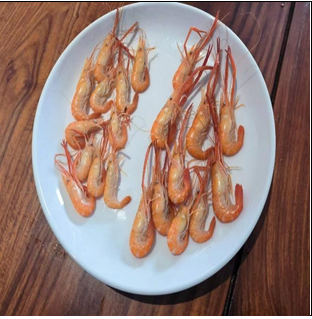


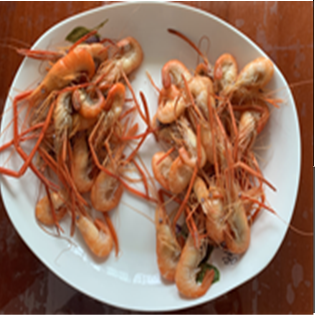
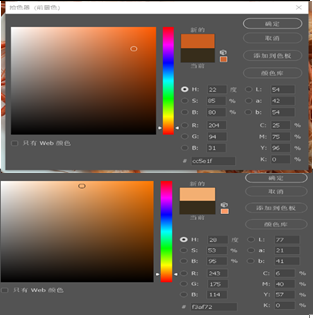
Upon observation of the two groups of M. nipponense prawns after boiling, it was found that the experimental group of J M. nipponense prawns exhibited a more pronounced orange-red color with a brighter hue (Figures 2 & 7). This indicates that astaxanthin can promote pigment accumulation in the bodies of M. nipponense prawns, thereby enhancing their color intensity and making their body color more vibrant. By processing the experimental and control groups of boiled prawns using the Photoshop color picker, we found that the astaxanthin-fed group of M. nipponense prawns (Figure 8) had R, G, and B values of 204, 94, and 31, respectively, whereas the control group of M. nipponense prawns (Figure 8) had R, G, and B values of 243, 175, and 114, respectively (lower RGB values indicate a deeper color). Through numerical comparison, it was found that the RGB values of the experimental group were lower than those of the control group, indicating that the experimental group with added astaxanthin had a deeper color than the control group.
Aquatic animals generally have a limited ability to synthesize astaxanthin de novo [22]. In prawns and other crustaceans, astaxanthin is the predominant pigment, constituting 86% to 98% of total carotenoids, and is crucial for their coloration [23]. Although crustaceans cannot produce astaxanthin on their own, they can convert exogenous carotenoids from their diet into astaxanthin or directly store dietary carotenoids, including astaxanthin, to achieve appropriate coloring [24, 25]. Thus, feed composition significantly influences crustacean coloration. This study demonstrates that astaxanthin enhances the coloration of M. nipponense, making the liver and pancreas more vivid and increasing their ornamental value and market appeal.
Benefit
From November to December 2023, the autumn breeding experiment recorded sales data and actual yield comparisons for both experimental and control groups (Table 4).
| Yield/kg | Yield per mu/kg | Commodity prawn yield/kg | Commodity prawn Yield per mu /kg | Revenue/¥ | Average revenue per mu/¥ | |
|---|---|---|---|---|---|---|
| Experimental group | 755 | 151 | 272 | 54 | 36220 | 7244 |
| Control group | 698 | 139 | 202 | 40 | 31040 | 6208 |
Table 4: Autumn breeding Experiment Yield Comparison - Jiangsu Provincial Breeding Base for M. nipponense.
| Yield/kg | Yield per mu/kg | Commodity prawn yield/kg | Commodity prawn yield per mu /kg | Revenue/¥ | Average revenue per mu/¥ | |
|---|---|---|---|---|---|---|
| Experimental group | 1357 | 167 | 553 | 68 | 68352 | 8438 |
| Control group | 968 | 158 | 338 | 55 | 45916 | 7527 |
Table 5: Autumn breeding Experiment Yield Comparison - Canlin Family Farm.
Data analysis using SPSS 20.0 Tables 4 & 5 showed that both the yield and average revenue per mu were higher in the experimental group than in the control group. The experimental group’s total yield and average revenue per
Hatching
mu increased by 7.5% and 14.3% at the Jiangsu Provincial Breeding Base for M. nipponense, and by 5.3% and 12.1% at Canlin Family Farm.
| Sampling count/individuals | Broodstock/individuals | Holding egg rate/% | |
|---|---|---|---|
| Experimental group | 70 | 40 | 67.5 |
| Control group | 70 | 47 | 59.6 |
Table 6: Hatching of _M. nipponense_ prawns.
As shown in Table 6, on May 17, approximately 70 M. nipponense prawns from each group were sampled and their holding egg rate are calculated. The experimental group had 40 broodstocks, with 27 egg-bearing, shows a holding egg rate of 67.50%. The control group had 47 broodstocks, with 28 egg bearing, shows a holding egg rate of 59.57%. The experimental group had a higher holding egg rate than that of the control group.
Research has shown that adding astaxanthin to feed can protect the ovarian development of female prawns and enhance their reproductive ability. The content of astaxanthin in prawn can affect the quality of juvenile embryos, and a shortage of astaxanthin can lead to a decrease in juvenile quality [26].
Astaxanthin can enter the nucleus as an active substance, be received by hormone receptors as a precursor, activate sex hormones, and promote accelerated development of oocytes [27]. Wang ZX, et al. [28] have shown through research that adding an appropriate amount of astaxanthin to feed can increase the yolk protein content of parent shrimp ovaries, hatching rate of fertilized eggs, metamorphosis rate of larvae, and the number of nauplii and flea like larvae, thereby improving the reproductive performance of female prawn. In this experiment, astaxanthin can increase the egg holding rate of female prawn and effectively improve the reproductive ability of M. nipponense, which is consistent with the above research.
Conclusion
Astaxanthin, a natural nutrient, is widely utilized in aquaculture due to its unique properties. The results of this experiment indicate that astaxanthin-supplemented feed enhances coloration and improves the growth and hatching ratio of M. nipponense. Future research will focus on investigating the impact of astaxanthin-supplemented feed on the nutritional composition and flavor of M. nipponense.
Acknowledgements
Thank Zizhou Wang for polishing the language. This work was supported by Jiangsu Province Agricultural Science and Technology Independent Innovation Project (CX (23)3070).
References
-
De Grave S, Ghane A (2006) The establishment of the oriental river prawn, _Macrobrachium nipponense_ (de Haan, 1849) in Anzali Lagoon, Iran. Aquatic Invasions 1(4): 204-208.
-
Cai Y, Naiyanetr P, Ng PKL (2004) The freshwater prawns of the genus Macrobrachium Bate, 1868, of Thailand (Crustacea: Decapoda: Palaemonidae). Journal of Natural History 38(5): 581-649.
-
New MB (2000) History and global status of freshwater prawn farming. Freshwater prawn culture: the farming of _Macrobrachium rosenbergii_ pp: 1-11.
-
Sun S, Xuan F, Fu H, Ge X, Zhu J, et al. (2016) Comparative proteomic study of the response to hypoxia in the muscle of oriental river prawn (_Macrobrachium nipponense_). Journal of proteomics 138: 115-123.
-
Liu B, Jiang SF, Huang ZB (2020) Habits of _Macrobrachium_ _nipponense_ and feed feeding key technology. Scientific fish farming (CHN) 10: 84.
-
GT Cui (2020) Stress response of _Eriocheir sinensis_ to pH and ammonia and its alleviation by dietary phospholipids and astaxanthin. Soochow University, Taiwan.
-
Niu J, Wen H, Li CH, Liu YJ, Tian LX, et al. (2014) Comparison effect of dietary astaxanthin and β-carotene in the presence and absence of cholesterol supplementation on growth performance, antioxidant capacity and gene expression of _Penaeus monodon_ under normoxia and hypoxia condition. Aquaculture 422: 8-17.
-
Petit H, Nègre-Sadargues G, Castillo R, Trilles JP (1997) The effects of dietary astaxanthin on growth and moulting cycle of postlarval stages of the prawn, _Penaeus japonicus_ (Crustacea, Decapoda). Comparative Biochemistry and Physiology Part A: Physiology 117(4): 539-544.
-
Lim KC, Yusoff FM, Shariff M, Kamarudin MS (2018) Astaxanthin as feed supplement in aquatic animals. Reviews in aquaculture 10(3): 738-773.
-
Wang YY, Song QH, Jia J, Dong H, Sun AH, et al. (2023) Nutritive value of _Rhodococcus rainieri_ and its application in fish feeds. Feed research (CHN) 17:167-172.
-
Wang JH, Xiong JL, Zhang DY, Ren HT, Zhang CN (2019) Effects of feed supplementation with astaxanthin on growth, body color, antioxidant capacity and immunity of _Cyprinus carpio_. Chinese journal of animal nutrition (CHN) 9: 4144-4151.
-
Li F, Huang S, Lu X, Wang J, Lin M, et al. (2018) Effects of dietary supplementation with algal astaxanthin on growth, pigmentation, and antioxidant capacity of the blood parrot (_Cichlasoma citrinellum_ × _Cichlasoma_ _synspilum_). Journal of Oceanology and Limnology 36: 1851-1859.
-
Cheng Y, Wu S (2019) Effect of dietary astaxanthin on the growth performance and nonspecific immunity of red swamp crayfish _Procambarus clarkii_. Aquaculture 512: 734341.
-
Zhang XJ, Zhang HT, Wang ZD, Sun GW, Liu M (2023) _Macrobrachium nipponense_ feed additives research progress. Journal of aquaculture (CHN) 9: 17-22.
-
Zhang ZL, Lu YP, Li JT, Zhang XX, Zheng PH, et al. (2023) Progress in the application of astaxanthin in shrimp and crab culture. China feed (CHN) 07:79-85.
-
Wang HF, Zhu JM (2016) Effects of adding astaxanthin to feed on the growth, survival rate and astaxanthin content of _Litopenaeus vannamei_. Guangdong feed (CHN) 04:25- 28.
-
Zhang J (2012) Effects of immune enhancers on growth, immunity and stress resistance of juvenile shrimp, _Litopenaeus vannamei_. Sun Yat-Sen University, China.
-
Liu XH, Wang BJ, Li YF, Wang L, Liu JG (2018) Effects of dietary botanical and synthetic astaxanthin on E/Z and R/S isomer composition, growth performance, and antioxidant capacity of white shrimp, _Litopenaeus_ _vannamei_, in the nursery phase. Invertebrate Survival Journal 15(1): 131-140.
-
Maoka T, Kawashima Y, Takaki M (2018) Structures of yellow xanthophylls and metabolism of astaxanthin in the prawn _Penaeus japonicus_. Journal of Oleo Science 67(11): 1425-1433.
-
Cheng Y, Wu S (2019) Effect of dietary astaxanthin on the growth performance and nonspecific immunity of red swamp crayfish _Procambarus clarkii_. Aquaculture 512: 734341.
-
Saleh N, Wassef AE, Shalaby SM (2018) The role of dietary astaxanthin in European sea bass (_Dicentrarchus_ _labrax_) growth, immunity, antioxidant competence and stress tolerance. Egyptian Journal of Aquatic Biology and Fisheries 22(5): 189-200.
-
Kong L, Cai C, Ye Y, Chen D, Wu P, et al. (2012) Comparison of non-volatile compounds and sensory characteristics of Chinese mitten crabs (_Eriocheir sinensis_) reared in lakes and ponds: Potential environmental factors. Aquaculture 364: 96-102.
-
Okada S, Nur-E-Borhan SA, Yamaguchi K (1994) Carotenoid composition in the exoskeleton of commercial black tiger prawns. Fisheries science 60(2): 213-215.
-
Najoan GC, Prasetyaningsih A, Prakasita VC, Wicaksono AA, Rahardjo D (2021) Anti-inflammatory activity test of astaxan thin extract from _Litopenaeus vannamei_ shrimp waste against the number of neutrophils and lymphocytes in white rats (_Rattus norvegicus_) injected with carrageenin. Sch Acad J Biosci 5: 123-129.
-
Nguyen KD (2013) Astaxanthin: a comparative case of synthetic vs. natural production. University of Tennessee, Knoxville.
-
Liñán-Cabello MA, Paniagua-Michel J (2004) Induction factors derived from carotenoids and vitamin A during the ovarian maturation of _Litopenaeus vannamei_. Aquaculture International 12: 583-592.
-
Liñán‐Cabello MA, Medina‐Zendejas R, Sánchez‐Barajas M, Herrera AM (2004) Effects of carotenoids and retinol in oocyte maturation of crayfish _Cherax quadrucarinatus_. Aquaculture Research 35(9): 905-911.
-
Wang ZX, Liang MQ, Wei YL, Xu JG, Ma Q, et al. (2023) The effect of astaxanthin on the reproductive performance, antioxidant capacity, and immune function of female prawns of _Litopenaeus vannamei_. Chinese Journal of Animal Nutrition (CHN) 2: 1195-1205.
- Genetic Improvement of Nile Tilapia (Oreochromis niloticus): Advances in Selective Breeding and Genomic Approaches for Sustainable Aquaculture
- Microplastics, Contaminants, and Waste Hotspots: Divergences and Faults in Prioritizing Control Efforts
- Creating a Healthier, More Vibrant Open and Closed Aquatic Environment. A Submersible, Centrifugal Magnetically Affixed Current Changing Aquarium Pump
- An Attempt to Assess Alpha Diversity and Sample Size: Using the Ostracod Assemblages off Kumamoto Port, Japan
- Assessment of the Efficiency of Common Fishing Gears and Crafts Used at Mohananda River of Chapai Nawabganj, Bangladesh
- Fish Productivity and Biodiversity Status of Sundarban Mangrove in Bangladesh