
Case Report: Severe Lower Extremity Contour Defect Correction with Cell-Assisted Lipotransfer and Flap
Here we report on a case involving a novel approach to correction of a severe lateral thigh contour defect resulting from necrotizing fasciitis. Cell-assisted lipotransfer (CAL), a promising technique in which lipoaspirate fat graft is enhanced with pluripotential adipose stem cells, was used in this case to replace deficit soft tissue volume in conjunction with advancement flap closure of the skin defect. The use of cell enhanced lipotransfer with excision and closure of the defect allowed a complete and permanent restoration of soft tissue volume in a one stage procedure. The one stage procedure was well-tolerated, and the patient experienced restored mobility, diminished pain, and improved cosmetic appearance compared to improvement expected from advancement flap closure alone. This report demonstrates the utility of CAL to supplement difficult and complex one stage reconstruction cases.
Introduction
Necrotizing fasciitis is a potentially limb and life- threatening infection characterized by rapid progression along fascial planes. It is associated with significant soft tissue necrosis, and a substantial risk of amputation, sepsis and mortality. It can be caused by a wide variety of mono and polymicrobial bacterial infections [1]. The pathogenesis of this type of infection has been associated with a wide-variety of microbes. The rapid spread of the infection in the subcutaneous tissue and along fascial planes can lead to severe necrosis and sepsis if not properly treated. Mortality rates are reported between 25-73% [2]. Accepted surgical treatment immediately after diagnosis includes wide exposure of the fascial plane with fasciotomy and aggressive surgical debridement repeated as needed. Aggressive surgical debridement typically yields open wounds and significant soft tissue deformity in surviving patients. Immediate coverage is achieved often with split-thickness skin grafting. Some cases are followed by secondary procedures, such as flap transfer and fat grafts to remedy lacking soft tissue and other contour defects [3, 4]. Here
we report on a case involving a novel treatment comprised of fasciocutaneous flap reconstruction of the skin defect and cell-assisted lipotransfer for the correction of a severe contour defect resulting from necrotizing fasciitis.
Case Presentation
The patient is a 23 year old male presenting with a significant soft tissue defect of the left lateral thigh and hip resulting from multiple fasciotomy and debridement procedures for necrotizing fasciitis. The subject has had a total of 8 previous surgeries in the treatment area including 7 surgical debridements and one composite skin graft. The hip defect became painful and severely limited the patient’s mobility. On exam there is a significant contour deformity consisting of a large concave area 27 cm x 14 cm. A longitudinal scar begins at the left lateral hip and extends caudal to the left lateral knee (Figure 1a). An area of split thickness skin graft, approximately 27cm x 14cm, covers the proximal tensor fascia lata with minimal subcutaneous tissue.
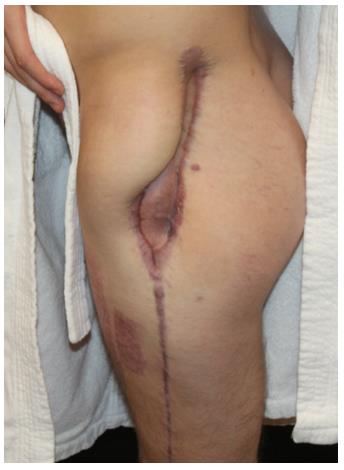
Figure 1a: Pre-op: The patient presents with a large lipodystrophy as a result of a necrotizing fasciitis.
The defect consists of a skin deficit approximately 27cm x 14cm where a split-thickness skin graft has healed over the tensor fascia lata and associated loss of underlying subcutaneous adipose tissue overlying the proximal lateral tissue. A treatment plan was designed to use a local advancement flap for skin coverage and cell- assisted lipotransfer (CAL) to replace deficient soft tissue volume. CAL using stromal vascular fraction (SVF), or cell- enhanced lipoaspirate, was suggested to maintain the viability of the muscle flap, reduce pain and improve skin quality at the affected site. After consulting with the patient and discussing other therapies, it was agreed that the contour defect would be treated using CAL combined with a myocutaneous flap reconstruction. The procedure was conducted under an IRB approved protocol and the patient provided a written informed consent. Intraoperatively, the patient underwent a suction-assisted liposuction procedure to harvest graft material and lipoaspirate for the SVF cell isolation. Approximately 950 mL of tumescent solution (50 mL of lidocaine plain into a sterile bag of 1000 mL saline solution with 2 mL of AMP epinephrine at a 1:1000 dilution) was infiltrated into the abdomen and love handles prior to harvest. A total of 160 mL of lipoaspirate is harvested and 150 mL is submitted for SVF isolation using a protocol previously described [5]. While the lipoaspirate processing was conducted by a trained technician in the operating room, the myocutaneous repair was underway. The area was outlined with a surgical marker and 20cc of lidocaine 1% with 1:400,000 epinephrines was administered. The existing scar was excised, including the skin graft en bloc. The dense scar tissue layer of the subcutaneous tissue was then excised using a number 10 blade. After confirming hemostasis, 10cc of SVF containing a total of 49.38 million viable nucleated cells combined with 10cc of decanted lipoaspirate was injected into the tensor fascia lata and subcutaneous tissue overlying the trochanter. The tensor fascia lata was then reconstructed using interrupted 0 vicryl and 0 monocryl sutures, and a second layer with 0 monocryl was used to bring the tensor fascia lata together. The subcutaneous space was closed in layers with 0 monocryl and 2-0 interrupted monocryl sutures. The skin was closed using 3-0 monocryl subcuticular and a prineo skin closure system. An island dressing was placed over the wound and the harvest site was covered with a bulky compression dressing. Following the procedure, the patient healed well with no adverse events reported. 6 months post- operatively, the patient reported no pain and increased mobility. The aesthetic appearance of the treated area was significantly improved as contour and symmetry were restored (Figure 1b). The subject was extremely pleased with the results and reported a notable increase in quality of life.
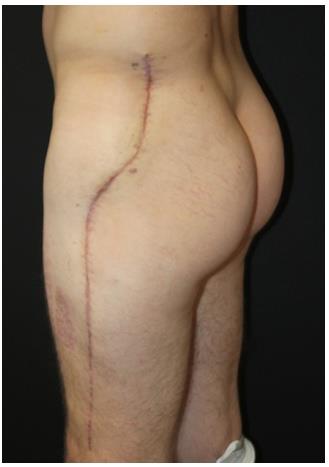
Figure 1b: 6 months post-operation.
Discussion
The stromal vascular fraction derived from adipose tissue attributes its regenerative potential to adipose- derived stem cells (ASCs). Recently, ASCs have been proposed for a wide range of therapeutic indications because of their multipotential differentiation capacity as well as the anti-inflammatory, antiapoptotic and proangiogenic cytokines included in the ASC secretome [6, 7]. Multiple studies have demonstrated that ASC supplementation can improve the viability of muscle and skin flap based reconstructions and decrease the instance of flap necrosis [8, 9]. Additionally, ASCs in combination with adipose tissue have been reported to markedly improve skin quality and reduce hypertrophic changes in skin [10, 11]. In this case, the use of SVF-enhanced fat grafting was well tolerated by the subject and no adverse events were reported. The overall skin quality of the affected area was improved significantly by the procedure and the removal of the defect resulted in restored mobility and elimination of pain. While it cannot be determined whether or not these benefits can be attributed fully to the myocutaneous reconstruction, the SVF cell enhanced fat or a combination of the two, as there was no in vivo tracking of SVF cells and no other cases to use as a comparison, preclinical data suggests that the SVF cells played an important role. This case demonstrates safety and tolerability of CAL and SVF cells in myocutaneous flap based reconstructions and that moving forward, SVF cell enhancement may play a pivotal role in improving flap viability and reducing instances of flap necrosis.
References
-
Taviloglu K, Yanar H (2007) Necrotizing Fasciitis: strategies for diagnosis and management. World J Emerg Surg 2: 19.
-
Young MH, Aronoff DM, Engleberg NC (2005) Necrotizing fasciitis: pathogenesis and treatment. Expert Rev Anti Infect Ther 3(2).
-
Chanal J, Duong TA, Aleyrie-Allanore L, Bosc R, Mayer J, et al. (2015) Necrotizing fasciitis of the thigh revealing a Crohn’s disease. J Eur Acad Dermatol Venereol 29(8): 1648-1649.
-
Mizuguchi Y, Matsumoto S, Kan H, Koizumi M, Kuriyama S, et al. (2015) Successful treatment of necrotizing fasciitis after rectal surgery with the application of negative pressure wound therapy: A case study. J Nippon Med Sch 82(6): 290-294.
-
Aronowitz JA, Lockhart RA, Hakakian CS, Kevin C Hicoket (2015) Clinical safety of stromal vascular fraction separation at the point of care. Ann Plast Surg 75(6): 666-671.
-
Rehmam J, Traktuev D, Li J, Merfeld Clauss S, Temm Grove CJ, et al. (2004) Secretion of angiogenic and antiapoptotic factors by human adipose stromal cells. Circulation 109(10): 1292-1298.
-
Zuk PA, Zhu M, Mizuno H, Huang J, Futrell JW, et al. (2001) Multilineage cells from human adipose tissue: implications for cell-based therapies. Tissue Engineering 7(2): 211-229.
-
Ataman MG, Uysal CA, Ertas NM, Bayraktar N, Terzi A, et al. (2016) The effect of adipose stromal vascular fraction on transverse rectus abdominis musculocutaneous flap: an experimental study. J Plast Surg Hand Surg 50(5): 272-280.
-
Sheng L, Yang M, Li H, Zijing Du, Yiai Yang, et al. (2011) Transplantation of adipose stromal cells promotes neo vascularization of random skin flaps. Tohoku J Exp Med 224(3): 229-234.
-
Luan A, Duscher D, Whittam J, Kevin J, Elizabeth RZ, et al. (2016) Cell-assisted lipotransfer improved volume retention in irradiated recipient site and rescues radiation-induced skin changes. Stem Cells 34(3): 668-673.
-
Sterodimas A, de Faria J, Nicaretta D (2011) Autologous fat transplantation versus adipose- derived stem cell-enriched lipografts: a study. Aesthet Surg J 31(6): 682-693.
- Management of Chronic Insertional Achilles Tendinopathy Using Flexor Hallucis Longus Tendon Transfer in Patients Over 50 Years of Age: A Four-Case Series Following the CARE Guidelines
- Application of Induced Pluripotent Stem Cells in Bone Tissue Engineering: Current Status and Prospects
- Surgical Management of Upper Thoracic Esophageal Squamous Cell Carcinoma with Concomitant Hypersplenism: Integration of Chai's Supra-Thoracic Apex Technique with Laparoscopic Splenectomy - A Technical Innovation Case Study with Systematic Review
- Evaluation of Masticatory Functional Efficiency of Stomatognathic System in Patients Undergoing Open Reduction Internal Fixation for Treatment of Pan-Facial Trauma: A Prospective Study
- Hepatic Abscess Secondary to Appendiceal Phlegmon an Unusual Complication of Appendiceal Phlegmon
- Report of Lumboperitoneal (LP) Shunt Procedure in Over Decades Experiences, Systematic Narrative Review