
Torsion of the Spermatic Cord in Children at the Brazzaville University and Hospital Center
The purpose of our study is to analyze the epidemiological, clinical and therapeutic aspects of spermatic cord torsion. Materials and methods: This is a retrospective cross-sectional descriptive study conducted in the pediatric surgery department of the Brazzaville University and Hospital Center between January 2013 and December 20015. Records of 11 children aged 0 to 15 years hospitalized for sperm cord torsion and considered exploitable were analyzed. The studied parameters were: epidemiological, clinical, therapeutic aspects. Results: 960 children were admitted to the service during the study period. Among them, 11 cases (1.14%) were for torsion of the spermatic cord. The average age of the patients was 11.5 years (0-15 years). The average consultation time was 22 hours extreme (4-72 hours). Scrotal pain is the main reason for consultation. Five patients (45.4%) were received before the 6th hour. All patients were operated on. The number of turns of turn varied from 1 to 3. Eight testicles (72.7%) were considered viable. The postoperative course was simple.
Mieret Jean Claude1*, Ondima Irène1, Bachir Abdel Salam1 and Bouya Prosper Alain2
Congo
Congo, Tel: (00242) 066228813; Email: jmieret@yahoo.fr parameters were: epidemiological, clinical, therapeutic aspects.
were considered viable. The postoperative course was simple.
Keywords: Twist; Spermatic cord; Child
Introduction
Large, painful pouches are a frequent reason for consultation in pediatric emergencies in the Caldamone, et al. [1] series. 25-30% was related to twisting of the spermatic cord. The diagnosis of spermatic cord twisting is rare (1/4000) [2], difficult and must be evoked in the face of acute scrotal pain. The possibility of twisting the spermatic cord imposes an early etiological and therapeutic diagnostic approach because the delay brings into play the functional and vital prognosis of the testicle. Surgical exploration is required before any acute scrotal pain suspected. In Britain, twisting of the spermatic cord is responsible for nearly 400 orchiectomies each year [3]. In Africa, Bah, et al. [4] noted 18.6% orchiectomies. The aim of this study was to analyze the epidemiological, clinical and therapeutic aspects of spermatic cord twisting in children in the pediatric surgery department at the Brazzaville University and Hospital Center.
Patients and Methods
This was a retrospective study of the descriptive type, carried out in the pediatric surgery department at the Brazzaville University Hospital of Brazzaville, between January 2013 and December 2015, ie 2 years. Children aged 0 to 15 years, operated on an emergency basis for suspicion of spermatic cord torsion, confirmed intraoperatively and whose records were usable were included in our study. All cases suspected at the clinic or on ultrasound and not confirmed intraoperatively were excluded. The hospitalization records and the operating room register were our sources of data. For each patient, we studied: frequency, age, affected side, clinical signs, therapeutic delay (defined as the time between the indication and the surgical procedure itself), the therapeutic aspect and his evolution.
Results
During the study period, 960 patients were admitted to the service. Among them, 23 for large painful pouches (2.4%) including 11 twist spermatic cord. The hospital frequency of twisting of the spermatic cord was 1.14%. Patients were aged 0 to 15 years with a mean age of 11.5 years (range 0-15 years) (Table 1). Eight (72.7%) patients had a left spermatic cord twist and 3 (27.3%) had a right spermatic cord twist. The average consultation time was 22 hours (4 - 72 hours). The reason for consultation was scrotal pain in all cases. Associated signs were: Governor's sign (ascension, retraction and horizontalization of the testicle) n = 8 (72%), the sign of prehn (scrotal pain not relieved by the uprising) n = 1 (9.1%) and the abolition of the Cremasterian reflex was in all cases (n = 11). In three children (27.3%), the pain was accompanied by vomiting. Doppler echo was not performed in any patient.
| Age | Effective | Percentage (%) |
|---|---|---|
| 0-29 jours | 1 | 9,1 |
| 30 jours-2 ans | 2 | 18,2 |
| 3 ans-10 ans | 1 | 9,1 |
| 11 ans-15 ans | 7 | 63,6 |
| Total | 11 | 100 |
Table 3: Age Distribution of Patients.
Table 1: Age Distribution of Patients. Therapeutically, all our patients were treated surgically (Table 2). The inguinal approach was n = 2 (18.2%), scrotal n = 9 (82%). The seat of the testis was scrotal in cases. The size of the testicles was normal in all cases. The following lesions were found: purplish testicle n = 3 (27.3%), blackish (necrotic) n = 3 (27.3%), testicular staining was not reported in records n = 5 (45.4%). We observed a loosely rounded turn with a purplish testicle n = 6 (54.5%), two turns n = 3 (27.3%), three turns n = 1 (9.1 %) and the number of turns was not specified in file n = 1 (9.1%). The testes returned to normal or near normal staining after surgical untwisting in 8 cases (72.7%). These testicles were fixed. And on those who did not resume normal staining, an orchiectomy was performed n = 3 (27.3%). The surgical procedures performed are shown in Table 3. The postoperative course was simple. The decline could not be appreciated.
| Therapeutic delay | Effective | Percentage (% | ) | |||||
|---|---|---|---|---|---|---|---|---|
| Less than 6 hours | 5 | 45,4 | ||||||
| 6 - 12 hours | 3 | 27,3 | ||||||
| 12 – 24 hours | 2 | 18,2 | ||||||
| 24 – 6 days | 1 | 9,1 | ||||||
| Total | 11 | 100 |
- Surgical gestures
- Number of
- Percentage patients
- (%)
- Homo-contra lateral
- Orchidopexy
- 6
- 54,5
- Homolateral Orchidopexy
- 2
- 18,2
- Orchidectomy and contra lateral orchidopexy
- 2
- 18,2
- Orchiectomy without contra lateral orchidopexy
- 1
- 9,1
- Total
- 11
- 100
Table 2: Distribution by Surgical Procedures.
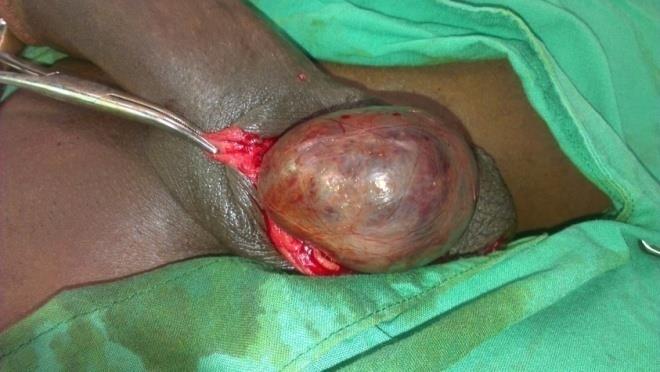
The limits of our study were related to the difficulties of follow-up of patients and our small sample. The hospital frequency of twisting of the spermatic cord in children is variously appreciated. It is 0.37% according to Bah, et al. [4] and 1.14% in our study. The average age in our series is close to that of Gnassingbé et al in Togo 9 years [5] and Even, et al. [6] in France 13 years. The frequency of twisting of the spermatic cord is higher between 11 and 15 years with 7 cases (63.6%) in our study. Twisting of the spermatic cord may be of interest to both sides. The left predominance found in our series (72.7%) is also reported by Cavusoglu, et al. (68%) [7]. the longer cord length on the left is incriminated because it is more likely to bend. Other authors affirm the opposite with a predominance of the right side [8]. The delay of consultation in our study could be explained by the ignorance of these pathologies in primary and secondary health structures, self-medication and socio-cultural factors. The pain of the hemi bourse was noted in all our patients as in the series of Cavusoglu, et al. [7]. This acute pain of the hemi bourse is a major sign of twisting of the spermatic cord, but it is not path gnomonic. Hence the interest of looking for the elements likely to support the diagnosis. The sign of Governor is more characteristic of the condition, found in 72.7% of our patients. It was present in 66.6% of cases according to Bah [4], 66.3% according to Zini [2] and 62% according to Della Negra [9]. For Morel Journel, et al. [10], the Governor's sign is suggestive of twisting the spermatic cord and remains the only physical sign that forms part of the clinical profile of a patient with spermatic cord torsion [9]. It should be routinely investigated in a teenager with scrotal pain [9]. The sign of prehn was met in 1 patient in our study. Its frequency was greater in the study by Bah, et al. [4], which reports 13 patients. This difference could be explained by the small sample size in our study. Twisting of the spermatic cord is a surgical emergency and no para-clinical examination should delay its surgical management. The scrotal doppler echo, a key examination for diagnosis, allows to find the number of turns and the absence of testicular vascular flow. In addition to the diagnostic contribution, it allows for subsequent monitoring of these patients. In our series, we did not perform any paraclinical exam. No external detrimental maneuver (BARCAT) was performed in our work because the conditions of access to the operating room were met. This maneuver still retains some indications inside the country in the enclosed areas with under-equipped sanitary structures. Emergency detorsion should be performed routinely to limit the duration of ischemia [11, 12]. Therapeutic delay plays an important role in the prognosis of the testis. In our series, five cases were received before the 6th hour. No testis was considered viable after the 12th hour. In the series of Bah et al [4], 11 patients were received before the 6th hour. The 6 hours delay is a statistical concept and not a security delay [9]. In our series, eight orchidopexies were performed including a contra lateral preventive. It is systematic in their care [9]. We performed three orchiectomies. The orchidectomy rate varies according to the authors; it is 35% according to Hayn, et al. [13], 63% according to Bayne, et al. [14] and 20.3% according to Even, et al. [6]. This could be explained by the long consultation time, the delay in taking charge, the large number of turns. Indeed, ischemia is proportional to the number of turns. More turns are tight and present in large numbers, plus there is a risk of testicular ischemia. In our series, we had 6 cases (54.5%) with a tight turn, which explained the number of testes saved (72.7%). The fixation of the contra lateral testicle is currently recommended by Mongiat, et al. [3], a fortiori after an orchiectomy because of the risk of torsion of the spermatic cord which is 3 to 18%. In our series, the decline could not be appreciated for financial and social reasons
Conclusion
Twisting of the spermatic cord remains an emergency that puts the testicle's vital prognosis at risk. The diagnosis is essentially clinical. Scrotal pain, testicular ascension and the sign of prehn are the essential arguments for a positive diagnosis. The only treatment is emergency surgery. The preservation of the testicle depends mainly on the duration of evolution and the number of turns of turns responsible for ischemia
References
-
Caldamone AA, Valvo JR, Altebarmakian VK, Rabinowitz R (1984) Acute scrotal swelling in children. J PediatrSurg 19(5): 581-584.
-
Zini L, Mouton D, Leroy X, Valtille P, Villers A, et al. (2003) Should scrotal ultrasound be advised in case of suspicion of torsion of the spermatic cord? ProgUrol 13(3): 440-444.
-
Mongiat-Artus P (2004) Torsion of the spermatic cord and testicular appendages. Annals of Urology 38: 25- 34.
-
Bah OR, Roupret M, Guirassy S, Diallo AB, Diallo MB, et al. (2010) Clinical and therapeutic aspects of spermatic cord torsion: study of 27 cases Prog Urol 20: 527-531.
-
Gnassingbe K, Akakpo-Numado KG, Songne-GB, Anoukoum Kao TM, et Tékou H (2009) Twists of the spermatic cord in the child. African J Urol 15 (4): 263- 267.
-
Even L, Abbo O, Le Mandat A, Lemasson F, Carfagna L, et al. (2013) Torsion of the spermatic cord in children: Impact of the mode of consultation on the time of care and the rate of orchidectomy. Arch Ped 20: 364-368.
-
Cavusoglu YH, Karaman A, Karaman I, Erdogan D, Aslan MK, et al.(2005) Acute scrotum etiology and management. Indian J Pediatr 72(3):201-203.
-
Mbibu NH, Maitama HY, Ameh EA, Khalid LM, Adams LM (2004) Acute scrotum in Nigeria: An 18-year review. Trop Doct 34(1): 34-36.
-
Della Negra E, Martin M, Bernardinis S, Bittard H (2000) Spermatic cord twists in adults. Progurol 10: 265-270.
-
Morel JN, Valignat C, Lopez JC, Perrin P (1998) Torsion of the testicle and its appendages. Rev Prat 48: 2119-2122.
-
Bachy B, Liard Zmuda RA (2002) The purse of the child and the teenager.
-
Galinier P, Carfagna L, Kern D, Moscovici J, Moscovici J (2003) Urgent pathology of external genital organs in infants. Arch Pediatr 10 (2): 174-178.
-
Hayn MH, Herz DB, Bellinger MF, Schneck FX (2008) intermittent torsion of the spermatic cord portends an increased risk of acute testicular infarctus. J Urol 180(4): 1729-1732.
-
Bayne AP, Madden Fuentes RJ, Jones EA, Cisek LJ, Gonzales ET Jr, et al. (2010) Factors associated with delayed treatment of acute testicular torsion demographics or interhospital transfer matter? J Urol 184(4): 1743-1747.
- Management of Chronic Insertional Achilles Tendinopathy Using Flexor Hallucis Longus Tendon Transfer in Patients Over 50 Years of Age: A Four-Case Series Following the CARE Guidelines
- Application of Induced Pluripotent Stem Cells in Bone Tissue Engineering: Current Status and Prospects
- Surgical Management of Upper Thoracic Esophageal Squamous Cell Carcinoma with Concomitant Hypersplenism: Integration of Chai's Supra-Thoracic Apex Technique with Laparoscopic Splenectomy - A Technical Innovation Case Study with Systematic Review
- Evaluation of Masticatory Functional Efficiency of Stomatognathic System in Patients Undergoing Open Reduction Internal Fixation for Treatment of Pan-Facial Trauma: A Prospective Study
- Hepatic Abscess Secondary to Appendiceal Phlegmon an Unusual Complication of Appendiceal Phlegmon
- Report of Lumboperitoneal (LP) Shunt Procedure in Over Decades Experiences, Systematic Narrative Review